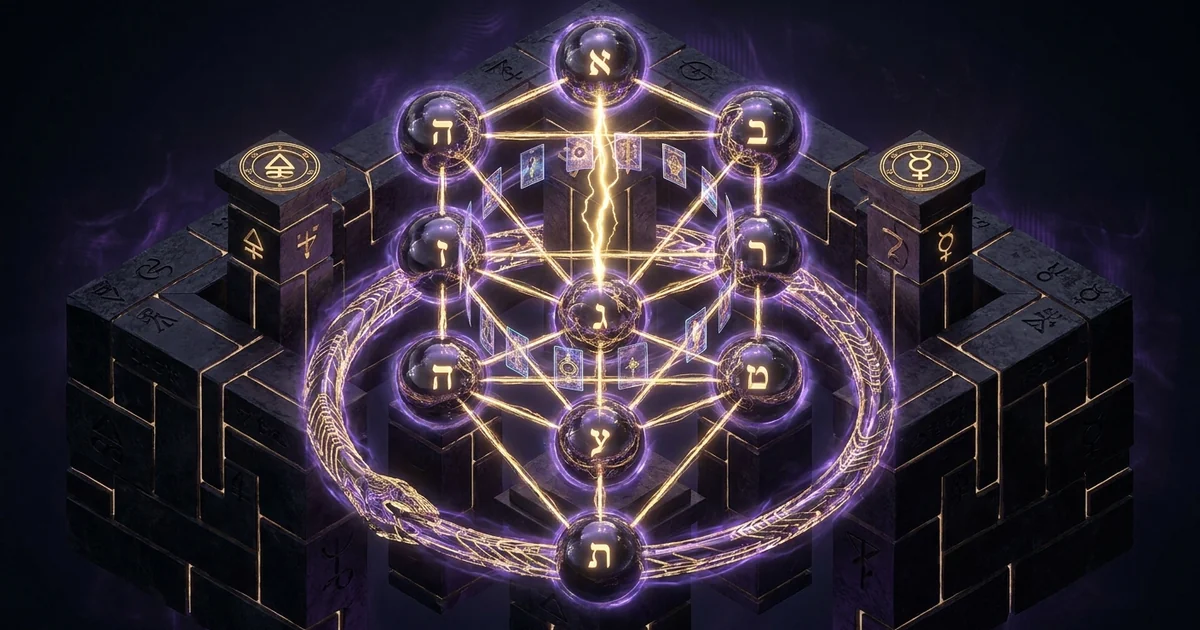
The Tree of Life Tarot Spread: Ten Sephirotic Spheres
Archetypal Thesis & Systemic Paradigm: The Otz Chiim as an Ontological Engine
The Tree of Life Tarot spread transcends colloquial fortune-telling to function as an objective, ten-dimensional coordinate framework for the mapping and resolution of psychic states. Grounded in the Lurianic and Hermetic Otz Chiim, this cartographic spread organizes 78-card symbolic dynamics across the ten Sephirotic hypostases and three vertical pillars, translating raw unconscious entropy into a cybernetic feedback system of spiritual involution and psychological individuation. Rather than operating as an anecdotal or chronologically linear spread—such as those commonly analyzed in comparative frameworks like the /tarot/celtic-cross-vs-tree-of-life discourse—the Sephirotic layout operates as an ontological engine. It renders visible the simultaneous, multi-tiered condensation of consciousness from the unmanifest, archetypal plenum down into material praxis.
Topological Mapping: From Undifferentiated Unity to Physical Actuation
In the architecture of the tree of life tarot spread sephirot, space is not organized along a horizontal temporal vector. The layout constructs a non-linear state-space diagram modeling the simultaneous emergence of psychological phenomena from the unconscious root of volition (Kether) down to physical, somatic actualization (Malkuth). When the practitioner distributes cards across this geometric matrix, they are not asking what will occur next in time; rather, they are mapping the instantaneous topological distribution of energy across the systemic whole. The cards illuminate how an overarching, transpersonal intent is mediated, filtered, refracted, and crystallized as it traverses the descending planes of reality.
Each station within this topological map serves as an operational locus. A card falling into the higher spheres does not signify an event detached from the querent’s physical reality; instead, it illustrates the specific metaphysical archetype or ideological seed that is conditioning the physical condition manifested in the tenth sphere. Because every Sephira is structurally bounded by its neighbors and mediated by connecting paths, the layout models complex teleological dynamics. An obstruction observed in the material domain (Malkuth) is frequently diagnosed as an unintegrated tension within the systemic architecture above it, such as an ideological paralysis in Hod or a deficit of expansive assertiveness in Chesed.
“The mandala is an archetypal image whose occurrence is attested throughout the ages. It signifies the wholeness of the self. This circular or quadripartite image serves as an instrument of psychological self-regulation, providing a spatial coordinate system whereby the fragmented ego can locate, integrate, and synthesize chaotic instinctual and transpersonal forces.” — Carl Gustav Jung, Mysterium Coniunctionis: An Inquiry into the Separation and Synthesis of Psychic Opposites in Alchemy (CW 14, 1956)
The Four Worlds (Olamot) as Stratified Operational Registers
The functional sophistication of the otz chiim layout expands through the operationalization of the Four Kabbalistic Worlds: Atziluth (Archetypal/Fire), Beriah (Creative/Water), Yetzirah (Formative/Air), and Assiah (Active-Material/Earth). In the context of a diagnostic session, these stratified registers allow the investigator to immediately isolate the ontological depth of a psychological complex. Atziluth houses the Supernal Triad (Kether, Chokmah, Binah), where forces exist as pure archetypal potential and unconditioned divine sparks; cards falling here denote transpersonal mandates and deeply ingrained, non-negotiable existential orientations.
Descending through Beriah, which encompasses Chesed, Geburah, and Tiphereth, the spread evaluates the affective and creative matrices of the soul. Here, raw archetypal will condenses into specific moral inclinations, intense emotional charges, and the sovereign organizing drive of the Ego-Self axis. Below the ethical veil lies Yetzirah, comprising Netzach, Hod, and Yesod, the astral realm of cognitive processing, behavioral mechanics, autonomic impulses, and imaginal patterning. Finally, Assiah corresponds precisely to Malkuth, the somatic terminus where neurosis, psychosomatic illness, or concrete socio-economic configurations physically manifest. By cross-referencing a card’s native suit and rank against the world of its occupying Sephira, the practitioner diagnoses jurisdictional incongruities, such as an intellectual sword struggling to function within the pristine fiery realm of pure volition.
Cybernetic Feedback and Psychic Self-Regulation
Viewed through the lens of modern systems theory, the Sephirotic spread constitutes an autopoietic, cybernetic feedback mechanism. Divination, stripped of superstitious determinism, represents the externalization of the querent’s unconscious psychodynamics onto an objective symbolic coordinate plane. The card array acts as an interactive mirror: unconscious contents, split off through repression or structural blind spots, are projected systematically onto the archetypal nodes of the Tree.
This projection initiates an immediate compensatory feedback loop. If the querent’s conscious disposition is characterized by hyper-rationalism (an inflated Hod complex), the appearance of a deeply chaotic, instinctual trump like The Moon in Netzach generates a corrective cognitive dissonance. Through the disciplined visual contemplation of the spread’s geometry, the ego observes its own internal architecture from an external vantage point. The dialectical tension between the pillars, synthesized through the central equilibrium of Tiphereth, invites the psyche to recalibrate its internal energetic flows, restoring dynamic homeostasis through symbolic synthesis.
Classical Provenance & Textual Lineage: Historical Genesis of the Sephirotic Grid
The application of the decadic Sephirotic framework to divination represents the historical convergence of two distinct Western esoteric currents: the cosmological ontology of Jewish mysticism and the pictorial archetypal traditions of the European Renaissance. Far from originating as a casual parlor game, the decadic architecture of the kabbalistic tarot spread directly inherits the deep speculative foundations developed over centuries of mystical inquiry, transitioning from visionary throne mysticism into systematized Hermetic praxis.
Merkabah and Yetziratic Lineages: Foundations of the Decadic Emanation Scheme
The operational structure of the ten Sephirot traces its lineage to early Jewish esoteric literature, fundamentally crystallized in the Sefer Yetzirah (The Book of Creation) composed between the second and sixth centuries CE. This foundational text introduced the doctrine of the ten numbers of nothingness (Sephirot Belimah) and the twenty-two letters of the Hebrew alphabet, postulating that the universe was constructed through these thirty-two paths of secret wisdom. Here, the Sephirot were not mythological deities or simple psychological labels, but cosmic dimensions, metaphysical limits, and elemental coordinates: depth of beginning, depth of end, depth of good, depth of evil, and the cardinal vectors of space.
[ 1. Kether ]
                          |
             +------------+------------+
             |                         |
       [ 3. Binah ]              [ 2. Chokmah ]
             |                         |
             +------------+------------+
                          |
                    [ (Da'ath) ]
                          |
             +------------+------------+
             |                         |
      [ 5. Geburah ]             [ 4. Chesed ]
             |                         |
             +------------+------------+
                          |
                   [ 6. Tiphereth ]
                          |
             +------------+------------+
             |                         |
        [ 8. Hod ]               [ 7. Netzach ]
             |                         |
             +------------+------------+
                          |
                    [ 9. Yesod ]
                          |
                    [ 10. Malkuth ]
As Gershom Scholem elucidates in his seminal studies on early Kabbalah, these decadic numbers transformed during the medieval period—specifically within the Provençal and Castilian Kabbalistic communities that produced the Sefer Ha-Bahir and the Zohar—from cosmogonic building blocks into the living, dynamic anatomy of the divine organism. The subsequent sixteenth-century Lurianic revolution introduced the catastrophic metaphysics of Shevirat ha-Kelim (the Breaking of the Vessels) and the redemptive doctrine of Tikkun (restoration). This historical shift transformed the Tree of Life into a dynamic map of fragmentation and psychospiritual reconstitution, providing the direct structural framework later adopted by esotericists to map the broken, conflicted states of the human mind seeking psychic reintegration.
The Hermetic-Christian Syncretism: Athanasius Kircher to Éliphas Lévi
The migration of the Kabbalistic Tree into the broader current of Western esotericism was catalyzed by Renaissance syncretists like Giovanni Pico della Mirandola and Johannes Reuchlin, who sought to demonstrate that Kabbalistic metaphysics confirmed the mysteries of Christian theology and Hermetic philosophy. In the seventeenth century, the Jesuit polymath Athanasius Kircher published his monumental Oedipus Aegyptiacus (1652–1654), which contained the now-canonical geometric rendering of the Tree of Life: the three-pillared, twenty-two-pathed diagram that became standard across Hermeticism. Kircher systematically mapped classical pagan pantheons, angelic hierarchies, and astrological spheres onto this single visual glyph.
It was not until the mid-nineteenth century, however, that the Tarot was formally married to this cosmological blueprint. The French occultist Éliphas Lévi (Alphonse Louis Constant), writing in Dogme et Rituel de la Haute Magie (1854–1856), announced that the twenty-two Major Arcana keys corresponded directly to the twenty-two letters of the Hebrew alphabet and their associated paths on the Tree of Life. Lévi asserted that the Tarot was none other than the ancient, pristine book of Hermes, an engineered system of universal knowledge whose ultimate key lay within Kabbalistic geometries.
“The 10 Sephiroth and the 22 Paths are together the 32 Paths of the Sepher Yetzirah… The four suits are the four Worlds, the ten small cards of each suit are the ten Sephiroth in each World… Thus does the entire Tarot mirror the Tree of Life, and he who understandeth the descent of the Divine Volition along the Lightning Flash can unlock the secret operations of the soul.” — S.L. MacGregor Mathers & W.W. Westcott, Book T: The Tarot and its Combinations (Hermetic Order of the Golden Dawn Private Curricular Manuscripts, 1888)
The Golden Dawn Formalization: Book T and Positional Synthesis
The definitive synthesis of Tarot and Kabbalah occurred in late nineteenth-century London within the Hermetic Order of the Golden Dawn. Founded by William Wynn Westcott, S.L. MacGregor Mathers, and William Robert Woodman, the Order developed an exhaustive curriculum wherein the Tarot functioned as the primary operational engine of their magical-psychological system. In their private instructional manual, Book T: The Tarot and its Combinations, Mathers codified the exact mathematical, astrological, and Kabbalistic correspondences that govern modern esoteric divination.
The Golden Dawn formally established the ten-card Sephirotic layout as the ultimate diagnostic spread for macroscopic inquiry. They mandated that the minor cards, numbered One through Ten, were not arbitrary depictions of historical fortune, but the direct material expressions of the ten Sephirot operating within the Four Worlds: the Aces residing in Kether, the Twos in Chokmah, descending systematically to the Tens in Malkuth. Under this rigorous framework, performing a sephirot reading ceased to be a passive exercise in omen-reading; it became an act of technical cartography, demanding that the practitioner calculate the precise resonance between a card’s innate Sephirotic frequency and the Sephirotic station it occupied within the layout.
Structural Mechanics & Symbolic Geometry: Ten Emanations and Triadic Pillars
To effectively interpret the tree of life tarot spread sephirot, the practitioner must master the structural tensions and geometric polarities embedded within the Otz Chiim. The ten stations cannot be evaluated as an arbitrary sequence of ten distinct fortunes; they represent an interconnected web of polar dynamics, governed fundamentally by three vertical pillars that synthesize universal force, limiting form, and integrative consciousness.
The Vertical Polarities: Mercy (Chesed/Chokmah), Severity (Geburah/Binah), and Equilibrium
The spatial geometry of the spread is bifurcated into two outer vertical pillars of opposing energetic polarities, perfectly mediated by a central axis. The right pillar, termed the Pillar of Mercy (Amud ha-Chesed) or the Pillar of Force, is characterized by expansiveness, uncontained dynamism, and masculine-active potency. It incorporates Chokmah (the primary catalytic spark) and Chesed (benevolence, organizational vision, and boundless abundance). In contrast, the left pillar, the Pillar of Severity (Amud ha-Din) or the Pillar of Form, governs contraction, definition, boundaries, and critical discernment. It links Binah (the cosmic womb, structural limitation) and Geburah (destructive judgment, surgical excision, and martial discipline).
The operational efficacy of a reading depends upon analyzing the lateral equilibrium between these opposing flanks. A card situated in Chesed cannot be understood in isolation; it must be assessed against the card situated in Geburah. If Chesed displays an excess of fluid, unstructured expansion (e.g., the Four of Cups or the Page of Cups) while Geburah displays severe paralysis or aggressive overcompensation (e.g., the Five of Swords), the structural diagnosis immediately reveals a systemic inability to channel visionary concepts into bounded, actionable execution.
Connecting and reconciling these dynamic extremes is the Middle Pillar (Amud ha-Emtza’i), the axis of consciousness and equilibrium. Ascending from the empirical base of Malkuth, through the instinctual-astral subconscious of Yesod, up into the central radiant core of Tiphereth, and terminating at the crown of Kether, this vertical axis represents the highway of psychological individuation. It is here that the warring tensions of the lateral pillars are distilled into self-awareness and conscious integration.
Positional Anatomy: The Ten Sephirotic Spheres from Kether to Malkuth
Within the operational praxis of the spread, each of the ten Sephirotic stations evaluates an invariant, specialized dimension of the querent’s total psychospiritual field:
- Kether (The Crown): The primordial root of volition; transpersonal intent, metaphysical purpose, and the primary teleological impulse underlying the situation. This position diagnoses the unconditioned core of the query, fundamentally independent of the ego’s conscious desires.
- Chokmah (Wisdom): The catalytic kinetic force; unbridled creative momentum, the primary dynamic vision, and the masculine-coded drive to manifest.
- Binah (Understanding): The structuring architecture; the mother of forms, defining limitations, institutional structures, and the contemplative boundary conditions that give raw vision concrete definition.
- Chesed (Mercy): Expansive actualization; operational benevolence, strategic planning, resource allocation, institutional expansion, and constructive leadership.
- Geburah (Severity): Discriminating assessment; necessary destruction, boundary enforcement, surgical elimination of redundant structures, conflict, and rigor.
- Tiphereth (Beauty): The solar equilibrium; the conscious Ego-Self axis, psychological integration, personal authenticity, and the harmonizing center of the personality.
- Netzach (Victory): The affective drive; visceral desire, instinctual energy, creative passions, autonomic emotional currents, and artistic inspiration.
- Hod (Glory): The cognitive apparatus; analytical reasoning, logic, linguistic translation, technical frameworks, communication, and procedural implementation.
- Yesod (The Foundation): The psychic blueprint; the subconscious repository, dream matrix, automatic habits, the reproductive imaginal realm, and the immediate astral precursor to physical manifestation.
- Malkuth (The Kingdom): The somatic terminus; concrete physical manifestation, socioeconomic outcomes, biological health, practical resources, and the tangible terminus of the entire energetic cascade.
The Lightning Flash (Mezhiv) vs. The Serpent of Wisdom (Nechesh) Dynamic
The reading of the cards requires an understanding of two counter-directional topological vectors that animate the Sephirotic geometry: the Lightning Flash (Mezhiv) and the Serpent of Wisdom (Nechesh). The Lightning Flash represents the downward, involutionary cascade of cosmogonic creation. It traces the zig-zagging, deterministic path of emanation from Kether down to Malkuth, outlining how a transpersonal concept progressively densifies, passing through dialectical polarizations between Mercy and Severity, until it solidifies as an immutable fact in the physical world. When diagnosing how a crisis reached its current concrete stage, the practitioner reads along the vector of the Lightning Flash.
Conversely, the Serpent of Wisdom represents the upward, evolutionary trajectory of human consciousness reclaiming its divine origin. The Serpent weaves deliberately through every connecting path, ascending from Malkuth, coiling around Yesod, Hod, and Netzach, passing through the solar core of Tiphereth, and piercing the Supernal realms toward mystical re-unification. In the context of divination and psychospiritual counsel, the Serpent provides the therapeutic protocol. It answers the question: Given this material deadlock in Malkuth, how must the querent intentionally transmute their subconscious assumptions (Yesod), cognitive frameworks (Hod), and emotional attachments (Netzach) to attain conscious liberation and archetypal reorientation?
Psychological Dynamics & Operational Praxis: The Sephirot Reading Protocol
Executing a Sephirotic consultation with clinical and Hermetic rigor requires a clear operational sequence. Laying out ten cards over an archetypal cosmogram can easily overwhelm the reader with symbolic noise if approached linearly. The practitioner must resist the colloquial urge to flip cards chronologically from position one to position ten, adopting instead a multi-pass diagnostic methodology.
The Diagnostic Workflow: Scanning for Structural Asymmetry and Elemental Dignities
The consultation commences with a macroscopic, holistic scan of the unrevealed or newly turned cards, evaluating the structural balance across the entire Tree prior to synthesizing individual meanings:
- Major Arcana Density: The reader calculates the ratio of Major to Minor Arcana. A dominance of Major Arcana across the layout signals that the querent is immersed in a profound individuation crisis governed by transpersonal fate, wherein individual egoic volition is heavily constrained by archetypal dynamics. A dominance of Minor Arcana demonstrates that the situation is logistical, fluid, and highly subject to immediate tactical intervention.
- Horizontal and Vertical Distribution: The reader evaluates the concentration of suits across the three vertical pillars and the four horizontal planes. An overabundance of Swords on the Pillar of Severity points to hyper-critical neurosis, paranoia, and defensive somatic contraction. Conversely, a cluster of Cups on the Pillar of Mercy exposes ungrounded emotional idealization and a catastrophic deficit of psychic boundaries.
- Elemental Dignities Calculation: Applying the traditional Hermetic doctrine of elemental dignities, adjacent cards are evaluated based on how their elemental assignments interact. Fire (Wands) and Water (Cups) neutralize and torment one another; Fire and Air (Swords) act symbiotically to amplify dynamic agitation; Earth (Pentacles) stabilizes Water but smothers Fire. If the card situated in Tiphereth (the core identity) is an airy Sword, and it is flanked horizontally by opposing watery and fiery cards, the central ego suffers acute psychological fragmentation, torn between irreconcilable instinctual desires and structural guilt.
Evolutionary Vector (Kether to Malkuth)
- Operational Focus: The downward trajectory of manifestation; teleological analysis.
- Analytical Vector: Reads from the unmanifest spark down to empirical crystallization.
- Diagnostic Utility: Maps how conscious decisions, unconscious intents, and archetypal forces materialize into somatic reality.
- Primary Function: Identifies where pristine vision encounters friction, blockage, or distortion across the descending dimensional registers.
- Core Clinical Question: Why did this specific material condition solidify, and at what structural level did the primary creative intent become corrupted?
Involutionary Vector (Malkuth to Kether)
- Operational Focus: The upward path of therapeutic redemption; the Serpent of Wisdom.
- Analytical Vector: Reads from concrete physical symptoms up toward psychospiritual causes.
- Diagnostic Utility: Deconstructs physical crises (Malkuth) into their subconscious (Yesod), cognitive (Hod), and affective (Netzach) origins.
- Primary Function: Guides psychological individuation, cognitive behavioral restructuring, and the integration of deep shadow dynamics.
- Core Clinical Question: What inner systemic transmutations must the ego enact to resolve the somatic deadlock and align with transcendent telos?
The Invisible Sephira: Da’ath as the Epistemological Threshold and Shadow Marker
Situated directly on the Middle Pillar, suspended between the Supernal Triad (Kether, Chokmah, Binah) and the lower Ruach (Chesed through Yesod), lies the non-Sephira: Da’ath (Knowledge). Da’ath is the phantom sphere, the dimensional rupture produced by the historical cosmic fall and the emergence of fractured dualistic consciousness. It is the gate to the Abyss (Tehom), guarded by the arch-demon Choronzon, representing the chasm where human conceptual reasoning fractures and fails before the unitive mysteries of the Divine.
In a sephirot reading, Da’ath is typically left unpopulated by a physical card, remaining a profound silence in the geometric center of the spread’s upper register. However, it functions as the ultimate shadow marker. Unresolved contradictions between the expansive creative wisdom of Chokmah and the restrictive structuring form of Binah fall directly into the chasm of Da’ath, transforming into toxic, dissociated complexes.
When a querent experiences severe cognitive dissonance, intellectualized cynicism, or intense trauma-induced dissociation, the investigator examines the silent axis of Da’ath. It reveals that the querent’s ego is attempting to replace authentic spiritual gnosis with rigid ideological dogmas, preventing the solar light of Tiphereth from receiving the transcendent sustenance of Kether.
Evolutionary vs. Involutionary Interpretive Trajectories
Once the structural topography and elemental dignities have been established, the practitioner executes the substantive interpretation along one of two deliberate pathways, determined by the nature of the consultation:
- The Evolutionary Vector (Downward): Commencing at Kether, the practitioner reads the descending arc of manifestation. This approach is optimal for macroscopic strategy, assessing the viability of large-scale initiatives, creative enterprise, or organizational design. It traces how a foundational ideal (Kether) generates raw conceptual momentum (Chokmah), meets formal legal and architectural constraints (Binah), secures expansive institutional capital (Chesed), undergoes critical quality control and stress testing (Geburah), achieves centralized brand identity (Tiphereth), inspires marketing and visceral engagement (Netzach), codifies operational protocols (Hod), crystallizes into a functional working model (Yesod), and finally impacts the market (Malkuth).
- The Involutionary Vector (Upward): Commencing at Malkuth, this psychotherapeutic protocol systematically deconstructs a crisis. Facing an acute somatic illness, financial collapse, or acute marital breakdown in Malkuth, the reader examines Yesod to identify the underlying instinctual delusions, conditioned emotional attachments, and toxic fantasy loops feeding the issue. Moving to Hod, the reader interrogates the pathological mental scripts, rationalizations, and cognitive distortions sustaining the complex. In Netzach, the reader brings to light the repressed emotional desires and relational patterns driving the cognitive distortion. Reaching Tiphereth, the querent faces their own egoic complicity, arriving at the profound, sobering integration of their shadow before attempting to approach the transpersonal healing vectors of the higher spheres.
Philosophical Synthesis & Macrocosmic Correspondence: Hermetic Axia in Operation
The structural architecture of the Tree of Life Tarot spread functions precisely because it is founded on the foundational Hermetic doctrine of universal correspondence: Quod est superius est sicut quod est inferius (“That which is Above corresponds to that which is Below”). The human psyche does not exist in an isolated ontological vacuum; it is structurally isomorphic with the broader macrocosmic order. The layout operates as an intersecting multidimensional glyph, bridging microcosmic psychological complexes with universal cosmic architectures, often analyzed alongside advanced spatial matrices such as the /sacred-geometry/metatrons-cube-tree-of-life and the cosmological schemes of the /astrology/planetary-rulerships-kabbalah.
The Hermetic Axiom of Reciprocity: Structural Isomorphism of Mind and Cosmos
Under this Hermetic framework, the ten Sephirot map with rigorous mathematical precision onto human neurobiology, psychological structures, and cosmic bodies. When an individual engages in an authentic Sephirotic divination, they are not manipulating random pasteboard; they are activating an externalized diagram of their own internal reality. The cards serve as catalytic resonance points, aligning individual subjective states with the timeless cosmic principles that govern dynamic manifestation.
This structural isomorphism implies that personal crises are merely localized instantiations of macrocosmic laws. An individual experiencing an uncontrollable eruption of rage and destructive behavior is not merely suffering from neurochemical dysregulation; their psychic field is gripped by an uncompensated, hyper-inflated activation of the Geburah archetype. By projecting this state onto the Tree of Life, the spread strips away petty, personalized guilt, repositioning the crisis within a cosmic context that immediately clarifies the required corrective dynamic: the reintroduction of the stabilizing, benevolent, mitigating forces of Chesed.
The following canonical Hermetic allocations outline the structural architecture of the ten Sephirotic stations within the Otz Chiim spread:
- 1. Kether: Cosmic Realm: Primum Mobile (Rashith ha-Gilgulim) | Planetary/Macrocosmic Ruler: The Crown / Pluto (Modern) | Golden Dawn Divine Name: Eheieh (I AM THAT I AM) | Microcosmic Psychological Function: The Transpersonal Self; Undifferentiated Will; Archetypal Telos.
- 2. Chokmah: Cosmic Realm: The Zodiac (Mazloth) | Planetary/Macrocosmic Ruler: Neptune / The Fixed Stars | Golden Dawn Divine Name: Yah | Microcosmic Psychological Function: Creative Volition; Primary Dynamic Libido; Pure Kinetic Force.
- 3. Binah: Cosmic Realm: Saturn (Shabbathai) | Planetary/Macrocosmic Ruler: Saturn | Golden Dawn Divine Name: YHVH Elohim | Microcosmic Psychological Function: Cognitive Structuring; Constraint; The Superego; The Architect of Form.
- 4. Chesed: Cosmic Realm: Jupiter (Tzedek) | Planetary/Macrocosmic Ruler: Jupiter | Golden Dawn Divine Name: El | Microcosmic Psychological Function: Expansive Identity; Beneficence; Organizational Vision; The Generous Executive.
- 5. Geburah: Cosmic Realm: Mars (Madim) | Planetary/Macrocosmic Ruler: Mars | Golden Dawn Divine Name: Elohim Gibor | Microcosmic Psychological Function: Boundary Preservation; Discriminating Intellect; The Surgical Shadow; Martial Discipline.
- 6. Tiphereth: Cosmic Realm: The Sun (Shemesh) | Planetary/Macrocosmic Ruler: Sol | Golden Dawn Divine Name: YHVH Eloah va-Da’ath | Microcosmic Psychological Function: The Conscious Ego; Archetypal Self-Integration; Authenticity; Solar Equilibrium.
- 7. Netzach: Cosmic Realm: Venus (Nogah) | Planetary/Macrocosmic Ruler: Venus | Golden Dawn Divine Name: YHVH Tzabaoth | Microcosmic Psychological Function: Affective Libido; Raw Emotional Drives; Artistic Intuition; Visceral Passions.
- 8. Hod: Cosmic Realm: Mercury (Kokab) | Planetary/Macrocosmic Ruler: Mercury | Golden Dawn Divine Name: Elohim Tzabaoth | Microcosmic Psychological Function: Analytical Logic; Linguistic Syntax; Critical Intellect; Practical Methodology.
- 9. Yesod: Cosmic Realm: The Moon (Levanah) | Planetary/Macrocosmic Ruler: Luna | Golden Dawn Divine Name: Shaddai El Chai | Microcosmic Psychological Function: The Imaginal Core; The Personal Subconscious; Automatic Conditioning; The Astral Matrix.
- 10. Malkuth: Cosmic Realm: The Elements (Cholem Yesodoth) | Planetary/Macrocosmic Ruler: The Four Elements / Terra | Golden Dawn Divine Name: Adonai ha-Aretz | Microcosmic Psychological Function: The Somatosensory Organism; Materialized Environment; Concrete Physicality.
Astrological Decans and Planetary Dignities within the Decadic Framework
The technical depth of the kabbalistic tarot spread reaches its apex through the dynamic interplay of astrological decans and planetary dignities. In the Golden Dawn system, the thirty-six numbered Minor Arcana (Cards 2 through 10 of each suit) represent the thirty-six ten-degree decanates of the tropical zodiac. Each decan is ruled by a specific classical planet according to the ancient Chaldean sequence.
When a Minor Arcana card lands upon a Sephira, a complex astrological field calculation occurs. For instance, consider the Three of Swords, designated Sorrow. Astrologically, it represents Saturn in Libra. If this card appears in Binah (the Sephira ruled by Saturn), its structural resonance becomes magnified. It is, in the language of classical astrology, operating in its absolute planetary domicile. The psychological experience of grief, boundary imposition, and structural finality described by the card ceases to be an ephemeral emotional state; it becomes an immovable ontological condition of the querent’s current circumstance, demanding complete acceptance rather than evasive resistance.
Conversely, should the Three of Swords appear in Chesed (ruled by expansive, jovial Jupiter), an intense astrological-Sephirotic contradiction erupts. Saturnian melancholic contraction struggles against the expansive, optimistic demands of the Jupiterian sphere, pointing to a profound psychological crisis where the querent’s capacity for strategic hope is actively crushed by unresolved past trauma and cynical defensive maneuvers.
Integration of the 22 Paths: The Latent Synapses of the Ten Spheres
Although the traditional Sephirotic layout requires the distribution of only ten cards corresponding to the Sephirot themselves, the reader must recognize that these ten spheres do not float in disconnected space. They are perpetually united by the twenty-two structural conduits that correspond to the twenty-two Hebrew letters and the twenty-two Major Arcana keys, a rich dynamic mapped deeply within the /tarot/major-arcana-paths-kabbalah curriculum.
The twenty-two paths operate as the latent synapses of the spread. They represent the dynamical processes, tests, and transformations required to transition from one Sephirotic state of consciousness to another. When examining the relationship between the card in Tiphereth and the card in Malkuth, the seasoned practitioner immediately visualizes Path 32, the path of the Hebrew letter Tav, ruled by Saturn and represented by The World (Key 21). This path crosses through the threshold of Yesod, reminding the reader that the solar will can only manifest in physical reality by first clearing the astral distortions of the lunar imagination. The twenty-two paths thus function as the invisible, continuous circulatory system through which the ten primary card placements process, digest, and exchange energetic information.
Frequently Asked Questions: Advanced Mechanics of the Sephirotic Layout
Handling Major Arcana Concentration in Practical Divination
When conducting an operational consultation, encountering a high density of Major Arcana cards across the ten Sephirotic stations drastically alters the interpretative protocol. In classical esoteric divination, the Major Arcana correspond to the twenty-two connecting paths of universal initiation, whereas the minor numbered cards correspond to the ten Sephirotic manifestations in the Four Worlds. Therefore, when a Major Arcana key drops directly into a Sephirotic station, it signifies that an entire archetypal path, a universal, non-negotiable law of cosmic initiation, has collapsed inward and occupied a structural locus of the querent’s psyche.
If, for instance, six or seven out of the ten stations are occupied by Major Arcana, the querent is undergoing an acute, profound individuation crisis. The ordinary ego-personality possesses minimal agency to alter the macroscopic trajectory of events. These are periods characterized by Jungian synchronicities, systemic fate, and transformative ego-death. The practitioner must inform the querent that their tactical, minor concerns (economic optimization, interpersonal squabbles) are temporarily subordinated to sweeping structural reorganizations dictated by the transpersonal Self. The interpretation must shift from strategic maneuvering to radical psychological yielding, guiding the individual to consciously cooperate with the archetypal forces dismantling and reconstituting their identity.
The Protocol for Da’ath: To Place an Eleventh Card or Maintain the Abyss?
The question of whether to formally deploy an eleventh card upon the invisible Sephira Da’ath remains one of the most vigorously debated technical topics in Hermetic cartography. Classical traditionalists adhering strictly to the Golden Dawn corpus maintain the station as an absolute, vacant Abyss. They argue that placing a card physically upon Da’ath reifies that which is fundamentally non-emanated, defiling the sacred rupture between the transcendent Supernal Triad and the lower psychological faculties (Ruach). For these practitioners, the Abyss must remain visually empty on the table, serving as a stark reminder of the epistemological boundary that the human intellect cannot cross without total surrender.
Modern psychological esotericists, however, occasionally deploy a dedicated protocol wherein an eleventh card is drawn and placed face down upon Da’ath, to be turned over only under specific diagnostic criteria. This card is revealed only when severe structural incongruity appears between the cards in Chokmah and Binah, or when the card in Tiphereth exhibits extreme, unexplained neurosis. In this context, the card placed upon Da’ath is interpreted strictly as the querent’s Epistemological Shadow, the profound, repressed truth that the ego refuses to acknowledge. It exposes the core cognitive distortion, the hidden secret, or the deep trauma-complex that poisons the Middle Pillar, functioning as a surgical intervention for acute psychotherapeutic crisis.
Remediating Structural Pathologies in the Spread via Active Imagination
A structural reading of the Tree of Life layout does not terminate in passive fatalism; its primary Hermetic purpose is operative remediation. Because the spread functions as an interactive cybernetic model of the psyche, any pathology, energetic blockage, or elemental imbalance exposed on the table can be directly intervened upon using active imagination, ritual recalibration, and symbolic substitution.
If an intensely afflicted card appears in a critical Sephira—such as the Three of Swords occupying Tiphereth (the seat of the conscious Self)—the practitioner does not simply deliver an ominous prognosis. Instead, through the discipline of Jungian active imagination, the querent is instructed to engage in deep visual dialogue with the archetypal figures within the card, tracing the roots of that sorrow back down through the subconscious matrix of Yesod.
Once the psychological complex is brought to conscious awareness, the practitioner utilizes symbolic remediation. The afflicted card is ritually extracted from the layout, and a deliberate compensatory card—in this case, perhaps the Sun (Key 19) or the Six of Wands (Victory)—is consciously placed into the Tiphereth station. The querent utilizes this newly introduced card as a meditative talisman, holding the structural geometry of the healed Tree in their mind’s eye during daily contemplative practice. This deliberate manipulation of archetypal symbols introduces corrective feedback into the unconscious, actively reorganizing the internal energetic circuits of the Otz Chiim and restoring psychic equilibrium to the living organism of the Self.