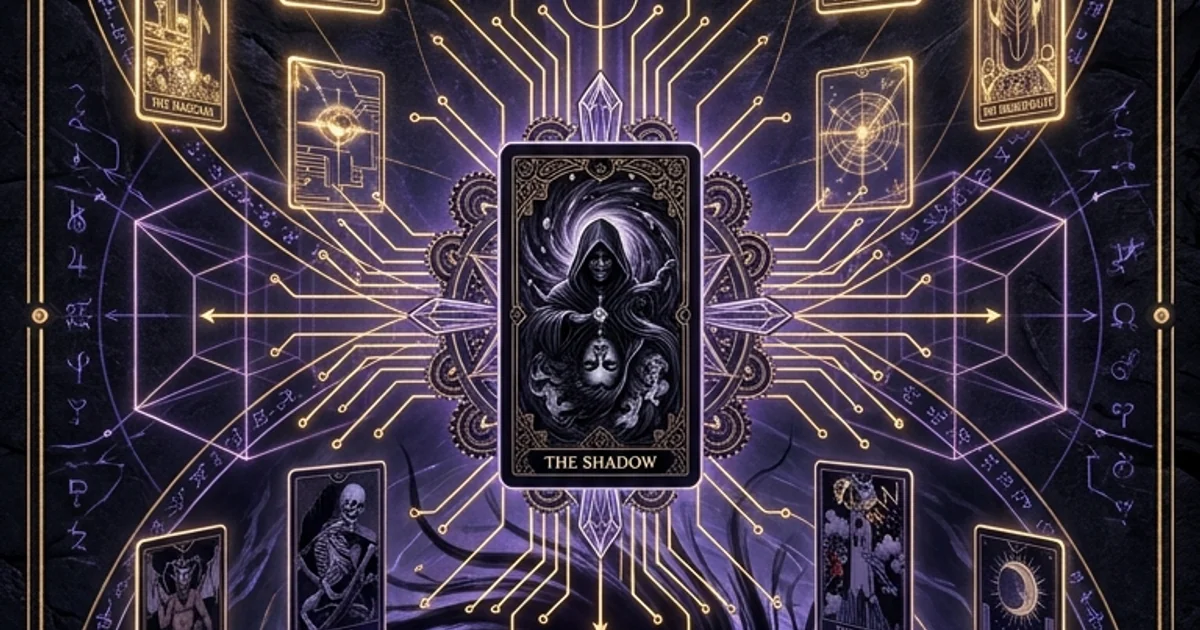
The Shadow Work Spread: Unveiling Subconscious Archetypes
Archetypal Thesis & Systemic Paradigm: The Subconscious as Cybernetic Field
Divinatory mechanics achieve operational legitimacy when stripped of fatalistic superstition and re-articulated through psycho-cosmological coordinate frameworks. Within analytical depth psychology and information theory, the subconscious mind does not operate as an inert reservoir of forgotten biological impulses; rather, it functions as an autonomous, self-regulating cybernetic field. This dynamic terrain is governed by homeostatic feedback loops that continuously endeavor to balance the conscious ego against the totality of the psyche.
When split-off fragments of the personality—sequestered behind the ego’s repressive defenses—are denied conscious assimilation, they form autonomous energetic constellations known as the shadow-complex. Rather than fading through psychological attrition, these disowned drives exert continuous energetic pressure upon the conscious threshold, generating involuntary projective phenomena. The shadow work tarot spread subconscious protocol serves precisely as an externalized, non-linear projective surface, transforming implicit neurotic defense mechanisms into explicit, legible archetypal topologies.
Epistemology of the Shadow: Beyond Moral Dualism into Systemic Compensation
The shadow complex cannot be reduced to colloquial notions of malevolence or ethical defect. In classical analytical psychology, the shadow constitutes the inverse contour of the persona—the aggregate of all psychic contents, instinctual drives, and behavioral potentialities incompatible with the selected ego-ideal. Because the conscious ego establishes identity through structural exclusion, every conscious adaptation automatically produces a corresponding unconscious counter-position.
This compensatory architecture ensures that whatever is suppressed within the conscious field gathers dynamic valence within the personal unconscious. In this epistemological model, evil is understood not as an ontological absolute, but as systemic fragmentation: psychic energy denied an integrated developmental channel degenerates into its primitive, archaic, and destructive mode of expression. The shadow is a structural necessity of ego development. Without systematic conscious integration, these split-off contents establish an adversarial relationship with the ego, orchestrating compulsive repetitions, behavioral parapraxes, and unyielding psychological projections onto the external social environment.
“The shadow is a moral problem that challenges the whole ego-personality, for no one can become conscious of the shadow without considerable moral effort. To become conscious of it involves recognizing the dark aspects of the personality as present and real. This act is the essential condition for any kind of self-knowledge, and it therefore, as a rule, meets with considerable resistance. Indeed, self-knowledge as a psychotherapeutic measure frequently requires much painstaking work that may extend over a long period of time.” — C.G. Jung, Aion: Researches into the Phenomenology of the Self, Collected Works Vol. 9/II, §14.
The Tarot Spread as an Externalized Mirror of Autonomous Complexes
The seventy-eight cards of the Tarot constitute a formal symbolic language—a closed yet infinite combinatoric matrix mirroring the structural architecture of the human psyche. When engaged within a shadow self reading, the spatial geometry of a tarot spread functions as an externalized state-space model of the unconscious. Under normal operations, the ego protects its constructed identity through a phalanx of defensive maneuvers: rationalization, intellectualization, displacement, and pathological projection.
These mechanisms are designed precisely to interrupt introspection and prevent the conscious mind from recognizing its own split-off impulses. The symbolic imagery of the /tarot/major-arcana-archetypes operates obliquely, circumventing discursive rational defenses by addressing the pre-verbal, mythopoeic cognitive processing centers of the psyche. By confronting the subject with objective, externalized symbolic keys, the spread depersonalizes the confrontation. The client no longer faces an abstract moral failing; they encounter an externalized archetypal configuration that demands active decipherment, thereby destabilizing the ego-defense barrier without inducing defensive psychic collapse.
Synchronicity as Non-Local Cybernetic Feedback
The operational mechanism that renders a Jungian tarot spread diagnostically viable rests upon C.G. Jung’s foundational postulate of synchronicity: an acausal connecting principle linking internal psychic states with external, objective physical phenomena. Within an information-theoretic framework, the manual randomization of the cards via shuffling is not a generation of chaotic entropy, but an entropic reset that allows the non-local psychic system to achieve structural isomorphism with the card matrix.
Synchronicity acts as the non-local feedback loop of the broader psychoid realm, in which the barrier between subjective mind and objective matter dissolves. The physical arrangement of cards does not predict an immutable, fatalistic future; rather, it renders visible the instantaneous, unconscious vector-equilibrium of the querent’s psychic energy at the precise moment of diagnostic inquiry. The spread provides the conscious observer with cybernetic telemetry, reflecting back the hidden systemic tensions and repressed instinctual dynamics that unconsciously govern the querent’s trajectory.
Classical Provenance & Textual Lineage: From Hermetic Nigredo to Analytical Cartography
The diagnostic application of symbolic cards to unconscious confrontation is not a modern psychological anomaly, but the direct heir to classical Western esoteric technologies of transmutation. Long before depth psychology formalized the mechanics of repressed libido and complex resolution, operative alchemical traditions and initiatory Hermetic fraternities recognized that psychic regeneration requires an initial, terrifying descent into the unintegrated substrate of the self.
The Alchemical Nigredo and the Golden Dawn’s Dark Night Archetypes
In classical Western alchemy, the Opus Magnum initiates through the indispensable phase of the nigredo, or blackening—the putrefaction and mortification of unrefined prima materia. Within this stage, the base material is subjected to relentless psychic heat within the alembic, decomposing the rigid structural form of the unexamined self into an undifferentiated, chaotic baseline. In the developmental frameworks formulated by Edward F. Edinger in Ego and Archetype (1972), the nigredo directly corresponds to the conscious ego’s catastrophic realization of its own limitations, moral bankruptcy, and complicity with the shadow.
“The evil and averse forces are the result of the unbalanced Sephiroth, left behind in the creation of the Universe… For the Qliphoth are the shells or husks of the unbalanced forces, which, wanting equilibrium, have produced chaotic, discordant, and monstrous manifestations. He who would ascend unto the Light must know the Darkness; he must descend into the abyss of his own being and bind the unbalanced forces, transmuting them through the equilibrium of the Middle Pillar.” — S. L. MacGregor Mathers, The Knowledge Lectures of the Hermetic Order of the Golden Dawn, MS Notebooks (c. 1888–1892).
The Hermetic Order of the Golden Dawn, through its codification of the Cipher Manuscripts and the subsequent synthetic scholarship of S. L. MacGregor Mathers and William Wynn Westcott, explicitly mapped these alchemical mortifications into the pictorial keys of the Tarot. The Golden Dawn did not view cards such as Key XIII (Death) or Key XV (The Devil) as crude harbingers of material disaster, but as operational stages of the alchemical nigredo. They represent systemic dissolutions of calcified ego-attitudes necessary to release the entrapped light of consciousness from its somatic-instinctual imprisonment.
The Transition from Fortune-Telling to Sallie Nichols’ Archetypal Cartography
Throughout the late eighteenth and nineteenth centuries, the Tarot remained predominantly confined to esoteric cartomancy, characterized by rigid fatalism and superstitious prognostication. A profound paradigm shift occurred through the pioneering integration of analytical psychology with the visual structures of the Tarot, systematically articulated by Sallie Nichols in Jung and Tarot: An Archetypal Journey (1980). Nichols demonstrated that the Major Arcana delineate an operative phenomenology of individuation—a visual codification of the soul’s perilous transit from naive ego-consciousness (The Fool) through systemic disintegration to psychological wholeness (The World).
This transition dismantled predictive divination. Nichols proved that when an individual draws a card of severe psychic tension, the image does not portend an external cataclysm imposed by a hostile cosmos, but illustrates an internal archetypal dynamic seeking conscious integration. By re-situating the cards as an interactive projective canvas for the active-imagination technique, modern analytical practitioners transformed the deck into an empirical instrument of psychological diagnosis, enabling querents to track the dialectic progression between the conscious personality and the personal and collective unconscious.
The Kabbalistic Qliphoth as Pathological Shadow Vectors of the Tree of Life
Within the Hermetic Kabbalah, which underpins the structural correspondences of modern esoteric Tarot, the cosmic and psychological architecture of existence is expressed through the Tree of Life (Otz Chiim). The Tree comprises ten balanced emanations (Sephiroth) linked by twenty-two paths. Its systemic inversion is the Tree of Death, populated by the Qliphoth—literally, the “shells” or “husks.” As articulated in Golden Dawn theory, the Qliphoth are not independently generated primordial evil forces; they are the pathological extremes of the Sephiroth themselves, originating from the “Kings of Edom” who reigned before balance was established.
When any divine or psychological attribute is isolated from the systemic whole—when Geburah (Severity) operates entirely divorced from Chesed (Mercy)—it degenerates into unmitigated destruction, generating the Qliphothic shell of Golachab (The Burning Ones). When applied to Tarot diagnostics, every card contains both its Sephiric (equilibrated, developmental) and Qliphothic (unbalanced, shadow) expressions. The shadow work spread explicitly interrogates these Qliphothic distortions, exposing where the querent’s psychic energy has curdled into rigidity, obsessive defense, or unintegrated instinctual compulsion.
Structural Mechanics & Symbolic Geometry: The Architecture of the Shadow Spread
A rigorous shadow self reading requires an exacting spatial topology. Arbitrary or formless card placements fail to generate the structured psychological tension necessary to provoke ego-transcendence. The architecture of the Shadow Work Spread relies upon dynamic geometric vectors that simulate the structural friction between conscious intent and subconscious resistance.
Coordinate Geometry: The Five-Point Heptagrammatic Tension Layout
The core architecture utilized for this diagnostic procedure is the Five-Point Heptagrammatic Tension Layout, derived from the systemic geometries of /sacred-geometry/heptagrammatic-vectors-tree-of-life. This spread positions five specific operational stations across a vertical and horizontal cross of psychic tension:
- Station I: The Persona Mask (Ego-Ideal). Placed at the superior coordinate, this card diagnoses the current conscious adaptation, the defensive self-concept, and the behavioral script that the ego presents to the collective social sphere.
- Station II: The Subconscious Shadow Core (Repressed Prima Materia). Positioned at the inferior coordinate, directly opposing Station I, this card unmasks the split-off instinct, trauma complex, or denied drive that the Persona Mask is actively expending metabolic and psychological energy to conceal.
- Station III: The Projection Vector (The Mirror of the Other). Situated on the left, horizontal axis, this card identifies the precise relational surface upon which the repressed core is unconsciously cast. It reveals how the client perceives their own shadow disowned and reflected in external adversaries, intimate partners, or institutional systems.
- Station IV: The Transmuted Gold (The Aurum Non Vulgare). Situated on the right horizontal axis, directly opposing the Projection Vector, this card diagnoses the latent evolutionary potency entrapped within the shadow-complex. Following Marie-Louise von Franz’s thesis in Projection and Re-Collection in Jungian Psychology (1980), the shadow contains the highest vitality; this station reveals what creative or assertive capacity is reclaimed once the projection is rescinded.
- Station V: Conscious Synthesis (The Middle Pillar / Tiphereth). Occupying the precise geometric center of the cross, this card dictates the operative behavioral protocol required to mediate between the conscious ego and the newly excavated subconscious material, initiating the systemic transition toward individuation.
Vector Analysis: Major Arcana Root Triggers vs. Minor Arcana Behavioral Symptoms
In diagnosing a shadow work tarot spread subconscious configuration, the analytical reader must apply strict vector analysis to the hierarchy of the arcana. When a Major Arcanum occupies the Subconscious Shadow Core (Station II), the querent is grappling not with an episodic situational neurosis, but with a deep, transpersonal archetype originating within the collective unconscious. These root triggers demand prolonged archetypal metabolization.
Conversely, when a Minor Arcanum occupies Station II, the shadow complex is rooted in biographical conditioning, localized developmental arrests, or immediate behavioral defense tactics. For example, if Key XV (The Devil) occupies the Shadow Core, the client is locked in an archetypal confrontation with the primal instinctual shadow, shadow-projection, and systemic bondage. If the Seven of Swords occupies that position, the shadow dynamic is localized within specific behavioral scripts of evasion, deceptive self-protection, and calculated intellectual isolation.
Elemental Dignities and Asymmetric Blockades
The definitive diagnostic precision of this system emerges through the rigorous application of /tarot/elemental-dignities-systemic-mapping. Cards do not operate in theoretical isolation; their energetic potencies are modified, amplified, or neutralized by the elemental properties of the cards adjacent to them within the spatial grid. The four Hermetic elements correspond directly to the Jungian functional types:
- Fire (Wands): Intuition / Volitional Libido
- Water (Cups): Feeling / Affective-Relational Value
- Air (Swords): Thinking / Discursive Intellect
- Earth (Pentacles): Sensation / Somatic Grounding
When Station I (Persona) and Station II (Shadow) display mutually hostile elemental dignities—such as Fire (active, expansive, dry) confronting Water (passive, receptive, moist)—a state of structural psychic dissociation is diagnosed. The ego-mask actively quenches or boils the instinctual feeling-nature of the unconscious.
If Air and Earth clash across the horizontal vector of Projection and Transmutation, the client’s analytical rationalizations (Air) are systematically severed from their embodied, somatic reality (Earth), producing intellectualized bypass and preventing the visceral grounding of the shadow-material. The practitioner must analyze these asymmetric elemental blockades to identify where energetic circulation has coagulated into neurotic stasis.
Psychological Dynamics & Operational Praxis: The Protocol of Confrontation
Executing a shadow self reading demands an uncompromising clinical demeanor. The objective is not to offer soothing platitudes or aesthetic affirmations, but to initiate an encounter with the disowned elements of the personal history and collective human drive. The practitioner operates as an objective cartographer of the psychic interior, facilitating the transition from unconscious projection to conscious integration.
Personal Shadow (Repressed Biographical Material)
- Etiology: Biographical developmental arrest, personal trauma, social conditioning, family-of-origin taboos.
- Structural Distribution: Dominance of Minor Arcana and Court Cards across diagnostic vectors.
- Affective Signature: Visceral somatic guilt, episodic shame, localized behavioral defensiveness, personal resentment.
- Resolution Mechanism: Ego-boundary restructuring, emotional catharsis, cognitive reframing, behavioral de-escalation.
Collective Shadow (Transpersonal Archetypal Inundation)
- Etiology: Activation of primordial psychic structures, encounters with the objective psyche, existential dread.
- Structural Distribution: Saturation of Major Arcana across core tension stations (Keys XIII, XV, XVI, XVIII).
- Affective Signature: Archaic terror, numinosity, cosmic dread, structural disorientation, paralysis of the ego-ideal.
- Resolution Mechanism: Mythopoeic amplification, active imagination, symbolic ritual, alchemical transmutation.
Active Imagination and Somatic Attunement with Adverse Arcanas
The technical methodology for processing harrowing cards drawn within the Shadow Core relies primarily upon Jung’s praxis of active-imagination. When cards such as Key XVI (The Tower) or the Three of Swords appear within the diagnostic layout, they must not be dismissed through intellectual abstraction. The querent is instructed to enter a state of lowered conscious threshold (the alchemical abaissement du niveau mental), fixing their visual attention upon the card’s central symbolic figure.
The practitioner directs the querent to initiate a conscious, dialectical interrogation of the card persona. If the Nine of Swords occupies the Projection Vector, the figure weeping into their hands is not analyzed as a passive concept; the client speaks directly to that entity, demanding an account of its vigilance, its somatic terrors, and its structural function in preserving ego-stability.
Concurrently, somatic attunement must track bodily reactions: constriction of the throat, diaphragmatic spasm, or localized abdominal pain. These somatic markers indicate where the split-off affect has been converted into neuromuscular armor. By compelling the conscious ego to maintain prolonged, non-judgmental presence with the disturbing image, the energetic charge held within the somatic symptom begins to release into conscious awareness.
+-----------------------------------------------------------------------------------+
|               DIAGNOSTIC ARCHETYPE MATRIX: THE MAJOR DESCENT KEYS                |
+-------------------+-----------------------------+---------------------------------+
| Arcanum Key       | Primary Shadow Pathology    | Transmuted Gold (Potency)       |
+-------------------+-----------------------------+---------------------------------+
| Key XIII: Death   | Pathological clutching;     | Radically unconditioned renewal;|
|                   | terror of psychic void;     | capacity to initiate terminal   |
|                   | necrotic ego calcification. | endings without ambivalence.    |
+-------------------+-----------------------------+---------------------------------+
| Key XV: The Devil | Disowned primal instinct;   | Unbound creative vitality;      |
|                   | projection of bondage;      | somatic integration; definitive |
|                   | compliance with compulsion. | boundary assertion.             |
+-------------------+-----------------------------+---------------------------------+
| Key XVI: The Tower| Structural narcissism;      | Liberation from false premises; |
|                   | brittle intellectualization;| collapse of pathological defense|
|                   | fear of catastrophic fall.  | mechanisms into direct truth.   |
+-------------------+-----------------------------+---------------------------------+
| Key XVIII: Moon   | Somatic terror; archaic     | Visionary intuitive receptivity;|
|                   | psychosis; devouring        | deep navigation of pre-rational |
|                   | maternal/primal engulfment. | emotional substrates.           |
+-------------------+-----------------------------+---------------------------------+
Differential Diagnosis: Personal Complex vs. Collective Archetypal Inundation
A critical diagnostic failure occurs when an analyst mistakes a collective archetypal activation for an ordinary biographical neurosis, or conversely, inflates a mundane personal trauma into a grand mythic trial. The shadow work spread operates as a differential diagnostic engine.
When a layout is heavily saturated with Minor Arcana, the practitioner is dealing primarily with the personal unconscious. The client’s shadow consists of the historical debris of their individual biography: conditioned shame regarding sexual expression, suppressed hostility toward a sibling, or parental financial anxiety. These issues require straightforward behavioral restructuring, boundary re-negotiation, and affective release.
However, when the central stations are captured by dense sequences of the Major Arcana, the personal ego has tapped into the archetypal substrata of the objective psyche. If Key XIII (Death), Key XV (The Devil), and Key XVIII (The Moon) appear simultaneously across the tension axes, the querent is experiencing a systemic structural crisis: the collapse of their baseline paradigm.
Here, the personal biography is merely the vehicle through which a transpersonal transformation is unfolding. The practitioner must adjust the therapeutic cadence accordingly. The treatment can no longer remain purely personal; it must engage mythopoeic amplification, symbolic correspondence, and a conscious navigation of the /astrology/saturn-pluto-complex-archetypal-descent, framing the client’s current suffering as an alchemical death necessary for psychic evolution.
De-escalating the Ego Defense Matrix: Transmutation via Counter-Archetypes
The ultimate objective of unconscious integration within the shadow framework is the extraction of the aurum non vulgare—the alchemical gold hidden within the prima materia. The shadow holds the primitive, energetic baseline of the human organism. A client who has completely repressed Key XV (The Devil) lacks not only access to their base impulses, but also lacks healthy aggression, erotic vitality, charisma, and the capacity to establish firm boundaries against ambient psychic invasion. The shadow work spread reveals this latent asset in Station IV (The Transmuted Gold).
To operationalize this reclamation without provoking a catastrophic counter-reaction from the ego defense matrix, the practitioner deploys the methodology of counter-archetypal balancing. The raw, volcanic force of the shadow core must be mediated through an archetypal lens that the ego can consciously comprehend and integrate. If the unbridled, reactive fury of the Five of Swords dominates the Projection Vector, it is transmuted by anchoring consciousness in the disciplined, strategic architecture of Key XI (Justice).
The goal is never the destruction of the shadow drive, but its systemic elevate-and-contain maneuver: the instinctual energy is acknowledged, stripped of its archaic, reactive compulsions, and redirected toward conscious, self-chosen evolutionary objectives.
Philosophical Synthesis & Macrocosmic Correspondence: Hermetic Polarities and Individuation
The clinical mechanics of shadow work find their metaphysical architecture within the Hermetic Axioms that govern the broader cosmos. Divinatory systems operate on the principle that the structural dynamics of the individual human mind (the microcosm) are isomorphic with the energetic currents of the universe (the macrocosm).
The Kybalion’s Principle of Polarity and Jung’s Enantiodromia
The Hermetic Principle of Polarity states: “Everything is Dual; everything has poles; everything has its pair of opposites; like and unlike are the same; opposites are identical in nature, but different in degree.” This Hermetic law finds its psychological parallel in Jung’s concept of enantiodromia—the regulatory principle whereby the extreme unilateral accentuation of any conscious attitude inevitably summons its exact opposite from within the unconscious.
Within the architectural framework of the Hermetic Tree of Life, the descent into the shadow core corresponds to the traversal of the Path of Ayin (Key XV, The Devil, assigned to Capricorn and Earth) and the Path of Pé (Key XVI, The Tower, assigned to Mars and Fire). These severe paths cross the lower veil, linking the Sephirah Tiphereth (the solar center of conscious selfhood and spiritual equilibrium) with Hod (Intellect) and Netzach (Desire).
The transit along these paths requires the operational phase of alchemical calcination—the total incinerating destruction of illusory ego structures by the downward-striking fire of direct spiritual reality. This violently releases the entrapped consciousness from its crystallized, dogmatic fixations.
When an individual’s conscious ego becomes increasingly unilateral, rigid, and moralistic, the subconscious system compensates by amassing a charge of inverse polar energy. Through the mechanics of enantiodromia, the unintegrated polarity does not quietly vanish; it breaks into conscious awareness through behavioral self-sabotage, psychological breakdowns, or sudden inversions of character.
The shadow work spread uses this principle systematically. By diagnosing the polarized spectrum of energy across Stations I and II, the spread reveals the exact velocity at which the ego is hurtling toward an enantiodromic crisis. It allows the individual to consciously re-polarize their psychic energy before the compensation manifests externally as a catastrophic event.
Macrocosmic Decanic Degradations and Microcosmic Psychic Fractures
The seventy-eight cards of the Tarot map to an astrological geometry of the cosmos: the twenty-two Major Arcana mirror the three elements, seven classical planets, and twelve signs of the Zodiac, while the thirty-six numbered Minor Arcana correspond to the thirty-six decans of the celestial wheel. In Hermetic astrology, each decan represents a specific operational modulation of planetary and zodiacal forces.
When a card lands in a pathological shadow position within the spread, it frequently exposes what ancient astrological texts describe as a “degraded decan”—a sector where planetary forces operate under extreme tension, such as Mars ruling the third decan of Pisces (Ten of Cups corrupted into satiety and stagnation) or Saturn ruling the second decan of Cancer (Four of Cups as emotional calcification and narcissistic withdrawal).
The psychological fracture witnessed within the human complex is thus contextualized as a localized participation in a wider, macrocosmic cycle of descent and dissolution. This realization strips the shadow confrontation of isolated neurotic shame. The client realizes that their personal suffering, their trauma complexes, and their private battles with instinct are systemic human events, written into the archetypal dynamics of the cosmos itself.
The Opus Magnum: Shadow Confrontation as the Indispensable Gate to the Self
Individuation—the overarching psychological imperative to evolve into the totality of the unified Self—remains entirely impossible without the conscious, prolonged confrontation with the shadow. Any spiritual or psychological system that promises enlightenment, psychic elevation, or transpersonal ascension while bypassing the chthonic descent into the shadow produces nothing more than psychic inflation, dissociation, and spiritual bypass.
The Western mystery tradition has perpetually maintained that the ascent of the Tree of Life begins precisely at the foot of the cross, in the dense, unredeemed material of Malkuth. The shadow work spread serves as the cartographic instrument for this initiatory descent. By mapping the suppressed, hostile, and disowned sectors of the psyche, the spread compels the ego to relinquish its throne of sovereign self-deception. In facing the cards that unmask our deepest terrors and hidden compulsions, we do not merely uncover our pathology; we recover the prima materia. We retrieve the raw, primal essence of the psyche, without which the alchemical marriage of the conscious and unconscious mind can never take place.
Frequently Asked Questions
Resolving Pathological Dread During Harrowing Draws
How should a reader psychologically stabilize a querent when a spread is dominated by harrowing archetypes such as Key XIII (Death), Key XV (The Devil), and the Ten of Swords?
The immediate task of the analytical reader is the de-escalation of literalism and the activation of archetypal contextualization. Pathological dread occurs exclusively when the conscious ego interprets symbolic, mythopoeic language as concrete, fatalistic prognostications of physical harm or moral damnation. The practitioner must inform the querent that the psyche speaks in visual hyperbole; an archaic complex cannot register the need for transformation through mild imagery, but requires shocking, disruptive archetypes to penetrate the ego’s defenses.
Cards such as The Devil or the Ten of Swords signal that an obsolete psychic structure is ready for conscious metabolization. The presence of these intense cards confirms that the subconscious feels adequately resourced to bring this toxic material to the surface; the psyche does not surface what it is entirely unprepared to confront. The reader must anchor the querent somatically, slowing the breath, shifting focus away from catastrophic predictions, and redirecting inquiry to where the feeling of betrayal, bondage, or structural decay is currently residing within their present biographical reality.
The Danger of Psychic Inflation and Pseudo-Integration
How can an investigator detect and guard against the phenomena of psychic inflation and pseudo-integration during shadow work readings?
Pseudo-integration occurs when the ego uses intellectualization to neutralize the transformative impact of the shadow spread. The client learns the psychological terminology, fluently labels their complexes, and accepts the presence of Key XV or the Seven of Swords conceptually, yet changes no underlying behavior. This produces a state of psychic inflation: the ego identifies with the role of the “enlightened shadow worker,” using depth psychology as a sophisticated defense mechanism to avoid the raw affective pain and shame of their actual neuroses.
The reader detects this dynamic when there is a total dissociation between the client’s analytical commentary and their somatic affect; the client speaks of profound trauma or deep rage with a flat, detached, or smiling demeanor. To guard against this, the practitioner must enforce rigorous operational praxis: demand that the querent articulate the concrete, behavioral manifestations of their shadow cards. If the client cannot state how their shadow dynamic operated in their interpersonal relationships within the past forty-eight hours, the integration is merely conceptual. Integration is measured exclusively through altered relational choices, somatic presence, and the cessation of compulsive projective dynamics in waking life.
Determining Spread Frequency and Diagnostic Cadence
What is the optimal operational cadence for deploying the Shadow Work Spread, and what are the clinical risks of excessive deployment?
The Five-Station Shadow Integration Circuit must be deployed sparingly and with disciplined diagnostic intent. The confrontation with the shadow destabilizes the ego-persona balance; it initiates a period of psychic digestion that demands considerable metabolic, emotional, and cognitive resources. Consequently, this spread should never be run on a weekly or casual basis. An optimal cadence ranges between quarterly seasonal intervals, at significant developmental transitions (such as major astrological Saturn, Uranus, or Chiron returns), or specifically when the querent finds themselves locked in an acute, unyielding projective loop or relational paralysis.
The clinical risks of excessive deployment include chronic ego-fragmentation, morbid introspection, and the systematic erosion of healthy ego defenses. The ego requires stability and boundary coherence to function within the socioeconomic and relational sphere. Subjecting the psychic foundation to perpetual putrefaction and alchemical dissolution without allowing adequate time for consolidation and ego-restructuring arrests healthy adaptation, trapping the individual in a self-absorbed, neurotic underworld without building the bridge back to conscious life.