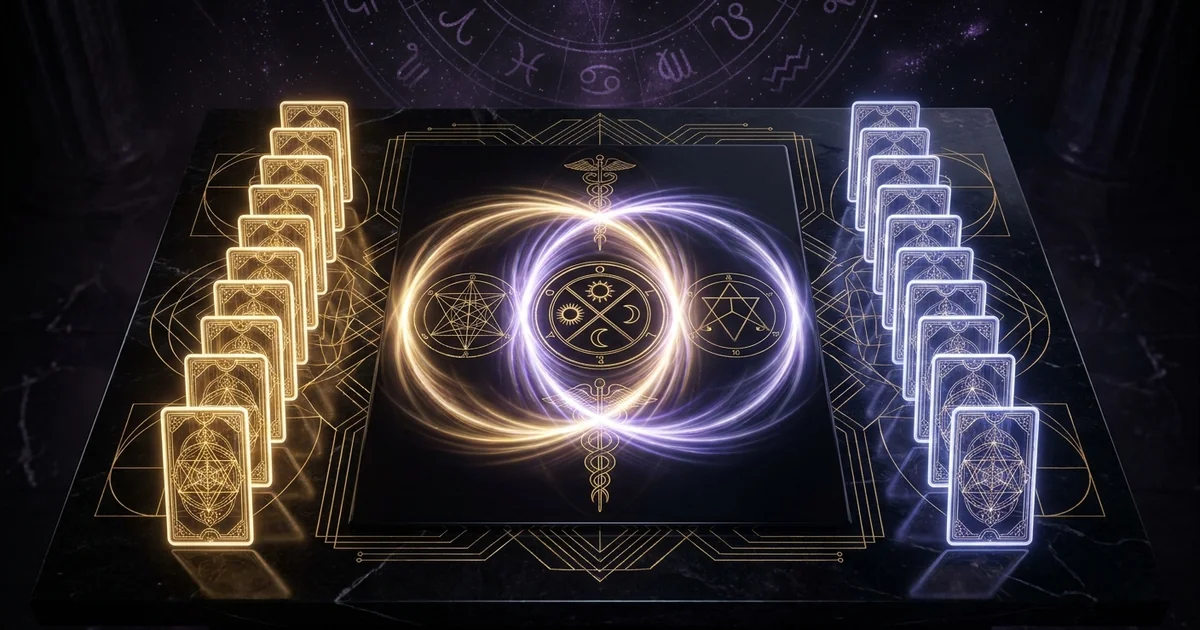
The Relationship Mirror Spread: Dyadic Soul Dynamics
Archetypal Thesis & Systemic Paradigm: The Relational Dyad as an Alchemical Vessel
The exploration of interpersonal dynamics within esoteric systems demands an ontological shift away from vulgar, deterministic divination toward a rigorous psycho-cosmological cartography. Human relational friction rarely stems from the direct collision of two fully conscious, discrete subjectivities. Rather, it represents an intricate entanglement of unconscious projective mechanisms wherein each participant’s repressed psychic contents are systematically cast upon the other. To approach relationship analysis through the tarot is not to forecast arbitrary romantic events, but to construct a dynamic state-space manifold capable of mapping the bilateral cybernetic feedback loops that govern dyadic consciousness. The relationship mirror tarot spread dynamics provide an objective visual coordinate system that mirrors the structural reality of relational entanglement, externalizing the invisible energetic architectures that bind two souls into a shared psychic field.
Central to this methodology is the phenomenon of projective-identification, a primitive psychological mechanism wherein split-off, unintegrated aspects of the self are unconsciously attributed to the partner, who is then subtly coerced into embodying those very characteristics. In a dyadic soul reading, interpersonal conflict ceases to be treated as a purely situational grievance; instead, it is recognized as a symptom of an unnegotiated archetypal drama. When an individual rejects their own capacity for shadow aggression, chaotic creativity, or structural severity, these internal dynamisms do not dissipate. They gather autonomous energetic momentum within the unconscious and are subsequently perceived across the relational threshold. The partner is transformed into an archetypal screen upon which the subject’s own disowned soul is enacted.
The relational field operates structurally as the alchemical vas hermeticum—the hermetically sealed crucible wherein the base matter of raw instinct, emotional compulsion, and egoic territorialism is subjected to relentless psychic heat. Without the containment provided by dyadic commitment, the volatile vapors of unconscious reactivity escape into ambient social avoidance. Within the closed circuit of the relational vessel, however, interpersonal tension initiates the stage of calcinatio: the systematic burning away of egoic falsities through the friction of incompatible apperceptions. The relationship mirror spread visually crystallizes this closed vessel, providing a reflective surface where each actor is compelled to witness how their own interior architecture distorts the perception of the counterpart, establishing an epistemological foundation for true individuation.
By treating the dyad as an emergent, organic totality rather than an aggregate of two isolated egos, the tarot spread tracks the teleological trajectory of the alchemical coniunctio-oppositorum. The ultimate aim of dyadic relational work is not mere domestic equilibrium or sentimental reconciliation, but the deliberate harmonization of archetypal polarities—conscious and unconscious, solar and lunar, active and receptive. As explored in esoteric models of relational development such as /sacred-geometry/vesica-piscis-dyadic-creation, the overlapping perimeter of two intersecting circles generates an autonomous central geometry: the mandorla or vesica piscis. In the Relationship Mirror spread, this metaphysical third manifests as an autonomous energetic entity possessing its own psychic laws, karmic trajectory, and evolutionary imperatives.
“The transference is the alpha and omega of the analytical method… In the dyadic relation, it is not merely two conscious personalities that meet, but four: the Adept and the Soror Mystica, together with the cross-over of their unconscious contra-sexual components—the Animus and the Anima. The lines of force cross and recross in a diagonal quaternio, such that the conscious intention of the ego is continually subverted by the clandestine nuptials of the unconscious figures beneath. Where there is no vessel to contain this cross-circulation, the personalities shatter against one another in demonic possession.” — C.G. Jung, Collected Works, Vol. 16, Paras 422–425
Projective Identification and the Transference Matrix
In his foundational analysis of the Rosarium Philosophorum woodcuts, C.G. Jung demonstrated that any profound dyadic relationship activates an archetypal cross-transference network. When two psyches enter sustained proximity, four distinct structural entities occupy the field: the conscious ego of Partner A, the conscious ego of Partner B, the unconscious contra-sexual archetype of Partner A (the Anima or Animus), and the unconscious contra-sexual archetype of Partner B. Marie-Louise von Franz expanded upon this dynamic, noting that anima-animus-projection operates with an absolute, quasi-hallucinatory conviction. Because the subject cannot experience their own projected contents directly within their ego boundary, the partner is perceived with complete phenomenological realism as possessing the exact qualities, both demonic and luminous, that belong strictly to the subject’s own split-off self.
The Relationship Mirror spread decodes this quaternary transference matrix by decoupling the conscious ego-concept from the unconscious apperception. When a practitioner reads the reciprocal horizontal vectors of the spread, they trace the precise diagonal cross-ties that Jung identified in the analytical vessel. If Partner A consciously presents a self-concept characterized by rational order (e.g., King of Swords) yet their unconscious undercurrent reveals an unacknowledged emotional famine (e.g., Five of Cups), Partner B will inevitably register and react to the emotional famine rather than the intellectual persona. Projective identification ensures that Partner B is unconsciously drafted into acting out the repressed grief or affective coldness that Partner A refuses to integrate. The spread renders this covert script explicit, transmuting unconscious acting-out into conscious psychological reclamation.
The Tarot Spread as a State-Space Manifold of Relational Consciousness
To understand the diagnostic efficacy of the Relationship Mirror, one must discard the mechanistic assumption that the cards function via linear cause-and-effect or supernatural intervention. Rather, the tarot operates as a state-space manifold: an acausal, topological representation of an open thermodynamic system governed by psychic energy. Every card drawn represents a specific energetic coordinate within the collective unconscious, possessing precise mathematical and symbolic values determined by its elemental, planetary, and sephirotic attributions.
When deployed within a dyadic architecture, the 78 arcanas constitute a phase space wherein the dynamic interactions of two conscious agents are mapped across multiple axes simultaneously. The spread organizes these psychic vectors into a bilateral matrix, externalizing what would otherwise remain inaccessible within the subjective phenomenological horizon of either participant. Just as a phase portrait in non-linear dynamics reveals attractors, bifurcations, and limit cycles within physical systems, the Relationship Mirror spread models the psychic attractors—both pathological neuroses and evolutionary potentials—that govern the relational field. It provides an epistemological bridge between individual introspection and systemic structural observation.
Transmuting the Dyad: From Dualism to the Living Coniunctio
The fundamental teleology of esoteric relational work lies in transmuting dualistic alienation into the living coniunctio. In the uninitiated state, human relationship remains trapped in an agonizing oscillation between identity and difference: the partner is either an identical mirror of the self (narcissistic fusion) or an unfathomable, hostile adversary (dualistic alienation). Both positions are fundamentally defensive, designed to protect the fragile ego from the terrifying demand of psychic transformation.
The Relationship Mirror spread serves as an instrument of dialectical transmutation. By displaying the two individuals as parallel columns flank-anchored by a sovereign mediating pillar, the architecture breaks the regressive pull toward both narcissistic identification and antagonistic polarity. It introduces what esoteric philosophy terms the “living third.” The transformation of base interpersonal reactivity into spiritual gold requires the sustained holding of opposites—the conscious tolerance of profound paradox, conflicting needs, and divergent perceptual realities. In this crucible, the cards cease to be static paper symbols; they become an operative mandala facilitating the conscious descent into the nigredo of relational disillusionment, the subsequent albedo of psychological clarity, and the ultimate rubedo of integrated spiritual intimacy.
Classical Provenance & Textual Lineage: From Hermetic Polarities to Golden Dawn Geometry
The formal architecture of the Relationship Mirror spread does not emerge ex nihilo from modern psychological eclecticisms; it represents the direct operational adaptation of classical Hermetic philosophy and Qabalistic sacred geometry. At the foundation of the Western Esoteric Tradition lies the Hermetic Principle of Polarity, articulated in the Corpus Hermeticum and later preserved in Renaissance occultism: all manifested phenomena exist along a continuum of polar opposition, generating the rhythmic oscillation necessary for creative cosmic generation. In the realm of mundane relationship, this metaphysical truth is obscured by egoic possessiveness. The mirror spread strips away this sentimental veneer, translating the primal metaphysical polarities of the cosmos into an exact divinatory calculus.
The structural arrangement of the mirror spread is directly derived from the archetypal schema of the Otz Chiim, or the Tree of Life. In classical Hermetic Qabalah, the manifest universe is sustained through the continuous interaction of two antithetical cosmic currents, mediated and equilibrated by an autonomous central channel. The right-hand column of the spread mirrors the Pillar of Mercy (Chokmah, Chesed, Netzach), representing the expansive, dynamic, uninhibited solar-phallic emanations of pure life-force. The left-hand column mirrors the Pillar of Severity (Binah, Geburah, Hod), embodying the restrictive, form-giving, critical lunar-cthonic forces of containment and judgment. When two human psyches enter a relationship, they inevitably distribute themselves across these pillars, frequently casting one partner into the role of the expansive, unregulated catalyst while forcing the other into the role of the hyper-vigilant, defensive boundary-keeper.
“Let the Adeptus Minor take heed that no card in divination standeth alone; for each symbol is modified, exalted, or destroyed by the companion that confronteth it. In the operation of polar dignities, if Fire meeteth Water across the sphere of working, let it be known that there is war in the vessel, and the work is hindered until a reconciling Air or Earth be brought to bear between them. As the Pillar of Severity counter-checks the Pillar of Mercy, so must the cards of the Left hand be weighed against the cards of the Right hand, and their equilibrium sought within the Central Path of the Middle Pillar.” — S.L. MacGregor Mathers & Moina Mathers, The Golden Dawn Tarot Cyphers and Book T
During the Renaissance, this geometry found mathematical and occult articulation in Heinrich Cornelius Agrippa’s De Occulta Philosophia, wherein the human dyad was examined through the lens of micro-cosmic reflection. Agrippa posited that the number Two (the Duad) is the number of division, mutual opposition, and discord, inherently instigating the descent into chaotic matter, yet simultaneously serving as the indispensable precondition for all beauty and communion. Without the Duad, the monadic Unity remains barren, locked in self-enclosed sterility. The Renaissance magical tradition recognized that looking into the soul of another human being is identical to looking into the speculum—the scrying mirror of the cosmic intelligence. The individual does not encounter a foreign entity, but rather a differentiated manifestation of the Universal Anthropos.
The formal translation of these Qabalistic and Hermetic principles into systematic tarot layouts occurred through the pioneering curricular work of the Hermetic Order of the Golden Dawn in the late nineteenth century. In Book T: The Tarot, S.L. MacGregor Mathers and Moina Mathers codified the absolute laws governing elemental-dignities, demonstrating that tarot cards cannot be interpreted as isolated semantic fragments, but must be calculated as interdependent energetic charges. The Golden Dawn discarded the crude, fatalistic synastry of late-medieval cartomancy—which sought merely to divine whether a union would bring material fortune or marital discord—in favor of an initiatory approach. Dyadic analysis was integrated into the Great Work: the systematic reconciliation of opposites within the human consciousness, utilizing the deck as an objective diagnostic tool for assessing systemic equilibrium across the tree-of-life-pillars.
Arthur Edward Waite, writing in The Pictorial Key to the Tarot (1910), codified this shift by imbuing the cards with rich mystical and psychological allegories. In his treatment of Key VI, The Lovers, Waite explicitly moved away from the historical depiction of a young man wavering between two women (the choice between vice and virtue) toward an exalted, Qabalistic tableau: a naked man (representing conscious understanding) gazing at a naked woman (representing the unconscious psyche), who in turn casts her gaze upward toward the mediating Archangel Raphael (the Supernal Synthesis). This iconic visual geometry provides the theoretical foundation for the Relationship Mirror spread. The mundane horizontal vector between the man and the woman cannot find true reconciliation on its own plane; it must be triangulated through the transcendent vertical intervention of the supernal intelligence.
The Pillars of the Tree of Life: Severity, Mercy, and the Middle Path
To apply the Relationship Mirror spread with technical rigor, the practitioner must align its physical columns with the sephirotic architecture. The column occupied by Partner A and the column occupied by Partner B do not merely represent two individuals; they represent the archetypal tension between the White Pillar of Jachin and the Black Pillar of Boaz. In any given moment of dyadic crisis, one partner unconsciously assumes the function of Mercy—seeking unmitigated expansion, absolute forgiveness, emotional enmeshment, and the dissolution of structural limits. Simultaneously, the other partner is polarized into the function of Severity—enforcing rigid boundaries, intellectual critique, emotional withdrawal, and punitive withdrawal.
The tragedy of unexamined relational conflict is that both partners mistake these temporary archetypal stances for their authentic core identities. The Relationship Mirror spread deconstructs this illusion by mapping the mutual horizontal reflections across the Middle Pillar. The Middle Pillar—corresponding to the sephiroth Kether, Da’ath, Tiphereth, Yesod, and Malkuth—is the path of equilibrium, reconciliation, and conscious integration. When the two parallel columns are evaluated against this central axis, the practitioner can diagnose precisely where the relationship has fallen into energetic disequilibrium, facilitating the return of both participants to the central line of conscious awareness.
Renaissance Microcosmic Mirrors and Agrippan Dyadic Mathematics
Renaissance natural magic viewed the dyad through the rigorous lens of sacred number theory. As Agrippa elucidated in the second book of Occult Philosophy, the number Two possesses no native center; it is fundamentally eccentric and unstable. It represents the rupture of the primal cosmic monad, the introduction of the alter ego, the first manifestation of otherness, and therefore the birthplace of both desire and mortal terror. In Agrippa’s mathematical mysticism, the dyad cannot attain rest within itself; it must continuously cycle through attraction and repulsion until it is either consumed by its own internal friction or elevated into the triadic harmony of the Ternary.
The Relationship Mirror spread operationalizes this Agrippan insight. By structuring the consultation around twin, three-card vertical arrays, the spread deliberately amplifies the tension inherent in the Duad. It forces the querents to witness the radical otherness of the partner’s internal experience. The spread refuses to offer a premature, sentimental synthesis; it holds the mirror steady, compelling both egos to confront the irreducible paradox that the person they believe they know intimately is, in reality, a vast, foreign psycho-spiritual continent operating under completely different archetypal imperatives.
Nineteenth-Century Esoteric Synastry: The Hermetic Order of the Golden Dawn and Book T
The profound contribution of the Golden Dawn to relationship analysis was the formalization of card interactions via the rules of elemental compatibility and polarity. In the traditional synastry techniques established within Book T, the Golden Dawn inner circle analyzed how cards of opposing columns interacted through their inherent elemental assignments: Fire (Wands), Water (Cups), Air (Swords), and Earth (Pentacles/Disks). Relationships were mapped not merely as personality clashes, but as thermodynamic operations.
Under this lineage, the modern practitioner does not ask, “Does this partner love me?” Instead, the analysis focuses on systemic questions: Does the Fire of Partner A’s conscious drive volatilize and evaporate the delicate Water of Partner B’s emotional undercurrent, or does it heat it into productive steam? Does the Air of Partner A’s analytical scrutiny wither the fragile Earth of Partner B’s physical security, or does it provide the necessary atmosphere for structural germination? By applying the rigorous methods detailed in /tarot/elemental-dignities-golden-dawn, the mirror spread transforms vague relational anxieties into a precise energetic diagnosis.
Structural Mechanics & Symbolic Geometry: The Bilateral Architecture of the Mirror Spread
The physical topology of the Relationship Mirror spread is an exercise in sacred geometry, deliberately designed to minimize interpretive ambiguity and maximize diagnostic precision. Unlike generalized spreads such as the Celtic Cross—which maps an individual’s psychic trajectory through time and situational conflict, as analyzed in /tarot/celtic-cross-archetypal-mechanics—the Relationship Mirror spread isolates the relational field itself as the primary subject of inquiry. The layout consists of seven precise geometric coordinates: two parallel, three-card vertical columns flanking a single, mediating central card.
[ Node 1 ]                      [ Node 4 ]
    (Conscious Ego A)               (Conscious Ego B)
           ^                               ^
           |                               |
           v                               v
       [ Node 2 ]      [ Node 7 ]      [ Node 5 ]
    (Apperception)    (The Coniunctio)  (Apperception)
           ^                               ^
           |                               |
           v                               v
       [ Node 3 ]                      [ Node 6 ]
     (Infraconscious)                (Infraconscious)
The geometric tension within this spread does not flow in a linear, temporal sequence (e.g., past, present, future). Instead, it operates across dynamic, multi-directional vectors: vertical columns that reveal individual internal coherence, horizontal axes that expose mutual projective distortion, and diagonal vectors that trace the covert cross-transference networks between the conscious ego and the unconscious undercurrent.
Column A (Nodes 1, 2, and 3) represents the psychological architecture of Partner A (traditionally the querent or the primary energetic focus of the consultation). Column B (Nodes 4, 5, and 6) represents the corresponding psychological architecture of Partner B. Node 7 stands sovereign between the two columns, acting as the structural keystone, the systemic apex, and the teleological composite consciousness of the dyad.
The Parallel Columns: Self-Concept vs. Partner-Apperception
The upper and middle tiers of the parallel columns establish the conscious and semi-conscious dynamics operating within the relationship. Node 1 articulates Partner A’s conscious self-concept within the dynamic: how they perceive their own behavioral posture, emotional contribution, and moral standing in the relationship. Positioned across the horizontal axis, Node 4 articulates Partner B’s conscious self-concept. When these two cards are analyzed together along Horizontal Axis I, the practitioner immediately observes whether the two conscious egos share a compatible semantic and archetypal language, or whether their conscious self-definitions are structurally antagonistic.
Immediately beneath the self-concept nodes lie the apperception positions: Node 2 (Partner A’s perception of Partner B) and Node 5 (Partner B’s perception of Partner A). These nodes do not reveal the objective truth of the partner; rather, they reveal the subjective lens through which each partner views the other. This horizontal axis (Horizontal Axis II) is the primary site of projective distortion.
By comparing Node 1 directly to Node 5, the spread reveals the precise divergence between how Partner A sees themselves and how Partner B actually perceives Partner A. If Partner A sees themselves as the Six of Swords (a weary, rational traveler seeking peace) while Partner B perceives them as the King of Swords (an emotionally detached, hyper-critical tyrant), the spread exposes the perceptual gap that generates chronic interpersonal friction. The same comparative operation is conducted across the opposing diagonal: comparing Node 4 (Partner B’s conscious self-concept) to Node 2 (Partner A’s perception of Partner B). This diagnostic comparison instantly isolates whether a partner is being seen for who they are, or whether they are being forced into a rigid projective mask.
The Subterranean Axis: Unconscious Drives and Karmic Undercurrents
At the base of the parallel columns lie Node 3 (Partner A’s subterranean unconscious drive) and Node 6 (Partner B’s subterranean unconscious drive). These nodes constitute the infraconscious foundation of the spread, operating far beneath the threshold of egoic intentionality. The cards occupying these positions reveal what the unconscious mind is actively seeking or defending against within the relational vessel: unacknowledged dependency needs, repressed shadow impulses, infantile attachment wounds, and deep-seated existential anxieties.
Horizontal Axis III (the direct linkage between Node 3 and Node 6) reveals the true, unacknowledged contract between the two souls. While the conscious minds at Nodes 1 and 4 may profess a mutual desire for harmonious, progressive domestic union, the unconscious drives at Nodes 3 and 6 may reveal an entirely different agenda.
For instance, if Node 3 manifests as the Seven of Swords (a fear of vulnerability necessitating deceptive self-preservation) and Node 6 manifests as the Eight of Cups (a deep, latent impulse toward abandonment and withdrawal), the dyad is locked in a structural death-spiral that no amount of conscious communication techniques can resolve. The unconscious undercurrents will systematically sabotage the conscious desires of the ego until these subterranean drivers are brought into the light of conscious awareness and consciously integrated.
The Central Pillar: The Composite Third and Relational Telos
Occupying the exact geometric epicenter of the spread is Node 7: The Composite Third. This card does not belong to Partner A, nor does it belong to Partner B. It represents the emergent systemic field generated by the intersection of their psyches—what esoteric practitioners designate as the “relational egregore” or the dyadic soul. In relational astrology, this dynamic is captured by the composite chart, a methodology examined in /astrology/synastry-composite-chart-dynamics; in the tarot, it is captured by this solitary mediating node.
Node 7 embodies the evolutionary telos of the relationship: the higher spiritual purpose, the primary karmic lesson, and the developmental frontier that the union was convened to explore. It functions as the arbiter between the two flanking columns. When horizontal conflict between the columns appears intractable, the card at Node 7 dictates the specific archetypal medicine required to achieve reconciliation. It answers the fundamental evolutionary question: What is this relationship attempting to awaken within both souls?
If Node 7 is occupied by a card of profound dissolution, such as Key XVI (The Tower), the ultimate evolutionary purpose of the dynamic is not personal comfort or domestic stability, but the structural shattering of obsolete egoic fortresses. If it is occupied by Key XIX (The Sun), the telos is the radiant realization of mutual creative vitality and uninhibited authentic visibility.
Psychological Dynamics & Operational Praxis: Decoding Projective Interlock and Elemental Dignities
The practical execution of a dyadic soul reading demands an advanced diagnostic methodology. The practitioner must resist the novice error of interpreting the seven cards sequentially or in narrative isolation. Instead, the operational praxis of the Relationship Mirror spread requires the clinical decoding of projective interlocks, elemental dignity calculations across polar axes, and the precise identification of court-card-personae as defensive archetypal avatars. The narrative of the spread is read not as a story unfolding in linear time, but as a living thermodynamic engine whose circuits of flow, resistance, and transformation must be methodically analyzed.
The practitioner begins by reading the spread dynamically, tracing the vector currents that flow through the horizontal and vertical pathways. When an energetic blockage is detected—such as a rigid, unyielding card sitting in the apperception node while a profoundly vulnerable card sits in the subterranean drive—the practitioner identifies this as a symptomatic point of psychic conversion. The consultation focuses on diagnosing the exact mechanisms by which the dyad converts unconscious vulnerability into conscious hostility, providing the querent with actionable psycho-spiritual insights rather than fatalistic predictions.
Complementary Flow (Dynamic Equilibrium)
- Elemental Matrix: Active elements (Fire/Air) and Passive elements (Water/Earth) interact via mutual nourishment (e.g., Wands heating Cups, Disks grounding Swords).
- Horizontal Resonance: Node 1 (Self-Concept) and Node 5 (Apperception) reveal archetypal continuity; the partner’s perception accurately mirrors the self-concept without severe distortion.
- Court Card Mechanics: Court cards occupy functional archetypal roles, serving as conscious tools of psychological mastery, mature relational agency, and dynamic role flexibility.
- Apex Dynamics (Node 7): The Major Arcana in Node 7 acts as an evolutionary catalyst, harmoniously integrating the opposing energies of both columns into a coherent, transformative spiritual telos.
Projective Interlock (Neurotic Stasis)
- Elemental Matrix: Elemental dignities manifest severe, unmitigated clashes (e.g., Fire confronting Water across Horizontal Axis I; Air directly suppressing Earth across Horizontal Axis III).
- Horizontal Resonance: Radical, irreconcilable divergence between Node 1 and Node 5; severe projective identification casts the partner into a disowned shadow avatar.
- Court Card Mechanics: Court cards manifest as rigid, reified defense masks, split-off parental complexes, and autonomous, unbending defensive postures designed to avert vulnerability.
- Apex Dynamics (Node 7): The central card acts as a zone of unresolved psychic crisis; the dyadic egregore is choked by mutually incompatible defense mechanisms, stalling individuation.
Diagnostic Reading of Horizontal Incongruencies
The primary diagnostic value of the Relationship Mirror spread resides in the identification of horizontal incongruencies. The practitioner must methodically evaluate the two primary cross-projective axes: Axis A (Node 1 versus Node 5) and Axis B (Node 4 versus Node 2). A horizontal incongruency occurs when the archetypal signature of a partner’s conscious self-concept is radically discordant with the archetypal signature of how they are perceived across the relational divide.
Consider an operational diagnostic scenario where Partner A’s conscious self-concept at Node 1 is represented by the Queen of Cups: they consciously perceive themselves as loving, emotionally available, compassionate, and deeply devoted to the relational harmony. However, at Node 5 (how Partner B apperceives Partner A), the spread reveals the Nine of Swords: Partner B does not experience Partner A as a compassionate sanctuary, but rather as an overwhelming source of existential anguish, anxiety, guilt-induction, and unceasing psychological pressure.
In this moment, the diagnostic practitioner does not arbitrate who is “right” or “wrong.” To do so is to fall into the shallow trap of mundane egoic validation. Instead, the practitioner exposes the projective interlock: Partner A’s unacknowledged emotional desperation (repressed within the Queen of Cups’ shadow) leaks into the relational field, where it registers within Partner B’s psychic perimeter as a suffocating, anxiety-inducing demand. The spread provides the clinical clarity required to demonstrate how an overt stance of self-sacrificing love can unconsciously function as an aggressive, boundary-violating bid for psychological control.
Elemental Dignity Matrices: Calculating Conflict and Cohesion
The analysis of the spread requires a rigorous application of the Golden Dawn elemental dignities, calculated across both the horizontal axes and the vertical columns. The four Hermetic elements are classified into two broad categories: Active/Masculine (Fire and Air) and Passive/Feminine (Water and Earth). Fire and Water are inherently hostile and mutually destructive (Fire boils Water; Water extinguishes Fire) unless mediated by an intervening element. Air and Earth are similarly inimical (Air scatters Earth; Earth obstructs Air). Conversely, Fire and Air are mutually invigorating (Air feeds Fire), and Water and Earth are mutually fruitful (Water fertilizes Earth; Earth contains Water).
When evaluating Horizontal Axis I (Node 1 to Node 4), the elemental dignity calculation reveals the operational friction between the two conscious egos. If Node 1 is occupied by the Three of Wands (Fire) and Node 4 is occupied by the Four of Cups (Water), the elemental clash is acute: Partner A’s desire for forward expansion and exploratory initiative is met with Partner B’s emotional withdrawal, apathy, and energetic retrenchment. The Fire is cooled and frustrated; the Water is subjected to invasive, agitating heat.
Node 1: Three of Wands (Fire) <--- Clash of Polarities ---> Node 4: Four of Cups (Water)
      [Active Expansion]                                          [Passive Inertia]
The practitioner must then look to Node 7 to locate the elemental reconciling agent. If Node 7 is occupied by a card of Air (such as the Ace of Swords or Key VIII, Justice), the elemental conflict can be consciously mediated through detached, objective communication, intellectual clarity, and the formal restructuring of behavioral agreements. Air circulates through the closed vessel, cooling the invasive heat of the Fire while introducing movement to the stagnant Water, transforming a destructive elemental deadlock into a functional dynamic equilibrium.
The Role of Court Cards as Living Personae and Unconscious Avatars
When Court cards manifest within the Relationship Mirror spread, their interpretive weight increases exponentially. In classical Hermetic psychology, Court cards do not merely denote external individuals; they represent specific modes of ego-functioning, specialized socio-psychological masks (the Jungian persona), or autonomous complexes within the personal and collective unconscious. When a Court card lands in one of the horizontal apperception nodes (Nodes 2 or 5), it almost universally indicates that the perceiver is not relating to a living human being, but to an unyielding archetypal avatar or an unintegrated parental imago.
If Partner B perceives Partner A (Node 5) through the lens of the Emperor, Partner B has mapped the archetypal Father complex onto the partner. Regardless of Partner A’s authentic behavior, Partner B will reflexively react to them as an authoritarian, dogmatic, emotionally cold patriarch against whom they must either rebel or submit. The relationship becomes haunted by the ghosts of ancestral authority.
Conversely, when Court cards manifest in the subterranean drive nodes (Nodes 3 or 6), they denote deep, unintegrated soul-components that are demanding expression. If a woman with a highly rational, intellectual conscious identity (King of Swords at Node 1) finds the Queen of Wands sitting in her subterranean drive at Node 3, her unconscious is crying out for the reclamation of her repressed instinctual passion, creative sovereignty, and erotic vitality. The relationship is functioning as the alchemical vessel compelling her to integrate her split-off shadow-self, using the friction with her partner to ignite the long-dormant flame of the repressed Queen within.
Philosophical Synthesis & Macrocosmic Correspondence: The Axiom of Maria and the Third Synthesis
The structural dynamics of the Relationship Mirror spread transcend individual and dyadic psychology, anchoring themselves in the macrocosmic laws that govern the evolution of consciousness itself. Relational crises are not anomalous interruptions of a peaceful spiritual life; they are the primary engines of metaphysical development. The Western Esoteric Tradition recognizes that the evolution of consciousness follows a triadic, cyclical rhythm: an original, undifferentiated unity fractures into dualistic polarity, which subsequently demands an exalting synthesis that restores unity at a higher, self-conscious octave.
This macrocosmic rhythm was formulated in early Hellenistic alchemy by Maria Prophetissa, whose enigmatic dictum—the Axiom of Maria—stands as one of the central pillars of Hermetic and Jungian thought. In Maria’s formulation, the movement of being is defined by an inexorable mathematical and spiritual progression: “One becomes Two, Two becomes Three, and out of the Third comes the One as the Fourth.” The Relationship Mirror spread serves as an exact symbolic and geometric execution of this primordial formula.
The triadic architecture of the Relationship Mirror spread precisely mirrors the macrocosmic structural models of both the Qabalistic Tree of Life and the Classical Alchemical Opus:
-
The Phase of Separation (The Two / Nigredo / The Lateral Pillars):
- Qabalah: The tension between Chokmah (Wisdom/Expansion) and Binah (Understanding/Contraction).
- Alchemy: The solutio and calcinatio; the bitter division of the primal matter into chaotic polarities.
- Mirror Spread: Column A (Nodes 1, 2, 3) confronting Column B (Nodes 4, 5, 6); the dualistic experience of interpersonal alienation, projective distortion, and egoic friction.
-
The Phase of Mediation (The Three / Albedo / The Middle Pillar):
- Qabalah: The descent of divine illumination through Da’ath down into Tiphereth (Beauty/Harmony/Conscious Center).
- Alchemy: The washing of the blackened matter; the emergence of the philosophical silver; the illumination of psychological insight.
- Mirror Spread: The activation of Node 7 as the Composite Third; the conscious recognition that the relationship possesses a sovereign reality and evolutionary purpose distinct from the individual egos.
-
The Phase of Integrated Realization (The Four as One / Rubedo / Malkuth Transfigured):
- Qabalah: The stabilization of the Supernal Light within the physical reality of Malkuth (The Kingdom), transforming matter into living spirit.
- Alchemy: The coniunctio rubea; the fixing of the volatile spirit; the marriage of the Red King and the White Queen in the Philosopher’s Stone.
- Mirror Spread: The re-assimilation of the entire spread into a holistic state of consciousness; the reclamation of projected shadows and the birth of the autonomous dyad as an embodied, spiritual vehicle.
The spread demonstrates that the dyad (The Two) is an unstable, inherently incomplete metaphysical stage. If two individuals attempt to remain locked in pure dualism, their relationship inevitably devolves into an exhausting power struggle for energetic supremacy. The only escape from the destructive gravity of the Two is the intentional summoning of the Third: the composite spiritual consciousness represented by Node 7. Once this Third is recognized and venerated by both participants, it reflects backward onto the dyad, transmuting the two separate beings into a unified, integrated spiritual unit (The One as the Fourth).
Buber’s I-Thou Ontology as a Divinatory State of Awareness
This esoteric transition finds a profound philosophical parallel in the dialogical existentialism of Martin Buber. In his masterwork Ich und Du (1923), Buber made the critical ontological distinction between two fundamental human modes of encountering the world: the I-It relation and the I-Thou relation. In the I-It orientation, the human ego treats the other person as an object, an instrument, a function, or a collection of psychical data to be analyzed, manipulated, and utilized for personal gratification. The other is experienced only through the past, reduced to a set of pre-determined concepts and static characteristics.
In contrast, the I-Thou orientation is an act of total, unreserved, and present encounter. The Thou cannot be experienced as a mere collection of qualities; it is encountered in its radiant, sovereign wholeness. Buber explicitly insisted that true spiritual reality does not exist within the isolated individual, nor does it reside within the external world; it exists between them: “All actual life is encounter… The Spirit is not in the I, but between I and Thou.”
The operational philosophy of the Relationship Mirror spread is an initiatory mechanism designed to elevate the querent from an I-It posture into an I-Thou encounter. When a querent approaches divination with petty, instrumentalist questions—such as “Is my partner lying to me?” or “Will they give me what I want?”—they are locked entirely within the deadening architecture of the I-It. The mirror spread dismantles this instrumentalization. By displaying the immense, multifaceted, and subterranean complexity of both psyches simultaneously, the spread shatters the querent’s reductive illusions. It confronts the querent with the terrifying, awe-inspiring reality of the partner’s sovereign interiority, compelling a transition into the sacred, mutual presence of the I-Thou.
Macrocosmic Cyclical Evolution: Microcosmic Reflection in the Cosmic Order
In the Hermetic worldview, the microcosm of human romance and dyadic entanglement is an exact reflection of the macrocosmic drama of cosmic evolution. The universe itself expands, differentiates, and returns to itself through the dynamic friction of polarized forces. As above, so below; as within, so without. The relational crises that manifest across the horizontal cross-ties of the tarot deck are not random, unfortunate accidents of biology or psychology. They are the precise evolutionary mechanisms through which the cosmic intelligence achieves self-awareness within time and space.
When two human souls are drawn into relational entanglement, they are drafted into the service of a cosmic necessity. The specific cards that fall into the bilateral columns represent the exact archetypal polarities that the macrocosm is attempting to reconcile through their living union. If the relationship experiences the agonies of the nigredo—the disillusionment, the shattering of romantic projection, the confrontation with the monstrous face of the unintegrated shadow—this is not proof that the relationship has failed. It is proof that the alchemical work has begun. By viewing their interpersonal struggles through the lens of this grand macrocosmic design, the participants are liberated from personal victimhood and elevated into conscious, willing co-workers within the cosmic evolution of consciousness.
Frequently Asked Questions: Advanced Dyadic Mechanics in Divination
Resolving Asymmetric Major and Minor Arcana Distributions
A frequent interpretative dilemma occurs when the Relationship Mirror spread exhibits an extreme structural asymmetry in the distribution of the Major and Minor Arcana between the two parallel columns. For example, a consultation may yield a Column A populated entirely by Major Arcana (e.g., Key XIII Death, Key XVI The Tower, and Key IV The Emperor), while Column B is occupied exclusively by low-ranking Minor Arcana (e.g., the Two of Pentacles, the Four of Swords, and the Three of Cups).
This structural asymmetry indicates a profound energetic imbalance in how the two individuals are inhabiting the relational field. When a column is dominated by Major Arcana, that partner is currently engulfed by massive, autonomous, archetypal currents from the collective unconscious. They are not merely experiencing personal emotional states; they are undergoing a severe, fate-altering psychic restructuring that shatters their conscious ego-boundaries. Their experience is numinous, overwhelming, and non-negotiable.
Conversely, the partner whose column is dominated exclusively by Minor Arcana is operating entirely within the localized, mundane, and situational realities of daily ego-functioning. They are preoccupied with logistical negotiations, transient emotional moods, and domestic routines. This generates a dangerous communicative divide: the partner undergoing archetypal possession experiences the other as trivial, shallow, and emotionally obtuse, while the partner in the Minor Arcana experiences the other as chaotic, melodramatic, and destructive.
To resolve this asymmetry, the consulting practitioner must guide the querent to recognize that neither level of experience is morally superior. The partner immersed in the Major Arcana must be assisted in grounding their archetypal ordeal into actionable, mundane structures, preventing the psychic inflation that threatens to incinerate the vessel. Simultaneously, the partner operating in the Minor Arcana must be gently awakened to the profound transpersonal currents operating beneath the surface of the domestic landscape, inviting them to expand their conscious awareness to hold the larger evolutionary transformation taking place.
Deconstructing Fatalistic Synastry Misinterpretations
One of the most persistent hazards in esoteric practice is the vulgar tendency to interpret discordant or challenging card configurations as fatalistic death sentences for the relationship. When querents observe severe cards such as the Three of Swords, the Ten of Swords, or Key XVI (The Tower) manifesting across the horizontal axes, the immediate egoic reaction is panic, frequently accompanied by the premature conclusion that the relationship must be abandoned.
The advanced practitioner must categorically reject this fatalistic stance. In the Hermetic tradition, cards of structural disruption do not signify literal external catastrophes, nor do they decree that a relationship is “karmically doomed.” Rather, they denote the necessary phase of solutio—the alchemical dissolution of rigid, dysfunctional psychological structures that have exhausted their evolutionary utility.
A relationship that encounters The Tower at Node 7 is not being ordered to dissolve into separation; it is being instructed that its current operating system is fundamentally bankrupt. The false persona-masks, the unacknowledged co-dependencies, and the infantile fantasies that sustained the early phases of the dynamic must be destroyed so that an authentic, sovereign, and conscious partnership can emerge from the rubble. The practitioner must reframe the reading away from fear-based, fatalistic prediction toward an empowering, initiatory diagnostic: the cards reveal the death of an obsolete dynamic, not the necessary death of the connection itself.
Operational Protocol for Reading Intractable Shadow Interlocks
When a reading reveals an intractable shadow interlock—characterized by reciprocal horizontal hostility, unmitigated elemental clashes across all three axes, and heavy shadow representations in both subterranean drives (e.g., Key XV The Devil confronting the Seven of Swords)—the practitioner must enact a specialized interpretive protocol designed to prevent escalating interpersonal blame.
The protocol begins with the immediate suspension of the partner-appraisal dynamic. In an intractable shadow interlock, neither partner is capable of seeing the other accurately. Any attempt by the querent to analyze, diagnose, or “fix” the partner across the horizontal divide will only fan the flames of projective identification. The practitioner must pivot the entire focus of the consultation 180 degrees, redirecting the querent’s awareness back into their own vertical column:
[External Projection: A -> B] ===== (BLOCKED / DISTORTING) =====> [Partner B]
           |
           v  (Practitioner Enacts Pivot)
[Interior Reclamation: Node 1 <---> Node 3]
           |
+---> Transmutation of Repressed Shadow- Isolate the Infraconscious Split: The practitioner directs the querent’s attention to the vertical axis between Node 1 (their conscious self-concept) and Node 3 (their subterranean drive). The practitioner demonstrates that the toxicity they perceive in the partner is an externalized mirror of the civil war occurring within their own psyche.
- Reclaim the Shadow Content: If the querent is projecting deceit, tyranny, or coldness onto the partner, the practitioner uses the card at Node 3 to locate precisely where the querent is practicing self-deceit, tyrannical self-suppression, or emotional coldness toward their own soul. The querent is challenged to acknowledge that the monster they see across the table is the unintegrated guardian of their own threshold.
- Establish Radical Psychological Containment: The querent is instructed to cease all attempts to extract emotional validation from the partner until they have achieved conscious relationship with the content of Node 3. By withdrawing the projection, the querent single-handedly breaks the cybernetic feedback loop that sustains the shadow interlock.
When even one participant in a dyad methodically reclaims their projections, the systemic equilibrium of the entire relationship shifts. The partner is stripped of their archetypal projection-mask, leaving them no choice but to confront their own unvarnished reflection in the living mirror of the shared soul. :::