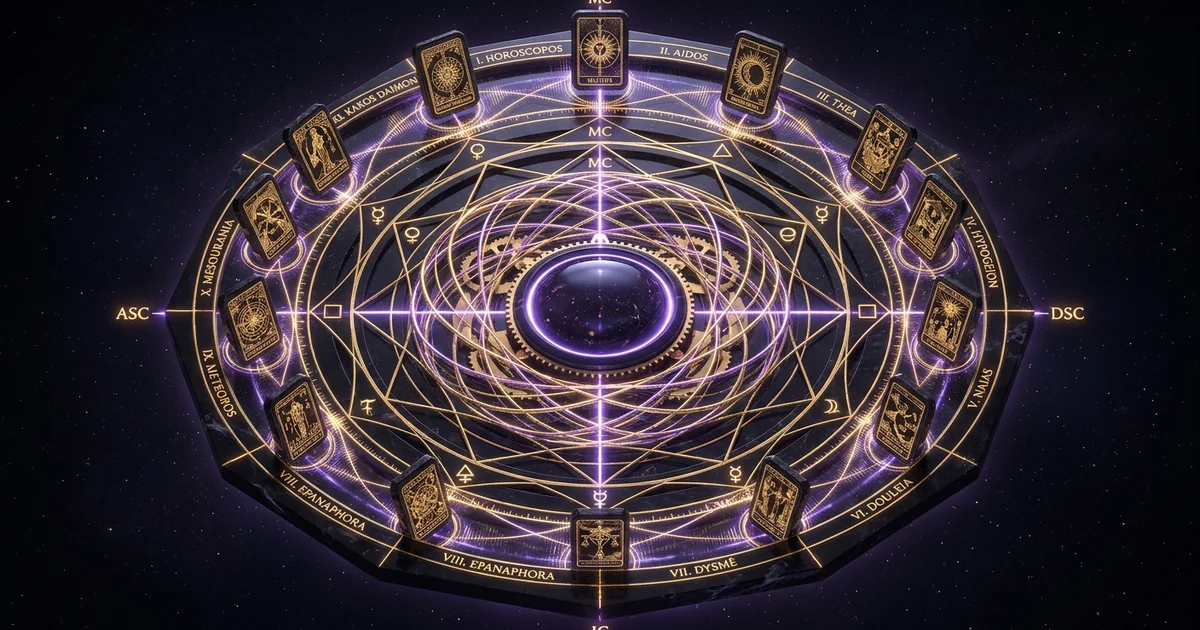
The Astrological Twelve Houses Spread: Mandala Divination
Archetypal Thesis & Systemic Paradigm: The Twelve-Fold Mandala as Psycho-Cosmic Cartography
The Dodekatropos as a State-Space Coordinate Grid
The astrological twelve houses tarot spread operates not as an arbitrary predictive cartomancy array, but as a cyclotomic mandala projecting the celestial coordinate framework onto the topological state-space of the human psyche. In classical astrology, the dodekatropos—the twelve-fold turning of the sky—established an unbroken circuit of mundane existence. When mapped onto the cartomantic tableau, this structure ceases to be a simplistic fatalistic engine. Instead, it becomes a closed-loop, self-regulating cybernetic feedback system. Each house functions as an operational sector, partitioning the undifferentiated field of consciousness into twelve discrete phenomenological domains.
Within this state-space representation, the human subject is neither an isolated observer nor a passive victim of external transit forces. The seventy-eight symbolic vectors of the tarot deck, when distributed across the twelve mundane sectors, quantify the distribution of psychic libido across distinct behavioral spheres. The spread formalizes human experience into an integrated manifold: from the primal somatic emergence of the first house to the psychic dissolution and unconscious consolidation of the twelfth. This architectural division prevents the fragmentation of interpretive meaning, bounding cartomantic divination within an epistemological coordinate grid that mirrors the natural geometry of space-time.
                  MC [House 10: Praxis/Individuation]
                                  ^
                                  |
[House 12: Crypt]                 |                 [House 8: Crisis]
        \                         |                         /
         v                        |                        v
ASC [House 1: Ego] <--------------+--------------> DSC [House 7: Shadow/Other]
         ^                        |                        ^
        /                         |                         \
[House 4: Imum Coeli]             |                 [House 6: Labor]
                                  v
                  IC [House 4: Matrix/Ancestry]
By transmuting the continuous flux of psychic life into twelve localized parameters, the spread reveals the homeostatic mechanisms of the unconscious. Just as thermodynamic systems require boundary definitions to track entropy and work, archetypal psychology requires structural partitions to locate neurosis, fixations, and teleological vectors of growth. The astrological twelve houses tarot spread transforms qualitative psychological phenomena into an intelligible spatial matrix, converting the irrational operations of chance into a structured diagnostic apparatus.
Jungian Mandala Mechanics and Circumambulation of the Self
Arranging the symbolic archetypes of the tarot in a twelve-fold circumambulation mirrors Carl Gustav Jung’s structural analysis of the mandala archetype. The circular disposition of cards acts as a psychotronic boundary—a temenos or sacred enclosure—that shields the fragile ego-consciousness from the overwhelming, unintegrated forces of the collective unconscious. In Jungian analytical psychology, the mandala is an autonomous psychic phenomenon representing the totality of the Self. It operates through circumambulation: an iterative psychological looping around an invisible, central locus of meaning.
When a practitioner lays the cards in a counter-clockwise circle, the physical operation enacts an alchemical circumambulatio. Each sequential card does not replace the preceding one; rather, it qualifies, balances, and challenges it across the dialectical field of the central axis. This ritual geometry facilitates the process of individuation, as mapped across the broader Major Arcana individuation journey. The unconscious contents of the querent, which typically manifest as fragmented complexes, neurotic projections, or unacknowledged shadow material, are forcibly distributed across explicit archetypal positions.
The structural circumambulation prevents psychic inflation. A querent experiencing an unintegrated influx of creative or intellectual energy cannot remain trapped in the solipsism of the First House (the ego-complex). The geometry of the mandala demands an immediate confrontation with the Seventh House (the relational counterweight) and the Fourth House (the somatic, ancestral base). Through this spatialization, the tarot deck ceases to be a deck of cards and transforms into an externalized diagnostic engine of the Self.
“The mandala is an archetypal image whose occurrence is attested throughout the ages. It signifies the wholeness of the Self. This circular image represents the wholeness of the psychic ground or, to put it in mythic terms, the divinity incarnate in man… The number twelve, as the product of 3 × 4, signifies the interpenetration of the spiritual dynamic with the material quaternary, establishing a temporal and spatial completeness.” — Carl Gustav Jung, The Archetypes and the Collective Unconscious (Collected Works, Vol. 9, Part 1, Princeton University Press, 1959, p. 387).
“Number helps to introduce order into the chaos of appearances. It is the most primary of all archetypes, functioning as a predetermined cosmic ordering principle… Twelve represents the completed realization of time transformed into structural space.” — Marie-Louise von Franz, Number and Time: Reflections Leading toward a Unification of Depth Psychology and Physics (Northwestern University Press, 1974, p. 114).
Chronotopic Projection: Synchronicity across Mundane Spheres
The astrological mandala acts as a dynamic chronotope—a construct wherein spatial and temporal indicators are fused into one functional unity. Drawing upon classical conceptions of time, the twelve houses spread collapses linear, profane chronology (Chronos) into qualitative, kairotic time (Kairos). This shift relies upon the principle of synchronicity, defined by Jung and Wolfgang Pauli as an acausal connecting principle wherein internal psychic states and external objective events coincide through shared meaning.
Through the mechanical shuffling, cutting, and circumferential layout of the cards, the macrocosmic celestial clockwork is rendered isomorphic with the querent’s psychic disposition. The spread does not claim that distant celestial bodies exert mechanical, gravitational, or electromagnetic forces upon paper cards. Instead, it asserts that the moment of cartomantic inquiry contains an innate structural signature. The twelve houses project this single temporal cross-section across twelve operational arenas.
Each sector of the spread captures the qualitative nature of time as it intersects with specific spheres of action: vocational execution, relational bonding, somatic regulation, and metaphysical crisis. Consequently, the astrological twelve houses tarot spread serves as an empirical instrument for mapping synchronistic resonance, extracting the querent from passive linear causality and placing them inside a participatory, self-reflective universe.
Classical Provenance & Textual Lineage: From Hellenistic Topoi to Hermetic Cartomancy
Genesis of the Topoi in Ptolemy and Valens
The architectural foundation of the twelve houses spread originates in classical Hellenistic astrology, specifically the doctrine of the twelve topoi (places). Unlike the later conflation that artificially merged the twelve signs of the zodiac with the twelve houses, the early Hellenistic lineage preserved a critical distinction between the zoidia (the celestial archetypes of the constellations) and the topoi (the mundane houses determined by the diurnal rotation of the Earth). Claudius Ptolemy, writing in his second-century CE treatise Tetrabiblos, established the astronomical and functional parameters of these places, tying their significance to their angular relationship with the horizon and the meridian.
                    Hellenistic Topoi (Ptolemy / Valens)
                                     │
                     Diurnal Sky Mechanics (Cardines)
                                     ▼
                   Hermetic Order of the Golden Dawn
                     (Book T: Decanic & Sign Math)
                                     │
                    Tabula Smaragdina Correspondence
                                     ▼
                   Modern Transpersonal Zodiac Spread
                  (Rudhyar: Cyclic Psychological Space)
Simultaneously, Vettius Valens, in his Anthologiae, detailed the empirical deployment of these topoi, designating their functional boundaries with uncompromising rigor. The first topos (Horoskopos or Ascendant) was understood as the seat of the psyche and the physical constitution; the second topos (Bios) governed livelihood and material intake; moving counter-clockwise through to the twelfth topos (Kakodaimon or Evil Spirit), which mapped confinement, psychic isolation, and hidden subversions. The Hellenistic schema did not treat the topoi as mere abstract categories; they represented the dynamic intersection between the sphere of the local observer and the celestial dome.
“The Ascendant is the beginning of the whole nativitas; it is the rudder, the place of the breath and of life… From it, the remaining eleven places divide the affairs of human fortune by their geometrical configurations to the four cardines.” — Claudius Ptolemy, Tetrabiblos, Book III, §10 (c. 150 CE, trans. F.E. Robbins, Harvard University Press, 1940).
“The Twelve Houses of the Horoscope are the twelve mansions of the Celestial Vault, wherein all forces operate. The Tarot keys, being attributed unto the Signs, the Planets, and the Elements, must naturally be ordered within these twelve places to unveil the complete operation of the macrocosm within the microcosm of the inquirer.” — S.L. MacGregor Mathers & Moina Mathers, Book T: The Tarot, Private Ritual Documents of the Hermetic Order of the Golden Dawn (1888).
The Golden Dawn Synthesis: Book T and Astrological Tarot Attribution
The systematic fusion of the Hellenistic dodecatope with the seventy-eight keys of the tarot was finalized in the late nineteenth century by the Hermetic Order of the Golden Dawn. In their foundational document, Book T (The Tarot), Samuel Liddell MacGregor Mathers and Moina Mathers codified a comprehensive symbolic syntax. They mapped the twenty-two Major Arcana to the three Elements, seven Planets, and twelve Signs of the Hebrew zodiacal alphabet, while mapping the thirty-six Minor Arcana number cards (numbered 2 through 10) to the classical astrological decans.
[Kether: Primal Will]
         │
    (Aleph / The Fool)
         │
[Chokmah] ─── (Heh / The Emperor / Aries: House 1) ───> [Tiphareth: Ego Integration]
         │
   (Vau / The Hierophant / Taurus: House 2)
         │
[Binah]   ─── (Zayin / The Lovers / Gemini: House 3) ───> [Yesod: Foundation/Unconscious]
This theoretical innovation radically enhanced cartomantic layout mechanics. The Golden Dawn established that every card possessed an inherent astrological identity based on the Hermetic Tree of Life tarot correspondences. When applied to an astrological layout, this created a multi-layered interpretive system.
A card placed in a house was no longer read in isolation; it had to be interpreted through the lens of elemental dignities and structural tensions between its native astrological ruler and the house it occupied. If the Two of Swords (attributed to the first decan of Libra, governed by the Moon) appeared in the Eighth House (the place of crisis and shared resources), the interpreter synthesized the cold, defensive mental stasis of the card with the Plutonian, transformative imperatives of the mundane sector.
Twentieth-Century Transmutation into the Zodiac Tarot Spread
In the twentieth century, humanistic and transpersonal astrologers such as Dane Rudhyar redefined the twelve houses. In The Astrological Houses: The Spectrum of Individual Experience (1972), Rudhyar stripped the mundane houses of their fatalistic, medieval baggage, recasting them as a cyclically unfolding process of psychological integration. He argued that the houses represent the twelve phases of individual experience through which an undifferentiated ego becomes a conscious, fully integrated person.
This intellectual pivot profoundly shaped esoteric cartomancy, giving rise to the modern zodiac tarot spread. Diviners abandoned the pursuit of crude event-predicting formulas (“an unexpected inheritance” or “a death by water”) in favor of structural psycho-cosmic diagnostic assessments. The spread emerged as an existential blueprint, mapping the querent’s current stage within the recurring drama of self-actualization.
Structural Mechanics & Symbolic Geometry: Layout Architecture and Axis Symmetries
The Cardinal Angles: Ascendant, IC, Descendant, and Midheaven
The structural spine of the twelve houses spread rests upon the cross of matter: the four cardinal angles (cardines). These angles anchor the circular layout, establishing four distinct quadrants of psychological and physical reality:
- The Ascendant (First House): The eastern horizon, representing the emergence of the conscious ego-complex, the somatic container, and the persona.
- The Imum Coeli (Fourth House): The subterranean depth, representing the unconscious foundation, ancestral karma, the anima mundi within the domestic sphere, and the roots of the subjective psyche.
- The Descendant (Seventh House): The western horizon, representing the relational field, the confrontation with the Shadow, and the externalized Other through whom self-knowledge is mediated.
- The Medium Coeli (Tenth House): The zenith, representing public praxis, vocational actualization, the teleological vector of individuation, and the integration of the ego into the socio-historical matrix.
These four cardines divide the mandala into an architecture of four quadrants: Subjective/Instinctual (Houses 1–3), Subjective/Expressive (Houses 4–6), Objective/Relational (Houses 7–9), and Objective/Transpersonal (Houses 10–12). The cardinal angles serve as energetic pillars; an affliction or concentration of Major Arcana at these four stations dictates the structural integrity of the querent’s total psychic economy.
       QUADRANT IV                      QUADRANT III
Transpersonal / Universal         Relational / Philosophical
   (Houses 10, 11, 12)                 (Houses 7, 8, 9)
                   \                 /
                    \   MIDHEAVEN   /
                     \   (MC: 10)  /
                      \     |     /
                       \    |    /
   ASCENDANT (1) <──────┼───o───┼──────> DESCENDANT (7)
                       /    |    \
                      /     |     \
                     /   (IC: 4)   \
                    /  IMUM COELI   \
                   /                 \
        QUADRANT I                      QUADRANT II
   Instinctual / Somatic            Emotional / Expressive
      (Houses 1, 2, 3)                 (Houses 4, 5, 6)
Polar Tension and Integration: The Six Diametrical House Axes
A rigorous reading of the astrological twelve houses spread avoids interpreting cards in linear, isolated succession. Instead, the operational mechanics demand the application of dialectical polarity: every house exists in a state of structural dynamic tension with its diametrical opposite (180 degrees away). This polarity models the psychological reality that no psychic complex exists without an opposing compensation in the unconscious.
- The Axis of Identity (House 1 vs. House 7): Contrasts the immediate instinctual assertion of the self (Aries/Mars archetype) against the negotiated reality of relational partnerships (Libra/Venus archetype). The cards in these positions illustrate the tension between personal autonomy and relational codependence.
- The Axis of Substance (House 2 vs. House 8): Contrasts self-generated, somatic, and material resources (Taurus/Venus) against shared, inherited, or crisis-driven systemic transformations (Scorpio/Pluto). It diagnoses the querent’s attachments versus their capacity for psychological surrender and cathartic purging.
- The Axis of Cognition (House 3 vs. House 9): Contrasts local, empirical, and transactional mental mechanics (Gemini/Mercury) against macrocosmic, mythic, and philosophical paradigms (Sagittarius/Jupiter). It reveals discrepancies between concrete operational logic and abstract teleological purpose.
- The Axis of Individuation (House 4 vs. House 10): Contrasts the inward, private, ancestral roots of the psyche (Cancer/Moon) against the outward, public, vocational manifestation of the Self (Capricorn/Saturn). It marks the tension between psychic regression into the matrix of origin and conscious progression toward social and spiritual authority.
- The Axis of Creativity (House 5 vs. House 11): Contrasts autopoietic, personal creative output and somatic joy (Leo/Sun) against collective ideological movements, collaborative networks, and trans-individual teleologies (Aquarius/Uranus).
- The Axis of Transcendence (House 6 vs. House 12): Contrasts the analytical, ritualistic, somatic disciplines of day-to-day existence (Virgo/Mercury) against psychic dissolution, oceanic surrender, and the confrontation with the collective unconscious (Pisces/Neptune).
Triplicities, Quadruplicities, and the Thirteenth Center Significator
Beyond the binary axes, the mandala is governed by the classical geometric relations of the triplicities (Elements) and quadruplicities (Modalities). The practitioner must synthesize these cross-aspectual chords:
- The Fire Triplicity (Houses 1, 5, 9): The vector of identity, spiritual aspiration, and energetic expansion.
- The Earth Triplicity (Houses 2, 6, 10): The vector of physical stabilization, somatic labor, and material manifestation.
- The Air Triplicity (Houses 3, 7, 11): The vector of communicative networks, rational dialectics, and social structuralization.
- The Water Triplicity (Houses 4, 8, 12): The psychic crypt, governing instinctual depths, transformative trauma, and transpersonal dissolution.
To synthesize these dynamic tensions, the advanced operator introduces a thirteenth card into the absolute geometrical center of the spread. This thirteenth card functions as the syntropic attractor—the central anchor. It is the unmoving pivot around which the twelve mundane spheres rotate.
In Jungian terminology, while the outer twelve houses represent the ego’s distribution across differentiated fields of life, the central card represents the transcendent function of the Self. It operates as the meta-significator, providing the teleological lens through which the twelve disparate cards must be integrated.
Psychological Dynamics & Operational Praxis: The Yearly Forecast and Diagnostic Reading Protocol
Temporal Deployment: Casting the Yearly Forecast Spread
When deployed as an annual or developmental diagnostic tool, the twelve houses spread provides a rigorous synchronistic calendar. In praxis, this spread is cast during moments of boundary transition: specifically the solar return (the precise moment the Sun returns to its natal coordinate) or the Vernal Equinox.
The operator employs one of two distinct methodologies for temporal assignment:
- The Zodiacal Transit Method: The twelve houses correspond to the twelve consecutive calendar intervals of the year, beginning with the house governed by the transit of the sun at the time of the casting. The cards illustrate the prevailing psychic atmosphere and systemic crises that unfold across consecutive thirty-day cycles.
- The Topological Domain Method: Time is abandoned as a linear sequence; instead, the houses represent twelve structural layers of the querent’s current life cycle. An event in the career realm (House 10) may occur simultaneously with a rupture in the unconscious matrix (House 4), but the spread renders their functional interdependence visible across space rather than across a timeline.
The operational casting requires a meditative protocol. The querent shuffles the deck while focusing their psychic energy on the systemic equilibrium of their life. The cards are drawn and laid counter-clockwise, beginning at the Ascendant and culminating in the Twelfth House, before placing the thirteenth card in the center.
Cross-Aspectual Decipherment: Squares, Trines, and Elemental Dignities
The analytical phase requires geometric rigor. The reader assesses the elemental affinities and geometric aspect patterns established between the positions, mirroring Hellenistic aspect theory:
[Trine Aspect: 120°]
House 1 (Fire) <────────────────────────────────────────> House 5 (Fire)
         \                                              /
          \                                            /
           \                                          /
            \                                        /
             ───────────> House 9 (Fire) <───────────
                      Consonant Libido Flow

[Square Aspect: 90°]
House 1 (Cardinal) <────────────────────────────────────> House 4 (Cardinal)
                       Psychic Friction / Crisis
- Trines (120-degree separations): Occur between houses of the same element (e.g., House 1, House 5, House 9). When cards of harmonious suit/element fall into these houses (such as the Wands in fire houses), libido flows smoothly through creative and aspirational channels. However, if conflicting cards (such as heavy Swords or Pentacles) occupy this triplicity, it reveals an internal resistance to spontaneous self-expression.
- Squares (90-degree separations): Occur between houses of the same modality (Cardinal: 1, 4, 7, 10; Fixed: 2, 5, 8, 11; Mutable: 3, 6, 9, 12). Cards in square relationship reveal deep structural friction, internal cognitive dissonance, and urgent operational blockages. A square between the Tenth House (career) and the First House (ego) denotes a critical conflict between external socio-cultural expectations and authentic personal identity.
- Elemental Dignities: Synthesizing the cards based on Golden Dawn dignities. A card belonging to the Water element (Cups) situated in a Fire house (e.g., the Fifth House) experiences elemental weakening. The emotional content is evaporated or agitated by the creative, combustive demands of the house, indicating neurotic friction, somatic exhaustion, or artistic frustration.
Predictive Fatalism
- Epistemology: Linear, deterministic, Newtonian causality.
- Interpretation of House 8: Literal death, financial ruin, or sudden unavoidable catastrophe.
- Agency of Querent: Passive recipient of pre-ordained external fates.
- Function of Divination: Predicting concrete historical occurrences to evade pain or grasp gain.
- View of the Archetype: Static, externalized omen.
Cybernetic Archetypal Praxis
- Epistemology: Non-linear, synchronistic, systemic state-space dynamics.
- Interpretation of House 8: Psychological shadow confrontation, ego-death, catharsis, and reallocation of shared libido.
- Agency of Querent: Conscious participant in an ongoing feedback loop of self-regulation.
- Function of Divination: Diagnosing psychic imbalances to facilitate intentional individuation.
- View of the Archetype: Dynamic internal/external field of self-organizing psychic energy.
Remediation Mechanics: Active Imagination and Archetypal Realignment
The diagnostic protocol is incomplete without archetypal remediation. When the spread uncovers severe structural distortions—such as a concentration of disruptive Major Arcana (e.g., Key XVI, The Tower, or Key XV, The Devil) in sensitive sectors like the Sixth House (somatic distress) or the Twelfth House (unconscious self-sabotage)—the querent must not adopt a passive, fatalistic stance.
The modern practitioner employs Jungian active imagination as an alchemical countermeasure. The card occupying the afflicted house is removed from the spread and placed on an altar or working surface. The querent enters a state of light trance, projecting their consciousness directly into the visual and symbolic frame of the card.
Through focused dialogue with the card’s personified archetypes, the querent brings unconscious conflicts into conscious awareness. By negotiating with the internal psychic complex represented by the card, the toxic energy within that mundane sector is neutralized, transmuting neurotic distress into fuel for individuation.
Philosophical Synthesis & Macrocosmic Correspondence: Hermetic Axioms and Systemic Evolution
The Hermetic Axiom ‘As Above, So Below’ in Spatialized Divination
The theoretical validity of the astrological twelve houses spread rests upon the classical axiom inscribed in the Tabula Smaragdina: “That which is below is like that which is above, and that which is above is like that which is below, to accomplish the miracles of the One Thing.” In this context, the spread is not a metaphorical recreation of the sky; it is an isomorphic representation of the cosmos.
       MACROCOSM (The Celestial Dome / Zodiacal Wheel)
                             │
                      As Above, So Below
                    (Structural Isomorphism)
                             ▼
        MICROCOSM (The Cartomantic Circular Mandala)
                             │
                      Exterior Realities
                             ▼
         PSYCHE (Inner State-Space of Consciousness)
The circular table functions as an operational altar where the macrocosm (the celestial dome) and the microcosm (the individual psyche) converge. The spread externalizes the querent’s implicit, unconscious reality into explicit spatial coordinates. The cards do not “cause” psychological states, nor do celestial configurations “cause” the distribution of paper keys. Instead, both are manifestations of an underlying, singular energetic matrix—what the Hermeticists termed the Anima Mundi and what modern depth psychologists designate as the psychoid level of reality.
The Dodecanary Cycle as an Iterative Cybernetic Loop
The twelve-house mandala is fundamentally an Ouroboros—an iterative cybernetic loop that resists linear endings. The movement from the Twelfth House back to the First House represents the critical boundary transition of human development.
[House 12: Nigredo / Dissolution]
                │
         (Alchemical Death)
                │
                ▼
[The Threshold / Ouroboric Loop]
                │
        (Alchemical Rebirth)
                │
                ▼
[House 1: Albedo / Ego Genesis]
The Twelfth House acts as the alchemical nigredo—the space of psychic decay, unconscious gestation, and institutional isolation. It is the necessary dissolution of the old psychic structure, without which the First House could never experience its albedo, the genesis of a renewed ego-consciousness. The twelve houses do not culminate in a static terminal state; the Twelfth House feeds directly back into the First.
This cyclotomic return reflects the feedback loops of modern systems theory. The outputs of the system (the lessons, karmic debts, and integrations of houses one through twelve) become the modified inputs for the subsequent turn of the wheel. The individual ascends or descends an evolutionary spiral, revisiting the twelve basic archetypal arenas at higher or lower levels of systemic integration.
Bridging the Twelve Houses with Qabalistic Sephiroth and Paths
In Western Hermetic Qabalah, the twelve houses connect with the emanations of the Tree of Life. While the ten Sephiroth represent structural levels of divine and psychic manifestation, the twenty-two Paths connecting them correspond to the letters of the Hebrew alphabet, which encompass the twelve astrological signs.
                 KETHER (The Center / Card 13)
                         /           \
                        /             \
             Path of Heh               Path of Zayin
            (Aries / H1)               (Gemini / H3)
                      /                 \
                     v                   v
                 CHOKMAH ──────────────> BINAH
                         \             /
                          \           /
                       Path of Cheth (Cancer / H4)
                                  │
                                  v
                              TIPHARETH
                                  │
                       Path of Nun (Scorpio / H8)
                                  │
                                  v
                                YESOD
                                  │
                     Path of Qoph (Pisces / H12)
                                  │
                                  v
                               MALKUTH
By mapping the houses to the Tree of Life, the spread gains ontological depth. The mundane affairs of the house are linked back to their root emanations in the divine architecture:
- House 1 (Ascendant): Aries | Card: The Emperor (Path 15: Heh) | Chokmah to Tiphareth | Psychological Function: Somatic ego-assertion, individuation onset.
- House 2: Taurus | Card: The Hierophant (Path 16: Vau) | Chokmah to Chesed | Psychological Function: Value identification, grounding of psychic resources.
- House 3: Gemini | Card: The Lovers (Path 17: Zayin) | Binah to Tiphareth | Psychological Function: Linear cognition, local communicative exchange.
- House 4 (IC): Cancer | Card: The Chariot (Path 18: Cheth) | Binah to Geburah | Psychological Function: Unconscious matrix, ancestral foundation, emotional baseline.
- House 5: Leo | Card: Strength (Path 19: Teth) | Chesed to Geburah | Psychological Function: Spontaneous autopoiesis, creative ego-projection.
- House 6: Virgo | Card: The Hermit (Path 20: Yod) | Chesed to Tiphareth | Psychological Function: Somatic discipline, analytical refinement, instinctual labor.
- House 7 (DSC): Libra | Card: Justice (Path 22: Lamed) | Geburah to Tiphareth | Psychological Function: Shadow projection, relational dialectics, integration of the Other.
- House 8: Scorpio | Card: Death (Path 24: Nun) | Tiphareth to Netzach | Psychological Function: Ego-death, cathartic transformation, reallocation of shared libido.
- House 9: Sagittarius | Card: Temperance (Path 25: Samekh) | Tiphareth to Yesod | Psychological Function: Mythic consciousness, teleological expansion, systemic synthesis.
- House 10 (MC): Capricorn | Card: The Devil (Path 26: Ayin) | Tiphareth to Hod | Psychological Function: Societal individuation, public praxis, structural authority.
- House 11: Aquarius | Card: The Star (Path 28: Tzaddi) | Netzach to Yesod | Psychological Function: Transpersonal community, ideological networks, emergent futures.
- House 12: Pisces | Card: The Moon (Path 29: Qoph) | Netzach to Malkuth | Psychological Function: Ego-dissolution, confrontation with the collective unconscious, alchemical nigredo.
Frequently Asked Questions: Technical Nuances of the Twelve Houses Spread
Resolving Discrepancies Between Card Zodiac Attributions and House Placements
A common technical crisis in reading the astrological twelve houses spread occurs when a card’s inherent astrological attribution directly contradicts the mundane house it occupies. For example, if Major Arcana IV (The Emperor, attributed to Aries) is dealt into the Seventh House (the natural domain of Libra and Venus).
This contradiction is resolved through the concept of archetypal counter-point. Rather than viewing the card as nullified or the house as erased, the tension itself becomes the primary diagnostic clue. The Emperor in the Seventh House reveals that the querent is deploying rigid, unilateral, Aries-style dominance within their relational sphere (a Libra domain). The querent demands total control where diplomatic reciprocity is required, creating severe relational friction.
The essential nature of the card represents how the psychic energy manifests, while the house denotes where that energy is forced to operate. When a card matches its natural house (e.g., The Moon in the Twelfth House), the archetype operates with unobstructed systemic ease; when mismatched, it signals acute psychological compensation or defensive projection.
Optimal Deployment: Solar Return vs. Gregorian New Year Forecasts
The systemic coherence of the astrological twelve houses spread is directly linked to the temporal boundary conditions chosen for its casting. Many modern practitioners casually cast the layout on the first of January (the Gregorian civil New Year). However, this calendar date is an arbitrary administrative boundary devoid of astronomical or psychodynamic significance.
The spread achieves its highest fidelity when aligned with true astronomical and personal cosmic milestones:
- The Solar Return: The exact degree, minute, and second at which the transit Sun aligns with the querent’s natal Sun. This marks the energetic reboot of the subjective identity, making it the premier threshold for an annual forecast.
- The Vernal Equinox: The entry of the Sun into zero degrees of Aries (the astronomical New Year). This marks the global cyclic resurgence of solar libido across the Northern Hemisphere, making it ideal for institutional, mundane, or trans-individual readings.
Deploying the spread along these celestial thresholds aligns the querent’s unconscious with real astronomical shifts, moving the cartomantic act from civil sentimentality into a resonant psycho-cosmic ritual.
Methodology for Integrating Major Arcana Concentration vs. Minor Arcana Diffusion
An essential diagnostic metric within the twelve houses spread is the spatial distribution of the tarot’s primary orders: the Major Arcana, the Minor Arcana, and the Court Cards. The operator must step back from individual card interpretations to evaluate the density of these groupings across the four quadrants.
A high concentration of Major Arcana across specific houses indicates areas of unavoidable systemic restructuring and deep unconscious transformation. If Houses Four, Eight, and Twelve (the Water Triplicity) are dominated by Major Arcana keys, the querent is undergoing a profound karmic and psychological purging. In these sectors, conscious ego-control is minimal; transpersonal forces dominate the landscape, demanding surrender and deep internal adjustment.
Conversely, an influx of Minor Arcana signals localized, transactional matters that remain within the querent’s conscious control. Pentacles in the Second or Tenth House demonstrate that professional and economic issues are mechanical rather than structural, requiring practical labor rather than existential transformation.
Court Cards indicate that specific people are serving as projection screens for the querent’s internal archetypal complexes. A Queen or King occupying the Seventh House highlights a dynamic where the querent has projected their own inner authority onto a partner, creating an imbalanced psychological relationship that must be retrieved through conscious dialogue.
       CONCENTRATION PROFILE OF THE TWELVE HOUSES SPREAD

Major Arcana Dominance         Minor Arcana Dominance          Court Card Clustering
  (Houses of Crisis)            (Operational Spheres)         (Relational Projection)
          │                               │                              │
          ▼                               ▼                              ▼
Structural Karmic Shifts         Tactical Daily Adjustments     Complex Projections onto
 Archetypal Individuation          Volitional Ego-Agency         External Social Actors
Through this multi-tiered interpretive hierarchy—moving from universal quadrant dynamics to specific card tensions, and synthesizing classical Hellenistic house logic with modern depth psychology—the astrological twelve houses spread proves itself as one of the most sophisticated, self-regulating diagnostic mandalas in the Western esoteric tradition.