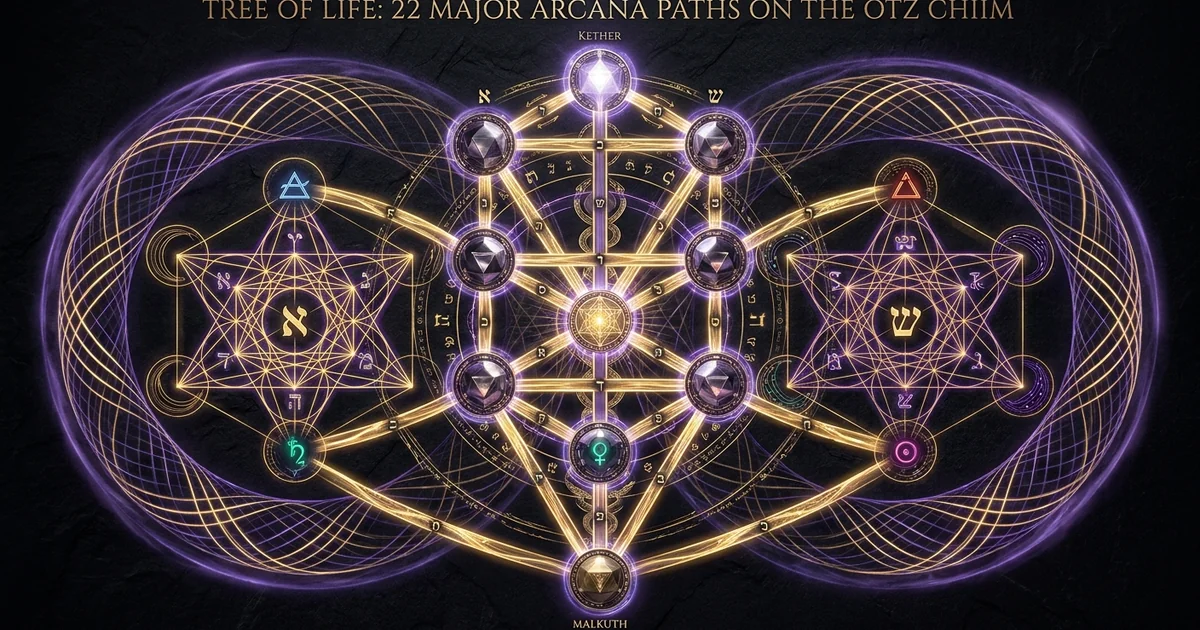
Tree of Life: 22 Major Arcana Paths on the Otz Chiim
Archetypal Thesis & Systemic Paradigm: The Otz Chiim as a Coordinate Architecture of Psyche
The integration of the twenty-two Major Arcana trumps onto the thirty-two paths of wisdom of the Otz Chiim (Tree of Life) represents one of the most sophisticated syntheses in Western esotericism. Rather than functioning as a mere instrument of divinatory fatalism, this cartographic synthesis operationalizes the Otz Chiim as a psycho-cosmological coordinate framework. The glyph itself constitutes a topological manifold: ten objective stations of being—the Sephiroth—interconnected by twenty-two subjective channels of transition. When the Major Arcana are mapped across these connective axes, the static emanational hierarchy described in classical Kabbalah transforms into a dynamic, cybernetic circuit of human consciousness, outlining the bidirectional movement of psychological involution and spiritual evolution.
[ 1: Kether ]
                       /   |   \
                     11   12    13
                     /     |     \
          [ 2: Chokmah ]--14--[ 3: Binah ]
             |   \   \     /   /   |
            15    16  \   /  17   18
             |     \   \ /   /     |
             |      [ 6: Tiphareth ]
             |     /   / \   \     |
            19   20   /   \   21  22
             |   /   /     \   \   |
          [ 4: Chesed ]---23---[ 5: Geburah ]
                 \     |     /
                  24   25   26
                   \   |   /
                 [ 7: Netzach ]
                   /   |   \
                  27   28   29
                 /     |     \
            [ 8: Hod ]--30--[ 9: Yesod ]
                 \     |     /
                  31   32   /
                   \   |   /
                   [ 10: Malkuth ]
Topological Vector Spaces: The Sephiroth as Basins of Attraction and Paths as Phase Transitions
In dynamic systems theory, a basin of attraction designates a state-space region toward which a system trajectories over time. Within the operational cartography of the Tree of Life, each Sephira represents an ontological basin of attraction—a discrete, stabilized hypostasis of psychic energy ranging from the somatic density of Malkuth to the undifferentiated singularity of Kether. Conversely, the twenty-two paths connecting these spheres do not operate as static structural bridges; they are dynamic vector transformations describing thermodynamic phase transitions between adjacent psychological states.
A transition across a path requires overcoming energetic thresholds, analogous to the activation energy required in chemical kinetics. For example, moving from the consolidated ego-consciousness of Tiphareth across Path 13 (ascribed to Gimel and The High Priestess) toward the transpersonal apex of Kether requires an absolute suspension of discursive logic. The trump associated with each path identifies the phenomenological qualitative dynamic of that transition, providing the operator with a symbolic blueprint of the specific psychological stresses, cognitive reorientations, and affective reorganizations required to shift equilibrium from one Sephirothic attractor to another.
The Trinary Classification: Mothers, Doubles, and Simples as Primary Energy Modulations
The mathematical and linguistic scaffolding of the paths derives directly from the Sepher Yetzirah, which categorizes the twenty-two letters of the Hebrew alphabet into three structural tiers: the three Mother letters (Aleph, Mem, Shin), the seven Double letters (Beth, Gimel, Daleth, Kaph, Peh, Resh, Tav), and the twelve Simple letters (Heh, Vav, Zayin, Cheth, Teth, Yod, Lamed, Nun, Samekh, Ayin, Tzaddi, Qoph). Within the macrocosmic architecture, these linguistic categories establish the foundational modes of cosmological differentiation; within the microcosmic psyche, they define distinct classes of psychological vector operations.
The three Mother letters represent the elemental equilibrium axes that traverse the Tree horizontally, regulating the foundational polarities of Air (intellect/mediator), Water (unconscious/dissolution), and Fire (volition/transmutation). The seven Double letters, possessing dual phonemic pronunciations that reflect fundamental cosmic polarities (life/death, peace/war, wisdom/folly), govern the planetary paths that intersect the vertical spine and lateral axes, embodying cyclical operational archetypes. The twelve Simple letters correspond directly to the zodiacal constellations, governing the diagonal channels that establish the developmental structural scaffolding of personality, instinct, and temporal individuation.
The structural reduction of the 32 Paths of Wisdom demonstrates absolute systemic symmetry:
- Paths 1 through 10: The Objective Emanations (The Sephirothic Monads), establishing the ontological spectrum from infinite potential (Ain Soph) to dense physical manifestation (Malkuth).
- Paths 11 through 32: The Subjective Transitions (The 22 Major Arcana Trumps), functioning as the operative vectors of consciousness:
- 3 Mother Letters (Paths 11, 23, 31): Elemental forces (Air, Water, Fire) establishing horizontal equilibrium.
- 7 Double Letters (Paths 12, 13, 14, 21, 27, 30, 32): Planetary forces mediating vertical consciousness and boundary shifts.
- 12 Simple Letters (Paths 15, 16, 17, 18, 19, 20, 22, 24, 25, 26, 28, 29): Zodiacal forces structuring the diagonal channels of behavioral differentiation.
Hermetic-Kabbalistic Syntropy: Moving Beyond Divinatory Fatalism into Psycho-Spiritual Cartography
The integration of the Major Arcana archetypes into the Hermetic Qabalah represents a radical departure from common cartomancy. Where popular fortune-telling views the cards as static indicators of external fate, the Qabalistic framework treats them as an interiorized cybernetic network. This syntropic paradigm views the human psyche not as a passive recipient of cosmic forces, but as an active participant capable of intentional self-reorganization.
By traversing the paths through structured meditation and pathworking, the practitioner engages in a systematic re-engineering of the psychic economy. The Tree functions as an early topological neural network: the Sephiroth operate as processing nodes, while the 22 Major Arcana paths delineate the synaptic weights, polarities, and directional currents of libido (psychic energy). Integrating the trumps within this geometry shifts the system from predictive fatalism to a psycho-spiritual cartography, wherein the practitioner deliberately directs the circulation of consciousness to achieve psychodynamic integration and ego-transcendence.
Classical Provenance & Textual Lineage: From Sepher Yetzirah to the Golden Dawn Synthesis
The historical synthesis of the Tarot with the Otz Chiim is not an unbroken ancient tradition, but the product of deliberate textual and philosophical evolution across two millennia. Classical Jewish Kabbalistic literature—from the early linguistic mysticism of the Sepher Yetzirah to the monumental theosophy of the Sefer Ha-Bahir and the Zohar—contained no references to Tarot iconography, which originated in the courtly playing cards of fifteenth-century Northern Italy. The systematic convergence of these separate lineages was engineered primarily in nineteenth-century France and Britain by Hermetic scholars seeking a unified, universal symbolic calculus.
The Proto-Kabbalistic Matrix: Sepher Yetzirah’s Twenty-Two Letters and Their Cosmic Domains
The core textual foundation of the path system resides in the Sepher Yetzirah (The Book of Formation), composed between the second and sixth centuries CE. This proto-Kabbalistic treatise posits that the cosmos was generated through thirty-two mystical paths of wisdom (Netivot Peliyot Chokmah), defined explicitly as the ten Sephiroth belimah (ineffable numbers) and the twenty-two letters of the Hebrew alphabet (Otiyot Yesod). The text systematically coordinates each letter with three primary cosmological domains: the Universe (Olam, macrocosm/astronomy), Time (Shanah, temporal cycles/seasons), and Soul (Nefesh, the microcosm/human anatomy).
“Twenty-two Foundation Letters: He engraved them, carved them, weighed them, permuted them, and transformed them, and with them He depicted all that was formed and all that would be formed… Three Mothers: Aleph, Mem, Shin; their foundation is a pan of merit, a pan of liability, and the tongue of decree deciding between them… Seven Doubles: Beth, Gimel, Daleth, Kaph, Peh, Resh, Tav… Twelve Simples: Heh, Vav, Zayin, Cheth, Teth, Yod, Lamed, Nun, Samekh, Ayin, Tzaddi, Qoph.” — Sepher Yetzirah, Chapter 1, Mishnah 1; Chapter 2, Mishnah 1–2 (Kaplan translation, 1990)
“The 32 Paths of Wisdom are the 32 cables of intellectual energy whereby the 10 Sephiroth are connected together… each path is a form of spiritual consciousness, having its own distinctive title and operational mode within the macrocosm and microcosm.” — William Wynn Westcott, The Sepher Yetzirah: The Book of Formation (1887 Introduction)
The structural rigor of the Sepher Yetzirah provided nineteenth-century occultists with an established classification matrix. The twenty-two letters were already explicitly categorized into three elements, seven planets, and twelve zodiacal constellations. Consequently, Hermetic scholars did not need to invent an astrological taxonomy for the Major Arcana; they simply needed to establish a coherent method for mapping the twenty-two pictorial trumps onto the twenty-two linguistic-cosmological conduits of the Yetziratic world.
The 19th-Century Syncretic Rupture: Éliphas Lévi and the Re-alignment of Trumps to the Alphabet
The decisive syncretic rupture occurred with the publication of Éliphas Lévi’s Dogme et Rituel de la Haute Magie (1854–1856). Lévi asserted that the Tarot was the primordial, book of Enoch, preserved in plain sight as a card game. He established the first public, systematic correlation between the twenty-two trumps and the twenty-two Hebrew letters. Lévi recognized the structural parity between the twenty-two letters of the Hebrew alphabet and the twenty-two Major Arcana trumps, postulating that the Tarot formed the visual key to decrypting the dynamic operations of the Tree of Life.
However, Lévi’s model contained a major structural tension regarding the placement of Le Mat (The Fool). Observing that The Fool was unnumbered or marked with zero in traditional decks, Lévi placed it between Path 20 (Judgement/Shin) and Path 21 (The World/Tav), or alternately associated it directly with the penultimate letter Shin. In Lévi’s paradigm, The Magician (Le Bateleur) was assigned to the first letter, Aleph. While this maintained an intuitive link between the conscious masculine will and the initial letter of the alphabet, it introduced astrological and geometric asymmetries across the Tree, misaligning the elemental and planetary attributions codified in the Sepher Yetzirah.
The Golden Dawn Standard: Mathers, the Cipher Manuscripts, and the Attribution of The Fool to Aleph
The resolution of these structural contradictions occurred between 1887 and 1890 with the founding of the Hermetic Order of the Golden Dawn, orchestrated by Samuel Liddell MacGregor Mathers and William Wynn Westcott. Utilizing the coded foundational instructions of the Golden Dawn Cipher Manuscripts, Mathers formalized what is now recognized as the standard Western esoteric attribution model. The defining innovation was restoring The Fool—the zero-point of the psyche—to the first letter, Aleph.
By attributing The Fool (0) to Aleph and mapping it to the 11th Path (connecting Kether to Chokmah), the Golden Dawn realigned the entire Major Arcana sequence with the Sepher Yetzirah. The Magician shifted to Beth (Path 12, Mercury); The High Priestess to Gimel (Path 13, the Moon); and the rest of the sequence followed logically. This correction aligned the mathematical geometry of the Tree with the psychological reality of individuation: the journey does not begin with conscious, deliberate mastery (The Magician), but with the transcendent, unmanifest potential of the void (The Fool) descending through the initial lightning flash of creative ideation.
Structural Mechanics & Symbolic Geometry: The Mathematical Routing of the 22 Paths
The twenty-two paths are not distributed randomly across the ten Sephiroth. Instead, they form a precise geometric network governing the transmission of psychic and cosmic forces. Their placement creates the three vertical columns: the Pillar of Severity on the left (Form, Contraction, Intellect), the Pillar of Mercy on the right (Force, Expansion, Dynamic Libido), and the Middle Pillar in the center (Equilibrium, Consciousness, Integration). The paths themselves fall into three geometric orientations: horizontal, vertical, and diagonal.
PILLAR ARCHITECTURE
       Severity              Middle               Mercy
        (Form)            (Consciousness)        (Force)
   [Binah] -------------------------------- [Chokmah]
      |       \          |          /          |
      |        \         |         /           |
      |         \        |        /            |
      |          \       |       /             |
      |           [ Tiphareth ]                |
      |          /       |       \             |
      |         /        |        \            |
      |        /         |         \           |
      |       /          |          \          |
   [Geburah] ------------------------------ [Chesed]
      |                  |                     |
      |                  |                     |
    [Hod]  -------------------------------- [Netzach]
                         |
                      [Yesod]
                         |
                     [Malkuth]</code></pre>
Horizontal Paths: The Elemental Transits of Aleph, Mem, and Shin across the Pillars
The three horizontal paths function as the dynamic diaphragms of the Tree of Life. They link the opposing lateral pillars, maintaining systemic equilibrium across the bifurcated field of consciousness. These paths correspond exclusively to the three Mother letters of the Sepher Yetzirah, embodying the elemental forces that sustain cosmic and psychological homeostasis:
- Path 11 (Aleph – The Fool): Spanning horizontally between Kether and Chokmah (or in some layouts, linking Chokmah and Binah above the Abyss), this path embodies the Element of Air. It represents the supernal breath, mediating between pure being and primordial polarization. It operates as the transcendent balance point of pure ideation.
- Path 23 (Mem – The Hanged Man): Bridging Geburah (Severity/Judgment) and Chesed (Mercy/Lovingkindness), this path corresponds to the Element of Water. It represents the psychological principle of voluntary ego-suspension, surrender, and alchemical dissolution. It counters dogmatic structural calcification through emotional and unconscious baptism.
- Path 31 (Shin – Judgement): Linking Hod (Intellect/Form) and Netzach (Emotion/Desire) at the lower astral tier, this path is assigned to the Element of Fire. It manifests as systemic catharsis, radical awakening, and the purifying flash of insight that breaks lower psychological fixations.
Vertical and Pillar Alignments: The Planetary Doubles and the Spine of Consciousness
The vertical paths embody direct channels of energetic transmission within the Tree. The most significant vertical vector is the central axis of the Middle Pillar, which runs unmediated from physical manifestation to absolute transcendence. The vertical channels are largely governed by the planetary Double letters, which arbitrate dynamic dualities within the psyche:
Outside the central axis, vertical paths run along the lateral pillars. Path 12 (Beth – The Magician, Mercury) connects Kether to Binah, anchoring the downward transmission of divine insight into structural comprehension. Conversely, Path 18 (Cheth – The Chariot) and Path 26 (Ayin – The Devil) facilitate vertical currents along the Pillar of Severity, regulating boundary definitions, psychological containment, and the structural confrontation with instinctual fixations.
Diagonal Trajectories: The Zodiacal Simples and the Architecture of Form
The twelve diagonal paths connect the lateral and central Sephiroth. Corresponding to the twelve Simple letters and the signs of the zodiac, these paths structure the complex architecture of human personality, cognitive processing, and affective response. They establish cross-pillar dynamics, balancing masculine/expansive and feminine/restrictive energies across the astral and psychic planes:
- Paths 15 (Heh – The Emperor / Aries) and 16 (Vav – The Hierophant / Taurus): Connect Chokmah and Binah to Tiphareth and Chesed, translating archetypal authority, structured law, and traditional frameworks into the higher levels of human consciousness.
- Paths 17 (Zayin – The Lovers / Gemini) and 18 (Cheth – The Chariot / Cancer): Govern the psychological transitions between the supernal archetypes and the mental faculties of the soul, negotiating dualistic choice and the psychic vessel required to cross the threshold of the Abyss.
- Paths 24 (Nun – Death / Scorpio) and 28 (Tzaddi – The Star / Aquarius): Mediate the intense psychological shifts between the Solar Self (Tiphareth) and the instinctual, emotional centers (Netzach and Yesod), governing ego-dissolution and spiritual aspiration.
By mapping the zodiacal archetypes across these diagonal trajectories, the Hermetic system correlates planetary dignities in Kabbalah with the inner dynamics of human transformation.
Comparative Path Analysis: The Structural Divergences in Western Esoteric Systems
The attribution of the Major Arcana to the paths of the Otz Chiim is not entirely uniform across Western esoteric schools. The discrepancies between major lineages demonstrate that these attribution systems are not immutable dogmas, but coherent symbolic structures designed to emphasize different facets of psychological development and metaphysical dynamics.
       [ Classical French Model (Lévi / Papus) ]
         - Aleph (Path 11) = The Magician (I)
         - Shin  (Path 31) = The Fool (0 / XXI)
         - Initiatory Vector: Will & Intellect -> Receptive Void

                               vs.

       [ British Standard Model (Golden Dawn) ]
         - Aleph (Path 11) = The Fool (0)
         - Beth  (Path 12) = The Magician (I)
         - Initiatory Vector: Primordial Void -> Focused Will

                               vs.

       [ Thelemic Revision (Aleister Crowley) ]
         - Liber AL Transposition: "Tzaddi is not the Star"
         - Path 15 (Aries) = The Star (XVII)
         - Path 28 (Aquarius) = The Emperor (IV)
         - Initiatory Vector: Inversion of Astral Hope & Sovereignty
The French Paradigm (Lévi, Papus, Wirth) vs. The British Consensus (Mathers, Crowley, Waite)
The fundamental divide in esoteric path cartography separates the nineteenth-century French occult tradition from the late Victorian British consensus. As established by Éliphas Lévi and subsequently adopted by Gérard Encausse (Papus) and Oswald Wirth, the French paradigm insists on assigning the first Trump, The Magician, to the first letter, Aleph. In this lineage, The Fool is placed either at the end of the alphabet (assigned to Shin or Tav) or treated as an unnumbered interstitial card between Trump XX and Trump XXI.
This positioning fundamentally alters the initiatory sequence. In the French school, the Great Work begins with the activation of conscious, masculine, magical will (The Magician as Path 11). The initiate begins from a place of active mastery, while the terrifying, unconditioned potential of The Fool is encountered as an advanced developmental crisis near the completion of the path.
In contrast, the British Golden Dawn consensus places The Fool on Aleph (Path 11). In this system, the journey of individuation begins with the leap into the abyss—the complete surrender of egoic security to the unconditioned divine breath. Masterful conscious direction (The Magician / Beth / Path 12) is recognized as a consequence of that initial leap, rather than its instigator.
The Tzaddi-Aries Controversy: Crowley’s ‘The Book of Thoth’ Structural Transposition
The most significant structural disruption to the Golden Dawn consensus came from Aleister Crowley in The Book of Thoth (1944). Crowley based his modification on a passage from his 1904 received text, Liber AL vel Legis (The Book of the Law), which stated cryptically: “All these old letters of my Book are aright; but Tzaddi is not the Star.”
Crowley reasoned that if Tzaddi was not The Star, a structural imbalance existed in the traditional Golden Dawn zodiacal attributions. The Golden Dawn mapped The Star to Tzaddi (Aquarius / Path 28) and The Emperor to Heh (Aries / Path 15). Crowley argued that just as Leo (Strength/Lust) and Libra (Justice/Adjustment) were swapped in the Golden Dawn system to balance the astronomical path of the sun, an analogous loop was required between Aries and Aquarius.
Golden Dawn Standard System
- Path 11 (Aleph): The Fool (0) — Pure elemental Air; unmanifest source consciousness initiating the descent into manifestation.
- Path 15 (Heh): The Emperor (IV) — Zodiacal Aries; divine structural authority, patriarchal order, establishing form from Chokmah to Tiphareth.
- Path 28 (Tzaddi): The Star (XVII) — Zodiacal Aquarius; celestial hope, astral distillation, bridging Netzach to Yesod with intuitive illumination.
- Initiatory Dynamic: A sequential, continuous astrological progression reflecting classical Neoplatonic descent and ascent.
Thelemic Revision (Crowley)
- Path 11 (Aleph): The Fool (0) — The supreme spiritual silence of Harpocrates; the unconditioned void passing through Kether to Chokmah.
- Path 15 (Heh): The Star (XVII) — Zodiacal Aries shifted; the cosmic goddess Nuit pouring forth astral consciousness directly from the supernals.
- Path 28 (Tzaddi): The Emperor (IV) — Zodiacal Aquarius shifted; imperial authority anchored in the lower astral tiers to stabilize emotional libido.
- Initiatory Dynamic: A non-linear astrological loop designed to reflect the psychological and spiritual paradigm shift of the New Aeon.
Hermeneutic Consequences: How Shifting Trumps Reconfigures the Psychological Landscape
These structural revisions are not mere academic quibbles; they fundamentally reshape the operational psychology of the Tree of Life. When The Emperor is shifted to Path 28 (Netzach to Yesod) as Crowley proposed, authority is no longer an intellectual, father-derived principle descending from the higher cognitive faculties of Chokmah. Instead, it becomes an instinctual, somatic power that directly regulates and disciplines the raw lunar unconscious of Yesod.
Similarly, moving The Star to Path 15 (Chokmah to Tiphareth) relocates divine illumination and astral hope from an ambient lower-astral intuition to a direct supernal revelation streaming down the right pillar of consciousness. Each adjustment alters how an initiate navigates the interior landscape, illustrating that these attributions function as specific symbolic cognitive maps, calibrated to navigate different psychological territories.
Psychological Dynamics & Operational Praxis: The 22 Paths as an Initiatory Map of Individuation
When viewed through analytical psychology, the ascent of the twenty-two paths parallels the journey of individuation described by Carl Gustav Jung. The Sephiroth function as archetypal structures of the unconscious, while the paths represent the operative processes through which consciousness confronts, assimilates, and integrates this subterranean material. The cards serve as visual and symbolic anchors for the Fool’s journey of individuation, guiding the ego through the dismantling and reconstitution of psychic structures.
       [ Supernal Realization: Kether / Chokmah / Binah ]
                               ^
         ================= THE ABYSS =================
          Path 17 (The Lovers)    Path 18 (The Chariot)
         =============================================
                               ^
        [ Solar Ego Integration & Transpersonal Core: Tiphareth ]
                               ^
                     Path 25 (Temperance)
                               ^
         [ Astral Blueprint & Personal Unconscious: Yesod ]
             /                                     \
    Path 31 (Judgement)                    Path 29 (The Moon)
    [Somatic Catharsis]                   [Descent into the Shadow]
             \                                     /
             [ Somatic Realization & Physical Organism: Malkuth ]
Pathworking (Netivah): Active Imagination and Directed Immersive Scrying on the Tree
The primary practical method for engaging the twenty-two paths is Netivah (Qabalistic Pathworking). Developed systematically within the Golden Dawn and later popularized by Israel Regardie and Gareth Knight, pathworking is an esoteric precursor to Jung’s technique of Active Imagination. The practitioner constructs the symbolic image of a Major Arcana trump within the imagination, uses the Hebrew letter as an invocatory key, and projects their conscious awareness through the card, treating it as a dynamic portal into the unconscious.
Within this interior landscape, the imagery of the card is experienced not as a static illustration, but as an interactive psychological ecosystem. The entities, landscapes, and obstacles encountered on the path correspond to autonomous complexes within the collective unconscious. By interacting with these figures, the operator establishes a conscious dialogue with repressed or unintegrated psychic energy, reconciling split-off complexes and bringing their latent potential into conscious awareness.
The Crossing of the Abyss: Path 17 (The Lovers) and Path 18 (The Chariot) as Threshold Modalities
The upper tiers of the Tree are bifurcated by the Great Abyss—a psychological and metaphysical chasm that separates the three supernal Sephiroth (Kether, Chokmah, Binah) from the lower seven emanations. The Abyss represents the absolute barrier between discursive, dualistic ego-consciousness and unconditioned transpersonal awareness. Two diagonal paths flank this threshold, governing the approach to this transformational boundary:
- Path 17 (Zayin – The Lovers): Connecting Tiphareth (the integrated ego) to Binah (archetypal form/understanding), this path represents the discrimination between the apparent and the real. It demands the alchemical union of opposites (coniunctio oppositorum). The initiate must integrate the anima/animus polarities within the psyche before the Abyss can be approached without fracturing the personality.
- Path 18 (Cheth – The Chariot): Connecting Geburah to Binah, this path embodies the protective vehicle (Merkabah) required to cross the void. The Chariot represents the complete containment and mastery of the lower instinctual drives (symbolized by the sphinxes or horses). It preserves structural integrity while crossing an ego-shattering threshold, protecting the core of consciousness from dissolution during the transition.
Shadow Integration at the Base: Path 31 (Shin/Judgement) and Path 29 (Qoph/The Moon) as Underworld descents
Before any transpersonal ascent toward Tiphareth can occur, the lower paths originating at Malkuth must be navigated. These lower channels represent the descent into the personal and biological unconscious, demanding the confrontation and integration of the Jungian Shadow:
- Path 29 (Qoph – The Moon): Linking Malkuth directly to Netzach along the base of the Pillar of Mercy, this path descends into the primordial, archaic layers of the psyche. It governs instinctual drives, somatic evolutionary memories, and deep-seated evolutionary fears. Traversing this path requires confronting the terrifying, uncurated imagery of the personal unconscious without succumbing to psychosis or somatic panic.
- Path 31 (Shin – Judgement): Linking Malkuth to Hod, this path demands the rapid, fiery calcination of false ego structures. The trumpet of the angel represents an irrevocable call to self-awareness, forcing the conscious personality to resurrect repressed psychological truths and integrate split-off complexes into conscious daylight.
“The alchemical coniunctio, like the traversal of the Middle Pillar paths in Hermetic Kabbalah, is not a process of intellectual assimilation, but an existential re-ordering of the psychic organism. The symbols of the Tarot trumps serve as archetypal mediators, circumambulating the central mystery of the Self until the ego-consciousness is sufficiently depotentiated to cross the Abyssal threshold without psychic disintegration.” — Carl Gustav Jung, Mysterium Coniunctionis (Collected Works Vol. 14, paras 706–710)
“Pathworking on the Otz Chiim is systematic psychological restitution. The twenty-two paths are the dynamic therapies of antiquity, utilizing archetypal symbolism to dismantle the neurotic fixations entrenched within the lower Sephiroth, elevating the libido until it stabilizes within the solar core of Tiphareth.” — Israel Regardie, The Middle Pillar: The Balance Between Mind and Magic (1938, p. 112)
Philosophical Synthesis & Macrocosmic Correspondence: Hermetic Axioms and Universal Cybernetics
The operational cartography of the twenty-two paths resolves the classical division between humanity and the cosmos by formalizing the foundational Hermetic axiom: Quod est superius est sicut quod est inferius (“That which is Above is like that which is Below”). Through this structural lens, the Otz Chiim is not merely a psychological schematic; it is a recursive cosmological algorithm.
[ AIN SOPH / THE UNMANIFEST ]
                     |
       ( Contraction / Zimzum )
                     v
       [ Macrocosm: Cosmic Emanation ]
         Pillar of Mercy  <====>  Pillar of Severity
                \               /
                 [ 22 Paths ]  <--- Cybernetic Equilibrium Channels
                /               \
       [ Microcosm: Human Consciousness ]
                     v
       ( Syntropic Re-Ascent )
                     |
       [ NON-DUAL REABSORPTION ]
The Macrocosmic Microcosmic Nexus: ‘As Above, So Below’ as a Recursive Algorithm
The recursive nature of the Tree operates identically at macrocosmic and microcosmic scales. Every Sephira contains an entire miniature Tree of Life within its own operational matrix, and each of the twenty-two paths can be fractalized into twenty-two subsidiary sub-paths. The Major Arcana provide a symbolic interface that allows an operator to navigate these nested levels of scale.
When an individual mediates a path within their own interior consciousness—for instance, balancing the dynamic between emotional impulse (Netzach) and analytical judgment (Hod) via Path 27 (The Tower / Mars)—they do not merely alter personal psychological variables. Within the Hermetic framework, they realign a universal vector, harmonizing the local system with the larger macrocosmic equilibrium. The path is a shared coordinate point where internal human psychology and external systemic structure intersect.
Information Flow and Entropy on the Otz Chiim: Equilibrium Maintenance across the Pillars
Viewed through modern cybernetics, the Tree of Life functions as an entropic regulation engine. A complex system requires continuous feedback loops to maintain homeostatic equilibrium against external chaos. The lateral pillars represent absolute opposing systemic tendencies:
- The Pillar of Mercy: Unchecked entropy, infinite positive feedback, expansion, raw force devoid of boundary. Left unregulated, it leads to systemic dispersion and dissolution.
- The Pillar of Severity: Absolute negative feedback, structural calcification, total contraction, and complete stagnation. Left unregulated, it leads to crystalline rigidity and operational death.
The twenty-two paths function as systemic feedback channels that dynamically regulate this tension. The horizontal and diagonal paths continuously route energy between the two poles, bleeding off excess pressure, preventing structural collapse, and feeding informational updates into the central processing nodes of the Middle Pillar. The Major Arcana trumps model the precise archetypal regulatory mechanisms that keep the system adaptable, resilient, and syntropic.
The Non-Dual Horizon: Convergence of the 22 Paths into the Unmanifest Ain Soph Aur
Despite the intricate complexity of its geometric axes, paths, and elemental attributions, the Otz Chiim is ultimately an impermanent conceptual scaffolding. In classical Kabbalistic theology, the entire emanational architecture emerges out of the Ain (Nothingness), the Ain Soph (The Infinite Without End), and the Ain Soph Aur (The Limitless Light). These transcendent horizons lie entirely beyond the manifest Tree.
The ultimate objective of the twenty-two paths is therefore self-transcendence. As the consciousness of the initiate ascends the lightning flash in reverse—progressing from the dualistic sensory world of Malkuth through the complex archetypal fields of the astral and transpersonal realms—the density of the symbolic forms gradually burns away. At the threshold of Kether, where Path 11 (The Fool) and Path 12 (The Magician) converge into the supernal point, the entire symbolic architecture collapses back into non-dual singularity. The paths serve as an elaborate, practical ladder of consciousness; once the summit is reached, the ladder dissolves, leaving only direct, unconditioned awareness.
Frequently Asked Questions
Why do different esoteric traditions disagree on whether The Fool is Path 11 or Path 32?
The historical disagreement stems from the structural placement of the zero-card within an alphabet-based system. Éliphas Lévi and the early French occultists treated The Fool as unnumbered or corresponding to the number zero, placing it between Trump XX (Judgement) and Trump XXI (The World), which mapped it to the Hebrew letter Shin (Path 31) or an interstitial Path 32.
The British Golden Dawn, relying on the Cipher Manuscripts, recognized that zero precedes one mathematically. By attributing The Fool to the first letter, Aleph, they placed it on Path 11 between Kether and Chokmah. This solved major astrological and elemental contradictions, matching Aleph’s canonical Yetziratic attribution to the Element of Air and establishing The Fool as the unconditioned spiritual source preceding manifested form.
How do the 22 Hebrew Letters connect the Major Arcana directly to astrology and the elements?
The structural link between the Tarot and astrological archetypes is mediated entirely by the linguistic taxonomy established in the Sepher Yetzirah. This ancient text classifies the twenty-two letters into three distinct tiers:
- 3 Mother Letters (Aleph, Mem, Shin): Assigned to the three primary elements—Air, Water, and Fire. The corresponding trumps (The Fool, The Hanged Man, and Judgement) operate as balanced horizontal pivots on the Tree.
- 7 Double Letters (Beth, Gimel, Daleth, Kaph, Peh, Resh, Tav): Assigned to the seven classical planets of the ancient cosmos. These letters correlate with the trumps governing the vertical and lateral axes: The Magician (Mercury), The High Priestess (Moon), The Empress (Venus), Wheel of Fortune (Jupiter), The Tower (Mars), The Sun (Sun), and The World (Saturn).
- 12 Simple Letters (Heh through Qoph): Assigned directly to the twelve signs of the zodiac. These correspond to the twelve diagonal paths that link the central and lateral Sephiroth.
What is the operational difference between meditating on a Sephira versus a Path?
In Qabalistic operational praxis, a Sephira is an objective, stable station of being—a structural reservoir of specific energetic qualities and archetypal attributes. Meditating on a Sephira involves identifying with a stabilized state of consciousness (e.g., resting in the solar harmony and emotional balance of Tiphareth, or the grounded physical reality of Malkuth).
A Path, conversely, is an active vector transition. It represents the psychological, cognitive, and affective process of moving from one established state of being to another. Meditating on a path—known as Pathworking—is dynamic, narrative, and catalytic. It confronts the practitioner with the psychological resistance, unconscious complexes, and developmental lessons that must be resolved to shift the psychic economy from one Sephirothic attractor basin to another.
Is it necessary to master traditional Jewish Kabbalah to understand the Hermetic Tarot paths?
While a thorough grasp of traditional Jewish Kabbalah provides invaluable context regarding the theosophical evolution of concepts like the Zimzum and the Sephiroth, it is not an absolute prerequisite for working with the Hermetic Tarot paths. This is because the integration of the Major Arcana onto the Otz Chiim is a distinct, syncretic development of Western esoteric Hermeticism rather than classical Rabbinic Kabbalah.
To maintain historical and hermeneutic precision, practitioners must distinguish between two separate frameworks:
- Rabbinic / Traditional Kabbalah (Qabbalah): An esoteric exegesis of the Torah, grounded in the Hebrew language, Jewish liturgical praxis, the performance of the mitzvot, and classical theosophical commentaries such as the Zohar and Lurianic texts. It explicitly rejects pictorial representations of the divine and contains no historical connection to the Tarot.
- Hermetic Qabalah (Cabala or Qabalah): A syncretic, universalized framework synthesized during the Renaissance and crystallized in the nineteenth century. It merges Christian Cabala, Neoplatonism, Rosicrucianism, and Western astrology with the twenty-two Major Arcana trumps, using the Tree of Life as a psychological map of consciousness and operational ritual.
:::