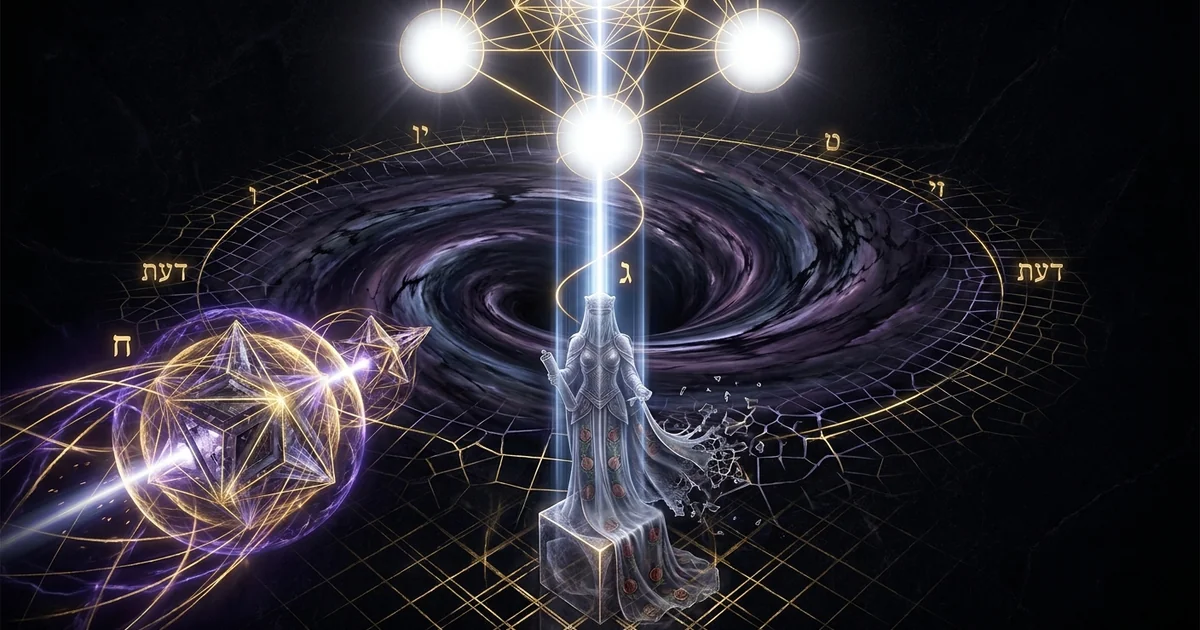
The Abyss of Daat: The High Priestess and Chariot Path
Archetypal Thesis & Systemic Paradigm: The Abyss of Da’at and the Vectorial Paths
The Ontological Singularity of the Supernal Divide
Within the architectural cartography of Hermetic Qabalah, the Tree of Life is severed by an epistemic and structural chasm known as the Abyss (Tehom). This chasm isolates the unitive, unconditioned non-duality of the Supernal Triad—Kether (Crown), Chokmah (Wisdom), and Binah (Understanding)—from the conditioned, differentiated realms of the Ruach and Nephesh, manifested through the lower seven Sephiroth. At the focal center of this gulf resides Da’at: the non-Sephira, the invisible nexus of knowledge, and the phantom coordinate where unmanifest potential collapses into manifest separation.
Rather than functioning as an energetic reservoir like the surrounding emanations, Da’at operates as an ontological singularity. In this zone, the ontological continuum fractures, causality ceases to operate sequentially, and the epistemological framework of the observing subject collapses. Within the symbolic technology of the Tarot, navigating this void requires specific archetypal vectors. The cards are not static pictorial emblems; they are dynamic operators within a state-space network of psycho-spiritual transformation. When consciousness ascends past Tiphereth and approaches the Choronzon threshold, it encounters the fundamental terror of self-negation: the realization that the sovereign ego is an organized fiction produced by lower cognitive feedback loops. Crossing the Abyss is therefore an absolute ontological mutation, where the conditioned mind must either surrender its defensive insularity or succumb to catastrophic psychosis and cognitive dispersion.
Axial Equilibrium vs. Lateral Containment: Path 13 and Path 18
To negotiate this metaphysical precipice, the Tree of Life supplies two divergent vectorial trajectories: Path 13, attributed to The High Priestess (the Hebrew letter Gimel), and Path 18, attributed to The Chariot (the Hebrew letter Cheth). These paths represent fundamentally distinct mechanical solutions to the problem of traversing the Abyss.
Path 13 functions as an axial plumb line. Originating in Tiphereth and terminating in Kether, it pierces directly through the invisible heart of Da’at along the Middle Pillar. The High Priestess embodies dynamic equilibrium, contemplative stillness, and the unbroken continuum of cosmic memory. Through Path 13, consciousness does not struggle against the void; rather, it mirrors the Supernal light across the chasm, bypassing subjective fragmentation through radical non-attachment and unconditioned receptivity.
Conversely, Path 18 operates along the Pillar of Severity, establishing a lateral, armored traverse from Binah to Geburah. Assigned to The Chariot, this path skirts the western perimeter of the Abyss. Instead of piercing the center, it acts as a structural perimeter fence, or dynamic containment vehicle, that encapsulates the volatile energies of the Upper Waters. The Charioteer constructs a closed system—an alchemical athanor or Merkavah—that permits the soul to transit the threshold of Severity without experiencing total structural collapse. Where the High Priestess achieves traversal via absolute transparency, the Charioteer achieves it through absolute enclosure.
Path 13: The High Priestess (Gimel)
- Qabalistic Alignment: Middle Pillar (Tiphereth to Kether), piercing the central core of Da’at.
- Structural Dynamics: Vertical, unconditioned, reflective equilibrium; direct bypass of the ego-construct.
- Astrological / Elemental Ruler: The Moon; dynamic fluid memory, unconscious depth, transpersonal illumination.
- Abyss Navigation Mode: Radical receptive silence; the dissolution of the observer into pure, unmediated observation.
- Primary Psychological Safeguard: Total detachment from finite identity; refusal to generate reactive projections within the void.
Path 18: The Chariot (Cheth)
- Qabalistic Alignment: Pillar of Severity (Binah to Geburah), skirting the lateral flank of the Abyss.
- Structural Dynamics: Horizontal-diagonal, armored containment; construction of an impenetrable psychological vehicle.
- Astrological / Elemental Ruler: Cancer (governed by the Moon); chitinous carapace, tidal mastery, containment of the volatile.
- Abyss Navigation Mode: Dynamic directional will; stabilization of autonomous unconscious forces through strict structural restraint.
- Primary Psychological Safeguard: Ego-syntonic containment; preservation of structural integrity to prevent entropic dispersal.
Choronzon as Systemic Entropy and Cognitive Dispersal
The primary systemic hazard of the Abyss is personified in Western esotericism as Choronzon, the “Dweller in the Abyss.” Methodologically, Choronzon must not be viewed as an anthropomorphic demon, but as an emergent property of cognitive entropy and linguistic decoherence. Within Da’at, meaning separates from syntax, and signifiers proliferate infinitely without landing upon a signified essence. Choronzon is the personification of this unintegrated psychological detritus: an entropic cacophony of autonomous complexes, repressed desires, and fragmented ego-identifications that violently assert their reality the moment the organizing rubric of the lower self dissolves.
When the aspirant crosses without the silent poise of Path 13 or the structural carapace of Path 18, the mind falls prey to ideological mania, psychic fragmentation, and spiritual megalomania—a condition classically diagnosed as the “Black Brother” who becomes trapped in Da’at, mistaking the static echo of their own isolated ego for the transpersonal unity of the Supernal Triad.
[ KETHER ]
           |
           |  Path 13 (Gimel / The High Priestess)
           |  "Vertical Equilibrium"
           v
=== [ THE ABYSS OF DA'AT ] === <--- Skirted laterally by Path 18 (Cheth / The Chariot)
           |                        from [BINAH] down to [GEBURAH]
           |
           v
      [ TIPHERETH ]
Classical Provenance & Textual Lineage: The Genesis of Da’at and the Qabalistic Void
Lurianic Shevirat ha-Kelim and the Genesis of the Non-Sephira
The genesis of Da’at as a structural void finds its historical and theological origin in the 16th-century Safed Kabbalah of Isaac Luria, meticulously documented by Gershom Scholem in Major Trends in Jewish Mysticism (1941). In the Lurianic cosmogony, the primary process of creation requires Tzimtzum—the voluntary withdrawal or contraction of the Ein Sof (the Infinite) to clear an epistemological and spatial clearing for finite existence. Into this primordial vacuum, a concentrated beam of divine light (Kav) was projected to fashion the primordial archetypes of the Sephiroth. However, the upper vessels, possessing greater proximity to the source, could hold this direct influx, whereas the lower structural vessels proved fragile and brittle.
This structural insufficiency precipitated Shevirat ha-Kelim—the Cataclysm of the Shattering of the Vessels. During this cosmic rupture, the seven lower proto-emanations shattered beneath the impact of unbuffered divine light, their fragments cascading downward to coalesce into the material realm, trapped within the shells of gross matter (Qlippoth).
In this Lurianic mapping, Da’at emerges as the scar tissue of this fracture. Prior to the fall, Da’at functioned as the unified interior dimension of Chokmah and Binah, the unitive consciousness through which dynamic wisdom and analytical understanding interfaced. With the shattering, this conscious nexus collapsed, leaving an unbridgeable gulf—a radical discontinuity where systemic unity once reigned. Da’at was transformed into a non-Sephira: an absent presence, a vacancy indicating where integrated gnosis should reside, and a perilous threshold separating unfallen eternity from historical, divided consciousness.
“The Abyss is the vacancy between the Supernals and the lower Sephiroth; it is the non-existent boundary wherein dwell the shells of unformed, chaotic impulses… Here, consciousness, deprived of its center of gravity in Tiphereth, falls into the dispersion of Choronzon, whose name is legion, unless it be sustained by the pure ray of Gimel, which is the unblemished virgin of the world.” — S.L. MacGregor Mathers, The Kabbalah Unveiled (1887), commentary on the Zoharic Book of Concealed Mystery
“The name of the Dweller in the Abyss is Choronzon, but he is not an individual. The Abyss is empty of being; it is filled with all possible forms, each equally insane, each making for its own destruction. These forms whirl into senseless aggregations, like dust-devils of the desert… He is the dispersion of that which is not one.” — Aleister Crowley, The Vision and the Voice: Liber 418 (1909), The Cry of the 10th Aethyr
The Golden Dawn Attribution of Major Arcana to the Supernal Threshold
In the late 19th century, the Hermetic Order of the Golden Dawn, under the scholarly leadership of S.L. MacGregor Mathers and William Wynn Westcott, synthesized the Zoharic and Lurianic cartographies with the Western esoteric Tarot. As recorded by Israel Regardie in The Golden Dawn (1937), the Order established precise systemic correspondences between the twenty-two letters of the Hebrew alphabet, the twenty-two paths of the Tree of Life, and the Major Arcana. In this schema, the Supernal Triad was protected by explicit symbolic custodians.
Path 13, allocated the letter Gimel (meaning “Camel”), was deliberately assigned to The High Priestess (Card II), positioning her as the solitary, virginal guardian traversing the vast, arid desert of the Abyss between the solar center of Tiphereth and the crown of Kether. The camel was chosen because it possesses the unique capacity to endure long passages through desolate expanses without external water, carrying its sustenance within itself. In the spiritual economy of the Tree, the High Priestess carries the waters of Supernal Grace across the dry, entropic desert of Da’at.
Simultaneously, the Golden Dawn positioned Path 18, designated by the letter Cheth (meaning “Fence” or “Enclosure”), as the path of The Chariot (Card VII). This path was established along the western boundary, connecting Binah (the Great Sea of Form) to Geburah (the Radical Scythe of Severity). Through this attribution, Mathers and his circle highlighted that the boundary of the Abyss is not merely a gap to be leaped, but a turbulent coast demanding containment, boundary construction, and rigorous navigational discipline.
The Western Esoteric Formulation of the Choronzon Entity
The operational conceptualization of Choronzon underwent a dramatic evolution from John Dee and Edward Kelley’s 16th-century Enochian diaries to the 20th-century formulations of Aleister Crowley. In Dee’s Mysteriorum Libri, the entity appears as Coronzom, an anarchic, evasive intelligence characterized by dissembling language and intentional disruption of mathematical harmonies.
Crowley formalized this entity within Hermetic Qabalah during his 1909 scrying of the Enochian Aethyrs in the Algerian desert. Crowley demonstrated that Choronzon is the personification of the metaphysical Abyss itself—the manifestation of that thermodynamic entropy which occurs when the ego attempts to enter the Supernal realm while clinging to its personal identity. Choronzon is the inevitable psychic consequence of intellectual hubris: the reduction of consciousness to a frenzied, chaotic dialectic stripped of the organizing teleology of the True Will.
By situating this ordeal at the border of the Supernals, Crowley cemented the doctrine that crossing the Abyss is not an incremental advancement in skill, but a total ontological break. The soul must cross either via the Middle Pillar’s quiet surrender or endure the severe boundary-tests of the lateral paths, lest the self be scattered into the screaming vacuum of unintegrated potential.
Structural Mechanics & Symbolic Geometry: Vectoring Path 13 and Path 18
Path 13 (Gimel / The High Priestess): The Vertical Plumb Line
The symbolic geometry of Path 13 operates as a pure vertical plumb line cutting along the central axis of symmetry on the Tree of Life. In topological terms, the Middle Pillar represents the axis of equilibrium, the path of dynamic balance that remains unaffected by the energetic polarities of the Pillar of Mercy (Chokmah-Chesed-Netzach) and the Pillar of Severity (Binah-Geburah-Hod).
Path 13 connects the sixth Sephira, Tiphereth, situated at the core of the ethical and rational ego-complex, directly to the primal unity of Kether. This trajectory cuts directly through the central coordinates of Da’at. The High Priestess, seated between the polar pillars of Boaz and Jachin (representing the structural dualities of the cosmos), acts as a living lens. The pomegranates adorning her veil signify the fertile patterns of manifest nature, yet this veil shields the aspirant from the blistering light of the Supernals until dualistic perception is mastered.
— Versus Flanking Lateral Movement —
Geometrically, Path 13 acts as a cosmic diameter dividing the circle of existence. The High Priestess does not navigate the Abyss through cognitive analysis, rational debate, or ritual aggression; these lower mental faculties, native to the Ruach, disintegrate upon contact with the void. Instead, her vehicle is memory (Mnemosyne)—transpersonal intuition untainted by discursive thought. She holds the scroll of the Law (TORA), which remains partially concealed within her robes, indicating that ultimate truth cannot be apprehended as external information, but must be experienced as an intrinsic structural state.
By anchoring her consciousness in the absolute stillness of the Middle Pillar, the High Priestess treats Da’at not as a field of chaotic combat, but as a holographic vacuum. The illusion of Choronzon disperses because she introduces no personal volition or reactive ego-projections upon which entropic patterns can take root.
Path 18 (Cheth / The Chariot): The Lateral Armored Traverse
Contrasted with the vertical plumb line of Gimel, Path 18 (The Chariot) exhibits a lateral, structural, and protective geometry. Traversing the diagonal line from Binah to Geburah, Path 18 is situated entirely on the Pillar of Severity. In the geometry of the Tree, Binah is the primordial matrix, the root of all form and structure, yet simultaneously the “Bitter Sea” (Marah) whose dark waters threaten to dissolve any lower systemic integrity that approaches her unbuffered.
Geburah is the focused dynamic force that executes structural elimination, discipline, and corrective boundary maintenance. Path 18 functions as the downward conduit of Binah’s structural architecture into Geburah’s active, defensive militarism.
The Hebrew letter assigned to this path is Cheth (ח), whose glyph graphically resembles a fence, enclosure, or defensive palisade. The Chariot symbolizes the construction of a mobile, impenetrable sanctuary capable of surviving near the toxic fallout of the Abyss. The Charioteer does not attempt to merge directly into the unconditioned void of Kether; rather, he constructs a dynamic enclosure—the classical Merkavah or celestial chariot described in Ezekiel’s vision.
The vehicle is driven by two sphinxes—one black, one white—signifying the primal dualities of force and form, attraction and repulsion. The Charioteer holds no physical reins; he commands the beasts through the absolute focus of the Will directed through a crystalline wand. The canopy of his vehicle is adorned with stars, signifying that he carries the overarching protection of the celestial vault (Binah) into the lower battlegrounds of existential struggle (Geburah).
Whereas Path 13 is a path of subtraction, where all identity is cast aside until only pure consciousness remains, Path 18 is a path of hyper-stabilized integration, where an indomitable psychological container is forged to withstand the chaotic, deconstructive currents streaming from the Abyss.
Geometric Coordinates: Transiting Da’at without Dissolution
The mathematical topology of traversing the Abyss reveals that space, within this Hermetic landscape, must be interpreted as a non-Euclidean state-space representation of consciousness. Within the coordinates of Da’at, linear causality breaks down completely. The coordinates are non-commutative; approaching the boundary through intellectual scrutiny ($A \times B$) yields entirely different psychological results than approaching it through mystical silence ($B \times A$).
The peril of Da’at is the loss of psychic coherence: without a stable coordinate reference, the self experiences an infinite regress of its own subjective assumptions.
[SUPERIOR HORIZON: SUPERNAL NON-DUALITY]
        Chokmah (2) <=======================> Binah (3)
                             \            /
                              \  DA'AT   /
                               \ (Void) /
                                \      /
                                 \    /
    [PILLAR OF MERCY]             \  /           [PILLAR OF SEVERITY]
                                   \/
                           Tiphereth (6)
               [INFERIOR HORIZON: CONDITIONED RUACH]
To cross via Path 13, consciousness must execute an absolute phase shift, transitioning from the discrete processing of the Ruach to the continuous state of the Neshamah. This is equivalent to moving along an axis that has zero length in time and space—a vertical quantum tunnel through the void.
To traverse via Path 18, consciousness executes an orbital maneuver, utilizing the gravitational pull of Binah to swing safely around the core of the singularity, channeling its structural intensity directly into the disciplinary fires of Geburah. Both movements resolve the fundamental danger of the void: preventing the cognitive architecture from fracturing into the entropic static of the Choronzon threshold.
Psychological Dynamics & Operational Praxis: The Ego’s Encounter with Disintegration
Analytical Psychology and the Dissolution of the Persona
Viewed through the analytical psychology of Carl Gustav Jung, the Abyss of Da’at correlates with that critical stage of individuation characterized by the catastrophic confrontation with the collective unconscious. In Mysterium Coniunctionis (1955), Jung explores the radical separation and synthesis of psychic opposites, establishing that before the soul can achieve the unio mentalis, it must undergo the mortificatio—the absolute decomposition of ego-structures that have organized the subject’s reality.
When the conscious personality advances beyond the integration of the Shadow and the Anima/Animus (processes occurring predominantly within the lower Sephiroth of Yesod, Netzach, and Hod), it encounters the archetypal core of the psyche at the threshold of Da’at.
“The encounter with the collective unconscious is a catastrophic event if the ego is not adequately equipped to endure the collision. The conscious mind is suddenly confronted with autonomous forces whose energy far exceeds its own. If the individual attempts to assimilate these contents through intellectual rationalization, or conversely, if the conscious boundary collapses under their weight, a state of complete psychic fragmentation ensues. The opposites tear the personality apart; the dragon of primordial chaos swallows the solar ego, precipitating a descent into the dark night of the soul from which only the forged, non-contingent self can emerge.” — Carl Gustav Jung, Mysterium Coniunctionis: Collected Works, Vol. 14 (1955)
At this boundary, the persona—the structural interface mediating between the ego and the social exterior—is thoroughly stripped away. What the Western esoteric tradition identifies as Choronzon is, in analytical terms, the eruption of autonomous, unintegrated complexes operating outside the central ego-complex. In everyday neurosis, these complexes express themselves as mild behavioral inconsistencies or emotional projections.
However, in the Abyss of Da’at, where the central organizing principle of the ego is suspended, these complexes detach entirely, achieving temporary autonomy. They assault the observer as an overwhelming multitude of conflicting voices, hallucinatory imperatives, and profound terrors of annihilation. If the ego identifies with any of these autonomous voices, it succumbs to archetypal inflation, a clinical condition indistinguishable from psychosis, wherein the individual proclaims themselves a master of divine mysteries while their actual psychic life degenerates into paranoid incoherence.
The Charioteer’s Armor as Ego-Syntonic Defense against Abyss Psychosis
It is within this perilous psychological territory that the functional role of Path 18 becomes clinically illuminating. The Chariot represents an ego-syntonic containment architecture—a robust, highly differentiated ego-complex that refuses to fracture under the immense psychic pressure of the unconscious. Erich Neumann, in The Origins and History of Consciousness (1949), delineates the vital developmental necessity of the “heroic” ego-defense system. The Charioteer’s armor is not an emblem of rigid psychological defensiveness or neurotic repression; rather, it represents the alchemical vessel (vas hermeticum), carefully sealed to prevent the volatile contents of the psyche from escaping into premature, catastrophic externalization.
The Charioteer embodies the psychological discipline that allows an individual to observe the terrifying depths of the unconscious without acting out its impulses. He maintains his stance between the black and white sphinxes—the dialectical tension between instinctual drives and spiritual demands—refusing to let either force seize control of the vehicle.
This operational stance reflects the alchemical maxim solve et coagula: while the Abyss seeks an immediate, violent solve (dissolution), the Charioteer enforces a counteracting coagula (coagulation), holding structural boundaries intact until the consciousness is properly stabilized. In therapeutic and esoteric praxis alike, Path 18 represents the ego’s capacity to tolerate profound ambiguity and terror without breaking, sustaining a functional perimeter around the self while skirting the edge of the numinous void.
The High Priestess’s Pneuma: Radical Receptivity as Trans-Personal Surrender
If The Chariot represents the structural preservation of the container, The High Priestess on Path 13 embodies an entirely antithetical, yet complementary, psychological mechanism: radical trans-personal surrender. Path 13 represents the transition from the structured ego to what Jung identified as the Self—the transpersonal center of totality that encompasses both the conscious and unconscious realms. The High Priestess achieves immunity against the madness of the Abyss by abandoning the defensive posture entirely.
Where the Charioteer relies upon armor, the High Priestess adopts radical, contemplative transparency. She offers no resistance to the void, and consequently, she provides no surface area for the entropic forces of Choronzon to seize upon.
This mode of traversal demands absolute ego-quietude. In this operational state, the practitioner ceases all discursive cognitive processing, mental commentary, and subjective intentionality. The High Priestess sits in unyielding stillness, holding the pneuma of the divine within herself. Her posture is that of pure observation, the witness consciousness (Sakshi) of Vedantic philosophy or the radical phenomenology of Husserlian reduction.
By suspending the natural human impulse to interpret, categorize, and judge the phenomena emerging from the Abyss, she neutralizes the subjective distortions of Da’at. The terrifying illusions of Choronzon pass through her as insubstantial shadows, unable to impact a consciousness that has divested itself of personal attachments, anxieties, and theological dogmas. The High Priestess does not fight the Abyss; she becomes the reflective mirror through which the Abyss recognizes its own unmanifest nature, opening a direct corridor of illumination between Kether and Tiphereth.
Philosophical Synthesis & Macrocosmic Correspondence: Hermetic Axioms and Cybernetic State-Space
Da’at as the Holographic Zero-Point Field
To fully comprehend the metaphysical function of Da’at within modern esoteric philosophy, one must synthesize classical Hermetic axioms with contemporary cybernetic systems theory and quantum field dynamics. In this framing, Da’at functions as a holographic zero-point field: an informational singularity characterized by maximum potential entropy and zero manifest information.
Prior to observation, all possible cosmological states coexist in supernal superposition within the divine intellect. The collapse of this supernal wave function into discrete structural realities occurs across the boundary of Da’at, cascading through the lower seven Sephiroth down to the physical terminal of Malkuth.
Da’at is the boundary where unconditioned data transitions into conditioned information. Below the Abyss, systemic reality is strictly governed by binary distinctions: true/false, light/dark, subject/object, severity/mercy. This binary division is the necessary engine of temporal manifestation. Above the Abyss, however, this binary architecture dissolves; Chokmah and Binah exist in continuous, non-dual co-inherence (Yichud), unified under the primordial point of Kether.
The Abyss is thus an epistemological phase boundary. When the conditioned mind attempts to compute the non-dual data of the Supernal Triad using the binary architecture of the lower cognitive faculties, the system crashes. This computational failure is experienced subjectively as Choronzon: the chaotic, nonsensical churning of broken code, semantic noise, and unresolvable logical paradoxes.
Astrological Correspondences: Lunar Reflectivity vs. Cancerian Enclosure
The astrological attributions assigned to Paths 13 and 18 within the Hermetic tradition further illuminate their systemic mechanics. Path 13 is governed directly by the Moon, while Path 18 is governed by Cancer—the cardinal water sign whose celestial domicile is the Moon itself. This astrological synergy creates a profound structural loop across the Supernal boundary.
| Parameter | Path 13: The High Priestess | Path 18: The Chariot |
|---|---|---|
| Hebrew Letter & Meaning | Gimel (ג) / Camel | Cheth (ח) / Fence, Enclosure |
| Gematria Value | 3 | 8 |
| Tree of Life Coordinates | Tiphereth $\rightarrow$ Kether (Middle Pillar) | Geburah $\rightarrow$ Binah (Pillar of Severity) |
| Astrological Attribution | The Moon (Pure Planetary Force) | Cancer (Cardinal Water Sign / Lunar Domicile) |
| Alchemical Phase | Sublimatio (Evaporation into pure spirit) | Coagulatio (Solidification of the vessel) |
| Cybernetic Dynamic | Direct Signal Transmission / Low Entropy | Closed Feedback Loop / High Shielding |
| Divinatory Diagnostic Marker | Unconscious insight, static pause, hidden laws | Controlled momentum, armored will, defensive triumph |
The Moon in its pure planetary attribution on Path 13 signifies total reflectivity, cyclical liquidity, and access to the deep ocean of the unconscious. Because the Moon possesses no intrinsic luminosity of its own, its power lies entirely in its capacity to reflect the solar light of Tiphereth upward to Kether, and to reflect the supernal light of Kether downward into the manifest mind. The Moon on the Middle Pillar is the archetype of the silver mirror, unclouded by subjective dust.
Conversely, Cancer on Path 18 represents the Moon’s qualities embodied within a cardinal, protective enclosure. The crab is defined by its hard chitinous exoskeleton, designed specifically to protect its soft, vulnerable interior from the crushing pressure of the oceanic tides. In Cancer, the fluid, dissolutive nature of water is enclosed within a structural matrix.
This corresponds precisely to the functional architecture of The Chariot: it is the vehicle that navigates the turbulent boundary between Binah (the Great Sea) and Geburah without allowing the inner life of the adept to be washed away by the oceanic currents of the Abyss. The High Priestess provides the pristine, reflective clarity of the water itself, while the Charioteer builds the armored vessel that sails upon it.
                  [ BINAH: THE SUPERNAL SEA ]
                               |
                               | (Fluid, Undifferentiated Matrix)
                               v
            =======================================
            [ THE ABYSS: THE TIDAL CHORONZON ZONE ]
            =======================================
               /                               \
              /                                 \
   Path 13 (The Moon)                    Path 18 (Cancer)
   [Pure Reflection]                     [The Armored Vessel]
   - Radical Fluidity                    - Chitinous Exoskeleton
   - Transpersonal Stillness             - Directional Boundary Maintenance
   - Dissolution of Ego-Image            - Dynamic Container for the Soul
              \                                 /
               \                               /
                v                             v
           [ TIPHERETH ]                 [ GEBURAH ]
The Dialectic of Form and Formlessness: Resolving the Supernal Paradox
The ultimate esoteric realization encoded within this symbolic topology is that the Abyss cannot be conquered through an exclusive reliance upon either Path 13 or Path 18; rather, the traversal demands an ultimate, dialectical synthesis of both modes. The seeker who relies solely upon the armored enclosure of The Chariot risks permanent containment within their own spiritual defenses—they may skirt the perimeter of the Abyss with great skill, but they will never break through its barrier into the unconditioned non-duality of the Supernal Triad. Their very armor becomes their prison, transforming them into a fortified fortress isolated in the void.
Conversely, the seeker who prematurely attempts the radical, receptive transparency of The High Priestess without first developing the immense structural discipline of The Chariot risks catastrophic psychic dissolution. To surrender an ego that has not yet been fully forged is not spiritual transcendence; it is simple regression into unintegrated unconsciousness. One must possess an adamantine vehicle before one can safely choose to step out of it into the void.
The Chariot builds the vehicle of the soul (Merkavah); The High Priestess silences the driver, allowing the cosmic light to guide it across the abyss. Through this dynamic dialectic between form and formlessness, enclosure and surrender, the practitioner navigates the perilous coordinates of Da’at, transforming an entropic chasm into the ultimate bridge of unitive gnosis.
Frequently Asked Questions: Technical Dimensions of the Abyss, Da’at, and Tarot Paths
Operational Mechanics of the Abyss in Tarot Consultations
In practical divinatory cartography and psychological diagnostic readings, the Abyss of Da’at does not manifest as a discrete card, because there is no single tarot card corresponding to a non-Sephira. Instead, the Abyss reveals itself through specific structural tensions, spatial anomalies, or polarized relational distributions across the spread layout. When a consultation exhibits a dramatic polarization—such as an overwhelming concentration of cards belonging to the Supernal archetypes (The Fool, The Magician, The Empress) separated from lower, highly material Minor Arcana, without bridging Middle Pillar trumps—the presence of an unintegrated Da’at boundary is indicated.
Operationally, the client is confronting an epistemological impasse: an ontological crisis where rational paradigms, diagnostic models, and habitual narrative structures have completely collapsed. The appearance of Card II (The High Priestess) in dynamic tension with Card VII (The Chariot) indicates that the subject is struggling between the necessity for defensive containment and the urgent imperative of radical surrender.
If the reading is dominated by fragmented, chaotic cards (such as the Five of Wands, Seven of Swords, or Eight of Cups) clustering around an absent center, the entropic forces of Choronzon are active within the querent’s psyche. In such instances, the divinatory mechanism identifies a state of profound cognitive dissonance where the conscious mind is compulsively generating rationalizations to avoid facing the vacuum of an existential transition.
Path Divergence: Middle Pillar Direct Ascent vs. Pillar of Severity Flanking
A fundamental technical inquiry in esoteric geometry asks: Why would an adept choose to skirt the Abyss via Path 18 rather than taking the direct, axial route of Path 13? The answer lies within the rigorous structural mechanics of the Tree of Life. Path 13 is an exceptional, vertical line of transmission, but its successful traversal demands an extraordinary degree of natural contemplative attainment and purity of will. For most evolving consciousnesses, an unmediated encounter with the singularity of Da’at results in instantaneous cognitive shock and unintegrated psychic dispersion.
Path 18, running from Binah to Geburah, serves as an indispensable flanking maneuver. It permits consciousness to approach the boundary of the Abyss within a strictly regulated container of Form (Binah) and Severity (Geburah).
[BINAH]
   |
   | Path 18 (Cheth / The Chariot)
   v
[GEBURAH] ---> Transits structural severity, bypassing central core.
VERSUS
[KETHER]
|
| Path 13 (Gimel / The High Priestess)
v
[DA'AT]  —> Direct, unbuffered vertical plunge through the void.
|
v
[TIPHERETH]
This lateral movement enables the adept to systematically dismantle lower psychological fixations through the rigorous disciplines of Geburah, utilizing Binah’s structural laws as an overarching guide. Skirting the Abyss via The Chariot trains the operational will, reinforces psychic boundaries, and eliminates lingering lower-egoic attachments. Only after this dynamic containment vehicle has been successfully forged and tested can the soul step onto the Middle Pillar and sustain the absolute, naked stillness demanded by the High Priestess.
Choronzon as Mythological Entity vs. Cognitive Defense Mechanism
The demarcation between Choronzon as an objective, external intelligence versus an internal, psychological defense mechanism is an essential technical distinction for the serious Hermetic practitioner. Classical ceremonial magic, particularly operating within medieval and early modern grimoiric paradigms, reifies Choronzon as an objective, external arch-demon—a personal entity dwelling within the waste spaces of creation, waiting to consume unwary magicians who fail to construct proper protective circles.
Contemporary esoteric psychology, operating through the integrated paradigms of depth psychology and cybernetic modeling, contextualizes this entity differently. Choronzon is recognized as the personification of the ego’s ultimate defense mechanism against its own necessary dissolution. When the lower personality senses that it is approaching the boundary of unconditioned non-duality, it experiences an existential panic of annihilation. To prevent its own dissolution, the ego-complex mobilizes its entire defensive arsenal: it generates rapid-fire ideological systems, sensory distractions, spiritual fantasies, paranoia, and fragmented identities.
This frantic, self-generated noise is precisely what constitutes Choronzon. The entity possesses an objective reality only in the sense that any sufficiently dense, autonomous psychological structure exerts real thermodynamic effects upon the consciousness experiencing it. To conquer Choronzon is not to defeat a demon in physical combat; it is to recognize that the roaring beast in the void is simply the sound of one’s own fragmented ego fighting for survival against the unitive silence of the Infinite.
Archival References & Critical Apparatus
- Crowley, Aleister. (1944). The Book of Thoth: A Short Essay on the Tarot of the Egyptians Being the Equinox Volume III No. V. London: O.T.O.
- Crowley, Aleister. (1909). The Vision and the Voice with Commentary and Other Papers (Liber 418). Simmering: Equinox.
- Jung, Carl Gustav. (1955). Mysterium Coniunctionis: An Inquiry into the Separation and Synthesis of Psychic Opposites in Alchemy. Collected Works Vol. 14. Princeton: Princeton University Press.
- Mathers, S.L. MacGregor. (1887). The Kabbalah Unveiled: Containing the following books of the Zohar: The Book of Concealed Mystery, The Greater Holy Assembly, The Lesser Holy Assembly. London: George Redway.
- Neumann, Erich. (1949). The Origins and History of Consciousness. Princeton: Princeton University Press.
- Regardie, Israel. (1937). The Golden Dawn: An Account of the Teachings, Rites and Ceremonies of the Order of the Stella Matutina. Chicago: Aries Press.
- Scholem, Gershom. (1941). Major Trends in Jewish Mysticism. New York: Schocken Books. :::