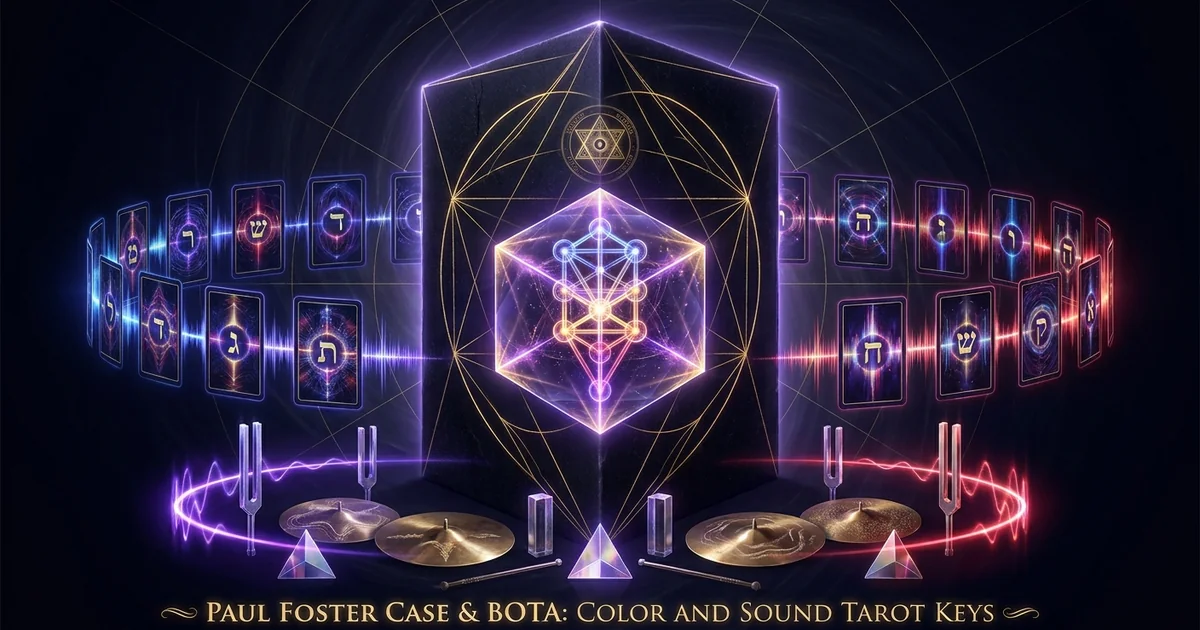
Paul Foster Case & BOTA: Color and Sound Tarot Keys
Archetypal Thesis & Systemic Paradigm: The Tarot as a Neuro-Acoustic Coordinate System
The Western esoteric canon underwent a radical epistemological shift in the early twentieth century through the work of Paul Foster Case. Moving away from the romanticized occultism of the late nineteenth century and the fatalistic fortune-telling of popular culture, Case reframed the Tarot as an engineered psycho-sensory apparatus. Within the curricular matrix of the Builders of the Adytum (B.O.T.A.), the 22 Major Arcana cease to be passive indices of mantic destiny; instead, they function as a rigorous state-space coordinate system for human consciousness. By synthesizing classical Hermeticism, the foundational taxonomy of the Sefer Yetzirah, and early twentieth-century neurobiology, Case posited that the structural archetypes of the Major Arcana operate as symbolic transducers capable of systematically converting transcendent metaphysical principles into precise optical and acoustic vectors.
                  ┌────────────────────────────────────────┐
                  │       Transcendent Metaphysical        │
                  │         Axiom (Ain Soph / Kether)      │
                  └───────────────────┬────────────────────┘
                                      │
                                      ▼
                  ┌────────────────────────────────────────┐
                  │         Symbolic Archetype / Key       │
                  │         (Geometric Configuration)      │
                  └───────────────────┬────────────────────┘
                                      │
                         ┌────────────┴────────────┐
                         ▼                         ▼
              ┌─────────────────────┐   ┌─────────────────────┐
              │ Chromatic Frequency │   │ Acoustic Frequency  │
              │  (Optical Spectrum) │   │ (Equal Temperament) │
              └──────────┬──────────┘   └──────────┬──────────┘
                         └────────────┬────────────┘
                                      │
                                      ▼
                  ┌────────────────────────────────────────┐
                  │       Psychosomatic Substrate          │
                  │   (Nephesh / Autonomic Realignment)    │
                  └────────────────────────────────────────┘
Transduction of Metaphysical Principles into Sensory Coordinates
The architecture of the B.O.T.A. system rests upon the premise that abstract spiritual realities cannot exert transformative leverage upon the human organism through intellectual assent alone. Conceptual cognition operates within the discursive limitations of the forebrain, a biological sector prone to semantic obfuscation and psychological defense mechanisms. To bypass this rational censorship, the Major Arcana were re-engineered by Case into visual resonators that encode the mathematical geometry of the Hebrew alphabet and the 32 Paths of Wisdom on the Tree of Life. Every line, glyph, chromatic value, and spatial relationship across the 22 Keys is calculated to stimulate concrete neurological responses, translating metaphysical axioms into sensory coordinates that register directly upon human perception.
When an initiate meditates upon Key 4, “The Emperor,” the practitioner does not simply encounter an allegorical personification of temporal authority or masculine archetypal power. The Key functions as a geometric and sensorial engine representing the letter Heh, the path connecting Chokmah to Tiphereth, the zodiacal sign of Aries, the acoustic pitch of C natural, and the optical wavelength of pure spectral Red. The deliberate optical presentation of red—unmuddied by arbitrary artistic idiosyncratic shading—activates specific neural firing patterns in the visual cortex, while the simultaneous or thematic intonation of C natural creates a multimodal sensory convergence. The card operates as an analog computing surface: metaphysical order is transduced into physical wavelength, grounding abstract divine architecture in the biological sensory apparatus of the operator.
The Subconscious Substrate: Nephesh and Autonomic Conditioning
Central to Case’s operational mechanics is his explicit mapping of esoteric anatomy onto Western psychology and neurophysiology. In the Qabalistic psychology utilized by Case, consciousness is categorized into three primary divisions: Neshamah (the superconscious soul and intuitive intellect), Ruach (the discursive, conscious ego-mind), and Nephesh (the subconscious, instinctual, and autonomic vitality). Esoteric failure, Case argued, inevitably occurs when the practitioner attempts to enact spiritual transmutation exclusively through the Ruach. The intellect lacks direct programmatic control over the vegetative and sympathetic nervous systems, which serve as the actual bodily bedrock of spiritual transformation.
The Nephesh, operating through the autonomic nervous system, does not respond to linguistic dialectic; it responds to imagery, rhythm, color, and acoustic resonance. Because the autonomic nervous system regulates endocrine secretion, cellular metabolism, cardiovascular rhythms, and visceral responses, spiritual regeneration demands the systematic retraining of this subconscious biological substrate. By bombarding the subconscious with coordinated sensory inputs—specifically calibrated chromatic hues and precise harmonic intervals—the practitioner circumvents the intellectual skepticism and cognitive fatigue of the conscious mind. The Major Arcana act as a diagnostic and remedial software suite: they introduce archetypal coherence directly into the Nephesh, thereby conditioning the autonomic nervous system to sustain elevated states of awareness without triggering psychosomatic collapse or neurotic backlash.
Cybernetic Feedback Loops in Symbolic Contemplation
Viewed through modern systems theory, the B.O.T.A. meditative curriculum operates as an iterative cybernetic feedback mechanism. A cybernetic loop requires a sensory input, a comparator that measures the signal against an established standard, an effector that modifies the internal state, and a feedback loop that informs subsequent cycles. In the context of B.O.T.A. symbolic contemplation, the pristine, uncorrupted Tarot Key serves as the absolute external standard—the archetypal setpoint representing cosmic equilibrium.
“The archetype is not merely an idea or an abstract concept; it is an instinctual dynamic, an energetic matrix grounded in the psychosomatic totality of the individual. When stimulated through formal sensory configurations, it bridges the chasm between intellectual comprehension and instinctual physiology, compelling the subconscious mind to align its somatic processes with the primordial pattern.” — Carl Gustav Jung, The Archetypes and the Collective Unconscious (Collected Works Vol. 9, Part 1)
When the practitioner engages in the visual fixation upon a Key, visual data cascades through the retino-geniculo-striate pathway, distributing neural signals across the primary visual cortex (V1) and higher-order associative areas. Simultaneously, the conscious intonation of the assigned musical pitch engages the auditory cortex and the vestibular system, generating cross-modal cortical binding. As internal deviations—such as mental distractions, affective distortions, or muscular tensions—emerge into consciousness, the absolute chromatic and geometric integrity of the Key serves as the corrective baseline. The operator notes the divergence, releases the discursive interference, and refocuses attention upon the objective sensory properties of the card. This cyclical interaction systematically trains the neural pathways, continuously pruning extraneous associative interference until the practitioner’s internal neuro-acoustic frequency matches the harmonic matrix of the archetype.
Classical Provenance & Textual Lineage: The Genesis of the B.O.T.A. Keys
The historical development of the Builders of the Adytum Tarot Keys is rooted in the structural ruptures and sectarian debates of the late nineteenth and early twentieth-century Western Mystery Tradition. While the populist wave of the occult revival was characterized by the syncretic and often historically unreliable assertions of figures like Éliphas Lévi, Gérard Encausse (Papus), and S.L. MacGregor Mathers, Paul Foster Case approached esoteric cartography with methodological sobriety and critical philological rigor. He recognized that the foundational documents of the modern occult resurgence—principally the Hermetic Order of the Golden Dawn’s Cipher Manuscripts—contained both profound structural insights and deliberate obscurations designed to mislead uninitiated investigators.
                    Hermetic Order of the Golden Dawn
                    (Cipher Manuscripts / Mathers System)
                                    │
                  ┌─────────────────┴─────────────────┐
                  ▼                                   ▼
        Arthur Edward Waite                 Paul Foster Case
        Rider-Waite-Smith Deck              Hermetic Critique (1918-1920)
        (Christian Mystic Blinds;           (Rejection of Blinds & Confusion;
         Concealed Qabalistic Geometry)      Restoration of Exact Scales)
                                                      │
                                                      ▼
                                            Builders of the Adytum
                                            (B.O.T.A. Tarot Keys, 1947)
                                            Pure Chromatic/Acoustic Canon
The Hermetic Order of the Golden Dawn and the Cipher Manuscripts
The genesis of twentieth-century Tarot mechanics can be directly traced to the Cipher Manuscripts, which formed the institutional authority for the establishment of the Hermetic Order of the Golden Dawn in 1888. Transcribed by William Wynn Westcott and systematized by MacGregor Mathers, these texts contained the revolutionary attribution of the 22 Major Arcana to the 22 paths of the Tree of Life and the 22 letters of the Hebrew alphabet, following the architectural guidelines found within the Sefer Yetzirah. Prior to this, continental occultists such as Lévi had placed Key 0 (The Fool) between Key 20 and Key 21, throwing the sequential correspondence between the letters, astrological signs, and Paths of Wisdom into internal disarray.
The Golden Dawn rectified this fundamental displacement by allocating The Fool (Aleph) to the 11th Path, thereby harmonizing the sequence of the 22 trumps with the linear progression of the Hebrew alphabet. Furthermore, the Golden Dawn introduced an elaborate, multi-layered color system known as the Four-Color Scales (King, Queen, Emperor, and Empress), which attributed unique spectral palettes to the Sephiroth and Paths across the Four Kabbalistic Worlds (Atziluth, Briah, Yetzirah, and Assiah). However, this ambitious chromatic schema, while theoretically dense, suffered from operational liability: the scales introduced visual conflict, arbitrary chromatic compounds (such as “citrine, olive, russet, and black” for Malkuth), and dense variations that complicated daily contemplative application for individual practitioners.
The Divergence: Case’s Critiques of Mathers and Waite
Paul Foster Case was initiated into the Hermetic Order of the Golden Dawn’s successor organization, the Alpha et Omega, in 1918, rapidly advancing to the Second Order under the direction of Moina Mathers. Yet, Case almost immediately detected systematic structural flaws and ideological accretions within the Order’s secret curricula. His primary critique centered upon the realization that MacGregor Mathers had integrated intentional “blinds”—deliberate errors in Qabalistic attribution, astrological timing, and chromatic resonance—ostensibly designed to protect esoteric secrets from the uninitiated, but which functionally crippled the spiritual progress of sincere initiates.
“The true Order of the Rosicrucians has never concealed the truth behind intentional distortions designed to bewilder the aspirant. Such blinds are the hallmarks of modern, degraded occultism. To awaken the latent centers of human consciousness, the symbolic keys must be purged of arbitrary artistic caprice and restored to their pure mathematical, optical, and musical integrity. Only when the sensory image accurately mirrors cosmic law can the Adytum of the human soul be entered.” — Paul Foster Case, The True and Invisible Rosicrucian Order (1927/1985)
Case was equally critical of Arthur Edward Waite’s 1909 Rider-Waite-Smith (RWS) deck. While acknowledging Waite’s courage in openly publishing the correct transposition of Key 8 (Strength) and Key 11 (Justice), Case recognized that Waite had deliberately veiled the cards’ Qabalistic mechanics beneath heavy Christian mystical symbolism and idiosyncratic pictorial details. Pamela Colman Smith’s illustrations, although aesthetically compelling, incorporated romantic backgrounds, arbitrary secondary colors, and asymmetrical compositions that obscured the pure geometric archetypes. Case observed that Waite had intentionally altered crucial symbolic metrics—such as the positioning of the pillars in Key 2 (The High Priestess) and the exact geometric construction of the cube upon which the Emperor sits—to prevent non-initiates from discovering the practical keys to internal alchemy.
Establishment of Builders of the Adytum and the Rosicrucian Core
Following his expulsion from the Alpha et Omega in 1920—prompted largely by disputes with Moina Mathers concerning the dangers of practical Enochian magic and the necessity of openly teaching clear Qabalistic principles—Case established the Builders of the Adytum (B.O.T.A.). His objective was to systematically demystify the Western Mystery Tradition, purging it of Victorian theatricality, autocratic grade structures, and psychically destabilizing practices. Case re-anchored the Western mystery curriculum firmly in the bedrock of authentic Rosicrucian internal alchemy, the wisdom of Kabbalah, and the structural mathematics of the Sefer Yetzirah.
Under the auspices of B.O.T.A., Case collaborated with artist and esotericist Jessie E. Jones to draft a definitive set of line-art Tarot Keys, eventually published in their finalized form in 1947 alongside his foundational text, The Tarot: A Key to the Wisdom of the Ages. The B.O.T.A. Keys stripped away the stylistic mannerisms of the Rider-Waite-Smith deck, replacing them with mathematically balanced Hermetic geometry, explicit Kabbalistic proportions, and severe, unshaded line art. By designing the keys to be physically hand-painted by the student according to an unyielding standard of pure spectral hues, Case returned the Tarot to its proper function: a functional, reproducible contemplative instrument designed to recalibrate human subconscious circuitry.
Structural Mechanics & Symbolic Geometry: Mathematical and Vibrational Correspondences
The technical architecture of the B.O.T.A. Tarot system depends upon the mathematical matrix articulated in the Sefer Yetzirah (The Book of Creation). The text organizes the universe through the 22 letters of the Hebrew alphabet, categorizing them into a structural triad: 3 “Mother” letters (Aleph, Mem, Shin), 7 “Double” letters (Beth, Gimel, Daleth, Kaph, Peh, Resh, Tav), and 12 “Simple” letters (Heh, Vav, Zayin, Cheth, Teth, Yod, Lamed, Nun, Samekh, Ayin, Tzaddi, Qoph). Case established that these textual divisions precisely correspond to the acoustic physics of the 12-tone equal temperament scale and the chromatic geometry of the optical color spectrum.
                  ┌────────────────────────────────────────┐
                  │       22 Hebrew Letters / Keys         │
                  └───────────────────┬────────────────────┘
                                      │
         ┌────────────────────────────┼────────────────────────────┐
         ▼                            ▼                            ▼
┌──────────────────┐        ┌──────────────────┐        ┌──────────────────┐
│    3 MOTHERS     │        │     7 DOUBLES    │        │    12 SIMPLES    │
│  Elements / Triad │        │    Planets / Pol. │        │   Zodiac / Cycle │
├──────────────────┤        ├──────────────────┤        ├──────────────────┤
│ Aleph (Air / E)  │        │ Beth (☿ / Yellow)│        │ Heh to Qoph      │
│ Mem (Water / G#) │        │ Gimel (☽ / Blue) │        │ Spectral Octave  │
│ Shin (Fire / C)  │        │ Daleth to Tav... │        │ C natural to B   │
└──────────────────┘        └──────────────────┘        └──────────────────┘
Sefer Yetzirah Division: 3 Mothers, 7 Doubles, and 12 Simples
In the cosmogony of the Sefer Yetzirah, the 3 Mother letters represent the primary, undifferentiated elements: Air (Aleph), Water (Mem), and Fire (Shin), with Earth regarded as a derivative coagulation. In Case’s chromatic-acoustic paradigm, these three letters represent the foundational energetic triangle:
- Aleph (Key 0, The Fool): Air, vibrational pitch E natural, spectral hue Pale Yellow.
- Mem (Key 12, The Hanged Man): Water, vibrational pitch G# natural, spectral hue Pure Deep Blue.
- Shin (Key 20, Judgement): Fire, vibrational pitch C natural, spectral hue Pure Spectral Red.
The 7 Double letters, which in the Hebrew language possess two distinct phonetic modes of pronunciation (hard and soft), represent the seven classical planets and the polarities of human experience (life/death, peace/war, wisdom/folly, wealth/poverty, grace/indignity, fertility/desolation, dominion/subjugation). Case assigned these to the planetary centers within the human organism—the autonomic nerve plexuses and endocrine glands—mapping them across the major musical intervals and primary secondary colors.
Finally, the 12 Simple letters represent the 12 zodiacal signs, the structural boundaries of space, and the 12 primary human physiological and cognitive functions (sight, hearing, smell, speech, taste, coition, work, movement, anger, mirth, thought, and sleep). Case realized that because the 12 signs of the zodiac form a closed, continuous celestial circle, they must mathematically correspond to the continuous, closed loop of the 12 chromatic semitones within a musical octave and the 12 distinct color transitions of the chromatic spectrum.
The 12-Tone Chromatic Scale and Pure Spectral Optics
The definitive breakthrough of the Case/B.O.T.A. model was the unification of the 12 zodiacal signs with the chromatic wheel and equal temperament musical tuning. Starting at the vernal equinox with the cardinal fire sign Aries (Key 4, The Emperor), Case initiated the chromatic sequence with the longest visible wavelength of light: Red. Proceeding sequentially through the zodiac, each adjacent sign advances precisely one chromatic semitone in sound and one standardized hue in the optical spectrum:
- Key 0: The Fool | Aleph (Mother) | Element: Air | Tone: E natural | Color: Pale Yellow
- Key 1: The Magician | Beth (Double) | Planet: Mercury | Tone: E natural | Color: Yellow
- Key 2: The High Priestess | Gimel (Double) | Planet: Moon | Tone: G# natural | Color: Blue
- Key 3: The Empress | Daleth (Double) | Planet: Venus | Tone: F# natural | Color: Green
- Key 4: The Emperor | Heh (Simple) | Sign: Aries | Tone: C natural | Color: Red
- Key 5: The Hierophant | Vav (Simple) | Sign: Taurus | Tone: C# natural | Color: Red-Orange
- Key 6: The Lovers | Zayin (Simple) | Sign: Gemini | Tone: D natural | Color: Orange
- Key 7: The Chariot | Cheth (Simple) | Sign: Cancer | Tone: D# natural | Color: Orange-Yellow (Amber)
- Key 8: Strength | Teth (Simple) | Sign: Leo | Tone: E natural | Color: Yellow
- Key 9: The Hermit | Yod (Simple) | Sign: Virgo | Tone: F natural | Color: Yellow-Green
- Key 10: Wheel of Fortune | Kaph (Double) | Planet: Jupiter | Tone: A# natural | Color: Violet
- Key 11: Justice | Lamed (Simple) | Sign: Libra | Tone: F# natural | Color: Green
- Key 12: The Hanged Man | Mem (Mother) | Element: Water | Tone: G# natural | Color: Blue
- Key 13: Death | Nun (Simple) | Sign: Scorpio | Tone: G natural | Color: Green-Blue (Teal)
- Key 14: Temperance | Samekh (Simple) | Sign: Sagittarius | Tone: G# natural | Color: Blue
- Key 15: The Devil | Ayin (Simple) | Sign: Capricorn | Tone: A natural | Color: Blue-Violet (Indigo)
- Key 16: The Tower | Peh (Double) | Planet: Mars | Tone: C natural | Color: Red
- Key 17: The Star | Tzaddi (Simple) | Sign: Aquarius | Tone: A# natural | Color: Violet
- Key 18: The Moon | Qoph (Simple) | Sign: Pisces | Tone: B natural | Color: Red-Violet (Magenta)
- Key 19: The Sun | Resh (Double) | Planet: Sun | Tone: D natural | Color: Orange
- Key 20: Judgement | Shin (Mother) | Element: Fire | Tone: C natural | Color: Red
- Key 21: The World | Tav (Double) | Planet: Saturn | Tone: A natural | Color: Blue-Violet / Indigo
This correlation establishes a non-arbitrary mathematical symmetry. Acoustic pitch and visual hue match across categorical classes: for example, Key 4 (The Emperor, Aries, Simple) shares the identical frequency of Red / C natural with Key 16 (The Tower, Mars, Double) and Key 20 (Judgement, Fire, Mother). The elemental, planetary, and zodiacal expressions of the underlying Martian/Igneous current are differentiated by their structural form, yet harmonically linked by identity of frequency.
Geometric Matrix of the 22 Paths on the Tree of Life
Within the geometry of the Otz Chiim, the 22 Paths of the Major Arcana serve as connective conduits linking the 10 Sephiroth. These paths are not passive geographic lines on a diagram; they are dynamic channels through which divine emanations are stepped down into tangible manifestation, and through which the consciousness of the practitioner ascends back toward the primary Source. Each path represents an exact energetic impedance and specific qualitative function.
When mapped onto the Tree of Life, the chromatic-acoustic keys of B.O.T.A. establish functional geometric axes across the cosmic architecture. The horizontal paths correspond precisely to the three Mother letters: the 11th Path of Aleph (Key 0) bridges Kether and Chokmah across the Supernal triad with the vibrational current of Pale Yellow (E natural); the 23rd Path of Mem (Key 12) bridges Geburah and Chesed across the middle pillar with the cool equilibrium of Blue (G# natural); and the 31st Path of Shin (Key 20) bridges Hod and Netzach across the lower threshold with the active heat of Red (C natural).
The vertical and diagonal paths establish polarized networks of planetary and zodiacal dynamics across the Tree. For example, the 19th Path of Teth (Key 8, Strength) bridges Chesed (Mercy) to Geburah (Severity) through the solar-ruled sign of Leo, intoning the frequency of Yellow (E natural), balancing primal instinctual forces directly across the moral matrix of the soul. Through this systematic integration, the Tree of Life transforms into a vibrational circuit board, where every movement of consciousness can be tracked, measured, and harmonized through its corresponding optical and acoustic signatures.
Psychological Dynamics & Operational Praxis: The Architecture of Subconscious Reprogramming
The core methodology of B.O.T.A. centers on operational praxis rather than theoretical memorization. Unlike contemporary commercial Tarot decks that are printed, pre-packaged, and utilized passively, the classical B.O.T.A. curriculum requires each initiate to construct their own deck through kinesthetic participation. By physically painting black-and-white line-art cards, the initiate enters into an intimate psychophysical relationship with the archetypal forms. This practice acts as a system of subconscious programming, operationalizing the Hermetic principle of mental transmutation through physical neuro-muscular reinforcement.
The Meditative Praxis: Kinesthetic Painting of Line-Art Keys
The process of painting the B.O.T.A. Keys operates as an active meditation that enlists multiple sensory and motor networks. As the practitioner applies opaque gouache or watercolor to the card stock, fine motor control is paired with intense visual scrutiny. Every precise boundary of the line art requires hyper-focused sustained attention; the hand must steady itself to apply paint up to the strict boundary of the ink line without bleeding over it.
This kinesthetic act forces the conscious mind (Ruach) to suspend its habitual, discursive internal monologue. Because the student must systematically prepare, mix, and apply each specific color—ensuring that the Red of Key 4 matches the exact spectral frequency rather than a diluted pink or muddy crimson—the optical properties of that color are processed deeply through the visual pathways and into long-term visual memory. The archetype is not passively viewed through mechanical reproduction; it is actively assembled, stroke by stroke, by the operator’s own neuromuscular system. This tactile-ocular synthesis engraves the geometric proportions, esoteric symbols, and chromatic values into the somatic neural maps of the body, establishing deep cognitive roots that cannot be matched by visual reading or passive academic study.
Acoustic Intonation and Optical Fixation Workflows
Once the Tarot Keys are painted to precise spectral specifications, they are operationalized through systematic contemplation rituals that combine optical fixation with acoustic intonation. These workflows are conducted in quiet, controlled environments designed to minimize extraneous environmental noise and visual interference. The initiate places the targeted card at eye level at an exact distance of comfortable focus, illuminating the surface with an even, full-spectrum light source.
The meditation workflow unfolds in structured phases:
- Optical Fixation (Trāṭaka Equivalent): The practitioner gazes steadily at the center of the Key without straining the ocular muscles or engaging in rapid saccadic movements. The details of the card—its geometry, human figures, astrological glyphs, and Hebrew lettering—are allowed to flood the perceptual field.
- Acoustic Intonation: The initiate intones the designated musical pitch associated with the Key using an external pitch pipe, tuning fork, or monochord as an acoustic reference. For example, when meditating upon Key 8 (Strength), the practitioner vocalizes the vowel sound Ah or Oh on the pitch of E natural. The physical vibration of the vocal folds creates mechanical oscillations that resonate through the cranium, stimulating the sphenoid bone, pituitary gland, and inner ear structures.
- Cross-Modal Cortical Entrainment: The sustained visual perception of the Key’s dominant hue (in the case of Key 8, pure radiant Yellow) overlaps simultaneously with the cranial resonance of E natural. This multimodal sensory convergence promotes inter-hemispheric coherence between the analytical left hemisphere and the spatial-perceptual right hemisphere, calming the amygdala and down-regulating baseline sympathetic arousal.
- After-Image Retinal Fixation: In advanced workflows, the initiate closes their eyes or shifts their gaze to a blank white card, observing the chromatic complementary after-image that arises on the retina (e.g., viewing violet after fixating upon yellow). This complementary response stimulates the visual cortex from within, demonstrating to the student the inherent polar compensation of the central nervous system.
Overcoming Cognitive Resistance via Non-Discursive Symbolism
The primary obstacle to deep psychological integration is the ego-defense mechanism of the discursive intellect. The Ruach continually filters incoming experiential data through pre-existing intellectual biases, cognitive rationalizations, and traumatic conditioned responses. When confronted with purely linguistic assertions—such as “I am aligned with divine order” or “I command my instinctual nature”—the conscious mind naturally generates counter-arguments, doubts, and cognitive dissonance rooted in past psychological failures.
The B.O.T.A. keys bypass this rational resistance entirely through their non-discursive architecture. The subconscious mind (Nephesh) processes geometric proportions, chromatic wavelengths, and musical frequencies directly, without linguistic translation. When an initiate fixates upon Key 1 (The Magician), the card does not articulate a verbal argument for mental focus; instead, it presents an unambiguous picture of balanced, directional concentration, encoded via the primary yellow hue of Mercury, the acoustic frequency of E natural, the upward-raised wand, and the horizontal infinity glyph (lemniscate). The Nephesh absorbs this balanced archetypal template as an immediate sensory fact. By systematically flooding the sensory apparatus with these non-discursive archetypal blueprints, the practitioner starves neurotic complexes of their habitual cognitive fuel, steadily replacing disordered psychological configurations with structural, geometric equilibrium.
Philosophical Synthesis & Macrocosmic Correspondence: Hermetic Optics and the Tree of Life
The operational practices of B.O.T.A. are grounded in a profound philosophical synthesis: the Hermetic axiom of correspondence, “As above, so below; as within, so without.” Under this view, human sensory perception is not an isolated, subjective quirk of biological evolution, but an intrinsic fractal reflection of cosmic dynamics. Paul Foster Case recognized that light and sound are the primary creative forces in the macrocosm, mirroring the initial creative commands of Genesis: “Let there be Light” (Fiat Lux). The human sensory faculties of vision and audition represent the microcosmic terminal points of these identical macrocosmic emanations.
Comparing the Golden Dawn Color Scales with the B.O.T.A. System
To appreciate the functional precision of the B.O.T.A. system, it must be contrasted with the Golden Dawn’s Four-Color Scales: the King Scale (associated with Atziluth, the Archetypal World), Queen Scale (Briah, the Creative World), Emperor Scale (Yetzirah, the Formative World), and Empress Scale (Assiah, the Material World). While the Golden Dawn schema constitutes a monument of Kabbalistic correspondence, its practical implementation poses severe sensory and contemplative difficulties.
Golden Dawn Four-World Color System
- Structural Scope: Four distinct, competing color scales across the Four Kabbalistic Worlds (96 color combinations total across the 22 Paths and 10 Sephiroth).
- Chromatic Complexity: Utilizes tertiary, quaternary, and fragmented colors (e.g., “citrine, russet, olive, and black,” “emerald flecked with gold,” “plum color”).
- Acoustic Mechanics: Musical correspondences are theoretical and secondary; they are not strictly bound to an unbroken circular chromatic octave.
- Meditative Focus: Highly complex; requires the practitioner to continually visualize shifts between worlds, risking intellectual fragmentation and sensory fatigue.
- Artistic Rendering: Historically delegated to variable personal execution or complex geometric designs that scatter optical concentration.
B.O.T.A. Monochord / Unified Spectrum System
- Structural Scope: A single, mathematically unified chromatic-acoustic standard that integrates the 22 Paths and Sephiroth into a direct operational matrix.
- Chromatic Complexity: Strictly restricted to the 12 pure spectral hues of the optical spectrum, plus clear primary and secondary planetary designations without arbitrary flecking.
- Acoustic Mechanics: Absolute 1:1 mathematical alignment between the 12 zodiacal signs, 12 semitones of the equal temperament scale, and the optical wheel.
- Meditative Focus: Streamlined; stabilizes the visual and auditory pathways upon pristine, unambiguous, resonant focal points.
- Artistic Rendering: Standardized black-and-white line-art printed Keys, hand-painted by the student to guarantee uniform, repeatable, objective sensory inputs.
Case recognized that for the purposes of internal alchemy and subconscious retraining, multiplying sensory palettes across four separate theoretical worlds introduced cognitive noise that undermined contemplative clarity. By anchoring the operational Tarot Keys to a single, mathematically pure spectrum, Case provided the student with a stable, unambiguous sensory fulcrum that operates reliably across all levels of consciousness.
The Polar Complementarity of Sound and Light as Unified Field
In Case’s Hermetic optics, sound and light are understood not as fundamentally distinct phenomena, but as dual manifestations of the identical universal kinetic energy—the Universal Life-Power (Prana or Telesma). They exist in a state of polar complementarity across the electromagnetic and vibrational spectrum:
$$E_{\text{Macrocosm}} = f(\lambda, \nu)$$
Light represents the centripetal, radiative, form-bestowing aspect of this power. Operating at extraordinarily high electromagnetic frequencies ($4.3 \times 10^{14}\text{ Hz}$ to $7.5 \times 10^{14}\text{ Hz}$ in the visible spectrum), light acts as the cosmic architect. It reveals geometry, defines outer limits, delineates spatial configuration, and establishes the formal archetypes of creation. In psychological terms, light is the structural template of the conscious mind and the superconscious vision.
Sound, by contrast, represents the centrifugal, kinetic, coagulating, and mobilizing aspect of the universal force. Operating as mechanical pressure waves through physical media at lower, physically sensible frequencies ($20\text{ Hz}$ to $20,000\text{ Hz}$), sound penetrates matter directly, setting atomic and cellular substrates into sympathetic physical resonance. Sound is the driving engine of transformation: it breaks down rigid crystallizations, stirs stagnant energy, and stirs the subconscious autonomic system (Nephesh) into active motion.
When the B.O.T.A. practitioner unites the intonation of the sacred sound with the visual contemplation of the chromatic key, these dual polarities of creation are bound together within the individual nervous system. Form (Light) is vitalized by Movement (Sound); the structural blueprint is charged with kinetic power. Microcosmic consciousness becomes a localized crucible wherein cosmic light and cosmic sound are recombined into their primordial unity.
Integration of the Cube of Space and Cosmic Dimensionality
The spatial and philosophical culmination of Case’s work is realized in his definitive structural reconstruction of the Cube of Space, a profound cosmic geometry derived directly from the second and third chapters of the Sefer Yetzirah. Case demonstrated that the 22 Major Arcana are not merely linear sequences or two-dimensional path connectors on the Tree of Life; they constitute the exact geometric boundaries, internal axes, and central core of a three-dimensional cubic coordinate system representing the totality of manifest existence.
                     North-West Edge (Key 15)
                         ┌─────────────┐
                        /             /│
                       /             / │
                      ┌─────────────┐  │
                      │             │  │ East-South Edge (Key 17)
                      │   Center    │  │
                      │  (Key 21)   │  ┌
                      │             │ /
                      │             │/
                      └─────────────┘
                    South-West Edge (Key 18)
The Cube of Space is bounded by:
- The Center Point: Key 21 (The World), representing the letter Tav, the Sabbath of creation, and the interior holy sanctuary of the divine presence.
- The 3 Internal Coordinate Axes: The three Mother letters, which intersect at the center point: Aleph (Key 0) forms the horizontal East-West axis; Mem (Key 12) forms the vertical North-South axis; and Shin (Key 20) forms the transverse Above-Below axis.
- The 6 Cardinal Faces: Six of the Double letters, representing the planetary faces of the cube: Beth (Key 1, Above), Peh (Key 16, Below), Daleth (Key 3, East), Kaph (Key 10, West), Resh (Key 19, South), and Gimel (Key 2, North).
- The 12 Boundary Edges: The twelve Simple letters, representing the zodiacal signs, which form the frame of the cube: four northeastern/southeastern/northwestern/southwestern vertical edges, four northern and southern horizontal edges, and four eastern and western boundary edges.
By placing the 22 Keys within the Cube of Space, the initiate is freed from planar, two-dimensional thinking. Contemplation of the Keys transforms into an active navigation of three-dimensional space and multidimensional consciousness. The operator sits mentally within the center of the Cube—identified with Key 21 and the letter Tav—surrounded on all sides by the archetypal geometry, chromatic hues, and acoustic frequencies of the cosmic order. The external physical universe is recognized as the outer projection of this psychic interior architecture, completing the great work of conscious cosmic alignment.
Frequently Asked Questions: Technical and Operational Clarifications
The Rationalization of Equated Tone and Hue
A primary question confronting the analytical investigator concerns the scientific basis for equating optical wavelengths of light with acoustic frequencies of sound. In modern classical physics, light is a transverse electromagnetic wave propagating through the vacuum of space at approximately $3.0 \times 10^8\text{ meters per second}$, while sound is a longitudinal mechanical pressure wave requiring a physical medium (such as air or water) through which to travel at roughly $343\text{ meters per second}$. How can an absolute equality be established between these two radically disparate physical phenomena?
Case approached this challenge using the ancient Hermetic Law of Octaves, later echoed in the sonic and optical harmonics of Isaac Newton and the cosmic harmonic mathematics of Johannes Kepler. While the physical transmission mechanisms of light and sound differ, their mathematical relationships are identical: both are periodic vibrational phenomena governed by harmonic frequency ratios.
To bridge the operational gap between the auditory range (measured in tens or hundreds of Hertz) and the optical range (measured in hundreds of Terahertz), Case utilized a mathematical stepping-down procedure based on octave doubling. By doubling an acoustic frequency continuously across forty successive octaves:
$$f_{\text{optical}} = f_{\text{acoustic}} \times 2^{n} \quad (\text{where } n \approx 40)$$
The acoustic frequency of C natural ($256\text{ Hz}$ or $261.63\text{ Hz}$ in equal temperament) scales directly into the electromagnetic frequency band of approximately $4.3 \times 10^{14}\text{ Hz}$, which is the precise frequency of spectral Red. Through this harmonic mathematics, the B.O.T.A. chromatic-acoustic correspondences are shown to be neither arbitrary nor merely poetic; they are mathematically proportional transformations across forty octaves of vibrational energy, demonstrating the underlying unity of the vibrational spectrum.
Resolving Historical Discrepancies in Key 8 and Key 11
The structural transposition of Key 8 (traditionally Justice in continental Tarot decks such as the Tarot of Marseilles) and Key 11 (traditionally Strength) has been a point of contention among esoteric historians. In continental decks, Key 8 was universally titled Justice, while Key 11 was designated Strength (La Force). When the Hermetic Order of the Golden Dawn correlated the 22 trumps to the Hebrew alphabet, MacGregor Mathers recognized that this continental sequence created a fatal astrological paradox: it placed Justice (Libra, an airy, intellectual sign) on the letter Teth (which means “Serpent” and corresponds astrologically to fiery Leo), while placing Strength (Leo, a fiery, instinctual sign) on the letter Lamed (which corresponds to Libra).
Continental (Marseilles) Sequence:
Key 8: Justice   ──> Misaligned with Letter Teth (Leo / Serpent)
Key 11: Strength ──> Misaligned with Letter Lamed (Libra / Scales)

B.O.T.A. / Restored Sequence:
Key 8: Strength  ──> Correctly Aligned: Letter Teth (Leo / Fire / E natural)
Key 11: Justice  ──> Correctly Aligned: Letter Lamed (Libra / Air / F# natural)
To resolve this discrepancy, the Golden Dawn instituted a structural swap, transposing the sequence to:
- Key 8: Strength (Letter: Teth, Sign: Leo)
- Key 11: Justice (Letter: Lamed, Sign: Libra)
While Arthur Edward Waite executed this swap pictorially in the Rider-Waite-Smith deck in 1909, he openly refused in his accompanying text (The Pictorial Key to the Tarot) to provide the initiates’ philosophical and Qabalistic justification for doing so, cryptically writing: “For reasons which satisfy myself, this card has been exchanged for that of Justice, which is naturally eight. As the change has that which satisfies me, it is not necessary to argue the matter with the reader.”
Paul Foster Case swept aside Waite’s deliberate obfuscation. In The Tarot: A Key to the Wisdom of the Ages, Case provided the definitive mathematical and astronomical proof: restoring Strength to Key 8 aligns the astrological sequence of the zodiacal Simple letters on the Tree of Life into perfect, uninterrupted order. Key 8 (Teth / Leo) represents the mastery of the serpent-power and instinctual autonomic vitality through spiritual intelligence, directly linked to the heart plexus (Tiphereth). Key 11 (Lamed / Libra) represents the cosmic law of equilibrium and action/reaction (karma), perfectly positioned as the central balancing pivot of the 22 Keys. Case showed that this swap was not an arbitrary modern revision, but the restoration of an ancient mathematical and cosmic symmetry that had been intentionally obscured in early continental printing to preserve the secret for genuine initiates.
The Prohibition of Divination in Classical B.O.T.A. Training
A defining feature of the Builders of the Adytum curriculum—one that sharply distinguishes it from nearly every other esoteric organization—is its strict, uncompromising prohibition against using the Tarot Keys for ordinary fortune-telling or mantic divination. Students who enter the B.O.T.A. curriculum are expressly instructed never to shuffle the cards, lay out spreads, or query the Keys regarding mundane outcomes, romantic relationships, or financial futures.
Case’s opposition to divination was based upon a precise understanding of psychological dynamics and esoteric law. He asserted that using the Tarot as a predictive device degrades the cards’ operational effectiveness in three fundamental ways:
- Paralysis of Volitional Agency: Predictive divination fosters a passive, fatalistic psychological orientation. When an individual consults the cards to discover “what will happen,” they abdicate their sovereign volitional willpower (Chokmah) and surrender their conscious self-direction to external circumstance or subconscious anxieties.
- Psychological Complex Projection: When an untrained practitioner lays out cards in a spread, the discursive intellect (Ruach) inevitably projects its own unresolved neuroses, unconscious fears, and ego-driven desires into the symbols. This contaminates the pure archetypal imagery, transforming what was engineered as a curative instrument into an echo chamber for subjective psychological pathology.
- Neutralization of Neuro-Acoustic Potency: The B.O.T.A. Tarot Keys are calibrated as precise, active transmitters designed to project archetypal order into the practitioner’s subconscious mind (Nephesh). In fortune-telling, this current is reversed: the operator attempts to use the cards as passive receivers of chaotic psychic projections. This reversal short-circuits the subtle sensory and psychological pathways, stripping the Keys of their capacity to catalyze genuine internal alchemy and somatic regeneration.
By completely eliminating fortune-telling, the B.O.T.A. system protects the archetypal integrity of the 22 Keys. The cards remain pure, sacred geometric mirrors of cosmic law—instruments of conscious self-evolution designed not to predict a pre-determined future, but to awaken the latent spiritual faculties required to actively build the inner Adytum of the living soul.