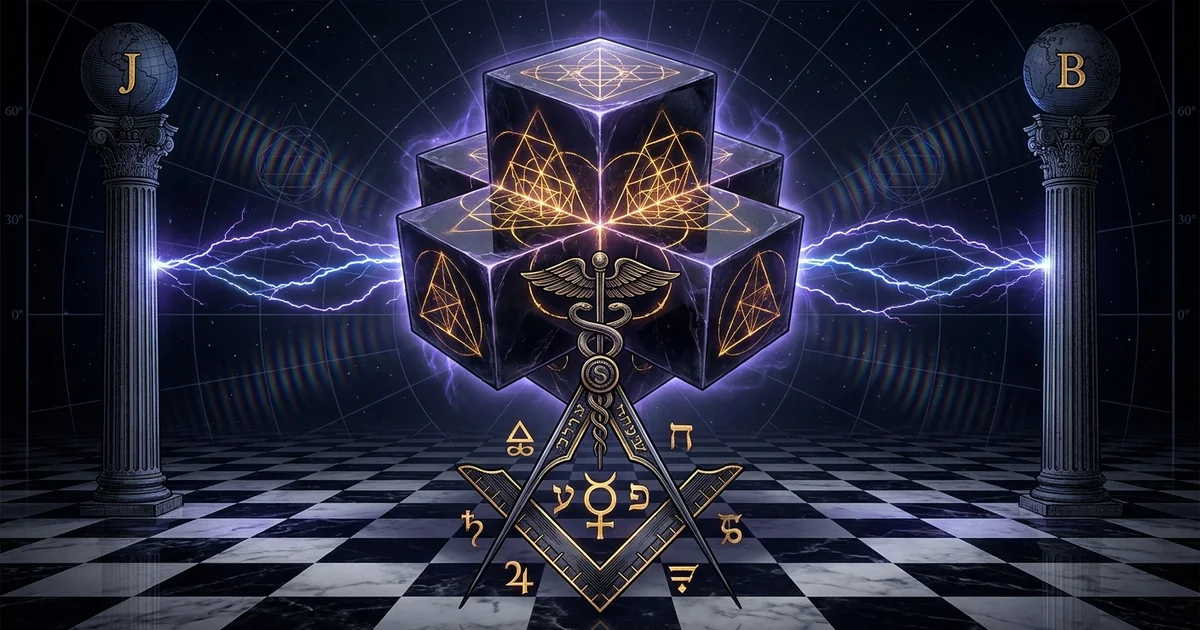
Oswald Wirth: Secret Masonic Geometry of 22 Arcana
Archetypal Thesis & Systemic Paradigm: The Tarot as the Operative Mason’s Tracing Board
The Major Arcana as an Initiatory Dynamic Engine
The publication of Oswald Wirth’s twenty-two Major Arcana in 1889—executed under the direct intellectual aegis of the French occultist Stanislas de Guaita—marked an epistemological rupture in nineteenth-century Western esotericism. Rather than treating the Trumps as instruments for passive fortune-telling, Wirth systematically reconceptualized the cards as an operative Masonic tracing board (tableau de loge). Within this framework, the Major Arcana cease to be static iconographic curiosities; instead, they function as a coherent initiatory engine designed to govern the structural individuation of the human psyche.
Operating within the intellectual matrix of French masonic hermeticism, Wirth recognized that popular cartomancy had reduced a profound psycho-cosmological system to deterministic parlor games. To counter this decay, he reconstructed the cards as an explicit architectural curriculum. The sequence of the Trumps does not delineate an arbitrary catalog of virtues, vices, and astrological omens, but an operational blueprint for the transmutation of consciousness.
Each card acts as a dynamic topological configuration of the Masonic Stone: beginning as the unworked mass of prime matter, subjected to successive geometric calibrations, and culminating in the self-luminous cubic cornerstone of the philosophical temple. In this schema, the initiate traverses an architectural labyrinth modeled directly after the Hiram Abiff archetype, where psychospiritual integration mirrors the legendary Master Mason’s cycle of mortification, extraction from the grave, and reintegration into the transcendent order of the Lodge.
+-------------------------------------------------------------------------+
|                  THE WIRTHIAN HEPTARCHIC POLARITY AXIS                   |
+-------------------------------------------------------------------------+
|  SOLAR/ACTIVE (I - X)           |  LUNAR/PASSIVE (XI - XX)              |
|  Volitional Epistemology        |  Receptive Mysticism & Regeneration   |
|  [ Conscious Crafting ]         |  [ Structural Transmutation ]         |
+---------------------------------+---------------------------------------+
|  I.     Le Bateleur             |  XI.    La Force                      |
|  II.    La Papesse              |  XII.   Le Pendu                      |
|  III.   L'Impératrice           |  XIII.  La Mort                       |
|  IV.    L'Empereur              |  XIV.   Tempérance                    |
|  V.     Le Pape                 |  XV.    Le Diable                     |
|  VI.    L'Amoureux              |  XVI.   La Maison Dieu                |
|  VII.   Le Chariot              |  XVII.  L'Étoile                      |
|  VIII.  La Justice              |  XVIII. La Lune                       |
|  IX.    L'Hermite               |  XIX.   Le Soleil                     |
|  X.     La Roue de Fortune      |  XX.    Le Jugement                   |
+---------------------------------+---------------------------------------+
|                TRANSCENDENT HORIZONTAL SYNTHESIS:                       |
|         0/XXII. Le Fou (Chaos) <---> XXI. Le Monde (Cosmos)             |
+-------------------------------------------------------------------------+
The Rectification of French Occultism through Masonic Hermeticism
The theoretical foundation of Wirth’s labor resides in the rectification of late nineteenth-century French occultism through the rigorous philological and geometric disciplines of Craft Masonry. While late Romantic occultists frequently surrendered to ungrounded astral speculation, Wirth anchored his reform in historical masonry and classical craft iconography. He maintained that the medieval imagiers—the master guildsmen and cathedral sculptors—were custodians of a subterranean Hermetic current that encoded operative wisdom into stone, wood, and printing blocks.
By fusing the Kabbalistic synthesis of Éliphas Lévi with the operative geometry of the Rite Écossais Ancien et Accepté (Ancient and Accepted Scottish Rite), Wirth stripped the iconography of centuries of degradation introduced by commercial card-makers. This was not an artistic embellishment, but a restorative archeological enterprise. The Tarot’s 22 Major Arcana paths were realigned with the primordial archetypes of the Hebrew alphabet, the Sepher Yetzirah, and the Quadrivium. Under Wirth’s hand, the cards became a dynamic apparatus through which the operator navigates the intermediary field between subjective experience and objective metaphysical form.
“The Tarot is a monumental work, as simple and as strong as the architecture of the cathedrals; a work which is durable like them, because it was conceived on a geometric basis… To decipher this silent book, we must learn to read the figures drawn by the ancient master-imagers, who were not ignorant artisans, but initiates possessing the science of numbers, of lines, and of symbols. By rectifying their mutilated work, we do not innovate; we merely restore the temple of thought to its pristine purity.”
Geometric Structuralism versus Divinatory Superstition
To understand the Oswald Wirth secret Masonic geometry Tarot, one must rigorously separate Wirth’s doctrine of “Intuitive Ideography” from profane cartomancy. Conventional fortune-telling operates on a deterministic, externalized theory of reality, interpreting cards through empirical, fatalistic anecdotes. Wirth completely rejected this method, identifying it as an infantile corruption of sacred geometry.
In contrast, Wirthian structuralism treats each Arcanum as an epistemological bridge—a geometric threshold mediating between sensory perception and the noetic forms of the collective unconscious. The card does not predict an exogenous event; rather, it articulates a precise coordinate within the structural mechanics of human cognition.
The lines, angles, posture, and spatial orientation of every figure correspond to Euclidean proportions that systematically engage the mind’s intuitive faculties. By contemplating these calibrated glyphs, the Masonic practitioner applies the square and compass to their own psychological fabric, achieving a state-space diagnosis of internal polarities.
Classical Provenance & Textual Lineage: From Court de Gébelin and Lévi to the 1889 Deck
The Lineage of the Paris Occult Revival: Stanislas de Guaita’s Commission
The emergence of Wirth’s 1889 Major Arcana was inextricably tied to the fin-de-siècle Parisian occult revival, a milieu defined by a reaction against positivist materialism. In 1887, Oswald Wirth, a Swiss-born clerk and practicing Mason, met the charismatic Marquis Stanislas de Guaita. Guaita, who had co-founded the Ordre Kabbalistique de la Rose-Croix, identified in Wirth an artist endowed with philological discipline and draftsmanship. Recognizing that previous occultists had theorized the Tarot without executing a visually pure deck, Guaita financed and supervised Wirth’s initial production of a private, limited-edition pack of the 22 Arcana, restricted to 350 copies.
Guaita’s private correspondence reveals that he regarded Wirth’s work as the vital bridge between speculative Hermeticism and operative symbolic praxis. De Guaita’s own major treatise, Le Temple de Satan (1891), relies extensively on the philosophical foundations established during this intense collaborative period. Wirth’s draftsmanship transformed Guaita’s abstract Kabbalistic concepts into rigorous structural diagrams, effectively formalizing the visual canon of French occultism.
       LINEAGE OF THE FRENCH INITIATORY TAROT TRADITION

       Antoine Court de Gébelin (1781)
       [ Monde Primitif: The Egyptian Hermetic Thesis ]
                       │
                       ▼
       Éliphas Lévi / Alphonse Louis Constant (1854-1856)
       [ Dogme et Rituel: Kabbalistic & Tetragrammatic Axis ]
                       │
                       ▼
       Stanislas de Guaita (1887-1889)
       [ Kabbalistic Order of the Rose-Cross: The Commission ]
                       │
                       ▼
       Oswald Wirth (1889 / 1927)
       [ Le Tarot des Imagiers du Moyen Âge: Masonic Operative Synthesis ]
Textual Transmission: Synthesizing the Marseille Pattern with Lévi’s Kabbalah
The textual lineage of Wirth’s deck traces back directly to Antoine Court de Gébelin’s monumental Monde Primitif (1781), which first hypothesized that the Tarot de Marseille preserved the lost wisdom of ancient Egypt. However, Wirth’s immediate philosophical progenitor was Éliphas Lévi (Alphonse Louis Constant). In Dogme et Rituel de la Haute Magie (1854–1856), Lévi famously proclaimed the Tarot to be the ultimate synthesis of all ancient esoteric sciences, asserting that its structure mirrored the twenty-two paths connecting the ten sephirot on the Tree of Life.
Despite Lévi’s conceptual breakthroughs, he left behind only a handful of isolated sketches, most notably his iconic representations of the Magus, the Chariot, and the Sabbatic Goat (Baphomet). Wirth systematically reconciled Lévi’s theoretical Kabbalah with the historic tarot-de-marseille standard, taking the woodcuts of Nicolas Conver (1760) as a raw historical template.
Wirth stripped away the crude inaccuracies that commercial woodblock carvers had accrued over centuries, replacing accidental distortions with deliberate alignments derived from Albrecht Dürer’s proportion studies and the geometric cannons of medieval guild stonecutters.
A profound structural schism separates the Continental Masonic system of Lévi and Wirth from the Anglo-Saxon system developed by the Hermetic Order of the Golden Dawn under S.L. MacGregor Mathers. The French school assigns the first Hebrew letter, Aleph, to Arcanum I (Le Bateleur), viewing the Juggler/Magician as the active, primordial point of departure for conscious creation, while reserving Shin (or the unnumbered position) for Le Fou (The Fool).
Conversely, the Golden Dawn shifted The Fool to Aleph, aligning the deck with the astrological elemental series (Air) and fundamentally altering the sequence of the 22 paths. For Wirth, assigning zero to the beginning disturbed the sacred architecture of the Scottish Rite, wherein the initiate begins as a conscious agent of work (Arcanum I) equipped with operative tools, rather than an unmanifest void.
The Craft Lodge Influence: Rite Écossais Ancien et Accepté and Wirth’s Philological Labor
Wirth’s perspective was continuously governed by his active membership in the Grande Loge de France and his elevation through the degrees of the Rite Écossais Ancien et Accepté. In card after card, Wirth inscribed the curriculum of the Scottish Rite, encoding the initiatory progression from the Entered Apprentice (1°) through the Master Mason (3°) to the Grand Inspector Inquisitor Commander (31°) and Sublime Prince of the Royal Secret (32°).
His philological labor aimed to prove that the Tarot was not a southern European gambling toy, but an operative mnemonic text crafted to preserve Hermetic science during eras of severe ecclesiastical suppression. This labor culminated in his masterwork, Le Tarot des Imagiers du Moyen Âge (1927), a text that firmly integrated the Major Arcana into the historical lineage of medieval architectural guilds.
Structural Mechanics & Symbolic Geometry: The Decadic Split and Pythagorean Quadrature
The Dyadic Octave: Cards I-XI (Active/Conscious) and XII-XXI (Passive/Unconscious)
The defining structural feature of the Wirthian Tarot is the organization of the first twenty numbered cards into a dual decadic register: two parallel rows of ten cards each, flanked by two autonomous cards representing cosmological poles. This dual register directly reflects the twin pillars of the Masonic temple: Jachin (the active, masculine, solar pillar of conscious willpower) and Boaz (the passive, feminine, lunar pillar of receptive consciousness and organic transformation).
   THE DUAL DECADIC MASONIC GRID (WIRTHIAN ARCHITECTURE)

   [ Pillar of Jachin: Active / Solar Initiation ]
   [I]  ─── [II]  ─── [III] ─── [IV]  ─── [V]   ─── [VI]  ─── [VII] ─── [VIII] ─── [IX]  ─── [X]
    │        │         │         │         │         │          │          │          │        │
    │        │         │         │         │         │          │          │          │        │  Dynamic Synthesis
    ▼        ▼         ▼         ▼         ▼         ▼          ▼          ▼          ▼        ▼
   [XI] ─── [XII] ─── [XIII] ─── [XIV] ─── [XV]  ─── [XVI] ─── [XVII] ─── [XVIII] ── [XIX] ─── [XX]
   [ Pillar of Boaz: Passive / Lunar Initiation ]

   ========================================================================================
   TRANSCENDENT AXIS: [ 0 / XXII ] LE FOU (The Unconditioned) <──> [ XXI ] LE MONDE (The Plenitude)
Cards I through X delineate the upward ascent of the individual ego through self-discipline, mastery over the four lower elements, and deliberate cognitive formation. Here, the initiate asserts volitional authority over their reality.
Cards XI through XX, conversely, delineate an inward descent and passive spiritual surrender: the initiate enters the realm of the unconscious, undergoes psychological dismemberment, confronts shadow dynamics, and endures internal alchemical combustion. Every card in the lower row forms an operative polarity with its paired vertical counterpart in the upper row:
- Arcanum I (Le Bateleur) and Arcanum XI (La Force): The mental initiation of self-conscious agility in raw intellectual space pairs with the visceral transmutation of instinctual biological energy, demonstrating that mental focus without somatic power remains impotent.
- Arcanum IV (L’Empereur) and Arcanum XIV (Tempérance): The rigid, rectilinear terrestrial law of the Emperor finds equilibrium in the fluid, psychic circulation and dynamic homeostasis of Temperance’s dual vases.
The Solar Path (Cards I-X)
- Mode: Operative Volition (The Conscious Will)
- Masonic Grade: Symbolic Lodge (Entered Apprentice, Fellowcraft, Master)
- Psychological Direction: Externalization, ego consolidation, and boundary definition
- Alchemical Phase: Coagula (Fixation of volatile conceptual structures)
- Dynamic Mechanism: Intellectual discrimination, application of moral tools, dynamic assertiveness
The Lunar Path (Cards XI-XX)
- Mode: Mystical Surrender (The Transpersonal Ego)
- Masonic Grade: High Degrees (In Search of the Lost Word, Chapter of Rose-Cross)
- Psychological Direction: Internalization, confrontation with the Unconscious, ego-death
- Alchemical Phase: Solve (Dissolution of rigid character structures)
- Dynamic Mechanism: Somatic catharsis, integration of the shadow, macrocosmic alignment
The Tracing Board Grid: Golden Ratio, 3:4:5 Triangles, and Circular Quadrature
Every figure in Wirth’s 1889 restoration is strictly regulated by Euclidean geometry and classical proportion systems. Under close structural analysis, the underlying linework reveals a scaffolding based on the golden ratio ($\Phi \approx 1.618$), the sacred Pythagorean 3:4:5 right triangle, and the classic problem of the quadrature of the circle.
For instance, in Arcanum IV (L’Empereur), the sovereign sits upon a block of pure unhewn granite: the rough ashlar in the process of becoming the perfect ashlar. His crossed legs, bent at a rigid ninety-degree angle, construct the vertical and horizontal legs of a 3:4:5 right triangle. His torso, arms, and head delineate an upward-pointing equilateral triangle, symbolizing the rule of spirit over dense physical matter. The combination of his upper triangle resting upon the rectangular cube below visually manifests the sacred number seven ($3 + 4 = 7$), the Masonic number required to open a Master’s Lodge.
THE GEOMETRIC ANATOMY OF L'EMPEREUR
                         ▲
                        / \
                       /   \       Equilateral Triangle:
                      /  ▲  \      Spirit / Conscious Principle
                     /_______ \
                     |   |    |
                     |   +----+    Rectangular Ashlar / Square:
                     |  /     |    Matter / Terrestrial Reality
                     +--------+
       Crossed Limbs: 3:4:5 Operative Pythagorean Triangle
       Synthesis: Triangle (3) atop Square (4) = The Septenary (7)</code></pre>
Conversely, Arcanum XII (Le Pendu) reverses this exact geometry. The Hanged Man is suspended by one ankle between two stripped trees bearing twelve lopped branches. His arms form a downward-pointing triangle behind his back, while his crossed legs construct an equal-armed cross above him.
Here, the sacred geometry of the Emperor is inverted: the triangle of spirit descends into the underworld of prime matter, visually articulating the alchemical axiom of Solve et Coagula. The Hanged Man is the operative Mason who has surrendered the rigid rectitude of the conscious ego to be transformed in the unconscious maternal waters.
Zero and Twenty-Two: The Dynamic Orbit of Le Fou and the Closure of Le Monde
Outside the strict twenty-card matrix drift two unassimilated forces: Arcanum XXI (Le Monde) and Le Fou (The Fool, assigned the cipher of 0 or the Hebrew letter Shin). Wirth did not view the Fool as an arbitrary wandering vagrant, but as the unconditioned primal energy of existence—the dynamic cosmic chaos that animates creation.
The Fool wanders diagonally across the grid, pursued by an animal biting his leg, representing the instinctual biological pressures driving the uninitiated psyche. Because he is unnumbered, he moves through all degrees without being contained by any single state.
    THE QUADRATURE OF THE WORLD (ARCANUM XXI)

           [ Man / Angel ]        [ Eagle ]
             (Air / East)        (Water / North)
                   \                 /
                    \               /
                     [ Elliptical  ]
                     [ Mandorla of ]
                     [ Integration ]
                    /               \
                   /                 \
             [ Bull / Ox ]        [ Lion ]
            (Earth / South)      (Fire / West)
Arcanum XXI (Le Monde) represents absolute geometric quadrature and structural closure. At its center stands a triumphant androgynous figure holding two wands—an echo of the dual batons of Arcanum I, now fully realized and unified. Surrounding this central axis is the elliptical mandorla of the wreath, flanked at the four corners by the biblical and astronomical Tetramorph: the Bull, the Lion, the Eagle, and the Angel.
These four figures correspond directly to the cardinal signs of the zodiac (Taurus, Leo, Scorpio, Aquarius), the four classical elements of the Western tradition (Earth, Fire, Water, Air), and the four Masonic virtues. Card XXI is the completed temple, the realization of the Grand Architect’s master plan where all structural polarities find permanent synthesis.
Iconographic Hermeneutics: The Alchemical Tools and Masonic Regalia within the Trumps
The Square, Compass, and Plumb: Implements Disguised in Plain Sight
A hermeneutic examination of the Wirthian iconography exposes an intricate array of Masonic working tools embedded directly into the physical stances, drapery, and implements of the figures. These are not merely decorative elements; they function as precise operative instructions for internal spiritual discipline.
In Arcanum VII (Le Chariot), the young conqueror does not hold reins to direct the two sphinxes pulling his car. Instead, his body functions as the guiding instrument. His left hand holds a golden scepter tipped with a sphere and a triangle, while his upper arms and resting posture construct the distinct ninety-degree angle of the Master’s Square. The vehicle itself is a mobile cubic stone, shielded by a celestial canopy supported by four columns, indicating that the driver’s psychological balance is anchored entirely in his comprehension of the quadrivium and celestial mechanics.
       CONCEALED CRAFT IMPLEMENTS IN THE TRUMPS

       Trump VII: Le Chariot    ---> Arms form the 90° Master's Square
       Trump IV:  L'Empereur   ---> Crossed legs trace 3:4:5 Triangle
       Trump XII: Le Pendu      ---> Limbs form Inverted Triangle over Cross
       Trump IX:  L'Hermite     ---> Staff acts as Masonic Plumb Line
In Arcanum IX (L’Hermite), the robed traveler steps deliberately through the darkness, shielding an amber lantern with his mantle while steadying his path with a staff. The staff acts as the Masonic plumb line: an instrument used by the Craft to verify absolute perpendicularity.
The Hermit does not run toward external illumination; he carries his own protected interior fire, testing the moral terrain step-by-step through self-rectification. The lantern itself is octagonal, a direct geometric reference to the intermediate plane between the terrestrial square and the celestial circle.
The Tetramorph and the Alchemical Salt, Sulfur, and Mercury
Beyond Craft tools, Wirth’s symbolic lexicon systematically incorporates classical Spagyric principles. The primary alchemical triad—Salt (the principle of physical crystallization and form), Sulfur (the dynamic, combustible animating fire), and Mercury (the fluid, volatile communicative spirit)—operates as an energetic baseline beneath every card.
Wirth’s chromatic palette is intentionally non-arbitrary. He restricted the coloration of his 1889 deck exclusively to:
- Red: Sulfur, solar heat, conscious masculine assertiveness.
- Blue: Salt, oceanic depth, receptive lunar containment.
- Yellow/Gold: Transmuted Mercury, solar radiance, intellectual illumination.
- Flesh Tone: Somatic biological reality, the human nervous system serving as the vessel of transformation.
In Arcanum I (Le Bateleur), the Magician stands before a table displaying the instruments of his art. These implements are not modern card suits, but the elemental and alchemical weapons of the adept: the Cup (Water/Salt), the Sword (Air/Mercury), the Pentacle (Earth/Physical Base), and the Wand (Fire/Sulfur). His hat traces the horizontal lemniscate ($\infty$), the mathematical figure of infinity and circular dynamic regeneration, demonstrating that the operator manipulates these alchemical principles within an uninterrupted continuum of vital force.
The Hiram Abiff Mythos Encoded: Mortification, Extraction, and Reintegration
The central drama of Craft Masonry—the assassination of Master Architect Hiram Abiff by three unworthy Fellowcrafts, his burial under a sprig of acacia, the decomposition of his body, and his subsequent raising through the Five Points of Fellowship—is encoded across the pivot points of the Major Arcana.
Arcanum XIII (La Mort) directly represents the Chamber of Reflection and the Masonic grave. The skeletal reaper cuts through limbs and crowned heads that protrude from a dark, rich soil, illustrating the putrefaction (nigredo) necessary for spiritual extraction.
The skeleton’s scythe forms the precise arc of the crescent moon, cutting away obsolete temporal structures. The bones themselves are tinged with pink flesh tones, signifying that this death is not a final biological oblivion, but the vital, operative mortification of the lower personality. Through this initiatory death, the candidate sheds the rough, unhewn projections of the ego and prepares to be raised as a Master Mason within the unified field of the Living Lodge.
Psychological Dynamics & Operational Praxis: The Cybernetics of Self-Rectification
Active Contemplation: The Tracing Board as an Apparatus for Hypnagogic Geometry
For Oswald Wirth, the operational praxis of the Tarot demands active contemplation (méditation active), a technique that bridges cognitive concentration and hypnagogic state access. The initiate does not interpret the card through discursive intellectual logic; instead, they utilize the card as an optical yantra.
By fixating the gaze upon the card’s strict geometry—the convergence of angles, the structural equilibrium of weights, and the complementary distribution of red and blue pigments—the practitioner induces a deliberate suspension of profane cognition. The card functions as an optical coordinate framework that reorganizes somatic awareness along sacred geometric axes.
In this state, the symbolic geometry bypasses conscious defense mechanisms, projecting archetypal patterns directly into the unconscious to resolve mental and emotional fixations.
Transmutation of the Rough Ashlar into the Perfect Ashlar via Archetypal Projections
The primary metaphysical task of the Freemason is to fashion the pierre brute (the rough, formless ashlar) into the pierre cubique (the perfect cubic stone, polished and fitted for insertion into the cosmic temple). Within Wirth’s psychological framework, the rough ashlar represents the unintegrated human psyche—fragmented, reactive, and driven by unconscious complexes.
THE ASHLAR TRANSMUTATION ENGINE
 [ Unconscious Complexes ]             [ Conscious Ego ]
             \                             /
              \                           /
               ▼                         ▼
          +-----------------------------------+
          |      WIRTHIAN TRACING BOARD       |
          |   (External Geometric Mirror)     |
          +-----------------------------------+
                            │
                            │ Rectification via Plumb & Level
                            ▼
          +-----------------------------------+
          |        LE PIERRE CUBIQUE          |
          |    (The Integrated Self / Temenos)|
          +-----------------------------------+</code></pre>
When an initiate meditates upon a Trump, they project their personal psychological conflicts onto the card’s visual architecture. Because Wirth’s cards are drawn according to immutable geometric proportions, the card functions as an external corrective mirror.
If an individual’s internal psychic balance is skewed by excessive aggression, the aggressive stance of Arcanum VII (Le Chariot) or the destructive lightning of Arcanum XVI (La Maison Dieu) illuminates the imbalance through structural contrast. The inherent mathematical harmony of the card challenges the subjective distortion, encouraging internal psychological alignment.
“The mathematical, geometric mandalas found in deep psychological exploration operate not merely as cultural artifacts, but as natural stabilizing centers within unconscious perturbations. As C.G. Jung noted during his seminars on Visions, the psyche under severe pressure naturally retreats to mathematical and geometric archetypes to re-establish an axis of equilibrium against chaotic instinctual flooding.”
The Major Arcana as Cognitive Coordinate Frameworks in Depth Psychology
In the light of depth psychology, Wirth’s Masonic Tarot can be understood as a precursor to C.G. Jung’s active imagination and archetypal cartography. Divination within this model is radically redefined: it is no longer an attempt to interrogate an external fate, but an act of cybernetic diagnostic mapping.
The layout of the cards functions as a dynamic system state-space representation. The reader analyzes where the subject’s mental edifice deviates from plumb and level. If a spread reveals a blockage at Arcanum VIII (La Justice), the diagnosis is not that the client faces an impending court trial, but that the psychological faculty of internal equilibrium and dispassionate judgment has fallen out of alignment. The card serves as a diagnostic matrix, offering a visual prescription for self-correction.
Philosophical Synthesis & Macrocosmic Correspondence: The Grand Architect’s Tetractys
The Tetractys of Pythagoras as the Blueprint of the 22 Paths
The ultimate structural key to Wirth’s esoteric geometry lies in the unification of the twenty-two Hebrew letters and the twenty-two Major Arcana within the Pythagorean Tetractys. The Tetractys, revered by the ancient Pythagoreans as the root of all cosmic manifestation, consists of ten points arranged in four descending rows:
$$\text{Tetractys} = 1 + 2 + 3 + 4 = 10$$
                           THE PYTHAGOREAN TETRACTYS
                                      ●             Row 1: The Monad (Point)
                                     / \
                                    ●   ●           Row 2: The Dyad (Line)
                                   / \ / \
                                  ●   ●   ●         Row 3: The Triad (Plane)
                                 / \ / \ / \
                                ●   ●   ●   ●       Row 4: The Tetrad (Solid)
Wirth applied this numerical progression to the structural architecture of the Tarot. The first ten cards (I through X) represent the unfoldment of the Tetractys in the active realm of conscious generation. The subsequent ten cards (XI through XX) mirror this unfoldment in the passive realm of inward organic transformation.
Together, these two decadic sequences yield twenty cards, which, when integrated with the two transcendent singular cards—Card 0 (Le Fou) and Card XXI (Le Monde)—yield the complete macrocosmic total of twenty-two.
Through this alignment, Wirth linked the Tarot directly to the pre-Socratic Greek tradition. The twenty-two Major Arcana paths cease to be an arbitrary collection of late-medieval allegories; they emerge as the systematic unfoldment of unity into multiplicity, governed by the mathematical laws of the Monad, Dyad, Triad, and Tetrad.
The Reconciliation of Polarities: The Coincidentia Oppositorum in Arcanum XXI
The summit of the Wirthian system is the attainment of the coincidentia oppositorum—the ultimate reconciliation of all polarities. In Arcanum XXI (Le Monde), the dualities that animate the lower nineteen cards collapse into an integrated, harmonic equilibrium.
The two wands held by the central androgynous figure represent the harmonization of the active and passive principles, the hot and the cold, the conscious and the unconscious. This figure is framed by the unbroken green wreath of nature, which is tied at its summit and base with red ribbons shaped like horizontal lemniscates.
This Arcanum embodies the absolute triumph of the Great Work: the rough ashlar has been shaped, measured, and set into the cosmic architecture; the Hiram Abiff archetype has risen from the tomb of matter; and the individual ego has unified with the transcendent will of the Grand Architect of the Universe.
       POLARITY RESOLUTION IN THE WIRTHIAN SYSTEM

       SOLAR REGISTER (I-X)   ──┐
       Volition / Light / Ego    │
                                 ├─► [ XXI. LE MONDE ] ◄─► Coincidentia Oppositorum
       LUNAR REGISTER (XI-XX) ──┘
       Surrender / Dark / Unconscious
Macrocosmic Cyclical Evolution and the Architecture of Modern Hermeticism
Oswald Wirth’s 1889 restoration accomplished far more than an artistic update of the Tarot de Marseille; it founded a distinct, rigorous counter-tradition within modern Hermeticism. While Anglo-American occultism increasingly embraced freeform mediumship, astral traveling, and eclectic syncretism, Wirth preserved a disciplined Continental tradition rooted in philosophical lucidity, Masonic craft discipline, and classical geometric proportions.
By demonstrating that the twenty-two Major Arcana embody a coherent mathematical and architectural blueprint, Wirth established the Tarot as an enduring instrument of human psychospiritual self-evolution. His work stands as an unbroken bridge between the medieval cathedral guilds, classical geometry, and modern depth psychology, providing the initiate with the exact tools needed to construct their own interior temple under the perpetual guidance of the Grand Architect.
Frequently Asked Questions
Why did Oswald Wirth preserve the French Tarot letter attributions instead of adopting the Golden Dawn system?
Wirth remained committed to the French Kabbalistic tradition initiated by Éliphas Lévi and codified within Parisian Masonic lodges. In this tradition, Aleph corresponds directly to Arcanum I (Le Bateleur), representing the absolute, singular, active point of departure for conscious existence.
Wirth saw the British Hermetic Order of the Golden Dawn’s decision to assign Aleph to The Fool as an unnecessary disruption of this traditional system. To Wirth, the initiate begins their spiritual journey not as an empty, formless void, but as a deliberate apprentice equipped with operative tools, ready to build upon the tracing board of life.
What is the operational purpose of the dual decadic table (Cards I-X and XI-XX)?
The dual decadic table arranges the first twenty numbered cards into two parallel, interacting horizontal registers of ten cards each, flanked by Arcanum 0 and Arcanum XXI. This format directly reflects the dual pillars of the Masonic temple: Jachin (Cards I–X, representing the solar, conscious, and volitional path) and Boaz (Cards XI–XX, representing the lunar, receptive, and unconscious path).
This arrangement demonstrates that every active, volitional achievement in the first register requires a corresponding inward, transformative sacrifice in the second. For example, the mental will of Le Bateleur (I) is balanced by the physical, instinctual mastery of La Force (XI), preventing the initiate from succumbing to one-sided intellectual or spiritual inflation.
How does Wirth’s concept of the ‘Imagiers’ connect medieval stonecutters to occult Tarot symbolism?
In Le Tarot des Imagiers du Moyen Âge, Wirth argued that the anonymous sculptors, stonecutters, and woodcarvers of medieval cathedral guilds (les imagiers) were the true guardians of classical esoteric wisdom during the Middle Ages.
Surviving under strict ecclesiastical surveillance, these craft guilds embedded Hermetic, Gnostic, and Pythagorean geometry directly into cathedral bas-reliefs, stone capitals, and popular woodcut prints. Wirth asserted that the earliest Tarot woodblocks were not secular card games, but portable, encrypted tracings of the same sacred geometry utilized by cathedral builders to represent the laws of the universe.
Can Wirth’s Masonic Tarot be utilized for practical divination, or is it exclusively an initiatory device?
While Wirth’s deck can be used for cartomantic readings, its primary design is that of an initiatory engine and an optical tool for active contemplation. Wirth explicitly criticized profane fortune-telling, warning that treating the cards as superstitious oracles debased their philosophical purpose.
When applied practically, Wirth advocated a methodology called Intuitive Ideography, where the cards serve as a diagnostic framework to assess a person’s psychological and moral balance, mapping their current status against the ideal geometry of the Masonic tracing board.
To operate Wirth’s cards as a diagnostic tool rather than a superstitious oracle, the practitioner must adhere to three foundational rules of interpretation:
- Geometric Diagnostics: The card must be examined for its structural lines of tension, identifying whether the subject’s energy is operating along the horizontal (material), the perpendicular (spiritual/moral), or the diagonal (transitional dynamic).
- Rejection of Fatalism: The cards never indicate inevitable events; they delineate energetic tendencies within the subject’s psychological state-space.
- The Rectifying Prescription: Every reading must conclude by identifying the compensating card—the geometric counter-weight within the 22 Arcana required to bring the client’s internal lodge back into alignment with the plumb line and the square.