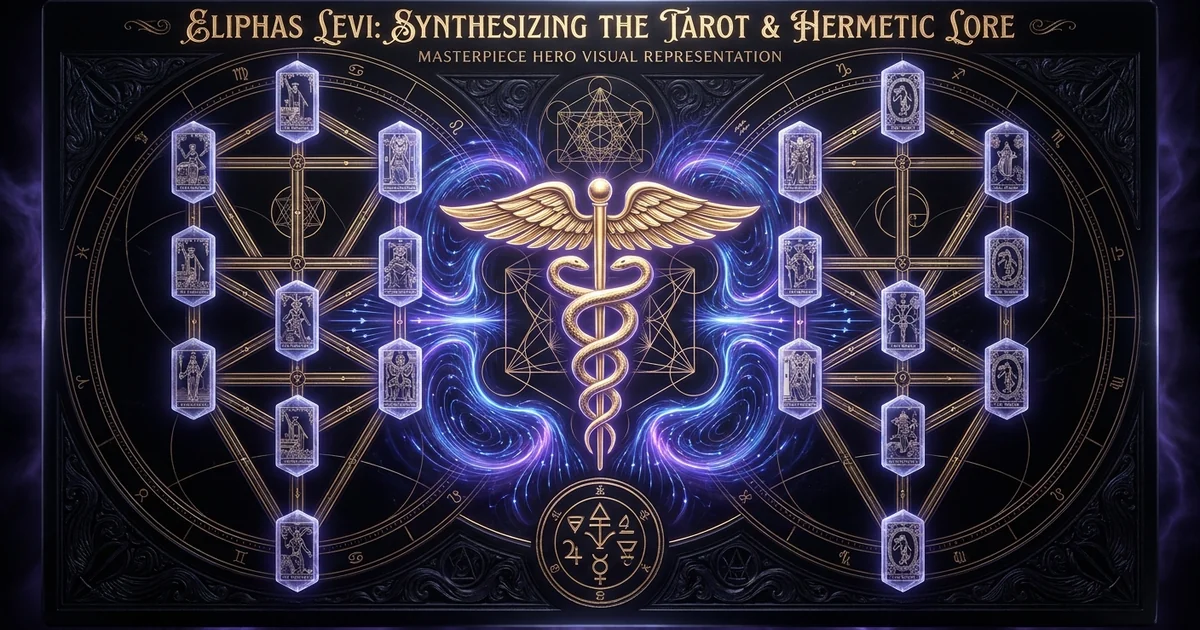
Eliphas Levi: Synthesizing the Tarot & Hermetic Lore
Archetypal Thesis & Systemic Paradigm: The Tarot as the Universal Hermetic Key
The Epistemological Leap of Alphonse Louis Constant
In the mid-nineteenth century, the French occultist Alphonse Louis Constant, writing under the Hebraicized nom de plume Éliphas Lévi, fundamentally reorganized Western esoteric philosophy. Prior to the publication of his twin-volume masterwork, Dogme et Rituel de la Haute Magie (1854–1856), the Tarot occupied an ambiguous cultural position: it was sustained either as a vernacular trick-taking card game (tarocchi) in continental taverns or as a tool of intuitive cartomancy popularized by Parisian fortune-tellers. Lévi executed a radical epistemological pivot. He rejected the predictive, fatalistic paradigm of the street prognosticator, identifying the 78 leaves of the Tarot not as instruments of petty divination, but as the fragmented remnants of the primordial Book of Hermes—an absolute philosophical, cosmogonic, and metaphysical alphabet.
By extracting the cards from the domain of vulgar amusement, Lévi reconstituted them as an objective symbolic engine. His core insight was that the Tarot constituted an integrated cognitive calculus: a systematic combinatorium whose primary purpose was to coordinate the macrocosmic laws of nature with the microcosmic operations of the human mind. This methodological shift served as the inaugural spark of the French Occult Revival, transforming esoteric practice into a structured epistemological inquiry. Lévi proposed that just as mathematics provides an abstract language for measuring material phenomena, the Tarot provides an exact symbolic nomenclature for analyzing the transformations of consciousness and the metaphysical architecture of reality.
“Lévi’s great innovation was not that he invented new doctrines, but that he systematized disparate strands of Renaissance Hermeticism, Christian Kabbalah, and nineteenth-century Romanticism into an integrated, seemingly rational occult science. In doing so, he provided a counter-Enlightenment framework that did not reject reason, but extended it through symbolic structuralism, transforming esotericism from fragmented superstition into a coherent psychological architecture capable of addressing the spiritual crisis of modernity.” — Wouter J. Hanegraaff, Esotericism and the Academy: Rejected Knowledge in Western Culture (Cambridge University Press, 2012)
The Astral Light as the Mediating Psychocosmic Substrate
Central to Lévi’s synthesis is the mechanics of what he designated the astral-light (lumière astrale). Drawing heavily upon Mesmer’s animal magnetism, Renaissance concepts of the spiritus mundi, and nineteenth-century electromagnetic field theories, Lévi posited the existence of a universal, hyper-sensitive metaphysical fluid that saturates all space. This substrate serves as the intermediate medium between pure noumenal spirit and gross phenomenal matter. The Astral Light is plastic, receptive, and continuously modulated by currents of human and cosmic volition; it acts as a cosmic mirror, preserving the archetypal imprints, forms, and emotional currents of every act and thought generated within the manifested universe.
Within this framework, the Tarot operates as an optical apparatus or electromagnetic regulator for the soul. Lévi recognized that the human will, operating in isolation, lacks the leverage necessary to govern the chaotic tides of the Astral Light. The major-arcana provide precise geometric and mythic lenses that arrest, clarify, and direct this elusive medium. By meditating upon or ritually manipulating the specific symbolic alignments of an Arcanum, the adept acts upon the Astral Light via a cybernetic feedback loop: the card focuses the operator’s subjective intent, projecting that purified mental current into the universal plastic medium, which in turn reflects back into the practitioner’s consciousness as transformed perception and expanded agency.
The 22 Arcana as an Ontological State-Space Alphabet
Lévi conceived the 22 Major Arcana as an exhaustive inventory of cosmological phases—a closed-loop, ontological state-space alphabet. Rather than treating the figures (the Juggler, the Empress, the Hierophant, the Hanged Man) as isolated, allegorical portraits, he perceived them as an organic taxonomy of fundamental dynamic states. Every human experience, metaphysical transition, and cosmic cycle could be resolved into a specific permutation of these 22 archetypal operators.
By linking these archetypal nodes together, Lévi developed a comprehensive model of human consciousness:
- The trumps represent an integrated grammar of being, where individual archetypes gain their precise definition only through their operational relationships to the surrounding system.
- The sequential array of the 22 keys forms a deliberate trajectory of psychic initiation, tracking the spirit’s descent from absolute unity into material multiplicity, followed by its systematic reintegration into transcendence.
- The combinatorial permutation of the keys allows the human mind to construct an exact semantic representation of any cosmological or psychodynamic problem, bridging subjective consciousness and objective reality.
This structuralist conception of the Tarot established the bedrock of the eliphas levi tarot kabbalah synthesis. Lévi asserted that whoever possessed the keys to the Tarot, even if imprisoned without access to external books or sensory stimulation, could deduce all branches of human knowledge, recover ancient wisdom, and speak with immutable authority on any metaphysical paradox. The Tarot was no longer a deck of painted pasteboards; it was the definitive map of human and cosmic consciousness.
Classical Provenance & Textual Lineage: From Renaissance Cartomancy to Dogme et Rituel
[Renaissance Trionfi Decks]
       │ (Secular / Allegorical)
       ▼
[Court de Gébelin (1781)] ──> Romanticized Egyptian Mythos
       │
[Etteilla (Alliette, 1783)] ──> Popularized Cartomantic Divination
       │
       ▼
[Éliphas Lévi (1854–1856)] ──> Structural Hebraic-Kabbalistic Synthesis
       │ (Dogme et Rituel)
       ▼
[Western Hermeticism / Modern Esoteric Cartography]
Court de Gébelin, Etteilla, and the Egyptian Premise
The integration of the Tarot into Western esoteric philosophy originated prior to Lévi, but it had lacked structural and linguistic coherence. The trajectory began in 1781 when the Protestant clergyman and scholar Antoine Court de Gébelin published the eighth volume of his monumental compendium, Monde Primitif, analysé et comparé avec le monde moderne. In an essay dedicated to the Taraux, Court de Gébelin posited that the cards were not of late-medieval Italian design, but were the sole surviving fragments of an ancient Egyptian book of wisdom—the Book of Thoth—rescued from the burning libraries of the Nile valley and disguised as an innocuous game of chance by prudent priesthoods.
Following Court de Gébelin’s speculative treatise, the French printmaker and mathematician Jean-Baptiste Alliette (writing under the anagrammatic pseudonym Etteilla) published Manière de se récréer avec le jeu de cartes nommées Tarots (1783–1785). Etteilla was the first to professionalize cartomancy, establishing operational rules, reversing meanings, and redesigning the deck to emphasize an idiosyncratic interpretation of Egyptian cosmogony. Despite his commercial success, Etteilla’s system was structurally volatile. He broke the historic sequence of the cards, rearranged the iconography to fit his own speculative narratives, and subordinated Hermetic philosophy to divinatory pragmatism. Lévi regarded Etteilla with intellectual disdain, condemning him in Histoire de la Magie (1860) as an uneducated illuminé whose arbitrary innovations had obscured the purity of the primitive tradition.
The Architectural Genesis of Dogme et Rituel de la Haute Magie
Recognizing the flaws in Etteilla’s methodology, Lévi engaged in a profound historical and textual reconstruction. He observed that while Court de Gébelin was correct in discerning a profound philosophical substrate within the Tarot, the Swiss clergyman had misattributed its structural syntax. The operational mechanics of the deck were not natively Egyptian in form, but explicitly Kabbalistic. The Tarot’s numerical architecture was inextricably anchored to the sacred linguistics of the Hebrew alphabet.
Lévi embedded this structural epiphany into the very compositional architecture of his foundational literary work, Dogme et Rituel de la Haute Magie. The text is strictly divided into two distinct volumes of 22 chapters each:
Dogme et Rituel de la Haute Magie
│
├── Volume I: Dogme (Theory / Ontology)
│    ├── Chapter 1: The Candidate (Aleph / Le Bateleur)
│    ├── Chapter 2: The Pillars of the Temple (Beth / La Papesse)
│    └── [...] through Chapter 22: The Sanctum Regnum (Tau / Le Monde)
│
└── Volume II: Rituel (Practice / Execution)
     ├── Chapter 1: Preparations (Aleph)
     ├── Chapter 2: The Magical Equilibrium (Beth)
     └── [...] through Chapter 22: The Kabbalah (Tau)
By organizing the work such that every theoretical premise in the Dogme and every ceremonial instruction in the Rituel corresponds directly to the numerical index, symbolic imagery, and Hebraic attribution of an individual Arcanum, Lévi transformed his textbook into an operational deployment of the Tarot itself.
“An absolute work of art, a creation that is simple and yet complex, like the architecture of a pyramid, and consequently durable like it; a book that is the summary of all sciences, whose infinite combinations can solve all problems; a book that speaks by causing us to think; an inspired instrument of all possible conceptions, the masterpiece of the human mind, and assuredly one of the most beautiful things that antiquity has bequeathed to us: the Tarot, this singular monument whose origin is lost in the night of time, is nothing other than the Clavicula Salomonis, the universal key of the Kabbalists and the true schema of the sanctuary.” — Éliphas Lévi, Dogme et Rituel de la Haute Magie (1854–1856), “Discours Préliminaire”
Textual Convergence: Merging the Sepher Yetzirah with Trionfi Decks
The textual catalyst that allowed Lévi to complete his structural synthesis was the Sepher Yetzirah (The Book of Formation), one of the earliest extant texts of Jewish Kabbalah. The Sepher Yetzirah establishes that the architecture of the cosmos was carved out through thirty-two mystical Paths of Wisdom, which consist of the ten ineffable Sephiroth (numerical emanations) and the twenty-two foundation letters of the Hebrew alphabet. The text groups these twenty-two letters into three distinct cosmological classifications:
- Three Mother Letters (Immot - א, מ, ש): Representing the primordial elements of Air (Ruach), Water (Mayim), and Fire (Esh), out of which the cosmos is generated.
- Seven Double Letters (Kefulot - ב, ג, ד, כ, פ, ר, ת): Representing the polarities of human experience, the seven classical planets, and the seven primary directions of cosmic space.
- Twelve Simple Letters (Peshutot - ה, ו, ז, ח, ט, י, ל, נ, ס, ע, צ, ק): Representing the twelve signs of the Zodiac, the twelve faculties of the human soul, and the twelve fundamental segments of time.
Lévi observed that the standard Italian Renaissance trionfi pattern—preserved in the classic Tarot of Marseille—contained an identical number of trump cards: twenty-two. For Lévi, this was not coincidental iconography or arbitrary card-play design. The 22 Major Arcana were an exact visual manifestation of the 22 foundation letters delineated in the Sepher Yetzirah.
By mapping the 22 trumps across the tree-of-life, Lévi integrated the pictorial allegories of the Renaissance with the profound metaphysical dynamics of classical Jewish mysticism, establishing the fundamental grammar that would drive the nineteenth-century french-occult-revival.
Structural Mechanics & Symbolic Geometry: The 22 Letters, 22 Arcana, and the Tree of Life
The Alphabetic-Arcana Alignment Matrix
Lévi established a linear, sequential attribution schema linking the numerical index of each Major Arcanum to the ordinal placement of the Hebrew letters. Unlike later esotericists who altered card sequences to harmonize with specialized astrological systems, Lévi maintained the structural integrity of the numbering found on the historic Tarot of Marseille:
| Major Arcanum (Marseille Index) | Traditional French Name | Hebrew Letter Attribution | Phonetic / Symbolic Value | Cosmic Category (Sepher Yetzirah) |
|---|---|---|---|---|
| I | Le Bateleur (The Magus) | Aleph (א) | Primordial Unity / Breath | Mother (Air) |
| II | La Papesse (The High Priestess) | Beth (ב) | The Sanctuary / Duality | Double (Moon) |
| III | L’Impératrice (The Empress) | Gimel (ג) | Generation / Nature | Double (Venus) |
| IV | L’Empereur (The Emperor) | Daleth (ד) | Authority / Form | Double (Jupiter) |
| V | Le Pape (The Hierophant) | He (ה) | Divine Law / Religion | Simple (Aries) |
| VI | L’Amoureux (The Lovers) | Vau (ו) | Equilibrium / Trial | Simple (Taurus) |
| VII | Le Chariot (The Chariot) | Zain (ז) | Triumph / Sovereign Will | Simple (Gemini) |
| VIII | La Justice (Justice) | Cheth (ח) | Karmic Law / Equilibrium | Simple (Cancer) |
| IX | L’Ermite (The Hermit) | Teth (ט) | Prudence / Hidden Light | Simple (Leo) |
| X | La Roue de Fortune (Wheel of Fortune) | Yod (י) | Destiny / Cyclic Manifestation | Simple (Virgo) |
| XI | La Force (Strength) | Kaph (כ) | Moral Potency / Mastery | Double (Mars) |
| XII | Le Pendu (The Hanged Man) | Lamed (ל) | Sacrificial Transmutation | Simple (Libra) |
| XIII | La Mort (Death) | Mem (מ) | Renewal / Dissolution | Mother (Water) |
| XIV | Tempérance (Temperance) | Nun (נ) | Transmutation / Combination | Simple (Scorpio) |
| XV | Le Diable (The Devil) | Samekh (ס) | The Astral Light / Polarity | Simple (Sagittarius) |
| XVI | La Maison Dieu (The Tower) | Ayin (ע) | Rupture / False Security | Simple (Capricorn) |
| XVII | L’Étoile (The Star) | Pe (פ) | Hope / Radiant Influx | Double (Mercury) |
| XVIII | La Lune (The Moon) | Tzaddi (צ) | Illusions / Twilight | Simple (Aquarius) |
| XIX | Le Soleil (The Sun) | Qoph (ק) | Radiance / Vital Truth | Simple (Pisces) |
| XX | Le Jugement (Judgment) | Resh (ר) | Resurrection / Awakening | Double (Sun) |
| [Unnumbered] | Le Mat (The Fool) | Shin (ש) | Unrestrained Vital Motion | Mother (Fire / Spirit) |
| XXI | Le Monde (The World) | Tau (ת) | The Absolute / Microcosm | Double (Saturn / Earth) |
This structural correlation created an accessible linguistic cipher: each card ceased to be an isolated medieval caricature and instead became an active symbol whose theological, cosmological, and physical ramifications could be directly unraveled by cross-referencing the letter’s properties in the Sepher Yetzirah.
The Strategic Enigma of Le Mat (The Fool) and Letter Shin
The critical anomaly within Lévi’s alignment matrix is his placement of the unnumbered Arcanum, Le Mat (The Fool). While twentieth-century esoteric organizations—most notably the Hermetic Order of the Golden Dawn—repositioned The Fool at the very beginning of the series as Card 0 assigned to the first letter Aleph (א), Lévi retained The Fool’s historic position as an anomalous, roving entity situated immediately between Key XX (Le Jugement) and Key XXI (Le Monde). Consequently, Lévi attributed Le Mat to the penultimate letter, Shin (ש).
Lévi's Sequential Alignment:
[Card XX: Le Jugement] ──> [Resh (ר)]
                                │
[Unnumbered: Le Mat]   ──> [Shin (ש)]  <-- Penultimate Disruptive Vector
                                │
[Card XXI: Le Monde]   ──> [Tau (ת)]
Lévi’s allocation of Shin to The Fool represents an intentional philosophical formulation rather than an arbitrary assignment:
- In the Kabbalah, Shin (ש) is the holy letter of cosmic Fire and Divine Spirit (Ruach Elohim), carrying an intense, combustive, and destabilizing potency.
- By placing this volatile force directly before Tau (ת)—the final letter signifying cosmic crystallization, stability, and completion (The World)—Lévi highlighted a core mystery of esoteric initiation: the ultimate obstacle to absolute realization is pure, unstructured psychic force.
- Le Mat represents the individual human soul that has cast aside the constraints of mundane reason. When undisciplined, this figure drifts into madness, vanity, and self-destruction, wandering forever through the wastes of the Astral Light; but when consciously mastered, this holy foolishness transmutes into divine inspiration and transcendental freedom.
By placing The Fool at Shin, Lévi preserved an initiatory threshold where complete systemic dissolution must immediately precede ultimate cosmological realization.
Geometric Redesign: The Chariot of Hermes and the Sanctum Regnum
Lévi did not restrict his synthesis to abstract philosophical texts; he redesigned specific emblematic icons to rectify historical distortions and encode pure Hermetic geometry. The most influential examples of Lévi’s symbolic restorations appear in his visual configurations of the 7th Key (The Chariot) and the 15th Key (The Devil / Baphomet).
In his rendering of the 7th Arcanum, The Chariot—which Lévi associated with the seventh letter, Zain, and the triumphant mastery of mind over matter—he eliminated the superficial military imagery characteristic of late Renaissance decks. Instead, Lévi configured the vehicle as a cube surmounted by a four-columned baldachin of the sanctum-regnum, representing the quaternary elements organized by spiritual will. The charioteer is depicted as an armored conqueror holding an unadorned sceptre of solar force, wearing a crown with three radiant pentagrams.
The vehicle is drawn not by standard horses, but by two sphinxes pulling in opposite directions: one white (representing mercy, expansion, and light), the other black (representing judgment, contraction, and darkness). The triumph of the initiate does not consist of destroying the dark sphinx, but of holding the psychic reins with such absolute equilibrium that both diametrically opposed vectors are forced to pull the chariot in a unified forward trajectory. This image exemplifies Lévi’s master axiom: the mastery of the Astral Light requires continuous, dynamic equilibrium between opposing natural polarities.
Psychological Dynamics & Operational Praxis: The Tarot as an Engine of Magickal Volition
Polarities of the Human Will and the Great Magical Agent
For Lévi, high magic (la haute magie) was not an appeal to supernatural intervention, demonic pacts, or theological miracles. He defined magic scientifically: it was the cultivation and direction of the human will to govern the fluid dynamics of the Astral Light. Because the Astral Light is naturally polarized into active and passive currents—symbolized throughout esoteric literature as the twin serpent-energies of the caduceus, the pillars of Jachin and Boaz, and the light and dark sphinxes of the Chariot—the untrained human mind is perpetually tossed about by its tides.
The 22 Major Arcana serve as an indispensable psycho-spiritual apparatus. When the adept contemplates an individual Arcanum, they are not engaging in passive aesthetic appreciation; they are executing a deliberate cognitive tuning operation. The Arcanum crystallizes a specific polarity within the Astral Light:
- The 1st Key (Le Bateleur) polarizes the operator’s will toward conscious initiation and concentrated volitional emission.
- The 2nd Key (La Papesse) counter-balances this drive by polarizing the mind toward contemplative receptivity and intuitive retention.
- The sequential cycling through these complementary archetypes trains the operator’s nervous system to manipulate internal energetic currents, preventing psychic imbalance, fanaticism, and mental exhaustion.
The Tarot as a Meditative Combinatorium for Active Imagination
By approaching the Tarot as a structural linguistic matrix, Lévi anticipated the depth-psychology methods that Carl Gustav Jung would develop half a century later. Lévi recognized that the human subconscious mind does not process abstract dialectical logic as readily as it processes living, symbolic iconography. The figures of the Major Arcana operate as primordial archetypes that access the deepest strata of the human psyche.
When an adept lays out the Tarot keys in dynamic geometrical arrangements, they establish a multi-dimensional combinatorium:
- The physical cards externalize internal mental and emotional complexes, casting them onto the table where they can be observed with clinical detachment.
- By repositioning, rotating, or synthesizing these symbolic keys, the operator restructures their internal cognitive network, dissolving fixations and harmonizing repressed elements of the subconscious.
- This practice operates as a precursor to Jungian active imagination: the operator engages in conscious dialogue with the symbols, allowing the archetypes to unfold their inherent narratives within the imagination while the rational ego maintains structural control over the process.
The Tarot thereby transforms from a static deck of cards into an operational engine of psychological re-engineering, wherein the adept consciously updates their own inner psychic software.
Comparative Paradigms: Divinatory Fatality vs. Volitional Self-Mastery
Lévi drew an unyielding line between the popular cartomancy of the nineteenth-century salons and his own Hermetic operative system. Vulgar fortune-telling was predicated upon a debilitating belief in fixed fatality (heimarmene), which reduced the human subject to an impotent victim of arbitrary destiny. In stark contrast, Lévi’s Hermetic methodology deployed the cards as a diagnostic and volitional tool designed to shatter deterministic habits and awaken autonomous self-mastery.
Vulgar Fortune-Telling (Passive Mantic Divination)
- Underlying Premise: Mechanical fatalism; human events are predetermined by external cosmic or supernatural forces.
- Epistemological Goal: Passive foreknowledge of future mundane circumstances (e.g., romantic unions, financial windfalls, physical sickness).
- Card Handling Mechanism: Random, superstitious shuffling; cards are viewed as arbitrary prognosticators acting through blind chance.
- Querent Status: Subjugated and dependent; an inactive consumer awaiting the pronouncements of an external oracle.
- Psychological Consequence: Neurological passivity, elevated existential anxiety, confirmation bias, and the surrender of sovereign personal agency.
Lévi's Hermetic Cartomancy (Active Operative Volition)
- Underlying Premise: Universal dynamic equilibrium; physical circumstances are downstream reflections of mental polarities directed through the Astral Light.
- Epistemological Goal: Diagnostic analysis of existing psychological and archetypal forces to optimize volitional intervention.
- Card Handling Mechanism: Methodical mathematical permutations; cards serve as structural keys to the Kabbalistic and Hermetic laws of nature.
- Querent Status: Autonomous sovereign; an active laboratory investigator deploying will to master internal and external currents.
- Psychological Consequence: Radical self-accountability, integration of unconscious polarities, emotional equilibrium, and sovereign volitional agency.
Philosophical Synthesis & Macrocosmic Correspondence: The Tetragrammaton and the Architecture of Reality
The Quaternary Formula (YHVH) within the Minor Arcana
While Lévi focused his most celebrated analyses on the 22 Major Arcana, his structural synthesis extended systematically across the 56 Minor Arcana. Prior to Lévi, esotericists lacked a unified paradigm to contextualize the four suits—Wands (Bâtons), Cups (Coupes), Swords (Épées), and Coins or Pentacles (Deniers). Lévi solved this systemic impasse by linking the suits directly to the sacred four-letter name of God, the tetragrammaton (יהוה - Yod, He, Vau, He final), which classical Kabbalah identifies as the fractal engine of all cosmic manifestation.
The Tetragrammaton & The Four Worlds:
[Yod (י)]   ──> Atziluth (Archetypal) ──> Fire  ──> Wands (Bâtons)
[He (ה)]    ──> Briah (Creative)       ──> Water ──> Cups (Coupes)
[Vau (ו)]   ──> Yetzirah (Formative)   ──> Air   ──> Swords (Épées)
[He (ה)]*   ──> Assiah (Material)      ──> Earth ──> Coins / Pentacles (Deniers)
*He final
Under Lévi’s quaternary attribution model, the 56 Minor Arcana represent the descent of macrocosmic energy across the four Kabbalistic worlds:
- The Scepters / Wands: Embody the letter Yod (י), corresponding to the element of Fire, the world of Atziluth (Archetypal Emanation), and the sovereign spark of spiritual Will.
- The Cups: Embody the first letter He (ה), corresponding to the element of Water, the world of Briah (Creative Conception), and the receptive depths of the Soul.
- The Swords: Embody the letter Vau (ו), corresponding to the element of Air, the world of Yetzirah (Formative Generation), and the analytical polarities of the Intellect.
- The Coins / Pentacles: Embody the second letter He (ה final), corresponding to the element of Earth, the world of Assiah (Material Realization), and the physical crystallizations of Action.
By structuring the Minor Arcana around this formula, Lévi provided a nested, fractal cartography of reality. The ten pip cards in each suit correspond directly to the ten Sephiroth descending through their respective elemental worlds, while the four court cards (King, Queen, Knight, Page) serve as living human personifications of the quaternary formula operating within social, psychological, and spiritual encounters.
“The quaternary is the universal number of creation, the key to all secrets, the figure of the cross, and the base of the cube. The four suits of the Tarot—Wands, Cups, Swords, and Pentacles—are the four hieroglyphic signs of the Tetragrammaton: the phallic Rod of Moses (Yod), the chalice of Joseph and Hermes (He), the piercing Sword of Michael (Vau), and the cyclic Disk or Pantacle of Solomon (He final). Through these four signs, the human intellect reads the sacred book of the universe and executes the Great Work.” — Synthesis from Éliphas Lévi, Dogme et Rituel de la Haute Magie and Le Sanctum Regnum
The Hermetic Axiom of Polar Equilibrium: Solve et Coagula
Permeating Lévi’s entire analysis of the Tarot is the alchemical imperative emblazoned across the arms of his famous illustration of the Sabbatic Goat (Baphomet): SOLVE ET COAGULA (“Dissolve and Coagulate”). This axiom describes the continuous, rhythmic pulsation of the universe: the systematic breakdown of obsolete forms followed by the reintegration of spiritual energy into purified material structures.
Within Lévi’s reading of the Tarot, this alchemical rhythm is manifested through dynamic archetypal polarities:
- The journey across the 22 trumps is not a flat linear progression, but a rhythmic alternation between Solve (dissolution, purification, and dismantling of ego-structures) and Coagula (reconstitution, stabilization, and spiritual embodiment).
- The 12th Arcanum (Le Pendu) and the 13th Arcanum (La Mort) operate as the ultimate Solve phase of initiation, ruthlessly breaking down the candidate’s rigid conceptual constructs and personal attachments.
- Conversely, the 14th Arcanum (Tempérance) and the 21st Arcanum (Le Monde) represent the Coagula phase, where purified, unattached consciousness is systematically reconstituted into an equilibrated spiritual vessel.
To Lévi, mastery of the Tarot requires an intuitive command of this polar mechanics. The magician is one who can dissolve psychic petrifications at will without collapsing into chaos (Solve), and who can crystallize spiritual insights into durable material reality without falling into dogmatic rigidity (Coagula).
The Transatlantic Heritage: Transmission to Mathers, Crowley, and Modern Psychology
The structural synthesis forged by Éliphas Lévi between 1854 and 1860 set off a profound chain reaction throughout European esotericism. While British occultists frequently criticized Lévi for intentional obfuscations, historical inaccuracies, and idiosyncratic French Catholic leanings, they nonetheless adopted his fundamental thesis: that the Tarot is the pictorial key to the Kabbalistic Tree of Life.
Transmission Vector of Lévi's Synthesis:
[Éliphas Lévi] (Dogme et Rituel, 1854–1856)
       │
       ▼
[Kenneth R.H. Mackenzie & Arthur Edward Waite] (Translation & Critique, 1886/1896)
       │
       ▼
[The Hermetic Order of the Golden Dawn] (Mathers, Westcott, 1888)
       │ ──> Transposed Justice (8) & Strength (11); Shifted Fool to Aleph (0)
       ├─────────────────────────────────┐
       ▼                                 ▼
[Arthur Edward Waite & Pamela Colman Smith]   [Aleister Crowley & Lady Frieda Harris]
(Rider-Waite-Smith Deck, 1909)                (Thoth Tarot Deck, 1944)
       │                                 │
       └────────────────┬────────────────┘
                        ▼
       [Modern Depth Psychology & Archetypal Cartography]
In late-nineteenth-century England, S.L. MacGregor Mathers and the founders of the Hermetic Order of the Golden Dawn extracted Lévi’s Hebraic attributions, modified them by transposing Keys 8 and 11 to align with astrological Libra and Leo, and established the theoretical basis for twentieth-century occultism.
Arthur Edward Waite, who translated Lévi’s major writings into English in 1896, drew heavily upon Lévi’s structural framework when he collaborated with Pamela Colman Smith in 1909 to create the universally recognized Rider-Waite-Smith (RWS) Tarot deck. Decades later, Aleister Crowley utilized Lévi’s core Kabbalistic architecture to compose his Book of Thoth (1944). Ultimately, Lévi’s transformation of the Tarot from a game of chance into a symbolic coordinate system laid the operational foundation for the twentieth-century intersection of esotericism and depth psychology, cementing the Tarot’s modern identity as an indispensable cartography of the human unconscious.
Frequently Asked Questions Regarding Lévi’s Hermetic Tarot Synthesis
Did Éliphas Lévi Design His Own Complete 78-Card Tarot Deck?
Lévi never executed, engraved, or commercially published a complete 78-card Tarot deck. His legacy rests primarily on his theoretical writings, along with a select number of iconic pen-and-ink drawings created to illustrate specific chapters of his books. The most famous of these include his structural designs for Key I (The Magus / Le Bateleur), Key VII (The Chariot / Le Chariot), Key X (The Wheel of Fortune), Key XV (The Sabbatic Goat / Baphomet), and Key XXI (The Sanctum Regnum / The World).
Lévi intended his readers to utilize the historic, woodblock-printed Tarot of Marseille (Tarot de Marseille) as their practical foundation. He believed that despite its crude, medieval aesthetics, the Marseille deck preserved the essential geometric, numeric, and symbolic ciphers of antiquity more faithfully than the ornate, speculative redesigns executed by Etteilla. Contemporary decks bearing Lévi’s name are post-humous compilations assembled by modern publishers who have extracted his book illustrations and integrated them into reconstructed Marseille frames.
Why Did Lévi Place The Fool at Hebrew Letter Shin Rather Than Aleph?
Lévi assigned the unnumbered Arcanum, Le Mat (The Fool), to the twenty-first letter of the Hebrew alphabet, Shin (ש), based on a rigorous initiation-oriented rationale:
- The Sequential Matrix: Lévi preserved the traditional Marseille numbering system, wherein Card I (The Magus) begins the numbered sequence. For Lévi, the first letter, Aleph (א), represented the primordial point of conscious emission, will, and cosmic light—qualities personified by the Magus standing at his cubical table of elemental elements.
- The Spiritual Function of Shin: In the Sepher Yetzirah, Shin is the Mother letter of elemental Fire and Spirit. Rather than viewing The Fool as the primordial void preceding creation, Lévi viewed him as an erratic, disruptive spiritual force wandering through space.
- The Initiatory Threshold: Placing this unnumbered, destabilizing force at Shin situates it directly before Tau (ת), the final letter corresponding to Card XXI (The World). This structural choice underscores an esoteric reality: immediately prior to achieving ultimate cosmic integration and peace, the initiate must traverse the supreme threshold of dissolution, where unbridled spiritual fire threatens to destroy the unprepared mind.
How Did Lévi’s Model Diverge from the Later Golden Dawn System?
The Hermetic Order of the Golden Dawn, founded in London in 1888, adopted Lévi’s foundational premise—that the 22 trumps correspond to the 22 Hebrew letters—but executed two significant structural modifications:
Structural Discrepancies between Systems:
┌───────────────────────────┬──────────────────────────────┬──────────────────────────────┐
│ Operational Metric        │ Éliphas Lévi's Model (1854)  │ Golden Dawn System (1888)    │
├───────────────────────────┼──────────────────────────────┼──────────────────────────────┤
│ Placement of The Fool     │ Unnumbered, placed at 21st   │ Numbered as Key 0, placed at │
│                           │ letter: Shin (ש)             │ the very beginning: Aleph (א)│
├───────────────────────────┼──────────────────────────────┼──────────────────────────────┤
│ Major Arcanum Key VIII    │ La Justice (VIII)            │ Strength (Transposed to VIII)│
│                           │ assigned to Cheth (ח)        │ assigned to Teth (ט / Leo)   │
├───────────────────────────┼──────────────────────────────┼──────────────────────────────┤
│ Major Arcanum Key XI      │ La Force (XI)                │ Justice (Transposed to XI)   │
│                           │ assigned to Kaph (כ)         │ assigned to Lamed (ל / Libra)│
├───────────────────────────┼──────────────────────────────┼──────────────────────────────┤
│ Cosmological Framework    │ Sequential Hebraic-Numerical │ Astrological-Zodiacal        │
│                           │ Accordance                   │ Decanate Accordance          │
└───────────────────────────┴──────────────────────────────┴──────────────────────────────┘
The Golden Dawn altered the arrangement because their founders insisted upon an absolute astrological concordance:
- They required that the 12 Simple letters of the Sepher Yetzirah match the traditional order of the Zodiac without interruption.
- In the historic Marseille deck used by Lévi, Justice was Key VIII and Strength was Key XI. If mapped sequentially, Justice (VIII) fell under the sign of Leo, and Strength (XI) fell under the sign of Libra—an astrological reversal that the Golden Dawn considered an error of tradition.
- S.L. MacGregor Mathers swapped the positions of the two cards, placing Strength at Key 8 (Leo) and Justice at Key 11 (Libra).
- The Golden Dawn shifted The Fool to the beginning of the sequence as Key 0, assigning it to Aleph (Air) to represent the primordial Void prior to the emergence of light.
While the Golden Dawn’s modification became the dominant paradigm across the English-speaking world via the Rider-Waite-Smith deck, Lévi’s model remains the classical foundation of continental European esotericism, serving as an elegant and enduring monument of nineteenth-century Hermetic philosophy.