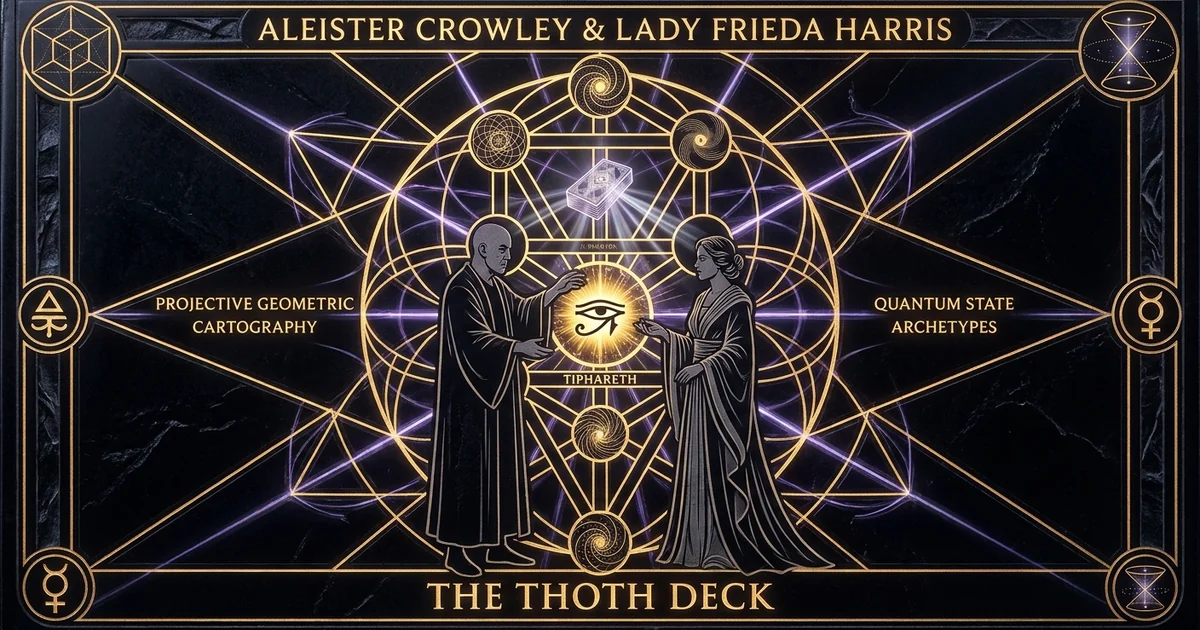
Aleister Crowley & Lady Frieda Harris: The Thoth Deck
Archetypal Thesis & Systemic Paradigm: The Thoth Deck as an Operative Engine of Consciousness
Transcending Static Cartomancy: The Non-Euclidean Hermetic Engine
The publication and conceptualization of the crowley frieda harris thoth tarot deck marks an epistemological rupture within Western esoteric cartography. For centuries preceding its wartime crystallization between 1938 and 1943, cartomancy functioned predominantly within a Newtonian, moralistic worldview. Traditional tarot architectures—culminating in the late-Victorian restorations of the Hermetic Order of the Golden Dawn and Arthur Edward Waite’s 1909 deck—treated the seventy-eight cards as static, pictographic allegories. In these frameworks, archetypes operated as fixed moral exemplars or deterministic signposts of fate, anchored in a Ptolemaic universe where symbols occupied immutable positions across a two-dimensional grid.
Crowley and Harris dismantled this mechanistic taxonomy. Drawing upon Hermetic Qabalah, non-Euclidean mathematics, and twentieth-century field theories, they reconstituted the tarot not as an illustrative index of external events, but as an operative, non-Euclidean engine of consciousness. Within the theoretical architecture of the Book of Thoth, the deck operates as a cybernetic state-space model. Each card represents a discrete vector of force intersecting a dynamic, multi-dimensional continuum, transforming the reading of symbols from passive fortunetelling into an active topological navigation of consciousness.
Rather than presenting archetypes as theatrical human figures frozen in moral dilemmas, Harris deployed dynamic intersecting planes, curved trajectories, and radiant vortices. This shift mirrors the transition from classical mechanics to thermodynamic equilibrium and relativistic field dynamics. The images do not merely illustrate a condition; they generate an optical and psychic tension that compels the observer’s cognitive apparatus to reconcile contradictory spatial planes. The deck functions as an instrument for psychic calibration, wherein the practitioner engages a recursive feedback loop between subjective intent and macrocosmic architecture, dissolving the artificial boundary separating the cartographer from the charted terrain.
+-------------------------------------------------------------------------+
|                  THE HERMETIC FEEDBACK CONTINUUM                        |
|                                                                         |
|   Macrocosmic Archetype (Objective Field Dynamics)                      |
|                         ▲               │                               |
|                         │ [Resonance]   │ [Topological Projection]      |
|                         │               ▼                               |
|   Microcosmic Consciousness (Subjective Intentionality)                 |
+-------------------------------------------------------------------------+
Thelemic Ontology and the Vector Space of the Aeon of Horus
At the philosophical nucleus of this operational engine lies Crowley’s Thelemic cosmology, specifically the shift from the dying-god mythos of the Osirian formula to the kinetic, non-dual paradigm of the Aeon of Horus. The Victorian occult revival, despite its esoteric claims, remained tethered to the patriarchal, self-sacrificial ethos of the Piscean-Osirian dispensation. In that model, human salvation required supplication before a transcendent, external deity, and spiritual evolution was framed as the linear redemption of fallen matter through suffering, moral self-denial, and ultimate physical dissolution.
The Thelemic tarot overthrows this soteriology by asserting the divinity of the self-actualizing individual—the star moving along its unhindered orbital trajectory through infinite space. In the Aeon of Horus, reality is understood as an ecstatic, perpetual collision of opposites: Hadit (the infinitely concentrated, atomic center of individual consciousness) and Nuit (the infinitely expanded circumference of cosmic space). The Thoth Tarot codifies this metaphysical premise into visual geometry. The cards no longer enforce static dualisms of sin and virtue, damnation and election; instead, they depict thermodynamic transformations of pure energy.
Within this vector space, archetypes exist in perpetual kinetic conversion. The passive water of the Hanged Man is not a passive martyrdom, but a deliberate, systemic suspension of personal ego in service to spiritual baptism. The Lightning Struck Tower ceases to represent divine retribution visited upon human arrogance; it illustrates the catastrophic release of bound energy from calcified structures, an evolutionary disruption necessary for the emergence of higher systemic coherence. The cards thus articulate a universe governed by non-dual awareness, where every phenomenon—light or dark, creative or destructive—functions as an indispensable coordinate within the autopoietic unfolding of the absolute.
“A psychoid archetype can be understood not as a purely psychic factor, but as an autonomous, trans-psychic ordering principle that bridges mental intention and physical manifestation through non-deterministic synchronicity. This directly parallels Aleister Crowley’s operational definition of Magick in the Book of Thoth: ‘the Science and Art of causing Change to occur in conformity with Will,’ wherein the cartographic manipulation of archetypal vectors within a symbolic state-space directly induces structural phase shifts within the observer’s subjective reality.” — Carl Gustav Jung, The Structure and Dynamics of the Psyche (Collected Works Vol. 8), collated with Aleister Crowley, The Book of Thoth (1944).
Classical Provenance & Textual Lineage: The Crowley-Harris Synthesis and Golden Dawn Ruptures
The Golden Dawn Cipher Manuscripts and Mathers’ Canon
The structural lineage of the crowley frieda harris thoth tarot deck traces directly back to the late nineteenth-century esoteric synthesis of the Hermetic Order of the Golden Dawn. Foundational to this tradition was Book T: The Tarot, an internal instructional document transcribed by S.L. MacGregor Mathers, which systematized the enigmatic fragments found within the Order’s Cipher Manuscripts. Mathers established an elaborate synthesis mapping the seventy-eight cards of the tarot to the twenty-two letters of the Hebrew alphabet, the thirty-two paths of the Qabalistic Tree of Life, the planets, the elements, and the thirty-six astrological decans.
                     [ CIPHER MANUSCRIPTS ]
                               │
                               ▼
                   [ Mathers' "Book T" (1888) ]
                     /                    \
                    /                      \
                   ▼                        ▼
        [ Waite-Smith Deck (1909) ]   [ Crowley-Harris "Thoth" (1944) ]
         - Static Pictorialism         - Dynamic Projective Geometry
         - Christian-Mystical Bias     - Thelemic Non-Dualism
         - Fixed Moral Dualism         - Relativistic Thermodynamics
While Crowley revered the architectural integrity of Book T, he recognized that its Victorian framing crippled its operational efficacy. Mathers had grafted a conservative, neo-Platonic moralism onto an inherently dynamic system. The earlier Hermetic drafts maintained strict scholastic hierarchies and dogmatic allegories that insulated the practitioner from the raw, destabilizing reality of the archetypal forces themselves.
Furthermore, Arthur Edward Waite’s influential 1909 deck—illustrated by Pamela Colman Smith—deliberately obscured or altered core esoteric attributions to safeguard Order secrets, while simultaneously overlaying the minor cards with scenic illustrations derived from a bourgeois Christian ethos. A comparative structural critique of this divergence is detailed in the analysis of the Rider-Waite-Smith comparative ontology. Crowley viewed the Waite-Smith design as a catastrophic regression: an adulteration of pure geometric and astrological forces into sentimental domestic tableaus. The Thoth project was therefore conceived not merely as a revision, but as a ruthless rectification of the Golden Dawn canon, stripping away moralistic accretion to reveal the unvarnished mathematical machinery beneath.
Lady Frieda Harris and Anthroposophical Form-Forces
The visual transformation of this canon would have been impossible without Lady Frieda Harris (née Marguerite Frieda Bloxam). A high-ranking Co-Mason, associate of the Anthroposophical Society, and an artist of consummate technical mastery, Harris entered Crowley’s orbit in 1937. Popular esoteric history has frequently minimized Harris as a passive executant—an amanuensis who translated Crowley’s verbal dictations onto canvas. Archival correspondence fundamentally refutes this patriarchal assumption. Harris was a rigorous esoteric theorist who actively challenged, reshaped, and executed the spatial framework of the entire corpus.
Harris introduced Crowley to the mathematical and cosmological systems of Rudolf Steiner and, specifically, the projective synthetic geometry developed by anthroposophical mathematician George Adams. Steiner’s Goethean color theory and Adams’s concepts of polar space and counter-space provided the precise artistic and metaphysical vocabulary needed to liberate the tarot from two-dimensional representation. Rather than deploying the flat, non-dynamic color planes common to Golden Dawn instructional diagrams, Harris insisted on the visual execution of living form-forces. She applied translucent layers of oil paint using complex spatial planes, establishing dynamic tension zones where archetypal energies coagulate into material form and dissolve back into spiritual counter-space.
Harris systematically rejected Crowley’s early sketches, which leaned heavily toward conventional Egyptian revivalism and traditional Golden Dawn iconography. She forced him to elevate his textual descriptions to meet her evolving spatial geometry. Her mastery of dynamic line, harmonic ratios, and projective geometries transformed what Crowley initially conceived as a swift six-month restorative project into an exhaustive, multi-dimensional masterwork that required five years of intense labor.
“My dear Harris: The sketches received this morning are a stunning departure, yet I must check your drift toward pure abstraction. We are not painting the intellectual satisfaction of Euclid; we are evoking the living, roaring daemons of the Astral plane. You speak of Steiner’s dynamic light-forces and your vanishing points residing outside the canvas frame—very well, let the planes collide until they shatter the eye of the observer, but the Atu must retain its Qabalistic spine! The flashing colors of the Order must not be dissolved into mere aesthetic mist; they must detonate. Your geometry must not merely frame the god; it must constitute the dynamic vector of his advent.” — Aleister Crowley, Private Correspondence, Archives of the Ordo Templi Orientis (Held at the Warburg Institute, London).
Five Years of Gestation: The 1938–1943 Wartime Genesis
The gestation of the Thoth Tarot unfolded amidst the physical devastation of World War II. Working in England under the constant threat of aerial bombardment, material shortages, and failing physical health, Crowley and Harris sustained an extraordinary intellectual collaboration. Harris placed Crowley on an essential weekly stipend, securing his financial survival while she labored exhaustively on multiple iterations of each card.
The historical conditions of wartime London infused the work with existential urgency. As the physical structures of European civilization collapsed under industrial bombardment, Harris and Crowley were systematically documenting the metaphysical collapse and reconstitution of the cosmic order. The brutal realities of mechanized destruction and splitting atomic nuclei validated their thesis: the Osirian world of patriarchal empires was undergoing an apocalyptic dissolution, making way for the catastrophic birth of the Aeon of Horus.
Between 1938 and 1943, Harris produced over one thousand sketches and finished water-color canvases, repainting numerous Major Arcana multiple times to achieve an uncompromising synthesis of occult correctness and spatial depth. The paintings were publicly exhibited for the first time in July 1942 at the Vincent Robinson Galleries in London, drawing thousands of viewers who recognized within their non-Euclidean geometries an unsettling, prophetic reflection of the modern psyche. The project culminated in 1944 with the private publication of Crowley’s masterwork, The Book of Thoth, although neither collaborator would live to see the complete deck industrially printed and made universally accessible as a 78-card physical edition.
Structural Mechanics & Symbolic Geometry: Projective Rays, Astrological Attributions, and the Tzaddi Rectification
Projective Synthetic Geometry and Counter-Space Dynamics
The visual architecture of the Thoth Tarot relies on the mathematical principles of projective geometry and counter-space dynamics. Unlike Euclidean geometry, which posits a rigid, unyielding three-dimensional space bounded by absolute measurements, projective synthetic geometry conceptualizes spatial form as the outcome of dynamic transformations between polar spaces: point-centered space and plane-centered counter-space. In counter-space, infinity is not a distant perimeter, but an active, inward-acting boundary condition that conditions the formation of living physical structures.
[ EUCLIDEAN CARTOGRAPHY ]               [ PROJECTIVE SYNTHETIC GEOMETRY ]
        Static, Cartesian Planes                     Dynamic Counter-Space
     ┌─────────────────────┐                     \        │        /
     │                     │                      \   Point of   /
     │     Fixed Form      │                        Inflection
     │                     │                      /   Counter-   \
     └─────────────────────┘                     /     Space      \
     Vanishing Point Inside Canvas              Infinitude Acts Inwardly</code></pre>
Harris systematically applied these principles to the planar compositions of both the Major and Minor Arcana. Rather than placing vanishing points within the interior perspective of the card—a convention that forces the viewer’s gaze into an artificial illusion of depth—she situated vanishing points beyond the margins of the physical frame. The pictorial plane thus becomes an intersection zone of incoming projective rays, generating an intense visual pressure.
In cards such as Trump I (The Magus) and Trump VII (The Chariot), forms do not sit passively in space; they emerge through the inflection of conflicting force fields. Archetypal figures appear crystalline, translucent, and multifaceted, capturing light through dynamic tension. This projective mechanics operates as a psychological trigger: the viewer’s perceptual apparatus cannot settle into passive consumption. The visual tension forces consciousness to project itself into the image, actively completing the broken lines of force and drawing the mind across the threshold between material extension and archetypal counter-space.
The Tzaddi Rectification: Restoring Zodiacal Symmetry
The most theoretically critical and controversial systemic reform Crowley executed within the Major Arcana was the rectification of the seventeenth Hebrew letter, Tzaddi. In classical Golden Dawn attribution—and throughout historical Qabalistic literature—the letter Heh was assigned to Trump IV (The Emperor / Aries), while the letter Tzaddi was assigned to Trump XVII (The Star / Aquarius). This assignment, however, produced an asymmetrical disruption within the Hermetic correspondence between the zodiacal belt and the twenty-two Paths of the Tree of Life.
This disruption was explicitly addressed in Crowley’s foundational channeled document, Liber AL vel Legis (The Book of the Law), where the discarnate intelligence Aiwass declared: “All these old letters of my Book are aright; but Tzaddi is not the Star” (Liber AL I:57). For over three decades, Crowley struggled to resolve the mathematical and geometric implications of this cryptic injunction.
He eventually realized that the zodiacal sequence along the Tree of Life contains an intrinsic structural twist or loop—comparable to the astrological precession of the equinoxes. If Tzaddi is assigned to The Emperor (Aries) and Heh is assigned to The Star (Aquarius), an elegant, symmetrical topological loop is restored to the cosmological architecture. In this rectified schema, the imperial sovereignty of Aries (The Emperor) is directly coupled with the generative, cosmological vision of Aquarius (The Star), balancing the fiery, masculine authority of terrestrial dominion with the ethereal, fluid mechanics of stellar continuous inspiration.
This programmatic inversion rectifies the energetic flow between the upper and lower Sephiroth. Path 15, bridging Chokmah (Wisdom) and Tiphereth (Beauty), becomes the descent of divine illumination through The Star, while Path 28, bridging Netzach (Victory) and Yesod (The Foundation), grounds the organizing, structural force of The Emperor. This topological symmetry resolves the historical anomaly, harmonizing the Hebrew alphabet with the celestial movement of the macrocosm.
Decanic Decoupling and the Astrological Pips
The Minor Arcana (pip cards 2 through 10 of each suit) are divorced from anecdotal genre scenes through an uncompromising integration of the classical decan system within the Hermetic Order. Mathers had assigned the thirty-six numeric pips to the thirty-six ten-degree divisions of the zodiac, matching each decan to a planetary ruler according to the ancient Chaldean order of the planets (Saturn, Jupiter, Mars, Sun, Venus, Mercury, Moon).
Harris and Crowley bypassed the narrative pastoralism popularized by the Waite-Smith deck. Instead, they designed each pip card as a rigorous geometrical mandala illustrating the interaction of a specific planetary force operating within an astrological sign at a designated Sephiric level on the Tree of Life. For example, the Seven of Swords is not rendered as a thief surreptitiously escaping an army camp; it is titled Unstable Effort and depicts the erratic, destabilizing impact of the Moon operating within the air sign of Aquarius, situated in the Sephirah Netzach.
+-----------------------------------------------------------------------------------+
|                        DECANIC PIP MECHANICS: SEVEN OF SWORDS                     |
|                                                                                   |
|   Sephirah: Netzach (Desire, Projection, Emotion)                                |
|   Sign:     Aquarius (Air, Intellectual Collectivity, Spatial Structure)          |
|   Planet:   Moon (Fluctuation, Instinct, Inconstancy)                             |
|                                                                                   |
|   Resultant Structural Dynamic: "Unstable Effort"                                 |
|   - Central Sun-blade assailed by six vacillating, curved lunar blades.          |
|   - Dynamic equilibrium fractured: systemic dissipation rather than focused will. |
+-----------------------------------------------------------------------------------+
Harris realized this conceptual tension through complex interactions of swords, wands, cups, and disks. The weapons and talismans do not function as static emblems; they cross, shatter, balance, or undermine one another along lines calculated through geometric ratios. The Six of Swords (Science—Mercury in Aquarius in Tiphereth) exhibits immaculate, harmonic hexagonal symmetry, embodying intellectual equilibrium. Conversely, the Five of Wands (Strife—Saturn in Leo in Geburah) features heavy, unwieldy clubs clashing against one another, creating visual dissonance. The pips thus function as dynamic thermodynamic states of consciousness, revealing the pure energetic mechanics governing human psychological conditions.
Psychological Dynamics & Operational Praxis: The Archetypal Mirror and Scrying the Astral Plane
From Passive Fortunetelling to Active Astral Scrying
In the operational praxis of the Western esoteric tradition, the cards of the tarot serve two profoundly different functions: external divinatory prediction or internal astral visionary exploration. Crowley explicitly subordinated the former to the latter. In the Thelemic framework, ordinary fortune-telling—interrogating the cards to determine mundane future events—is viewed as an inferior application that traps the human consciousness within the fatalistic cycles of material illusion.
Instead, the Thoth deck was engineered to function as an apparatus for active astral scrying—technically defined in Golden Dawn and Thelemic praxis as scrying in the spirit vision. In this operational methodology, the card serves as an astral portal or optical gateway. By steadying the visual gaze upon the geometric axes and vibrating color contrasts of a specific Trump, the practitioner destabilizes the consensus perceptual apparatus, inducing an altered, hypnagogic state of consciousness.
Once the physical image is interiorized, the practitioner projects their localized center of consciousness through the card’s central geometric nexus into the astral realm associated with that specific Path on the Tree of Life. The card’s projective synthetic geometry, calibrated by Harris’s use of dynamic counter-space, acts as a stabilization matrix. It prevents the scryer from drifting into subjective, idiosyncratic fantasy, holding the astral landscape locked to the objective Qabalistic frequencies of the archetype under investigation. The deck functions not as an index of what will happen, but as an energetic mirror revealing the underlying psychic forces currently configuring the practitioner’s reality.
Adjustment and Lust: Dynamic Polarity vs. Static Morality
The psychological shift from Victorian moralism to Thelemic thermodynamics is most visible in Crowley’s renaming and reconceptualization of Major Arcana VIII and XI. In the historical canon, Key VIII was titled Justice and Key XI was titled Strength. Crowley systematically altered these keys to Adjustment and Lust, an ideological reconfiguration analyzed in the comparative matrix below.
Rider-Waite-Smith: Moral-Statics
- Trump VIII: Justice
- Iconography: A stone-faced maternal judge holding an upright steel sword and mechanical balance-scales, seated between immovable gray pillars.
- Psychological Axiom: External moral judgement, retribution, karmic scorekeeping, and adherence to societal or divine laws.
- Energetic State: Static equilibrium; rigid containment; defensive suppression of human transgressive instinct through moral terror.
- Trump XI: Strength
- Iconography: A serene, haloed virgin gently closing the jaws of a compliant lion, decorated with garlands of pastoral roses.
- Psychological Axiom: The ethical triumph of pure spiritual meekness over the savage animal nature; physical instinct subjugated by Christian virtue.
- Energetic State: Repression and subdual; instinctual drives subdued by the conscious superego.
Thoth: Thermodynamic Kinetics
- Trump VIII: Adjustment
- Iconography: A radiant, dynamic harlequin maiden poised entirely upon the tips of her toes, balancing an immense balance-scale from her headdress while suspended within a precarious geometric web of intersecting rays.
- Psychological Axiom: Continuous autopoiesis; self-correcting dynamic balance; systemic compensation occurring within real-time fluid mechanics.
- Energetic State: Dynamic equilibrium; equilibrium maintained not by static immobility, but through perpetual, hyper-sensitive micro-movements.
- Trump XI: Lust
- Iconography: The crowned Scarlet Woman (Babalon) riding ecstatic upon the back of the seven-headed Great Beast, holding aloft the incandescent, foaming Graal of cosmic vitality.
- Psychological Axiom: Joyous integration of primal, untamed drive with transpersonal spiritual consciousness; liberation from guilt.
- Energetic State: Orgastic cosmological empowerment; thermodynamic circulation of uninhibited evolutionary energy without moral neurosis.
This shift dismantles the binary neurosis that plagued early psychological models. Adjustment acknowledges that balance is never a permanent state of static rest, but a dynamic capacity for real-time responsiveness to changing environmental and psychic conditions. Lust reframes primal physical energy from an existential threat into the foundational engine of all spiritual realization. The practitioner is not instructed to repress the wild primordial drives, but to mount and steer them with ecstatic, uninhibited conscious mastery.
The Court Cards as Fourfold Cybernetic Feedback Units
Crowley systematically dismantled the feudal, patriarchal nomenclature of the Golden Dawn and traditional decks—which relied on the familiar structure of King, Queen, Knight, and Page—rebuilding the Court Cards as a dynamic elemental engine: Knight, Queen, Prince, and Princess.
       [ KNIGHT: Yod ] ──── (Primal Ignition / Fire)
              │
              ▼
        [ QUEEN: Heh ] ──── (Receptive Containment / Water)
              │
              ▼
       [ PRINCE: Vau ] ─── (Dynamic Execution / Air)
              │
              ▼
     [ PRINCESS: Heh (final) ] ── (Material Grounding / Earth)
              │
              └─────── Cycles back to awaken the Knight (Tetragrammatic Loop)
This restructuring reflects the fourfold mechanics of the Tetragrammaton ($Y-H-V-H$), mapping human behavioral tendencies not as static social roles, but as kinetic velocities and thermodynamic energetic vectors:
- The Knight (Fire / Yod): Represents pure kinetic acceleration, violent projection, and sudden generative potency. Mounted on charging steeds, these figures symbolize the untamed, unreflective spark of intentionality.
- The Queen (Water / Heh): Represents deep receptive containment, reflective processing, and fluid transformation. Seated upon thrones above turbulent seas, these figures incubate the volatile energy delivered by the Knights.
- The Prince (Air / Vau): Represents the analytical intellect, strategic calculation, and deliberate application of force. Drawn in chariots propelled by abstract elemental forces, they symbolize the conscious ego operationalizing systemic thought.
- The Princess (Earth / Heh final): Represents materialized grounding, somatic instinct, and foundational realization. Depicted as dynamic dancers within earthly landscapes, they symbolize the final manifestation of energy into physical form.
These sixteen figures operate as a cybernetic feedback system. Under Qabalistic mechanics, the Princess does not remain inert matter; through the completion of her work, she awakens the Knight, initiating a new cycle of spiritual and psychological evolution. The Court cards thus serve as a functional diagnostic map of psychological complexes, tracking how energy ignites, circulates, executes, and crystallizes within the human psyche.
Philosophical Synthesis & Macrocosmic Correspondence: Hermetic Axiomatics and Nuclear Physics
The Microcosmic Mirror: Quantum Indeterminacy and the Zero Formula
A foundational innovation of the Thoth Tarot is its deliberate synthesis of archaic Hermetic axioms with the conceptual breakthroughs of early twentieth-century quantum mechanics and nuclear physics. During the years of the deck’s development, the Newtonian model of a predictable, mechanistic universe dissolved, replaced by Planck’s quantum of action, Heisenberg’s uncertainty principle, and Einstein’s relativistic spacetime curvature. Crowley, an astute student of mathematics and physics, recognized that modern subatomic mechanics offered empirical validation for the deepest paradoxes of esoteric Qabalah.
This synthesis converges upon Crowley’s central philosophical equation: $0 = 2$. In the Book of Thoth, non-dual Absolute Reality is not conceived as a single, static monad, but as absolute nothingness ($0$) containing infinite, balanced positive and negative polarities ($+1 + -1 = 0$). Creation is not an event originating from a distant, transcendent creator, but an ongoing spontaneous fluctuation of the cosmic vacuum. Reality differentiates simultaneously into polar opposites—matter and antimatter, particle and wave, consciousness and space—which perpetually dance together and collapse back into the primordial void.
This axiom is visually encoded in Trump 0, The Fool. Harris depicts the archetypal Fool stepping into the abyss not as an oblivious wanderer, but as a hyper-dynamic, green-clad cosmic engine of infinite potentiality. He holds the pineal grape-cluster, the fiery dagger, and the butterfly of transformation, suspended within concentric ellipses of light. He is the cosmic vacuum itself—unconditioned zero—carrying within his stride the total latent kinetic energy of the entire manifested universe.
                                [ THE FOOL: 0 ]
                       (Absolute Void / Infinite Potential)
                                       │
                      ┌────────────────┴────────────────┐
                      ▼                                 ▼
               [ HADIT: +1 ]                     [ NUIT: -1 ]
           (Atomic Point-Self)              (Infinite Circumference)
                      │                                 │
                      └────────────────┬────────────────┘
                                       │
                                       ▼
                       [ MANIFESTED UNIVERSE: 0 = 2 ]
                        (Dynamic Dynamic Conversion)
In cards such as Trump XX (The Aeon) and Trump XIX (The Sun), Harris directly introduces visual signifiers of modern physics: crystalline lattices, radiant radioactive fields, and subatomic spin-paths. The universe of the Thoth deck is fundamentally an indeterminate, open-ended quantum landscape, where reality transforms dynamically in response to the observation and focused Will of the conscious participant.
Tetragrammaton as a Cybernetic Dissipative System
The ancient Qabalistic formula of the Tetragrammaton ($Y-H-V-H$) is reinterpreted within the Thoth paradigm as an open thermodynamic, self-organizing system—a direct historical precursor to Ilya Prigogine’s theoretical work on dissipative structures. Rather than viewing the four Qabalistic worlds as a static, descending ladder of perfection, Crowley and Harris configured them as an active energetic metabolism.
- Yod (Fire / Atziluth / Knights):
- Thermodynamic State: Plasma; extreme kinetic agitation; uncontained thermal expansion.
- Systemic Function: Entropy-breaking informational spark; sudden energetic input into the psychic system.
- Heh (Water / Briah / Queens):
- Thermodynamic State: Liquid; molecular cohesion, high fluid viscosity, structural conductivity.
- Systemic Function: Dissipative thermal cooling; informational storage, affective containment, and contextual boundary formation.
- Vau (Air / Yetzirah / Princes):
- Thermodynamic State: Gas; dynamic compressibility, turbulent airflow, relational dispersion.
- Systemic Function: Systemic transmission; intellectual synthesis, vector transformation, and systemic analysis.
- Heh Final (Earth / Assiah / Princesses):
- Thermodynamic State: Solid; crystalline geometry, frozen inertia, maximal density.
- Systemic Function: Complete systemic grounding; somatic precipitation, structural resistance, and recursive feedback initialization.
Within this thermodynamic cycle, entropy is continually overcome. The energy of the system does not bleed off into heat death; instead, when the cycle reaches its densest structural boundary in the Earth phase (Assiah / The Princess), the latent heat held within that material form is unlocked. This triggers a phase shift that re-ignites the initial spark (Atziluth / The Knight), establishing an autopoietic, self-regenerating feedback loop that sustains the Great Work across time.
The Alchemical Great Work in an Industrial-Technological Paradigm
The Thoth Tarot represents the radical modernization of the Western alchemical tradition. Classical European alchemy developed its visual and conceptual vocabulary within an agrarian, handicraft paradigm. Its vessels were clay crucibles and glass alembics; its operations were paced by the slow burning of peat or the seasonal warmth of animal manure. Crowley and Harris, living through the twentieth century’s catastrophic industrial mobilizations, recognized that this archaic symbolism failed to register within the mechanized nervous system of modern humanity.
In Trump XIV (Art), the alchemical union of opposites (coniunctio oppositorum) is re-engineered with severe geometric and systemic precision. Replacing the passive temperance-angel of traditional decks, Harris presents a dynamic, two-faced, androgynous entity executing the operational synthesis of fire and water. The alchemical fire is not an open kitchen flame; it radiates like the focused thermal output of an industrial furnace. The water emerges as iridescent, pressurized fluid. The figures fuse within a distillation vessel that functions with the functional clarity of a modern chemical reactor.
       [ TRADITIONAL TEMPERANCE ]              [ THOTH TRUMP XIV: ART ]
       - Passive, moral balance               - Industrial alchemical engine
       - Dilution of dynamic opposites        - Pressurized fusion of Fire and Water
       - Pastoral Christian virtue            - Radical psychic transmutation
This alchemical industrialism reaches its ideological apex in the treatment of the Suit of Disks. Crowley discarded the traditional term “Pentacles,” with its connotations of medieval talismanic superstition, adopting “Disks” to explicitly emphasize the spinning, atomic, and planetary nature of matter. These cards are saturated with references to physical work, industrial production, gear systems, heavy masonry, and planetary mechanics. Matter is not passive clay waiting to be escaped by an ascetic spirit; matter is crystallized light, a dense lattice of rotating atomic disks awaiting evolutionary liberation through the focused application of human consciousness.
Frequently Asked Questions: Deciphering the Thoth Paradigm
Why Did Lady Frieda Harris Redraw the Major Arcana Multiple Times?
Lady Frieda Harris executed multiple iterations of several Major Arcana—most famously producing eight distinct, full-scale paintings of Trump I (The Magus)—not due to technical hesitation or artistic indecisiveness, but because of the unprecedented metaphysical complexity of the operational task. The working relationship between Crowley and Harris operated as a recursive feedback process. Crowley provided the Qabalistic structural coordinates, the classical attributions, and the core symbolic parameters derived from his magical diaries and Book T. Harris, however, was tasked with rendering these attributions visible through the advanced principles of synthetic projective geometry and Goethean color dynamics.
In early drafts of The Magus, The Chariot, and The Lovers, Harris discovered that conventional representational techniques collapsed the images back into the static anthropomorphism of the Victorian era. The figures looked like costumed actors posing within a stage set. To break this pictorial inertia, she was forced to repeatedly strip away conventional perspective, inventing an entirely new visual lexicon.
Each successive iteration pushed the composition further toward dynamic planar fields, interpenetrating counter-spaces, and vibrational color harmonies. In the final version of The Magus, for instance, the god Mercury does not stand casually on solid earth; he balances with extreme kinetic precarity upon a radiant ray of force, jugglery apparatus floating around him as spinning geometric projections. Harris repainted the canvas until the physical form dissolved into pure, concentrated velocity, ensuring that the image functioned as a dynamic energetic transmission rather than an inert illustration.
How Does the ‘Tzaddi Is Not the Star’ Dictum Structurally Alter Divinatory Readings?
The reallocation of the Hebrew letter Tzaddi to Trump IV (The Emperor) and Heh to Trump XVII (The Star) radically alters the psychological and operational diagnosis delivered during a divinatory reading. In decks adhering to the unrectified Golden Dawn attributions (such as the Rider-Waite-Smith system), The Emperor is associated with Heh—the letter of the Mother, vision, and breath. This created an unresolvable structural contradiction: the archetypal sovereign of patriarchal, worldly dominion was burdened with a receptive, visionary letter, while The Star was chained to Tzaddi, the hook or fishing spear, denoting terrestrial capturing and mechanical fixation.
Under the rectified Thoth schema, the divinatory diagnosis snaps into sharp focus:
- When The Emperor appears: It indicates the direct, piercing, and forceful application of structure, terrestrial dominion, and legislative will upon the world (Tzaddi as the spear or decisive hook). The card no longer denotes a passive, brooding monarch sitting on a stone block; it indicates aggressive, assertive stabilization, the mobilization of systemic authority, and the establishment of functional boundaries through structural power.
- When The Star appears: It indicates pure, boundless, universal inspiration, the descent of cosmic grace, and transcendent perception (Heh as the window, the breath of spirit, and the cosmic waters poured out without limit). It diagnoses a situation calling for complete surrender to continuous inspiration, unburdened by the terrestrial impulse to grasp, fixate, or mechanically govern.
By reversing the historical loop, readings conducted with the Thoth deck clearly decouple cosmic inspiration (The Star) from terrestrial political governance (The Emperor), offering an uncompromising diagnosis of how spiritual power projects downward into structural manifestation.
What Exact Mathematical Principles Differentiate Synthetic Geometry from Classical Perspective in the Pip Cards?
Classical Euclidean perspective—formulated during the Italian Renaissance by Brunelleschi and Alberti—operates on the assumption of a rigid, three-dimensional Cartesian metric space. In this classical framework, all lines of sight converge at a single, centralized vanishing point located strictly on the horizon line within the canvas. This construction assumes a static, detached human observer looking through a frame onto a detached, passive world.
Projective synthetic geometry, rooted in the mathematical formulations of Girard Desargues and extended into anthroposophical physics by George Adams, breaks this assumption by asserting the primacy of counter-space (polar space). In synthetic geometry:
- Space is not an empty, neutral container populated by isolated objects; it is the dynamic resultant of two polarity-generating fields: the expansive, outward-pushing force of the point-center, and the contractive, inward-working force of the infinite perimeter.
- The plane, rather than the point, is taken as the primary spatial primitive. Vanishing lines do not terminate at a comfortable distance within the pictorial horizon; instead, vanishing points are projected out to actual infinity or positioned deliberately outside the physical edges of the canvas.
- Forms are established through the intersection of planar sheaths and ray-complexes, known mathematically as path-curves.
[ CLASSICAL EUCLIDEAN PERSPECTIVE ]       [ PROJECTIVE SYNTHETIC PERSPECTIVE ]
        Canvas Margin                             Canvas Margin
     ┌───────────────────┐                     \        │        /
     │         \         │                      \       │       /
     │          \        │                       \      │      /
     │     [ Vanishing ] │                        \     │     /
     │      Point Inside │                         [ Archetype ]
     │          /        │                        /     │     \
     │         /         │                       /      │      \
     └───────────────────┘                      /       │       \
      Observer Sits Outside Canvas             Vanishing Points Reside Outside Frame</code></pre>
When applied to the pip cards of the Thoth deck, this mathematical architecture changes their psychological operation. In cards such as the Eight of Swords (Interference) or the Nine of Wands (Strength), the depicted symbols—the weapons, disks, or lotuses—are governed by path-curve dynamics. The observer’s visual field is continuously compressed and stretched by multiple conflicting planar horizons.
The image does not reproduce a snapshot of static objects in rest; it maps the structural lines of dynamic tension within the archetypal realm. The observer’s nervous system registers this synthetic geometric tension as an immediate, visceral experience of systemic velocity, pressure, equilibrium, or structural collapse, directly bypassing the analytical ego to calibrate the deeper structures of consciousness.