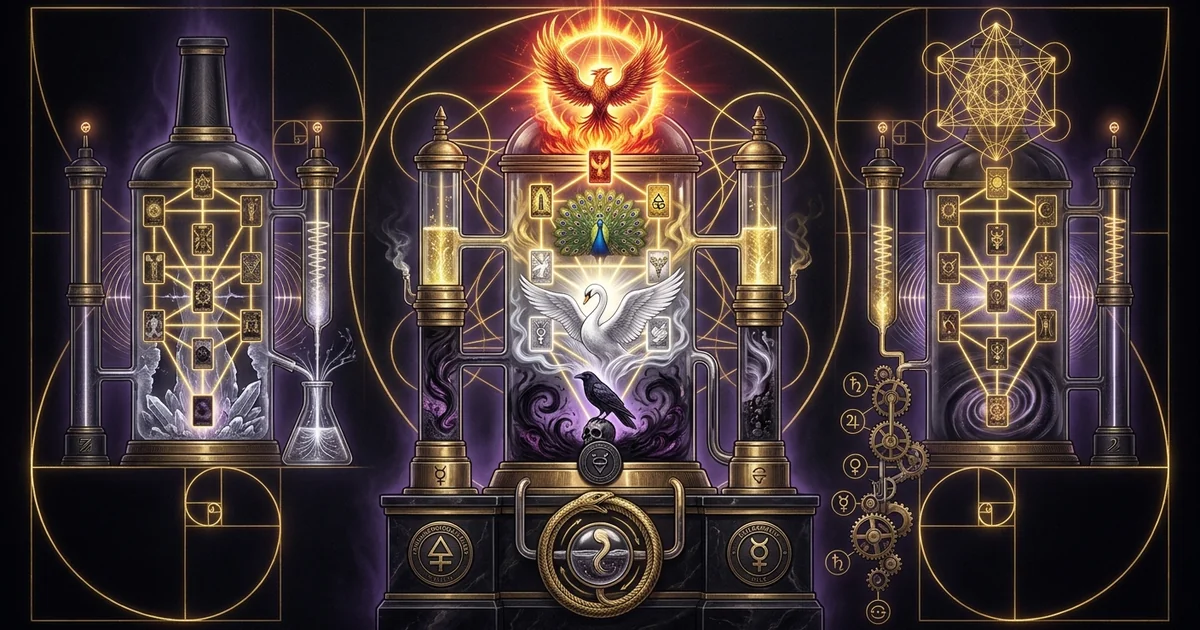
Alchemical Symbolism in the Waite-Smith Tarot Deck
Archetypal Thesis & Systemic Paradigm: The Tarot Deck as Spagyric Engine
The 1909 tarot pack conceived by Arthur Edward Waite and rendered visually by Pamela Colman Smith operates not as an arbitrary apparatus for mechanical divination, but as a portable, exteriorized spagyric laboratory. When approached through the lens of esoteric historiography and depth psychology, the deck reveals itself as a coherent symbolic engine designed to execute the magnum-opus—the Great Work of classical and Renaissance alchemy. Rather than predicting deterministic, linear events within the profane sphere, the structural dynamics of the 78 cards configure a psycho-cosmological coordinate framework that mirrors the chemical and spiritual transmutations of base matter into living gold. The interplay of archetypal imagery, elemental geometries, and chromatic shifts establishes an operational matrix wherein the querent’s conscious state is projected, dissociated, purificated, and recombined through precise spagyric mechanics.
The Magnum Opus Encoded in Cartomantic Morphology
The morphologic architecture of the Waite-Smith deck systematically codifies the core alchemical trajectory: nigredo (blackening or putrefaction), albedo (whitening or purification), citrinitas (yellowing or spiritual dawning), and rubedo (reddening or absolute induration). Rather than dispersing these phases haphazardly across its iconographic catalog, the deck situates them within a teleological progression that initiates with Key 0, The Fool, and culminates in Key XXI, The World. This cartomantic morphology does not merely reference metallurgical operations; it formally operationalizes them. The symbols function as living talismans that catalyze specific psychic resonances within the observer, dissolving rigid ego-complexes through an initiatory continuum.
In this context, the Major Arcana trumps chart the macrocosmic blueprint of the Great Work, while the Minor Arcana pips negotiate the microcosmic, operational details of daily chemical precipitation. The deliberate alignment of the trumps with alchemical stages becomes evident upon analyzing their chromatic and compositional elements: the somber, decomposing landscape of Key XIII (Death) signals the radical decay of the ego required by nigredo; the celestial, aqueous illumination of Key XVII (The Star) captures the crystalline dawn of albedo; the vibrant, solar effusion of Key XIX (The Sun) radiates the golden awakening of citrinitas; and the crowned, balanced integration within the laurel wreath of Key XXI (The World) concretizes the sovereign rubedo. This systemic arrangement secures the deck’s primary status as an operative vehicle for internal distillation.
Transmuting the Prima Materia of Psychic Experience
At the foundation of spagyric philosophy lies the concept of the prima-materia—the undifferentiated, chaotic substance containing the latent potential of all created forms, often stigmatized as worthless or vile by the uninitiated. In the Waite-Smith paradigm, human consciousness in its unregenerate, habituated state constitutes this raw matter. The querent brings their chaotic life experience, unintegrated repressions, and fragmented instinctual drives to the cards, which act as a mirror of this baseline substance. The cards initiate the master axiom of the laboratory: solve-et-coagula—dissolve and coagulate. The unrefined material of the psyche must be completely broken down into its elemental components before it can be recombined into an incorruptible vessel.
The four suits of the Minor Arcana—Wands, Cups, Swords, and Pentacles—function as the structural reagents of this operative dissolution. They map directly onto the four classical elements (Fire, Water, Air, Earth) and reflect the triune alchemical matrix of Sulfur, Mercury, and Salt. Wands embody volatile Sulfur, the masculine, combustive, and animating spiritual fire; Cups instantiate philosophical Mercury in its watery, receptive, and intuitive aspect; Swords represent the subtle, volatile Air that cuts through matter via dialectical purification; and Pentacles signify the fixed, crystalline Salt that anchors and coagulates ethereal energies into structural form. By manipulating these four elemental modes, the practitioner exposes the prima-materia to specific temperatures, pressures, and moistures, transmuting the unformed matter of baseline awareness into structured, integrated gnosis.
The 78-Card Apparatus as a Closed Hermetic Retort
To execute transmutations without catastrophic psychic inflation or dissipation, the alchemist requires a sealed vessel: the vas-hermeticum. In the operational grammar of the Waite-Smith system, the entire 78-card deck constitutes this hermetically sealed pelican or alembic. The structural boundaries of the cards—their physical dimensions, consistent border framing, and closed symbolic cross-references—preserve the psychic energy raised during operative contemplation. Without such containment, the volatile operations of the unconscious would spill into undifferentiated pathology; within this vessel, the psychological reagents circulate, condense, and precipitate repeatedly through the cyclic process known as circulatio.
The Fool’s journey through the 22 paths of the Major Arcana demonstrates this perpetual circulation. Key 0 does not simply progress in a naive, straight line from innocence to worldly maturity; rather, The Fool embodies the volatile, primordial spirit (spiritus mercurialis) entering the sealed retort. As the trump sequence unfolds, this raw spiritual force undergoes successive distillations across the four cardinal alchemical colors, suffering dissolution in the abyss of the central trumps and attaining fixed sovereign consciousness in the final emblems. Upon reaching Key XXI, the process does not terminate; it condenses back down into Key 0 at an elevated octave of awareness. The 78-card structure thus operates as a cybernetic feedback system, regulating and recycling psychic energy toward ultimate crystallization.
Classical Provenance & Textual Lineage: Hermetic Genealogies and Iconographic Transmissions
The integration of alchemical symbolism within the 1909 tarot pack was neither accidental nor a cosmetic affectation; it was the direct product of Arthur Edward Waite’s extensive scholarly career and Pamela Colman Smith’s extraordinary artistic synthesis of historical esoteric emblemata. Waite approached the tarot not from the vantage point of popular French occultism, which he largely viewed as structurally sloppy and historically ungrounded, but through the rigorous recovery of classical Hermetic texts, Renaissance Christian Kabbalah, and Rosicrucian mysticism. His deep textual familiarity with Renaissance spagyric tracts formed the conceptual substructure that Smith brought into concrete, visible manifestation.
“The Tarot embodies symbolical presentations of universal ideas, behind which lie all the implicits of the human mind, and it is in this sense that they contain secret doctrine, which is the realization of the truth contained in the soul of man… The deeper mysteries of the cards disclose the paths of spiritual regeneration, which are identical with the Great Work of spiritual alchemy.”
Waite’s Scholarly Immersion in Renaissance Alchemical Tracts
Long before directing the design of the Tarot, Arthur Edward Waite had established himself as a preeminent translator and editor of historical alchemical literature. His landmark translations of the Hermetic Museum (1893), The Hermetic and Alchemical Writings of Paracelsus (1894), and the collected works of Thomas Vaughan (Eugenius Philalethes) exposed him directly to the dense visual and philosophical vocabulary of the early modern spagyric tradition. Waite was acutely conscious of the subtle allegories utilized by Basil Valentine in The Twelve Keys of Basil Valentine and Michael Maier in his 1617 emblem book Atalanta Fugiens. He recognized that these historical authors did not labor over physical lead and furnace charcoal, but operated a sophisticated psychological and spiritual technology disguised as metallurgy.
Consequently, Waite recognized the 78 tarot cards as a parallel stream of this same underground river of esoteric transmission. His objective in designing a new deck under the auspices of William Rider & Son was to purify the cards of the crude astrological and quasi-Egyptian encrustations popularized by Antoine Court de Gébelin and Éliphas Lévi, restoring their alignment with Christian Hermeticism and spiritual alchemy. In this enterprise, Waite acted as the theoretical magus, prescribing precise textual allegories and esoteric lineages, while maintaining an intentional veil over the Secret Tradition to preserve its initiatory potency from profane misuse.
Pamela Colman Smith’s Synthesis of the Sola Busca and Rosicrucian Emblems
While Waite provided the conceptual blueprints, the visual manifestation of this spagyric engine was the solitary achievement of artist and mystic Pamela Colman Smith. A key historical event directly catalyzed her work: in 1907, the British Museum exhibited black-and-white photographic reproductions of the late fifteenth-century Sola Busca Tarot, a deck long recognized by esoteric historians as saturated with alchemical, metallurgical, and classical Greco-Roman motifs. Smith immersed herself in the Sola Busca’s revolutionary structure—which was the first known historical deck to illuminate the pip cards with complete, dramatic figurative scenes rather than simple geometric repetitions of suit symbols.
Through the Sola Busca lineage, Smith adopted the methodology of embedding complex esoteric processes into everyday narrative tableaux. She layered this Renaissance visual syntax with the alchemical emblem tradition found in Heinrich Khunrath’s Amphitheatrum Sapientiae Aeternae (1609) and the iconic woodcuts of the Rosicrucian manifestos. Smith translated abstract spagyric operations into direct physical gestures: the pouring of fluids between dual vessels, the calcination of stony forms beneath desert suns, the binding and release of figures within earthen trenches, and the integration of planetary metals within royal robes. Her visionary line work transformed the deck from an intellectual puzzle into a visually immediate theater of interior transformation.
Divergence from French Occultist Mechanization to Operative Mysticism
The Waite-Smith pack marked a deliberate, radical departure from the prevailing French occult synthesis pioneered by Éliphas Lévi, Gérard Encausse (Papus), and Paul Christian. The French school had subjected the tarot to an intellectualized, dogmatic straightjacket, forcing the 22 Major Arcana into rigid, unyielding correspondences with the 22 letters of the Hebrew alphabet and specific astrological decanates at the expense of dynamic narrative resonance. Papus, in The Tarot of the Bohemians, reduced the living cards to a structural clockwork of ternary and quaternary mathematical permutations.
Waite saw this dogmatic mechanization as spiritually sterile. Informed by his Rosicrucian and Golden Dawn background, he chose to revitalize the deck through an emphasis on living, narrative mysticism. By suppressing the direct appearance of Hebrew letters and astrological ciphers from the faces of the cards—a design decision that horrified contemporary occult purists—Waite and Smith returned the cards to the tradition of European spiritual emblemata. The resulting visual system prioritizes direct archetypal recognition over mechanical table-referencing, prompting the reader’s intuitive faculties to operate as an active laboratory of the soul, directly engaging with the living mythos of the Great Work.
Structural Mechanics & Symbolic Geometry: Spagyric Architecture of the Trumps and Pips
The operational power of the Waite-Smith Tarot stems from its dual-level structural architecture. At the macrocosmic level, the 22 Major Arcana trumps model the great cosmic and psychosexual operations of spiritual alchemy, mapping the soul’s progression along the initiatory pathways of the Major Arcana. Concurrently, the 56 Minor Arcana pips modulate elemental distributions across the mundane plane, using dynamic symbolic geometries to signify whether a specific elemental energy is in a state of fixation, calcination, putrefaction, or volatilization.
Trump XIV: Temperance (Solve)
- Alchemical Operation: Distillatio and Sublimatio; the continual spiritualization of the dense.
- Fluidic Dynamics: The ceaseless, frictionless exchange of vital fluids between two complementary urns.
- Vessel Architecture: Open, dynamic circulating retort; one foot in the unconscious waters, one on the earth.
- Psychic Vector: Expansion, harmony, balance, dissolving rigid ego-crystallizations into light.
Trump XV: The Devil (Coagula)
- Alchemical Operation: Fixatio and Mortificatio; the petrifaction of the spiritual into gross matter.
- Fluidic Dynamics: Complete stagnation of life currents; energy frozen into animal lust and terrestrial chains.
- Vessel Architecture: Hermetically sealed, suffocating cubic pedestal; binding the animus and anima.
- Psychic Vector: Contraction, density, obsessive materialism, the absolute descent into base prima materia.
Nigredo, Albedo, and Rubedo in the Major Arcana Trumps
The triadic sequence of classical metallurgy is systematically distributed throughout the trumps, forming clear milestone markers for the initiatory path. The critical phase of nigredo—the terrifying descent into the blackness of the unintegrated shadow and the total putrefaction of the baseline personality—is anchored primarily in Key XIII (Death) and Key XV (The Devil). In Key XIII, Smith strips away all outward illusion of worldly rank; the black banner bearing the mystic white rose signifies that within the very core of absolute mortificatio lies the genetic germ of regeneration. The armored skeleton astride the pale horse acts as the ultimate calcining agent, reducing all forms to their imperishable limestone foundation. In Key XV, the calcined material is trapped in gross, unrefined earth, demonstrating the complete, dense fixation of the spirit beneath the goat-god of Mendes, where human polarities are chained to a solid cubic block of base matter.
The transition to albedo unfolds as the soul is drawn up from the putrefactive abyss into the celestial washing of the ablutio. This operation is dominated by Key XIV (Temperance), Key XVII (The Star), and Key XVIII (The Moon). Temperance embodies the continuous distillation of psychic fluids, with the androgynous angel demonstrating the fluidic harmony between opposite temperatures. In Key XVII, the celestial woman pours the purified waters of the psyche back into both the terrestrial soil and the subterranean pool under the eight-pointed cosmic star, signifying the pristine washing of the base matter. The Moon illustrates the perilous threshold of albedo, where the volatile soul must navigate the hallucinatory, lunar illusions of the subconscious swamp, guided past the howling beasts toward distant, purifying towers.
The final ascent through citrinitas into rubedo marks the crowning triumph of the magnum-opus. In Key XIX (The Sun), the golden dawn breaks; the innocent child crowned with flowers and riding a white horse under a radiant solar face exemplifies the realization of citrinitas, where philosophical gold emerges from the long lunar night. This process reaches absolute consummation in Key XXI (The World). Here, the central figure is completely integrated within an emerald, ouroboric laurel wreath—a symbol of the completed closed vessel. Flanked by the four fixed Kerubic beasts of the zodiac (Lion, Bull, Eagle, Human), this image announces the total fixation of the volatile and the volatile spiritualization of the fixed, representing the supreme coagulation of the Lapis Philosophorum (the Philosopher’s Stone).
Alchemical Glyphs in Tarot Pips: Elemental Salts, Fixation, and Volatilization
The genius of Pamela Colman Smith is most profoundly evident in her transformation of the 56 Minor Arcana pips into a catalog of operative spagyric glyphs. Abandoning the static geometry of historical Italian and French decks, Smith populated the pips with dynamic natural forces, alchemical beasts, and coded body language that denote specific metallurgical states:
-
The Suit of Wands (Alchemical Sulfur): Smith repeatedly employs the iconography of living, sprouting wood and the elemental Salamander. In cards such as the King and Queen of Wands, small salamanders bite their own tails or repose beside the throne, representing the successful stabilization of calcinatio—the internal fire of spiritual desire that consumes impurities without destroying the fundamental vessel. The sprouting leaves on the staves indicate that this fiery Sulfur remains vital, generative, and organically connected to the universal vegetative soul.
-
The Suit of Cups (Philosophical Mercury): Cups are defined by perpetual hydromancy and dynamic dissolutio. The fluids depicted across the suit do not remain static; they foam, spill, cascade, and evaporate. In the Five of Cups, the three spilled vessels release the black gall of grief onto the muddy earth, while the two upright cups behind the figure preserve the untainted essence of the mercurial waters. In the Seven of Cups, the fluid dissolves into visionary clouds, where disparate archetypal images (jewels, dragons, laurel wreaths, veiled heads) volatilize within the vaporous fumes of an unsealed distillation retort.
-
The Suit of Swords (Philosophical Air): Smith models the mental operations of separation and dialectic analysis through the cold, surgical steel of the blade (separatio). In the Three of Swords, three steel blades pierce a weeping heart beneath torrential storm clouds, visually formulating the agonizing yet essential division of the conscious mind from unconscious somatic identification. In the Ten of Swords, the absolute finality of mortificatio through Air is exposed: the human vessel lies impaled beneath a leaden black sky, while the faint yellow streak on the horizon signals that the radical, painful separation of forms is finally complete, allowing the first glimmers of dawn to emerge.
-
The Suit of Pentacles (Alchemical Salt): The discs in the suit of Pentacles are not mere commercial coins; they are physical seals inscribed with the microcosm of the five-pointed star—the signature of coagulatio. In the Three of Pentacles, the mason works inside a stone cathedral, carving the Pentacles into the permanent architectural fabric of the sanctuary, signaling the deliberate crystallizing of invisible spiritual ideals into durable physical matter. Conversely, in the Five of Pentacles, two impoverished figures limp through the snow outside a glowing church window, illustrating the spiritual hazard of coagulatio: when the divine Salt is divorced from the living spirit, it petrifies into freezing cold, structural deprivation, and terrestrial alienation.
The Hermetic Androgyne and the Chemical Wedding in Keys XIV and XXI
A central objective of the Great Work is the transcendence of primordial duality and the creation of the divine hermaphrodite—the Rebis or hermetic-androgyne. The Waite-Smith deck encodes this metaphysical reconciliation across two pivotal Major Arcana keystones: Key XIV (Temperance) and Key XXI (The World). These cards act as terminal brackets for the higher operative mysteries.
                    THE HERMETIC CHEMICAL UNION

    Trump XIV: Temperance                Trump XXI: The World
      (Intermediate Union)                  (Consummated Rebis)
  ============================          ============================
  - Androgynous Solar Angel             - Dancing Hermetic Androgyne
  - Liquid Exchange (Dynamic)           - Double Wands of Power (Fixed)
  - Earth and Water Bridge              - Enclosed in Ouroboric Wreath
  - Volatile Sublimation                - Fixed Coagulation (The Stone)
In Key XIV, Temperance presents an angelic figure whose garments and features intentionally defy distinct gender classification. Wearing the solar triangle within the square of matter upon its breast, this androgynous intelligence balances one foot upon the dry, conscious earth and submerges the other within the moist, unconscious water. The angel continuously decants the fluid essence from one vessel to another, demonstrating the intermediate Chemical Wedding (coniunctio), where the volatile and the fixed engage in non-destructive, rhythmic communication. This is not the absolute consummation of the work, but its ongoing, purified titration.
The final, definitive manifestation of the Rebis appears in Key XXI, The World. Here, the dancing figure—traditionally understood in the secret tradition of Christian Hermeticism as the divine Sophia or the purified Adam Kadmon—holds two wands representing the perfected unification of the active and passive currents of universal magnetism. Wrapped in a light violet scarf that conceals its non-dual anatomical sexuality, this figure dances within the oval wreath of triumph, which forms the cosmic womb or vesica piscis. Flanked by the tetramorph of the four elements completely redeemed and fixed in eternal equilibrium, the dancer is the Lapis Philosophorum made flesh: the living embodiment of the coniunctio oppositorum, where consciousness and matter, solar intellect and lunar instinct, are indivisibly and perpetually wed.
Psychological Dynamics & Operational Praxis: The Tarot as Active Imagination and Chemical Individuation
Long before Carl Gustav Jung explicitly analyzed Western alchemy as a projected system of depth psychological integration, Arthur Edward Waite and Pamela Colman Smith encoded this precise psycho-chemical process into their deck. When viewed through the framework of archetypal psychology, the 78 cards cease to be static predictive ciphers and become dynamic interfaces for active imagination. The consultation of the deck functions as a psychological extraction, whereby the split-off complexes of the personal and collective unconscious are drawn out of the shadows, projected onto symbolic matrices, and subjected to the transformative pressure of conscious reflection.
“The alchemical operation consisted essentially in two things: the separation of the gross from the subtle… and the combination of the purified elements into a unified whole. In psychological terms, this is nothing other than the differentiation of consciousness and the subsequent integration of the unconscious contents into an expanded, unified Self.”
Archetypal Projection and the Consultative Vas Hermeticum
In analytical psychology, the therapeutic or consultative space must function as an inviolable container—a psychological vas-hermeticum. Without absolute confidentiality, focus, and structural containment, the fragile and often terrifying materials emerging from the unconscious will cause the client to regress into defense mechanisms or psychic fragmentation. In the tarot consultation, the physical perimeter of the reading table and the formal choreography of the layout construct this sealed retort. The querent sits before the cards, projecting their internal conflicts, repressed desires, and shadow elements directly into the externalized visual allegories crafted by Smith.
This projection mechanism is fundamentally identical to the operative experience of the historical alchemist, who observed the dragons, chemical weddings, and black suns within the boiling fluid of his glassware. Because the human psyche cannot directly perceive its own unconscious depths without an intervening mirror, the visual syntax of the Waite-Smith cards provides a high-resolution, archetypal screen. The consultation room becomes an oratory and a laboratory (ora et labora), where the invisible currents of the querent’s psychic life are extracted, observed with objective detachment, and prepared for systemic purification.
The Spread as Dynamic Psycho-Chemical Titration
When the cards are dealt into a formal spread—such as the Celtic Cross designed by Waite himself—the layout functions as a diagrammatic map of an ongoing psycho-chemical titration. The positions of the spread designate specific chambers within the retort: the core conflict (the prima materia), the opposing or crossing force (the catalytic reagent), the subterranean subconscious roots (the sediment at the bottom of the alembic), and the crowning conscious ideals (the volatile steam rising to the top).
THE CELTIC CROSS ALEMBIC
                        [Top: Volatile]
                       Key Spiritual Aim
                               |
[Subconscious Roots] <--- [The Heart] ---> [Immediate Past]
 (Sediment / Depths)      (Prima Materia)  (Spent Reagent)
                               |
                      [Base: Precipitate]
                       Fixed Manifestation</code></pre>
In this context, the practitioner does not recite a fixed, fatalistic destiny; rather, they evaluate the thermodynamic and chemical balance of the psychic system. If an excess of Fiery Wands appears beside a single, evaporating Cup, the psychological diagnosis indicates severe somatic inflation, exhaustion, and the imminent volatilization of emotional stability. The consultation then intervenes as an operative balancing process, determining what specific elemental reagents—perhaps the grounding Salt of the Pentacles or the critical, cutting Air of the Swords—must be introduced into the querent’s daily consciousness to avert structural collapse and facilitate the safe distillation of the current crisis.
Sublimating the Shadow Material Encoded in the Minor Decanates
One of the most psychologically demanding aspects of the Waite-Smith pack is its unflinching depiction of human suffering, dread, and ruin, particularly within the cards governed by the astrological decanates of Mars and Saturn, as detailed in the study of decans and tarot correspondences. Cards such as the Five of Cups, the Eight of Cups, the Nine of Swords, and the Ten of Swords confront the reader with unadulterated shadow material. Profane cartomancy often seeks to soften or deflect these cards, viewing them as unwanted omens of external misfortune.
Spagyric depth psychology, however, recognizes these difficult stations as the indispensable phase of mortificatio and putrefactio. True psychological growth is impossible without the systemic mortification of egoic grandiosity. The Nine of Swords, which illustrates a figure weeping into their hands upon an ebon bed while nine steel swords pierce the pitch-black wall above them, depicts the claustrophobic crucible of the dark night of the soul. This profound psychic agony cannot be bypassed; it must be completely endured within the sealed vessel of the psyche so that the false constructions of the persona can be reduced to ash. Only when the conscious ego is completely broken down can the pure, crystalline essence of the true Self precipitate out of the broken vessel.
Philosophical Synthesis & Macrocosmic Correspondence: Hermetic Axioms in the Cartomantic Cosmos
The operational validity of the Waite-Smith Tarot rests upon the classical axiom inscribed upon the legendary Emerald Tablet of Hermes Trismegistus: Quod est inferius est sicut quod est superius, et quod est superius est sicut quod est inferius—“That which is below is like that which is above, and that which is above is like that which is below, to accomplish the miracles of the One Thing.” The cards operate as a bridge between the celestial architecture of the macrocosm and the biological, emotional struggles of the microcosm. Every card is an intersecting point where universal geometric and spiritual laws intersect with human life.
| Card Key / Suit | Alchemical Principle | Elemental / Planetary Modality | Initiatory Stage of the Work |
|---|---|---|---|
| Suit of Wands | Active Sulfur (Anima) | Fire / Generative Volatility | Calcinatio (Purification through heat) |
| Suit of Cups | Philosophical Mercury (Spiritus) | Water / Fluid Receptivity | Dissolutio (Dissolution of forms) |
| Suit of Swords | Philosophical Air (Separator) | Air / Dialectical Clarity | Separatio / Sublimatio (Division of gross from subtle) |
| Suit of Pentacles | Philosophical Salt (Corpus) | Earth / Crystalline Coagula | Coagulatio (Fixation in physical reality) |
| Key XIII (Death) | Putrefactio | Scorpio / Fixed Water | Deep Nigredo (Decomposition of the old self) |
| Key XIV (Temperance) | Distillatio | Sagittarius / Dual Fire-Water | Albedo (Equilibrium of inner opposites) |
| Key XIX (The Sun) | Citrinitas | Solar Ray / Gold Awakening | Transmutation of Lunar light to Solar Gold |
| Key XXI (The World) | Lapis Philosophorum | Saturn / Earth / Quintessence | Rubedo (The perfected Hermetic Androgyne) |
As Above, So Below: Aligning Tree of Life Paths with Spagyric Transmutation
The hidden metaphysical skeleton of the Waite-Smith pack is the Kabbalistic Tree of Life and Tarot system. Under the Golden Dawn system of correspondences that Waite adapted, the 22 Major Arcana trumps correspond to the 22 paths connecting the ten divine emanations (Sephiroth). However, Waite and Smith integrated this Kabbalistic skeleton with the seven classical planetary metals and the twelve zodiacal operations of classical alchemy, producing a comprehensive psycho-cosmological coordinate map.
When the querent traverses these paths, they do not merely walk a theoretical maze; they submit their subtle body to the specific metallurgical influences dictated by the planets. The path of Key XIV (Temperance), corresponding to the Hebrew letter Samekh and the sign Sagittarius, links Yesod (the Astral Foundation) directly with Tiphareth (the Solar Heart of Christ-Consciousness). Alchemically, this path constitutes the long, straight tube of the celestial still, through which the unrefined, instinctual lunar waters of Yesod are sublimated, boiled, and purified by the solar furnace of Tiphareth. The entire Tree of Life, within the Waite-Smith tradition, thus functions as a vertical chemical distillation column, mediating between the raw material of the physical realm (Malkuth) and the pure, transcendent light of the unmanifest Crown (Kether).
The Lapis Philosophorum as Realized Selfhood and Psycho-Cosmological Axis
In the final reckoning of esoteric Hermeticism, the ultimate quest of the alchemist is the creation of the Lapis Philosophorum—the Philosopher’s Stone, capable of instantly transmuting base metals into gold, healing all earthly sickness, and conferring eternal life. Transmuted through the depth psychological lens of Jung and the Christian mysticism of Waite, this Stone is revealed to be nothing less than the fully realized Self, the unified center of total psychic awareness that transcends and unifies the conscious ego and the vast ocean of the unconscious.
The Philosopher’s Stone in the Waite-Smith system is not an abstract metaphysical concept, but a concrete psycho-cosmological axis achieved through long self-purification. It is embodied by the dancing figure in Key XXI, who holds the twin polar wands of command while floating untethered yet perfectly centered within the four elements of the cosmos. This stone is incorruptible; having descended into the deepest nigredo of Key XV and navigated the blinding albedo of Key XVII, the individual who attains this state of consciousness can no longer be shattered by the shifting tides of terrestrial fortune. They have become an operative center of reality, a living catalyst who transforms their surrounding cultural, familial, and spiritual environment into spiritual gold merely through their integrated presence.
Universal Feedback Loops: The Continuous Dissolution and Coagulation of Consciousness
A fundamental error of vulgar esoteric interpretation is the assumption that the Great Work is an absolute, static destination—a permanent mountain peak upon which the adept sits in perpetual detachment. The spagyric architecture of the Waite-Smith Tarot completely undermines this linear fantasy. By arranging the cards as a continuous circle where Key XXI (The World) directly circles back into Key 0 (The Fool), the deck presents spiritual development as a non-linear, cybernetic feedback loop.
Each achievement of the Lapis constitutes the generation of a fresh prima-materia at a higher octave of being. The ouroboros—the serpent eating its own tail that frames the world dancer—is the ultimate emblem of this continuous metabolic loop. As soon as the volatile is completely fixed, it must be dissolved again (solve et coagula) to prevent it from degenerating into dogmatic rigidity and sterile calcification. The Fool stands forever at the edge of the precipice, white rose of pure potential in hand, poised to plunge once more into the cosmic retort. The cartomantic journey is therefore eternal, modeling the cosmos as a living, self-regenerating organism that perpetually explores, dissolves, purifies, and coagulates its own divine consciousness throughout the endless corridors of time.
Frequently Asked Questions: Resolving Alchemical Hermeneutics in the Waite-Smith Tradition
Why Did Waite Suppress Overt Astrological Glyphs in Favor of Alchemical Parables?
Arthur Edward Waite deliberately excluded overt astrological and Kabbalistic glyphs from the face of the 1909 cards—an intentional design choice that distinguished his deck from contemporary decks designed by French occultists and later Golden Dawn offshoots. Waite’s objective was dual: pedagogical and initiatory. Firstly, he recognized that displaying explicit astrological signs, Hebrew letters, and planetary sigils reduced the cards to a mechanical lookup table, encouraging practitioners to engage in rote intellectual categorization rather than genuine contemplative engagement.
Secondly, Waite understood that classical alchemy expressed its deepest, most transformative truths through open pictorial parables, as demonstrated in Renaissance masterpieces like the Mutus Liber (the “Wordless Book”) and Maier’s Atalanta Fugiens. By clothing the underlying astrological and Kabbalistic mechanics within dynamic narrative scenes, Waite and Pamela Colman Smith created an interface that speaks directly to the visual, symbolic language of the unconscious mind. The astrological forces—such as the fiery Martian nature of the Tower or the refined Sagittarian balance of Temperance—are fully present within the postures, landscapes, and color palettes of the images, requiring the querent to digest the operative energies organically rather than decode them mechanically.
How Does Pamela Colman Smith’s Botanical Iconography Signify Chemical Stages?
Throughout the 78 cards of the deck, Pamela Colman Smith integrates a meticulously coded botanical system that signals the precise thermodynamic and chemical states of the soul’s transmutation. The two most prominent botanical motifs are the White Lily and the Red Rose, which appear across both the Major Arcana and the court and pip cards. In Key VIII (The Magician), white lilies and red roses entwine above his head and grow beneath his feet, signifying the harmonious balance between the volatile spiritual intellect (the Lily of albedo) and the fixed terrestrial passion (the Rose of rubedo).
                      BOTANICAL TRANSMUTATION MATRIX

         White Lily (Albedo)               Red Rose (Rubedo)
       =======================           =====================
       - Volatile Purification           - Fixed Concretization
       - Fluidic / Lunar Radiance        - Igneous / Solar Passion
       - Incorruptible Purity            - Materialized Divinity
                  \                               /
                   \                             /
                    THE MAGICIAN'S FLOWER GARDEN
                     (Solve et Coagula Combined)
In Key XIII (Death), the black armor of the skeleton is visually arrested by the stark white, five-petaled rose emblazoned upon his dark banner. This rose indicates that the horrifying calcination and putrefaction of nigredo is not an end in itself, but the essential seedbed for the absolute purity of the forthcoming albedo. Similarly, the dynamic foliage sprouting from the dead wood of the Wands denotes that the Sulfur remains living and fecund, while the stylized sunflower turned toward the innocent child in Key XIX (The Sun) marks the joyous turning of earthly matter to receive the golden transmutation of the celestial citrinitas.
Can the Waite-Smith Deck Be Practiced Operatively Without Christian Mysticism?
While Arthur Edward Waite was undeniably an esoteric Christian mystic who understood the magnum-opus through the lens of the Holy Grail, the Rosicrucian tradition, and Christian Kabbalah, the operative mechanics of the 1909 deck do not require dogmatic adherence to Christian theology. The spagyric technology underlying the cards relies on universal archetypal processes that predate institutional Christianity and reflect the fundamental structure of the human psyche.
The sequence of solve-et-coagula, the confrontation with the shadow in the nigredo, the purification of consciousness in the albedo, and the sovereign realization of the Lapis Philosophorum in the rubedo are universal markers of human individuation, as demonstrated by modern transpersonal and analytical psychology. The Waite-Smith deck functions effectively within secular psychotherapeutic settings, pagan and Hermetic ceremonial spaces, or eastern non-dual paradigms. The symbols operate as structural coordinates of consciousness itself; they require neither blind faith nor theological dogma, but an honest willingness to place the chaotic prima-materia of one’s lived experience into the sealed alembic of the cards and endure the transformative fires of self-knowledge. :::