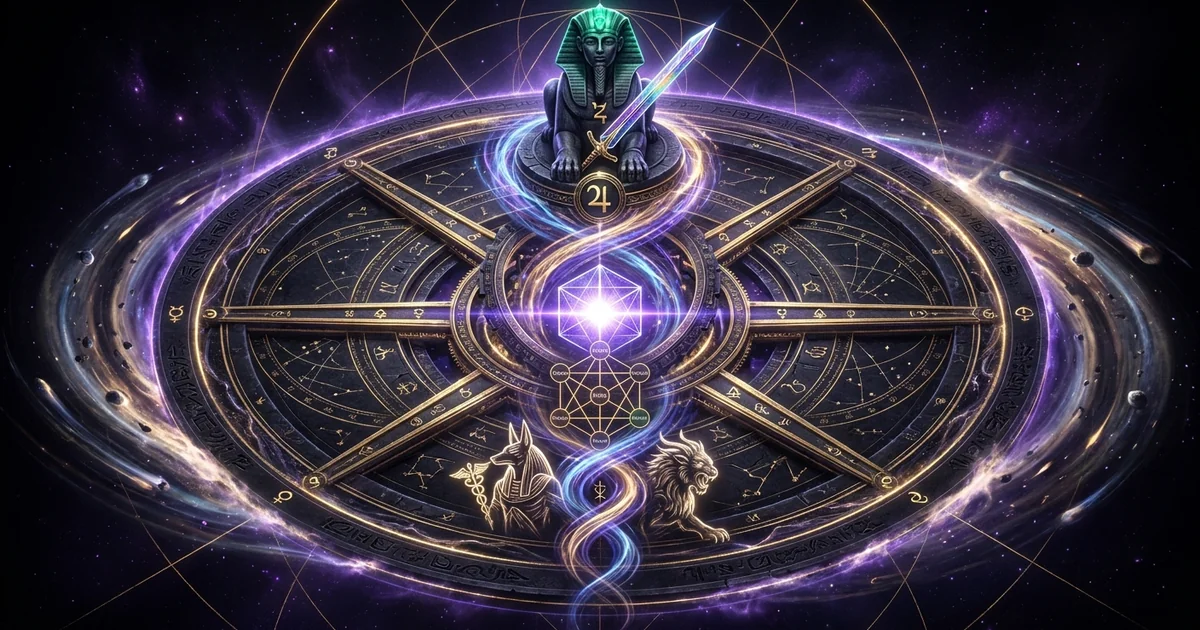
Wheel of Fortune: Cycles of Karma and Cosmic Destiny
Archetypal Thesis & Systemic Paradigm: The Cybernetics of Destiny and the Invariant Hub
The Wheel of Fortune (Key X) functions within the Hermetic and psycho-cosmological canon not as a deterministic engine of stochastic terror, but as an autopoietic, cybernetic feedback system that maps conscious awareness against unconscious structural cycles. Positioned as Major Arcana 10, the card embodies the decimal crystallization of unity ($1$) collapsing into and regenerating from the boundless void of potentiality ($0$). Far from dictating an unalterable subjection to circumstance, the archetype models the recursive interface between deterministic thermodynamic entropy and teleological individuation. The systemic operation of the wheel of fortune cycles karma destiny dynamic demands an epistemological reorientation: the card does not merely reflect external happenings, but rather reveals the mechanics of personal psychic projections encountering macrocosmic order.
The Dialectic of Heimarmene and Proneia: Distinguishing Blind Fate from Conscious Destiny
Within Hellenistic and Gnostic cosmologies, the concept of heimarmene defined the inescapable astral servitude imposed by the planetary spheres—a mechanical, cyclical incarceration wherein the soul remains trapped within the lower sublunar matrices of cause and effect. This fatalistic subjection to the planetary archons corresponds to the psychological state of unintegrated, unconscious participation mystique. When an individual operates entirely under the sway of instinctual complexes and unresolved conditioning, life presents itself as an arbitrary sequence of triumphs and catastrophes. In this state, the ego remains chained to the outermost circumference of the rotating wheel, subjected to brutal rotational velocity and alternating between manic inflation at the apex and crushing despair at the nadir.
Conversely, proneia—the Stoic and Neoplatonic formulation of divine Providence—signifies the systemic intelligence that governs the cosmos, an ordering principle wherein every apparent catastrophe serves an underlying teleological purpose. The transformation of heimarmene into proneia occurs strictly through an internal shift in systemic perception. When viewed through the lens of analytical psychology, fate is unintegrated psychology projected outward onto phenomenal reality; as Carl Gustav Jung famously observed, until the unconscious is made conscious, it directs life and is termed fate. The Wheel of Fortune represents the exact coordinate where this psychological transmutation becomes viable, allowing the practitioner to decode systemic patterns rather than reactively suffering their kinetic consequences.
The Geometrical Topology of the Vortex: The Unmoving Hub versus the Fluctuating Periphery
To understand the topological mechanics of Major Arcana 10, one must analyze the relationship between the wheel’s circumference and its axle. In classical kinematics, points along the rim of a rotating disc travel at maximum tangential velocity ($v = r\omega$), enduring the most severe variations in spatial position and centripetal stress. By contrast, as the radius approaches zero ($r \to 0$), tangential velocity collapses into immobility. At the mathematical center—the unmoving hub—absolute rotational equilibrium is achieved. This spatial invariance serves as the central operative metaphor of Hermetic gnosis: while phenomenal circumstances oscillate wildly across polar axes, the core of transcendent consciousness remains fundamentally unaffected.
Liberation from the cyclic oscillations of circumstance requires the systematic relocation of the self-concept from the rim to the axle. When the practitioner remains anchored to the rim, every rise in status, health, or fortune inherently contains the mathematical inevitability of its corresponding descent, generating acute existential anxiety. By retreating inward toward the zero-point hub of the rotating self, the witness consciousness detaches from kinetic identification with the fluctuating waves of temporal reality. This interior hub does not stop the wheel from turning; rather, it neutralizes the emotional inertia of its rotation, converting what was once an agonizing vortex of blind recurrence into a deliberate, observable laboratory of psychic integration.
Key X as a Phase Transition: The Bridge from Solitary Introspection (Key IX) to Equilibrium (Key XI)
In the structural architecture of the Tarot’s Major Arcana, Key X operates as a critical phase transition, marking the definitive boundary between individual ego development and transpersonal systemic initiation. The initiate arrives at Key X directly from the solitary introspective sanctuary of Key IX, The Hermit, where personal consciousness was distilled through withdrawal, silence, and the concentration of the interior light of the Yod. Having stabilized the internal flame of awareness, the practitioner can no longer remain within the protected isolation of the cloister; the systemic reality of the external universe must be confronted.
Key X shatters the illusion of isolated autonomy by introducing the relentless mechanics of macrocosmic cycles. It demonstrates that internal psychological integrity must be stress-tested within the dynamic, evolving arena of cosmic law. Furthermore, the Wheel functions as the direct mechanical precursor to Key XI, Justice. While the Wheel displays the dynamic, cyclical, and turbulent manifestation of cause, effect, and energetic return, Justice subsequently provides the cold, static, and analytical codification of those very same karmic operations. Without the rotational momentum and experiential reckoning generated by the Wheel, the scales of Justice would lack systemic material to calibrate, balance, and resolve.
“The archetype of the rotating wheel, or the cyclical compensation of the psyche, represents the mathematical necessity of balance within an autopoietic system. What is not brought to consciousness from within returns from without as a cyclical fate, demanding the ego’s alignment with the totality of the Self. The rotating center is the archetype of the unmoving mover, wherein temporal distress is sublimated into teleological equilibrium.”
Classical Provenance & Textual Lineage: From Boethian Rota to the Hermetic Synthesis
The iconography and conceptual foundations of Key X trace a complex lineage from antiquity through late-antique philosophy to modern occult revivals. Far from emerging ex nihilo in medieval gaming decks, the image of the cyclical engine reflects centuries of philosophical contemplation regarding the nature of luck, necessity, and cosmic order. The card serves as a palimpsest wherein classical Stoicism, Christian scholasticism, and Renaissance Kabbalah converge into a unified glyph of esoteric dynamics.
       [ Classical Fatum / Heimarmene ]
                      │
                      ▼
       [ Boethian Consolatio (524 CE) ]
         (Rota Fortunae & Divine Providence)
                      │
                      ▼
   [ Éliphas Lévi: Dogme et Rituel (1854) ]
   (Ezekiel's Merkavah & the TARO/ROTA Cipher)
                      │
                      ▼
     [ Hermetic Order of the Golden Dawn ]
     (Path 21: Kaph / Chesed-Netzach / Jupiter)
                      │
                      ▼
   [ Waite-Smith Synthesis (Key X, 1910) ]
The Boethian Wheel: Classical Stoicism, Christian Providence, and the Visio de Consolatione
The defining philosophical codification of the wheel in Western thought was established by Anicius Manlius Severinus Boethius in his 524 CE masterpiece, De Consolatione Philosophiae. Imprisoned under false charges of treason and awaiting execution by King Theodoric, Boethius receives a visionary visitation from Lady Philosophy, who deconstructs his lamentations concerning the arbitrary loss of political power, wealth, and liberty. Philosophy introduces the personification of Fortune, whose inherent nature is mutability itself: to complain about Fortune’s inconstancy is to misunderstand the very definition of her essence, which is to turn her wheel relentlessly, elevating the low and bringing down the proud.
“Inconstancy is my very essence; it is the game I never cease to play as I turn my wheel in its whirling circle, delighting to see the lowest turn to the top and the top to the bottom. Mount if you will, but on this condition: that you will not think it an injustice to step down when the rules of my game call for it… If you submit your neck to her yoke, you must prepare yourself for whatever she lays upon you.”
Crucially, Boethius does not leave the soul subjected to this mechanical tyranny. In Book IV of the Consolatio, Philosophy delineates the critical distinction between Fatum (Fate) and Providentia (Providence). Providence is the divine, immutable mind that conceives the whole cosmic system simultaneously in an eternal present, whereas Fate is the temporal disposition of this unified plan deployed across the unfolding rhythms of time. The closer an intellect draws to the transcendent divine mind, the freer it becomes from the turbulent chains of Fate. Boethius’s formulation provided the precise intellectual blueprint that transformed the Wheel of Fortune from a horrifying engine of classical fatalism into a pedagogical device for the spiritual elevation of the intellect.
Éliphas Lévi’s Kabbalistic Reconstruction: Ezekiel’s Vision and the Taro-Rota-Tora Cipher
The transition of the Wheel from a medieval allegory of worldly vanity into a rigorous Hermetic glyph occurred through the work of the French occultist Éliphas Lévi. In Dogme et Rituel de la Haute Magie (1854), Lévi synthesized the traditional medieval Rota with the prophetic vision of Ezekiel’s Merkavah (the fiery chariot composed of intersecting, eye-filled wheels). Lévi recognized that the four living creatures of Ezekiel—the Man, the Lion, the Ox, and the Eagle—corresponded precisely to the four quadrants of the celestial sphere, the four elemental kingdoms, and the four letters of the Tetragrammaton ($\text{Y-H-V-H}$).
Furthermore, Lévi unveiled the multidirectional cryptographic wheel cipher, demonstrating that the Latin word ROTA (wheel) forms a continuous semantic loop when shifted through its rotational permutations: ROTA (the wheel) TARO (speaks) ORAT (the law) of TORA (the divine doctrine). Lévi integrated alchemical iconography onto the wheel’s framework, embedding the sigils of Salt ($\ominus$), Sulfur ($\triangle$), and Mercury ($$), alongside the ascending jackal-headed figure of Hermanubis (symbolizing evolutionary illumination) and the descending reptilian form of Typhon-Set (representing material decay and entropic collapse). By doing so, Lévi transformed the card into an active talisman of cosmic reconciliation, illustrating that destruction and regeneration are the dual systemic poles of a single ontological movement.
Golden Dawn Standardizations: Rectification of the Jovian Attribution and Path 21 Dynamics
When the Hermetic Order of the Golden Dawn formulated its comprehensive curriculum in late 19th-century London, S.L. MacGregor Mathers and his circle standardized the astrological and kabbalistic assignments of the Tarot deck. Correcting earlier Continental discrepancies, the Golden Dawn attributed Key X directly to the 21st Path of the Tree of Life, linking the Sephirah Chesed (Mercy, the formative sphere of Jupiter) to Netzach (Victory, the sphere of Venus and elemental vitality). This specific path attribution bridged transpersonal divine benevolence with dynamic astral manifestation.
Under this schema, the Golden Dawn officially assigned Key X to the planet Jupiter—termed Tzedek in Hebrew, meaning “Righteousness” or “Equity.” This rectification permanently divorced the card from vulgar associations with blind, chaotic chance. Arthur Edward Waite, working in collaboration with artist Pamela Colman Smith, manifested this Hermetic-Kabbalistic synthesis in the 1910 Rider-Waite-Smith deck. Smith rendered the Tetramorphic entities in the four corners of the card as celestial scribes, each reading from a sacred book, thereby indicating that the cycles of fate are not arbitrary explosions of nature, but the structural execution of cosmic intelligence recorded within the akashic memory of the macrocosm.
Structural Mechanics & Symbolic Geometry: Qabalistic Paths, Planetary Dignities, and the Tetramorph
The internal architecture of Major Arcana 10 is an intricate geometrical and kabbalistic matrix. The symbols contained within the glyph operate not merely as decorative allegories, but as formal operators in a unified psycho-cosmological equation. To fully deconstruct the card’s function, its Hebrew letter attribution, planetary dignity, and cross-quarter elemental anchors must be examined as intersecting vectors of force.
- Hebrew Letter Attribution: Kaph ($\mathbf{\supset}$ / $\mathbf{ך}$), meaning “The Hollow or Palm of the Hand.” Value: 20 (or 500 when final).
- Tree of Life Vector: 21st Path, descending diagonally from Chesed (Sphere 4, Architectonic Mercy) to Netzach (Sphere 7, Dynamic Astral Victory).
- Astrological Governance: Jupiter ($\jupiter$), the Greater Benefic; ruler of Sagittarius and Pisces; exalted in Cancer.
- Tetramorphic Cross-Quarters: Fixed Signs of the Zodiac—Aquarius (Man/Air), Scorpio via the Transmuted Eagle (Water), Leo (Lion/Fire), and Taurus (Bull/Earth).
- Cryptographic Perimeter: Hebrew Tetragrammaton ($\text{י-ה-ו-ה}$) interleaved with the Latin anagrammatic engine $\text{R-O-T-A}$.
- Alchemical Inner Core: Salt ($\ominus$), Mercury ($$), Sulfur ($\triangle$), and the dissolution/integration solvent Aquarius/Water ($\approx$).
The 21st Path of Kaph: The Concave Palm, Grasping Capacity, and Formative Compression
The Hebrew letter assigned to the 21st Path is Kaph ($\mathbf{\supset}$), which translates literally to the “hollow of the palm” or a cupped hand preparing to grasp, hold, or shape form. Anatomically and symbolically, Kaph embodies the physical and psychological capacity to receive, contain, and mold raw energetic currents into tangible systemic configurations. The hand cupped to hold water indicates structural containment: without the concave palm, the fluid slips away; with it, the fluid can be directed, drunk, or applied.
In its negative, unconscious aspect, Kaph signifies the grasping reflex of the ego—the desperate, neurotic attempt to clutch at transient phenomenal states and freeze the wheel at its highest point of fortune. This clutching instinct generates karmic friction, as the rigid hand resists the inevitable rotation of temporal mechanics. In its exalted, initiatory sense, Kaph represents the sovereign capacity of the adept to serve as an open, receiving vessel for divine currents. The path links Chesed’s expansive, archetypal ideation with Netzach’s dynamic, emotive, and aesthetic crystallization. Kaph is the concave matrix through which abstract divine grace is compressed into the kinetic reality of biological and psychological evolution.
Jovian Governance: Tzedek, Expansion Dynamics, and the Transpersonal Order of Chesed
The attribution of Jupiter to the Wheel of Fortune is of foundational systemic significance. In esoteric astrology, Jupiter is not simply the signifier of material windfalls or vulgar prosperity; it is the Jovian principle of structural synthesis, philosophical coherence, and the expansion of cognitive horizons toward systemic wholeness. As Tzedek, Jupiter establishes cosmic justice not through the severing sword of limitation (which belongs to Saturn and Geburah), but through the abundant, generative integration of all differentiated phenomena into an orderly macrocosmic tapestry.
Because Jupiter governs the card, the cycles of fate mediated by Key X are intrinsically benevolent when viewed from an integrated, transpersonal perspective. Even when the wheel precipitates an apparent catastrophe, the Jovian dynamic ensures that the systemic collapse of an obsolete paradigm creates the exact structural aperture required for higher philosophical expansion. Jupiter represents the gravitational glue of the cosmos, maintaining orbital harmony across planetary bodies; within the psyche, it operates as the self-regulating mechanism of the unconscious, continuously expanding the ego’s boundaries to encompass rejected aspects of reality.
The Tetramorphic Vectors and Alchemical Trinities: Hermanubis, Typhon-Set, and the Sphinx
Anchoring the four corners of Key X is the Tetramorph—the four fixed signs of the zodiac that represent the alchemical squaring of the circular wheel. The Angel of Aquarius (Fixed Air) signifies enlightened intellect; the Eagle of Scorpio (Fixed Water) represents sublimated emotional desire; the Lion of Leo (Fixed Fire) embodies purified spiritual will; and the Bull of Taurus (Fixed Earth) denotes grounded physical stabilization. Each entity holds a book of divine law, demonstrating that the four fundamental states of matter and consciousness are bounded by invariant structural principles. These fixed anchors hold the celestial fabric steady, preventing the dynamic rotational energy of the wheel from dissolving into total, uncontained chaos.
                  [ The Golden Sphinx ]
               (Tiphareth Equilibrium / Mercury)
                           ▲
                           │
       [ Hermanubis ] ─────┼───── [ Typhon-Set ]
     (Evolutionary Gnosis)  │    (Entropic Dissolution)
                           ▼
                  [ The 8-Spoked Wheel ]
              (Salt - Sulfur - Mercury Cycles)
Directly upon the wheel’s circumference interact three distinct mythological figures. Rising along the right flank is Hermanubis—a composite deity merging the Greek Hermes (intellect, language, psychopomp) with the Egyptian Anubis (guardian of the dead, embalmer of forms). Hermanubis symbolizes the ascending evolutionary impulse: the progressive refinement of human consciousness as it climbs out of the primeval mire toward celestial gnosis. Descending on the left flank is Typhon-Set, depicted as a serpentine dragon of darkness. Far from representing absolute evil, Typhon embodies the necessary downward movement of material entropy—the inexorable biological law that breaks down outworn, crystallized structures to release their trapped psychic energy back into the circulatory system of the universe.
Presiding over the apex of the wheel sits the enigmatic, blue-winged Sphinx, holding the upright sword of discernment. The Sphinx occupies the transcendent point of balance, unmoved by the ascending Hermanubis or the descending Typhon. Possessing the body of a lion and the head of a human, the Sphinx represents the ultimate synthesis of animal instinct and divine intellect. It personifies the alchemical element of Mercury in its exalted state, maintaining silence and equilibrium above the turbulent currents of temporal change. The Sphinx serves as an archetypal reminder that the sovereign soul does not fight the descent of Typhon or cling desperately to the ascent of Hermanubis, but remains seated at the crest of awareness, wielding the sword of clear discrimination.
Psychological Dynamics & Operational Praxis: Navigating Transits, Recursion, and Karmic Enactment
Within the domain of analytical psychology and esoteric praxis, the Wheel of Fortune serves as a diagnostic instrument for mapping psychic recursion. Human beings are fundamentally cyclical organisms, conditioned by biological chronorhythms, developmental epochs, and the deep, repetitive grooves of the personal and collective unconscious. When Key X manifests within an initiatory or divinatory framework, it signals that the subject has intersected with a macrocosmic nodal point—a temporal juncture wherein latent systemic pressures demand either psychological evolution or catastrophic re-enactment.
Deconstructing the Repetition Compulsion: From Neurotic Feedback Loop to Spiral Ascent
Sigmund Freud identified the repetition compulsion (Wiederholungszwang) as the fundamental psychological mechanism whereby an individual continuously recreates traumatic scenarios from the past, unconsciously arranging circumstances to suffer the identical wound. Left unchecked, the repetition compulsion traps the psyche within a closed-loop behavioral circle. The individual encounters the same toxic relational dynamics, professional failures, and psychological crises, mistakenly attributing these recurrences to an external, malevolent fate. In the lexicon of Key X, this closed loop represents absolute subjugation to the mechanical rim of the wheel.
The operative liberation offered by the Wheel of Fortune lies in transforming the closed two-dimensional circle into an open three-dimensional spiral. This transition occurs through conscious metabolization of the underlying complex. When an entropic descent (Typhon) is experienced with deliberate awareness rather than neurotic resistance, the ego undergoes the necessary psychic death, realizing that what is falling apart is not the true self, but an outworn, defensive psychic structure. By anchoring the consciousness to the hub, the energy locked within the repetition compulsion is liberated, transforming the descent into the raw kinetic propellant required for evolutionary ascent (Hermanubis). The pattern will inevitably return—as cycles are invariant—but it will return at a higher octave of psychic complexity.
The Witness State Praxis: Meditative Anchoring to the Hub during Macro-Cosmic Crises
Operative esoteric practice requires cultivating the psychological “Witness State” (Sakshin in Vedic philosophy, or the Quiet Mind of Hermeticism) when navigating acute planetary transits or existential crises. When external reality undergoes sudden, destabilizing reversals—economic collapse, relational severances, physical illness—the animalistic amygdalic complex immediately reacts with terror, attempting to grasp at the vanishing paradigm.
To anchor consciousness to the hub during such structural shifts, the practitioner utilizes a specific meditative protocol:
- Spatial De-identification: The subject consciously identifies the catastrophic event not as an assault upon the self, but as a dynamic movement along the external circumference of phenomenal experience. The practitioner verbally affirms: “I am not the rising form, nor am I the falling form; I am the space within which rotation occurs.”
- Kinematic Observation: Rather than projecting psychic energy into resisting the descent of Typhon, the practitioner tracks the systemic decay of the obsolete form with neutral curiosity. The question shifts from “Why is this happening to me?” to “What outworn psychic crystallization is this entropic current clearing away?”
- Equilibrium Realization: The practitioner visualizes the serene, upright sword of the Sphinx at the crown of the psyche. By stabilizing the breath and detaching from the emotional oscillation of the rim, the practitioner accesses the Jovian capacity of Chesed, observing the larger teleological pattern that binds the current crisis to future individuation.
Divinatory Calibration: Differentiating Episodic Disruption from Epochal Destiny Trajectories
In applied divination, misinterpreting Major Arcana 10 as a simple indicator of “good luck” or “bad luck” represents an elementary failure of systemic analysis. Key X signals an objective epochal shift rather than an episodic disruption. When minor cards (such as the Five of Cups or Ten of Swords) appear, they denote local, subjective, and emotionally reactive crises that can be negotiated through immediate psychological adjustment. Key X, by contrast, indicates that the transpersonal ecosystem has shifted its baseline parameters; the individual has crossed an event horizon wherein prior modes of operation are rendered systemically obsolete.
Divinatory calibration requires the reader to ascertain whether the querent is fighting against the wheel’s direction of travel. If an individual attempts to initiate an expansive project while the wheel is actively executing a Typhonic descent, the initiative will inevitably founder under crushing systemic friction. Conversely, if an individual mistakes a Hermanubis ascent for personal, egoic supremacy, they invite immediate enantiodromia—the compensatory reversal of fortune designed to restore macrocosmic balance. The presence of the Wheel demands radical surrender of ego-driven timing in favor of conscious attunement to macrocosmic chronorhythms. Agency is preserved, but it is exercised through exquisite timing rather than brute force.
Philosophical Synthesis & Macrocosmic Correspondence: Chronobiology, Systemic Thermodynamics, and Hermetic Law
The operational mechanics of Key X extend beyond individual psychology, mirroring fundamental laws that govern the physical, biological, and systemic architecture of the universe. From the non-equilibrium thermodynamics of complex systems to the chronobiological rhythms of celestial mechanics, the archetype of the wheel serves as the universal signature of dynamic existence.
The Hermetic Axiom of Rhythm: The Pendulum Swing and the Law of Neutralization
The second of the Seven Hermetic Principles articulated in the Kybalion is the Principle of Rhythm: “Everything flows, out and in; everything has its tides; all things rise and fall; the pendulum-swing manifests in everything; the measure of the swing to the right is the measure of the swing to the left; rhythm compensates.” Key X is the absolute visual and mathematical sigil of this law. The wheel demonstrates that dynamic balance within the cosmos is never a static, stationary state, but a continuous, rhythmic oscillation between polarities.
The Hermetic practitioner, however, does not submit passively to this pendulum swing. The text outlines the operational Law of Neutralization: while the physical and astral vehicles inevitably experience the rhythmic swing from expansion to contraction, the master consciousness polarizes itself at the unmoving mental hub, allowing the pendulum to swing beneath it on the lower planes without pulling the higher mental state along in its wake. This is precisely the function of the blue-winged Sphinx seated upon the platform of Key X. The Sphinx does not attempt to break the pendulum or halt the wheel; it neutralizes the emotional inertia of the swing by maintaining absolute psychic equilibrium.
Nonlinear Thermodynamics: Strange Attractors, Dissipative Structures, and Phase Space
The mechanics of the Wheel of Fortune anticipate modern discoveries in nonlinear thermodynamics and chaos theory, specifically the work of Nobel laureate Ilya Prigogine regarding dissipative structures. In open physical systems far from thermodynamic equilibrium, entropy is not merely a force of decay; it is the essential catalyst for the spontaneous emergence of higher-order complexity. When a system is driven to a critical threshold of instability—its bifurcation point—the existing structure collapses under chaotic turbulence, reorganizing itself into a more sophisticated, highly integrated dissipative structure capable of processing greater flows of energy.
Deterministic Fatalism (Mechanical Rim)
- Ontological Paradigm: Subjugation to mechanical heimarmene; the cosmos operates as an indifferent, predatory, or chaotic meat-grinder.
- Psychological Posture: Helplessness alternating with manic egoic inflation; acute anxiety generated by rapid shifts in circumstance.
- Perception of Crisis: Catastrophe viewed as senseless victimhood, personal punishment, or terminal entropic decay.
- Systemic Trajectory: Circular, two-dimensional trap; endless neurotic re-enactment of the repetition compulsion.
- Operational Mode: Reactive resistance; desperately clutching at transient forms along the volatile rim.
Hermetic Providence (Conscious Hub)
- Ontological Paradigm: Alignment with Jovian proneia; the cosmos functions as an autopoietic, self-regulating developmental matrix.
- Psychological Posture: The unmoving Witness State; identification with the invariant, transcendent center of consciousness.
- Perception of Crisis: Catastrophe decoded as systemic bifurcation; the necessary dissolution of obsolete structures for higher emergence.
- Systemic Trajectory: Spiral, three-dimensional evolution; transmutation of karmic inertia into deliberate individuation.
- Operational Mode: Conscious synchronization; rhythmic neutralization and intentional attunement to macrocosmic cycles.
Within this scientific framework, the descending dragon Typhon represents the necessary entropic destabilization that drives the psychic system toward its bifurcation point, while Hermanubis represents the emergent order that self-organizes out of the crucible of systemic collapse. The Wheel of Fortune mathematically mirrors the phase space of a “strange attractor,” wherein chaotic, seemingly unpredictable trajectories are discovered to be bounded by a hidden, magnificent geometrical symmetry. Chaos is revealed to be order that has not yet been comprehended by the observer.
Cross-System Synchronicity: Parallels with I Ching Hexagram 24 (Fu) and the Jovian Cycle
The universality of Key X is corroborated by its precise structural synchronicities across divergent mantic and astronomical systems. In Chinese cosmology, Hexagram 24 of the I Ching, Fu / Return, encapsulates the exact metaphysical inflection point depicted at the base of the Wheel of Fortune. Composed of the Thunder trigram (Zhen) moving upward from beneath the Earth trigram (Kun), Fu represents the winter solstice—the precise moment when the single line of Yang light emerges spontaneously at the bottom of a hexagram previously dominated by five descending Yin lines. The classical commentary on Hexagram 24 declares: “In Return, the heart of Heaven and Earth is seen.” This matches the base of Key X, where the descending force of darkness reaches its absolute limit and instantaneously triggers the ascending, evolutionary thrust of Hermanubis.
       HEXAGRAM 24 (FU / RETURN)
            ───────  (Yin - Earth)
            ───────  (Yin - Earth)
            ───────  (Yin - Earth)
            ───────  (Yin - Earth)
            ───────  (Yin - Earth)
            ───────  (Yang - Thunder / The Light Returns)
Furthermore, this systemic rhythm is physically mirrored in the 11.86-year orbital period of the planet Jupiter around the Sun. Approximately every twelve years, an individual completes a complete Jovian cycle, undergoing an epochal realignment of philosophical values, social opportunities, and psychic horizons. These astronomical milestones—occurring at ages 12, 24, 36, 48, 60, 72, and 84—consistently mark massive macrocosmic structural transitions where the wheel turns definitively, demanding the shedding of outdated developmental paradigms to accommodate the next orbital octave of spiritual growth.
Frequently Asked Questions: Resolving Advanced Esoteric and Structural Inquiries
Does Key X Signify Inevitable Pre-Ordained Fate or Conscious Synchronicity?
Key X does not denote mechanistic, immutable pre-determinism, nor does it describe random, meaningless luck. Within modern esoteric cartography, the Wheel of Fortune designates a high-density field of conscious synchronicity—an inflection point where the internal psychological trajectory of the individual intersects definitively with the structural mechanics of macrocosmic law. The events precipitated by Key X are pre-ordained only to the exact extent that the individual remains unconscious of their own psychic conditioning.
When an individual operates in a state of psychological blindness, the wheel acts upon them as an irresistible physical force, compelling external outcomes through the agency of unconscious projection. However, for the awakened practitioner, Key X represents an invitation to conscious participation. The timing and nature of the cyclical wave are determined by macrocosmic rhythms, but the individual retains total operational sovereignty regarding how that energetic momentum is received, metabolized, and directed. The card indicates that the wave has arrived; whether the initiate drowns in the undertow or surfs the crest depends entirely upon their identification with the unmoving hub of awareness.
Why Is Jupiter Assigned to the Wheel Instead of Saturn (Chronos) or Uranus?
A frequent point of confusion among intermediate students is why the Wheel of Fortune is governed by Jupiter rather than Saturn—the traditional lord of time, cycles, and karmic retribution—or Uranus, the modern planetary signifier of sudden disruptions and unexpected turns of fate. The answer lies in the deep kabbalistic architecture of the Tree of Life. Saturn is assigned to the 32nd Path and the 21st Major Arcanum (Key XXI, The World), representing the absolute material crystallization, final structural limitation, and ultimate boundary of the cosmos. Saturn binds, ossifies, and terminates; it does not turn the wheel, but builds the container within which turning occurs.
Jupiter, by contrast, is assigned to the 21st Path because it is the planetary emissary of Chesed—the primary sphere of organization, divine architecture, and synthetic harmony. Jupiter represents the macrocosmic intelligence that ensures that all cyclical movement ultimately serves the good of the whole. If the Wheel were governed by Saturn, it would be a cold, terminal torture-rack of inescapable material decay; if governed by Uranus, it would be an erratic, discontinuous, and psychotic explosion devoid of coherent evolutionary continuity. Jupiter imbues the Wheel with systemic benevolence, structural equity, and the teleological guarantee that every collapse of form is deliberately designed to foster the expansion of consciousness.
How Does an Inverted Wheel of Fortune Manifest in Hermetic Practice?
When Major Arcana 10 appears in an inverted orientation, vulgar divinatory traditions typically assign it the fatalistic reading of “bad luck,” financial ruin, or catastrophic misfortune. Within Hermetic operational praxis, an inverted Key X indicates a state of intense, agonizing psychic friction caused by the ego’s violent refusal to yield to a necessary developmental cycle. The wheel itself never stops rotating; it is impossible to break or invert the macrocosmic engine of the cosmos. Therefore, the reversal does not describe a broken wheel, but an individual attempting to run backward along the rim of a moving treadmill.
An inverted Wheel of Fortune is an urgent clinical signal of the repetition compulsion operating at peak intensity. It reveals that the individual is actively resisting the entropic clearing of Typhon-Set, clutching desperately to a dead career, an abusive relationship, or an outworn cognitive paradigm that the universe is attempting to dissolve. This resistance creates systemic turbulence, manifesting subjectively as stagnation, severe anxiety, and a feeling of being crushed by circumstances. The practical prescription for an inverted Key X is radical non-attachment: releasing the white-knuckle grip of the ego, dropping from the fluctuating rim into the stillness of the center, and permitting the natural systemic rotation to clear the board for the next Jovian expansion.