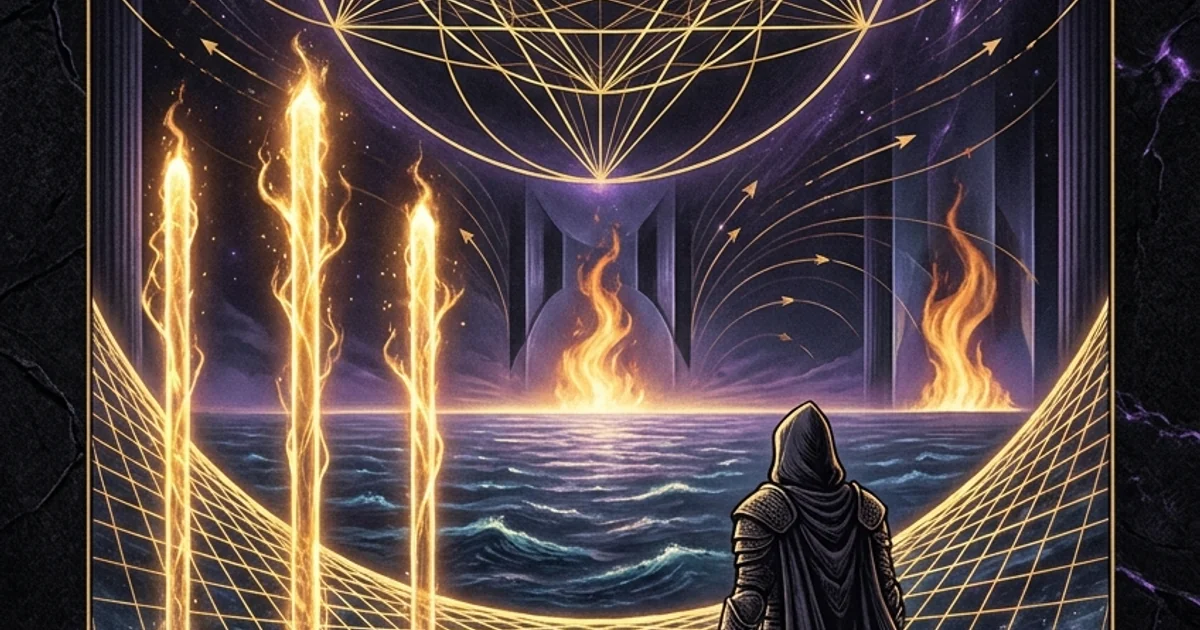
Three of Wands: Established Vision & Cosmic Expansion
Archetypal Thesis & Systemic Paradigm: The Mechanics of Established Vision
The Three of Wands constitutes the archetypal stabilization of primordial Volition as it passes into architectural expansion. Within the cosmological mechanics of Western esotericism, the suit of wands tracks the descent and distribution of the fire element through descending dimensional thresholds. While the initial eruption of energy within the Ace of Wands represents unconditioned ontological potential, and the /tarot/two-of-wands-meaning isolates that impulse at a volatile subjective crossroads, the Three of Wands marks the structural crystallization of directional momentum. The card functions as an archetypal nexus where visionary contemplation collapses raw potentiality into systemic macrocosmic expansion. Far from a passive tableau of wistful waiting, the card models prospective intentionality—a psycho-spatial operation wherein sovereign ego-consciousness, having established its programmatic footing, projects systemic agency across the spatiotemporal field.
From Ketheric Flash to Binah’s Formative Matrix
The transition from the initial emanations of the Tree of Life to the third sephira governs the inner mechanics of this card. In the Kabbalistic cosmos, fire manifests in its purest, most volatile state within the archetypal world of atziluth. The Ketheric flash of the Ace of Wands and the Chokmahic polarization of the Two of Wands lack spatial durability; they burn with immediate, unmediated intensity that threatens to exhaust its fuel without durable manifestation. The intervention of binah—the cosmic womb of form, understanding, and structural delimitation—provides the matrix through which this unconditioned solar-cardinal fire gains coherence.
The Three of Wands represents the Sephirah Binah (Understanding) operating within the World of Atziluth (Archetypal/Primordial Fire). This alignment reveals the paradox of the card: Binah, traditionally associated with Saturnian limitation, dark matter, and severe maternal constriction, acts upon the unrestrained volcanic ignition of Chokmahic Fire. Within Atziluth, this constriction does not suffocate the flame; rather, it engineers an energetic crucible, converting raw kinetic explosion into a sustained teleological laser. The Primordial Mother shapes the Will-to-Be into the Will-to-Form, establishing the archetypal blueprint before its astral descent.
By grounding fire within binah, the Three of Wands reconciles dynamic volition with architectural law. Binah imposes spatial parameters, generating the container through which the creative will of the magician or demiurge ceases to be a chaotic discharge and becomes an organized expedition. Within this metaphysical framework, the primordial masculine current (Chokmah) is received, measured, and assigned a structural trajectory by the primordial feminine current (Binah). The result is not stasis, but the formulation of an intentional vector capable of navigating distance without dissolving its initial integrity. Understanding the mechanics of /qabalah/binah-understanding-archetypes is essential to grasping how the initial spark resists entropic dispersion.
The Volitional Horizon: Teleology and Intentional Energy Fields
The structural geometry of the Three of Wands operates around the volitional horizon. This horizon is not a geographical boundary, but a topological boundary-condition of consciousness. In the language of phenomenology and field theory, intentionality is always directional—consciousness is perpetually consciousness of something. The figure stationed upon the promontory establishes an intentional field that links the subjective core of the will with objective outer space. This teleological orientation pulls future temporal structures into present operations.
The three of wands tarot meaning demands that one interpret anticipation as active metaphysical deployment. When consciousness envisions a terminal objective with crystalline clarity, it exerts a subtle organizing pull upon the intermediate variables. This process is governed by systemic cybernetics: the visionary does not merely imagine an outcome, but establishes a field of resonance that constrains chaotic fluctuations. The promontory functions as the sovereign node within an open network; the three staves driven into the earth act as conductive antennae that stabilize the local coordinate frame, allowing the intentional gaze to extend across oceanic flux without cognitive vertigo.
Overcoming Static Equilibrium in Fire Element Dynamics
Within thermodynamic and elemental models, the fire element exhibits a persistent vulnerability to rapid entropy: it either consumes its substrate instantaneously or suffocates under its own ash. The fundamental challenge of the /tarot/wands-suit-fire-element-esoteric is sustaining coherent momentum without capitulating to the static equilibrium of premature closure or the entropic exhaustion of wild conflagration. The Two of Wands struggles with this precisely because its polarized poles lock the consciousness in an energetic stalemate—a condition of agonized deliberation between the internal fortress and the terrifying outer world.
The Three of Wands breaks this stalemate through asymmetric vectoring. The addition of the third structural point resolves the binary tension, functioning as an energetic fulcrum that tilts the system outward. The fire element ceases to feed exclusively upon internal psychological friction and begins to consume open space as its operational fuel. Dynamic equilibrium replaces static tension. The system sustains its elevated thermodynamic state because it has externalized its operational trajectory; by dispatching its energetic assets (symbolized by the trans-oceanic vessels), the sovereign prevents the destructive internal heat-death that inevitably occurs when Cardinal Fire remains confined to an insular psychology.
Classical Provenance & Textual Lineage: Historical Transmutations of the Card
The hermeneutic development of the Three of Wands reveals a steady refinement of its underlying mechanics. The image evolved from an abstract numerical arrangement into a nuanced symbolic drama of exploration, imperial commerce, and transcendent mastery. By tracing this lineage through the primary texts of modern occultism, one observes how the fundamental formula of the card has retained its structural integrity while gaining psychological and metaphysical sophistication.
       HISTORICAL EMBODIMENTS OF THE THREE OF WANDS

  Mathers / Golden Dawn (1888)        Waite-Smith (1910)           Crowley / Harris (1944)
┌──────────────────────────────┐┌──────────────────────────────┐┌──────────────────────────────┐
│ "Lord of Established Strength││   "The Promontory Watcher"   ││           "Virtue"           │
│ Solar-Aries Decanic Formula  ││ Vision externalized via sea  ││ Uncorrupted Will in Atziluth │
│ Balance of Force & Harmony   ││ Merchant ships as projections││   Central fiery sun-lotus   │
└──────────────────────────────┘└──────────────────────────────┘└──────────────────────────────┘
The Golden Dawn Formula: The Lord of Established Strength
In the foundational curriculum of the Hermetic Order of the Golden Dawn, preserved within the Cypher Manuscripts and synthesized in S. L. MacGregor Mathers’ Book T, the Three of Wands is titled “The Lord of Established Strength.” The Golden Dawn assigned the card to the second decan of the cardinal fire sign Aries, ruled by the Sun. This attribution forms the structural cornerstone of its traditional interpretation. Mathers and Westcott recognized that the confluence of Sol—the source of cosmic vitality, order, and conscious awareness—with the primordial impetus of Aries produces a state of organized force that has moved past the precarious infancy of initial effort.
S. L. MacGregor Mathers, Book T (1888): “Established force, strength, realization of hope. Completion of labor. Success after struggle. Pride, arrogance, conceit. Realization of projects. Continuation of that which was begun by the Two. Nobility, power, wealth, prestige.”
Aleister Crowley, The Book of Thoth (1944): “This card refers to Binah in the sphere of the element of Fire. It represents the establishment of primeval energy. The will is fulfilled… It is the card of Virtue—this word being used in its ancient sense of strength, efficacy, and inherent nature… It is the Sun in Aries, the sign of his exaltation; and the energy of the ram is directed and balanced by the solar harmony.”
Under the Golden Dawn dispensation, the card signifies the structural consolidation of conquest. The “Established Strength” does not imply final resting completion—which belongs to the sphere of Malkuth or the Tens—but rather the stabilization of a beachhead. The initial skirmish with non-being has been won; the supply lines are secured; the architectural lines of communication are open. Mathers links this attribution directly to societal and material triumph, noting that the combination of solar nobility with Arian initiative generates an aura of unimpeachable command, though carrying the shadow risk of imperial hubris.
Waite-Smith Visual Hermeneutics: The Watcher on the Promontory
When Arthur Edward Waite collaborated with artist Pamela Colman Smith to create the Rider-Waite-Smith (RWS) deck in 1910, they instituted a visual revolution. Departing from the unadorned, crossed-baton geometry characteristic of the Tarot de Marseille, Smith, guided by Waite’s programmatic directives, rendered a fully realized dramatic tableau. A dignified figure, cloaked in robes of crimson and emerald green with a patterned mantle slung over the left shoulder, stands with his back turned toward the observer. He occupies an elevated crag overlooking an inlet traversed by three slender vessels cutting through waters of gold and azure toward distant, mountainous shorelines.
In The Pictorial Key to the Tarot, Waite delineates the symbolic import of this posture. The solitary watcher rests his right hand upon one of three tall staves planted securely into the soil of the promontory, while the other two staves flank him on his left, forming a gate or architectural colonnade through which his vision travels. Waite notes:
“He symbolizes an able, concentrated force of enterprise, looking out over the wide waters at his dispatched ships, which are returning or departing on his business. It represents established work, partnership, enterprise, discovery; it is the commercial aspect of intellectual projection.”
The decisive visual pivot is the deliberate turning away from the querent. The promontory sovereign does not engage in dialogue with the immediate social sphere; his gaze is unswervingly fixed upon the horizon of temporal emergence. The figure has externalized his interiority. The ships are external psychic contents—ventures, investments of libido, structural conduits of will—sent out into the universal sea of potential to trade with the unknown and return with the wealth of expanded consciousness.
Thoth and the Cult of Virtue: Solar Dominance in the Sign of the Ram
In Aleister Crowley’s The Book of Thoth, illustrated by Lady Frieda Harris, the third arcanum of the fire suit sheds anthropomorphic narrative in favor of pure dynamic geometry and radiant chromatic forces. Crowley names the card simply “Virtue.” He retrieves the term’s classical Latin etymology—virtus—signifying intrinsic excellence, potency, moral courage, and inherent functional capacity. For Crowley, the Three of Wands represents the pristine state of will: pure, undistorted, operating precisely according to its cosmic formula, entirely untainted by the “lust of result.”
The Harris composition depicts three crossed wands crowned with lotus blossoms, their intersections radiating crystalline white and fiery orange shafts of light against a deep scarlet and gold field. This is the Sun exalted in Aries, expressing itself through the maternal architecture of Binah. Here, the raw sexual and spiritual force of the Ram is purified by the solar heart. Crowley emphasizes that this card marks the definitive establishment of primordial energy. It is the creative fiat having found its focus. The “Virtue” of the card is its total alignment with cosmic law: the will expands outward not out of compensatory lack or manic desperation, but because expansion is the natural, inevitable expenditure of abundant being.
Structural Mechanics & Symbolic Geometry: Astrological and Qabalistic Decans
The operational efficacy of the Three of Wands depends upon a web of astrological, geometric, and chromatic correspondences. Far from arbitrary associations, these vectors establish an energetic equation that governs the card’s function within the broader cartography of the Hermetic cosmos.
                  ASTROLOGICAL & GEOMETRIC FORMULA

         Aries 10°–20°                  The Triad (Binah)
   ┌───────────────────────┐        ┌───────────────────────┐
   │     Solar Diurnal     │        │     First Polygon     │
   │ Exaltation in Cardinal│        │  Bifurcation Exceeded │
   │         Fire          │        │ Directional Momentum  │
   └───────────┬───────────┘        └───────────┬───────────┘
               │                                │
               └───────────────┬────────────────┘
                               │
                               ▼
                    [ Three of Wands: Virtue ]
              Sovereign Direction & Dynamic Equilibrium
Solar Sovereignty in the Second Decan of Aries (10°–20° Aries)
The astrological foundation of the card resides within the second decan of Aries, spanning 10° to 20° of the cardinal fire sign. In the classical /astrology/decan-system-classical-astrology, as outlined by Claudius Ptolemy in the Tetrabiblos and preserved in the medieval Picatrix, this face is assigned to the diurnal planetary rulership of the Sun. This attribution produces an exceptionally harmonious astrological signature. Aries is the sign of the Sun’s exaltation, the sector of the zodiac where the solar principle of life, consciousness, and generative sovereignty attains its most radiant and uninhibited expression.
The first decan of Aries (ruled by Mars, embodied in the Two of Wands) represents the initial, abrasive rupture of spring—the ram battering down the icy inertia of winter with raw, uncalculated brute force. In the second decan, this martial violence is softened, illuminated, and centralized by the Sun. The Sun provides the cohesive core that cardinal fire otherwise lacks. It introduces dignity, farsightedness, and royal magnanimity to what was previously a localized rebellion. The individual or system operating within this decanic frequency commands through intrinsic presence rather than reactive friction. The heat of Aries becomes continuous and sustained, providing the thermodynamic push required to maintain long-range expeditions across unexplored terrains.
The Geometry of Three: The Triad as Generative Stability
Geometrically, the number Three represents the resolution of structural duality and the birth of actual dimensional manifestation. In Pythagorean monadology, the point (One) possesses only location without extension; the line (Two) introduces distance and polarity but remains trapped within a one-dimensional tug-of-war. Only with the introduction of the third point does the first geometric polygon—the triangle—emerge into reality. The triangle is the fundamental structural unit of physical space, the irreducible minimum required for structural stability and load-bearing capacity.
Two of Wands (Dominion / Mars in Aries)
- Structural Mode: The Dyad; binary opposition, unstable tension, polarizing crossroads.
- Energetic Direction: Inwardly focused, deliberative, hesitant, defensively fortified.
- Psychic Condition: The sovereign stands within the ramparts, clutching an orb; world is held in miniature, unmanifest, theoretical.
- Dynamic Friction: Mars introduces volatility, friction, and anxiety of commitment. Subjective consciousness wrestling with its own ambitions.
Three of Wands (Established Strength / Sun in Aries)
- Structural Mode: The Triad; first polygon, dynamic stability, directional momentum.
- Energetic Direction: Outwardly focused, operational, teleological, structurally deployed.
- Psychic Condition: The sovereign stands on the open promontory, back turned to viewer; assets dispatched into the trans-oceanic expanse.
- Dynamic Equilibrium: Sol introduces harmony, steady irradiation, farsighted nobility. Objective realization operating without internal ambivalence.
Within the Three of Wands, this geometric law manifests through the arrangement of the three staves. In the RWS rendering, two staves are anchored behind the figure, while the right hand rests firmly upon the third, positioned slightly ahead. This configuration mirrors the mechanics of a tripod or a spiritual portal. The two rear staves represent the reconciled opposites—the conscious and unconscious, the inner intent and outer resources—while the forward stave serves as the directional rudder, anchoring the sovereign will within the physical coordinate space. The polarity that paralyzed the figure in the /tarot/two-of-wands-meaning is resolved; the system achieves the dynamic stability necessary to support unhindered forward expansion.
Vesting the Ships: Chromatic Symbolism and Oceanic Horizons
The chromatic distribution within the Waite-Smith composition details the precise interaction between elemental forces. The promontory sovereign is clad in red and green, trimmed with gold. In the Hermetic color scales of the Golden Dawn, red corresponds to the vitality of the fire element and the martial origins of Aries, while green balances this heat through its association with Venus, organic growth, vegetative fertility, and receptive physical harmony. Gold directly channels the solar brilliance of the exalted Sun. The figure’s garments signify an internal integration: the drive of the conqueror is wedded to the patience of the cultivator.
Beneath the promontory lies the sea, rendered in shades of luminous gold and deep azure. In Western esoteric cartography, the ocean represents the primordial astral waters—the collective unconscious, the realm of infinite fluidity, unstructured chaos, and latent potentiality. By painting the sea with golden reflections, the iconography signals that the solar fire of the promontory has successfully irradiated the water. The active masculine principle (Fire/Sun) and the passive feminine principle (Water/Ocean) are not in destructive opposition; rather, the ocean has become a highway for the sovereign’s vessels. The three ships, slicing cleanly through the waves, symbolize the conscious ego’s structures successfully navigating the non-ego, carrying the sovereign’s energetic investments toward the far-off mountainous shores of concrete realization.
Psychological Dynamics & Operational Praxis: The Observer and Prospective Action
When translated into the framework of analytical psychology and esoteric operational praxis, the Three of Wands sheds any vestige of simplistic prognostic fortune-telling. It emerges instead as a precise diagnostic model of dynamic prospective consciousness. The card maps the conditions necessary for the sovereign ego to engage the teleological orientation of the psyche without succumbing to anticipatory neurosis or psychic inflation.
                     THE TRANSCENDENT FUNCTIONAL CIRCUIT

 ┌──────────────────────┐    Active Projection    ┌──────────────────────┐
 │ Sovereign Conscious  │ ──────────────────────> │ Transpersonal Future │
 │ Ego on Promontory    │ <────────────────────── │ Emerging Horizon     │
 └──────────────────────┘    Autonomous Returns   └──────────────────────┘
            │                                                ▲
            │                                                │
            └────────── Binah Scaffolding / Discipline ──────┘
The Jungian Transcendent Function on the Edge of Manifestation
In the depth psychology of C. G. Jung, the mind moves past paralyzing inner conflict through the activation of the transcendent function. This psychological engine arises from the tension of opposites, constructing a synthetic third position that incorporates the values of both conflicting poles while opening a completely unprecedented vector of developmental growth. The Three of Wands is the visual and energetic embodiment of this moment.
The figure’s posture—standing at the edge of a cliff with back turned toward the viewer—illustrates an ego-consciousness that has successfully mediated its internal polarities and now stands aligned with the teleological orientation of the Self. The figure does not look backward toward the querent or the past; it looks outward toward the emerging contents of the collective unconscious. In the clinical context, this corresponds to the phase of individuation where an individual ceases to obsess over the etiologies of childhood trauma or theoretical career crossroads, and instead begins to observe the objective effects of their choices rippling across the social and environmental field. The psychic libido is no longer trapped in introverted rumination; it has been cast forward into the world as an organizing principle.
De-escalating Anticipatory Anxiety vs. Commanding Strategic Horizon
A frequent pathology encountered in applied divinatory consultation is the confusion between active visionary command and anticipatory anxiety. In the grips of anticipatory anxiety, the subject projects catastrophic or manic expectations onto an unknown future, freezing operational capacity through continuous, hyper-vigilant scanning. The subject remains psychologically trapped within the Two of Wands, clutching the theoretical world within an enclosed fortress, terrified that launching an enterprise will result in its destruction.
Marie-Louise von Franz, On Divination and Synchronicity: The Psychology of Meaningful Chance (1980): “In archetypal divination, the card or hexagram drawn does not cause an event, nor does it merely forecast a static outcome. Rather, it offers a snapshot of the qualitative time field—the kairos—at the exact moment the inquiry is launched. When a card representing structural foresight appears, such as the Three of Wands, it points to the non-local alignment of the observer’s subjective state with an unfolding objective trajectory. Anticipatory consciousness, when freed from the ego’s neurotic demands, acts as an open radar system that reads the field’s gradients, recognizing that the energetic investment has already collapsed the probability wave.”
The Three of Wands provides an antidote to this paralysis by demanding an uncompromising inventory of commitments. The ships are not awaiting construction in a theoretical dry-dock; they have already been launched. The promontory sovereign does not pace the shoreline in a state of agitation, nor does he attempt to micromanage the currents or swim alongside the hulls. The sovereign understands the operational principle of strategic trust: once the structural parameters of an enterprise have been correctly engineered and aligned with macrocosmic law, the practitioner must grant the enterprise its autonomous lifecycle. Farsighted command is characterized by an interior silence that observes the unfolding horizon with steady, non-interfering objectivity.
Active Imagination Protocol: Standing with the Promontory Sovereign
Within the therapeutic and esoteric discipline of active-imagination, the visual architecture of the Three of Wands serves as an entry point into dynamic psycho-cosmological alignment. This protocol does not rely upon passive daydreaming, but rather the rigorous, experiential inhabiting of the card’s geometric coordinate space.
The practitioner begins by anchoring awareness within the physical body, establishing a breath cycle synchronized with the rhythmic pulse of the solar heart. In the imaginal eye, the practitioner steps onto the elevated precipice, consciously assuming the physical posture of the promontory sovereign. The two rear staves are experienced as the spine’s foundational supports: the left stave grounding the receptive, ancestral, and unconscious lineage; the right stave channeling the active, intellectual, and strategic competencies. The practitioner’s right hand grasps the central forward stave, which is experienced not as an external object, but as the conductive axis of the True Will rooted deeply into the bedrock of reality.
From this vantage point, the practitioner looks outward across the golden waters of the mind. Each ship traversing the bay is consciously identified with a specific transpersonal project, relationship, or energetic investment that has been committed to the world. The practitioner observes these vessels moving away from the shore, resisting the compulsive urge to pull them back through fear or propel them forward through impatient fantasy. The practitioner holds this elevated promontory consciousness until the distinction between the internal will and the external horizon dissolves into a unified, flowing circuit of deliberate momentum.
Sequential Vectors & Systemic Circuitry: The Fire Descent Framework
To comprehend the full operational mechanics of the Three of Wands, one must analyze its location within the wider evolutionary circuits of the tarot and its trans-cultural analogs. The card does not stand in isolation; it functions as a node within an integrated kinetic engine governing the manifestation of energy from raw spark to settled institutional form.
The Evolutionary Progression: Ace, Two, and Three of Wands
The developmental vector through the primary minor arcana of the fire suit illustrates the systematic crystallization of divine energy:
- Ace of Wands: The ontological root of Fire. Unconditioned potential, the burst of divine inspiration, absolute vitality devoid of spatial or temporal coordinate limitation. It is the unchanneled thunderbolt of Kether within Atziluth.
- Two of Wands: The emergence of polarity and the crisis of location. The energy encounters its first horizon, bifurcating into subjective intention and objective reality. The will is captured within the fortress of its own deliberations; it holds the globe in miniature, balancing the pain of insular safety against the risk of manifestation.
- Three of Wands: The breakthrough into structural deployment. The binary tension is shattered by the Binah-mediated triad. The will is externalized; the ships are built, manned, and launched across the ocean. The perspective shifts from the internal debate of the fortress to the panoramic foresight of the promontory.
- Four of Wands: The landing and initial consolidation. Having successfully crossed the waters, the energy establishes its first settled settlement, celebrated through the architectural portal of the /tarot/four-of-wands-meaning.
In this sequence, the Three of Wands operates as the definitive engine of transition. It is the bridge between the purely theoretical formulation of a destiny and its physical embodiment. Without the structural courage and panoramic horizon of the Three, the potential of the Ace would curdle into the brooding, impotent stagnation that constantly threatens the isolated ruler of the Two.
Macrocosmic Echoes: The Trigram Li and Hexagram 56 (The Wanderer)
This dynamic finds a structural parallel within the classical I Ching (Book of Changes). The fire element corresponds to the trigram Li (☲), representing Clarity, Brightness, and Adhesion. Li is fire: it has no definitive physical substance of its own, but must cling to a combustible material to illuminate the world. When fire possesses no coherent substrate, it explodes, flickers, and dies. When it adheres to a steady structural order, it transforms into an all-illuminating beacon that dispels confusion.
       I CHING CORRESPONDENCE: HEXAGRAM 56 (LÜ - THE WANDERER)

       Trigram Li (Fire) Above        ☲   (Clarity, Illumination, Vision)
       ───────────────────────────────
       Trigram Gen (Mountain) Below   ☶   (Immobility, Promontory, Bedrock)
This structural dynamic is captured in Hexagram 56, Lü (The Wanderer), where the trigram Li (Fire) sits atop the trigram Gen (Mountain, ☶). The Mountain provides the immovable promontory—the secure foundation, the structural stability of the two rear staves rooted in bedrock. Above this mountain rests Fire, blazing upward and outward, surveying the far country with absolute clarity. The Wanderer is not a lost vagabond; he is the explorer who travels through strange lands with acute awareness, maintaining internal integrity precisely because his clarity (Li) is supported by a foundational reserve of internal stillness (Gen). The sovereign of the Three of Wands matches this hexagram: he stands upon the mountain of established inner mastery, casting his fiery light across the vastness of the foreign seas.
Human Design Parallel: Gate 51 to Gate 42 Developmental Flow
Within the cybernetic framework of the Human Design System—which maps the 64 hexagrams to somatic and genetic channels—a parallel developmental arc can be traced from the initial initiation of will to its sustained systemic expansion. The movement from Gate 51 (The Gate of Shock / The Arousing) within the Heart/Ego Center to Gate 42 (The Gate of Growth / Increase) within the Sacral Center mirrors the energetic evolution from the raw fire of Aries to the organized deployment of the Three of Wands.
Gate 51 represents the sudden, martial thunderbolt that shatters complacency—the Ace and Two of Wands breaking open the psychological field through unexpected challenge. Gate 42, located in the cyclic format of the Sacral, represents the capacity to bring a cycle of growth to full structural maturation and expansion. It governs the programmatic follow-through of an enterprise once it has cleared its initial ignition. The Three of Wands serves as the operational bridge between these two centers: it takes the raw sovereign ego-will of the Heart (Gate 51) and anchors it into an objective, generative cycle of development (Gate 42), ensuring that the initial energetic shock is converted into sustained, evolutionary maturation.
Philosophical Synthesis & Macrocosmic Correspondence
To engage the Three of Wands at its highest level of abstraction is to confront the fundamental mechanics of cosmic creation. The card operationalizes core Hermetic axioms, transforming theoretical metaphysics into an operational engine of conscious expansion.
The Hermetic Axiom of Polarity Transcended
The second Hermetic principle, the Principle of Polarity—“Everything is dual; everything has poles; everything has its pair of opposites”—is resolved through the third principle, the Principle of Rhythm, via the structural geometry of the triad. The Two of Wands demonstrated the vulnerability of the dualistic mode: when consciousness conceives of itself as separate from its operational environment, the world inevitably presents itself as a hostile or alien theater. The sovereign is trapped behind his stone battlements, viewing the horizon not as an extension of his own being, but as a threat to his territorial control.
The Three of Wands resolves this illusion. By introducing the Binah matrix, the card proves that expansion and containment are not mutually exclusive opposites, but coordinated aspects of a single generative impulse. Containment (the anchoring of the staves, the disciplined focus of the solar gaze) is the necessary condition that allows expansion (the sailing of the ships, the survey of the oceanic field) to occur without structural failure. The sovereign does not destroy his boundaries; rather, he expands his boundary-conditions to encompass the trans-oceanic horizon. The objective world ceases to be an alien adversary and becomes the functional theater through which the sovereign explores his own macrocosmic potential.
Cybernetic Feedback Loops in Divinatory Cartography
When divinatory systems are evaluated not as fortune-telling mechanisms, but as sophisticated psycho-cosmological feedback mechanisms, the Three of Wands serves as a real-time monitor of a system’s navigational parameters. Within systemic cybernetics, any goal-directed system requires continuous informational feedback from its operational theater to maintain its trajectory toward a targeted state.
The promontory sovereign represents the cybernetic comparator: the central processing node that compares the system’s initial teleological intent with the emerging conditions of the environment. The ships are the system’s exploratory probes, dispatched into the informational space to gather empirical data and secure energetic resources. The Three of Wands indicates that the system’s internal configuration is operating at maximum efficiency: the signals sent out into the world are traversing the medium without catastrophic distortion, and the horizon is clear enough to allow the comparator to anticipate future adaptations long before physical impact occurs.
Cosmic Expansion as the Entropic Dissolution of False Boundaries
The deep spiritual mandate encoded within the Three of Wands is the necessary dissolution of false egoic boundaries in service of cosmic integration. The natural tendency of the uninitiated ego is to construct increasingly defensive, insular walls to protect its fragile identity from the demands of the universe. This strategy ultimately breeds systemic death; any closed thermodynamic system that refuses to exchange energy and information with its environment will inevitably suffer total entropic decay.
The Three of Wands breaks open the closed system. The sovereign steps out of the castle, ascends the open promontory, and turns his back upon the comfort of self-referential identity. He launches his essence into the transpersonal sea. This act of cosmic expansion is an act of spiritual courage: it recognizes that the Self is not a tiny, isolated fragment of matter clinging to a rock, but the vast, continuous field that encompasses both the promontory, the ships, the oceanic depths, and the distant, unfolding shores.
Frequently Asked Questions
Diagnostic Distinctions Between Two and Three of Wands
The diagnostic differentiation between these two arcana hinges upon the exact location of the system’s operational assets and the psychological posture of the sovereign. Practitioners frequently conflate the two because both compositions feature a solitary figure holding a stave while surveying an expanse from an elevated perspective. However, the systemic states they model are fundamentally distinct.
In the Two of Wands, the figure is enclosed within the stone battlements of a castle. He holds a miniature globe within his right palm, while the two staves are affixed to the parapet walls, acting as the bars of an energetic cell. This imagery marks an internal, subjective phase: the individual is wrestling with the agonizing crisis of decision. The assets have not been deployed; the world is held only in concept, theoretical and fragile. Mars in Aries introduces tension, restlessness, and the paralysis of over-deliberation.
In the Three of Wands, the stone battlements have vanished, replaced by an open, unfortified promontory. The miniature globe is gone, because the sovereign no longer needs an abstract model; the vast ocean itself lies open to his deployed assets. The ships are already at sea. The sovereign holds the forward stave as a dynamic navigational rudder rather than an anchor of restraint. The Sun in Aries replaces martial anxiety with nobility, serene foresight, and systemic commitment. The transition from the Two to the Three is the ontological crossing from theoretical planning to executed, irreversible rollout.
Significance of the Figure’s Back Turned to the Querent
The deliberate aesthetic choice to depict the promontory sovereign with his back completely turned to the viewer serves as an imperative regarding the directional flow of consciousness. In the majority of the tarot’s minor arcana, the depicted figures engage the viewer through three-quarter views, direct frontal gaze, or profile interactions within localized social situations. In the Three of Wands, the figure completely averts his face from the querent.
When the Three of Wands emerges within an analytical consultation, the averted gaze of the sovereign establishes an immediate diagnostic rule:
- Cease Self-Referential Analysis: The querent must immediately terminate introspective, identity-focused rumination. The answers to the current systemic crisis cannot be extracted from psycho-archaeology or re-examining past motivations.
- Externalize Intentionality: The consciousness must be re-oriented outward, focusing strictly upon operational vectors, objective structural deployments, and the macrocosmic horizon.
- Acknowledge Launched Momentum: The querent must recognize that certain operations are already set in motion; attention should be focused upon preparing for their systemic returns rather than obsessively adjusting their launching conditions.
This averted posture signifies that the sovereign’s attention has been completely transferred from the subjective ego (self-image, social validation, defensive self-justification) to the objective teleological vector. The figure invites the querent not to analyze his face, but to stand beside him and look where he is looking. It is a call to shift the perspective from the mirror to the horizon. The querent is instructed to cease asking “Who am I in this situation?” and instead ask “Where is the structural momentum traveling, and what must be prepared for its eventual landing?”
Deciphering Reversals: Inertia, Delayed Ships, or False Foresight?
When the Three of Wands appears in an inverted or ill-dignified structural position within an archetypal array, it does not herald arbitrary tragedy or simple commercial failure. Rather, it diagnoses an energetic disruption within the circuit of Binah-mediated fire. The pathological manifestation of this arcanum typically branches into three distinct systemic distortions:
The first distortion is false foresight and megalomaniacal inflation. In this state, the querent mistakes grandiose fantasies for established operational expansion. The solar dignity of the second decan of Aries curdles into imperial hubris: the sovereign stands upon the promontory dreaming of trans-oceanic conquests, but has failed to construct seaworthy vessels. The ships sent into the water are illusory, lacking structural engineering, and they founder in the first astral squall.
The second distortion is anxious micromanagement and the refusal to delegate. The inverted Three of Wands reveals a consciousness that has nominally launched an enterprise, but remains psychologically tethered to the ships by umbilical cords of fear. The querent obsessively attempts to control the uncontrollable, sending frantic, contradictory counter-orders that disrupt the autonomous lifecycle of the deployed assets. This energetic snag stems from a failure to trust the structural matrix established during the initial planning phase.
The third distortion is navigational blindness and systemic delay. This manifests when the sovereign has stationed himself upon the wrong promontory—a low-lying hillock obscured by immediate environmental obstacles—preventing him from reading the true gradients of the horizon. The ships are delayed not because the sea is hostile, but because they were dispatched along obsolete navigational coordinates. The corrective prescription for the reversed Three of Wands is an immediate withdrawal to the foundational geometry of the two rear staves: anchoring consciousness, re-establishing structural parameters within Binah, and waiting for the clarity of the diurnal solar principle to burn away the fog of premature or ill-conceived expansion. :::