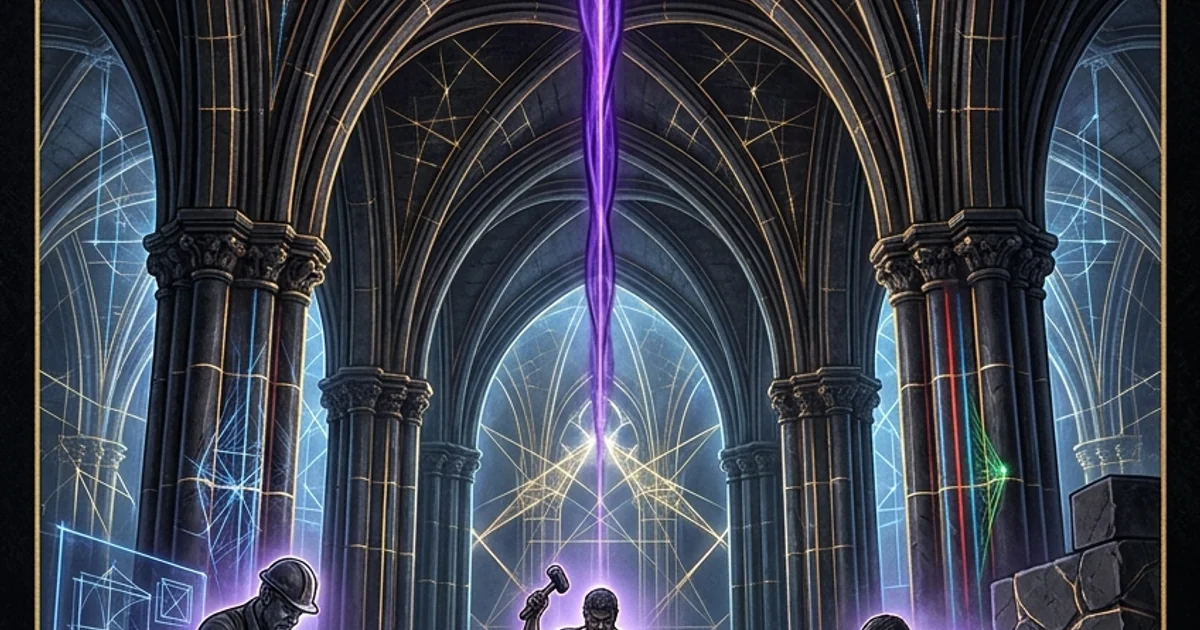
Three of Pentacles: Sacred Craftsmanship and Co-Creation
Archetypal Thesis & Systemic Paradigm: The Geometry of Material Manifestation
The Three of Pentacles operates as an archetypal nexus of crystallizing intentionality, demarcating the precise operational phase where metaphysical archetype solidifies into material form through collaborative, disciplined labor. Far from functioning as an omen of minor commercial transaction or mundane vocational praise, the card delineates the fundamental mechanics of cosmic condensation. Within the architecture of esoteric cartography, manifestation is neither spontaneous nor solipsistic; it demands a geometric bridge connecting the unmanifest energetic reservoir to the resistance of physical reality. In this arcanum, the volatile spiritual current undergoes deliberate constriction, channeling transcendental ideation into durable, tectonic reality. The card models the transformation of isolated subjective vision into objective, sacred architecture through a rigorous systemic triadic synthesis, establishing the baseline conditions under which spiritual potency achieves formal equilibrium within the world of space and time.
+-------------------------------------------------------------------------+
|                  ARCHETYPAL MAPPING OF THE THREE OF PENTACLES           |
+=========================================================================+
| Qabalistic Sphere  | Binah (Understanding / Primordial Form)            |
| World              | Assiah (The World of Action and Material Substratum)|
| Astrological Decan | Second Decan of Capricorn (10°00' - 19°59' Capricorn)|
| Planetary Ruler    | Mars in Capricorn (Exalted Kinetic Drive in Earth) |
| Alchemical Phase   | Coagula (Fixation of the Volatile Spirit)          |
| Elemental Matrix   | Earth of Earth (Crystalline Coagulation)            |
| Hermetic Title     | The Lord of Material Works                         |
+-------------------------------------------------------------------------+
The Triadic Imprint: Binah’s Descent into Assiah
To fathom the three of pentacles tarot meaning, one must map its descent down the Tree of Life into the lowest of the four kabbalistic realities: Assiah, the realm of physical action, material friction, and somatic expression. In the archetypal grammar of the Sephiroth, the number Three universally indexes Binah—the primordial Great Mother, the cosmic womb of form, and the architectural matrix of the universe. Whereas Kether supplies the dimensionless, unpolarized point of pure potential, and Chokmah releases the dynamic, undifferentiated explosive force of the masculine kinetic vector, Binah provides the essential restriction: the boundary, the container, the limit, and the blueprint. Binah is the cosmic architect that receives the boundless light and confines it within an intelligible circumference.
When this severe, formalizing Binah-consciousness descends into Assiah—the mineralized plane of concrete elements—it does not express itself as mere theoretical comprehension. Instead, it manifests as structural engineering, masonry, and the deliberate shaping of coarse physical earth. The primordial darkness of Binah becomes the literal dark stone of the foundation. The volatile, kinetic equilibrium established in the Two of Pentacles passes from a state of indeterminate oscillation into deliberate fixation. Binah in Assiah represents the moment the contract is signed, the stone is quarried, and the plumb line is dropped. Matter is no longer an unruly, chaotic expanse; it is bounded by the mathematical proportions of sacred geometry, subjecting the raw materials of nature to the transcendent laws of higher cosmic symmetry.
Qabalistic Allocation: Binah in Assiah (The Understanding of the Material World of Action).
Elemental Composition: Primal Earth expressing through architectural stability and crystalline consolidation.
Pythagorean Triad: The Tetraktys foundation, wherein the monad (point) and dyad (line) attain structural stability only upon reaching the triad (plane), providing the absolute minimum structural requirement for two-dimensional spatial containment and three-dimensional physical masonry.
The Mechanics of Sacred Architecture: Transmuting Spirit to Matter
The transformation of metaphysical archetype into physical architecture demands an understanding of the earth element not as an inert, dead substrate, but as a dense, living capacitor for metaphysical frequencies. In the Three of Pentacles, matter acts as a recording medium. The stonework of the emergent sanctuary is organized so that every arch, pillar, and vault mirrors an aspect of the celestial hierarchy. This process is essentially alchemical: spiritual intentionality is focused through the physical body of the artisan, transmitted through the iron of the chisel, and permanently encoded into the crystalline matrix of the stone.
This crystallization requires friction. Without the natural structural resistance of the material realm, spiritual intention dissipates into diffuse, formless abstraction. The resistance of the granite or limestone forces the creative will to discipline itself, to prune away non-essential idiosyncrasies, and to align with universal physical constants such as gravity, stress-load distribution, and thermodynamic entropy. The three of pentacles symbolism reveals that sacred architecture is the physicalization of prayer; the cathedral is an externalized, ossified nervous system of the cosmos, wherein the divine mind contemplates its own structural elegance through the medium of human stonecraft.
Collaborative Teleology and Collective Individuation
A central structural axiom of the Three of Pentacles is the impossibility of solipsistic creation at the level of monumental manifestation. While the hermit or the solitary mystic may achieve unitive states of consciousness within the isolated laboratory of the mind, the exteriorization of that vision into shared physical reality requires an intricate, intersubjective organism. The card systematically dismantles the myth of the solitary genius. Sacred craftsmanship is inherently socio-structural, requiring a dynamic division of cognitive, intuitive, and manual labor to anchor the transpersonal impulse.
In this operational dynamic, collective individuation occurs through the sublimation of personal ego into the shared objective telos of the Work. The cathedral cannot be erected by the stonemason alone, for without the architect’s geometric plan, the stones collapse; nor can it be built by the architect alone, whose theoretical schemata lack somatic weight and kinetic execution; nor can it exist without the clerical overseer, who anchors the construction within the historical, ritual, and spiritual purpose of the community. Manifestation is revealed as a triadic feedback loop: intuition designs, authority sanctifies, and craft executes. The resulting edifice stands as an objective mirror of collective psychological integration, testifying to the harmonized alignment of the three foundational strata of the human psyche.
Classical Provenance & Textual Lineage: From The Lord of Material Works to RWS Iconography
The modern psychological and hermetic understanding of this arcanum is the product of centuries of iconographic evolution and textual transmission, transitioning from Renaissance grimoires through late-nineteenth-century occult societies to the standardized visual vernacular of the Rider-Waite-Smith (RWS) deck. The transformation of this card from an austere geometric arrangement of coins into a dramatic tableau of sacred labor marks a critical evolutionary leap in esoteric cartography, shifting the focus from passive fortune-telling to an active psychology of manifestation.
+-------------------------------------------------------------------------+
|                  HISTORICAL LINEAGE OF THE THREE OF PENTACLES           |
+=========================================================================+
| Historical Era     | Source / Tradition         | Core Signification    |
+--------------------+----------------------------+-----------------------+
| 16th Century       | Agrippa (De Occulta Phil.) | Mars in Capricorn II: |
|                    |                            | Labor, exertion, work |
+--------------------+----------------------------+-----------------------+
| Late 19th Century  | Hermetic Order of the      | Lord of Material      |
|                    | Golden Dawn                | Works: Foundation     |
+--------------------+----------------------------+-----------------------+
| 1909               | Waite & Smith (RWS Deck)   | Guildcraft, Masonry,  |
|                    |                            | Cathedral Building    |
+--------------------+----------------------------+-----------------------+
| 1944               | Crowley & Harris (Thoth)   | Three of Disks: Works |
|                    |                            | (Crystalline Pyramid) |
+--------------------+----------------------------+-----------------------+
The Hermetic Order of the Golden Dawn and the Title of ‘Material Works’
Within the inner curriculum of the Hermetic Order of the Golden Dawn, as preserved in the cipher manuscripts and synthesized by S.L. MacGregor Mathers, the Three of Pentacles was stripped of its pedestrian divinatory interpretations—such as petty financial gain or vocational status—and elevated to its cosmic title: The Lord of Material Works. This attribution placed the card under the direct jurisdiction of the second decan of Capricorn, a sector of the ecliptic where the foundational earth element is energized by the focused aggression of Mars.
Mathers and his contemporaries, including Aleister Crowley in his later codification in The Book of Thoth and Liber 777, understood “Material Works” not as passive receipt of wealth, but as the initial, definitive establishment of physical form. In the Golden Dawn system, the suit of Pentacles (or Disks) represents the final completion of the Tetragrammaton, the Heh final, wherein the spiritual fire of the Wands, the intellectual water of the Cups, and the systemic wind of the Swords coalesce into palpable reality. The title Lord of Material Works denotes the concrete establishment of an enterprise: the laying of cornerstones, the establishment of guilds, and the setting of foundations capable of sustaining massive metaphysical weight without fracturing.
S.L. MacGregor Mathers, The Golden Dawn Rituals (c. 1888):
“The Three of Pentacles: The Lord of Material Works. Working and constructive force, building up, erection, creation, realization, and increase of material things; gain in commercial transactions; but also selfishness, narrowness, and ungenerosity. It is the beginning of the materialization of the purpose.”
Heinrich Cornelius Agrippa, De Occulta Philosophia Libri Tres, Book II, Chapter 37 (1533):
“In the second face of Capricorn ascends the image of a man pursuing after work and striving, seeking what he cannot find… It hath the signification of seeking that which cannot be brought to pass, of labor, and of exertion without complete fruition unless disciplined by rule.”
Iconographic Transmutation: Colman Smith’s Cloistered Cathedral Architecture
When Arthur Edward Waite collaborated with artist Pamela Colman Smith in 1909 to generate the iconography of the Rider-Waite-Smith deck, they radically broke from the Continental tarot tradition. In the Tarot of Marseilles and historical Italian decks, the card displayed three simple interlaced coins amid ornamental foliage, offering little immediate narrative to the eye. Waite and Smith executed an iconographic coup by embedding the card within the physical interior of an active construction site—specifically, a Gothic cathedral cloister.
/ \
      / * \      <-- The Arch / Keystone: Metaphysical Canopy
     / * * \         (Three Pentacles in Upward Triangle)
    |-------|
    | [M]   |    <-- The Master Mason (Somatic Force / Artisan)
    |   [A] |    <-- The Architect (Theoretical Blueprint / Plan)
    |    [C]|    <-- The Cleric (Sacred Purpose / Spiritual Telos)
Smith depicted a master stonemason standing on a wooden bench, holding a chisel and mallet, turned toward two figures who consult an architectural parchment. These figures—a tonsured monk representing the sacred ecclesiastical authority, and an architect holding a measuring compass, representing secular mathematical science—engage with the artisan in focused dialogue. Smith’s choice of setting is profoundly deliberate: the masonry is not an ordinary domestic dwelling or commercial storefront, but a sanctuary of divine worship.
The three pentacles are carved into the spandrel of the ribbed vaulting above the figures, forming an inverted triangle or cloverleaf pattern. By enclosing these archetypes within a Gothic vault, Smith visually encoded the medieval craft guild system, emphasizing that true work is simultaneously sacred, intellectual, and manual. The bench upon which the sculptor stands physically elevates the manual laborer to equal eye-level with the intellectual and clerical classes, asserting the indispensable dignity of execution within the hierarchy of creation.
Renaissance Precedents: The Magus as Builder in Decanic Grimoires
The historical roots of this imagery reach back beyond nineteenth-century occult revivals into the Renaissance decanic literature, notably Agrippa’s De Occulta Philosophia and the Latin translations of the Picatrix (Ghayat al-Hakim). In these grimoires, the decanic spirits of Capricorn are described in terms of relentless industry, manual exertion, and the subjugation of the landscape to the will of the ruler. Agrippa’s characterization of the second decan of Capricorn presents a figure caught in the tension of ambitious pursuit, a soul seeking to bend the inert resistance of the terrestrial sphere to an internal blueprint.
The Renaissance magus was fundamentally an architect of reality. The concept of the architekton was inextricably bound to magical practice: the magus manipulated the lower world through sympathy with the celestial spheres, essentially building talismans, temples, and memory palaces that operated as physical engines for astral currents. The Three of Pentacles captures this exact Renaissance ethos. It synthesizes the Hermetic maxim that to know the divine is to construct its reflection in the world of substance, moving humanity from passive contemplator of nature to active co-demiurge of the material sphere.
Structural Mechanics & Symbolic Geometry: Astrological and Hermetic Coordinates
To comprehend the functional mechanics of the Three of Pentacles, one must dissect its exact placement within the coordinate system of Hellenistic and Hermetic astrology. The card is assigned to the second decan of Capricorn, spanning precisely from 10°00’ to 19°59’ of the tropical sign of the Sea-Goat. This decanic assignment determines the internal thermodynamics of the card: the raw, dynamic, catalytic energy of Mars operating within the dense, cold, structured, Saturnian earth of Capricorn.
Mars in Capricorn: The Exalted Dynamic of Bound Drive
In traditional astrology, Mars finds its exaltation (hypsoma) in the sign of Capricorn. This planetary placement represents one of the most structurally formidable configurations in the zodiac. In its native domiciles of Aries and Scorpio, Mars is an untamed, explosive kinetic force—either radiating outward in fiery aggression or descending inward into turbulent emotional currents. In Capricorn, however, the volcanic energy of the warrior planet is subjected to the absolute dominion of Saturn, the cosmic architect of gravity, time, and structural boundary.
+-------------------------------------------------------------------------+
|                  MARS IN CAPRICORN: THERMODYNAMIC BALANCE               |
+=========================================================================+
| Planetary Force    | Mars (Combustion, Kinetic Thrust, Chisel, Mallet)  |
| Astrological Sign  | Capricorn (Saturnian Earth, Stone, Gravity, Time)  |
| Operative Dynamic  | Exaltation: Maximum Directed Energy into Minimum   |
|                    | Volume; Controlled Stress Distribution             |
| Mechanical Metaphor| The Hydraulic Ram: Liquid pressure harnessed within|
|                    | reinforced steel cylinders to fracture rock        |
+-------------------------------------------------------------------------+
This exaltation creates an optimal mechanic for physical creation. Mars provides the relentless, unyielding drive required to quarry the bedrock and swing the mallet, while Capricorn ensures that not a single erg of energy is squandered in erratic display. The force is channeled into the tip of the chisel. In the Three of Pentacles, Mars is not waging war against external adversaries; it is waging war against entropy, gravity, and the shapelessness of raw matter. The planet of iron and exertion is put to work in the service of architectural permanence. The exalted nature of this pairing guarantees that the work produced is not flimsy, rushed, or superficial, but calculated to endure centuries of geological and historical weathering.
The Second Decan of Capricorn: Chronos Meeting the Will to Build
The decans, or faces, represent ten-degree subdivisions of the zodiac that reveal the nuanced, internal psychology of the astrological signs. The second decan of Capricorn is uniquely characterized by the collision between the linear, entropic weight of Chronos (Saturn) and the purposeful, evolutionary will of Mars. In this decanic sector, the individual recognizes that life is finite and that the physical vehicle is subject to decay; therefore, the only viable response to mortality is the construction of works that outlast the physical organism.
This decan embodies the discipline of sustained labor. It governs the structural engineering required to erect aqueducts, monuments, and institutional frameworks that outlive their individual builders. The consciousness functioning within this space understands the laws of delayed gratification: current kinetic exertion must be invested into foundational stone, so that future generations may inhabit the resulting enclosure. It is the decan of the master builder who designs a cathedral whose ultimate completion he knows he will never live to see, subordinating his temporal ego to the continuity of the craft lineage.
Tessellation of the Vault: Architectural and Esoteric Geometries
The architectural composition within the iconography of the card relies heavily on the laws of Pythagorean sacred geometry. The arch depicted is an ogival or pointed Gothic arch, an architectural innovation that fundamentally altered Western spatial consciousness. Unlike the rounded Romanesque arch, which required thick, oppressive bearing walls to absorb downward lateral thrust, the pointed arch redirects the lines of gravitational stress downward at a much steeper angle, permitting the walls to be perforated with stained glass and opening the stone structure to divine illumination.
/\
              /  \
             / /\ \
            / /  \ \
           / /    \ \
          /_/______\_\
         |  CATHEDRAL |
         | BASE PLANE |
         +------------+
The three pentacles are arranged in a precise configuration within the vaulting: two lower pentacles supporting a single higher pentacle, forming an upward-pointing triangle. This geometry corresponds to the sacred delta, the symbol of the triune Godhead, but inverted here into the architecture to demonstrate the principle of triangulation. In physics and structural engineering, the triangle is the only geometric polygon that is inherently rigid; a square or rectangle will deform under lateral shear force unless braced by a diagonal member, whereas a triangle cannot deform without breaking its joints. By placing the pentacles in this tripartite geometric nexus, the card visually codifies the physical law that manifestation requires triangulation: thesis, antithesis, and synthesis; architect, monk, and stonemason; design, sanction, and execution.
Psychological Dynamics & Operational Praxis: The Master Craftsperson and Co-Creation
When evaluated through the lens of analytical psychology and depth-oriented systems theory, the Three of Pentacles ceases to be merely a description of medieval guildcraft and emerges as a diagnostic blueprint for the psychic architecture of human collaboration. The card delineates the conditions under which human beings can exit narcissistic isolation and enter into functional, creative alignment with one another and with the objective psyche.
+-------------------------------------------------------------------------+
|                  PSYCHO-STRUCTURAL ALIGNMENT MATRIX                     |
+=========================================================================+
| Figure / Complex   | Archetypal Faculty       | Psychological Function  |
+--------------------+--------------------------+-------------------------+
| The Tonsured Monk  | Transpersonal Intuition  | Teleological Purpose    |
|                    | (Clerical Overseer)      | and Sacred Telos        |
+--------------------+--------------------------+-------------------------+
| The Architect      | Structural Intellect     | Ego-Systemic Blueprint  |
|                    | (Geometric Planner)      | and Measurable Design   |
+--------------------+--------------------------+-------------------------+
| The Stonemason     | Somatic Kinetic Drive    | Embodied Execution and  |
|                    | (Somatic Artisan)        | Friction Resistance     |
+--------------------+--------------------------+-------------------------+
Jungian Transference and the Inter-Subjective Work (The Temenos)
In Carl Gustav Jung’s alchemical treatises, particularly Psychology and Alchemy, physical spaces dedicated to ritual and focused labor are identified with the alchemical concept of the temenos—a consecrated, demarcated precinct insulated from the chaotic, disintegrative intrusions of the collective unconscious. The cathedral building site in the Three of Pentacles is precisely such a temenos. Within this protected space, the raw, unconscious contents of the psyche are projected onto the physical work, permitting the complex operation of transference and counter-transference to unfold safely.
THE TEMENOS (PSYCHIC WORKSPACE)
  +-----------------------------------------+
  |  Ego-Complexes in Functional Dialogue   |
  |                                         |
  |     [Intuition] <-----> [Intellect]     |
  |            \               /            |
  |             \             /             |
  |              v           v              |
  |               [Execution]               |
  |                                         |
  |  Target: Individuation via the Object   |
  +-----------------------------------------+
The construction of the cathedral becomes an externalized proxy for the individuation process itself. The stones represent the unintegrated, primitive complexes of the unconscious—crude, jagged, and disparate. Through the cooperative labor of the psyche’s components, these complexes are hewn, smoothed, and fitted together into an integrated totality. The temenos provides the psychological containment required for this arduous process. Without this psychic perimeter, the ego becomes overwhelmed by the sheer magnitude of the unconscious, resulting in neurosis, professional fragmentation, or psychic inflation. The Three of Pentacles instructs the practitioner to construct a psychic boundary around their creative endeavors, treating the workspace as a consecrated vessel where transformation can occur without external contamination.
Marie-Louise von Franz, Number and Time (1974), p. 102:
“The triad represents the operational unfolding of the monad into space and dynamic reality. While the number two holds the psyche in the paralysis of binary opposition, the arrival of the number three introduces an asymmetrical dynamic that compels movement toward physical manifestation. In psychological systems, the third factor acts as the catalytic mediator, transmuting insoluble inner tension into creative, externalized structure.”
The Architectural Triad: Inner Architect, Inner Craftsman, Inner Critic
Intra-psychically, the three figures depicted upon the card represent the structural faculties necessary for mature creative agency within the individual psyche. When a project stalls or experiences systemic structural failure, it can invariably be traced to an imbalance among these three internal autonomous complexes:
- The Inner Cleric (The Spiritual / Ethical Overseer): This faculty holds the ultimate purpose, the transpersonal telos, and the ethical integrity of the work. It asks: Why is this work being brought into the world? Does it serve the evolution of consciousness, or is it merely an inflation of the ego? If this faculty is absent, the work descends into cynical commercialism and hollow consumerism.
- The Inner Architect (The Structural Intellect): This faculty governs systems design, structural logic, temporal pacing, and resource allocation. It translates the numinous mandate of the Cleric into an actionable schematic. It asks: How will this structure stand? What are the measurable dimensions, the budgetary constraints, the technical dependencies? If this faculty is absent, the work remains an ungrounded, chaotic fantasy that collapses under the weight of material reality.
- The Inner Craftsman (The Somatic Executive): This faculty is the embodied, visceral capacity to endure the physical labor of execution. It is the hand that strikes the stone, the patience that tolerates repetitive, detailed tasks, and the somatic presence that works through physical exhaustion. If this faculty is absent, the individual becomes an impotent intellectual, endlessly theorizing blueprints they lack the somatic discipline to build.
Individuation requires that these three internal agents function in fluid, respectful communication. The master mason does not disdain the cleric’s philosophical questions, nor does the architect belittle the mason’s calloused, practical experience.
Operational Praxis: Navigating Professional Synergy and Creative Alignment
In pragmatic divinatory cartography and operational consultation, the appearance of the Three of Pentacles signals the absolute requirement to transition from individual conceptualization to systemic, collaborative execution. It demands an audit of the querent’s current operational matrix. The practitioner must analyze where the collaborative breakdown is occurring within the professional or creative hierarchy.
OPERATIONAL AUDIT: VECTOR DISCORDANCE
[ Cleric / Visionary ] --> Lack of Clarity?
|
v
[ Architect / Planner ] --> Flawed Systems Design?
|
v
[ Craftsman / Laborer ] --> Somatic Resistance / Skill Deficit?</code></pre>
When this arcanum presents itself, it demands the establishment of clear contracts, explicit procedural blueprints, and the recognition of distinct domains of expertise. It explicitly advises against attempting a major enterprise in isolation; the querent must seek out specialized collaborators whose skills complement their own structural deficiencies. The card validates peer review, structural critique, and apprenticeship within a recognized lineage or guild. It demonstrates that true mastery does not consist of knowing how to do everything, but of understanding how to integrate one’s specific technical contribution into a larger, functional socio-technical system.
Philosophical Synthesis & Macrocosmic Correspondence: Hermetic Axioms of Form
The Three of Pentacles operates as a micro-structural reflection of macrocosmic laws that govern the crystallization of order out of entropy across all systemic domains, from the thermodynamics of crystallogenesis to the complex structures of human civilizations.
Two of Pentacles: Dynamic Flux
- Operational Mode: Unstable, kinetic equilibrium.
- Psychological State: Solitary juggling of dualistic currents; hyper-adaptability to volatile environmental changes.
- Structural Result: Transitory balance; high vulnerability to external systemic shocks; fluid expenditure of kinetic energy.
- Cosmic Principle: Solve—the dissolution of fixed structures into rhythmic, uncommitted potentiality.
Three of Pentacles: Manifest Order
- Operational Mode: Fixed, tripartite structural integrity.
- Psychological State: Collaborative integration within a socio-technical hierarchy; commitment to a permanent, shared telos.
- Structural Result: Crystalline permanence; distribution of structural stress across geometric vectors; long-term durability.
- Cosmic Principle: Coagula—the fixation of the volatile spirit into dense, measurable, sacred substance.
Solve et Coagula: The ‘Coagula’ Phase of the Great Work
The central axiom of Western alchemy, Solve et Coagula (Dissolve and Coagulate), finds its precise materialization in the progression of the pentacles suit. The Two of Pentacles represents the ultimate solve phase within the material plane: boundaries are rendered permeable, currencies are kept in dynamic circulation, and the ego maintains equilibrium only by remaining perpetually unattached to any single fixed structure. The Three of Pentacles, by contrast, marks the sudden, deliberate transition to the coagula phase.
To “coagulate” is to fix the volatile. It is the process whereby the subtle, elusive vapors of the alchemical vessel are cooled, condensed, and precipitated out as a solid residue at the bottom of the alembic. In the Three of Pentacles, this coagulation is accomplished through physical labor and structural discipline. The airy ideas of the intellect and the watery passions of the soul are forced down into the earth element, where they are solidified into architectural stone. The Great Work cannot remain indefinitely in the stage of spiritualized vapor; if the philosopher’s stone does not achieve physical weight, density, and tangible utility, the alchemical process has aborted. The Three of Pentacles is the guarantor of material realization, the indispensable proof that the spirit has successfully penetrated the mineral realm.
Comparative Archetypes: Trigram Ken (Mountain) and Gate 60 in Human Design
This systemic dynamic of constructive limitation and tectonic stability finds precise cross-traditional parallels in the I Ching and contemporary synthesis frameworks. In the I Ching, the Three of Pentacles resonates profoundly with Trigram Ken (Mountain, Keeping Still), particularly when doubled as Hexagram 52, or interacting with Trigram Ch’ien (Heaven) to form Hexagram 26 (Ta Ch’u, The Taming Power of the Great). The Mountain represents the principle of immovable stability, the threshold where kinetic motion ceases and is compressed into geological mass. Hexagram 26 specifically delineates how the primal, creative energy of heaven is stored, contained, and disciplined within the firm contours of the mountain, mirroring how the celestial blueprint in the Three of Pentacles is contained within the cathedral’s stone walls.
+-------------------------------------------------------------------------+
|                CROSS-SYSTEMIC ARCHETYPAL CORRESPONDENCES                |
+=========================================================================+
| Framework          | Structural Identifier    | Systemic Dynamics       |
+--------------------+--------------------------+-------------------------+
| Tarot              | Three of Pentacles       | Binah in Assiah; Mars   |
|                    |                          | in Capricorn; Coagula   |
+--------------------+--------------------------+-------------------------+
| I Ching            | Hexagram 26 (Ta Ch'u)    | Heaven within Mountain: |
|                    |                          | Energy bound in stone   |
+--------------------+--------------------------+-------------------------+
| Human Design       | Gate 60 (The Gate of     | Mutative pressure bound |
|                    | Acceptance / Limitation) | by absolute physical law|
+--------------------+--------------------------+-------------------------+
Similarly, in the Human Design system—which synthesizes the I Ching with the chakra system and quantum astrology—this dynamic is mirrored in Gate 60 (The Gate of Acceptance / Limitation), located in the Root Center. Gate 60, derived from Hexagram 60 (Chieh, Limitation), operates as an essential mechanical capacitor for mutative energy. It teaches that transcendence cannot occur by evading physical limits, but exclusively through absolute acceptance of and submission to the structural constraint of form. The Three of Pentacles embodies the mechanics of Gate 60: it demonstrates that the architect and the stonemason can only achieve greatness by submitting to the unforgiving limitations of physics, gravity, and the material properties of the rock.
The Sanctification of the Mundane: Craft as Theurgy
Through this macrocosmic synthesis, craftsmanship is elevated from a mechanism of economic survival to an act of high theurgy. In the late Neoplatonic philosophy of Iamblichus and Proclus, theurgy (theourgia) was distinguished from mere intellectual theology (theologia). Theology spoke about the gods through discursive intellect; theurgy invoked and actualized the gods through physical operations, using material objects—stones, plants, geometric tokens—as divine receptacles (synthemata) capable of anchoring celestial energy into the physical plane.
The stonecutter in the Three of Pentacles is a theurgist in the truest classical sense. Each blow of the mallet is an invocation; each measurement taken with the compass is an act of cosmological alignment. The cathedral is not merely an aesthetic container where humans gather to discuss divinity; it is an active theurgic machine designed to modify the vibrational field of both the landscape and the human beings who enter its precinct. The Three of Pentacles dissolves the dualistic heresy that separates the sacred from the profane, establishing that the ultimate realization of the metaphysical occurs at the rock face through the sweat, precision, and disciplined sacrifice of the builder.
Frequently Asked Questions: Advanced Hermetic and Technical Inquiries
Differentiating the Craftsmanship of the Three from the Mastery of the Eight of Pentacles
A frequent interpretive challenge in esoteric cartography is distinguishing the operational nature of the Three of Pentacles from that of the Eight of Pentacles. While both cards depict artisans engaged in physical labor within the pentacles suit, their underlying archetypal mechanics and systemic coordinates are radically distinct:
+-------------------------------------------------------------------------+
|                  ARCHETYPAL COMPARISON: THREE VS. EIGHT                 |
+=========================================================================+
| Arcanum            | Three of Pentacles        | Eight of Pentacles     |
+--------------------+---------------------------+------------------------+
| Qabalistic Sephira | Binah (Form / Matrix)     | Hod (Intellect/Detail) |
| Astrological Decan | Mars in Capricorn (Exalt) | Sun in Virgo           |
| Hermetic Title     | Lord of Material Works    | Lord of Prudence       |
| Operational Scope  | Macro-Architectural       | Micro-Iterative        |
| Social Topology    | Triadic Collaborative     | Solitary Monastic      |
| Objective Focus    | Foundational Framework    | Precision Refinement   |
+--------------------+---------------------------+------------------------+
The Three of Pentacles is governed by Binah (Form) and Mars in Capricorn; its focus is macro-structural, architectural, and collaborative. It establishes the organizational framework, lays the foundational cornerstones, and aligns the disparate institutional components (vision, plan, labor) required to bring a massive enterprise into existence.
The Eight of Pentacles, by contrast, is allocated to Hod (Splendor/Intellect) in Assiah, expressing through the Sun in Virgo. Its title is The Lord of Prudence. The Eight depicts a solitary craftsperson focused entirely on micro-iterative refinement, engraving identical coins with obsessive, repetitive precision. There is no architect and no cleric present in the Eight; the individual is entirely absorbed in the solitary discipline of honing a specific, individualized technical mastery. The Three builds the cathedral; the Eight carves the individual altar screens with hyper-focused technical perfection.
Deciphering the Reversal: Shadow Aspects of Martian Ambition in Bureaucratic Structures
When inverted or operating within its shadow polarity, the Three of Pentacles does not indicate an absolute absence of material energy, but rather the structural corruption of the triadic feedback loop. The harmonious exaltation of Mars in Capricorn degenerates into bureaucratic calcification, architectural overreach, or destructive interpersonal discord within the collaborative matrix:
- Architectural Hybris and Structural Collapse: The construction continues without accurate mathematical calculation, resulting in an edifice that violates the laws of gravity and stress-load distribution. In practical terms, this manifests as rushed work, cutting corners, using substandard materials, or prioritizing cosmetic appearance over foundational stability, leading to systemic structural collapse.
- Institutional Tyranny and Clerical Dogmatism: The Cleric complex seizes absolute, authoritarian control over the building site. The project becomes choked by rigid dogmatism, institutional red tape, and micromanagement, suffocating the creative autonomy of the architect and the artisan.
- Egoic Balkanization: The triadic alliance ruptures into narcissistic hostility. The architect refuses to adjust blueprints to somatic realities; the stonemason rebels against the overarching geometric plan, producing crude, misaligned work; the patron refuses to compensate the labor or clarify the sacred purpose. The cathedral remains an abandoned, roofless ruin—empirical evidence of the failure of inter-subjective alignment.
Evaluating the Role of the Monastic Figure: Spiritual Sanctification of Secular Trade
The inclusion of the monastic figure within Smith’s depiction of the cathedral cloister is frequently misinterpreted by modern secular commentators as a symbol of medieval ecclesiastical oppression or clerical exploitation of the working class. Within esoteric hermeneutics, however, this figure fulfills a non-negotiable structural and teleological necessity.
The monastic overseer represents the transpersonal anchor. In classical societies, the construction of temples and sacred precincts was never conceived as a merely secular, transactional economic enterprise. The physical labor was understood to be hazardous to the soul if not anchored to a transcendent telos; to manipulate the fundamental elements of nature without divine sanction was viewed as an act of titanic hubris (Promethean transgression). The monk’s presence ensures that the material work remains subordinated to the spiritual regeneration of the community.
Furthermore, the clerical figure acts as the socio-cultural link to the collective unconscious of the epoch. He carries the myths, the symbols, and the ancestral narrative of the people, feeding these motifs into the architectural imagination of the architect. Without this clerical presence, the master builder possesses immense technical skill but no sacred story to tell; the mason carves stone, but the stones remain mute. The monk sanctifies the secular trade, guaranteeing that the final edifice will serve as a physical mirror for the celestial city.