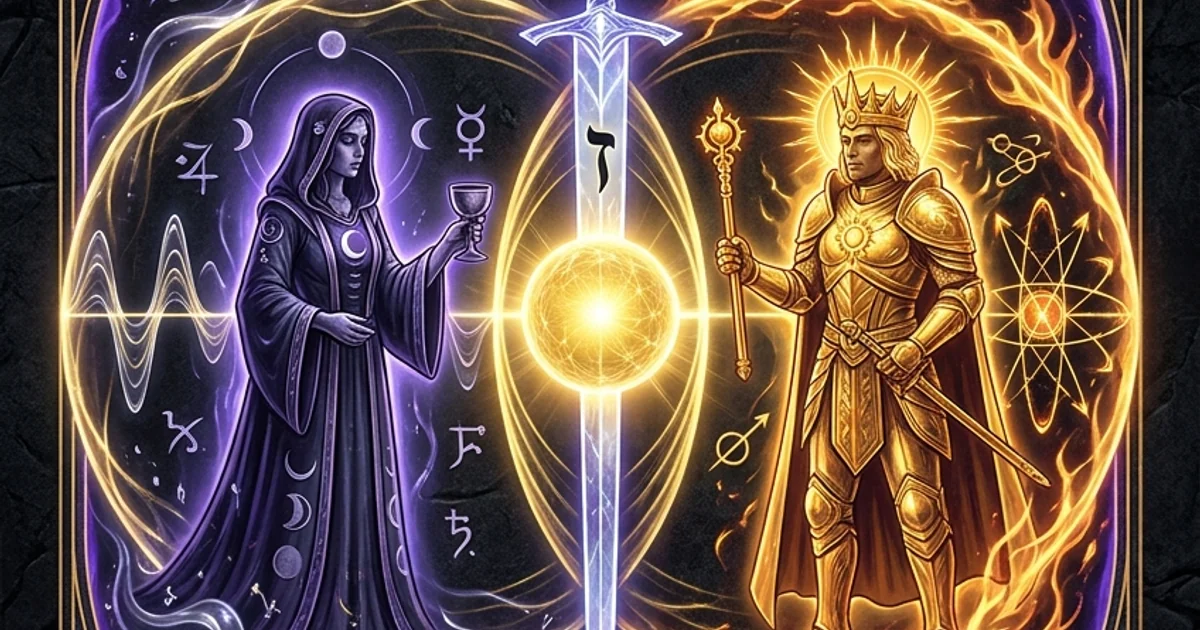
The Lovers Archetype: Sacred Synthesis & Divine Union
Archetypal Thesis & Systemic Paradigm: The Dialectics of Sacred Synthesis
The Bifurcated Ego and the Call to Psycho-Cosmic Integration
Arcanum VI, designated as The Lovers, marks the definitive structural boundary between the exteriorized acculturation of the ego and the interiorized initiatory trajectory of the soul. In the structural progression of the Major Arcana, the initial sequence of cards culminates in Arcanum V, The Hierophant, who crystallizes collective doctrine, institutional law, and the received linguistic matrix of the social order. The Lovers archetype disrupts this exogenous equilibrium by exposing the conscious subject to the acute tension of internal bifurcation. The ego realizes it is not an indivisible monad, but an intrinsically divided consciousness operating within an ocean of split polarities. This realization marks the inception of genuine psycho-spiritual agency; moral and spiritual authority is stripped of external orthodoxy and transposed into the interior sanctuary of ethical discernment.
This epistemological crisis is neither accidental nor pathological. It represents the conscious awakening of the psyche to its constitutional duality. In psychological mechanics, the encounter forces an interrogation of the foundational premises established by The Magician, who wields elemental tools in isolation. In Arcanum VI, those dynamic potencies must be contextualized within an interactive, dialectical field. The individual ego discovers that individuation cannot unfold through solipsistic mastery. The bifurcated ego stands at the boundary of self and other, subject and object, conscious and unconscious, compelled to choose between regression into unconscious enmeshment or ascension toward conscious integration.
Beyond Romantic Sentimentalism: Coniunctio Oppositorum as an Operative Paradigm
Exoteric interpretations persistently reduce Arcanum VI to the banal tropes of romantic partnership, domestic affection, or simplistic sentimental alignment. Hermetic science and analytical psychology reject this reductionism. The Lovers archetype serves as an operative diagram of the coniunctio oppositorum—the alchemical wedding of fundamentally antithetical principles. The card formalizes the precise dynamics through which polarized elements within the psycho-cosmic substrate interact without annihilating one another. Rather than presenting a passive state of emotional comfort, the alchemical wedding is an exacting, energetic transmutation wherein Sol (the masculine, solar, sulphur principle) and Luna (the feminine, lunar, mercurial principle) undergo simultaneous dissolution (solutio) and coagulative reunification (coagulatio).
To navigate this operative paradigm is to comprehend that polar opposites exist in an interdependent, thermodynamic tension. Sacred synthesis does not entail the homogenization of opposites into an undifferentiated slurry, which would constitute an entropic collapse into chaos. Instead, the alchemical schema demands that each pole be brought to the apex of its distinct operational clarity before synthesis can occur. The psychic tension generated between the conscious ego and the contrasexual archetype—the anima in man or the animus in woman—serves as the pressure vessel within which transmutative heat (calcinatio) is generated. Divine union, therefore, represents the paradoxical coexistence of radical differentiation and indissoluble synthesis.
The Triadic Architecture: The Dual Human Agents and the Archangelic Transcendent Function
Visual analysis of the classic esoteric iconographic layout reveals a triadic architecture: two terrestrial agents positioned beneath a celestial intermediary. In the Hermetic tradition, the male figure signifies the self-conscious, discursive intellect, while the female figure signifies subconscious receptivity and affective matrixing. Yet their gaze indicates an indispensable esoteric mechanism: the male looks to the female, and the female directs her gaze vertically toward the supramundane mediator, traditionally identified as the Archangel Raphael. This gaze sequence illustrates that discursive consciousness cannot perceive the divine directly without the mediating lens of the subconscious instinctual field, just as subconscious instinct remains blind without the structural guidance of conscious discernment.
The hovering angelic figure embodies the Jungian transcendent function: the autonomous third element that emerges from the sustained, unyielding tension between psychic opposites. The transcendent function does not arbitrate between polarities via rational compromise; it subsumes them into an expanded dimensional framework. Without this transcendent presence, the encounter between the two human figures inevitably degenerates into mimetic rivalry, codependent enmeshment, or mutual projection. The archangel operates as the psychopomp of the higher octave, demonstrating that the resolution of any systemic duality requires access to a systemic coordinate situated outside the plane of the conflict itself.
“The unio mentalis, which is the first stage of the conjunctio, consists in the separation of the soul from the body and the knowledge of oneself… But this mental union is only a preliminary step. The second stage of the conjunctio is the re-uniting of this unio mentalis with the body… Only after this can the third and ultimate stage occur: the union of the whole man with the unus mundus, the eternal, primordial ground of all existence.” — C. G. Jung, Mysterium Coniunctionis (Collected Works, Vol. 14), p. 457–460.
Classical Provenance & Textual Lineage: The Evolution of Arcanum VI
The Mantegna and Visconti-Sforza Precedents: The Moral Dilemma of Hercules
The iconographic genealogy of Arcanum VI exposes a profound structural shift from fifteenth-century moralistic allegories to nineteenth-century esoteric cartographies. In the mid-fifteenth-century Visconti-Sforza deck, the card—titled L’Amore—presents an icon of mundane aristocratic betrothal. A man and a woman stand hand-in-hand beneath a canopy, their union solemnized by a winged, blindfolded Cupid perched upon a pedestal, poised to loose an arrow of instinctual passion. This composition reflected the socio-political realities of the Renaissance nobility, where marriage was an alliance of lineage, power, and property, shot through with the irrational intervention of romantic cupiditas.
Concurrently, the Mantegna Tarocchi and related Renaissance emblems linked this dynamic to the classical apologue of Prodicus: the “Choice of Hercules.” In this mythological motif, the young hero stands at a crossroads, confronted by two personifications: Virtus (Virtue), austere, elevated, and directing his path toward arduous self-mastery, and Voluptas (Pleasure or Vice), alluring, sensuous, and offering immediate instinctual gratification. Arcanum VI in this lineage is an arena of ethical trial. The initiate is not passive; they are summoned to exercise discriminatory free will at an ontological bifurcation point. The earliest functional identity of Arcanum VI is not unitive ecstasy, but the moral crisis of conscious selection.
The Tarot de Marseille Paradigm: L’Amoureux, the Matron, and the Maiden
In the Tarot de Marseille canon, most clearly articulated in the designs of Jean Noblet (c. 1650) and Nicolas Conver (1760), Arcanum VI is inscribed as L’Amoureux—the singular “Lover,” rather than the plural “Lovers.” This grammatical precision changes the psychological locus of the image. The card does not depict a completed union, but the internal condition of an individual caught within an acute psychic split. The composition features a young man pinned between two distinct female figures: to his right, a stern, crowned woman dressed in austere, uniform blue and red garments; to his left, a younger, garlanded woman whose flowing hair and hand position suggest instinctual attraction and terrestrial enticement.
Above this triad, hovering within a radiant, segmented solar disc, a small, winged infant (Eros/Cupid) aims his arrow directly at the youth’s groin or solar plexus. The young man’s feet are set in divergent directions, illustrating the somatic reality of ambivalence. He cannot advance toward spiritual maturity without relinquishing the maternal-regressive pull of the elder woman, yet he cannot pursue the maiden without risking subjugation to instinctual obsession. L’Amoureux captures the adolescent ego on the rack of emergent desire and moral accountability, suspended in the agonizing interval that precedes decisive commitment.
The Golden Dawn Hermetic Restructuring: The Edenic Restoration of Waite and Crowley
The nineteenth-century occult revival led by the Hermetic Order of the Golden Dawn dismantled the moralistic tripartite motif of the Marseille deck, recovering what S. L. MacGregor Mathers and his circle perceived as the card’s primordial Qabalistic and alchemical architecture. Arthur Edward Waite, working in collaboration with artist Pamela Colman Smith, removed the older woman and the younger maiden, transforming the scene into an Edenic sanctuary prior to the Fall. The two figures are depicted entirely nude, stripped of terrestrial social markers, representing the pristine state of Adam and Eve as primordial consciousness and subconscious feeling.
“The card represents human love, here presented as part of the way, the truth, and the life… It suggests not the choice between virtue and vice, but the higher and lower love, or rather the spiritual love that reconciles all division. The woman looks to the angel; the man looks to the woman; and this order of the hierarchy shows the path of descent and ascent through which human nature is transformed.” — Arthur Edward Waite, The Pictorial Key to the Tarot (1910), Part II, “The Trumps Major.”
Simultaneously, Aleister Crowley and Lady Frieda Harris, in the execution of The Book of Thoth, advanced this esoteric rehabilitation to its ultimate alchemical conclusion. Crowley redesignated Key VI as The Lovers, while designing its thematic counter-pole, Arcanum XIV, as Art. In Crowley’s card, the scene represents the Chymical Wedding of Christian Rosenkreutz (Johann Valentin Andreae, 1616).
The card features the King (crowned with gold, holding a sceptre) and the Queen (crowned with silver, bearing the cup), accompanied by the Black Child and the White Child, and flanked by the legendary figures of the Red Lion and the White Eagle. Crowley placed the entire tableau under the canopy of the hooded figure of the Hermetic Hermit—the supreme, hidden animator of cosmic wisdom. The narrative shifted from a human dilemma to an explicit manual of esoteric metallurgical transformation.
Structural Mechanics & Symbolic Geometry: The Gemini-Zayin Matrix
Path 17 Mechanics: Connecting Supernal Binah to Solar Tiphereth
Within the mathematical cartography of the Hermetic Qabalah, Arcanum VI is mapped to the seventeenth path on the Tree of Life. Path 17 runs diagonally across the central axis of the cosmic diagram, establishing a direct conduit between the third Sephirah, Binah (Supernal Understanding, the Great Mother, the archetypal matrix of form and limitation), and the sixth Sephirah, Tiphereth (Beauty, the Solar Center, the harmonizing locus of conscious selfhood). This placement charges Arcanum VI with an immense metaphysical mandate: it is the vehicle through which the sublime, transcendent forms of the Supernal Triad are stepped down and apprehended by the developing individuality of the human soul.
Path 17 acts as an architectural lightning rod. Binah resides beyond the Abyss, an incomprehensible cosmic sea of undifferentiated potential and primordial constriction (tzimtzum). For Binah’s systemic architectures to illuminate the human psyche at Tiphereth without shattering its fragile baseline operations, an intermediate path of clear cognitive discernment is required. The initiate cannot leap from self-absorbed egoic concerns directly into the void of Binah without succumbing to psychosis or spiritual inflation. Path 17 structures the descent of form into the human heart, demonstrating that understanding is attained only when the mind learns to hold two opposite truths in dynamic, sustained equilibrium.
The Glyph of Zayin: The Discriminating Blade of Conscious Cleavage
The Hebrew letter assigned to Path 17 is Zayin (ז), whose literal translation is not “love,” “union,” or “marriage,” but “weapon” or “sword.” This linguistic assignment exposes the primary paradox at the center of the lovers archetype sacred synthesis: union cannot exist without prior severance. The sword is the quintessential instrument of division, cutting through amorphous, incestuous, and symbiotic states of unconscious fusion. To achieve genuine sacred synthesis, the subject must wield the blade of Zayin to cleave that which has been illegitimately blended.
In the Sefer Yetzirah, the seventeenth path is termed the “Disposing Intelligence” (Sekhel Manhig). This intelligence trains the human mind to classify, separate, differentiate, and organize archetypal components with mathematical exactitude. True synthesis is not the collapsing of differences into a vague, oceanic oneness; that is the illusion of regression to the pre-conscious matrix. Rather, Zayin cuts the subject away from the mother, cuts the ego away from the collective unconscious, and separates the anima/animus from the external human screen upon which it is projected. Only when the components are completely detached can an authentic, un-coerced covenant of unity be forged.
- Path Designation: 17th Path of the 32 Paths of Wisdom (The Disposing Intelligence).
- Hebrew Letter: Zayin (ז), Value: 7. Signification: The Sword / Weapon.
- Tree of Life Vector: Binah (Understanding) to Tiphereth (Beauty/Harmony).
- Astrological Rulership: Gemini (Air, Mutable, Ruled by Mercury).
- Color Scales (Golden Dawn):
- Atziluth (Archetypal): Pure Orange.
- Briah (Creative): Clear Violet.
- Yetzirah (Formative): Dull Brown / Red-Orange.
- Assiah (Material): Russet Grey, flecked with white.
- Esoteric Attributions: The Oracle of Apollo; The Alchemical Twins; The Children of the Voice; The Caduceus.
Astrological Gemini: Mutable Air, Mercury’s Caduceus, and Dual Polarization
The astrological governance of Arcanum VI belongs to Gemini, the mutable air sign ruled by the psychopomp Mercury. Gemini is symbolized by the Twins (Castor and Pollux), one mortal, the other immortal—an allegorical formulation of the human condition, which bridges transient bodily existence and eternal archetypal consciousness. Mutable air represents intellective agility, linguistic resonance, lateral cognition, and the continuous exchange of information between polar nodes. This air element prevents the static fixation of either pole, ensuring that the dialogue between the masculine and feminine remains a fluid, dialectical circulation.
This communicative dynamic is embodied in the symbol of the Caduceus of Hermes. The central staff corresponds to the Sushumna or the Middle Pillar of the Tree of Life, while the two intertwined serpents represent the Ida and Pingala, the solar and lunar currents winding around the spine of manifestation.
The serpents do not merge into a single reptile; they face each other across the axis of the wand, held apart yet bound together by the horizontal vectors of their alternating trajectories. Gemini operates as the connective tissue of the cosmos, providing the cognitive lattice work that permits these opposing voltages to alternate without generating an energetic short circuit.
Psychological Dynamics & Operational Praxis: Archetypal Integration in Consultation
Withdrawal of Contrasexual Projections: Anima and Animus Recognition
Within the clinical and diagnostic space of archetypal divination, the emergence of Major Arcana 6 marks an acute confrontation with the phenomenon of projection. In the psychology of C. G. Jung, an individual’s internal contrasexual soul-image—the anima in the male psyche, the animus in the female—is initially residing in the unconscious. Because contents of the unconscious cannot be perceived directly, they are projected outward onto an external object. The subject experiences an overwhelming, numinous fascination with another person, mistakenly attributing to that individual the divine, transcendent properties belonging to their own unintegrated inner archetype.
When The Lovers card appears in a consultation, the analyst must first assess whether the querent is caught in this projective identification. To mistake the projection for the reality of the external partner leads to inevitable disillusionment: the mortal partner cannot bear the weight of a living divinity. The querent must wield Zayin to strip the projection away from the external vessel and internalize its contents. The querent is called to recognize that the ecstasy, wholeness, and radiant vitality they perceive in the other are the dormant capabilities of their own deep psyche, demanding conscious cultivation and integration.
Splitting versus Synthesis: Navigating Borderline Defenses in Divination
In psychological consultations, Arcanum VI frequently functions as a diagnostic mirror for primitive defensive structures, specifically the split defense characteristic of borderline ego organizations. Under psychological duress, the immature ego splits the world into idealized “all-good” objects and demonized “all-bad” objects to protect itself from the anxiety of emotional ambiguity. In cartomantic consultations, querents confronting relational turbulence often pull Arcanum VI while trapped in this exact splitting mechanism, obsessively asking the oracle to confirm whether a relationship is entirely divine or completely toxic.
The Lovers archetype forces the deconstruction of this binary defense mechanism. It demands the capacity for ambivalence—the recognition that an individual, a situation, or a psychic state can be simultaneously nurturing and frustrating, creative and destructive. When Arcanum VI is drawn reversed or in positions of psychic obstruction, it often indicates an inability to tolerate this tension. The individual seeks salvation through an external savior, or retreats into misanthropic isolation to preserve ideological purity. The analytical reader must utilize the card to demonstrate that authentic synthesis requires integrating both the shadow and the light of the polarized elements, refusing to resolve the tension through defensive splitting.
“If an individual attempts the alchemical coniunctio without having fully faced and differentiated the shadow, the result is not union, but psychic contamination. The ego becomes possessed by archetypal forces it can neither comprehend nor control… The union of opposites is only possible between differentiated entities; otherwise, one simply falls into an unconscious, instinctual swamp where all boundaries are lost.” — Marie-Louise von Franz, Individuation in Fairy Tales and Alchemical Active Imagination (1977), p. 112.
Active Imagination and the Caduceus Layout: Practical Protocol for Pathworking
For experiential application, Path 17 requires structured active imagination protocols that prevent affective flooding while allowing the querent to engage the opposing archetypal forces directly. The “Caduceus Layout” is a five-vector diagnostic and operative pathworking spread configured specifically to emulate the geometry of Arcanum VI and Path 17:
- Position 1: The Present Split (The Terrestrial Field): Identifies the core paradox or polarized conflict currently dividing the querent’s psychic energy.
- Position 2: Zayin, the Cleaving Task: Identifies what unconscious enmeshment, codependency, or false assumption must be severed by the discriminating intellect.
- Position 3: The Solar Vector (Animus/Action): The masculine archetypal current: what conscious, structuring, assertive principle requires integration?
- Position 4: The Lunar Vector (Anima/Receptivity): The feminine archetypal current: what unconscious, instinctual, relational capacity requires honoring?
- Position 5: The Angelic Transcendent Factor (Raphael): The emergence of the third unitive force: the higher synthesis that reconciles the tension without eliminating its polarity.
The practitioner leads the querent into a meditative visualization along the Tree of Life. Commencing at Tiphereth (the solar plexus of consciousness), the querent visualizes an expansive, vertical gate inscribed with the glyph of Zayin. Drawing the visionary sword, the querent enters the mutable winds of Gemini along Path 17, approaching the Supernal Mother Binah. The active imagination task consists of placing the two warring factions of the current life-conflict on either side of the Caduceus, sustaining the cognitive tension between them until the Archangelic presence (the transcendent function) provides an image, word, or symbolic resolution that neutralizes the conflict from above.
Philosophical Synthesis & Macrocosmic Correspondence: Hermetic Axioms and Cross-System Parallels
The Principle of Gender and Polarity in Hermetic Philosophy
Arcanum VI represents the practical realization of two primary Hermetic axioms articulated in the Kybalion: the Principle of Polarity (“Everything is dual; everything has poles; everything has its pair of opposites”) and the Principle of Gender (“Gender is in everything; everything has its Masculine and Feminine Principles; Gender manifests on all planes”). In the Hermetic worldview, cosmic creation is not an ex nihilo fiat executed by an undifferentiated monad. It is an eternal erotic dance, an undulating, systemic resonance generated between complementary polarities.
The macrocosmic order manifests exclusively through the dynamic interplay of these dual voltages. Force cannot act without Form; Electric charge requires Magnetic containment; the cosmic Yod remains inert without the responsive matrix of the primal Heh. Arcanum VI demonstrates that this dynamic is not confined to human biology or sociology. It is a fundamental law of cosmological architecture. The Lovers card reveals that existence itself is suspended within this continuous, creative tension. The goal of Hermetic initiation is neither to obliterate polarity into quietist stasis nor to succumb to dualistic fragmentation, but to master the subtle art of psychocosmological equilibration—learning to dwell consciously at the precise midpoint where these forces perpetually cross.
Cross-System Isomorphism: I Ching Hexagram 31 (Xian / Mutual Influence) and Hexagram 54
In the ancient Chinese mantic system of the I Ching (Book of Changes), this exact structural and phenomenological dynamic is articulated in Hexagram 31 (Influence). Hexagram 31 is formed by the trigram Dui (The Joyous, Lake, the youngest daughter) placed above the trigram Gen (Keeping Still, Mountain, the youngest son). The spatial arrangement is functionally synonymous with the geometry of Arcanum VI: the soft, receptive waters of the lake rest upon the firm, steadfast pinnacle of the mountain, creating an effortless, mutual attraction that operates without force or coercion.
Upper Trigram: Dui (The Lake)
- Cosmic Element: Open Water / Joyful Receptivity
- Position: Upper Trigram (Heavenly / Relational Manifestation)
- Operative Principle: Permeability, emotional resonance, and harmonious attraction
Lower Trigram: Gen (The Mountain)
- Cosmic Element: Solid Earth / Immovable Stillness
- Position: Lower Trigram (Inner Root / Foundational Anchor)
- Operative Principle: Structural boundary, quiet contemplation, and moral integrity
The commentary on the Decision in the I Ching states: “The weak is above, the strong below. The two forces stimulate and respond to each other, so that they unite.” This dynamic mirrors the precise alchemical formula wherein the volatile must be stabilized by the fixed, while the fixed must be animated by the volatile.
Conversely, the shadow inversion of this dynamic is depicted in Hexagram 54, Gui Mei (The Marrying Maiden), where desire attempts to operate out of systemic order, leading to premature action, enmeshment, and misaligned union. Arcanum VI embodies the organic resonance of Hexagram 31, where genuine synthesis occurs because both the mountain (structural containment) and the lake (affective receptivity) maintain their fundamental integrity.
Human Design Correlates: The 20-34 Channel and the Gate 6/59 Sexual Duality Axis
In the modern synthetic framework of the Human Design System, this archetypal polarity is mapped along the genetic and energetic coordinates of the Solar Plexus and Sacral Centers, specifically through the Channel of Mating (59-6), formally termed the “Design of Focused on Reproduction.” Gate 59, residing in the Sacral Center, represents the archetypal drive to break down barriers to union (the genetic pull of Luna). Gate 6, situated within the emotional Solar Plexus, represents the friction, boundaries, and emotional selectivity that determine who is admitted into intimate energetic contact (the discriminating sword of Zayin).
Sacral Center: Gate 59 (Intimacy)
- Operative Principle: Breaking Down Bounds / Genetic Openness
- Functional Role: Penetrating aura barriers to establish physical union
- Bio-Energetic Drive: Continuous sacral reproductive and creative libido
Solar Plexus: Gate 6 (Friction)
- Operative Principle: Emotional Friction / Selective Boundary
- Functional Role: Regulating entry through emotional clarity and discernment
- Bio-Energetic Drive: Testing intimacy over time to ensure authentic alignment
This dynamic demonstrates scientifically and energetically what the Hermetic tradition has long posited: synthesis cannot be sustained without friction. Gate 6 governs the pH balance and osmotic boundaries of the cell; it is the biological sword that ensures an organism is not compromised by indiscriminate merging.
Similarly, the overarching archetypal matrix links to the 20-34 Channel of Charisma, where raw sacral power is refined through existential presence. In this way, Arcanum VI maps onto the cellular and psychological mechanisms that calibrate distance, boundary maintenance, and emotional timing prior to the release of creative and procreative forces.
| System | Coordinate / Assignment | Functional Dynamic / Mechanical Significance |
|---|---|---|
| Tarot Major Arcana | Arcanum VI: The Lovers | Path 17 connecting Binah to Tiphereth; Integration of Anima and Animus under transcendent grace. |
| Hebrew Alphabet | Zayin (ז) | “The Sword”; Value: 7; The analytical power of differentiation as a precondition for synthesis. |
| Astrology (Gemini I) | 0°–10° Gemini (Jupiter) | “The Master of the Dual Force”; Expansion of cognitive perspectives, seeking unity through multiplicity. |
| Astrology (Gemini II) | 10°–20° Gemini (Mars) | “The Severing of Ties”; The friction of divergent wills; the active operation of the blade of discernment. |
| Astrology (Gemini III) | 20°–30° Gemini (Sun) | “The Illumination of Duality”; The solar integration of the intellectual and instinctual polarities. |
| I Ching | Hexagram 31 (Xian) | Lake over Mountain; Mutual, spontaneous influence between opposite structural potencies. |
| Human Design | Gate 6 (Conflict / Friction) | The emotional boundary keeper that governs intimacy (Gate 59) through rigorous energetic discernment. |
Frequently Asked Questions: Advanced Inquiries into Arcanum VI
How Does the Severing Weapon of Zayin Reconcile with the Concept of Divine Union?
The paradox of Zayin—the sword—operating as the glyph for divine union dissolves when examined through the lens of psychological differentiation. Unconscious unity is not divine union; it is original, undifferentiated symbiosis. In this primal, infantile state, boundaries between self and other, conscious ego and unconscious archetype, are completely blurred. Such enmeshment leads directly to codependency, narcissistic projection, and psychological stagnation.
The sword of Zayin is the indispensable instrument that cuts through this unconscious enmeshment. It separates the child from the psychological matrix of the parents, the ego from the overwhelming impulses of the collective unconscious, and the real human partner from the mythological image of the anima or animus. Without this sharp, analytical division, authentic love is impossible, because love requires an autonomous “I” capable of consciously relating to an authentic “Thou.” The weapon of Zayin does not destroy the connection; it clears the relational space, transforming a blind, compulsive entanglement into a conscious, sovereign covenant.
What Distinguishes the Sacred Synthesis of The Lovers (VI) from the Shadow Bondage of The Devil (XV)?
Arcanum VI (The Lovers) and Arcanum XV (The Devil) are structural, esoteric polarities linked across the Tree of Life. In modern numerological reduction, 15 reduces to 6 (1 + 5 = 6), marking The Devil as the inverted shadow refraction of The Lovers archetype. In the Waite-Smith iconography, this mirror relationship is visually explicit: Arcanum VI features an angel hovering over a man and a woman who stand in open, expansive nature, unbound and looking toward the heavens; Arcanum XV features a horned goat-demon perched upon an altar, with a man and a woman chained by their necks to the pedestal, their gaze cast downward into the realm of material bondage.
The Lovers (Arcanum VI)
- Underlying Force: Conscious Love (Eros)
- Mode of Connection: Autonomous Covenant
- Direction of Gaze: Ascending to the Angel
- Relationship to Shadow: Differentiated & Seen
- Astrological Polarity: Gemini (Mutable Air)
The Devil (Arcanum XV)
- Underlying Force: Compulsive Drive (Id)
- Mode of Connection: Chained Enmeshment
- Direction of Gaze: Descending to Matter
- Relationship to Shadow: Repressed & Projective
- Astrological Polarity: Capricorn (Cardinal Earth)
The decisive operational difference resides in the presence of conscious choice and the direction of psychic devotion. In Key VI, the two figures are bound by the transcendent function; their union is an exercise of conscious free will that elevates their instinctual energy toward the spiritualization of consciousness. In Key XV, the figures are bound by unconscious instinct, material fixation, and disowned shadow dynamics.
The chains linking the figures in The Devil are deliberately depicted as loose; they could be slipped off over the head at any moment, yet the figures remain trapped because they project their own creative agency onto the external demonic construct. Key VI represents union through conscious integration, whereas Key XV represents imprisonment through unconscious projection.
Does Arcanum VI Primarily Signify Mundane Partnership, or Is It Exclusively an Internal Event?
To separate this archetype into an “either/or” dynamic between an external relationship and an internal psychological event violates the Hermetic axiom of correspondence: “As Within, So Without; As Without, So Within.” Arcanum VI is an internal alchemical operation that inevitably configures the external relational landscape. The internal event—the withdrawal of contrasexual projections, the integration of masculine and feminine psychic vectors, and the development of the transcendent function—is the prerequisite for authentic mundane partnership.
When an individual completes this internal synthesis, the psychic field undergoes an energetic reorganization. The individual no longer seeks a partner who operates as a psychological prosthetic to compensate for their disowned attributes. This internal realignment activates the law of synchronicity, drawing into the subject’s life an external other who reflects this heightened state of psychological maturity.
Conversely, an external partnership frequently serves as the empirical laboratory wherein this internal integration is catalyzed through relational conflict and mutual transformation. To view Arcanum VI as merely mundane is superficial; to view it as exclusively internal is solipsistic. The Lovers archetype is the dynamic bridge connecting internal individuation with the realization of sacred union in the manifest, relational world.