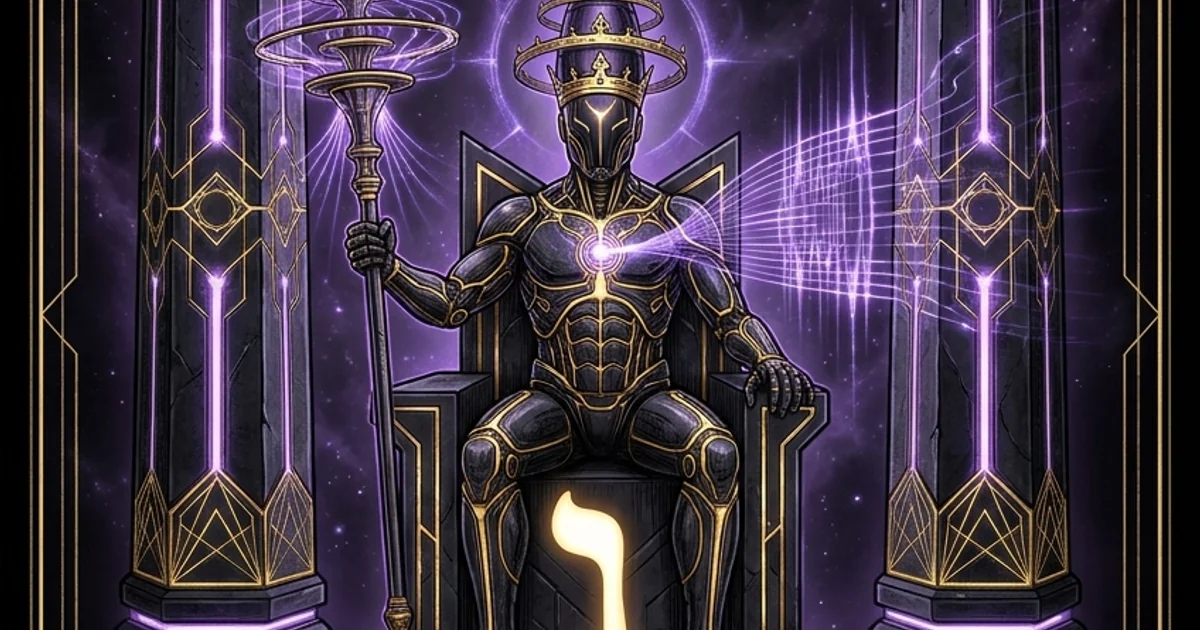
The Hierophant: Sacred Doctrine and Exoteric Mystery
Archetypal Thesis & Systemic Paradigm
The Pontifex Maximus: Function of the Sacerdotal Intermediary
Within the structural architecture of the Tarot’s Major Arcana, Key V—The Hierophant—operates not as an emblem of arbitrary tyrannical dogma, but as the indispensable cybernetic transductor between absolute metaphysical reality and the bounded cognitive apparatus of incarnate human consciousness. Etymologically rooted in the classical Greek hierophantes (“one who reveals sacred things”) and historically fused with the Latin designation Pontifex Maximus (“the supreme bridge-builder”), the archetype occupies the systemic bridgehead (pontifex-bridge) between the numinous and the institutional. Where the Magus concentrates raw, unconditioned cosmological force and The Emperor establishes the terrestrial, legislative stability of the socio-political order, The Hierophant operates across an intermediate, sacerdotal plane. His office is neither merely administrative nor purely visionary; it is interpretive, pedagogical, and structural.
The primary systemic function of this sacerdotal intermediary is the transduction of high-voltage ontological gnosis into step-down, assimilable formats. Unmediated metaphysical revelation—the blinding flash of the absolute—induces psychic fragmentation and spiritual catatonia within the unprepared ego. The Hierophant therefore construct an epistemological transformer: a system of symbolic liturgy, theological grammar, and ritual gesture that renders unconditioned truth intelligible, reproducible, and communicable. In this operational modality, sacred doctrine functions as a precise semiotic technology. It does not petrify truth to destroy its vitality, but rather codifies it within a collective architecture that shields the neophyte from psychic inflation while ensuring that the spiritual signal survives intact across generational time.
The Dialectic of Exoteric Form and Esoteric Gnosis
A fundamental tension within occult historiography and archetypal psychology centers upon the dialectic between the exoteric container and the esoteric impulse. The Hierophant is frequently misapprehended by modern secular consciousness as an archaic vestige of clerical authoritarianism—a repressive institutional gatekeeper designed to enforce orthodoxy and suppress spontaneous mystical experience. This critique, while historically justified regarding corrupt sacerdotal institutions, fundamentally misunderstands the archetypal mechanics of the hierophant sacred doctrine mysteries. Without the scaffolding of an exoteric matrix, the esoteric current immediately dissolves into an incoherent, solipsistic subjectivism. The vessel is as structurally mandatory as the liquid it holds.
Esoteric gnosis requires an exoteric dialectic to achieve ontological permanence. If spiritual realization remains strictly idiosyncratic, it lacks the morphic resonance necessary to seed civilization, cultivate ethical culture, or inform lineage transmission. The Hierophant establishes the canon: the grammatical rules of the sacred language through which the unspeakable can be iteratively approximated. The canon serves as an objective reality-check against spiritual bypass and delusional inflation. Far from standing in absolute opposition to inner illumination, the institutional boundary provided by Key V constitutes the normative threshold against which true mystical rebellion gains traction and authentic transcendence is achieved.
Key II: The High Priestess
- Epistemological Vector: Inward, intuitive, nocturnal, unmediated gnosis.
- Structural Mode: Receptive interiority, passive silence, apophatic theology.
- Qabalistic Orientation: Central Pillar of Mildness; traverses the Abyss via Path 13 (Gimel) linking Tiphereth to Kether.
- Psychological Manifestation: Unconscious, anima integration, unformulated archetypal imagery, dream matrix.
- Transmission Mechanism: Direct contemplative silence; occultation of the mystery behind the veil.
Key V: The Hierophant
- Epistemological Vector: Outward, pedagogical, diurnal, codified doctrine.
- Structural Mode: Expressive institution, active articulation, cataphatic theology.
- Qabalistic Orientation: Pillar of Mercy; traverses Path 16 (Vav) linking Chokmah to Chesed.
- Psychological Manifestation: Conscious Superego, Senex integration, formulated religious symbols, collective mythos.
- Transmission Mechanism: Sacerdotal utterance, oral and textual canon; bridge-building via liturgical ritual.
Topological Placement within the Septenary Progression
The primary septenary of the Major Arcana (Keys I through VII) delineates the foundational establishment of the self-conscious personality within its cosmic and social matrix. In this opening sequence, Key V acts as the crucial synthesis of the elemental forces that precede it. The initiate passes from the primeval masculine and feminine polarities of Key I (The Magus) and The High Priestess to their materialized social forms in Key III (The Empress) and Key IV (The Emperor). The Hierophant immediately follows this structural grounding, introducing the transcendent third factor that lifts the human animal out of purely biological and political determinism into metaphysical accountability.
Positioned directly between Key IV (The Emperor) and Key VI (The Lovers), the Hierophant establishes the cultural superego and historical memory without which ethical choice is rendered meaningless. Key IV organizes the terrestrial polis through physical law, but Key V anchors that law in an eternal transcendent sanction. Only when the initiate has thoroughly internalized the structural doctrine of the Hierophant can they confront the profound crisis of ethical self-determination, relational polarity, and individualization represented by The Lovers. Key V provides the foundational paradigm that the initiate must master, integrate, and eventually navigate as they progress into the disintegrative trials of the second and third septenaries.
Classical Provenance & Textual Lineage
From Il Papa to the Mystagogue: Renaissance Iconography to Golden Dawn Reform
The iconographic lineage of Key V reveals an evolutionary trajectory reflecting Europe’s shifting philosophical relationship with authority, revelation, and the classical mystery traditions. In the earliest surviving 15th-century trionfi decks, such as the Visconti-Sforza, the card is unequivocally designated as Il Papa (The Pope). Depicted in pontifical vestments, bearing the papal cross and wearing the triple tiara, the figure stood alongside L’Imperatore as one of the two historical pillars of Western medieval political theology. In this early incarnation, the card functioned within an overtly Christian allegorical paradigm, representing the ecclesiastical authority that governed the soul’s salvation, complementary to the temporal authority governing the civic body.
+-----------------------------------------------------------------------+
| HISTORICAL ICONOGRAPHIC EVOLUTION OF MAJOR ARCANA V                   |
+-----------------------------------------------------------------------+
| 15th Century: Visconti-Sforza         --> Il Papa (Historical Papacy) |
| 18th Century: Antoine Court de Gébelin --> Le Grand Hiérophante        |
| 19th Century: Éliphas Lévi             --> The Mystagogue of Gnosis   |
| Late 19th C.: Hermetic Golden Dawn    --> Master of the Hall of Truth |
| 1910: Waite-Smith Synthesis           --> The Hierophant Initiator    |
+-----------------------------------------------------------------------+
With the late 18th-century antiquarian occult revival spearheaded by Antoine Court de Gébelin in Monde Primitif (1781), the card underwent an ontological metamorphosis. Court de Gébelin systematically stripped the card of its narrow Roman Catholic provincialism, re-identifying it as Le Grand Hiérophante—the chief priest of the Eleusinian mysteries who alone possessed the authority to exhibit the sacred objects (hiera) to the initiates (epoptai). This re-identification transformed the image from a temporal ecclesiastical official into a perennial archetypal master of esoteric revelation.
This line of classical recuperation achieved its operational peak in the late 19th century through the Hermetic Order of the Golden Dawn, founded in 1888 by S. L. MacGregor Mathers and W. Wynn Westcott. Drawing upon the enigmatic Golden Dawn Cypher Manuscripts, Mathers systematically integrated Key V into the magical hierarchy of the Rosicrucian Adeptus Minor grade. Within the Golden Dawn’s inner teachings, the Hierophant was designated as the “Master of the Hall of the Dual Manifestation of Truth.” The card ceased to depict an institutional bureaucrat; it now imaged the continuous flow of western occult initiation, anchoring the perennial lineage of ancient Egypt, classical Greece, and Rosicrucianism within a coherent ritualized vehicle.
The 19th-Century Esoteric Shift: Éliphas Lévi and the Eleusinian Rebranding
The intellectual catalyst for this profound reorientation was the French occult philosopher Éliphas Lévi (Alphonse Louis Constant). In his seminal work Dogme et Rituel de la Haute Magie (1854), Lévi reclaimed Catholic sacerdotalism while subverting its dogmatic exegesis, arguing that the Roman priesthood possessed the external forms of an archaic, universal transmission whose inner keys had been abandoned by the institutional clergy. Lévi positioned Key V as the symbol of the absolute sacerdotal hierarchy, which derives its authority not from administrative decrees, but from its mastery over the universal equilibrium of the astral light.
Lévi mapped Key V directly to the Hebrew letter Vav and identified it as the theological link uniting the visible to the invisible. By recontextualizing the card through the lens of ancient mystery cults—principally the rites of Eleusis, Mithras, and Isis—Lévi asserted that true authority resides in the mystagogue: the consecrated teacher who preserves the secret oral tradition (Kabbalah) amidst a degraded exoteric world. For Lévi, Key V represents the absolute necessity of lineage, formal transmission, and spiritual discipline. He argued forcefully against the wild, unregulated occultism of romantic individualists, insisting that magical power severed from sacerdotal architecture degenerates into sorcery and psychic disequilibrium.
The Waite-Smith Synthesis: The Crossed Keys and the Twin Neophytes
When Arthur Edward Waite conceptualized the Major Arcana for the Rider-Waite-Smith deck in 1909, executed by the artist Pamela Colman Smith, he executed a definitive iconographic synthesis. Waite consciously preserved the liturgical architecture of Christian sacerdotalism while rigorously purging it of historical sectarianism, fully aligning the imagery with the perennial initiatory tradition.
“He is the ruling power of external religion, as the High Priestess is the prevailing genius of the hidden mysteries. He is rather the power of the keys, exoteric orthodox doctrine, and the way of the outside world, when this world is raised into the transcendent sphere. He is not the Prince of the Church, but the High Priest who is the expounder of the sacred mystery, the communicator of the inner knowledge to those who are outside… He is the channel of grace to the world; he is the institution as it should be, the vehicle of the spirit.”
Waite’s visual revisions encode structural hermeneutics into the card’s compositional geometry:
- The Crossed Keys: Positioned at the feet of the Hierophant, crossed in the form of a Saint Andrew’s cross, are the keys of Gold (the solar, conscious, intellectual doctrine) and Silver (the lunar, unconscious, psychic doctrine). These keys correspond to the traditional “keys of the kingdom,” yet Waite interprets them as the dual methods of occult cognition: passive reception and active operation, through which the mysteries of heaven and earth are systematically unlocked.
- The Twin Neophytes: Kneeling before the throne are two acolytes clad in clerical vestments patterned with symbolic floral motifs. The acolyte on the left wears robes adorned with red roses (symbolizing desire, passion, and the active generative will), while the acolyte on the right wears robes emblazoned with white lilies (symbolizing thought, purity, and intellectual receptivity). They mirror the dual currents of human nature: volition and intellect, passion and contemplation.
- The Sacerdotal Gesture: The Hierophant raises his right hand in the traditional ecclesiastical benedictio latina—with the thumb, index, and middle fingers extended upward (representing the Trinity), while the ring and little fingers are folded into the palm. This sign denotes the downward projection of the divine reality into the manifest world and the concealment of the profoundest arcanum within the exoteric exterior. In his left hand, he holds the triple papal cross, whose tiers construct a ladder of cosmic descent through the three worlds of cabalistic cosmology.
Structural Mechanics & Symbolic Geometry
Path 16 on the Otz Chiim: Vav as the Cosmological Fastener
In the geometry of the Hermetic Qabalah, the twenty-two Major Arcana correspond directly to the twenty-two paths connecting the ten Sephiroth on the tree-of-life. Key V is situated along path-16-vav, traversing the vast metaphysical expanse between Chokmah (Wisdom, Sephira 2) and Chesed (Mercy/Majesty, Sephira 4) on the active Pillar of Mercy (Right Pillar). This topological coordinates reveal the profound structural mechanics of the archetype.
       [ Chokmah ] (Sephira 2: Primeval Wisdom / Seed)
            |
            |   Path 16: The Hierophant (Vav / "The Nail")
            |   [ Astrological Attribution: Taurus (Fixed Earth) ]
            v
       [ Chesed ]  (Sephira 4: Sovereign Architecture / Mercy)
Chokmah represents the dynamic, unconditioned masculine seed of pure divine consciousness: non-conceptual, boundless, and overwhelming. Chesed represents the initial coagulation of that primeval impulse into a stable, expansive, and sovereign architecture of cosmic order. Path 16 is therefore the cosmic channel through which the raw, unconditioned divine revelation of Chokmah is stepped down and articulated into the formulated, compassionate, and structural governance of Chesed. For a detailed exploration of this Qabalistic dynamic, see the technical monograph on the Path 16 Vav Analysis.
The Hebrew letter assigned to Path 16 is Vav (ו), whose literal meaning is “nail,” “peg,” or “fastener.” In the Hebrew grammatical system, Vav operates as the conjunctive prefix (translating directly as “and”), functioning as the primary structural ligature linking disparate clauses and ideas. Cosmologically, Vav is the cosmological fastener: the structural tensor that links heaven to earth, macrocosm to microcosm, and transcendent ideation to physical implementation. The Hierophant, as the personal incarnation of Vav, fastens the initiate’s fluctuating terrestrial psyche to the immutable metaphysical architecture of the supernal realm. He is the cosmic nail that secures humanity to divinity.
- Sephirothic Junction: Chokmah (Sephira 2 - Divine Wisdom) to Chesed (Sephira 4 - Sovereign Mercy).
- Hebrew Letter: Vav (ו), Value: 6; Meaning: “Nail,” “Tent Peg,” or “Cosmic Fastener.”
- Astrological Attribution: Taurus (♉), the Fixed Earth sign of the Zodiac.
- Elemental Dynamics: Venusian Earth; the coagulation of divine force into concrete form.
- Color Scales (Golden Dawn System):
- Atziluth (Archetypal): Red-Orange.
- Briah (Creative): Deep Indigo / Blue-Grey.
- Yetzirah (Formative): Rich Warm Olive.
- Assiah (Material): Dark Golden Brown / Terracotta.
- Esoteric Title: The Magus of the Eternal; Master of the Hall of the Dual Manifestation of Truth.
Astrological Attribution: The Fixed Earth of Taurus and Venusian Coagulation
Key V is astrologically ruled by the sign of Taurus (taurus-fixed-earth). As the second sign of the zodiac, Taurus represents the fixed, somatic, and materially stabilized phase of the elemental earth principle. While its preceding sign, Aries, explodes outward in a flash of cardinal fire, Taurus gathers this volatile energy and condenses it into enduring physical forms, structures, and systems. For an extensive examination of this astrological dynamic, see the treatise on the Taurus Fixed Earth Archetype.
The attribution of Taurus to the Hierophant appears paradoxical to superficial esoteric analysis: why should the supreme revealer of metaphysical mysteries be governed by the most earthy, material, and sensory sign of the zodiac? The answer lies in the Hermetic doctrine of manifestation. Heinrich Cornelius Agrippa, in his De Occulta Philosophia (1533), notes that terrestrial forms are the essential receivers and retainers of celestial impressions: without a stable corporeal foundation, divine influences evaporate into formless chaos.
Taurus is ruled by Venus and is the sign of the Moon’s exaltation. The Venusian rulership infuses the Hierophant’s doctrine with harmony, aesthetic symmetry, and liturgical beauty. The rituals over which he presides are not dry intellectual propositions; they are multi-sensory pageants consisting of solemn chants, fragrant incenses, magnificent vestments, and consecrated architecture designed to engage the animal senses and ground divine memory into the somatic nervous system of the initiate. The exaltation of the Moon within Taurus indicates that the fluctuating, receptive human subconscious (the lunar astral plane) finds its ultimate stability and purification when anchored to the fixed rock of archetypal doctrine. Taurus is the sacred mountain, the immovable temple, the steady institutional foundation capable of weathering cultural cataclysms.
Geometric Hermeneutics: The Papal Cross, the Triple Tiara, and Trinitarian Transduction
The visual geometry of Key V is built around a rigorous triadic matrix. The Hierophant’s central vestment, the triple tiara (triregnum), and the triple cross in his left hand all establish an overarching trinitarian geometry.
The three horizontal crossbars of the papal staff correspond directly to the Three Worlds of the Hermetic Kabbalah and the tripartite division of the human soul:
- The Upper Bar: Corresponds to the Archetypal World (Atziluth) and the highest cognitive faculty, the Neshamah (the divine soul, pure intellect, and will).
- The Middle Bar: Corresponds to the Creative and Formative Worlds (Briah and Yetzirah) and the middle faculty, the Ruach (the ethical, psychological, and rational ego-consciousness).
- The Lower Bar: Corresponds to the Material World (Assiah) and the lowest faculty, the Nephesh (the somatic, animal, and instinctive vitality).
Through this geometric talisman, the Hierophant demonstrates his absolute mastery over the continuum of being. The cross acts as an energetic conductor: spiritual power originates in the supernal apex of the upper bar, cascades through the intermediate ethical realm of the middle bar, and discharges safely into the foundational terrestrial reality of the lowest bar. The Hierophant does not merely preach abstract theology; he mediates across this triadic spectrum, stabilizing the transcendent reality within the psychophysical constitution of the neophytes who sit at the base of his throne.
Psychological Dynamics & Operational Praxis
The Senex Archetype and the Preservation of the Transcendent Function
Through the framework of Jungian archetypal psychology, the Hierophant is the clearest operational embodiment of the constructive senex-archetype: the archetype of the Wise Old Man, the elder, the father-priest, and the guardian of collective wisdom. As Carl Gustav Jung elucidated throughout his writings, the psyche possesses a dual tension between the spontaneous, metamorphic energy of the unconscious (often animated by the Puer Aeternus or the Anima) and the stabilizing, conservative, crystallizing principle represented by the Senex.
Key V protects what Jung termed the transcendent-function: the psychic capacity to synthesize conscious and unconscious contents into a higher, unified symbolic reality. The transcendent function cannot operate within a psychic vacuum; it requires an elaborate symbolic language to externalize, mediate, and integrate the numinous contents erupting from the collective unconscious. The Hierophant provides this vocabulary. He is the psychic architect who builds the mythic containment vessel that permits the ego to interface with the numinosum without being annihilated by psychosis or swallowed by inflation.
“Dogma takes the place of the collective unconscious by formulating its contents on a grand scale. The Catholic way of life is completely surrounded and protected by this formulation, so that there is no need for any direct collision with the unconscious… The dogmatic system provides an almost complete substitute for the unconscious, an equivalent that protects the soul from the terrors of direct experience while preserving its numinosity in a manageable and healing form.”
Jung perceived that collective religious symbols and liturgical structures are not arbitrary intellectual fabrications, but protective psycho-spiritual technologies evolved over millennia. When an individual undergoes a spontaneous breakthrough of archetypal material, the absence of a Hierophantic framework causes severe psychological distress: the ego is flooded by raw, untamed mythologems it can neither comprehend nor integrate. The Hierophant provides the collective map, the historical precedent, and the ritual container through which this terrifying experience is contextualized, stabilized, and safely assimilated into conscious awareness.
Pathology of the Orthodoxy Complex: Spiritual Infantilization and Rigidity
Every archetypal structure possesses a destructive shadow polarity, and Key V’s shadow is among the most pervasive and culturally destructive in human history: the pathology of the orthodoxy complex. This distortion occurs when the cybernetic feedback loop of living transmission breaks down, and the liturgical vehicle is fatalistically conflated with the ineffable truth it was forged to convey.
+-------------------------------------------------------------------------+
| ARTIFACTUAL DEGRADATION: THE ORTHODOXY COMPLEX                          |
+-------------------------------------------------------------------------+
| LIVING TRANSMISSION:                                                    |
| Transcendent Logos ---> Semiotech Container ---> Soul Realization       |
|                                                                         |
| CALCIFIED ORTHODOXY:                                                    |
| Container Equated with Logos ---> Idolatry of Form ---> Psychic Stasis |
+-------------------------------------------------------------------------+
When this calcification occurs:
- Idolatry of the Vessel: The dogmatic form ceases to be a dynamic signifier pointing toward a transcendent signified; it becomes an idol. The letter of the law completely eclipses the living spirit that originally generated it.
- Spiritual Infantilization: The twin acolytes, instead of advancing toward spiritual adulthood and personal Adeptship, are kept in a perpetual state of psychological dependency. The institutional hierarchy claims an absolute monopoly on the dispensation of grace and the interpretation of truth.
- Dogmatic Petrification: Taurus’s fixed earth quality degenerates into inertia, rigidity, and fear of change. Any attempt to update the linguistic or ritual framework to meet the psychological needs of a new aeon is demonized as heresy. The bridge (pontifex) transforms into a prison wall, arresting the individuation process and trapping the spiritual seeker in a neurotic superego-tyranny.
Operative Contemplation: Decoding the Sacerdotal Voice within Divinatory Consultation
In an operative divinatory context, the appearance of Key V demands a rigorous diagnostic audit of the querent’s internal and external relationship with authority, lineage, and structural belief systems. The card challenges the practitioner to evaluate whether their current philosophical, academic, or spiritual structures are serving as liberating pedagogical scaffolds or as suffocating psychical prisons.
When interpreting Key V, the analyst must pose specific operational inquiries:
- What established tradition, formal lineage, or collective methodology is the querent currently called to internalize and master?
- Is the querent attempting a premature, antinomian rebellion against a tradition they have not yet had the discipline to understand or integrate?
- Conversely, is the querent subordinating their inner sovereign gnosis to an external institutional authority, an abusive spiritual guru, or a calcified intellectual dogma out of fear of autonomous moral accountability?
- Where does the querent need to construct a rigorous, somatic, Taurus-anchored daily discipline or ritual container to prevent their creative or spiritual aspirations from dissipating into formless air?
The sacerdotal voice of Key V never counsels anarchic dispersion. It counsels structural immersion: find the legitimate lineage, sit before the throne of the master, absorb the syntax of the sacred science, and allow the discipline of the form to forge the interior diamond of the spiritual body.
Philosophical Synthesis & Macrocosmic Correspondence
Hermetic Axiom of Transmission: As Above, So Formulated Below
The venerable Hermetic axiom—Quod est superius est sicut quod est inferius (“That which is above is like that which is below”)—is often quoted merely as an assertion of cosmic symmetry. Yet Key V illuminates a more demanding corollary: that which is above must be rigorously formulated below. Metaphysical truth cannot remain an ethereal, abstract vibration; it must precipitate down the Tree of Life into concrete, palpable forms that can be historically transmitted.
This is the principle of spiritual embodiment. The Hierophant does not allow truth to remain unmanifest. He compels it down into geometry, into the architectural ratios of the cathedral, into the musical frequencies of the Gregorian chant, into the specific theological grammar of the creed. By giving form to the formless, the Hierophant completes the macrocosmic circuit. He ensures that the divine reality penetrates the dense fabric of the material world (Assiah), allowing the earthly plane to become a transparent sacrament through which the supernal light shines.
The Cybernetics of Lineage: Homeostatic Preservation versus Evolutionary Entropy
From the perspective of informational cybernetics, an esoteric lineage functions as a complex, homeostatic communication channel operating across centuries of environmental entropy. The fundamental problem facing any spiritual tradition is signal preservation: how does one transmit an exquisitely subtle, high-dimensional metaphysical signal through the noisy, low-dimensional channel of human history without the message suffering catastrophic distortion, corruption, and decay?
::: diagram [Downward Transduction of Spiritual Transmission]


    Unconditioned Wisdom: Chokmah


    │


    ↓


    Path 16 / Vav: The Hierophant Transductor


    │


    ↓


    Formulated Sovereign Doctrine: Chesed


    │


    ↓


    Initiatory Rite / Dual Neophytes: Terrestrial Psyche


:::
The Hierophant is the personification of this cybernetic negative feedback mechanism. Negative feedback reduces deviation from the systemic set-point, resisting the chaotic perturbations of cultural fashion, political upheavals, and individual eccentricities. The canon, the liturgical rubric, the initiation oath, and the apostolic succession are the redundant checks and balances that protect the integrity of the spiritual signal. While this conservatism often appears rigid to contemporary observers, it is the sole structural reason that the esoteric teachings of ancient Egypt, classical antiquity, and the medieval Hermetic schools survived the collapse of empires and the fires of persecutions to arrive intact at the modern desk.
The Hierophant as the Threshold Guardian of Esoteric Realization
Ultimately, The Hierophant acts as the grand Threshold Guardian standing before the sanctuary of personal liberation. In the sequence of the Major Arcana, the initiate cannot proceed to the radical, personal choice of Key VI (The Lovers) or the triumphant psychological autonomy of Key VII (The Chariot) without first passing through the pedagogical school of Key V.
There is no legitimate antinomianism without prior orthodox mastery. The occultist who attempts to break the cosmic law before mastering its letter does not achieve mystical illumination; they achieve psychosis, spiritual inflation, and catastrophic psychological disintegration. The Hierophant is the schoolmaster who demands that the neophyte learn the classical scales before attempting the free-form improvisation of the master. One must fully absorb the doctrine, internalize the moral architecture, and surrender the ego’s petty demands to the higher lineage. Only when the doctrine has been completely integrated can the initiate transcend it from within, passing through the twin pillars of the temple and out into the blazing, unmediated sunlight of the supernal mysteries.
Frequently Asked Questions
Resolving the Dogmatic Conundrum: Is the Hierophant Inherently Anti-Progressive?
The Hierophant is not structurally anti-progressive; he is inherently conservational. In archetypal systems, progress without conservation is not evolution—it is cancerous proliferation. The Hierophant provides the morphogenetic field within which evolutionary adaptations can stabilize and avoid catastrophic self-annihilation.
+------------------------------------------------------------------------+
| REACTIONARY PETRIFICATION  vs.  HIEROPHANTIC CONSERVATION              |
+------------------------------------------------------------------------+
| Reactionary: Freezes the historical vessel, crushing new life.         |
| Conservational: Guards the structural kernel, enabling evolutionary    |
|                 shoots to anchor in fertile, historical soil.         |
+------------------------------------------------------------------------+
Without the structural continuity provided by Key V, intellectual and spiritual culture would suffer permanent amnesia, forcing each generation to reinvent the fundamental geometries of consciousness from a state of total ignorance. The Hierophant establishes the cultural and spiritual grammar; what subsequent initiates choose to write with that grammar constitutes the progressive dimension of history. His role is to guard the structural kernel of truth, ensuring that the evolutionary shoots of tomorrow are deeply anchored in the fertile, tested soil of millennial human experience.
How Does the Hierophant Diverge from the Hermit (Key IX) Regarding Truth Transmission?
While both archetypes are keepers of esoteric wisdom and act as teachers, their operational modalities, social configurations, and epistemological mechanisms diverge sharply:
- The Hierophant (Key V) transmits truth exoterically and collectively. He operates within the temple, flanked by twin pillars, addressing acolytes who kneel before a shared altar. His medium is the public canon, the collective ritual, the spoken liturgy, and the visible lineage. He is the guardian of the collective historical heritage.
- The Hermit (Key IX) transmits truth esoterically and individually. He operates in the wilderness, on the isolated mountain peak, carrying a lantern whose light is partially occulted by his cloak. He has no students, no acolytes, no written doctrine, and no institutional structure. He models solitary, introspective gnosis attained through radical withdrawal from the collective matrix.
The Hierophant provides the foundation of the sacred science to the group; the Hermit represents the advanced initiate who, having mastered the Hierophant’s school, abandons the institutional shelter to seek the unmediated divine spark in absolute solitude.
What Does the Reversal of the Hierophant Indicate Regarding Spiritual Authority?
When Key V is inverted or pathologically situated within an esoteric reading, it signals a systemic crisis in the Querent’s relationship with authority, lineage, and structure. This disturbance manifests primarily along two diametrically opposed vectors:
- Tyrannical Calcification: The Querent is trapped within an oppressive, calcified religious, familial, or intellectual orthodoxy. The external institution has become an authoritarian monolith that demands the suppression of independent thought and moral sovereignty. It indicates the presence of corrupt spiritual teachers, dogmatic fundamentalism, and the spiritual infantilization of the self.
- Anarchic Fragmentation and Spiritual Bypass: Conversely, the reversal can diagnose a destructive, undisciplined rejection of all formal training, lineage, and structural scaffolding. The Querent is attempting to attain mystical heights while bypassing the foundational psychological work, contemptuously discarding traditional wisdom in favor of an undisciplined, shallow New Age narcissism. It signals that the “cosmic nail” (Vav) has been ripped from its moorings, leaving the personality adrift in an unanchored sea of chaotic psychic forces. In this condition, the remedy is not further rebellion, but a deliberate return to the rigorous discipline of foundational techniques and structural mastery.