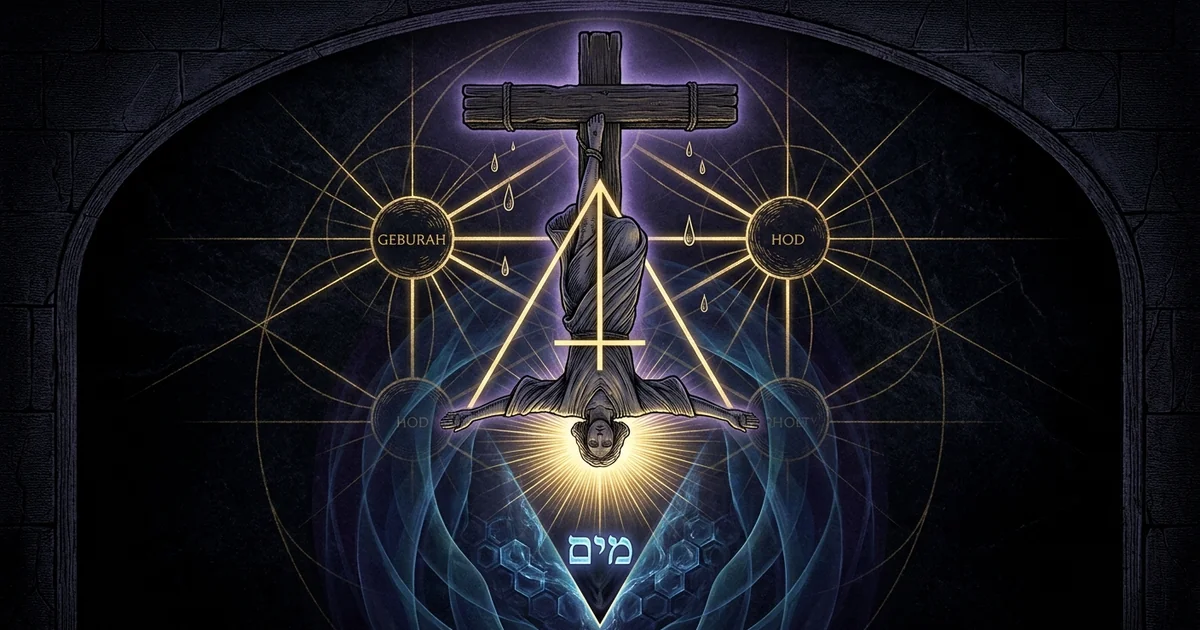
The Hanged Man: Surrender, Inversion & Transcendence
Archetypal Thesis & Systemic Paradigm: The Mechanics of Voluntary Suspension
The Paradigm of Kenosis: Volitional Ego-Depletion as Noetic Portal
Within the structural architecture of the major-arcana, Key XII—The Hanged Man—operates not as an index of punitive subjugation or passive victimhood, but as the precise mathematical and metaphysical fulcrum of the entire initiatory cycle. Where preceding keys track the progressive consolidation, stabilization, and ethical testing of the ego apparatus, Key XII enacts a radical ontological pivot. It formalizes the doctrine of kenosis (κένωσις), the deliberate self-emptying of personal volition, whereby the adept intentionally surrenders the illusion of autonomous agency to become an unresisting conductor for transpersonal intelligence. This is not the involuntary helplessness of psychological trauma, nor is it the lethargic immobility of melancholia. Rather, it represents the highest operational deployment of the will: the voluntary suspension of volitional motor-action in order to dismantle the reactive feedback loops of the mundane personality.
Through kenosis, the practitioner enacts a strategic withdrawal from terrestrial teleology. In standard consciousness, the ego functions as an assertive engine, perpetually projecting intent, securing boundaries, and attempting to dominate its phenomenological field through linear causality. Key XII disrupts this circuit by demonstrating that the apparatus constructed to navigate the horizontal world is fundamentally unequipped to perceive or assimilate vertical, transcendent reality. To cross the threshold into advanced spiritual realization, the operational system of the self must undergo an intentional zeroization. The ego must consent to its own systemic suspension, allowing its operational parameters to be neutralized so that a higher perceptual matrix can register upon the purified sensorium. This volitional depletion serves as an epistemological portal: by evacuating mundane ambition and motor compulsion, the consciousness creates a vacuum into which the unconditioned light of the macrocosm rushes.
“The archetype of the wounded healer or the suspended god expresses an inescapable psychological necessity: the ego must suffer a temporary defeat, a suspension of its sovereign pretensions, if the broader personality—the Self—is to emerge into conscious realization. This voluntary descent into the water of the unconscious, analogous to the nekyia or the night sea journey, demands the total cessation of egoic striving. Where the personal will insists on mastery, neurosis festers; where the will submits to the transpersonal pattern, individuation proceeds.” — Carl Gustav Jung, The Archetypes and the Collective Unconscious, Collected Works Vol. 9, Part 1, §442.
The Gravitational Inversion of Consciousness: Turning Terrestrial Values Upside Down
By anchoring the somatic axis upside down, suspended by a single ankle from a living wooden gallows, Key XII enacts an absolute perspective reversal. The card challenges the foundational assumption of terrestrial survival: that security is attained by planting the feet firmly upon physical earth while raising the head toward the sky. The Hanged Man inverts this gravitational orientation. His feet are bound to the celestial scaffolding—often depicted as a living tau-cross or arbor vitae sprouting verdant leaves—while his head hangs downward, immersed in the nether currents of the atmosphere, hovering immediately above the subterranean abyss.
This spatial dislocation enforces a radical reassessment of phenomenological value systems. In the terrestrial paradigm, weight pulls downward, status ascends upward, and power is quantified by muscular propulsion and external conquest. Viewed through the lens of the inverted adept, these values are exposed as structural mirages. That which the consensus reality deems foundational—material accumulation, social prestige, immediate physical security—is recognized as contingent and ephemeral, while that which mundane society treats as negligible—interior stillness, non-striving, passive receptivity—is revealed as primary. The Hanged Man achieves the hanged man surrender transcendence dynamic precisely because physical stillness unbinds interior contemplative velocity. Immobilized in three-dimensional space, the consciousness is liberated from the demands of spatial navigation, allowing the perceptual apparatus to turn inward and re-anchor its epistemic coordinates in the absolute.
The Geometry of Equilibrium: Stable Inversion vs. Catastrophic Collapse
A critical diagnostic feature of Key XII is the absolute serenity displayed across the subject’s countenance. In traditional iconography—crystallized comprehensively by Pamela Colman Smith under the direction of Arthur Edward Waite—the figure exhibits neither physical agony, muscle tension, nor psychological terror. The suspension is not a chaotic plunge or a violent hanging; it is a posture of immaculate, crystalline equilibrium. The right leg is secured to the transverse beam of the gibbet, while the left leg is bent behind the knee, tracing the crossbar of a numeral 4. The arms are folded placidly behind the back, forming an inverted triangle with the head acting as the downward apex.
This somatic configuration demonstrates that Key XII represents stable, deliberate inversion rather than the catastrophic, involuntary collapse characteristic of Key XVI (The Tower). While The Tower signifies the violent rupture of an ego-structure shattered by exterior force due to its rigid refusal to yield, The Hanged Man signifies the preventative, conscious embrace of dissolution. By adopting the inverted stance deliberately, the adept harmonizes with the inexorable laws of entropy and transformation, thereby neutralizing their destructive potential. The apparent disorientation of being suspended upside down is stabilized by the geometric precision of the pose; it establishes an axis of dynamic stillness at the center of the world’s gyre, demonstrating that psychological and metaphysical equilibrium is attained not by resisting the gravitational pull of universal law, but by surrendering to it entirely.
Classical Provenance & Textual Lineage: From Il Traditore to the Adept of the Living Water
The Fifteenth-Century ‘Infamy’ Iconography: Shaming Rituals of Renaissance Italy
To trace the evolutionary trajectory of Key XII is to witness one of the most astonishing semiotic transmutations in Western esotericism. In the earliest surviving fifteenth-century Italian decks, such as the Visconti-Sforza Tarot (c. 1450), the card bore the explicit socio-political label Il Traditore—The Traitor. In Renaissance Italy, suspension by one ankle was not a mystical allegory, but a brutal, secular form of judicial shaming known as the pittura infamante (defaming portraiture). Fugitives, oath-breakers, and political traitors who fled execution were painted in effigy upon the external walls of public buildings, suspended upside down by one foot, frequently clutching moneybags to signify their corrupt betrayal of the civic body.
+-----------------------------------------------------------------------+
| HISTORICAL TRANSMUTATION OF KEY XII ICONOGRAPHY                       |
|                                                                       |
|  15th Century             18th-19th Century         20th Century      |
|  Visconti-Sforza          Court de Gébelin / Lévi   Waite-Smith       |
|                                                                       |
|  [Il Traditore]    --->   [Prudence / Adept]  --->  [Mystic Martyr]   |
|   Judicial Shame           Esoteric Reversal         Solar Nimbus     |
|   Secular Treason          Hermetic Initiation       Ecstatic Stillness|
+-----------------------------------------------------------------------+
The iconography of Il Traditore was designed to broadcast total socio-political degradation: the criminal was inverted to reflect the moral perversion of his actions, suspended between earth and sky as an outcast rejected by both the terrestrial city and the heavenly sphere. His clothes were often ragged, and his posture communicated the helpless humiliation of exposure before the civic gaze. In this primordial phase, the card operated entirely within the moralistic and penal framework of late medieval jurisprudence. It cautioned the observer against the catastrophic perils of civic betrayal, financial greed, and the inevitable public retribution enacted by sovereign power.
Occult Reclamation: Antoine Court de Gébelin and Eliphas Lévi’s Esoteric Recasting
The transmutation of this penal emblem into an instrument of high esoteric initiation commenced in the late eighteenth century with Antoine Court de Gébelin. In his monumental work Monde Primitif (1781), Gébelin examined the Tarot de Marseille and claimed that the cards were the surviving leaves of an ancient Egyptian book of wisdom. Confronted with the jarring, punitive nature of Il Traditore, Gébelin committed a foundational hermeneutic leap: he argued that the card had been printed upside down by ignorant Italian card-makers. Viewed in what he considered its “correct” orientation, the figure was not hanging from a beam at all, but was standing on one foot with the other raised, embodying the cardinal virtue of Prudence (Prudentia), contemplating her next step.
While Gébelin’s historical premise regarding Egyptian origins and printing errors was philologically flawed, his interpretive intervention decisively ruptured the card’s secular penal identity. The definitive metaphysical recasting was subsequently accomplished in the mid-nineteenth century by the French occultist Éliphas Lévi (Alphonse Louis Constant). In Dogme et Rituel de la Haute Magie (1854–1856), Lévi integrated the Tarot with the Hermetic Kabbalah, aligning the twenty-two trumps with the twenty-two letters of the Hebrew alphabet. Lévi recognized that the figure’s inversion was not an accident of the printing press, but the deliberate core of its mystery. He identified the card with the Hebrew letter Lamed (later systematically reassigned by the Golden Dawn to Mem), transforming the Renaissance traitor into the figure of the Promethean adept, the self-sacrificing initiate who descends into matter, or the Christological avatar whose physical helplessness masks an omnipotent spiritual authority. For Lévi, the inverted man was the revealer of hidden wisdom, whose voluntary suspension constituted the very secret of magical equilibrium.
Golden Dawn Codification and Waite’s Mystical Refinement: The Martyrdom of Light
The Hermetic Order of the Golden Dawn, founded in 1888 by S.L. MacGregor Mathers, William Wynn Westcott, and W.R. Woodman, formalized this transformation within their seminal instructional text, Book T: The Tarot. The Golden Dawn stripped away the lingering associations with criminality and civic punishment, entitling the card “The Hanged Man” and subtitling it “The Spirit of the Mighty Waters.” They situated it upon the Tree of Life on the 23rd Path, assigning it decisively to the Hebrew Mother Letter Mem and the element of Water.
“The gallows from which he is suspended forms a Tau cross, while the figure from the position of the legs forms a reversed cross. There is a nimbus about the head of the seemingly martyred person. It should be noted (1) that the tree of sacrifice is living wood, with leaves upon it; (2) that the face expresses deep entrancement, not suffering; (3) that the figure, as a whole, suggests life in suspension, but life and not death… It has been called falsely a card of martyrdom, a card of prudence, a card of the Great Work, a card of duty… I would say very simply on my own part that it expresses the relation, in one of its aspects, between the divine and the mundane… He who can understand that the whole story of his higher nature is hinted at in this card will know that it has an intimate reference to the secret of all mysteries.” — Arthur Edward Waite, The Pictorial Key to the Tarot, Part II, §XII.
When Arthur Edward Waite directed the artist Pamela Colman Smith to execute the definitive Major Arcana 12 design for the 1910 Rider-Waite-Smith deck, he crystallized this esoteric lineage into an enduring archetype of mystical beatitude. Waite introduced a pivotal iconographic detail absent from early historic decks: a radiant, golden nimbus blazing like a solar crown around the head of the suspended figure. By crowning the adept with this luminous halo, Waite demonstrated that the physical brain, situated lowest toward the earth, had become the locus of divine illumination. The gallows was rendered as a living, T-shaped tree—a direct invocation of the tau-cross and the arbor vitae—sprouting fresh green shoots from its hewn timber. Thus, the penal instrument of Renaissance infamy was irrevocably transfigured into the sacred tree of voluntary cosmic sacrifice, articulating the paradox that total temporal surrender generates immediate transcendental enlightenment.
Structural Mechanics & Symbolic Geometry: The Tau Cross, the Hebrew Mem, and the Path of Water
Qabalistic Topography: Path 23 Connecting Geburah (Severity) and Hod (Splendor)
On the Qabalistic tree-of-life, Key XII governs the 23rd Path, an energetic horizontal-diagonal channel that bridges the fifth Sephirah, Geburah (Severity, Judgment, Martial Force), with the eighth Sephirah, Hod (Splendor, Concrete Intellect, Mercurial Form). This topographical location is vital for comprehending the systemic function of the archetype. Geburah represents the catabolic, purificatory, and strictly disintegrative power of the divine architecture; it is the cosmic scalpel that shears away superfluity. Hod represents the operational mind, the faculties of logic, naming, classification, and communication.
[ GEBURAH ]  (Severity / Pure Catabolic Force)
            \
             \
              \  <--- 23rd Path (Hebrew Letter: MEM / Element: WATER)
               \      [ KEY XII: THE HANGED MAN ]
                \
                 v
              [ HOD ]  (Splendor / Concrete Mercury / Intellect)
The path-23-geburah-hod demonstrates how absolute, martial rigor descends into the intellectual framework of the initiate. If Geburah’s raw, incinerating judgment were to impact the concrete mind directly without mediation, the fragile mechanisms of human cognition would be obliterated in psychosis or despair. Path 23 mediates this influx through the solvent medium of elemental Water. The martial discipline of Geburah is converted into the spiritual discipline of voluntary renunciation; the soul does not fight the severity of cosmic law but absorbs it, allowing it to dissolve the rigid dogmatism and intellectual calcifications resident in Hod. Through Key XII, the analytical mind of Hod ceases its restless ratiocination and surrenders to the higher, terrifying justice of Geburah, discovering that absolute intellectual humility is the prerequisite for divine gnosis.
Elemental Water and the Mother Letter Mem: Dissolution of Egoic Structures
Key XII is attributed to the mother-letter-mem, one of the three foundational cosmological pillars in the Sepher Yetzirah (alongside Aleph/Air and Shin/Fire). Mem is the primordial glyph of universal Water (ים, Yam), denoting the oceanic abyss, the amniotic fluid of cosmic genesis, baptismal regeneration, and the solvent that dissolves all crystallized physical forms. In Hermetic cosmology, as Heinrich Cornelius Agrippa notes in De Occulta Philosophia Libri Tres (Book II), Water is the receptive matrix of all generative virtue, carrying the seeds of all things within an undifferentiated, pliant continuum.
+--------------------------------------------------------------------------+
| QABALISTIC & ALCHEMICAL CORRESPONDENCES: KEY XII                         |
+-----------------------------------+--------------------------------------+
| Sephiric Channel                  | Path 23: Geburah (5) -> Hod (8)      |
+-----------------------------------+--------------------------------------+
| Hebrew Letter                     | Mem (מ) — Mother Letter (Value: 40)  |
+-----------------------------------+--------------------------------------+
| Cosmological Attribution          | Elemental Water (Water of Water)     |
+-----------------------------------+--------------------------------------+
| Astrological Polarities           | Ruled by the Primordial Depths       |
+-----------------------------------+--------------------------------------+
| Alchemical Glyph                  | Inverted Sulfur (Matter over Spirit) |
+-----------------------------------+--------------------------------------+
| Color Scales (Golden Dawn)        | King: Deep Sea Green                 |
|                                   | Queen: Sea Green                     |
|                                   | Emperor: Deep Purple                 |
|                                   | Empress: White-Flecked Olive Green   |
+-----------------------------------+--------------------------------------+
| Somatic / Biological Locus        | Amniotic Fluid; Somatosensory Reset; |
|                                   | Venous Return & Cranial Perfusion    |
+-----------------------------------+--------------------------------------+
The water-mem attribution explains why the posture of the Hanged Man must be fundamentally passive and static. Water cannot be hammered, carved, or forced into permanent shapes by muscular exertion; it yields completely to the contours of any vessel, yet effortlessly erodes the most unyielding granite through persistent, gravity-bound submission. In the human psyche, the ego manifests as an arid, calcified structure—a coagulated island of defensive identifications. The application of the Mother Letter Mem acts as a universal solvent (alkahest). By entering the baptismal medium of the 23rd Path, the rigid mental constructs, fixations, and defense mechanisms of the personality are liquefied. The adept is immersed in the primordial waters of the unconscious, experiencing a symbolic drowning that strips away the mortal husk to reveal the incorruptible spiritual core.
Dynamic Somatic Geometry: The Inverted Triangle Surmounting the Cross (Alchemical Sulfur in Reverse)
The somatic geometry embedded within Key XII operates as an intricate alchemical hieroglyph. When the figure’s posture is mapped geometrically, it yields two interlocking polygons:
- The lower physical body (the crossed legs) forms the equal-armed cross (+), or the numeral 4, emblematic of the four elements, the quaternary structure of matter, and terrestrial limitation.
- The upper physical body (the torso, folded arms, and downward-pointing head) forms a downward-pointing triangle (∇), or the numeral 3, emblematic of the divine ternary, the spiritual will, and elemental water.
[ Tau-Cross / Gallows Beam ]
                     |
                    (o)  <-- Ankle suspended
                     |
                   /   \
                  /     \   <-- Legs forming the Cross (4)
                 /   +   \
                +---------+
                    | |
                  \     /
                   \   /    <-- Torso and arms forming Inverted Triangle (3)
                    \ /
                    (O)     <-- Head with radiant Nimbus (Point of Light)
In classical Hermetic alchemy, the standard glyph for alchemical-sulfur consists of a triangle surmounting a cross ($\triangle$ over $+$), symbolizing the active, fiery, divine spirit dominating, ordering, and spiritualizing inert matter. In Key XII, this sacred geometry is inverted: the cross of matter surmounts the downward triangle of spirit ($+$ over $\nabla$).
Far from signifying a demonic degradation of the spirit by gross matter, this inversion formalizes the exact esoteric mechanism of incarnation and redemption. It depicts the alchemical Sulfur operating in reverse: the descent of the divine consciousness into the densest depths of the physical vessel. Spirit does not conquer matter by fleeing from it into abstract celestial realms; rather, it redeems matter by fully plunging into its subterranean core. The cross of matter sits uppermost, anchored to the heavenly tree, while the downward triangle of divine consciousness penetrates the terrestrial baseline. The head, crowned with the solar nimbus, marks the profound nadir of this descent—the point where transcendent awareness fully saturates the somatic matrix, igniting the divine spark within the dark mud of physical existence.
Systemic Inversion: Cybernetics, Homeostasis, and Perspective Reversal
Negative Feedback Loops and the Strategic Refusal of Motor Agency
Viewed through modern cybernetic and systems theories, Key XII presents an exquisite model of system homeodynamics. In any complex adaptive system, when an environmental stressor triggers an escalating positive feedback loop—wherein an initial deviation is continuously amplified by the system’s reactive responses—the inevitable trajectory is systemic exhaustion, catastrophic oscillation, or entropy. The conventional ego operates predominantly through these runaway positive feedback loops: confronted with threat, uncertainty, or failure, its default response is to redouble its volitional output, deploying aggressive planning, frantic muscular activity, and escalating cognitive control.
The Hanged Man introduces an intentional, hyper-stabilizing negative feedback loop through the strategic refusal of motor agency. By consciously arresting all outward kinetic propulsion, the adept decouples the internal state from environmental perturbation. The system ceases to react; it absorbs the ambient stress without generating compensatory noise. In the terminology of cybernetics, Key XII drives the system’s kinetic energy to absolute zero, allowing the homeostatic regulators of the deeper psyche to re-establish dynamic baseline equilibrium. The cessation of external motor manipulation terminates the energetic hemorrhage caused by neurotic struggle, transmuting wasted kinetic force into pure potential energy.
Key XII: The Hanged Man (Voluntary Inversion)
- Vector of Agency: Volitional submission; conscious kenosis; active non-striving (Wu Wei).
- Energetic Trajectory: Kinetic energy drawn inward and condensed into a luminous potential field (the nimbus).
- Structural Integrity: Somatic and spiritual equilibrium maintained through rigorous internal geometry (4 over 3).
- Psychic Consequence: Illumination, perceptual parallax, baptismal dissolution of neurosis without somatic trauma.
- Qabalistic Axis: Path 23 (Mem/Water), linking Severity to Intellect through receptive surrender.
Key XVI: The Tower (Involuntary Rupture)
- Vector of Agency: Involuntary catastrophe; unconscious hubris shattered by exogenous transpersonal force.
- Energetic Trajectory: Uncontrolled, explosive kinetic dissipation; catastrophic release of bound energy.
- Structural Integrity: Total structural failure; shattering of rigid, defensive ego-architecture.
- Psychic Consequence: Psychosis, acute panic, ego-shattering disorientation, traumatic confrontation with reality.
- Qabalistic Axis: Path 27 (Peh/Fire/Mars), bridging Victory and Splendor through violent cataclysm.
Optical Parallax: The World Perceived from the Celestial Anchor
The systemic inversion of Key XII produces a phenomenon analogous to optical parallax: by shifting the observer’s viewing station from the conventional ground plane to the suspended, inverted vantage point, the apparent position of all surrounding objects and values undergoes a structural transformation. When the perceptual axis is turned upside down, the normative horizon disappears. Phenomena that previously appeared towering and insurmountable—existential dread, social obligation, historical guilt—are suddenly viewed from an angle that reveals their hollow, constructed nature.
This perspective reversal unmasks the hidden infrastructure of consensus reality. In normal terrestrial perception, the human subject takes the ground beneath its feet for granted, perpetually gazing upward or outward at what it desires or fears. Suspended by the ankle, the adept’s anchor is relocated to the living wood above, while his head hangs over the void. From this inverted orientation, the sky is perceived not as a distant ceiling, but as an infinite floor, and the earth is recognized not as a solid foundation, but as a ceiling to which consciousness was previously pinned. This epistemic shift strips the consensus worldview of its self-evident authority, exposing the arbitrariness of societal codes and unlocking a state of profound cognitive freedom.
Comparative Archetypal Topography: Odin at Yggdrasil and Christ at Golgotha
The psycho-cosmological mechanics of Key XII find exact structural resonance in the central initiatory myths of Indo-European and Near Eastern traditions. Foremost among these is the narrative of Odin’s voluntary ordeal upon the World Tree, Yggdrasil, recorded in the Old Norse Hávamál:
"I ween that I hung on the windy tree,
Hung there for nights full nine;
With the spear I was wounded, and offered I was
To Odin, myself to myself,
On the tree that none may know
What root beneath it runs."
— Hávamál, Stanza 138
Odin’s ordeal matches the precise operational parameters of Key XII: the god is not executed by an external adversary, but offers “himself to himself.” His suspension is self-willed, prolonged, and held in total physical stillness between the branches and the subterranean roots of the cosmos. It is precisely at the nadir of this prolonged agony—at the point of complete physical and metabolic exhaustion—that the structural code of reality breaks through into his consciousness: he peers downward into the darkness, screams, and takes up the Runes of power. Illumination is bought at the exact price of voluntary, prolonged helplessness.
[ TRANSCENDENT AXIS: COSMIC TREE / GIBBET ]
                            |
           +----------------+----------------+
           |                                 |
           v                                 v
   [ ODIN AT YGGDRASIL ]             [ CHRIST AT GOLGOTHA ]
   - Self offered to self            - Kenosis: God empties self
   - 9 nights of suspension         - 3 hours of darkness / Tau-Cross
   - Yields the secret Runes         - Yields redemption / Spirit
           |                                 |
           +----------------+----------------+
                            |
                            v
               [ KEY XII: THE HANGED MAN ]
               - Volitional Inversion
               - The Nimbus of Illuminated Gnosis
This matrix appears with equal potency in the Christological mystery of the Crucifixion upon the tau-cross of Golgotha. Pauline theology explicitly articulates this as kenosis (Philippians 2:7–8): the divine Logos “emptied Himself, taking the form of a servant… and became obedient unto death.” In both mythologems, supreme transcendental sovereignty is obtained not through the triumphalist exertion of divine omnipotence, but through its absolute renunciation. The Hanged Man is the generic, universalized blueprint of this solar-sacrificial intelligence: the divine being who consents to be pinned, bound, and inverted within the cross of manifestation to release the hidden light trapped within the material world.
Psychological Dynamics & Operational Praxis: The Art of Deliberate Yielding
Contemplative Decoupling: Navigating Pathological Fixation and Neurotic Urgency
In modern psychodynamic practice and Jungian analytical praxis, the appearance of the Hanged Man archetype marks a decisive developmental threshold in the process of individuation. Pathologically, the modern ego is addicted to instrumental agency; when confronted with an intractable inner conflict, a relational rupture, or an existential void, it instinctively accelerates its attempts at cognitive problem-solving. This neurotic urgency generates severe psychical friction, commonly manifesting as chronic anxiety, insomnia, obsessive rumination, and psychosomatic tension.
The Hanged Man introduces the discipline of contemplative decoupling. It instructs the consciousness to consciously separate the reality of an existential impasse from the compulsion to immediately resolve it. In this state, the practitioner is guided to inhabit depressive, stuck, or liminal conditions not as chronic failures requiring immediate therapeutic repair, but as sacred periods of psychical incubation. By decoupling the ego from its demand for linear progress, Key XII creates a sheltered interior container wherein unconscious contents can rise to the surface without being prematurely categorized, intellectualized, or acted out by the conscious personality.
Hermeneutic Diagnostic Rules: Interpreting Key XII in Diagnostic Spreads
When deployed within clinical or analytical cartographies, the hermeneutic interpretation of Key XII demands extreme diagnostic precision. The practitioner must carefully evaluate whether the archetype is presenting in its dignified (integrated) or ill-dignified (pathological) configuration, as the superficial symptom—stagnation—is identical in both instances, while the underlying psychodynamics are diametrically opposed.
+--------------------------------------------------------------------------+
| HERMENEUTIC DIAGNOSTIC CRITERIA: KEY XII                                 |
+-----------------------------------+--------------------------------------+
| Dignified / Integrated Execution  | Ill-Dignified / Pathological Variant |
+-----------------------------------+--------------------------------------+
| Conscious, chosen surrender       | Involuntary victimization; passivity |
+-----------------------------------+--------------------------------------+
| Serene acceptance of incubation   | Bitter, resentful martyr complex     |
+-----------------------------------+--------------------------------------+
| Decoupling from mundane teleology | Executive paralysis; procrastination |
+-----------------------------------+--------------------------------------+
| Transmuted perspective; lucidity  | Delusional stubbornness; escapism    |
+-----------------------------------+--------------------------------------+
| Dynamic non-action (*Wu Wei*)     | Depressive catatonia; self-sabotage  |
+-----------------------------------+--------------------------------------+
In its dignified expression, Key XII indicates a conscious, dignified alignment with necessary delay. It counsels the querent or analysand to abandon all outward offensive campaigns, cease litigations, delay definitive career shifts, and fully accept a period of external immobilization. The individual is not stuck because they are weak; they are immobilized because the deeper Self has pulled the emergency brake on the conscious personality to prevent a catastrophic collision.
Conversely, in its ill-dignified or inverted presentation, Key XII diagnoses a corrupted, passive-aggressive imitation of surrender: the martyr complex. Here, the individual exploits their suffering as emotional currency, weaponizing their helplessness to manipulate external actors. It signals an ego that refuses to take responsibility for its life, mistaking neurotic indecision, chronic procrastination, or depressive resignation for spiritual detachment. The diagnostic imperative in any analytical reading is to expose the hidden motivation: is the suspension a conscious sacrifice of the personal will to a transpersonal calling, or is it a cowardly abdication of agency designed to evade the responsibilities of adult life?
The Transmutation of Liminality: From Impotence to Unshakeable Sovereignty
The ultimate psychological triumph of Key XII resides in the transmutation of liminality. Society conditions the individual to evaluate their existential worth through productivity, velocity, output, and observable triumph. Consequently, to find oneself in a liminal zone—unemployed, creatively barren, physically ill, or socially marginalized—is routinely experienced as castration, impotence, and annihilation.
The Hanged Man transmutes this degradation by fully claiming the stance of the suspended witness. When an individual consciously assumes the posture of Key XII, they assert: I am not defined by my motor capacity, nor is my value contingent upon social utility. I am that consciousness which remains intact when all doing has ceased. By deliberately occupying the space between states, the individual strips consensus reality of its power to reward or punish. They discover an unshakeable sovereignty that does not rely on conquest or external validation. The liminal space is transformed from a punitive prison into an alchemical vessel of spiritual gestation, converting what the world perceives as humiliating defeat into an ecstatic experience of interior illumination.
Philosophical Synthesis & Macrocosmic Correspondence: The Baptismal Waters of Mem
The Law of Inversion in Hermetic Philosophy: ‘As Above, So Below’ Turned on Its Head
The foundational operational axiom of classical Hermetic philosophy—crystallized in the Emerald Tablet of Hermes Trismegistus—declares: “That which is Below corresponds to that which is Above, and that which is Above corresponds to that which is Below, to accomplish the miracles of the One Thing.” While this law is traditionally conceptualized as a vertical, mirror-like symmetry, Key XII reveals its deeper, operative paradox: the macrocosm and the microcosm are not merely reflections of each other; their dynamics are fundamentally inverted.
               [ CELESTIAL REALM: MACROCOSM ]
                 Roots anchored in Heaven
                             |
                             |  (Cosmic Inversion)
                             v
               [ TERRESTRIAL REALM: MICROCOSM ]
                 Branches reaching into Earth
To align the mundane self with the divine architecture, one cannot simply amplify terrestrial strategies toward heaven. The pathway to the summit of the spiritual mountain requires an absolute descent; the acquisition of absolute power demands absolute powerlessness; and the realization of authentic life necessitates the voluntary embracing of mystical death. As P.D. Ouspensky noted in The Symbolism of the Tarot (1913), the Hanged Man is a portrait of a man who has discovered the secret of turning himself upside down in order to see the universe as it truly is. By pulling the terrestrial feet upward toward the branches of the Tree of Life and directing the cognitive apparatus toward the abyss, Key XII operationalizes the Hermetic law: to comprehend the Above, the initiate must fully surrender to the gravity of the Below.
Cosmic Gestation: The Archetypal Matrix of the Embryo in Amniotic Fluid
Macrocosmically, the Hanged Man corresponds to the universal archetype of embryonic gestation within the cosmic womb. In biological embryology, the mammalian fetus develops suspended upside down, floating within the warm, pressurized, saline medium of amniotic fluid, tethered to the maternal organism via a single lifeline: the umbilical cord. Its head rests downward toward the pelvic outlet, preparing for the violent, cataclysmic transition of birth.
Key XII replicates this uterine morphology with surgical precision. The figure suspended by one leg from the living wood is the cosmic embryo suspended by the umbilical axis from the divine source, submerged within the primordial waters of the mother-letter-mem. In this state of intrauterine gestation, the fetus possesses no motor autonomy: it cannot run, speak, hunt, or assert linear intent. Its nourishment is mediated entirely through receptive conduits. To attempt premature motor agency within the womb would cause biological death; survival is predicated upon absolute, non-striving submission to maternal biology. In precisely this manner, Key XII represents the soul in its gestation chamber. The suspension is not an end in itself, but the mandatory developmental phase of total receptivity required before the spiritual organism can be birthed into a higher octave of being.
The Gateway to Key XIII: Surrender as the Exact Prerequisite for Mystical Death
Within the initiatory progression of the Major Arcana, the sequential placement of Key XII is structurally vital. It serves as the immediate, indispensable threshold to Key XIII: Death (/tarot/major-arcana-death-transformation). The systemic architecture of the Tarot demonstrates that mystical transformation, radical ego-liquidation, and rebirth cannot occur spontaneously or through violent assault; they require the prior spiritual pacification enacted by the Hanged Man.
If the human consciousness were to encounter the scythe of Key XIII while still operating in the aggressive, defensive posture of Key XI (Justice) or Key VII (The Chariot), the encounter would be catastrophic. The rigid ego would perceive Death as an annihilating assault, resulting in traumatic fragmentation. Key XII prepares the consciousness for this transition by liquefying its defensive crystallizations within the waters of Mem. By the time the adept reaches Key XIII, the illusion of autonomous egoic control has already been volitionally abandoned; the self has already accepted stillness and non-resistance. Key XII makes Death possible without terror: it converts what would have been a horrific execution into a natural, harmonious transition, paving the way for the profound alchemical transmutations subsequently articulated in Key XIV (/tarot/major-arcana-temperance-art-alchemy) and the perpetual cycles of /archetypes/the-ouroboros-dissolution.
Frequently Asked Questions Regarding Key XII
Clarifying Fatalistic Misunderstandings and Pathological Stagnation
A widespread misunderstanding of Key XII is the assumption that it advocates for fatalism, passivity, or political quietism. Novice practitioners frequently interpret the card as an injunction to abandon practical responsibility, submit passively to abusive socio-political structures, or accept toxic circumstances under the guise of “spiritual surrender.”
This fatalistic misinterpretation ignores the volitional core of the archetype. The Hanged Man does not counsel submission to human tyranny, nor does it legitimize abusive power dynamics. The surrender demanded by Key XII is not an abdication to external, corrupted worldly forces, but an internal, highly conscious surrender of the ego to the transpersonal directives of the Self and cosmic law. There is a vast, unbridgeable metaphysical chasm between being an unconscious victim of circumstance and electing to enter the sacred pause of the Hanged Man. True surrender is an act of supreme spiritual courage: it requires far more interior strength to arrest the impulse toward reactive vengeance or manic productivity than it does to mindlessly lash out or succumb to helpless despair.
Differentiating Key XII Surrender from Clinical Depressive Paralysis
In modern psychodynamic diagnostics, distinguishing between the spiritual non-action (Wu Wei) of Key XII and the pathological immobility of clinical depression is a vital diagnostic necessity. While both states manifest outwardly as behavioral withdrawal, cessation of motor output, and social disengagement, their internal phenomenological mechanics are fundamentally contradictory.
- Somatic & Sensory Profile: Clinical depression is characterized by psychomotor retardation, somatic heaviness, sensory blunting, and chronic muscular constriction (the feeling of being crushed beneath a leaden weight). Key XII exhibits dynamic relaxation, heightened sensory receptivity, and physical weightlessness (floating in a fluid medium).
- Affective & Cognitive Tone: Depression is driven by a pervasive sense of helplessness, cognitive rumination, self-reproach, despair, and emotional numbness. Key XII is accompanied by a profound interior peace, the serene cessation of internal narrative, and the suspension of self-judgment.
- Conscious Volition: In depressive paralysis, the individual desperately wants to act or feel differently but finds their motor apparatus unresponsive (involuntary executive dysfunction). In Key XII, the individual has consciously chosen to suspend action, recognizing that any premature intervention would disrupt a delicate, necessary process of unconscious gestation.
- Noetic Illumination: Depression is experienced as an encroaching, suffocating darkness. The Hanged Man is crowned with the golden nimbus—the direct manifestation of interior spiritual light born from the voluntary stillness of the mind.
The Alchemical Polarity Between Key XII (Mem) and Key XIV (Temperance/Samekh)
Within the dynamic architecture of the /tarot/tree-of-life-qabalah-paths, Key XII and Key XIV (Temperance) form an essential alchemical and systemic polarity that governs the transmutation of the soul across the middle and lower Sephiroth.
       [ KEY XII: THE HANGED MAN ]
       - Path: 23 (Geburah -> Hod)
       - Element: WATER (Mother Letter: Mem)
       - Mechanism: Solvent / Dissolution / Immersion
       - Vector: Passive / Downward Flow / Gestation
                     ^
                     |   (Alchemical Polarity)
                     v
       [ KEY XIV: TEMPERANCE / ART ]
       - Path: 25 (Yesod -> Tiphareth)
       - Element/Sign: SAGITTARIUS (Double Letter: Samekh)
       - Mechanism: Coagulation / Volatilization / Integration
       - Vector: Active Balance / Upward Directed Arrow
Where Key XII operates entirely through the solvent, dissolving power of elemental Water (the Mother Letter Mem), Key XIV operates via the element of Fire and the mutable zodiacal sign of Sagittarius, signified by the Hebrew letter Samekh (the prop or support). Key XII represents the alchemical solutio—the total liquefaction of the ego’s rigid forms, the downward-directed soaking of consciousness in the unconscious ocean, and the absolute suspension of directional aim.
Conversely, Key XIV represents the alchemical coagulatio and conjunctio—the conscious, artful tempering of polarities, the precise pouring of fluids between golden and silver vessels, and the upward release of the Sagittarian arrow toward the solar heart of Tiphareth. Key XII dissolves the calcified structure; Key XIV re-synthesizes the purified constituents into a higher, unified substance. Without the total, ego-liquidating baptism of the Hanged Man’s water, the alchemical fire of Temperance would merely bake the ego’s delusions into an impenetrable, unredeemable stone. The surrender of Key XII is the absolute, non-negotiable prerequisite for the golden integration of Key XIV.