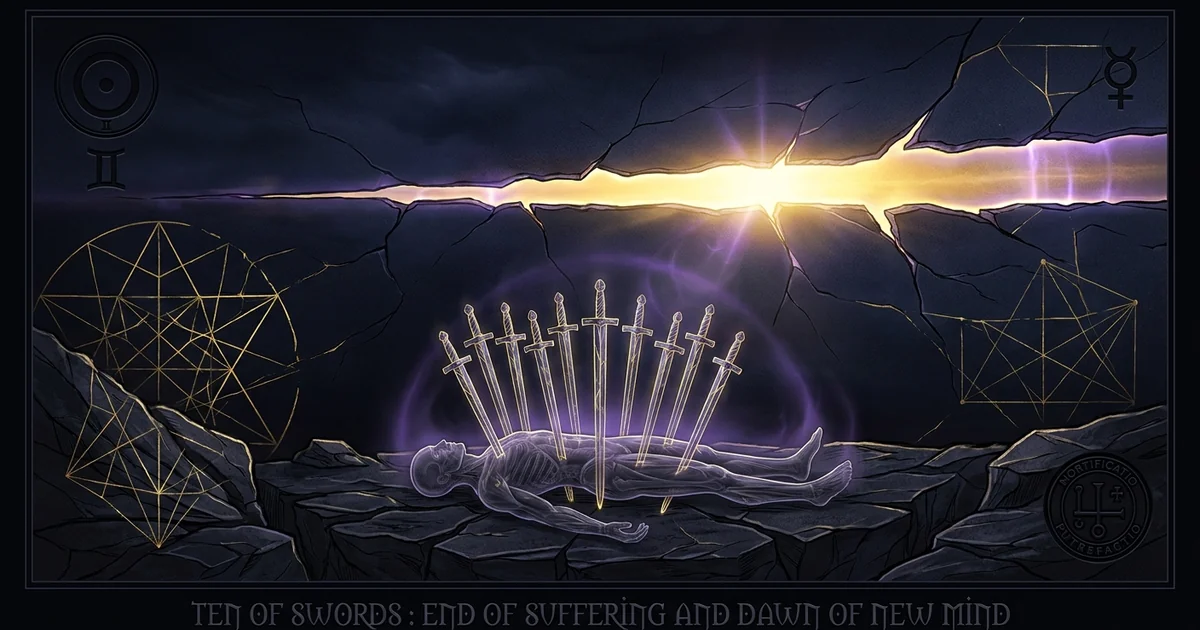
Ten of Swords: End of Suffering and Dawn of New Mind
Archetypal Thesis & Systemic Paradigm: The Apoptosis of Discursive Mind
Epistemological Exhaustion of the Swords Suit
The Ten of Swords designates the terminal collapse of the discursive intellect (Ruach) when systematically divorced from transcendent intuition. Within the cartographic progression of the Minor Arcana, the card marks an absolute boundary condition: the self-annihilation of hyper-rationality through the hyper-proliferation of its own dualistic categories. As consciousness navigates the suit of swords archetypal journey, the pure, undivided cognitive capacity initially refracted through the Ace of Swords undergoes sequential division, qualification, and structural petrification. By the time this mental energy reaches its tenth station, discursive thought has turned cannibalistic. The analytical blade no longer dissects external phenomena to reveal truth; instead, the egoic operating system turns inward, multiplying diagnostic judgments until the psychic architecture collapses under the weight of its own unyielding syllogisms.
In the framework of Western Hermeticism, the Ten of Swords maps to the sphere of Malkuth (The Kingdom) within Yetzirah (The Formative World). This placement represents the terminal basement of the Air element. Malkuth grounds and crystallizes whatever energetic current it hosts. When the fluid, gaseous, and kinetic properties of Air intersect with the dense, inertia-bound boundary conditions of Malkuth, the intellect undergoes structural petrification. Astrologically allocated to the third decan of Gemini (Gemini III: 20°–30° Gemini) under the rulership of the Sun, the card mathematically synthesizes the solar principle of total, uncompromising illumination with mutable, volatile duality, exposing the irreconcilable bankruptcy of unanchored analysis.
This collapse is an example of systemic apoptosis: programmed cellular death transposed to the realm of psychic schemas. The human cognitive apparatus possesses an innate failsafe. When an interpretative matrix or narrative ego becomes so brittle, self-referential, and catastrophic that it paralyzes the organism, the systemic tension forces a total cognitive shutdown. The ten swords impaling the prostrate subject do not denote external aggressors; they are the externalized projections of ten discrete cognitive premises pushed to their absolute dialectical terminus. The ten swords represent the complete set of Sephirotic emanations operating in their most degraded, disconnected mode, severing the subject’s attachment to an untenable worldview.
The Air Element at its Material Horizon
Air (Vau of the Tetragrammaton) is intrinsically kinetic, communicative, relational, and immaterial. It mediates between the catalytic fire of Atziluth and the receptive water of Briah. However, when the air element descends through Yetzirah and strikes the interface of Assiah (the physical, material realm), its structural dynamics invert. The velocity of thought encounters the friction of concrete reality. Mental abstraction, which can entertain infinite hypotheticals without physical consequence, suddenly faces the uncompromising limit of material embodiment. In this impact zone, hyper-extended logic crystallizes into an inescapable labyrinth of despair.
The ten of swords tarot meaning reveals this precise cosmological threshold: the maximum possible densification of Air. The atmosphere becomes heavy, pressurized, and suffocating. The mind, having spent its currency in the anxious vigilance of the Nine of Swords, discovers that its predictive models can no longer adjust to reality. Ideation has frozen into dogma; mental models have displaced direct perception. At this material horizon, the discursive mind can go no further downward without undergoing an elemental phase shift. To survive, the consciousness trapped within the Yetziratic cage must surrender its discursive supremacy and allow its calcified structures to break, clearing the field for a grounded, somatic baseline.
Deconstructing Fatalism: Epistemic Annihilation vs. Physical Death
Exoteric and pop-cultural approaches to tarot iconography frequently commit the category error of literalism, reading the imagery of the Ten of Swords as an omen of biological demise, literal backstabbing, or irremediable personal tragedy. Such interpretations mistake the signifier for the signified. The cartomantic tradition, when illuminated through the lens of esoteric psychology and Hermetic philosophy, does not deal in the mechanistic prediction of somatic mortality. Rather, it charts structural thresholds of awareness. The “death” illustrated in the Tenth Arcanum of Air is strictly epistemological.
Epistemic annihilation is the total deconstruction of the subject-object divide through the collapse of the interpretive apparatus itself. The supine figure on the shore does not represent a corpse awaiting burial, but the mortal ego-construct (the persona) struck down by the exhaustion of its own hyper-rational strategies. The suffering depicted is not actively occurring; it has concluded. The blood pooling beneath the head signifies the drainage of vital psychic energy (Prana or Ruach) from the cerebral centers down toward the earth. By deconstructing the fatalistic misinterpretation of this card, the investigator recognizes the archetype’s fundamental gift: the absolute finality of an intolerable mental regime, demarcating the exact coordinates where psychological suffering reaches absolute zero and can proceed no further.
Classical Provenance & Textual Lineage: From ‘Ruin’ to the Dawn Horizon
The Hermetic Order of the Golden Dawn and ‘Book T’
The systematic foundation for the modern esoteric interpretation of the Ten of Swords was codified in the late nineteenth century by the Hermetic Order of the Golden Dawn. In Book T: The Tarot, Comprising the Secret System of Practical Exegesis, Samuel Liddell MacGregor Mathers and his circle classified the card under the official title: “The Lord of Ruin”. This title was not intended as a vulgar prophecy of financial bankruptcy or material catastrophe, but as an exact assessment of what happens when the solar life-force operates through the dispersed, mercurial channels of the final decan of Gemini.
“Malkuth in the Sphere of Air. The Lord of Ruin. Gemini 20° to 30°. Solar and Gemini influence. It represents almost complete disruption and failure; ruin of all plans and projects; labor lost; yet with a faint hope of recovery, as it is the end of the Suit of Swords. Insolence; riotous behavior; undisciplined mind. Treachery, yet defeat of the traitor through his own excess. It is the exhaustion of the intellectual force through endless sub-division and lack of equilibrium.”
— S. L. MacGregor Mathers, Book T: The Tarot (1888)
Book T established that the decanate corresponding to the Ten of Swords exposes the solar current to the volatile mutability of Gemini, an Air sign ruled by Mercury. In this sector of the heavens, intellectual curiosity becomes unbound from moral or spiritual gravity. The Golden Dawn recognized that the “Ruin” indicated is an intellectual ruin—the destabilization of any system built entirely upon logic without the stabilizing counterweight of spiritual or material reality. The card represents the conclusion of the Yetziratic cycle, where the restless dispersion of Gemini has shattered the initial unity of the suit into ten antagonistic splinters.
Crowley’s Decadence of Thought: ‘The Lord of Ruin’
In The Book of Thoth (1944), Aleister Crowley deepened this analysis, positioning the Ten of Swords as the ultimate demonstration of intellectual decadence. For Crowley, the card reflects the disaster that ensues when the intellect claims sovereignty over the higher spiritual centers:
“The number Ten, Malkuth, as always, represents the culmination of the unmitigated energy of the idea. It shows reason run mad, a chaotic riot of senseless mechanism. It is the mind divorced from the supernal wisdom of Chokmah and the understanding of Binah. It is the logic of the lunatic, whose syllogisms are formally flawless, but whose premises are fundamentally absurd.” — Aleister Crowley, The Book of Thoth (1944)
Crowley’s visual design, executed by Lady Frieda Harris, strips away human anatomy to expose pure symbolic geometry. The central swords form the broken, shattered structure of the Tree of Life. Their hilts are corrupted by the astrological glyphs of the planets, bent and degraded under structural stress. Crowley notes that the Sun in Gemini burns out the mutable framework, demonstrating that pure ratiocination, left unchecked, inevitably attacks its own foundational axioms. The swords do not merely strike outward; they converge inward, their points meeting at the central axis, obliterating the core of the intellectual vessel. Crowley demonstrates that without direct connection to the supernal Sephiroth, discursive reason constructs a closed circuit of self-referential despair.
The Pictorial Innovation of Pamela Colman Smith: The Golden Horizon
Prior to the publication of the Rider-Waite-Smith (RWS) deck in 1909, historic decks such as the Tarot of Marseilles rendered the Ten of Swords as an abstract geometric lattice of curved blades, often encircling two central crossed swords. This arrangement conveyed tension, but obscured the psychological reality of the card. The pictorial revolution orchestrated by Arthur Edward Waite and executed by artist Pamela Colman Smith radically reframed the Western esoteric understanding of this arcanum by introducing explicit figurative narrative.
Smith synthesized the Golden Dawn’s Qabalistic teachings into a tableau of dramatic emotional and spiritual resonance. A figure lies face down upon the shoreline, draped from the waist down in a rich crimson mantle, pinned to the earth by ten heavy, straight broadswords piercing the length of the spine and neck. The water before him is flat, glassy, and black, devoid of waves or kinetic movement, signifying the total suspension of emotional turbulence.
Waite’s critical contribution, brilliantly realized by Smith, lies in the upper half of the composition: the oppressive, pitch-black storm clouds lift at the base of the canvas to reveal a radiant, golden horizon illuminating a distant, calm shoreline. This visual cue transforms the card from an image of defeat into a threshold of radical liberation. The suffering is structurally localized to the supine figure; the environment itself is transitioning into a new dawn. Waite noted in The Pictorial Key to the Tarot that the card signifies an absolute terminus, a horizon where the worst has already occurred, rendering future dread impossible and clearing the field for renewal.
Structural Mechanics & Symbolic Geometry: Malkuth in Yetzirah and Gemini III
Qabalistic Topography: The Terminal Sephirotic Descent
To grasp the structural mechanics of the Ten of Swords, one must analyze its position within the descending vector of the Sephirotic emanations mapped across the Four Kabbalistic Worlds. As detailed in the mechanics of Malkuth in the four worlds, the tenth Sephirah functions as the sinkhole, container, and final execution layer for the energetic impulses of the nine Sephiroth above it.
In the World of Yetzirah, Kether corresponds to the Ace of Swords—the single, pristine, undivided flash of analytical truth. As this ray descends:
- It splits into binary debate in Chokmah (Two of Swords).
- It experiences the trauma of triangulation and structural boundary in Binah (Three of Swords).
- It passes through the defensive retreat of Chesed (Four of Swords).
- It encounters competitive degradation in Geburah (Five of Swords).
- It seeks communicative navigation in Tiphareth (Six of Swords).
- It lapses into deceitful evasion in Netzach (Seven of Swords).
- It yields to cognitive entrapment in Hod (Eight of Swords).
- It descends into nocturnal anxiety in Yesod (Nine of Swords).
When this energy reaches Malkuth of Yetzirah, the structural capacity of the mental plane collapses. Malkuth demands materialization. Yetziratic Air cannot materialize without transforming into something other than thought. Thus, the Ten of Swords represents the absolute edge of the Yetziratic universe. It is the boundary stone where intellectual abstraction strikes reality, shatters its own instruments of measurement, and deposits its psychic debris on the threshold of Assiah, the physical world of action and embodiment.
Astrological Decan Mechanics: Sun in Gemini (The Burnout of Duality)
The astrological architecture governing the Ten of Swords is the third decan of Gemini, spanning 20° to 30° of the sign, traditionally associated with the Sun. According to the classical system preserved by Heinrich Cornelius Agrippa in De Occulta Philosophia Libri Tres (1533), this decan signifies the exhaustion of mutable Air under the relentless glare of solar consciousness:
Gemini is the sign of the cosmic twins, the split mind, analysis, logic, and rapid discursive exchange. Its nature is mutable, light, and endlessly adaptable. However, when the Sun—representing the primary, unified, indivisible center of consciousness (Tiphareth)—occupies this final decan of mutable Air, an intense thermodynamic friction occurs. The Sun seeks absolute truth, central sovereignty, and undivided integration. Gemini, conversely, operates by multiplying pathways, splitting hairs, and generating parallel options. The Sun in Gemini III pours continuous solar energy into the engine of dualistic thought, driving the mental machinery at high speeds until the communicative gears shear apart. The nervous system (Mercury) is scorched by this sustained, hyper-vigilant illumination.
The synthesis of the Sun in Gemini III produces intellectual burnout. The solar light strips away all illusions of subjective comfort. The mind can no longer hide behind rationalizations, linguistic games, or theoretical compromises. The intellect has illuminated its situation so thoroughly that it has exposed its own systemic inability to solve its existential dilemma. The dualistic apparatus breaks, leaving the subject exposed to direct reality.
Iconographic Geometry: Spinal Punctures and the Golden Horizon
The iconographic composition designed by Pamela Colman Smith reveals a calculated geometric alignment with esoteric human anatomy. The ten swords are not scattered at random across the field; they form a precise linear array penetrating the dorsal axis of the supine body, directly mapping onto the central channel of subtle anatomy: the Sushumna Nadi.
[Iconographic Anatomy of the Tenth Station]
Sword 1  –> Medulla Oblongata / Brainstem (Cessation of Discursive Will)
Swords 2–7 -> Cervical & Thoracic Spine (Deconstruction of Somatic Armor)
Swords 8–9 -> Lumbar Axis (Exhaustion of Kinetic Ambition)
Sword 10 –> Sacral Base / Malkuth (Final Anchoring into Earth)
The placement of the primary sword at the base of the skull, penetrating the medulla oblongata, marks the decisive severance of the discursive ego’s control over the neuromuscular system. In yogic physiology, the Sushumna Nadi is the channel through which spiritual energy ascends once the polarized channels of Ida (lunar, mental) and Pingala (solar, physical) achieve absolute equilibrium. The swords piercing the spine indicate that the nervous system’s perpetual loop of hyper-vigilant, catastrophic scanning has been physically arrested. The swords ground the hyperactive energy of the nervous system directly into the soil.
The horizontal geometry balances this vertical impalement. The prone figure lies parallel to the shoreline, echoing the horizontal line separating the black sea from the sky. This horizontal plane represents complete surrender to gravity. The ego has abandoned its vertical pretensions to pride, ambition, and intellectual dominance; it rests flat upon the earth. Above this horizontal axis, the color spectrum shifts: the jet-black sky of Yetziratic despair gives way to an unambiguous strip of cadmium yellow and molten gold along the horizon. This dawn is not an external sun rising to illuminate the old ego; it is the emergence of unconditioned consciousness, rising precisely because the internal narrator has fallen silent.
Psychological Dynamics & Operational Praxis: Enantiodromia and the Surrendered Ego
Jungian Enantiodromia: The Collapse into Opposites
From the perspective of analytical psychology, the Ten of Swords serves as an unvarnished illustration of enantiodromia. Formulated initially by Heraclitus and later integrated into depth psychology by Carl Gustav Jung, enantiodromia describes the psychological law whereby an extreme, one-sided dynamic inevitably generates and collapses into its polar opposite.
“This characteristic phenomenon practically always occurs when an extreme, one-sided tendency dominates conscious life, for in time an equally powerful counter-position is built up within the unconscious, which first inhibits the conscious performance and subsequently breaks through the conscious control… The more one-sided his conscious attitude is, and the further it is removed from the optimum of human adaptation, the greater will be the counter-action of the unconscious.”
— C.G. Jung, Psychological Types (Collected Works Vol. 6, §709)
When the conscious personality identifies entirely with the discursive intellect—becoming obsessed with control, predictive mastery, defensive cynicism, and analytical detachment—it suppresses the somatic, emotional, and transcendent dimensions of the Self. The Ten of Swords represents the tipping point of this rationalist neurosis. The ego’s attempts to protect itself through hyper-vigilance generate a counter-catastrophe in the unconscious.
The catastrophic mental collapse is the psyche’s self-correcting maneuver. By driving the rationalist paradigm into complete operational failure, the unconscious forces the conscious ego into absolute capitulation. The enantiodromic shift is immediate: hyper-control collapses into complete surrender; relentless rumination yields to silence; and the illusion of mental sovereignty dissolves into the raw acceptance of present-moment reality.
Cognitive Exhaustion and the Dissolution of Narrative Self
The suffering indexed by the Ten of Swords is rooted in the narrative self: the fragile psychological construct built from memories, anticipations, self-judgments, and theoretical strategies. Throughout the progression of the Swords suit, the narrative self attempts to master its environment through intellectual calculation. In the Seven of Swords, it attempts strategic evasion; in the Eight, it experiences cognitive entrapment; in the Nine of Swords, it endures the nightmare of catastrophic forecasting.
The Ten of Swords demonstrates the systemic exhaustion of this predictive machinery. The worst-case scenario constructed by the anxious mind has theoretically materialized; the blade has fallen, the system has crashed, and the narrative self has reached the end of its script. At this exact juncture, a profound liberation occurs: there is nothing left to defend, nothing left to calculate, and nowhere left to fall.
The paralysis of the Ten of Swords is not pathological; it is therapeutic rest. In clinical terms, it reflects the state of profound cognitive fatigue that follows acute crisis, wherein the brain’s default mode network (DMN)—the seat of ego-narrative and self-referential rumination—experiences functional down-regulation. The individual lying on the shore has run out of arguments. The exhaustion of discursive narrative strips away the false identification with thought itself, revealing the presence of a deeper, unconditioned awareness that remains entirely unharmed by the collapse of the persona.
Divinatory Decoupling: Navigating Catastrophic Ideation in Consultation
In the praxis of esoteric counseling and clinical divination, the appearance of the Ten of Swords requires skilled navigational de-escalation. Because the imagery triggers visceral anxiety in querents predisposed to catastrophic ideation, the practitioner must decouple the card’s visceral symbolism from fatalistic literalism:
- Acknowledge the Finality of the Cycle: The consultant must frame the card not as an impending disaster, but as an event that has already reached its structural limit. The active voice of trauma belongs to the Nine of Swords; the Ten represents the aftermath, the stillness that follows the systemic rupture.
- Diagnose the Intellectual Trap: Trace the swords back to their epistemic source. What unbending belief, ideological premise, or narrative strategy has been pursued to the point of self-destruction? What conceptual cage has finally exhausted its structural integrity?
- Prescribe Somatic Surrender: The client must be guided out of the Yetziratic realm of mental calculation and into the Assiatic reality of the physical body. When the mind is trapped in an infinite loop of problem-solving, attempting to think one’s way out only reinforces the problem. The correct operational response is physical rest, biological regulation, and the complete suspension of strategic action.
The querent must understand that the impalement is absolute: you cannot negotiate with a Ten of Swords scenario using the same intellectual apparatus that created it. The consultant must guide the querent to let the dying mental framework perish completely, without attempting to resuscitate a paradigm whose systemic utility has expired.
Philosophical Synthesis & Macrocosmic Correspondence: The Dawn of New Mind
The Hermetic Law of Rhythm and Polarity
The Ten of Swords operates in strict alignment with the foundational Hermetic Principles codified in classical philosophical treatises and the Hermetic axioms of polarity and rhythm. The universe maintains equilibrium through perpetual oscillation; the swing of the pendulum to the left is the measure of the swing to the right.
The Ten represents the extreme limit of the pendulum’s arc within the intellectual realm. Having traveled to the furthest point of separation, dualism, and analytical dissection, the pendulum pauses at its apex of maximum tension. It can go no further in the direction of alienation. The momentum ceases, and the return swing begins immediately. The ten of swords symbolism demonstrates this thermodynamic law: maximum darkness coincides precisely with the inception of the dawn. The moment of complete ruin is identical with the release from the burden of maintaining an untenable psychic structure.
[The Hermetic Pendulum of Yetzirah]
(Thesis: Ace of Swords) -------------------- (Antithesis: Ten of Swords)
Pure Intuitive Will                              Total Discursive Exhaustion
\                                                    /
\                                                  /
\                                                /
\                                              /
-----> [ Apex of Reversal: Enantiodromia ] <—
|
v
(Synthesis: Ace of Pentacles)
Grounded Assiatic Reality
The Metaphysical Bridge: From Yetziratic Ruin to Assiatic Embodiment
The macrocosmic architecture of the Tarot relies on a continuous elemental progression: $$\text{Fire (Wands/Atziluth)} \longrightarrow \text{Water (Cups/Briah)} \longrightarrow \text{Air (Swords/Yetzirah)} \longrightarrow \text{Earth (Pentacles/Assiah)}$$
The terminal station of the Swords suit serves as the evolutionary bridge into the suit of Pentacles. The mental exhaustion experienced in the Ten of Swords is the prerequisite for the grounded, somatic consciousness represented by the Ace of Pentacles.
Discursive Mind (Nine to Ten of Swords)
- Epistemology: Hyper-rationalism, deductive projection, catastrophic ideation, radical dualism.
- Somatic State: Sympathetic nervous system overdrive, neuromuscular bracing along the spinal column, insomnia, sensory dissociation.
- Energetic Polarity: Volatile, dispersed, ungrounded Air (Vau); hyper-kinetic intellectual friction.
- Operational Mode: Continuous defensive strategizing, resistance to present reality, desperate maintenance of identity structures.
Integrated Mind (Dawn Horizon to Ace of Pentacles)
- Epistemology: Direct phenomenological apprehension, somatic knowing, acceptance of boundary conditions.
- Somatic State: Parasympathetic rebound, neuromuscular release, grounding of Prana into the earth, physical stillness.
- Energetic Polarity: Dense, stable, receptive Earth (Heh final); kinetic force condensed into material substance.
- Operational Mode: Surrender of predictive control, pragmatic embodiment, unmediated reception of the present moment.
When the discursive mind exhausts its capacity to map the universe, the individual falls out of the abstract sky and lands upon the earth. The Ten of Swords is the descent of Icarus. The wings of pure ratiocination, glued together by egoic pride, melt under the light of the Sun in Gemini, casting the thinker into the material world. This return to the earth is not a defeat; it is the essential healing of a consciousness alienated from its biological, somatic, and spiritual ground.
The Dawn Motif as the Inception of the Supernal Intellect
The golden strip of light dominating the horizon of the Ten of Swords represents the dawn of the New Mind. In the Qabalistic scheme, this is the light of Binah (Supernal Understanding) breaking through the ruins of Ruach (the lower discursive intellect). Ruach operates through logic, division, time, and anxiety; Binah operates through intuitive synthesis, timeless comprehension, and the quiet acceptance of necessity.
This dawn confirms that the darkness belongs entirely to the local storm of personal history. The clouds of anxiety are low-hanging, atmospheric Yetziratic phenomena. Above them, the cosmic horizon remains serene, illuminated by the perpetual light of the Supernal Triad. The death of the lower mental apparatus permits the birth of the higher mind.
When the constant background chatter of egoic defense is extinguished, the individual perceives reality as it is, uncontaminated by the filtering mechanisms of hope and fear. The dawn indicates that the spiritual seeker does not need to construct a new worldview; they need only wait in silence as the light of direct perception illuminates the horizon.
Frequently Asked Questions: Analytical Resolves on the Tenth Arcanum of Air
FAQ 1: Does the Ten of Swords Ever Presage Physical Death?
Within the rigorous epistemological framework of esoteric Tarot, the Ten of Swords does not indicate physical mortality. Treating this card as an omen of biological death is a literalist error that ignores the symbolic structure of the deck. Physical death, when mirrored within the seventy-eight Arcana, is governed by the broader, transformative archetypes of the Major Arcana—specifically Key 13 (Death), which charts the systemic dissolution of form under the sign of Scorpio, or Key 16 (The Tower), which marks the sudden shattering of physical and egoic enclosures.
The Ten of Swords operates specifically within Yetzirah, the World of Formation, which corresponds to the psychological realm of thoughts, concepts, beliefs, and communication. Its impalement is an epistemological event: the collapse of an identity construct, the death of a cherished narrative, or the failure of a theoretical plan. While the psychological shock of such a collapse can register somatically as fatigue, the card signifies an internal clearing of dead mental frameworks, freeing consciousness to realign with reality.
FAQ 2: How Does the Ten of Swords Fundamentally Differ from the Three and Nine of Swords?
The Swords suit features three major cards of acute suffering: the Three, the Nine, and the Ten. Each operates on a distinct psychological and cosmological register:
- The Three of Swords (Binah in Yetzirah) represents the initial affective trauma of division. It is the sorrow that occurs when the mind first discovers that reality does not conform to desire. The heart is pierced by the awareness of limitation, separation, and loss. The suffering is emotional, acute, and dramatic.
- The Nine of Swords (Yesod in Yetzirah) represents subjective cognitive feedback. Here, the suffering resides entirely in the anticipatory imagination. It is the card of nightmare, rumination, guilt, and hyper-vigilant anxiety. The swords do not touch the figure; they hang on the wall of the bedroom. The agony is self-generated through catastrophic projection.
- The Ten of Swords (Malkuth in Yetzirah) represents objective systemic terminus. The anticipatory dread of the Nine of Swords has reached its actual conclusion. The swords have dropped from the wall and grounded into the body. The event has occurred; the narrative has collapsed; the suffering is finished. While the Nine is pure subjective torture, the Ten is objective finality and the immediate beginning of the dawn.
FAQ 3: What Structural Shift Occurs When the Ten of Swords Appears Reversed?
When the Tenth Arcanum of Air appears inverted, its structural dynamic shifts in one of two distinct directions, determined by the surrounding systemic geometry:
- Resistance to Inevitable Ego-Dissolution: In this mode, the inversion indicates a psychic refusal to accept that the paradigm is dead. The querent attempts to revive a ruined ideology, pulling swords from the spine to re-enter a battle that has already been decisively lost. This prolongs the crisis, trapping the consciousness in a purgatorial state of denial.
- The Nascent Awakening (The Emergence from Ruin): More commonly, the inversion signifies the beginning of the recovery phase. The ten swords fall away from the back through gravitational release; the body begins to stir; the blood has finished draining; and the subject lifts their gaze to the golden horizon. It marks the precise psychological moment where the nervous system exits its state of freeze, integration begins, and the dawn stops being a distant line of light and becomes the querent’s immediate reality.