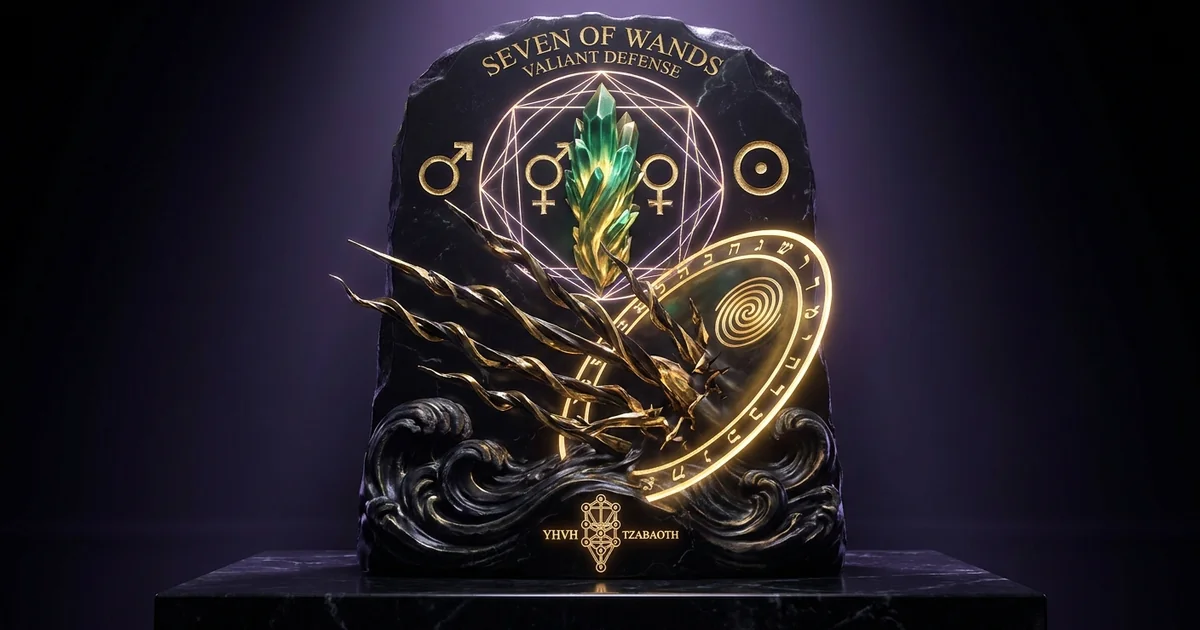
Seven of Wands: Valiant Defense and Spiritual Courage
Archetypal Thesis & Systemic Paradigm: The Thermodynamics of Valour
The Seven of Wands represents the systemic crisis of sustained individuation. Within the symbolic architecture of Hermetic Qabalah and analytical psychology, this card does not signify random misfortune or external persecution; rather, it denotes the precise moment an emergent conscious agency encounters the structural friction generated by its own differentiation. Having achieved harmonious recognition in the central solar equilibrium of the Six of Wands, the volitional impulse of the wands suit descends across the Abyss of the Middle Pillar, landing precipitously in the seventh sephira: Netzach.
The seven of wands tarot meaning encodes an ontological shift. The descent of the primordial fire element from the pure, unconditioned realm of Atziluth into the lower, astral-emotional sphere of Netzach forces pure spiritual intentionality to grapple with kinetic viscosity. The card crystallizes a thermodynamic truth: energy cannot express itself within a contingent medium without generating resistance. When an individual extracts their consciousness from the undifferentiated mass of the collective unconscious, the collective exerts an equal and opposite homeostatic pull. The conflict depicted upon the card’s surface is the psychic cost of maintaining an elevated coordinate against the entropic baseline of the environment.
Netzach in Atziluth: The Kinetic Viscosity of Archetypal Fire
To apprehend the structural mechanics of this card, one must examine its Qabalistic coordinates: Netzach in the archetypal world of Atziluth. Netzach, situated at the base of the Pillar of Mercy on the tree-of-life, governs victory, emotional endurance, instinctual drive, and aesthetic-kinetic force. When the undifferentiated volitional fire of Atziluth penetrates Netzach, it loses the pristine, unified coherence it possessed in Kether, Chokmah, and Tiphareth. Fire in Netzach becomes passionate, turbulent, dispersive, and intensely emotional.
This sephirotic descent induces kinetic viscosity. In the upper worlds, the Will experiences no distinction between intent and manifestation; in Atziluth-Netzach, the Will encounters the emotional astral plane as a resisting medium. The divine impulse must fight for its survival. In the system of the Hermetic Order of the Golden Dawn, this operational state is named the “Lord of Valour.” Valour is not required when triumph is effortless or structurally guaranteed; valour is the specific virtue demanded when an isolated monad is structurally outmatched by environmental inertia yet refuses to capitulate. The primal fire must sustain its internal combustion against the cooling waters of the astral matrix, transforming what was once effortless inspiration into rigorous, localized defiance.
The Crisis of Individuated Agency Against Collective Homeostasis
From the vantage point of Jungian analytical psychology, this dynamic maps onto the acute phase of individuation. In moving from the collective celebration of the Six of Wands—wherein the ego-consciousness aligns with social validation and archetypal inflation—to the solitary platform of the Seven, the psyche undergoes a painful decoupling. The ego, having claimed a spark of authentic selfhood, finds itself targeted by the homeostatic mechanisms of the collective unconscious.
The collective psyche behaves as a conservative cybernetic system; any autonomous perturbation of its equilibrium is treated as an existential pathogen. Consequently, the individual who asserts a differentiated moral, creative, or spiritual position is immediately assaulted by projections, envy, and the reactionary inertia of the group mind. The six adversary staves thrust upward from the chasm represent autonomous complexes and archetypal pressures attempting to drag the elevated consciousness back into the primordial soup of the collective shadow. Defensive crystallization becomes mandatory. If the ego yields its boundary, it suffers psychic dissolution; if it over-identifies with the struggle, it risks paranoid rigidity. The Seven of Wands is the trial of holding the perimeter of the sovereign self without succumbing to neurosis.
The Teleology of Opposition in Cybernetic Consciousness
In cybernetic terms, resistance is not an impediment to agency; it is the structural feedback mechanism that defines agency. Without systemic opposition, a boundary cannot know its own geometry. The six staves rising from below act as diagnostic probes that reveal the weaknesses, blind spots, and structural instabilities of the sovereign agent perched above.
Far from being a tragic accident, the dialectical resistance modeled in the Seven of Wands possesses an undeniable teleology: the consolidation of the Self. The adversary is a necessary evolutionary sparring partner. Without the six wands of counter-intentionality pushing against the solitary adept, the will would remain a theoretical abstraction—an inflated solar fantasy lacking material tensile strength. By parrying each localized thrust, consciousness learns the economy of force, the calibration of boundaries, and the reality of its own sovereignty.
Classical Provenance & Textual Lineage: The Genesis of the Lord of Valour
The textual genealogy of the Seven of Wands documents an evolution from abstract geomantic mechanics to an explicit dramatic portrait of existential combat. In historical European cartomancy, particularly the Tarot de Marseille tradition, the Seven of Batons was represented by a geometric matrix of interlaced floral batons: a central axis surrounded by curved, intersecting vegetative staves. This design emphasized the organic tensions of nature, growth, and elemental balance, but lacked an individualized psychological protagonist.
It was within the esoteric engine of late nineteenth-century British occultism that the card was transfigured. S. L. MacGregor Mathers and the Inner Order of the Hermetic Order of the Golden Dawn synthesized the decanic astrology of the Mediterranean with the Qabalistic tree-of-life, extracting the Seven of Wands from agricultural fatalism and framing it as an unyielding esoteric trial of spiritual stamina.
“Netzach in the Suit of Fire: Lord of Valour (Mars in Leo). Possible victory, depending on the amount of energy expended. Counter-influence, obstacles, yet courage to face them. Boldness, insolence, defiance, obstinacy. Here the fire of Leo is stirred to sudden and violent activity by the influence of Mars; it is the energy that rises to meet and overcome a multitude of adversaries.” — S. L. MacGregor Mathers, The Golden Dawn: Book ‘T’
The Golden Dawn Cipher Manuscripts and Book ‘T’
In Book ‘T’, the foundational internal curriculum of the Golden Dawn, the card is officially titled “The Lord of Valour.” Its formula was mathematically derived by assigning the seven lower sephiroth of each elemental world to the thirty-six decans of the zodiac. By allocating the third decan of Leo to Netzach in the wands suit, Mathers and his circle established an energetic collision between Mars, the cosmic principle of division and war, and Leo, the fixed sign of regal, centered solar radiation.
Book ‘T’ outlines an ambiguous operational outcome: “Possible victory, depending on the amount of energy expended.” Unlike the unmitigated triumph of the Six of Wands or the unimpeded, swift vector of the Eight of Wands, the Seven exists in an ongoing present tense of crisis. It marks a contested space. Crowley, operating directly from this Golden Dawn framework in The Book of Thoth (1944), observed that in the Seven of Wands, the original divine energy of fire has begun to lose its pristine balance: “The fire is no longer the full, balanced energy of the Sun in Leo… it has become the fierce, erratic, and desperate energy of Mars in the third decan of that sign.” For Crowley, the Seven represents a departure from the perfection of Tiphareth, a stage where the will must resort to brute martial exertion to hold its ground against degradation.
The Decanic Lore of Picatrix and Agrippan Geometry
The decanic intelligence presiding over this card traces back through Renaissance hermeticism to medieval Arabic astromagic. In the Picatrix (Ghayat al-Hakim), the third decan of Leo is depicted as an elder statesman, an armored warrior, or a man holding a drawn sword and wearing garments of authority, surrounded by wild beasts or threats that he keeps at bay through sheer vigilance.
Heinrich Cornelius Agrippa, in his De Occulta Philosophia Libri Tres (1533), formalized these images for the Western esoteric tradition. Agrippa characterizes the third face of Leo as an arena where one confronts adversity through royal dignity and martial severity:
“There ascends in the third face of Leo a man of vile stature, hairy, having in his left hand a naked sword, and in his right a shield, fierce, angry, and full of wrath… It signifieth contentious words, wrath, and fighting, but also strength, mastery, and boldness against that which is evil.”
This classical lineage shows that the core of the Seven of Wands has long been associated with the solitary champion holding a perimeter. The Agrippan synthesis explains why the figure is isolated: the third decan of Leo represents the terminus of the sign, the liminal border where fixed solar identity prepares to transition into the mutable, critical earth of Virgo. It is the twilight of sovereignty, where authority can no longer be taken for granted and must be actively defended with steel.
Waite-Smith Iconographic Mutations: The Unequal Buskins and Solitary High Ground
When Arthur Edward Waite and artist Pamela Colman Smith created their 1909 deck, they broke radically from the Marseille tradition, translating the abstract decanic lore into a narrative landscape. Waite envisioned a solitary youth poised on the edge of a craggy, elevated precipice, clutching a rough-hewn stave with both hands to beat back six rising staves thrust upward from an unseen abyss.
The seven of wands symbolism engineered by Smith introduced several vital anomalies. The defender’s footwear is asymmetrical: on his right foot he wears a laced, dark boot or buskin, while on his left foot he wears a loose, golden shoe or slipper. This detail is not an artistic accident; it is an esoteric signature of asymmetrical grounding. The right foot, associated in Qabalah with the Pillar of Mercy and active outward projection, is armored for rugged, temporal combat. The left foot, aligned with the Pillar of Severity and internal receptivity, remains loosely clad, sensitive to the subtle currents of the earth. The adept stands with one foot braced in worldly struggle and the other tethered to the fluid, intuitive conditions of the inner life.
       [ HIGH GROUND: Individual Sovereign Consciousness ]
                         \       /
                          \  |  /   <-- Single Held Wand (Unified Will)
                           \ | /
~~~~~~~~~~~~~~~~~~~~~~~~~~~~ V ~~~~~~~~~~~~~~~~~~~~~~~~~~~~
            [ PRECIPICE / PSYCHIC FAULT LINE ]
~~~~~~~~~~~~~~~~~~~~~~~~~~~~~~~~~~~~~~~~~~~~~~~~~~~~~~~~~~~
              /      /      |      \      \      \
             /      /       |       \      \      \
       [ CHASM: Six Disjointed Staves of Collective Shadow ]
The physical terrain provides a second critical symbolic dimension. The solitary combatant occupies the high ground—a green, fertile ridge separated from the viewer and the adversaries by a deep gully through which water flows. The high ground signifies verticality of consciousness: an ethical, intellectual, or spiritual perspective attained through hard-won self-awareness. The six staves below are disembodied; no hands or torsos are visible. Smith deliberately abstracts the antagonists to emphasize their status as collective, impersonal forces rather than distinct individuals. The adept is not fighting human peers; he is defending his summit against the anonymous undertow of the collective shadow.
Structural Mechanics & Symbolic Geometry: Mars in the Third Decan of Leo
The dynamic tension of the Seven of Wands is governed by its technical astrological allocation: Mars in Leo, spanning the coordinates of 20° to 30° of the fixed fire sign. This decanic matrix fuses two diametrically opposed qualities of the fire element: the fixed, centripetal, regal heat of the Sun (ruler of Leo) and the cardinal, centrifugal, disruptive heat of Mars.
- Decan: Third Decan of Leo (20°00’ to 29°59’59" Leo).
- Planetary Ruler: Mars (traditional and Golden Dawn decanic system).
- Qabalistic Sphere: Netzach (Victory / The Seventh Sephira).
- World: Atziluth (Archetypal Volition / Fire of Fire).
- Geomantic Attribution: Fortuna Minor (Lesser Fortune / Sudden externalized impetus) and Puella (Venusian aesthetic-instinctual currents of Netzach).
- Color Scale (Atziluth): Amber-gold shot with piercing emerald rays.
- Formula: Fixed Volition (Leo) challenged by Disruptive Kinetic Force (Mars) sustained through Emotional Endurance (Netzach).
Decanic Astrology: Planetary Dignity and the 20°–30° Leo Matrix
In classical astrology, Mars in Leo is an elemental match: Fire in Fire. However, the nature of this ignition is distinct. Leo is the fixed hearth of the zodiac; its operational mode is stability, sustained radiance, self-identity, and dramatic centralization. Mars, conversely, is the principle of cut, severance, kinetic rupture, and tactical aggression. When Mars occupies the third decan of Leo, it activates the latent defensiveness of the fixed sign.
Leo demands absolute sovereignty within its domain. Mars provides the tactical weaponry to defend that sovereignty against encroachment. In the 20° to 30° zone—a decan historically associated with trials, the conclusion of cycles, and the exhaustion of reserves—Mars operates not as an imperial conqueror marching outward, but as a besieged monarch defending the citadel. The native fire of Leo does not disperse; it becomes pressurized. This thermodynamic pressure produces sustained combustion: the ability to endure an attritional siege without running dry.
Qabalistic Topography: The Seventh Sphere and the Pillar of Mercy
On the tree-of-life, Netzach sits at the terminus of the right-hand Pillar of Mercy, directly beneath Chokmah (Wisdom) and Chesed (Mercy). It receives the descending lightning flash via the 24th Path of Nun (Death) from Tiphareth, or the 27th Path of Pé (The Tower) from Hod. Netzach is traditionally designated as Victory, but this Victory is not the cold, cerebral victory of an intellectual argument (Hod), nor the transcendent peace of the central Sun (Tiphareth). It is an instinctual, kinetic triumph over exhaustion.
As an un-equilibrated sephira standing opposite Hod (Splendor/Intellect), Netzach is characterized by excess. Its elemental virtue is unyielding persistence; its vice is unbridled passion and paranoia. In the Seven of Wands, Netzach’s position at the foot of the Pillar of Mercy manifests as an absolute commitment to life and self-expression. It will not permit the conscious ego to be swallowed by the cold, analytical criticisms of the Pillar of Severity. Yet, because it lacks the direct central balance of the Middle Pillar, this stance feels precarious. The figure on the cliff experiences his defense as an all-or-nothing emotional emergency.
Vector Analysis of the Seven Staves: Six Below, One Held
The geometric composition of the Seven of Wands establishes an asymmetrical vector field. A close spatial analysis reveals the mathematical and symbolic logic governing the deployment of force within the frame:
[Vector Configuration: 6-versus-1 Spatial Geometry]

Adversary Vectors:     ↑   ↑   ↑   ↑   ↑   ↑  (Six vertical thrusts from below;
                      /   /   |   |   \   \    uncoordinated, divergent angles,
                     /   /    |   |    \   \   originating from the unconscious)

Defense Vector:                \ /
                                X    (Single stave held diagonally with both hands;
                               / \    intercepts and traverses all incoming lines)
The six wands thrusting upward from the lower margin do not form a disciplined, unified phalanx. Their angles are divergent, chaotic, and uncoordinated. They represent the dispersed, unintegrated complexes of the unconscious, attacking simultaneously but without systemic unity. They are the fragmented many against the integrated one.
The seventh wand, gripped securely with both hands across the chest of the defender, acts as a transversal axis. Geometrically, a single diagonal line can intersect multiple parallel or semi-vertical lines simultaneously. The defender does not need six wands to meet six adversaries; the singular, integrated focus of a conscious will out-maneuvers dispersed opposition. The defense is holistic: one wand, wielded with focused intentionality, neutralizes the disparate energy of the six.
Psychological Dynamics & Operational Praxis: Archetypal Defense and Boundary Architecture
In clinical archetypal psychology, the seven of wands tarot meaning moves from metaphysical abstraction to concrete somatic and psychic reality. The card depicts the psychological vulnerability that follows a significant inner breakthrough. When an individual claims their authentic sovereignty—breaking free from familial scripts, ancestral curses, or collective social dogmas—they enter a liminal space. The euphoria of the Six of Wands fades, leaving the ego nakedly exposed on the newly occupied territory of the Self.
“Whenever an individual attempts to step out of the collective consensus and realize a higher degree of consciousness, the collective unconscious reacts with instantaneous jealousy. The shadow, which was previously distributed across the social environment, suddenly condenses and arrays itself against the individual. The surrounding collective feels this differentiation as an implicit insult or threat to its own lazy slumber, and it responds by hurling autonomous projections like arrows at the emerging ego.” — Marie-Louise von Franz, Shadow and Evil in Fairy Tales (1980)
The Ego-Self Axis Under Siege: Projective Identification and Mob Psychology
The psychological crisis of the Seven of Wands is the phenomenon of mass projection. When an individual differentiates themselves, the surrounding collective (whether family, institution, or social milieu) experiences the individual’s autonomy as a rejection of group cohesion. In response, the collective initiates projective identification: it projects its disowned shadow material, its moral cowardice, and its suppressed aggression directly onto the differentiated person.
The subterranean wands in Smith’s iconography represent these venomous, disembodied projections. The mob does not attack with reasoned discourse; it attacks through an instinctual swarm logic. For the individual holding the stave, the danger is twofold:
- Paranoid Projection: The individual risks projecting their own repressed aggression back onto the critics, descending into a chronic siege mentality that ossifies the psyche.
- Moral Capitulation: The individual yields to the exhausting pressure of the group, abdicating their high ground to regain social safety, which leads to psychic deflation and the death of the budding Self.
Active Imagination and the Somatics of Grounded Resistance
Operational engagement with the Seven of Wands requires cultivating an embodied boundary architecture. This card demands the somatic integration of Mars: the capacity to feel anger, assertiveness, and protective territoriality without sliding into destructive rage.
In active imagination, an individual confronting the Seven of Wands must not attempt to annihilate the six rising staves. To destroy them is to attempt the impossible: the eradication of the collective unconscious itself. Instead, the praxis consists of parrying. The stave is held diagonally, utilizing leverage, torque, and posture to redirect hostile momentum away from the core of the psyche.
This requires the integration of the asymmetrical footwear. The practitioner must stay rooted in the unarmored, open slipper of intuitive empathy while bracing the armored boot of boundary enforcement on the rock of material reality. If both feet wear armored boots, the individual calcifies into a tyrant; if both wear soft slippers, they are trampled. Valour is the conscious balancing of structural hardness with spiritual vulnerability.
Divinatory Remediation: Navigating Depletion and Hyper-Vigilance
When the Seven of Wands appears in an operational or divinatory consultation, it serves as a clinical diagnostic of psychic energy allocation. It marks a moment of severe energetic taxation. The querent is indeed under siege, but the remedy is not panic; it is the conservation of force.
       [ NEUROTIC POLARITY ]                       [ INTEGRATED VALOUR ]

    Hyper-Vigilant Paranoia                       Conscious Temenos
   (Pillar of Severity Excess)                  (Equilibrated Netzach)
                ▲                                         ▲
                │                                         │
  Exhausting, preemptive strikes;           Holds ground without advancing;
  sees enemies in every shadow;             discriminates between real and
  loss of connection to ground.             imagined threats; preserves energy.
                │                                         │
                ▼                                         ▼
    Catastrophic Capitulation                    Somatic Grounding
     (Collapse of Ego-Boundary)                (Asymmetrical Footwear)
The card warns against hyper-vigilance. Mars in Leo can easily burn through the body’s adrenal reserves, confusing hyper-vigilant anxiety with authentic vigilance. Remediation involves erecting a temenos—a sacred, consecrated perimeter around the personal life. The querent must discern which battles are necessary structural defenses of their core individuation, and which are vanity-fueled squabbles provoked by the bait of the collective shadow.
Philosophical Synthesis & Macrocosmic Correspondence: Polarity and the Crucible of Becoming
To comprehend the macrocosmic significance of the Seven of Wands, one must abandon the modern illusion that spiritual development is an ascent into frictionless peace. Across the world’s wisdom traditions, spiritual evolution is consistently modeled as an agon—a sacred, dialectical struggle through which being discovers and refines its latent potency.
Heraclitean Strife as the Ontological Ground of Unity
The philosophical ground of the Seven of Wands is found in the fragments of Heraclitus of Ephesus. Heraclitus observed that polemos (strife or war) is not an accidental failure of cosmic order, but the structural father and king of all things (Polemos panton men pater esti). The cosmos maintains its integrity not through static stasis, but through the tense equilibrium of opposing forces, exactly like the bow and the lyre (palintropos harmoniē—counter-thrusting harmony).
The Seven of Wands is the living embodiment of this counter-thrusting harmony. The solitary defender is not separate from the environment he combats; he and his adversaries constitute a single, closed energetic circuit. The adversaries push upward; he parries downward. The points of impact between the staves generate the friction that prevents the universe from collapsing into entropic heat-death. Spiritual courage is the embrace of this friction as the very medium of existence. The soul does not awaken in spite of opposition; it awakens because opposition forces it to summon its previously dormant divinity.
Comparative Archetypes: Arjuna on Kurukshetra and the Solitary Monad
The mythic parallels to this card are cross-cultural and structurally consistent. It is the archetype of the solitary champion defending a narrow pass against overwhelming odds: Horatius at the bridge; Leonidas at Thermopylae; or Arjuna poised in his chariot at Kurukshetra in the opening chapter of the Bhagavad Gita.
Arjuna’s crisis mirrors the exact threshold of the Seven of Wands. Looking across the field of battle, he sees his teachers, kinfolk, and elders arrayed against him—the very matrix of the collective world that birthed him. His initial response is moral collapse and paralysis; he drops his bow. Krishna’s instruction to Arjuna is the definitive discourse on the Seven of Wands: the warrior must act according to his swadharma (his individual soul-purpose), wielding the weapon of action without attachment to the outcome, defending the evolutionary trajectory of consciousness against the regressive claims of tradition and kinship.
Five of Wands: Strife (Geburah in Atziluth)
- Astrological Attribution: Saturn in Leo (First Decan).
- Sephirotic Locus: Geburah (Severity/Correction).
- Spatial Geometry: Symmetrical, horizontal cross-hatching of five staves; no clear ground plane; all actors on equal footing.
- Psychic Condition: Lateral, exploratory friction; ego-competition among peers; creative chaos; squandering of kinetic force.
- Resolution Vector: Requires structural ordering, establishment of rules, and clarification of hierarchy to avoid mutual exhaustion.
Seven of Wands: Valour (Netzach in Atziluth)
- Astrological Attribution: Mars in Leo (Third Decan).
- Sephirotic Locus: Netzach (Victory/Persistence).
- Spatial Geometry: Asymmetrical, vertical hierarchy; one unified stave held above, parrying six divergent staves rising from below.
- Psychic Condition: Vertical existential defense; the individual standing against the mob; maintenance of an achieved level of consciousness.
- Resolution Vector: Demands sustained endurance, moral boundaries, and tactical economy of force until the attack dissolves.
The Fire Element across the Minor Arcana Heptad
The evolutionary progression of the wands suit demonstrates how the divine will moves from initial ignition to material reality. A comparative examination of the sephirotic “Sevens” within the Minor Arcana reveals the unique integrity of the fire element when confronted with the destabilizing number Seven:
- Seven of Cups (Netzach in Briah / Water): Fire is smothered by illusion; the emotional waters of Briah disperse into daydreams, corrupting the will through fantasy and emotional dissipation.
- Seven of Swords (Netzach in Yetzirah / Air): The astral wind makes the intellect unstable, forcing the will into covert maneuver, evasion, moral ambiguity, and intellectual compromise.
- Seven of Pentacles (Netzach in Assiah / Earth): Fire is trapped in dense matter, experiencing its limit as heavy, stagnant waiting, physical fatigue, and questionable return on investment.
- Seven of Wands (Netzach in Atziluth / Fire): Fire meets Fire. Although Netzach introduces instability and crisis, the elemental synergy allows the will to transmute the destabilizing force into pure valour. It is the only Minor Arcana Seven that turns the crisis of the number into a dynamic preservation of identity.
Frequently Asked Questions: Technical and Hermetic Clarifications
Is the Conflict in the Seven of Wands Internal or External?
In Hermetic philosophy, the internal-external dichotomy is an illusion born of the lower astral senses. The Hermetic principle of correspondence—“As above, so below; as within, so without”—dictates that the subterranean staves represent both simultaneously.
Psychologically, the rising staves are disowned, autonomous complexes residing in the personal and collective shadow. Sociologically, these same complexes inevitably constellate as external critics, institutional gatekeepers, familial pressure, or competitive adversaries. The outer conflict is the physical dramatization of the inner threshold. If an adept attempts to defeat the external adversaries while ignoring the inner doubt, fear, and guilt that mirror them, the high ground will be lost. The defense must be mounted internally first, through moral clarity and psychic cohesion, which then projects outward as an unshakeable boundary in the physical world.
How Does Mars in Leo Distinguish the Seven of Wands from the Five of Wands?
While both cards belong to the suit of fire and depict multi-stave combat, their astrological and Qabalistic architectures operate on completely different systemic levels.
The Five of Wands is governed by Saturn in the first decan of Leo and resides in the sephira Geburah. It represents an unorganized, democratic, horizontal melee. In the Five, five individuals wield five staves in a chaotic contest where no one holds the high ground, no blood is drawn, and no structural hierarchy has been established. It is the exploratory friction of youth, testing limits and competing for status.
The Seven of Wands is governed by Mars in the third decan of Leo and resides in Netzach. Here, the horizontal scramble is over; an individual has already achieved the summit of personal realization. The conflict is strictly vertical. It is not an exploratory skirmish between peers, but an asymmetric, existential siege where an established sovereign authority is targeted for destruction by the lower elements. The Seven of Wands requires defensive precision, moral endurance, and unwavering spiritual courage.
What is the Operational Meaning of the Card Reversed in Consultation?
When inverted or structurally compromised in an esoteric consultation, the Seven of Wands signals a catastrophic rupture of the psychic perimeter. It diagnoses the exhaustion of the Mars-in-Leo fire, indicating that the querent has crossed the boundary from courageous defense into debilitating depletion.
Operationally, the reversal reveals:
- Ego Collapse and Capitulation: The querent is on the verge of dropping their stave, yielding their hard-won moral or spiritual position to the demands of the collective consensus due to pure psychic exhaustion.
- Pathological Paranoia: The querent is swinging wildly at phantoms, misidentifying supportive or neutral forces as adversaries, and burning through their vitality in neurotic, defensive rage.
- The Defense of an Obsolete Citadel: In specific contexts, it denotes an obstinate, ego-driven refusal to surrender a theological, intellectual, or operational stance that has become structurally sterile. The querent is defending an obsolete fortress that life is attempting to clear away for the swifter currents of the Eight of Wands.
The remediation for the reversed card is an immediate withdrawal from non-essential combat, the restoration of somatic reserves, and a radical audit of whether the ground being defended is an authentic expression of the Self or merely an entrenched monument of the shadow-ego.