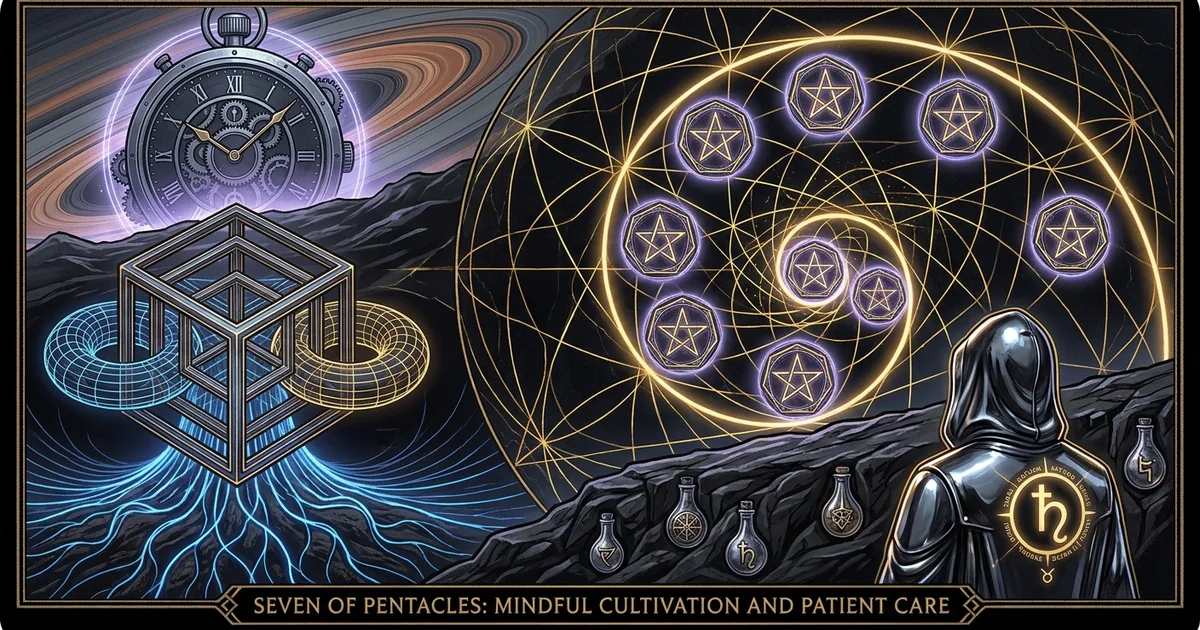
Seven of Pentacles: Mindful Cultivation and Patient Care
Archetypal Thesis & Systemic Paradigm
Netzach in Assiah: The Vegetative Dynamic within the Material Plane
Within the architecture of the Hermetic Qabalah, the Sevens across all four suits register an acute instability born of force exceeding form. In the minor arcana, the seventh Sephirah, Netzach—designating Victory, Venusian instinct, vegetative propulsion, and raw emotional stamina—descends into the fourth world of Assiah, the realm of physical action, chemical fixation, and dense materialization. This structural juxtaposition generates an immediate energetic friction. Netzach represents the uninhibited surge of biological life, the autonomic drive that compels cells to divide and flora to breach the crust of the earth. Assiah, conversely, represents the final thermodynamic sink of the cosmos: matter governed by inertia, entropy, and spatial resistance.
When the dynamic vegetative vitality of Netzach impacts the dense inertia of Assiah, kinetic progression decelerates into a state of structural suspense. The result is the Seven of Pentacles, an archetypal coordinate wherein the fiery impulse of vegetative life must submit to the gravitational drag of physical mechanics. On the Tree of Life, Netzach stands at the base of the Pillar of Mercy, directly balancing Hod (Intellect/Form) and receiving the lightning flash down through Tiphareth. Yet without the direct structural containment of Hod, Netzach’s raw life-drive risks uninhibited dissipation unless anchored into the physical grid of Malkuth through the crucible of Assiah. In this operational zone, physical labor cannot be hurried through sheer psychological volition. The vegetative dynamic operates according to autonomous enzymatic and metabolic parameters that remain wholly impervious to human urgency, demanding that kinetic manipulation yield to somatic receptivity and biological endurance.
The structural blueprint of the Seven of Pentacles operates at the systemic confluence of the 7th Sephirah (Netzach: Victory, instinctive vegetative force, Venusian polarity) projected into the World of Assiah (the Material Plane of Making and Physical Effect). This Qabalistic coordinate is assigned directly to the third decan of Taurus (20°00’ to 29°59’ Fixed Earth), ruled astrologically by Saturn. The resultant matrix synthesizes Venusian organic proliferation with Saturnian temporal restriction, requiring conscious labor to submit to the chronometric laws of matter.
The Dialectic of Telos and Biological Gestation
The seven of pentacles tarot meaning fundamentally establishes an anti-Promethean paradigm. The Promethean posture—the core mythos animating industrial modernity—presupposes that nature is an inert, passive canvas upon which human consciousness projects its sovereign telos through mechanical intervention and kinetic dominance. Under the aegis of the pentacles suit, however, human agency is decentered. The archetype exposes the operational limits of willful imposition: human beings do not grow crops; plants grow themselves, drawing upon an endogenous biological teleology that humanity can only steward, protect, and observe.
This epistemological realization reframes fallow periods and vegetative suspension not as systemic failure, but as an absolute metabolic necessity. In the vegetative cycle, growth does not follow a linear, exponential trajectory. It adheres instead to a non-linear, rhythmic pulsation marked by prolonged phases of subterranean chemical reorganization, invisible root expansion, and cellular stabilization. When the cultivator attempts to accelerate this process, the systemic integrity of the crop collapses. The Seven of Pentacles forces the observing consciousness to acknowledge that the autonomous tempo of the natural world cannot be bypassed. The earth element demands an alignment of human intention with seasonal macrocosms, asserting that waiting is not the absence of work, but the foundational matrix of true gestation.
The Epistemological Shift: From Active Manipulation to Observational Vigilance
At this specific juncture within the decanic sequence, the practitioner experiences a critical epistemological pivot. The energetic expenditure shifts definitively from the realm of active physical manipulation to that of observational vigilance. In the preceding cards of the suit, human labor was actively engaged in foundation building, raw acquisition, or structural maintenance. In the Seven of Pentacles, every requisite physical intervention has already been executed: the soil has been tilled, the furrow dug, the seed deposited, and the irrigation channels cut. Further intervention at this juncture ceases to yield positive thermodynamic value; it becomes counterproductive.
The archetype functions as an operative feedback mechanism, alerting the practitioner to the severe diminishing returns of hyper-vigilant interference. Constantly unearthing the seed to measure germination disrupts the micro-ecological matrix necessary for cellular stabilization. The cultivator’s duty shifts from that of an intrusive technician to an objective auditor of organic viability. This mode of perception requires an internal discipline far more demanding than simple manual exertion: the capacity to endure the acute psychological tension of the intervening silence, sustaining an unbroken field of mindful attention over an unyielding material process.
Classical Provenance & Textual Lineage
The Golden Dawn Cipher Manuscripts and the ‘Lord of Success Unfulfilled’
The classical hermetic title of the Seven of Pentacles within the operational curriculum of the Hermetic Order of the Golden Dawn is the “Lord of Success Unfulfilled.” Originally transcribed from the Cipher Manuscripts and formalized by Samuel Liddell MacGregor Mathers in his 1888 treatise The Tarot: Its Occult Signification, Use in Fortune-Telling, and Method of Play, this nomenclature has frequently been misinterpreted as an omen of failure, abortive labor, or ultimate disappointment. This pessimistic reading, however, misconstrues the esoteric vocabulary of nineteenth-century occult cosmology.
“The Seven of Disks or Pentacles: Lord of Success Unfulfilled. Netzach of Heh (final). Taurus, 3rd Decan. Saturn in Taurus. The card represents a young man resting upon his spade and looking down upon seven pentacles arranged upon a leafy bush, one upon the ground. It denotes cultivation, labor, work undertaken, yet yield delayed; the suspension of the harvest prior to its ripening; the necessity of patience and the testing of material stability under the presidency of the angel Asmodel.” — S. L. MacGregor Mathers, The Tarot (1888); Golden Dawn Flying Rolls and Rituals of the Grade of Philosophus.
Within the Golden Dawn system, “unfulfilled” denotes an index of incomplete temporal incubation rather than structural ruin. It signifies that the physical manifestation is halfway across the threshold of actualization: the energetic capital has been successfully committed, the form is functionally viable, yet the cycle has not intersected with the appointed hour of harvest. Aleister Crowley, drafting The Book of Thoth (1944), pushed this designation to its catastrophic extreme by titling the card “Failure,” arguing that Saturn’s ingress into the nocturnal sign of Taurus produces a mechanical deadweight that calcifies vegetative force into complete lethargy. Yet Mathers and the authentic Golden Dawn lineage preserved a more nuanced ontological framework. The card marks an inflection point where success is structurally imminent, contingent upon the operator’s capacity to refrain from premature consumption.
Iconographic Transmutation: From Marseille Pips to the Smith-Waite Agrarian Pastoral
Prior to the artistic revolution engineered by Arthur Edward Waite and Pamela Colman Smith in 1909, the card’s visual lineage in the continental tradition—crystallized in the Tarot de Marseille—relied entirely upon abstract geometric pip arrangements. In the Marseille pattern, the Seven of Deniers (Pentacles) displayed seven geometric coins interwoven with sinuous acanthus leaves, emphasizing the formal mathematical division of five coins clustered in a dynamic cross flanked by two balancing nodes. These abstract geometries mirrored cosmic law but largely obscured the subjective human experience within the material plane.
Smith fundamentally disrupted this continental orthodoxy by transmuting the pip into an agrarian pastoral narrative. In the iconic Smith-Waite rendering, an exhausted yet attentive laborer stands motionless in a fertile garden. He rests his physical weight upon a long-handled agricultural tool—a spade or mattock—while his contemplative gaze fixes upon a heavy, vine-laden bush bearing six golden pentacles, with a seventh coin resting singularly on the loam beneath his boots. By introducing this agrarian archetype, Smith visually translated the esoteric concept of the Sabbath pause into exoteric human consciousness. She situated the card within the physical lineage of terrestrial husbandry, turning what was once a mere diagram of elemental geometry into a profound psychological inquiry into labor, fatigue, and the existential weight of expectant waiting.
Marseille Tradition (Abstract Geometric Pip)
  │
  ├─ Mathematical balance of forces
  └─ Obscured human-phenomenological experience
  │
  ▼
Golden Dawn Hermetic Re-evaluation (1888)
  │
  ├─ Title: "Lord of Success Unfulfilled"
  └─ Decanic integration: Saturn in Taurus
  │
  ▼
Smith-Waite Pastoral Synthesis (1909)
  │
  ├─ Laborer resting on mattock
  ├─ 6 Pentacles suspended on vine / 1 on ground
  └─ Integration of the Sabbath pause and somatic vigilance
Agrippan Decanic Cosmology: Saturnian Ingress into the House of Venus
The structural logic governing the seven of pentacles symbolism finds its historical and cosmological antecedents in Heinrich Cornelius Agrippa’s Three Books of Occult Philosophy (1533). Agrippa, drawing upon the Hellenistic decanic lineages preserved by Claudius Ptolemy in the Tetrabiblos and the Arabic transmissions of Abu Ma’shar and the Picatrix, assigned the third face of Taurus to the dominion of Saturn. Agrippa describes this decan as an emissary of arduous exertion, physical labor, the clearing of stone from stubborn soil, and the slow, grueling construction of fortifications.
This decan establishes an unnatural energetic collision: Saturn, the principle of contraction, coldness, scarcity, and chronological decay, enters the nocturnal, fixed-earth domicile of Venus, the principle of cohesion, moist organic proliferation, and visceral luxury. The moist, life-giving fertility of Taurus is subjected to the freezing, crystallizing gaze of the Greater Malefic. This cosmological friction strips Taurus of its hedonistic ease, converting its abundant physical fertility into a grueling school of discipline. The agrarian landscape depicted by Smith reflects this Agrippan reality: the earth is fertile, yet it demands unsparing physical tribute and offers no immediate reward until Saturn’s chronological toll has been fully extracted.
Structural Mechanics & Symbolic Geometry
Decanic Astrometry: Saturn in Taurus (20° to 30° Fixed Earth)
Astrometrically, the Seven of Pentacles occupies the final decan of Taurus, spanning from precisely 20°00’ to 29°59’ of the Fixed Earth sector of the zodiac. Ptolemy notes in the Tetrabiblos that the decans serve as qualitative modifiers of planetary energetic expressions, acting as specific environmental contexts where planets display either heightened dignity or structural friction. When analyzing the Saturn in Taurus transit, one observes the cosmic archetype of boundary and bone descending directly into the muscular tissue of the bull.
Seven of Pentacles (Saturn in Taurus)
- Decanic Alignment: 3rd Decan of Taurus (20°–30° Fixed Earth).
- Operative Mode: Deliberative suspension, contemplative pause, bio-mechanical conservation.
- Hermetic Title: Lord of Success Unfulfilled.
- Systemic Mechanism: Gestation within the soil; submission to non-linear chronobiology; qualitative non-intervention.
- Thermodynamic Flow: Latent energy; zero mechanical work performed; observation of metabolic stabilization.
Eight of Pentacles (Sun in Virgo)
- Decanic Alignment: 1st Decan of Virgo (0°–10° Mutable Earth).
- Operative Mode: Kinetic iteration, meticulous repetitive labor, artisanal precision.
- Hermetic Title: Lord of Prudence.
- Systemic Mechanism: Active fabrication; conscious shaping of matter; hyper-vigilant micro-calibration.
- Thermodynamic Flow: Continuous kinetic output; energy applied to substrate via iterative technique; tangible artifacts generated.
This astrological geometry explains the profound heaviness native to the card’s atmosphere. Taurus is a sign of continuous somatic continuity; it resists sudden alteration, favoring the steady accrual of substance. Saturn, meanwhile, imposes temporal debt, audit, and structural contraction. When Saturn operates within Fixed Earth, time ceases to be a progressive, flowing river; it condenses into the dense consistency of wet clay. Every development must be paid for in the currency of chronometric patience. The card marks that precise stage in any endeavor where progress slows to an imperceptible crawl, confronting the ego with the cold, immovable reality of physical limitation.
The Geometry of Six Plus One: Energetic Investment versus Evaluative Distance
The numerical and spatial arrangement of the seven pentacles on the Smith-Waite card reveals a deliberate, asymmetrical sacred geometry. Six of the golden pentacles are woven inextricably into the biological matrix of the vine itself, while a solitary seventh pentacle rests isolated on the dirt, situated precisely between the cultivator’s feet and the tip of his mattock. This configuration is not artistic caprice; it mirrors the cosmic geometry of the Tree of Life descending into matter.
The six pentacles embedded within the foliage represent the realm of Tiphareth—the solar center of balance, harmony, and integrated past investment. These six coins denote the work that has already been executed, crystallized, and surrendered to the morphogenetic field. They are structural assets embedded within the living ecosystem; they can no longer be retrieved, spent, or modified. They represent sunk energy, fixed capital, and systemic momentum.
   [ Vine Foliage: The Six Pentacles of Past Labor ]
          (●)       (●)       (●)
               (●)       (●)
                    (●)
                     │
      [ Ground Plane: Loam and Roots ]
                     │
   Cultivator's Mattock ─── [ (●) The Seventh Pentacle ]
                                 (Free Capital / Tactical Reserve)
Conversely, the solitary seventh pentacle lying at the laborer’s feet denotes the present moment of tactical consciousness. It is the uncommitted resource, the free seed-capital, or the immediate harvest of the current cycle. Because it rests upon the earth, detached from the vegetative mass, it signifies the choice that confronts the cultivator: Does one consume this initial yield to sustain current metabolic needs, or does one retain it as seed for the subsequent evolutionary cycle? The distance between the six coins in the bush and the single coin on the ground establishes an evaluative space, forcing the consciousness to weigh the total energetic yield against the ultimate expenditure of life force.
The Mattock as Axis Mundi: Somatic Grounding and Thermodynamic Conservation
The postural mechanics of the agrarian laborer constitute one of the most vital visual treatises on somatic grounding in Western esotericism. The figure does not stand erect in a posture of triumph, nor does he recline in sleep. Instead, his body forms a triangle with the earth, his two arms crossed over the wooden handle of the mattock, his chin or torso resting upon his forearms. The tool of labor has ceased to be an instrument of violent terrestrial disruption; it has been transformed into a weight-bearing axis, a localized axis mundi anchoring the human nervous system into the electromagnetic field of the planet.
This posture signifies the conscious embrace of thermodynamic conservation. In thermodynamics, doing work requires an energetic gradient; continuous output without rest causes mechanical exhaustion and systemic breakdown. By leaning upon the mattock, the laborer drops his metabolic rate, grounding his physical core into the soil. The energetic current ceases to flow outwardly into manual labor and turns inward, circulating through the muscular skeletal system as restorative stamina. The mattock connects the laborer’s physical body directly to the subterranean root system of the crop. He is not separate from the garden; he has become an organic extension of its seasonal metabolism, waiting in thermodynamic equilibrium until the natural order signals the resumption of kinetic activity.
Psychological Dynamics & Operational Praxis
Analytical Psychology: The Maturation of the Transcendent Function in Material Life
Interpreted through the framework of Jungian analytical psychology, the Seven of Pentacles represents an essential milestone in the individuation process: the ego’s confrontation with, and submission to, the autonomous developmental tempo of the unconscious. In modern psychological development, the conscious ego habitually identifies with the masculine principle of conscious direction (Logos), assuming that any psychic complex, emotional blockage, or creative endeavor can be forcefully resolved through active cognitive intervention.
The Seven of Pentacles represents the activation of what C.G. Jung termed the transcendent function within the context of concrete reality. The transcendent function does not operate through the supremacy of conscious will over unconscious content; it emerges precisely when the ego acknowledges its complete inability to manufacture a psychological synthesis through forced rationalization. The ego is forced into a state of watchful passivity, standing before the unconscious and bearing the severe tension of unresolved opposites. Just as the laborer cannot force the blossom into fruit, the individual cannot force a psychological complex into premature resolution. The card demands that the individual cultivate an ego-state that can coexist with psychic latency, allowing deep compensatory archetypal images to gestate, organize, and emerge in their own autonomous season.
“In studying the archetypal foundations of divination systems and synchronicity, one observes that time is not a uniform, quantitative continuum, but a qualitatively differentiated field. There is a right moment—the ancient Greek Kairos—for a psychic or physical content to emerge into manifestation. When we force a development before its qualitative index has struck, we do not produce life; we produce an abortion of the archetype. The art of wisdom consists in waiting upon the organic maturation of the unconscious constellation, tolerating the fallow state until the energy crosses the threshold of its own accord.” — Marie-Louise von Franz, On Divination and Synchronicity: The Psychology of Meaningful Chance (1980), pp. 42–44.
Metabolizing the Frustration of Delayed Gratification
A central psychological pathology of the contemporary ego is the inability to metabolize the acute frustration inherent in delayed gratification. Conditioned by algorithmic immediacy, hyper-industrial feedback systems, and instantaneous information retrieval, the modern psyche experiences any interval of silence, gestation, or latency as an existential threat. In therapeutic practice, this neurosis manifests as chronic premature harvesting: individuals repeatedly initiate creative projects, interpersonal relationships, or therapeutic processes, only to abandon or violently uproot them the moment the immediate surge of dopamine subsides.
The Seven of Pentacles functions as an indispensable ego-corrective against this psychodynamic defect. It demands cognitive defusion from immediate sensory reinforcement. To endure the Seven of Pentacles requires that the individual develop a high tolerance for ambiguity and subterranean obscurity. The psyche must learn to distinguish between terminal dormancy (death) and developmental dormancy (incubation). This metabolic transition requires the individual to sit alongside their own unactualized potential without collapsing into panic, recognizing that the most structurally durable realignments within human character are precisely those that occur silently, beneath the threshold of conscious awareness, over protracted durations of linear time.
The Shadow Archetype: Agribusiness Exploitation versus Paralytic Neglect
When the archetypal energy of the Seven of Pentacles is repressed, pathologized, or inverted, it fractures into two polarized shadow manifestations, both rooted in a catastrophic refusal to engage the qualitative reality of organic time.
[ THE SYSTEMIC MEAN: MINDFUL CULTIVATION ]
          Vigilant stewardship / Balanced non-intervention
                       │
       ┌───────────────┴───────────────┐
       ▼                               ▼
[ THE ACTIVE SHADOW ]         [ THE PASSIVE SHADOW ]
Hyper-Vigilant Agribusiness     Paralytic Resignation
- Premature harvesting        - Abulia and systemic rot
- Forcible over-tilling       - Willful avoidance of labor
- Soil exhaustion             - Depleted, choked roots
The active shadow manifests as what can be termed the neurosis of agribusiness exploitation. In this state, the ego is seized by a manic anxiety regarding productivity. Terrified of stillness, the individual hyper-manages the environment: they constantly probe the ground, inject synthetic stimulants into the process, over-till the soil, and attempt to force the crop into immediate monetization. This active shadow invariably leads to soil exhaustion, catastrophic burnout, and the premature termination of viable systemic projects. It is the pathology of stripping an ecosystem of its long-term fertility to manufacture a short-term statistical illusion of progress.
The passive shadow, inversely, manifests as paralytic neglect or depressive abulia. Conflating patient waiting with complete abandonment, the individual slips into fatalistic resignation. Convinced that their labor will never yield an adequate return, they throw down the mattock and walk away from the garden entirely. Under this pathology, the untended vine is quickly invaded by parasites, the irrigation ditches collapse into silt, and the pentacles—once laden with potential—are strangled by weeds and rot upon the stem. The shadow here lies in utilizing the concept of “divine timing” or “patience” as a psychological rationalization for cowardice, avoidance of necessary labor, and a refusal to steward the material conditions of existence.
Philosophical Synthesis & Macrocosmic Correspondence
Hermetic Cybernetics: Feedback Loops in Self-Organizing Systems
Viewed through the lens of modern systems theory and Hermetic cybernetics, the Seven of Pentacles serves as a sophisticated visual model of a self-organizing system operating through second-order cybernetic feedback loops. In classical first-order cybernetics, an external operator manipulates an objective machine to produce a desired output. In second-order cybernetics, pioneered by theorists such as Heinz von Foerster, the observer is explicitly understood to be an internal, constitutive component of the system being observed.
The cultivator in the Seven of Pentacles is not an external architect imposing a rigid Euclidean geometry upon nature; he is a biological node embedded within an autopoietic ecological circuit. His contemplative stance marks the phase in cybernetic regulation where input must drop to zero so that the system can process information and achieve structural homeodynamics. If the cultivator continues to introduce energetic perturbations into the field, the system is prevented from stabilizing, precipitating runaway entropy. The card illustrates the systemic threshold where the optimal control strategy is non-action (wu wei), demonstrating that observing, auditing, and processing environmental feedback is itself the highest form of systemic regulation.
The Alchemical Fermentation: The Putrefaction of the Seed before Sprouting
Within the Western alchemical tradition, the Seven of Pentacles corresponds precisely to the critical liminal territory separating Coagulatio from Putrefactio and Fermentatio. In the stage of Coagulatio, the volatile spirit is fixed, crystallized, and drawn down into the solid, heavy matter of the physical vehicle (the mineral body of Assiah). Yet once matter is coagulated, it cannot evolve further in its current crystalline state; it remains rigid, brittle, and barren.
   [ Coagulatio ] ──> Dense materialization & physical fixation
         │
         ▼
[ Seven of Pentacles ] ──> Liminal suspension in the dark earth
         │
         ▼
  [ Putrefactio ] ──> Autolytic cellular dissolution of the seed
         │
         ▼
  [ Fermentatio ] ──> Alchemical rebirth: the spiritual sprout
To release the trapped solar essence within the seed, the form must undergo Putrefactio—a silent, dark, autolytic decay within the moist bowels of the earth. The seed coat must physically soften, rot, and disintegrate. To an uninitiated observer, this phase resembles nothing less than death and irreversible decomposition. The Seven of Pentacles is the visual icon of this alchemical threshold. The laborer stands above the soil, bearing witness to a process wherein life appears entirely suspended, yet within the subterranean darkness, the enzyme of Fermentatio is quietly constellating the ultimate resurrection of the gold.
Macrocosmic Cycles: Agriculture as the Mirror of Celestial Harmonics
On the macrocosmic scale, the Seven of Pentacles anchors the realization that human agriculture is the primary technological mirror of celestial harmonics. The movements of the agrarian laborer do not originate in isolated subjective desire; they are direct responses to the orbital mechanics of the cosmos—the precession of equinoxes, the synodic cycles of the planets, and the seasonal thermic oscillations of the sun. The agrarian cycle is applied Hermeticism: as above, so below.
This realization establishes that every evolutionary system requires mandatory intervals of zero entropy-generation to preserve its long-term operational viability. The biblical concept of the Shmita—the sabbatical year commanded in Levitical law, wherein agricultural land must lie fallow every seventh year—is the societal codification of this cosmic law. In this structural paradigm, continuous extraction is recognized as a fundamental violation of ecological and metaphysical mechanics. The Seven of Pentacles serves as a structural sanctuary within the minor arcana, declaring that without the sacred boundary of the fallow period, the earth withers, the soil turns to dust, and the civilizational harvest collapses into absolute ruin.
Frequently Asked Questions
Resolving the Paradox of ‘Success Unfulfilled’
The classical Golden Dawn moniker, “Lord of Success Unfulfilled,” continues to provoke confusion among contemporary students of the tarot, who frequently interpret the phrase as an omen of disappointment, truncated effort, or total collapse. To resolve this semantic paradox, one must deconstruct the card’s internal mechanics through the lens of esoteric chronometry.
The title does not designate a negative terminal outcome; rather, it delineates an unconsummated developmental stage within an otherwise successful operational cycle. “Unfulfilled” indicates that the energetic investment has been completely successful in establishing the structural scaffolding of the work, but the process has arrived at a natural developmental pause prior to the final crystallization of the harvest. The labor has succeeded in bringing the organism to the absolute threshold of fruiting, yet the temporal index required for ripening has not yet aligned.
When this card presents itself in an analytical consultation, it indicates that the querent’s anxiety stems not from an objective flaw in their architecture or methodology, but from an infantile demand for chronological compression. The “unfulfillment” is a warning against premature foreclosure: if the operator demands an immediate return on investment at this specific coordinate, they will transform a nascent success into an actualized failure by severing the fruit while it remains acidic, unripe, and toxic to the system.
Differentiating the Seven of Pentacles from the Four of Swords and Hanged Man
Within the tarot matrix, several cards represent pauses, suspensions of kinetic energy, or intervals of non-action. The practitioner must maintain rigorous operational distinctions between the Seven of Pentacles, the Four of Swords, and the Major Arcana’s Key XII, The Hanged Man, to ensure diagnostic precision.
The Four of Swords operates within the element of Air (Yetzirah). Its cessation is an intellectual sanctuary, a clinical convalescence designed to preserve mental coherence and prevent the nervous system from collapsing under psychic combat. The knight lies entombed within a sacred space, withdrawing his cognitive faculties from the arena of dialectical conflict to realign his logic.
The Hanged Man, belonging to the elemental path of Water (Mem/Briah), represents a voluntary metaphysical ego-inversion. His suspension is spiritual and sacrificial: the personality surrenders its sovereign agency, hanging suspended between heaven and earth to achieve a profound psychological metanoia, trading mundane orientation for transcendent illumination.
The Seven of Pentacles, by contrast, is anchored entirely within the somatic, agricultural substrate of Earth (Assiah). There is neither the intellectual sanctuary of the Swords nor the mystical inversion of Key XII. The laborer remains standing in the mud, muscularly engaged, holding the physical instrument of his labor, looking directly at the material reality of his investment. The suspension is not an escape from matter, but a total, grounded immersion within the biological laws of matter itself. The work is not abandoned; it is merely resting in the ground.
Four of Swords (Air)      --> Mental convalescence & intellectual withdrawal
The Hanged Man (Water)    --> Spiritual ego-inversion & sacrificial surrender
Seven of Pentacles (Earth) --> Biological dormancy, somatic patience & grounded stewardship
Navigating the Tension Between Abandoning a Depleted Project and Enduring Dormancy
A central interpretive challenge posed by the Seven of Pentacles lies in discerning whether an enterprise is merely experiencing the natural dormancy of a gestation cycle or whether it has degenerated into an energetic dead-end that demands immediate liquidation. Navigating this tension requires an objective diagnostic audit of the living system, setting aside the neurotic distortions of wishful thinking and the sunk cost fallacy.
To determine the true ontological condition of the endeavor, the practitioner must analyze the relationship between the laborer, the tool, and the vine depicted within the card’s visual architecture:
- Examine the Root Matrix: Is the underlying systemic structure fundamentally healthy, anchored, and capable of nutrient uptake? If the core mechanism of the project, relationship, or psychological process possesses structural integrity, the lack of immediate outward progress is merely decanic dormancy dictated by the Saturn in Taurus dynamic.
- Audit the Seven Pentacles: Are the six pentacles on the vine showing signs of cellular expansion and vitality, or are they shriveling, graying, and rotting upon the vine? The card requires an unemotional calculation of actual yield versus metabolic burn rate.
- Inspect the Seventh Coin: The solitary pentacle at the cultivator’s feet represents the pragmatic alternative: the capacity to take one’s remaining liquid resources, pivot away from an exhausted plot of land, and begin clearing fresh soil elsewhere.
If the vine is alive, the instruction is an unwavering, stoic patience; if the vine is structurally dead, continuing to stand over it with a mattock is no longer mindful cultivation, but a morbid, melancholic attachment to an agricultural corpse. The Seven of Pentacles demands pragmatic assessment of physical root vitality over sentimental attachment to an idealized yield.