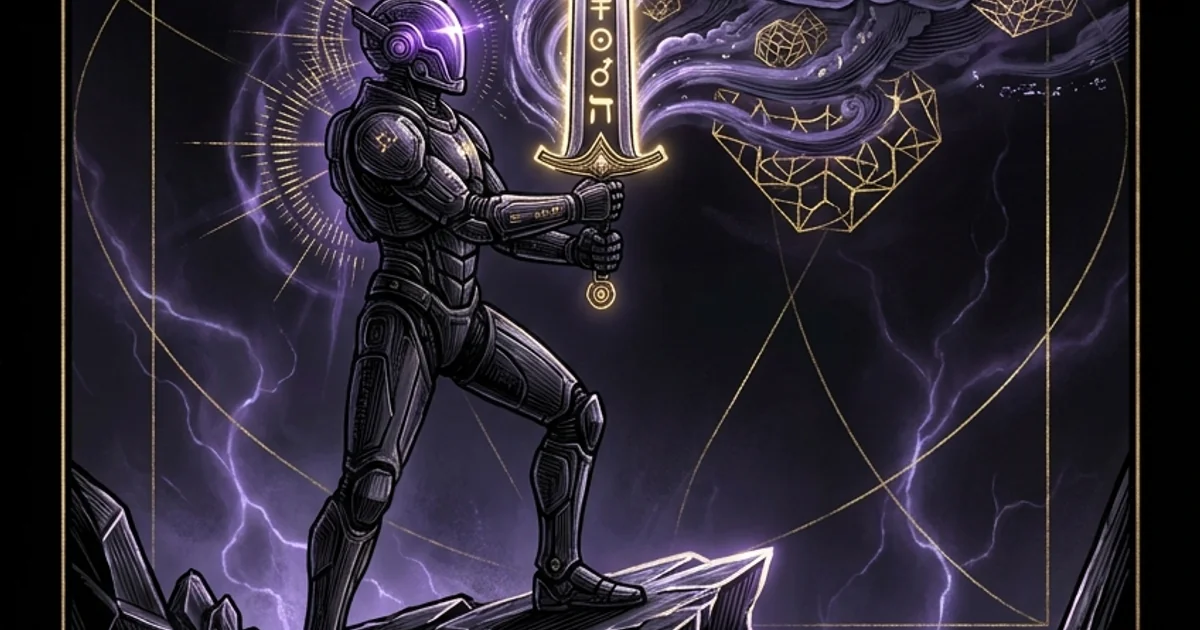
Page of Swords: Inquisitive Intellect and Alert Vigilance
Archetypal Thesis & Systemic Paradigm: The Nascent Wind of Discernment
Within the taxonomic architecture of the Western Mystery Tradition, the Page of Swords constitutes the elemental manifestation of Earth of Air. This designation establishes a precise metaphysical cross-quarter: the fixation, coagulation, and grounding of the volatile, highly dispersed medium of gaseous atmosphere into a defined, material locus. Within esoteric cartography, cards representing the court are not static personality portraits; rather, as demonstrated within the systemic framework of the court cards system, they embody dynamic intersections of elemental forces acting within specific spheres of consciousness. To evaluate the Page of Swords solely through the lens of vulgar fortune-telling—as an arbitrary herald of petty gossip, domestic surveillance, or juvenile malice—is to misunderstand the mechanical and psycho-spiritual operations of the suit of swords. The archetype governs the critical threshold where pre-cognitive energetic flux is apprehended by discursive awareness, subjected to rigorous diagnostic parsing, and weaponized as systemic vigilance.
                  YETZIRAH (The Formative World / Air)
                                 │
                                 ▼
                     Discursive Consciousness
                                 │
                  MALKUTH (The Earthy Manifestation)
                                 │
                                 ▼
              [ Page of Swords: Earth of Air ]
Malkuth in Yetzirah: The Earthy Part of Air
The Qabalistic placement of the Page of Swords positions this card as the direct expression of Malkuth within the Formative World of Yetzirah. In classical Hermetic cosmology, Yetzirah represents the psychic, astral substrate wherein raw archetypal intentions (originating in Atziluth and stepped down through Briah) assume structural, geometric lineaments before crystallizing into physical manifestation. Air (Ruach) is the reigning elemental current of this world, operating as discursive thought, communicative exchange, linguistic codification, and intellectual distinction. Yet, when this fluid, inherently expanding medium encounters the stabilizing inertia of Malkuth—the final Heh (ה) of the divine name Tetragrammaton (יהוה)—its velocity is abruptly arrested.
This sub-elemental friction generates a profound cognitive compression. The Page of Swords is not the sweeping, celestial wind of the archangels, nor the torrential gale of intellectual revolution; it is the micro-climate of the mind, the localized gust that kicks up dust, tests structural perimeters, and inspects the integrity of immediate forms. Heinrich Cornelius Agrippa, in Book II of De Occulta Philosophia Libri Tres (1533), notes that while Air in its celestial condition is ungraspable and generative of life, its terrestrial admixture becomes sharp, penetrative, and bound to tangible sensation. The Malkuthian attribution demands that ideas cease to exist as untethered abstractions. They must be grounded in physical metrics, empirical validation, and immediate tactical awareness. Consequently, the Page of Swords embodies the empirical impulse within the human psyche: the mandate to verify mental constructs against objective reality.
The Page of Swords operationalizes the Heh final (ה) of the Tetragrammaton within the Yetziratic sphere. While Yetzirah corresponds macrocosmically to the Vau (ו) and the mental plane, the Page represents the terminal grounding point within that plane. Thus, Earth of Air indicates the materialization of mental force: the moment an abstract thought becomes a distinct phrase, an ambient suspicion crystallizes into an evidentiary investigation, or atmospheric pressure condenses into an observable weather pattern.
Discursive Intellect as an Immunological Sentry
Epistemologically, the Page of Swords represents the nascent awakening of critical consciousness operating as an internal immunological defense mechanism. Before the ego-complex can achieve the synthetic wisdom of the Queen or the commanding strategic authority of the King, it must develop an operational perimeter defense. The nascent intellect must separate the “I” from the “Not-I,” isolating the internal self from invasive psychical projections, social gaslighting, and the deceptive glamour of the unexamined unconscious.
In this capacity, the archetype functions as a psycho-cybernetic sentry. It scans the cognitive perimeter, monitoring sensory and semantic inputs for errors, anomalies, and structural threats. Rather than accepting environmental data passively, the Page interrogates the incoming signal. It refuses to conflate sentimentality with truth; it demands identification, clarification, and validation. In the developmental trajectory of human cognition, this corresponds to that vital developmental phase where an individual discovers the operational utility of negation—the power of saying “No,” of asking “Why?”, and of exposing contradictions within the surrounding environment. The fundamental page of swords tarot meaning centers on this acute, unsparing scrutiny: the intellectual apparatus functioning as an alert, diagnostic instrument that shields the psyche from psychic entropy and uncritical absorption of external dogmas.
The State-Space Transition from Sensation to Mental Representation
To rigorously conceptualize this archetype, one must analyze the state-space transition between pure sensory perception and organized mental representation. In raw animal awareness, an environmental perturbation—such as the snap of a twig or a sudden drop in barometric pressure—triggers an unmediated physiological reflex. However, the Page of Swords signifies the exact micro-second where that physiological perturbation is halted and converted into an epistemic inquiry. The sensory data is held in suspense while the analytical blade of the intellect dissects it into component variables: distance, trajectory, velocity, intent, and structural impact.
This transition marks the emergence of the conscious observer. The intellect creates a necessary distance between subject and object. By decoupling immediate affective reaction from environmental stimulus, the Page constructs a mental theater wherein scenarios can be modeled, anticipated, and preempted. The air element here acts as the medium of representation, while the earth element provides the fixed coordinate system upon which that representation is mapped. This dynamic transforms a reactive organism into a vigilant, inquiring intelligence capable of strategic environmental reconnaissance.
Classical Provenance & Textual Lineage: Evolution from GD Cyphers to Smith-Waite Iconography
The interpretive history of the Page of Swords reveals an evolutionary refinement from esoteric heraldry to psycho-symbolic realism. In the historical transition from continental Tarot systems—where the Valet de Épées often denoted a simple military scout, attendant, or domestic spy—to the esoteric synthesis of the late nineteenth and early twentieth centuries, the card underwent a radical dimensional expansion. The Hermetic Order of the Golden Dawn systematically re-engineered these cards from rudimentary divinatory keys into precise cosmic and psychological coordinates, renaming the Page of Swords the “Princess of the Rushing Winds; the Lotus of the Palace of Air.”
Traditional Continental Tarot ──────► Golden Dawn Reformation ──────► Modern Archetypal Engine
(Valet de Épées: Valet/Spy)          (Princess of Rushing Winds)        (Epistemic Scout / Sentry)
Golden Dawn Cypher Manuscripts and Crowley’s Princess of the Rushing Winds
In the Golden Dawn Cypher Manuscripts, and subsequently in S. L. MacGregor Mathers’ 1888 treatise The Tarot: Its Occult Signification, Use in Fortune-Telling, and Method of Play, the Court cards were emancipated from traditional feudal archetypes. Mathers established that the Knaves or Pages embody the elemental daughters who bring the work of the King and Queen to physical fruition. In this esoteric hierarchy, the Princess of the Swords was assigned the rulership over the third quadrant of the celestial sphere around the North Pole, governing the earthly manifestation of the mental currents.
Building upon this lineage in The Book of Thoth (1944), Aleister Crowley radically amplified this dynamic, depicting the Princess of Swords as an unyielding, amazon-like figure characterized by severe intellectual purity and sudden, kinetic violence. Crowley observed that this archetype unites the elasticity and pervasive subtlety of Air with the unyielding, definitive weight of Earth. The Princess wields her sword not to build empires, but to dismantle illusions, strike down dogmas, and clear the mental atmosphere of noxious vapors. Her vigilance is total, bordering on the ruthless, precisely because she embodies the untamed, uncorrupted severity of logic stripped of emotional appeasement.
“The Princess of Swords represents the earthy part of Air; that is, the fixation of the volatile, or the materialization of the Idea. She represents the co-heir to the kingdom, the throne of the Valkyries. Her characteristics are absolute purity, unyielding severe logic, and an extraordinary capacity for practical analysis. She is aggressive, alert, and swift to discover the weak point in any defense; her scrutiny is devastating to pretension.”
Iconographic Deconstruction of the Smith-Waite Dynamic Stance
When Arthur Edward Waite and artist Pamela Colman Smith formulated their foundational tarot deck in 1909, published alongside Waite’s The Pictorial Key to the Tarot (1911), they preserved the Golden Dawn’s underlying sub-elemental mechanics while translating them into a singular, highly expressive psychological posture. The figure in the Smith-Waite depiction does not rest comfortably in a domestic chamber, nor does he recline upon a throne; he stands braced upon an elevated, uneven crag of green earth, exposed directly to turbulent atmospheric winds.
       [ Upward/Leftward Blade Vector ]
                       ▲
                       │
             (Hyper-Alert Gaze) ◄── Torso Twists Right
                       │
              [ Counter-Poised Feet ]
             (Right: Planted / Left: Poised to Sprint)
The core physical stance depicted by Smith encapsulates an active kinematic paradox:
- The Page’s lower limbs are oriented in a running posture, weight shifted forward onto the balls of the feet as if poised for rapid, decisive flight or a sudden lateral sprint.
- Simultaneously, the upper torso and head are sharply twisted back over the shoulder, scanning the opposing horizon for approaching anomalies.
- The two-handed grip on the massive broadsword reinforces this dynamic tension: the weapon is held aloft, tilted toward the upper left, yet the eyes are riveted toward the right.
This intentional asymmetry crystallizes the state of pure cognitive vigilance. The Page embodies hyper-vigilance—not the paralyzing immobility of panic, but the spring-loaded, biomechanical alertness of an apex scout. The environment itself reinforces this instability: cumulus fractus clouds streak wildly through the cerulean vault, while waters in the lower left chop into cresting, white-capped waves. The Page is the only human figure anchored in this windswept theater, operating as a conscious lightning rod mediating between the volatile sky and the stabilizing rock.
The Blade as Scalpel: Diagnostic Weaponry in Classical Commentaries
A critical hermeneutic error in modern esoteric literature is the conflation of the Page’s weapon with an instrument of brute warfare. Waite explicitly designates the Page’s primary attributes as “surveillance, vigilance, and subtle discernment,” noting that while the youth carries an offensive blade, the demeanor is diagnostic rather than imperialistic. The double-edged sword within this esoteric grammar is fundamentally a linguistic, analytical scalpel.
In classical philosophical commentaries, such as those descending from the Platonic tradition of dividing reality through the diaeresis (collection and division), the sword acts as the instrument of precision dialectic. It distinguishes between appearance (doxa) and reality (episteme). The upright posture of the sword demonstrates that the mind is held in an active state of potential energy: the blade is unsheathed, unencumbered by the rust of complacency, and oriented vertically along the axis of cosmic order. It stands ready to cut through obscurities, bisect logical fallacies, and sever psychological enmeshments. The weapon does not strike out blindly; it creates a cleared intellectual space wherein clear perception becomes possible.
Structural Mechanics & Symbolic Geometry: Aerodynamics and Elemental Tension
The visual composition of the Page of Swords is governed by rigorous geometric and aerodynamic tensions, visually embodying the thermodynamic frictions of the sub-elements. The card does not present a stable, harmonious symmetry; instead, it is organized around off-center, intersecting vectors that visually destabilize the frame, forcing the observer’s eye to mirror the restless, scanning movements of the analytical intellect.
   Fractured Clouds / Atmospheric Shear  (Air Element)
  ─────────────────────────────────────────────────────►
          ▲                  /
          │                 /
    Vertical Blade         /   Chopping Waves / Fluid Turbulence
    Axis (Dissection)     /   (Dynamic Instability)
          │              /
          ▼             ▼
  ─────────────────────────────────────────────────────►
    Elevated Terrestrial Crag           (Malkuthian Earth)
Vector Analysis: The Upright Blade, Cresting Waves, and Fractured Clouds
The structural geometry of the card is dominated by three distinct vector fields:
- The Verticality of the Sentry: The straight line of the double-edged sword establishes a rigid, non-negotiable vertical coordinate. This axis serves as the mental datum against which all environmental turbulence is evaluated. It intersects the turbulent horizon at a sharp angle, symbolizing the intervention of human intelligence within the raw, indiscriminate forces of nature.
- The Horizontal Atmospheric Shear: Behind the Page, high-altitude wind currents are made visible through striated, fractured cloud banks (cumulus fractus). These horizontal strokes signify the unceasing flow of ideas, cultural memetics, and discursive data that permeate the social sphere.
- The Fluid Kinetic Instability: In the lower left quadrant of the card, water—traditionally the domain of the emotional, affective body—is depicted as churning and broken. This reveals an essential principle of the swords suit: where Air is volatile and intense, the emotional equilibrium of Water is disrupted. Intellect, in its nascent stage, inevitably agitates the emotional substrate, refusing to allow stagnant pools of unexamined sentiment to remain undisturbed.
The Sub-Elemental Friction: Coagulating Fluid Air through Terrestrial Rigidity
The internal philosophical tension of Earth of Air lies in the contradictory impulses of its constituent elements. Air is by definition hot and moist (in the classical Aristotelian schema), tending toward expansion, universal dissemination, and continuous motion. Earth, by contrast, is cold and dry, demanding contraction, permanence, and crystallization.
When these two elements are violently compressed within a single archetypal vessel, the result is extreme internal pressure. This sub-elemental friction prevents the Page from achieving the relaxed equilibrium found in cards governed by harmonious mixtures (such as Water of Earth in the Page of Pentacles). In the Page of Swords, the intellect is perpetually striving to pin down the wind. It catalogues, records, measures, and cross-references ambient impressions. The mind cannot rest because its terrestrial mandate requires it to construct permanent structural scaffolding out of shifting atmospheric currents. This manifests phenomenologically as acute mental inquisitiveness, an unquenchable thirst for verified facts, and a pervasive suspicion of broad, sweeping generalizations that lack physical substantiation.
Kinetic Asymmetry and Vigilant Spatial Orientation
The physical orientation of the figure highlights the necessity of multi-directional attention in complex systems. The Page looks back over his shoulder while advancing toward an unseen forward trajectory. In cybernetic terms, this represents a continuous feedback loop: the system cannot advance into new terrain without simultaneously auditing its historical trail and monitoring its rear vulnerabilities.
This asymmetric posture functions as an antidote to ideological blindness. Most intellectual archetypes err through fixating entirely upon an idealized forward vision (the ungrounded idealism of the air element) or becoming petrified by past conditioning (the terrestrial drag of untransmuted earth). The Page of Swords thrives precisely in the tension between these vectors. The posture ensures that the cognitive field remains open in a full 360-degree perimeter, maintaining absolute environmental scanning even while traversing unstable terrain.
Psychological Dynamics & Operational Praxis: The Scout Archetype and Epistemic Vigilance
Viewed through the lens of analytical psychology, the Page of Swords represents an autonomous psychological sub-personality operating within the conscious ego-complex. This is the intellect in its exploratory, youthful modality—an aspect of the puer aeternus that has severed its umbilical connection to the maternal instinctual matrix and adopted the function of pure, diagnostic discernment.
                         THE INTELLECTUAL COMPASS

                       [Epistemic Scout] (Integrated)
                              ▲
                              │
  [Inquisitive Detachment] ◄──┼──► [Diagnostic Precision]
                              │
                              ▼
                     [Weaponized Skeptic] (Shadow)
                   (Paranoia & Cynical Sabotage)
The Puer Aeternus in Intellectual Mode: The Scout vs. The Soldier
In contemporary cognitive science and archetypal psychology, a fundamental distinction is drawn between the mentality of the “Soldier” and that of the “Scout.” The Soldier intellect is motivated by tribal allegiance, defensive rationalization, and the drive to protect pre-existing dogmas at all costs; every counter-argument is perceived as an enemy assault that must be repelled.
Conversely, the Page of Swords represents the pure embodiment of the Scout Mindset. The scout is not deployed to win the war, conquer physical territory, or establish an ideological empire; the scout’s solitary mandate is to construct an accurate map of the terrain. The scout seeks to ascertain what is actually there, indifferent to whether the discovered truth is comforting, hazardous, or destructive to preconceived illusions. In this psychological posture, curiosity overrides ego defense. The intellect is light, unburdened by institutional orthodoxies or emotional entanglements, allowing it to slip across conceptual borders, gather crucial operational intelligence, and return to the central executive function of the psyche with an unvarnished report.
“Extraverted thinking is conditioned in a larger measure by these objective data than by the subjective, inner source… it is never directed towards the subjective origin of the idea, but always towards its objective reality and practical validity. When this orientation assumes an exclusive dominance, the thinking becomes atomized, suspicious, and bound entirely to external facts, producing a hyper-active vigilance that mistrusts the inner life.”
Shadow Dynamics: Hyper-Vigilance, Paranoia, and Epistemic Invalidation
When the archetype falls into its shadow configuration, the productive vigilance of the scout degenerates into chronic, debilitating hyper-arousal. The delicate equilibrium between Earth and Air collapses, leaving the psyche trapped in a closed, recursive hall of mirrors where every neutral stimulus is interpreted as an impending ambush or systemic conspiracy.
The pathological manifestations of this shadow pole include:
- Weaponized Skepticism: The intellect uses its diagnostic scalpel not to discern truth, but to execute systematic epistemic invalidation. It deconstructs everything while constructing nothing, dismissing genuine affective experiences, artistic beauty, or transcendent realities as cognitive illusions.
- Surveillance Compulsion and Espionage: The individual manifests an obsessive need to monitor others, snooping through digital communications, interrogating innocent motives, and manufacturing pretexts for conflict out of minor communicative ambiguities.
- Intellectual Paranoia and Cynicism: Because the individual lacks trust in the instinctual and emotional realms (the missing elements of Water and Fire), they construct an elaborate fortress of rationalized defensiveness, mistaking chronic cynicism for intellectual sophistication.
       HEALTHY EXPRESSION                         SHADOW POLARITY

┌───────────────────────────────┐        ┌───────────────────────────────┐
│     Inquisitive Alertness     │  ───►  │        Hyper-Vigilance        │
│   (Mapping objective truth)   │        │     (Chronic paranoia)        │
├───────────────────────────────┤        ├───────────────────────────────┤
│     Diagnostic Precision      │  ───►  │     Weaponized Skepticism     │
│   (Severing contradictions)   │        │   (Deconstructive nihilism)   │
├───────────────────────────────┤        ├───────────────────────────────┤
│     Empirical Discernment     │  ───►  │    Intellectual Cowardice     │
│  (Testing data against facts) │        │(Detached, snarky commentary)  │
└───────────────────────────────┘        └───────────────────────────────┘
Contemplative and Consultative Interpretation Frameworks
In operational divinatory practice, encountering the Page of Swords demands an immediate diagnostic assessment of how the querent processes information. It indicates a developmental moment wherein critical, dispassionate inquiry must take precedence over emotional reactivity or romantic indulgence.
The practical interpretative protocols dictate that when the Page appears:
- Upright: The querent is urged to adopt the stance of the impartial investigator. The situation requires rigorous fact-checking, boundary re-negotiation, transparent communication, and dynamic mental agility. It counsels listening closely to the quiet, uncomfortable anomalies in a narrative—the subtle inconsistencies that others overlook. It is a decisive call to embrace direct intellectual confrontation with unvarnished facts.
- Consultative Mandate: The practitioner must instruct the querent to gather intelligence before launching an offensive. The Page does not possess the kinetic strike capacity of the Knight or the sovereign authority of the King; premature action based on incomplete reconnaissance will result in structural catastrophe.
Philosophical Synthesis & Macrocosmic Correspondence: Hermetic Mentalism and Cybernetics
Beyond individualized psychological operations, the Page of Swords occupies a structural position within macrocosmic philosophy. In the Hermetic worldview articulated in the Corpus Hermeticum and later formulated in the Kybalion, the universe is governed by the Principle of Mentalism: “THE ALL is MIND; The Universe is Mental.”
Within such an idealistic cosmology, reality is fundamentally informational in nature. The physical cosmos is a vast, self-computational network continually articulating, measuring, and re-calibrating its own internal states. The Page of Swords is the macrocosmic function of this recursive self-observation. It is the universe opening its eyes within localized spacetime to inspect its own structural perimeters.
MACROCOSMIC MIND (The All)
                                     │
                                     ▼
                      [ Recursive Self-Observation ]
                                     │
             ┌───────────────────────┴───────────────────────┐
             ▼                                               ▼
[ The Sensor / Filter: Page of Swords ]           [ The Kinetic Vector: Knight ]
    (Signal-to-Noise Optimization)                   (Forceful Transmission)
The Hermetic Sentry: Nous Acting as Perceptual Filter
In Hermetic philosophy, Nous (higher intuitive mind) descends into the realm of nature, becoming fragmented into discursive thoughts (diannoia) before returning to divine unity. The Page of Swords embodies Nous in the process of awakening within the lower, fragmented worlds. It functions as the cognitive filter that shields the spark of divine intellect from the ambient spiritual noise of physical incarnation.
Agrippa emphasizes that without the intellectual sentry, the human vessel becomes a passive conduit for any wandering astral spirit or emotional miasma. The Page of Swords serves as the gatekeeper of the mental sanctum. By invoking the divine name associated with the sword—names of severing, division, and analytical clarity—the Hermetic practitioner employs the Page of Swords to establish a psychic circle of defense, banishing illusions and binding chaotic mental projections through the authority of cold, dispassionate truth.
Comparative Anatomy: Page of Swords vs. Knight of Swords
To demarcate the operational limits of the Page of Swords, one must analyze its structural divergence from the adjacent figure in the royal court: the Knight of Swords. Within the system of Jungian archetypes and Hermetic mechanics, these two cards represent radically different phases in the vectorization of the Air element.
Page of Swords: Nascent Scrutiny
- Sub-Elemental Formula: Earth of Air (Volatile intellect anchored to empirical reality).
- Kinematic State: Poised, spring-loaded alertness, standing on the defensive/exploratory axis.
- Directionality: 360-degree environmental scanning; multi-directional awareness.
- Primary Function: Information gathering, boundary auditing, and threat detection.
- Epistemic Modality: The Scout: inquisitive, questioning, diagnostic, and detached.
Knight of Swords: Kinetic Force
- Sub-Elemental Formula: Fire of Air (Intellect energized by kinetic ideological drive).
- Kinematic State: Terminal velocity, galloping headlong into the atmospheric gale.
- Directionality: Unidirectional, tunnel-visioned, piercing forward momentum.
- Primary Function: Direct ideological assault, shattering obstacles, and systemic disruption.
- Epistemic Modality: The Soldier: dogmatic, crusading, highly polarized, and offensive.
Where the Page gathers the signal, the Knight transmits the force. The Page asks the critical question that exposes the flaw in the fortress wall; the Knight is the battering ram that charges through the breach. Conflating these two operations results in strategic ruin: to strike with the Knight’s violent conviction before the Page has concluded the reconnaissance is to invite self-destruction.
Cybernetic Feedback Loops and Signal-to-Noise Optimization
In modern cybernetics, systems maintain dynamic homeostatic equilibrium through the continuous operation of negative feedback loops. A system measures its output against a reference metric, calculates the error variance, and sends a corrective signal back to the input controller.
The Page of Swords is precisely this error-correcting mechanism. In an environment saturated with informational entropy—propaganda, hyper-real simulations, emotional projections, and systemic noise—the Page functions as a high-pass filter. It isolates the high-frequency, relevant signal from the low-frequency ambient rumble. By constantly auditing the cognitive network for discrepancies, the archetype prevents systemic cascade failures. It is the code compiler that refuses to execute an algorithm until the syntax error is corrected; it is the sensor that sounds the alarm the microsecond structural fatigue compromises the integrity of an airframe.
Frequently Asked Questions: Analytical Clarifications on the Page of Swords
Distinguishing Alert Inquisitiveness from Generalized Anxiety
A central clinical and hermeneutic problem is distinguishing the healthy, watchful inquisitiveness of the Page of Swords from the paralyzing, generalized dread depicted in the Nine of Swords. The fundamental distinction lies in the vector of control and the locus of cognitive attention.
       ALERT INQUISITIVENESS (Page)                   GENERALIZED ANXIETY (Nine)

┌────────────────────────────────────────┐     ┌────────────────────────────────────────┐
│ - Locus: Outward, empirical, spatial   │     │ - Locus: Inward, recursive, isolated   │
│ - Posture: Biomechanically prepared    │     │ - Posture: Head in hands, paralyzed    │
│ - Modality: Objective data auditing    │     │ - Modality: Catastrophic fantasy       │
│ - Effect: Proactive boundary control   │     │ - Effect: Neurochemical exhaustion     │
└────────────────────────────────────────┘     └────────────────────────────────────────┘
The Page of Swords is oriented outward. His eyes scan the horizon, his blade is balanced, and his muscles are engaged in dynamic equilibrium. He deals strictly with observable variables, empirical facts, and external threats. He is not suffering; he is simply working.
The Nine of Swords, by contrast, is completely decoupled from external sensory reality. The figure sits upright in bed, hands clutching the face in an agony of internal, recursive rumination. In the Nine, the Air element has turned inward upon itself, creating a phantom torture chamber of worst-case scenarios, guilt, and existential terror. The Page of Swords is the specific antidote to the pathology of the Nine of Swords: to escape the neurotic nightmare of the Nine, one must lower the hands from the face, pick up the blade of the Page, step out into the cold atmospheric wind, and begin objectively mapping the actual facts of the situation.
Navigating the Polarity of Upright and Reversed Orientations
When navigating the polarity of the card in consultative praxis, the reversed Page of Swords should never be reduced to a mechanical omen of bad news or malice. Instead, reversal signifies a mechanical disruption within the sub-elemental matrix of Earth of Air.
In the reversed orientation, the stabilizing, Malkuthian earth component typically evaporates, leaving the fluid air element completely untethered. This produces:
- Intellectual Cowardice and Passive-Aggression: The inability to articulate a direct, confrontational truth, resulting in anonymous leaks, sub-tweeting, petty gossip, and snide, subversive commentary designed to injure without exposing the speaker to danger.
- Cognitive Impotence: The individual hoards data, books, and courses endlessly, suffering from an acute analysis paralysis where the scout never reports back to base, remaining forever frozen in the phase of preliminary reconnaissance.
- Vulnerability to Deception: The sentry has fallen asleep at the perimeter wall, or worse, has been compromised by confirmation bias, accepting false data simply because it flatters existing prejudices, thereby rendering the entire psychic architecture vulnerable to hostile manipulation.
Reconciling the Earthy Part of Air across Historical Systems
Across comparative divination systems, students frequently encounter differing designations for the court cards that can produce profound theoretical confusion. Continental systems (such as the Tarot of Marseilles) designate this figure as the Valet de Épées, emphasizing the social role of the youth, apprentice, or domestic servant. The Golden Dawn systematically elevated these figures to Princesses, while Aleister Crowley strictly replaced the title of “Page” with “Princess” to emphasize the polar, systemic interplay between the King/Knight (Yod), Queen (Heh), Prince (Vau), and Princess (Heh Final).
Despite these nomenclatural divergences, the underlying systemic attribution remains invariant: this card represents the Earthy part of Air. Whether titled Valet, Page, or Princess, the structural mechanics do not change. The card universally designates the lowest, densest, most outwardly visible, and highly tactical node of the mental hierarchy. It is the intellect engaged in empirical labor, operating within the physical domain to gather data, cut away structural decay, and maintain absolute vigilance over the boundaries of human consciousness.