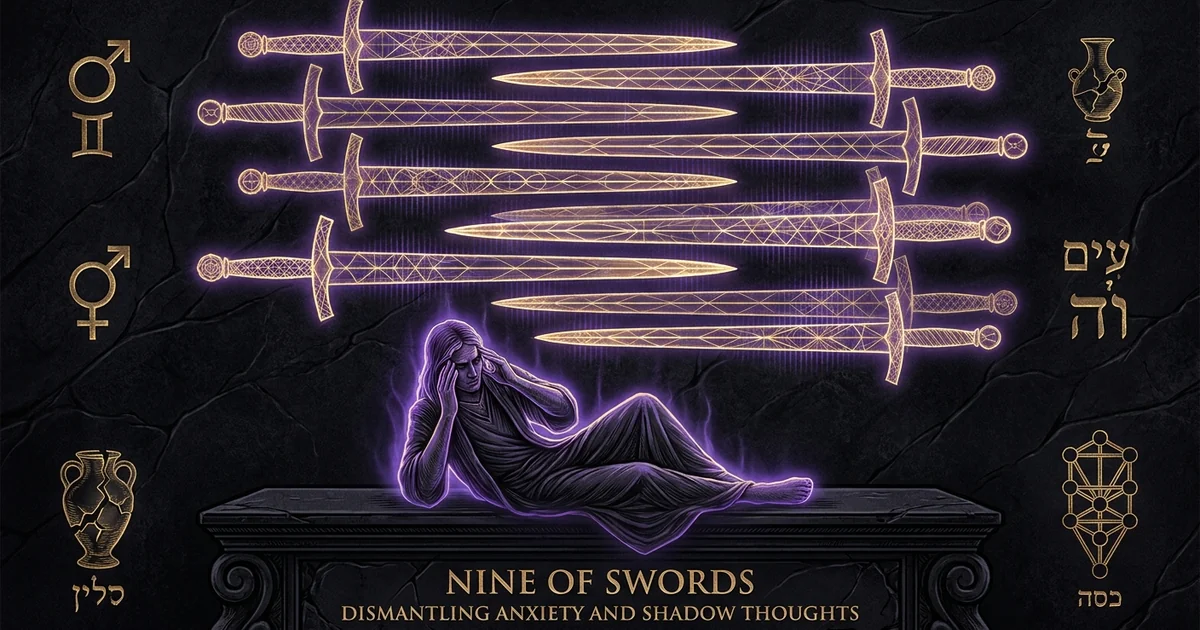
Nine of Swords: Dismantling Anxiety and Shadow Thoughts
Archetypal Thesis & Systemic Paradigm: The Epistemology of Intellectual Anguish
The Tyranny of the Unbridled Ruach
In the structural taxonomy of Hermetic Qabalah, the suit of swords acts as the operational vehicle for the air element, corresponding directly to the psycho-spiritual faculty of Ruach—the discursive, analytical intellect. When balanced by the transcendent wisdom of Neshamah (intuitive soul-consciousness) and grounded through Guph (the somatic, physical body), the Ruach functions as an instrument of divine discernment, parsing truth from illusion via razor-sharp dialectical critique. However, when the Ruach becomes severed from both higher vertical illumination and baseline somatic grounding, its computational velocity does not decelerate. Instead, its analytical power refracts inward, initiating an auto-cannibalistic feedback loop. The Nine of Swords illustrates this catastrophic epistemological threshold: the discursive intellect turned entirely against its own psychic vessel.
The crisis staged within the nine of swords tarot meaning is not a circumstance of structural defeat imposed by an external adversary, but an insular cognitive rebellion. Operating in the nocturnal chamber of the unmonitored ego, the discursive faculty splits into an agonizing dialectic between the persecutor and the persecuted, both housed within the same subjective field. Here, the rational capacity—designed to segment, categorize, and synthesize experiential data—begins to segment its own consciousness. The mind manufactures an escalating matrix of hypothetical catastrophe, wherein every potentiality is analyzed through an uncalibrated threat-detection mechanism. This produces a state of cognitive hyper-arousal where abstract possibilities are granted the existential weight of imminent, physical facts.
Without somatic modulation, the speed of this discursive loop outpaces the nervous system’s capacity to process affect. The subject is paralyzed by the sheer momentum of unresolved propositions. Within this insular cognitive theater, logic operates with absolute structural consistency yet remains completely divorced from reality. The mind constructs airtight syllogisms derived from false, anxiety-driven premises, proving with mathematical rigor why total ruin is inevitable. This autopoietic closed loop demonstrates that the greatest instrument of human liberation—the rational intellect—possesses an equal and opposite capacity to become an engine of sustained psychological torture when untethered from cosmological reality.
Subjective Horror vs. Objective Geometry
A rigorous semiotic deconstruction of the nine of swords symbolism exposes a foundational disparity between the subject’s internal experience and their actual material conditions. In the classic iconography, the individual sits upright in bed, head buried within trembling palms, utterly consumed by an agony so acute it registers as bodily trauma. Yet, upon precise examination of the spatial geometry, an essential truth reveals itself: not a single one of the nine suspended blades makes contact with the physical flesh of the Querent. The swords hover entirely in the black background behind and above the figure, aligned horizontally in rigid, parallel tiers.
“The shadow is a moral problem that challenges the whole ego-personality, for no one can become conscious of the shadow without considerable moral effort. To become conscious of it involves recognizing the dark aspects of the personality as present and real. This act is the essential condition for any kind of self-knowledge, and it therefore, as a rule, meets with considerable resistance… while some traits of the shadow can be integrated into the conscious personality without too much difficulty, others prove stubbornly resistant, and usually yield only when an intense emotional tie to an object is dissolved.” — Carl Gustav Jung, Aion: Researches into the Phenomenology of the Self, CW 9ii, §14–19.
This geometrical non-contact is the central diagnostic key of the card. The torment depicted is not the product of an executioner’s strike; it is an epiphenomenon of projection. The swords represent autonomous shadow-complexes that have detached from the ego’s conscious oversight during the sensory deprivation of the night. In the waking state, sensory stimuli and social interactions provide friction that anchors the Ruach to empirical reality. When those anchors dissolve in the dark, the unintegrated complexes of the unconscious rise unhindered. They organize themselves into the psychic architecture of the swords, looming over the subject as an absolute, suffocating ceiling of doom.
The tragedy of the Nine of Swords lies precisely in this epistemic failure: the individual interprets their subjective terror as an accurate reading of objective reality. The mind experiences somatic symptoms—tachycardia, diaphoresis, respiratory restriction—and retroactively rationalizes these somatic signals by manufacturing catastrophic narratives. The blades are not descending; they are fixed, suspended artifacts of thought. The subject’s hands cover their eyes, confirming that the real tragedy is not that the swords are falling, but that the individual refuses to look directly at the blades to verify whether they possess mass, velocity, or the power to shed actual blood.
The Night-Sea Journey of the Anxious Ego
Within the broader framework of archetypal psychology, the Nine of Swords occupies the liminal threshold known as the nigredo of the intellect, or the subterranean phase of the night-sea journey. Unlike the mythological hero who descends into the underworld armed with divine talismans, the ego in the Nine of Swords finds itself ambushed in the very space reserved for restoration and psychological integration: the bed. The bedchamber is the sanctum of the subconscious, the site where the conscious ego is intended to surrender its sovereignty and dissolve into the restorative waters of the unconscious.
When the ego harbors unacknowledged guilt, unexpressed rage, or chronic existential dread, this surrender becomes impossible. The unconscious ceases to function as a nourishing ocean and instead transforms into a mirrored torture chamber. The nocturnal setting symbolizes the absolute withdrawal of external sensory light, plunging the conscious mind into an encounter with its own repressions. Heinrich Cornelius Agrippa, in his De Occulta Philosophia Libri Tres (1533), notes that nocturnal phantasms achieve their highest potency when the animal spirit (spiritus animalis) is left undirected by the rational will, allowing malignant astral influences to imprint upon the passive imagination.
This subterranean journey, painful as it is, serves an indispensable teleological purpose. The Nine of Swords represents the penultimate density of the mental plane before its ultimate, irreversible materialization. It is an evolutionary crucible. By concentrating the subject’s unintegrated neuroses into an unbearable peak of acute distress, the archetype forces an existential crisis. The ego is driven to the absolute outer boundary of what mental rumination can endure. At this breaking point, consciousness is confronted with a definitive choice: either remain trapped within the self-imposed prison of cognitive projection or lower the hands from the eyes, confront the phantoms directly, and dismantle the architectural scaffolding of the anxiety complex.
Classical Provenance & Textual Lineage: Transmission of the ‘Lord of Despair’
Hermetic Order of the Golden Dawn and Book T
The modern esoteric architecture of the Nine of Swords originates in the secret curriculum of the Hermetic Order of the Golden Dawn, codified primarily by S.L. MacGregor Mathers and Florence Farr in the foundational 1888 manuscript known as Book T: The Tarot. In this system, each minor arcana pip card from the Two through the Ten is assigned an esoteric title, an astrological decan, and a precise station upon the Qabalistic Tree of Life. To the Nine of Swords, the Golden Dawn assigned the ominous attribution: “The Lord of Despair and Cruelty.”
“NINE OF SWORDS: The Lord of Despair and Cruelty. Yesod in Yetzirah. (Mars in Gemini). Despair, cruelty, pitilessness, agony, pain of mind, suffering, loss, illness, yet some subtle craft and subtlety. Malice, spite, labor, pain, sorrow, dishonesty, unfaithfulness. According to dignity: Either pure misery, agony of spirit, and pitiless malice; or quiet resignation, heroic endurance of intense pain, and philosophical detachment from earthly suffering.”
The assignment of “Despair and Cruelty” is not merely poetic melodrama; it is a technical formula denoting the friction generated when the fiery, severance-oriented dynamic of Mars is injected into the mutable, communicative air sign of Gemini, specifically within the ninth Sephira, Yesod. The Golden Dawn understood that the number Nine represents the completion of a structural cycle just prior to its final crystallization in the physical world (Malkuth). In the suit of Swords, this signifies that the dialectical, divisive energy of the air element has reached its absolute structural apex.
Mathers and Farr recognized that “Cruelty” in this context operates dualistically: it is the pitiless malice the intellect directs outward when cornered, but far more frequently, it is the ruthless sadism the conscious ego inflicts upon itself through chronic hyper-criticism and existential despair. The Golden Dawn manuscripts emphasize that this card demonstrates the maximum entropy of the discursive mind when decoupled from the mediating influences of the Middle Pillar, warning the adept that without the light of Tiphareth, the intellect inevitably constructs its own personal abyss.
The Pamela Colman Smith Visual Revolution
Prior to the publication of the Rider-Waite-Smith deck in 1909, historical tarot traditions—such as the Tarot of Marseilles—represented the Nine of Swords through non-scenographic, geometric arrangements of nine curved, interlaced scimitars, often accompanied by austere floral flourishes. These historic pip cards communicated systemic concepts of struggle, balance, and tension through abstract spatial distribution, leaving the precise psychological interiority of the experience unrendered.
Arthur Edward Waite, working in collaborative tandem with the visionary artist and occultist Pamela Colman Smith, revolutionized this lineage by transmuting abstract esoteric attribution into vivid psychological drama. In The Pictorial Key to the Tarot (1910), Waite describes the card with characteristic precision: “One seated on her bed in an attitude of desolation, by whom nine swords are directed over her, whilst her head rests upon her hands… It is a card of utter desolation, but it is not death.”
Smith’s visual execution fundamentally transformed esoteric cartography. By enclosing the scene within an austere, windowless bedchamber and drenching the backdrop in total pitch-blackness, she visually isolates the subject from the wider cosmos. The individual is not depicted outside, contending with the elements or engaged in battle; they are contained within an intimate, domestic interior. Smith introduces profound iconographic nuances: the carved wooden bed features an engraved bas-relief depicting one figure striking down another in mortal combat, signaling that the roots of this nocturnal torment lie in unresolved inter-relational violence or ancestral trauma. By visually anchoring the Golden Dawn’s Qabalistic abstractions within the universally recognizable experience of insomnia and nocturnal panic, Smith established the definitive visual paradigm for existential dread in the Western esoteric canon.
Crowley’s Cruelty: The Pure Destructive Energy of Intellectual Agony
In deep structural divergence from the humanistic, narrative-driven iconography of the Waite-Smith tradition, Aleister Crowley and Lady Frieda Harris strip away all human personalism in The Book of Thoth (1944). Crowley titles the card simply “Cruelty,” retaining the Golden Dawn decanic attribution of Mars in Gemini while refusing to comfort the viewer with narrative distractions. In the Thoth Nine of Swords, the composition is dominated by nine jagged, rusted, and chipped daggers that point downwards, their tips converging toward a central void.
Crowley interprets this card as the raw, impersonal mechanics of the intellect collapsing under its own excessive velocity. In The Book of Thoth, he writes:
“The Nine of Swords is called Cruelty… Here the original disruptive nature of the air element has been raised to its highest power… There is no relief; it is the mind turned inward, conscious only of its own agony, an analysis that finds no synthesis, an intellect that has destroyed its own capacity for peace.”
Harris’s visual rendering utilizes jagged, crystalline geometry, acidic sulfur yellows, and sickly purples. Venom and arterial blood drip continuously from the serrated edges of the blades, pooling upon a chaotic, fractured backdrop. There is no weeping figure; the viewer is the shattered consciousness. Crowley’s technical analysis emphasizes that the mutable air of Gemini scatters the focused destructive force of Mars into hundreds of simultaneous cuts. The cruelty is not calculated or cold like Saturnian malice; it is kinetic, erratic, and pervasive. It represents the utter failure of hyper-rationalism to solve the problem of existence, terminating instead in a self-devouring labyrinth of pure intellectual poison.
Structural Mechanics & Symbolic Geometry: Yesod in Yetzirah and Mars in Gemini
Qabalistic Architecture: The Foundation in the World of Formation
To diagnose the functional mechanics of the Nine of Swords, one must analyze its location within the coordinate system of Hermetic Qabalah. The card corresponds to the Sephira Yesod (the Foundation) expressed within the metaphysical sphere of Yetzirah (the World of Formation). Yesod is the lunar clearinghouse of the Tree of Life. It is the astral repository of images, memory, instinct, and psychic impressions, operating as the final machinery of distribution that shapes the raw spiritual forces descending from the upper Sephiroth before they manifest physically in Malkuth.
Yetzirah is precisely the realm of the air element—the mental stratum of ideas, conceptual forms, and discursive language. When Yesod—a lunar, fluid, highly impressionable Sephira—is situated inside Yetzirah, the intellectual atmosphere becomes intensely magnetized by the instinctual, subterranean current of the subconscious mind. Yesod does not operate through clear solar logic; it operates through associative imagery, emotional resonance, and deep ancestral memory.
Consequently, when the intellectual faculty of Yetzirah falls into Yesod without the balancing solar equilibrium of Tiphareth, the mind loses its objective clarity. Instead of processing reality through clean empirical deduction, Yetzirah/Yesod fabricates a dense, shifting hall of mirrors. The intellect begins to spin out complex narratives grounded entirely upon the shifting sands of lunar mood and suppressed instinct. It is here that the autonomous complexes find their expressive form, clothing raw fear in intricate rational garments. The “Foundation” of the psyche becomes occupied by acute anxiety, transforming the subconscious baseline into a hyper-reactive mechanism that registers phantom threats as existential emergencies.
Decan Astromancy: Mars in the Second Decan of Gemini
Astrologically, the Nine of Swords corresponds to the second decan of Gemini (spanning 10° to 20° of the tropical zodiac), a decan governed directly by the planetary force of Mars. Under classical astrological doctrine, Gemini is a mutable air sign ruled by Mercury, characterized by rapid cognitive processing, intellectual adaptability, bifurcated viewpoints, and endless linguistic dialectics. When the archetypal heat, aggression, and kinetic violence of Mars are forced into the mutable air of Gemini, an acute cosmological mismatch occurs.
- Sephira: Yesod (The Foundation / Astral Treasury)
- Qabalistic World: Olam Yetzirah (The World of Formation / Astral-Mental Realm)
- Astrological Coordinates: Mars in Gemini (Second Decan: 10°00’00" to 19°59’59" Gemini)
- Elemental Designation: Air (Hot and Moist, intellectual, discursive)
- Mathematical Polarity: Feminine/Receptive polarity within an Active/Masculine Element
- Golden Dawn Color Scales:
- King Scale (Atziluth): Pure active yellow
- Queen Scale (Briah): White, flecked with purple
- Prince Scale (Yetzirah): Grayish-yellow
- Princess Scale (Malkuth): Black, rayed with yellow
Mars desires direct, linear conquest, decisive action, and physical discharge. In the mental ecosystem of Gemini, however, Mars discovers no physical adversary to engage. Blocked from external somatic manifestation, the Martian martial energy turns inward, weaponizing the mercurial intelligence against the subject. The duality of Gemini splits the psyche into two opposing camps: the critical prosecutor and the defenseless inner victim.
The Mars in Gemini transit and natal dynamic generates an intellectual friction characterized by obsessive cognitive hyper-vigilance. The mind races at breakneck velocity, obsessively debating both sides of every catastrophic scenario without ever reaching closure. Mars provides the explosive emotional fuel (rage, panic, existential dread), while Gemini supplies an infinite repertoire of linguistic rationalizations, catastrophic permutations, and theoretical worst-case outcomes. The intellect becomes a machine gun firing empty discursive shells into the dark, traumatizing the ego with hypothetical horrors.
The Geometry of the Nine Suspended Blades
The geometric arrangement of the nine blades provides crucial mechanical insight into the nature of mental anguish. In the Waite-Smith iconography, the swords are arranged in three groups of three, or an unbroken tier of nine, stacked horizontally on a black field. They point uniformly from the active, conscious left (past/internal) toward the receptive right (future/external).
Structurally, the swords occupy the upper two-thirds of the compositional frame, forming a dense grid that hangs over the reclining human figure like an iron portcullis. This geometric arrangement functions as an energetic ceiling, effectively capping the flow of spiritual light descending from Kether through the Tree of Life. The mind is encased in an impenetrable grid of its own linear concepts.
Crucially, the swords are completely static. There is no vector line suggesting dynamic descent; they do not fall; they do not vibrate; they simply are. This visual stasis proves that the crisis of the Nine of Swords is not an ongoing event, but a structural state of cognitive fixation. The mind has taken fluid, temporal thoughts—which are naturally transient, arising and passing like wind—and crystallized them into permanent, suspended monuments of terror. The subject feels crushed not by moving kinetic forces, but by the sheer, unyielding weight of their own static, non-integrated conclusions.
Psychological Dynamics & Operational Praxis: Deconstructing Cognitive Phantoms
Neurosis, Insomnia, and Nocturnal Rumination Cycles
Viewed through the lens of modern clinical neuropsychology integrated with archetypal analysis, the Nine of Swords stands as the quintessential pictorial representation of an unmitigated default mode network (DMN) hyper-activation crisis, manifesting clinically as acute insomnia, panic disorder, and nocturnal rumination. During normal diurnal consciousness, the task-positive network (TPN) is engaged through interaction with external environmental stimuli, effectively suppressing the self-referential narratives of the DMN.
When the subject enters the sensory-deprived environment of the bedchamber, the TPN deactivates, leaving the DMN unconstrained. In an integrated psyche, this transition allows the mind to slip smoothly into slow-wave and REM sleep states. In an individual suffering from chronic nervous system dysregulation, the DMN seizes this sensory vacuum to execute catastrophic threat-modeling protocols. The brain searches for safety by obsessively reviewing past failures and simulating future perils.
Because the body is immobilized in bed, the motor cortex cannot discharge the sympathetic arousal triggered by these thoughts. Cortisol and adrenaline flood the vascular system, inducing tachycardia and shallow thoracic respiration. The hyper-aroused brain interprets this visceral somatic distress not as a chemical consequence of its own rumination, but as empirical confirmation that an acute, external threat is present. This creates a self-sustaining somatosensory panic loop: the thought triggers the somatic alarm; the alarm validates the thought; the amplified thought escalates the somatic alarm. The subject sits up in bed, clutched by a profound sense of doom, thoroughly convinced that their life, sanity, or security is fundamentally shattered.
The Quilt of Alchemical Roses and Astrological Glyphs
One of the most profound esoteric details embedded by Pamela Colman Smith within the Nine of Swords is the intricate pattern adorning the subject’s bedcover. The quilt is not a plain domestic fabric; it is meticulously embroidered with a geometric checkerboard alternating between two potent occult motifs: red, five-petaled roses and astrological glyphs of the planets and zodiacal constellations.
The red rose, in the Western Mystery Tradition, is the universal emblem of desire, passion, earthly love, and the vital blood of incarnate existence. The astrological glyphs symbolize the macrocosmic forces, the planetary spheres, and the celestial machinery that governs individual destiny and karmic cycles. By placing the tormented subject beneath this specific blanket, Smith visually reveals that the individual is wrapped directly in the unintegrated material of their own incarnational history.
The suffering depicted is not an arbitrary curse imposed by malevolent external entities; it is composed of the very desires, attachments, karmic choices, and cosmological patterns that the individual has pursued and accumulated throughout their life. The quilt represents the astral matrix of the personal ego. The individual is literally suffocating under the weight of their own unresolved emotional investments. The passions that were never sublimated (the roses) and the existential lessons that were never consciously digested (the astrological glyphs) now press upon the subject’s body, preventing rest. The blanket demonstrates that the torture of the Nine of Swords is always self-generated: the psyche is bound by the threads of its own woven tapestry of identity.
Nine of Swords: Yesod in Yetzirah
- Epistemic State: Subjective, internal, nocturnal panic loop.
- Somatic Interaction: Zero physical contact; the blades hover completely suspended.
- Mechanism: Catastrophic anticipation, acute anxiety, insomnia, runaway DMN.
- Integrative Potential: High; crisis is resolvable by opening the eyes and dispelling cognitive phantoms.
- Temporal Horizon: The dark night of the mind; crisis occurs before material manifestation.
Ten of Swords: Malkuth in Yetzirah
- Epistemic State: Objective, exhaustive, systemic material collapse.
- Somatic Interaction: Absolute physical trauma; all ten blades transfix the spinal column.
- Mechanism: Final termination of a paradigm, total structural bankruptcy, cessation of struggle.
- Integrative Potential: Absolute closure; the mental storm has exhausted itself into total stillness.
- Temporal Horizon: Dawn breaks across the horizon; the inevitable reset after total collapse.
Active Imagination Protocol: Entering the Bedchamber
To dismantle the severe psychological paralysis indicated by the Nine of Swords, the Querent must not rely on passive intellectualization, which only feeds the Gemini-Mars machinery. Instead, operational praxis requires the clinical application of C.G. Jung’s method of Active Imagination—a conscious, deliberate descent into the imaginal space of the card to confront and deconstruct the autonomous complexes directly.
[ Active Imagination Protocol: The Chamber of the Nine Blades ]

Stage 1: Somatic Downregulation
- Sit upright in a grounded posture; do not recline.
- Engage deliberate extended-exhalation breathing (inhale 4 counts, hold 2, exhale 8).
- Sever the somatosensory panic loop by consciously decelerating cardiac rhythm.

Stage 2: Imaginal Projection
- Visualize the windowless, pitch-black bedchamber of the Nine of Swords.
- Approach the weeping figure seated upon the bed; place a grounding hand upon their shoulder.
- Demand that the figure lower their hands from their face.

Stage 3: The Dialectical Interrogation of the Blades
- Turn attention upward to the nine suspended swords.
- Address each blade individually, moving systematically from lowest to highest:
    "Blade, what factual evidence do you possess in physical reality?"
    "Blade, what percentage of your threat is objective material, and what percentage is cognitive projection?"
- Force the autonomous complex behind each sword to vocalize its specific terror.

Stage 4: Structural Dissolution
- As each cognitive distortion is identified and stripped of empirical validity, visualize the corresponding blade losing its metallic density.
- Observe the blade sublimating from iron into thin astral vapor, exiting through the room's upper perimeter.
- Continue until the space above the bed is entirely cleared of suspended metal.
Through this active imaginal protocol, the subject shifts from a passive recipient of nocturnal torture to an active, sovereign investigator. By forcing each hypothetical blade to articulate its factual validity against objective baseline reality, the discursive mind’s bluff is called. The swords are revealed for what they truly are: not instruments of inescapable physical execution, but thin, astral thought-forms that dissipate the instant they are subjected to direct, conscious examination.
Philosophical Synthesis & Macrocosmic Correspondence: The Alchemical Purification of Ruach
The Principle of Mentalism and the Crucible of Doubt
At the macrocosmic level, the Nine of Swords serves as an absolute diagnostic mirror for the first Hermetic axiom articulated in the Kybalion: “THE ALL IS MIND; The Universe is Mental.” This axiom affirms that reality at its most fundamental metaphysical stratum is ideological, constructed from mental patterns and vibratory states. However, the Western esoteric tradition recognizes an inherent danger within this truth: if the cosmos is mental, then an uncontrolled, pathological micro-mind possesses the terrifying capability to construct a completely convincing, closed, and autonomous hell-realm that functions as an absolute subjective reality.
The Nine of Swords demonstrates the dark night of the Hermetic magus. It is the crucible of doubt. In the earlier stages of esoteric development—exemplified by the Eight of Swords—the individual experiences restrictions that are partially social, doctrinal, or environmental. But in the Nine, all external frameworks have fallen away. The mind stands naked before its own creative potency, confronting the fact that its greatest persecutor has never been an external force, but its own unbridled capacity to generate catastrophic illusions.
This makes the card an indispensable stage in the alchemical Magnum Opus. The Nine of Swords represents the advanced stage of Calcination and Putrefaction applied directly to the mental body. The intellect’s comfortable assumptions, rationalized defenses, and inflated delusions of total control must be systematically incinerated in the furnace of acute existential anxiety. The mind must be brought to an absolute standstill through the discovery of its own profound limitations. Only when the discursive intellect realizes that its own hyper-rationalization produces nothing but despair does it finally surrender its usurpation of the psychic throne.
The Transition from Despair to Lucid Awareness
The esoteric teleology of the Nine of Swords is not to consign the adept to eternal torment, but to force a radical breakthrough into lucid awareness. In classical mysticism, this is the crisis of the dark night of the spirit, wherein all familiar lights—intellectual constructs, philosophical doctrines, theological systems—are extinguished, leaving the consciousness suspended in total sensory deprivation.
This sensory darkness is actually a veil of profound mercy. By plunging the conscious ego into absolute internal blackness, the Nine of Swords strips the individual of all superficial, external distractions. The anguish experienced is the agonizing friction of the false self dying. The ego weeps because its strategies of control, its endless intellectual maneuvers, its calculations of future security have failed utterly.
When the suffering reaches its maximum point of saturation, an energetic reversal inevitably occurs—an enantiodromia. The mind, exhausted by its own self-inflicted torment, cannot sustain the frequency of acute terror indefinitely. In the absolute silence that follows the exhaustion of panic, a new quality of consciousness emerges: radical, unvarnished lucidity. The individual finally understands that they are not the thoughts; they are the witness observing the thoughts. The moment the witness consciousness detaches from the content of the rumination, the authority of the nine swords is instantly broken.
Transmutation of Martial Fire within the Air Matrix
The ultimate work of the adept confronting the Nine of Swords is the complete alchemical transmutation of Mars in Gemini. In its unintegrated, pathological state, Mars in Gemini operates as a runaway engine of intellectual self-laceration, an erratic firestorm cutting through the delicate nervous system with obsessive, splintered narratives.
When subjected to esoteric transmutation, this volatile combination shifts from an instrument of subjective cruelty into the sharpest tool of spiritual discrimination (Viveka in the Yogic tradition). The fire of Mars provides the courageous, unyielding willpower to cut straight through self-pity and delusion, while the air of Gemini supplies the exquisite dialectical precision required to identify the root fallacies of the ego’s defenses.
Instead of directing the martial blades inward to lacerate the vulnerable self, the transmuted adept wields the sword of Mars in Gemini as a clinical scalpel. The scalpel is deployed outward against false dogmas, toxic relational attachments, and the deeply rooted cognitive distortions of the unconscious. Mars in Gemini, fully refined, becomes the champion of absolute truth, capable of articulating complex spiritual realities with razor-sharp lucidity. The nine swords are drawn down from the sky, reshaped, and integrated not as instruments of suspended dread, but as an arsenal of discernment that defends the sovereignty of the psyche, preparing the vessel for the ultimate structural catharsis depicted in the Ten of Swords.
Frequently Asked Questions: Analytical and Interpretive Resolutions
Predictive Calamity vs. Psychological Projection
In practical divinatory consultations, the appearance of the Nine of Swords universally triggers acute dread in the Querent, who frequently misinterprets the card’s graphic imagery as an omen of catastrophic external events: the sudden death of loved ones, terminal medical diagnoses, financial ruin, or acts of physical violence. It is the absolute technical duty of the diviner, grounded in rigorous esoteric philosophy, to immediately correct this fatalistic misinterpretation.
The Nine of Swords belongs definitively to the suit of Swords (the air element, mental realm) and to the Sephira Yesod (the astral-subconscious realm of images). It does not reside in Malkuth (the material world of concrete physical manifestation). Therefore, the card does not predict an objective, external disaster. It diagnoses an internal, subjective state of catastrophic anticipation.
The crisis is almost exclusively endogenous. It reveals an individual currently overwhelmed by severe anxiety loops, nocturnal insomnia, hyper-vigilance, and unresolved guilt. The diviner must rigorously reframe the consultation: the card is not a mirror of what will happen in the physical world; it is an x-ray of what the Querent fears will happen, showing how their own catastrophic threat-modeling is actively sabotaging their present somatic and psychological equilibrium. The danger is not external ruin, but the internal exhaustion caused by fighting phantom battles in the dark.
Differentiating the Nine of Swords from the Eight and Ten
Navigating the progressive dialectic of the late Swords suit requires a precise structural understanding of the subtle evolutionary shifts occurring between the Eight, Nine, and Ten. Each represents a distinct stage in the descent and resolution of the mental element as it approaches physical manifestation on the Tree of Life.
The Eight of Swords represents cognitive entrapment through learned helplessness and ideological dogma. The figure is bound and blindfolded, surrounded by an external fence of swords, yet the bindings are loose and the space between the blades is open. The problem in the Eight is one of unexamined beliefs: the subject remains imprisoned simply because they believe they are trapped.
The Nine of Swords shifts the crisis entirely inward. In the Nine, the blindfold and bindings are gone; the subject is alone in bed. The threat is no longer a set of social doctrines or external limitations; it is the acute, kinetic eruption of the shadow-complex. The Eight is a cold, chronic state of mental paralysis; the Nine is a hot, acute crisis of nocturnal panic and hyper-vigilant terror.
The Ten of Swords marks the final, irreversible termination of this mental cycle. In the Ten, the psychological drama of the Nine has finally exhausted its structural momentum. The subject no longer weeps in bed; they are pinned flat upon the earth, all ten swords transfixing the spine from neck to sacrum. While visually horrific, the Ten represents a profound relief: the anticipation of doom that tortured the subject in the Nine has finally arrived, fully crystallized in Malkuth, and is now permanently over. In the Ten, the struggle is dead, the storm clouds break, and the golden dawn illuminates the horizon. The Nine is the unbearable struggle against the ghost; the Ten is the quiet, final burial of the corpse.
Integration Protocols for the Nine of Swords in Divinatory Practice
When the Nine of Swords appears in an esoteric or clinical consultation, the practitioner must execute a clear, structured operational protocol designed to de-escalate the Querent’s nervous system, strip the card of its superstitious charge, and empower the client with concrete cognitive and metaphysical tools.
First, the practitioner must initiate Immediate Narrative Reframing. The Querent must be directed to examine the card’s geometry, observing explicitly that the swords do not touch the figure. The practitioner must state plainly: “This card shows that the primary source of your current exhaustion is not your actual life circumstances, but the catastrophic narrative your mind is weaving about those circumstances in the absence of complete information.”
Second, the diviner must recommend Somatic Regulation and Sleep Hygiene Interventions. Because the Nine of Swords maps precisely to nervous system hyper-arousal and sleep architecture collapse, the intellectual problem cannot be solved purely through further intellectual analysis. The Querent must be instructed to ground the runaway Ruach in the physical vessel of Guph. This includes:
- Strict cessation of light-emitting sensory devices two hours before sleep (eradicating the artificial stimulation of the Gemini-Mercury matrix).
- The practice of somatic discharge techniques (intense physical exertion during daylight hours, followed by prolonged hot water bathing with magnesium salts prior to rest).
- Implementation of parasympathetic activation protocols (extended-exhalation breathwork, yoga nidra, or progressive muscle relaxation) to manually deactivate the runaway Default Mode Network.
Third, the Querent must be prescribed Cognitive Externalization Protocols. The fatal error of the Nine of Swords is keeping the catastrophic thoughts locked within the insular, nocturnal chamber of the skull, where they echo and amplify. The Querent must be instructed to externalize the swords by transcribing their catastrophic scenarios onto physical paper in exhaustive, unvarnished detail during broad daylight.
By forcing the nebulous, terrifying astral phantoms of Yesod onto the physical, grounded medium of paper (Malkuth), the Querent subjects the Mars in Gemini hysteria to the cold, objective light of the conscious solar intellect. Once written down, each catastrophic proposition must be systematically audited against empirical facts, asking: “Is this scenario an established reality today, or is it an autonomous shadow-thought masquerading as an absolute prophetic certainty?” Through this disciplined intervention, the nine swords are systematically dismantled, the hands are pulled away from the weeping eyes, and the sovereign consciousness reclaims its foundational seat of peace.