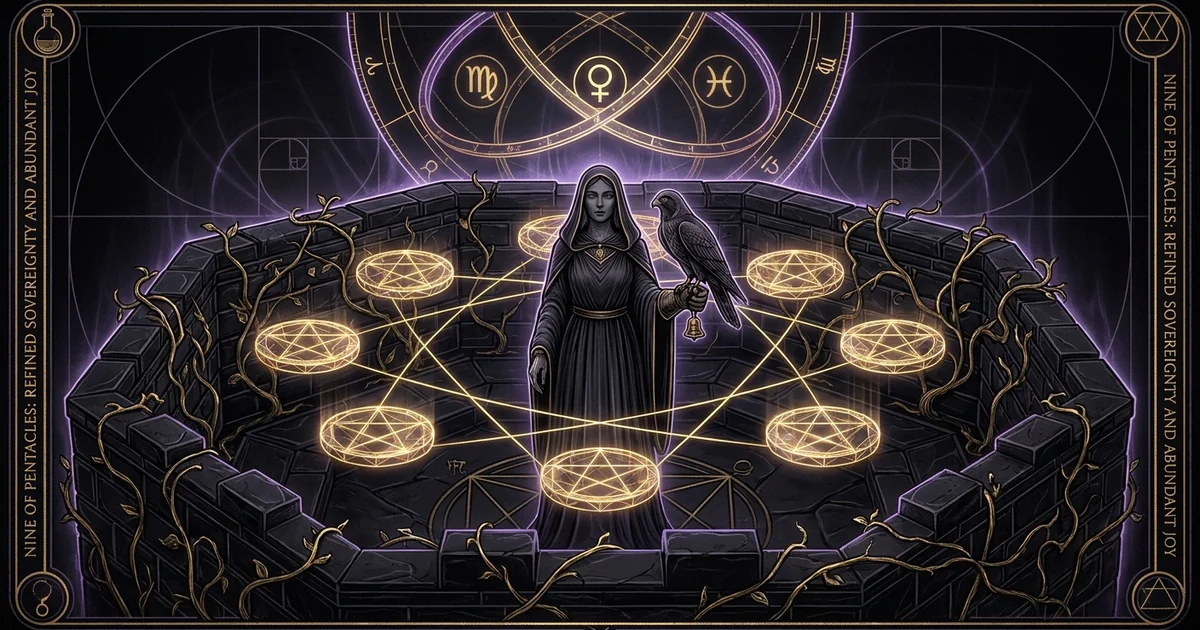
Nine of Pentacles: Refined Sovereignty and Abundant Joy
Archetypal Thesis & Systemic Paradigm: The Architecture of Autarky
The Nine of Pentacles formalizes the psycho-cosmological realization of autarky and material sublimation within the Western esoteric tradition. Rather than operating as an index of vulgar, consumerist accumulation or leisure-class indulgence, the card functions as an archetypal state-space of self-sustained individuation. In this space, raw instinctual labor has undergone alchemical distillation into refined sovereignty.
Within the structural mechanics of the suit of pentacles esoteric anatomy, this arcanum occupies the penultimate threshold before the total systemic inertia and transgenerational enmeshment of the Ten of Pentacles. It models a generative pause: ego-consciousness suspended in a self-replenishing, bounded matrix where labor has ceased to be an alienated exertion and has instead crystallized into an integrated aesthetic domain.
BINAH (Saturn)
                         |
                 CHOKHMAH (Zodiac)
                         |
                      TIPHERETH
                         |
                   YESOD (Foundation)
                   [Assiatic Domain]
                         |
                  MALKUTH (Kingdom)
The Assiatic Crystallization of Yesod
To understand the nine of pentacles tarot meaning, one must locate its coordinate along the Tree of Life. As the ninth Sephirah, Yesod signifies the “Foundation”—the subtle, astral reservoir of formative images, reproductive vitality, and the etheric double. When mapped into the fourfold kabbalistic architecture, the nines represent the descent of Yesod into each of the elemental realms.
In Assiah, the material World of Action governed by the earth element, Yesod does not express itself as volatile instinct or shifting lunar tides. Instead, it operates as the ultimate physical matrix of coherence. It serves as the tangible crystallization of vital blueprints into living architecture.
Yesod in Assiah represents the moment the psychic apparatus builds a durable container for instinctual energy. While the initial emanation of the suit begins with the unformed potential of the Ace and progresses through the mechanical iterations of physical production, the ninth station is the functional culmination of the suit’s interior life.
It is the lunar engine of reproduction, reflection, and aesthetic refinement anchored immovably within the soil. In this Sephiric position, the physical plane ceases to be an arena of friction. Instead, it becomes a mirror reflecting the self-regulation of consciousness back upon itself.
The nine pentacles on the card do not represent debts owed or coins hoarded; they materialize as the tangible nodes of an etheric web, illustrating how the psychological energy of the operator has successfully stabilized physical reality into an equilibrium of psychic peace.
The Hortus Conclusus as the Alchemical Vas
The central iconographic motif structuring this arcanum is the enclosed garden—the classical hortus conclusus. In medieval and Renaissance emblematic literature, the garden wall does not function merely as a physical boundary against invaders. It functions as the alchemical vas hermeticum, an insulated vessel within which the volatile components of the psyche are subjected to the fires of transformation without risking environmental contamination.
In the Nine of Pentacles, this botanical sanctuary is heavy with mature, grape-laden vines. These vines represent the organic integration of Dionysian fertility within an Apollonian structural framework.
“The hortus conclusus (enclosed garden) is an ancient symbol of the Mary-cult and an allegorical image of the vas hermeticum. It represents a demarcated, sacred precinct, walled off from the profane world, within which the work of psychic transformation and the synthesis of the self may proceed without disturbance. The enclosure signifies the essential psychic boundary that separates the differentiated ego from the undifferentiated, collective unconscious.” — Carl Gustav Jung, Psychology and Alchemy (Collected Works, Vol. 12, §138)
As an alchemical vehicle, the enclosed garden of the Nine of Pentacles represents the terminal stage of the Coagula operation. The chaotic, dispersive elements of the animal soul (nephesh) have been gathered, purified, and transplanted into an engineered biosphere. The botanical ecosystem thrives precisely because it is separated from the chaotic, unregulated wilderness beyond the perimeter.
This bounded territory serves as the spatial prerequisite for psychological individuation. By asserting absolute boundary integrity over her immediate domain, the archetypal figure secures the psychic stillness required to sublimate primal desires into intellectual, spiritual, and aesthetic refinement.
The hortus conclusus serves as a living, respirating metaphor for a psychic interior that has rendered itself impenetrable to the demands of the collective unconscious.
Psychological Sovereignty Beyond Feudal Interdependence
From an archetypal perspective, the Nine of Pentacles embodies an existential milestone: the emergence of the self-contained subject who exists outside feudal, familial, or collective obligations. In historical feudal agrarian systems, human productivity was defined by enmeshment. Serfs, vassals, and dynastic lords occupied positions within a dense matrix of reciprocal exploitation and biological obligations.
The figure within the Nine of Pentacles subverts this dynamic completely. She stands alone, solitary yet fully fulfilled, beholden to no sovereign and responsible for no progeny.
This state-space formalizes what classical political philosophy terms autarky (autarkeia): self-sufficiency that eliminates the structural vulnerability of desire. By producing, managing, and sustaining her own material and psychic resources, the individual dissolves the parasitic loops of codependency that compromise ego integrity.
Psychologically, this represents the integration of the animus within a fully autonomous consciousness. The sovereign feminine subject no longer relies on an external masculine vector to cultivate the earth, govern the estate, or establish defensive perimeter walls.
The labor that established the estate has already occurred; the nine of pentacles symbolism marks the shift from active, outward conquest to internal governance, self-possession, and the quiet enjoyment of an individuation process brought to term.
Classical Provenance & Textual Lineage: The Lord of Material Gain
Hermetic Order of the Golden Dawn and the Title of Primum Mobile
The conceptual architecture of the modern Nine of Pentacles descends directly from the cipher lineage and ritual arcana of the Hermetic Order of the Golden Dawn. In the late-nineteenth-century papers compiled by S. L. MacGregor Mathers, the small cards of the Minor Arcana were systematically uncoupled from shallow cartomantic fortune-telling. They were elevated into a rigorous mathematical-theurgic matrix of astrological decanates and Sephiric emanations.
Within the Golden Dawn schema, the card is officially titled “The Lord of Material Gain,” assigned to the central decan of the virginal earth triplicity.
“The 9 of Pentacles is Yesod in Assiah. It is the Sphere of the Primum Mobile of Earth, governed by Venus in the sign of Virgo. Title: The Lord of Material Gain. Complete realization of material success, bringing ease, rest, and contemplative leisure. But as it is the ninth Sephirah, it warns against the danger of losing the spiritual in the material, pointing toward that turning point where production ceases and harvest crystallizes into static form.” — S. L. MacGregor Mathers, Golden Dawn Ritual Papers: Book T
The title “Lord of Material Gain” carries an exact theological designation within the Golden Dawn’s cosmology. The term Gain is not synonymous with the mere generation of liquidity (Work in the Three of Pentacles) or aggressive transactional exchange. Instead, Gain designates the definitive capture and consolidation of kinetic energy into a static, self-sustaining treasury.
The card represents the final point of equilibrium where material resources yield complete liberation from survival anxiety. It realizes the ideal conditions for esoteric contemplation without precipitating the systemic decline, ossification, and bureaucratic petrifaction that inevitably overtakes the suit in its Tenth station.
The Smith-Waite Iconographic Mutation: Falconry, Snails, and Chlamys
When Arthur Edward Waite and Pamela Colman Smith re-imagined the tarot deck in 1909, they broke with the French Marseilles tradition. In that older tradition, the minor cards presented rigid, geometric iterations of suit tokens.
Smith, operating under both the Hermetic framework of the Golden Dawn and the aesthetic influences of the Arts and Crafts movement, transformed the ninth pentacle into a Renaissance allegory of aristocratic containment.
Waite’s commentary in The Pictorial Key to the Tarot (1910) underscores this deliberate departure:
“A woman, with a bird upon her wrist, stands amidst a great abundance of grapevines in a large garden of a manorial house… It represents the wide domain of material property, but also that state of mind which is completely satisfied with its environment.”
Smith introduced three pivotal iconographic elements that transformed the card’s hermetic resonance:
- The Falcon: Perched hooded upon her heavy gloved wrist, the bird of prey shifts the card’s register from domestic pastoralism to noble leisure. Falconry was an aristocratic pursuit of imperial discipline. The hood signifies instinct subordinated to human will; the apex predator of the aerial sphere (Ruach) has been tamed, calibrated, and held captive by an operator rooted in the terrestrial plane (Nephesh).
- The Snail: Moving across the foreground path at the foot of the woman’s robes, the snail introduces an explicit temporal metric. It represents the slow, incremental accretion of biological time. It reflects the truth that the Nine of Pentacles cannot be manifested through sudden strokes of fortune or violent windfalls. It is the product of steady, deliberate, and unhurried natural growth.
- The Robes (Chlamys): The woman is adorned in an amber, flowing gown decorated with stylized floral or alchemical motifs, evoking the planetary solar hue of Tiphereth reflecting downwards through Yesod. The garment envelops her, emphasizing protective insulation and aesthetic elegance over practical field-labor attire.
Crowley’s Thoth System: Forty-Fold Geometric Multiplication
In Aleister Crowley’s The Book of Thoth (1944), executed in collaboration with Lady Frieda Harris, the Nine of Disks departs from Smith’s figurative tableau to return to an intense geometric dynamic. Crowley retains the Golden Dawn title, designating the card “Gain,” but he reinterprets the astrological coordinate of Venus in Virgo through his own esoteric framework.
Crowley perceives the card not as a tranquil, protected garden, but as a hyper-charged, dynamic circuit of generative matter. In the Thoth Nine of Disks, the disks are configured as an interlocking, triangular cluster of three equilateral triangles, forming a three-dimensional pattern of forty interconnected points.
Crowley writes:
“The Disks are arranged in the form of an equilateral triangle of nine, pointing upwards, surrounded by a ring of disks… The card represents the highest possible development of the element of Earth, so far as it can be brought about by the unaided action of the forces of the Sign itself.”
Crowley emphasizes that Venus in Virgo here indicates a fertile balance. The natural, expansive luxury of Venus is disciplined by the discriminating, analytical exactitude of Virgo.
Consequently, the Thoth card avoids the static quality of Waite’s vision. Instead, it presents matter at its peak energetic potential—where material gain is continuously reabsorbed, circulated, and metabolized by the divine feminine principle (Nuit). Crowley’s disks are charged talismans of solar-phallic energy stabilized in salt, embodying the maximum generative yield of the earth element before it tilts into the entropic, entombing decay of the Ten.
Structural Mechanics & Symbolic Geometry: Astro-Qabalistic Coordinates
Astrological Decanate: Venus in the Second Decan of Virgo
The structural efficacy of the Nine of Pentacles is governed astrologically by the placement of Venus in the second decan of Virgo, historically designated as the face of material harvest and intellectual discrimination. According to Claudius Ptolemy in the Tetrabiblos, Virgo is the nocturnal, earthy sign of the mutable triplicity, ruled by Mercury. Under classical planetary dignities, Venus is formally in its fall (casus) within Virgo, reaching its absolute depression at 27 degrees.
This traditional debilitation poses an apparent hermetic paradox: How can the “Lord of Material Gain” be ruled by a planet situated in the sign of its cosmic detriment?
The resolution lies in the decanic division. While Venus suffers debilitation in Virgo at the macro-zodiacal level—because the diffuse, wet, unitive, and hedonistic nature of Venus conflicts with the dry, sterile, hyper-analytical, and classifying mechanics of the Mercurial virgin—the second decan (10° to 20° Virgo) redeems this tension.
Here, the critical discernment of Virgo strips Venus of its self-indulgent, boundary-dissolving liabilities. The planetary drive shifts from raw romantic enmeshment to technical craftsmanship, refined taste, selective aestheticism, and meticulous ecosystem management.
In this decanate, Venus operates not as the wild, ocean-born aphrodite of desire, but as the master landscape architect. The analytical impulse of the sign disciplines the planet’s creative instinct, ensuring that every vine is pruned, every stone set with mathematical precision, and every output calibrated to yield maximum balance.
Debilitation is thus transformed into an operational strength: the card achieves material and psychological sovereignty precisely because it rejects sentimental entanglements in favor of objective, self-directed excellence.
Sephiric Emanation: Yesod in Assiah (Foundation in the World of Action)
In the cosmological architecture of the Kabbalah, Yesod occupies the central pillar of balance, functioning as the vital conduit through which the emanations of the upper eight Sephiroth are condensed before being grounded into Malkuth, the physical universe. Yesod is assigned to the Sphere of the Moon, governing the tides of generation, the subconscious dream plane, and the formative ether (prana or chi).
When this lunar-etheric node projects its energetic signature into Assiah—the dense, chemical plane of matter—it generates an operational effect known as Assiatic stabilization. In the three preceding suits, Yesod manifests as:
- Yesod in Atziluth (Nine of Wands): Unshakable defensive spiritual endurance.
- Yesod in Briah (Nine of Cups): Emotional self-satisfaction and psychical fulfillment.
- Yesod in Yetzirah (Nine of Swords): Unconscious torment and psychological rupture.
In Assiah, Yesod’s task is the synthesis of form and matter. It anchors the volatile psychic patterns of the imagination into physical infrastructure.
The Nine of Pentacles reflects a condition where the etheric blueprint of the psyche has successfully colonized material form. There is no dissonance between what the soul envisions and what the body experiences.
The “Foundation” is laid directly within the earth; the home, the garden, and the somatic vessel become a coherent biological unit. This provides the stable physical foundation necessary for sustained interior contemplation, entirely free from the existential friction of physical instability.
Micro-Iconography: The Snail, the Grape Arbors, and the Hexagrammic Disks
A structural reading of Pamela Colman Smith’s composition reveals a conscious geometric distribution designed to communicate stability. The primary visual weight is organized through the nine gold pentacles embedded directly within the fruitful vine-stocks.
       [Top: Triad of Intellectual/Spiritual Harvest]
                       (O)   (O)   (O)
       [Middle/Base: Senary Pillar of Material Stability]
                           (O)   (O)
                           (O)   (O)
                           (O)   (O)
The pentacles are not distributed haphazardly across the canvas; they are stacked in an asymmetrical configuration composed of a lower pillar of six, arranged in three adjacent pairs, counterbalanced by a triad arranged on the left side of the female figure.
The senary structure (six pentacles) establishes a direct resonant link to Tiphereth, the solar center of beauty, integration, and conscious selfhood. This indicates that the garden’s material base is stabilized by the harmony of the central spiritual sun. The remaining triad represents the integration of the supernal Sephiroth (Kether, Chokhmah, Binah), demonstrating that this garden is governed not by blind instinct, but by a higher, transcendent logic.
The presence of the snail (Helix aspersa) in the lower left corner provides a crucial hermetic key. In classical iconography, the snail is an emblem of:
- Festina lente (“Make haste slowly”): The deliberate, cautious, yet inexorable movement toward an evolutionary telos.
- Autarkic geometry: The snail carries its own architecture, its sanctuary, and its container permanently upon its back, drawing inward into its own spiral whenever external conditions turn hostile.
The grapevine arbor confirms this dynamic. The grape is a dual symbol within Western esoteric systems: it requires patient, multi-year agricultural infrastructure to cultivate, yet its ultimate extraction yields wine—the quintessential alchemical symbol of the spirit extracted from the dense flesh of matter.
The Nine of Pentacles visualizes the stage immediately preceding the crushing of the grapes. The harvest is ripe, immaculate, and pristine; it pauses at the exquisite moment of aesthetic perfection before being consigned to the fermentation of social exchange.
Psychological Dynamics & Operational Praxis: The Solitary Connoisseur
Individuation Mechanics: The Tamed Falcon as Sublimated Libido
In the domain of Jungian analytical psychology, the Nine of Pentacles serves as a clinical blueprint for the advanced stages of the individuation process. Specifically, the relationship between the central female figure and the hooded falcon maps the conscious ego’s capacity for instinctual sublimation.
The falcon is an apex carnivore, biologically wired for violent pursuit, sharp vertical ascent, and instinctual predation. It represents what Jung termed the raw, undifferentiated libido—the primal drive of psychic energy, frequently expressed through aggressive, territorial, or sexual modalities.
+--------------------------------------------------------------+
|                    PSYCHIC METAMORPHOSIS                     |
|                                                              |
|   RAW INSTINCT (Falcon)            SUBLIMATION (The Hood)    |
|   • Predatory libido               • Voluntary boundary      |
|   • Dispersed reactivity           • Channeling of focus     |
|   • Territorial compulsion         • Aesthetic sovereignty   |
|                 │                            │               |
|                 └────────────► ◄─────────────┘               |
|                               │                              |
|                               ▼                              |
|                INTEGRATED EGO-CONSCIOUSNESS                  |
|                • Psychological Autarky                       |
|                • Directed Creative Will                      |
+--------------------------------------------------------------+
By depicting the falcon hooded and resting quietly upon the woman’s wrist, the iconographic language communicates voluntary containment. The hood does not blind the bird permanently; rather, it shields the predatory impulse from ambient environmental triggers.
This prevents the reactive dispersion of energy. The ego does not destroy or repress the instinctual animal—an operation that would result in neurosis or shadow eruptions—but honors it, clothes it in fine craft (the decorated hood), and integrates it as an asset of personal sovereignty.
This sublimation mechanics indicates that refined joy and inner peace cannot be attained through either ascetical suppression or unrestrained indulgence. True sovereignty (autarky) requires the conscious taming of one’s own predatory drives. The sovereign subject has learned to suspend reflexive reaction.
She holds psychic tension on her own arm. She directs the instinctual drive inward to fuel self-discipline, creative contemplation, and sensory discrimination.
Boundary Integrity: Differentiating Autonomy from Pathological Isolation
The garden wall of the Nine of Pentacles marks an absolute, differentiated boundary between the Self and the Collective. In operational psychoanalysis, this boundary is both the card’s greatest psychological achievement and its primary structural hazard.
[ PROFANE COMMERCE / UNCONSCIOUS MOB ]
       =====================================  <-- Garden Parapet
             [ THE HORTUS CONCLUSUS ]
             • Curated sensory stimuli
             • Psychological containment
             • Individuated sovereignty
             =================================  <-- Latent Shadow:
                   [ AVOIDANT FORTRESS ]            Sterile solipsism &
                   (Gilded cage of isolation)       epistemic stagnation
Under healthy psychic conditions, this boundary represents functional ego differentiation. The individual has disentangled herself from:
- Familial complexes and transgenerational inherited burdens.
- The uncurated, chaotic projections of peer groups and social hierarchies.
- Compulsive, transactional entanglements masquerading as relationship bonds.
However, the line separating autarkic autonomy from schizoid, avoidant insulation is exceptionally fine. When the ego over-identifies with the comfort of its own enclosure, the hortus conclusus degenerates into a gilded cage.
The defensive walls, initially erected to protect the delicate early stages of individuation, can calcify into permanent barriers against external reality. In this dysfunctional register, the individual risks slipping into a sterile solipsism: an emotional coldness that pathologizes intimacy, rejects necessary social frictions, and retreats into a hyper-controlled, boutique reality where nothing unpredictable can challenge the ego’s fragile sovereignty.
Nine of Pentacles: Individual Autarky & Sublimation
- Sephiric Station: Yesod in Assiah (Vital Foundation).
- Systemic Scope: The solitary, individuation-complete self.
- Economic Paradigm: Personal autarky, self-sufficiency, and direct harvest.
- Psychological State: Conscious cultivation of boundaries; animus integration; sublimated libido (the hooded falcon).
- Vulnerability: Emotional detachment, isolationism, loss of relational vitality.
Ten of Pentacles: Collective Dynastic Enmeshment & Inertia
- Sephiric Station: Malkuth in Assiah (Physical Kingdom).
- Systemic Scope: The multigenerational family, clan, or institution.
- Economic Paradigm: Dynastic wealth, inheritance, mortgages, institutional capital.
- Psychological State: Subordination of individuality to tribal identity, ancestral mandates, and structural permanence.
- Vulnerability: Bureaucratic petrifaction, claustrophobic enmeshment, loss of autonomy.
Divinatory Operation: Assessing Material Sufficiency vs. Epistemic Arrogance
When the Nine of Pentacles appears within an analytical consultation, its interpretive vectors must be parsed along the axis of resource equilibrium. The diagnostic protocol requires determining whether the querent’s material and psychic ecosystem is truly functioning as a self-sustaining engine of joy, or if it represents an aristocratic defense against existential transformation.
In its upright, well-dignified state, the card signals:
- The achievement of financial, material, or creative autonomy. The subject has arrived at a phase where they can exist on their own terms, sustained by investments of labor made across long developmental cycles.
- The cultivation of exquisite aesthetic discernment. The querent is urged to privilege quality over volume, curation over acquisition, and refined leisure over nervous activity.
- Radical emotional independence. It validates the decision to step away from collective entanglements, toxic alliances, or codependent obligations in order to establish an unassailable private sanctuary.
Conversely, if the surrounding elemental dignities are ill-aspected—or if the card manifests in an inverted, shadow dynamic—the interpreter must evaluate the emergence of epistemic arrogance. Here, material sufficiency transforms into hubristic detachment.
The individual assumes that because their personal garden is pristine, they are entirely exempt from the broader economic, environmental, or psychological crises unfolding in the exterior collective. The subject mistakes economic insulation for genuine spiritual liberation, relying on material comfort to pacify an increasingly barren interior life.
Philosophical Synthesis & Macrocosmic Correspondence: Earth in its Purest Sublimation
Aristotelian Eudaimonia and the Self-Sufficient Bios Theoretikos
The philosophical foundation of the Nine of Pentacles aligns with Aristotle’s formulation of eudaimonia (human flourishing) as articulated in the Nicomachean Ethics. Aristotle asserts that the highest human good must possess the attribute of autarkeia (self-sufficiency): that which, taken by itself, makes life desirable and deficient in nothing.
Aristotle specifically isolates the bios theoretikos—the life of contemplation—as the only lifestyle that is completely self-sufficient:
“The philosopher, even when by himself, can contemplate truth, and the better the wiser he is; he can perhaps do so better if he has fellow-workers, but still he is the most self-sufficient of all men… and this activity alone would seem to be loved for its own sake; for nothing arises from it apart from the contemplating, whereas from practical activities we gain more or less apart from the action.” — Aristotle, Nicomachean Ethics, Book X, 1177a25–1177b5
The Nine of Pentacles represents the material and structural preconditions necessary for this contemplative ideal. The sovereign figure in the garden does not work the soil with her bare hands; she observes, touches, and contemplates the fruits of the soil with a gloved hand.
Labor has completed its historical trajectory. The subject is no longer driven by the servile requirements of sheer physical survival (zoe); she has crossed the threshold into the good, elevated life (bios). She embodies the contemplative connoisseur whose absolute economic independence frees the soul to turn its attention toward beauty, philosophy, and internal expansion.
The Hermetic Axiom of Coagulation: Completing the Great Work in Assiah
In classical Hermetic alchemy, the progress of the Magnum Opus moves along a cyclical, recursive axis encapsulated by the axiom: Solve et Coagula (“Dissolve and Coagulate”). The volatile must be made fixed, and the fixed must be made volatile, until the base metal of unrefined consciousness is transmuted into the incorruptible gold of the Philosophers.
Within this alchemical taxonomy, the suit of swords represents the extreme of Solutio—the sharp, analytical severance of matter, the violent deconstruction of illusions, and the mental dissipation of form. The Nine of Pentacles represents the opposing triumph of Coagula.
   [ CHAOTIC PRIMA MATERIA ]
              │
              ▼ (Solve: Dissolution via Swords)
   [ PURIFIED VOLATILE INTELLECT ]
              │
              ▼ (Coagula: Condensation via Pentacles)
   [ STABILIZED CORPOREAL GOLD: 9 OF PENTACLES ]
Here, the volatile animal spirits have been drawn down, chilled, stabilized, and coagulated into the very cellular fabric of the estate. It is the realization of the Emerald Tablet’s declaration: “Its power is integrating, if it be turned into earth.”
The card proves that the spiritual path does not terminate in a bodiless, disincarnate vacuum. The Great Work reaches its operational zenith when the highest spiritual, intellectual, and aesthetic principles are made flesh, walking calmly upon the paved paths of a physical sanctuary, insulated by the heavy amber folds of an earthly garment.
Cybernetic Homeostasis of the Enclosed Ecological System
Viewed through modern cybernetic and systems theory, the hortus conclusus of the Nine of Pentacles operates as a self-regulating, closed-loop ecological system operating at dynamic homeostatic equilibrium. It demonstrates how maximal individual freedom is achieved not through uncontrolled expansion, but through the deliberate engineering of corrective feedback loops.
In systemic thermodynamics, an open system constantly bleeds negentropy to its surrounding environment, falling prey to the entropy of its ambient context. The Nine of Pentacles models an engineered closed perimeter where:
- Energetic input and metabolic output achieve near parity, drastically lowering internal entropy ($\Delta S \to 0$).
- The feedback mechanisms (illustrated by the falconry loop: human control regulating predatory nature, predatory nature guarding the garden from pests) are entirely internal.
- The system achieves homeostatic autopoiesis—it continuously regenerates and sustains its own structural organization without relying on external corporate, dynastic, or collective subsidies.
The Nine of Pentacles represents the mastery of limits. The woman does not seek to conquer the neighboring territory, clear-cut the surrounding forests, or build an industrial empire. She recognizes that the expansion of borders beyond the perimeter of individual management inevitably invites administrative decay, moral compromises, and systemic chaos.
By voluntarily restricting the radius of her governance to that which she can intimately perceive, cultivate, and comprehend, she secures a micro-biosphere of minimum entropy. It is an ecosystem whose boundaries generate tranquility, turning containment into the ultimate engine of sustained joy.
Frequently Asked Questions: Advanced Decodings of the Ninth Pentacle
Resolving the Venus in Virgo Debilitation Paradox
The presence of Venus in Virgo in the Nine of Pentacles frequently confuses students of esoteric astrology who rely on broad, unnuanced planetary dignities. Since Venus is in its fall in Virgo, conventional horoscopic astrology often interprets this placement as indicative of critical dissatisfaction, relational frigidity, hypochondriacal anxiety, and excessive fastidiousness.
Why, then, does the tradition ascribe the radiant title of “The Lord of Material Gain” and the aesthetic sovereignty of the Nine of Pentacles to a planetary force operating in its essential debility?
The resolution of this paradox rests upon understanding how decanic rulership alters essential dignity. As Ptolemy notes in the Tetrabiblos, decanic faces provide specialized environments where planets can perform functions impossible within their signs of rulership or exaltation. While Venus in Pisces (exaltation) is boundless, oceanically compassionate, and romantic, it is also completely devoid of boundaries, prone to financial delusion, and easily exploited in the mundane world of Assiah.
In Virgo’s second decan, the critical, analytical, and classifying power of Mercury acts as a selective filter upon the Venusian impulse:
- Discrimination Over Indulgence: Venus in Virgo does not consume vulgar quantities of luxury; it selects only that which possesses superior craftsmanship, structural purity, and lasting utility.
- The Transmutation of Emotional Labor into Craft: The relational drive of Venus is redirected toward the material vessel. The love that might otherwise be squandered on volatile interpersonal drama is invested in the cultivation of the estate, the garden, and the arts of living.
- Self-Contained Sensuality: In this decan, Venus realizes that self-love is impossible without structural boundaries. The fall of Venus here marks the death of codependent romantic illusions and the birth of an independent aesthetic sovereignty. The debility is precisely what makes the individual untouchable, establishing an autarkic equilibrium where personal fulfillment is never held hostage to the affections of another.
Analytical Distinctions: Nine of Pentacles versus Ten of Pentacles
The line of demarcation between the Nine of Pentacles and the Ten of Pentacles is one of the most critical transitions in the Minor Arcana, marking the shift from the individual to the collective, and from Yesod to Malkuth.
+--------------------------------------------------------------+
|                 SYSTEMIC TAXONOMY OF PHASES                  |
|                                                              |
|        NINE OF PENTACLES             TEN OF PENTACLES        |
|        (Yesod in Assiah)            (Malkuth in Assiah)      |
|                                                              |
|   • The Solitary Individual     • The Multi-Generational Clan|
|   • Autarkic Autonomy           • Institutional Enmeshment   |
|   • Sublime Kinetic Harvest     • Static Dynastic Property   |
|   • Flexible Self-Possession    • Familial Ancestral Mandates|
|   • The Living Cultivated Garden• The Stone Archway & Heraldry|
+--------------------------------------------------------------+
The Nine of Pentacles is an autarkic, individualistic card. The figure stands alone in her curated space; there are no children tugging at her hem, no husband asserting patriarchal rights, and no ancestors demanding the continuation of the family name. The property is coextensive with the sovereign subject. It is the fruit of her individual discipline, designed to serve her personal contemplation, intellectual leisure, and spiritual refinement.
Once the transition into the Ten of Pentacles occurs, this fragile individual autonomy is swallowed by the collective. In the Ten, the garden is replaced by an ancestral estate’s stone archway. Multiple generations appear: the patriarch, the parents, the children, and the domestic dogs.
Wealth is no longer a personal instrument of aesthetic freedom; it has consolidated into institutional capital, trusts, legal entitlements, and dynastic property.
The Ten of Pentacles represents security achieved at the expense of individual freedom. The sovereign subject of the Nine is transformed into a custodian of a lineage. The Nine of Pentacles values the living, breathing harvest of the day, while the Ten of Pentacles values the permanent, mineralized, and bureaucratic legacy that survives long after the individual has perished.
Shadow Manifestations and Inversion Dynamics
When the structural equilibrium of the Nine of Pentacles is inverted, its core virtues—autonomy, refinement, boundary integrity, and leisure—undergo specific degradations. The shadow of this arcanum does not typically manifest as direct financial poverty, but rather as the psychic deformities produced by a pathological relationship with safety, boundaries, and material isolation.
The four primary shadow archetypes of the card encompass:
- The Gilded Cage and Financial Codependency: In its most literal reversal, the individual enjoys material comfort that is not earned through self-directed discipline, but purchased through servitude, transactional relationships, or reliance on an external provider. The garden walls cease to be boundaries erected by the Self and become the gilded bars of an ideological, marital, or corporate prison.
- Pathological Isolation and Schizoid Solipsism: When the garden wall becomes an absolute defensive armor, all relational vulnerability is extinguished. The subject retreats into a boutique ivory tower, dismissing the messy, necessary realities of intimacy as “low vibrational” or hazardous. The result is emotional atrophy disguised as spiritual independence.
- Hyper-Fastidious Hypochondria: Driven by the shadow mechanics of the Mercurial-Venusian Virgo matrix, the individual develops an obsessive, neurotic fixation on contamination—both somatic and environmental. The subject constantly polices their food, their space, and their social circle with hyper-critical precision, transforming the sanctuary into an anxious sterile laboratory.
- Sterile Aestheticism: The elevation of surface refinement over substance. The querent becomes a passive consumer of cultural capital, measuring personal worth exclusively through the curation of status symbols, interior design, and curated online aesthetics. In this state, the soul starves in the midst of luxury, severed from the fertile, chaotic dirt that is the ultimate source of genuine spiritual transformation.