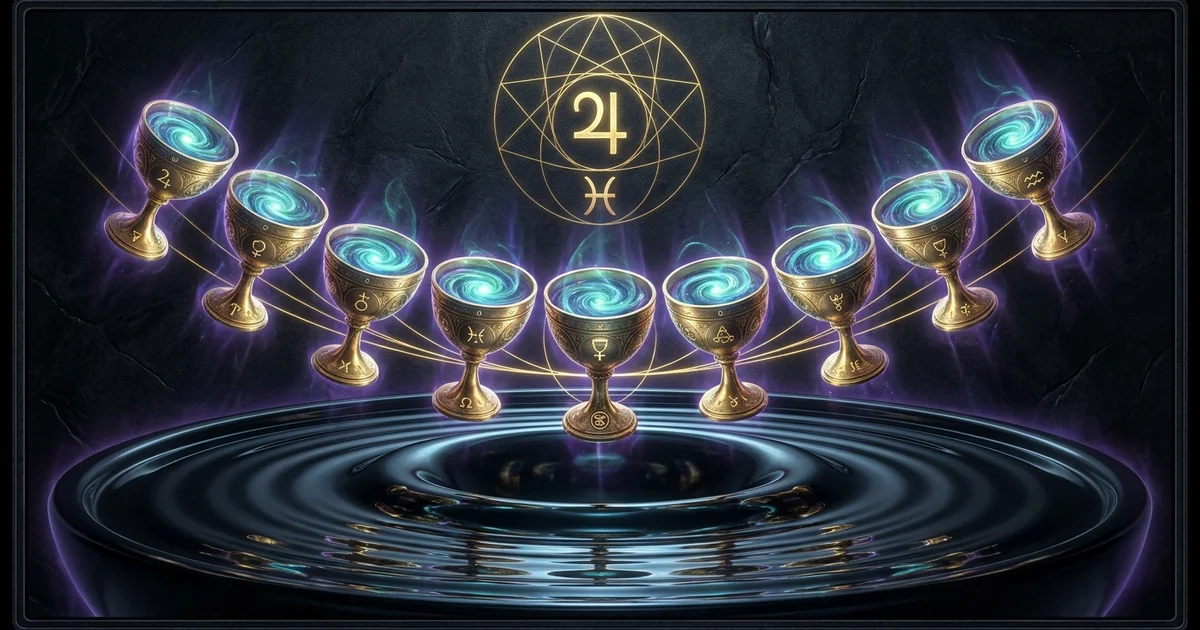
Nine of Cups: Soul Fulfillment and Emotional Abundance
Archetypal Thesis & Systemic Paradigm: The Mechanics of Emotional Homeostasis
The Nine of Cups represents the systemic stabilization of affective currents within Briatic Yesod. It does not function as an emblem of trivial, hedonistic “wish-fulfillment”—a reductive designation inherited from late-nineteenth-century parlor cartomancy—but as an intricate psycho-cosmic equilibrium wherein conscious volition and the unconscious water element achieve structural and operative coherence.
Within the architectural hierarchy of the Western Mystery Tradition, every minor arcanum serves as an energetic vector mapping the descent of divine intent through elemental consolidation. In this specific minor card of the cups suit elemental water pathways, the volatile fluctuations of the astral plane crystallize into an interior reservoir of emotional abundance. This consolidation marks an ontological threshold: the personality secures an autonomous center of gravity capable of withstanding external turbulence, while simultaneously confronting the structural vulnerabilities of self-contained solipsism and narcissistic inflation.
Yesod in Briah: The Lunar Astral Matrix Grounded in Fluidic Will
To comprehend the deeper mechanics of the nine of cups tarot meaning, one must map its position upon the Tree of Life. The sphere of Yesod (Foundation) constitutes the ninth Sephira, the vital etheric-astral engine that collects, condenses, and synthesizes the emanations of the preceding eight Sephiroth before precipitating them into the dense physical baseline of Malkuth. When Yesod is situated within Briah—the archangelic, creative World of pure Water—its native lunar, reflective characteristics operate upon the element of human emotion, instinctual longing, and unconscious desire.
In this alignment, analyzed extensively in Yesod as the astral foundation in Briah, the fluidic and mutable nature of water ceases to be an uncontained oceanic deluge. Instead, it encounters the structural organizing principle of the Foundation. Yesod provides the psychic container: a lunar matrix that receives the solar-tipherethic light and mirrors it downward without dispersion.
Consequently, the Nine of Cups models the creation of an interior psychic cistern. The instinctual libido is neither repressed through ascetic austerity nor scattered into neurosis; it is gathered, pressurized, and brought into homeostatic balance. The human psyche experiences this structural state as deep soul fulfillment, an affective baseline where subjective needs and archetypal currents resonate in harmonic unison.
The Dynamic Equilibrium of the Number Nine as Entelechy of the Minor Arcana
Numerologically, nine represents the dynamic apex of single-digit progression—the number of completion, integration, and final consolidation prior to the systemic collapse and inevitable transition signaled by the decade. In the minor arcana, the nines represent an entelechy: the complete actualization of a suit’s potential, operating at the height of its elemental nature before grounding into concrete matter.
This entelechy becomes pronounced when tracing the suit’s evolutionary sequence from the desolation of the Eight of Cups archetypal passage. Where the Eight demands a painful Saturnian renunciation—an acknowledgment that the previous structures of emotional satisfaction have turned stagnant, forcing the ego to journey into the barren mountains of psychic withdrawal—the Nine marks the triumphant psychic re-emergence.
The libido, having divorced itself from toxic or outgrown external projections during the passage of the Eight, turns entirely inward. Within the crucible of this interior reorientation, the energy does not dissipate into depressive apathy; rather, it discovers an inexhaustible, self-generating wellspring. The Nine of Cups is the psychological consequence of surviving the dark night of the affective senses: a consolidated emotional independence that no longer relies on the capricious validation of the external world.
Transmuting Hedonistic Wish Fulfillment into Conscious Psychic Plenitude
The persistent popular categorization of the Nine of Cups as the unvarnished “wish card” represents a fundamental failure of modern exoteric divination to understand the cybernetics of desire. In vulgar cartomancy, a “wish” is conceived as an arbitrary appetite satisfied by an external, benevolent demiurge. Esoterically, a wish is the unconscious seeking systemic equilibrium through archetypal attraction.
When the Nine of Cups appears, the fulfillment it signals is the product of an alignment between conscious intent and unconscious receptivity. The individual experiences “good fortune” because their affective field has ceased broadcasting contradictory, self-sabotaging interferences.
The psychological energy, no longer spent maintaining defensive repressions or longing for unreachable external targets, pools within the subject as felt contentment. Psychic plenitude is achieved when the ego surrenders its frantic, grasping posture and adopts an attitude of open, expectant containment. The wish is fulfilled not because the cosmos bends to egoic vanity, but because the ego has finally inhabited the exact vibrational frequency of its underlying Briatic blueprint.
Classical Provenance & Textual Lineage: From Mathers’ ‘Material Happiness’ to Waite’s Wish Card
The hermeneutic evolution of the Nine of Cups reflects a steady transition from occult systemic taxonomies to iconographic psychological allegories. Tracking this trajectory illuminates how the card’s fundamental attribution has been refracted through different ceremonial and psychological lenses over the past two centuries.
Golden Dawn Attribution: ‘The Lord of Material Happiness’ and Its Hermetic Lineage
In the cipher manuscripts and secret curricula of the Hermetic Order of the Golden Dawn, synthesized by S. L. MacGregor Mathers and W. W. Westcott in Book T (1888), the Nine of Cups was assigned the official title of “The Lord of Material Happiness.” The Golden Dawn system operated with strict structural rigor, deriving card interpretations directly from the intersection of decan, planet, sign, and Sephira.
“Nine of Cups: The Lord of Material Happiness… Attributed to Yesod in the World of Briah; Jupiter in Pisces. Complete success, pleasure and happiness; physical well-being. But with a liability to vanity, self-sufficiency, and idle dissipation.” — S. L. MacGregor Mathers & W. W. Westcott, Book T: The Tarot (1888)
Mathers and the Golden Dawn hierophants recognized that while this card marked the apex of affective well-being within the material and etheric spheres, its very perfection harbored an insidious spiritual trap. The attribution to Yesod—a lunar, astral sphere—ensures that the “happiness” attained has a seductive, hypnotic quality.
Because the conditions of the Briatic world are fluid and imaginative, the subjective feeling of abundance can easily detach from objective reality. The Golden Dawn warned that when this force remains ungrounded or over-emphasized, it devolves into moral lethargy, smug self-satisfaction, and the premature cessation of spiritual striving. The initiate was cautioned against mistaking the comforting harbor of Yesod for the ultimate shore of Kether.
Pamela Colman Smith’s Visual Iconography: The Feast, the Curtain, and the Folded Arms
When Arthur Edward Waite commissioned Pamela Colman Smith to illustrate the Rider-Waite-Smith (RWS) deck in 1909, he sought to externalize these subtle occult attributions into exoteric pictorial emblems. Smith’s visual execution of the Nine of Cups is a masterclass in psychological characterization and esoteric ambivalence.
[ Chalice 1 ] ... [ Chalice 5 ] ... [ Chalice 9 ]
               \             |             /
                [   Arc of Parabolic Armor   ]
                             |
                   [ Draped Cobalt Bench ]
                             |
             [ Seated Figure: Arms Inwardly Folded ]
Smith presents a portly, middle-aged figure seated upon a wooden bench draped in blue fabric. The individual’s arms are folded squarely across his chest, his facial expression projecting a mixture of absolute contentment, sensory satiety, and unyielding self-assurance. Behind him, arranged in an arched, semicircular horizontal row atop a raised ledge covered in the same azure textile, stand nine golden chalices. The background is a flat, unadorned golden-yellow, evoking the solar radiance of Tiphereth illuminating the astral waters of Yesod.
Every artistic choice within this tableau encodes systemic meaning:
- The Folded Arms: While exoteric readers interpret this gesture as pure relaxation or pride, psychoanalytic body-language diagnostics identify it as a classic barrier posture. The figure has sealed his thoracic cavity and heart center; he receives nothing new from the outer world, nor does he pour anything out. He sits as a closed system.
- The Cobalt Drapery: The deep blue fabric covering the bench and supporting the cups explicitly denotes the element of water in its receptive, passive, and reflective mode. The physical structure supporting his emotional harvest is entirely aquatic and psychic.
- The Semicircular Wall of Cups: The nine chalices do not sit upon a banquet table awaiting guests; they are raised behind him like a curved rampart, a defensive fortification constructed entirely of accumulated emotional victories and psychic capital.
Waite himself remarked in The Pictorial Key to the Tarot (1910) that the card represents “concord, contentment, physical bien-être; also victory, success, advantage; satisfaction for the Querent or person for whom the consultation is made.” Yet, true to his method of veiling deeper truths, Waite preserved the visual tension that Smith rendered: this is a satisfaction achieved through complete, deliberate insulation from the surrounding environment.
The Crowleyan Reading: Jupiterian Expansiveness Constrained by Astrological Phase
In The Book of Thoth (1944), Aleister Crowley approached the card—which he titled simply “Happiness”—through an uncompromising astrological and teleological framework. Crowley, alongside artist Lady Frieda Harris, stripped the image of its bourgeois, sedentary human figure, returning the composition to its pure geometric and elemental dynamics.
Crowley posited that the Nine of Cups demonstrates the highest possible beneficence of the Water element precisely because it marries the generous, expansive principle of Jupiter with the deep, sensitive, oceanic current of Pisces. In the Thoth deck, the nine cups are arranged in an orderly, symmetrical pattern of three triangles crowned by a central chalice, all overflowing into one another, resting upon a calm, luminescent sea. Crowley acknowledged that this card represents the absolute fulfillment of water’s nature: it is wine, nectar, and the realization of subjective joy.
However, Crowley’s systemic brilliance lay in his refusal to romanticize this state. He observed that the position of Nine, being structurally adjacent to the Ten, marks an extremely fragile equilibrium. Because it resides in Pisces—a dual, mutable sign ruled by both Jupiter and Neptune—the happiness depicted is inherently static and impermanent:
“The cups are arranged in the form of an equilateral triangle, with one cup at each vertex, and two cups along each side… This card is the best that can be hoped for in the suit of Water. It represents the complete stabilization and perfection of the element. But it also marks the moment just before the catastrophe of the Ten.” — Aleister Crowley, The Book of Thoth (1944)
Crowley’s diagnostic points directly to the thermodynamic reality of psychic life: an emotional current that reaches total containment and self-satisfaction has ceased to flow. In the fluid domain of Briah, the cessation of flow is the immediate precursor to decay.
Structural Mechanics & Symbolic Geometry: Yesod in Briah and Jupiter in Pisces
The psycho-spiritual dynamics of the Nine of Cups are strictly determined by its astrological coordinates. The card corresponds to the second decan of Pisces, mathematically defined as the segment from 10°00’ to 19°59’ of the mutable water sign, ruled by Jupiter under both the traditional Chaldean order of planetary rulerships and the triplicity systems codified by Claudius Ptolemy in the Tetrabiblos.
- Sephira: Yesod (The Foundation / Etheric Receptive Matrix)
- Qabalistic World: Briah (The Creative Archangelic Realm / Elemental Water)
- Astrological Coordinates: 10°00’ – 19°59’ Pisces (Second Decan of Pisces)
- Planetary Ruler (Chaldean & Triplicity): Jupiter
- Sign Modality & Element: Mutable Water
- Tetragrammatonic Formula: The final crystallization of the Vav within the Briatic Heh, bridging toward Heh-final.
Astrological Decan Geometry: The Second Decan of Pisces (10° to 20°)
The second decan of Pisces occupies a unique place in the celestial sphere. Pisces, the twelfth and final sign of the tropical zodiac, represents the oceanic dissolution of forms, the return of differentiated consciousness to the boundless collective unconscious, and the mystical yearning for transcendent union. Within this mutable water matrix, the second decan operates under the direct rulership of Jupiter, the planet of expansion, systemic coherence, spiritual abundance, and structural benevolence.
To explore this transit in depth, consult our foundational treatise on Jupiter in Pisces decan dynamics. When Jupiter operates within its own domicile in the heart of Pisces, the planetary and sign energies exhibit an extraordinary mutual affinity. Ptolemy notes in Book I of the Tetrabiblos that Jupiter’s essential nature is temperate, warming, and moistening—qualities that perfectly align with the natural temperament of water.
In the second decan, this moistening, fertilizing influence prevents the Piscean water from collapsing into the swamp of depressive dissolution or chaotic boundarylessness. Jupiter acts as an expansive yet stabilizing field: it gives the fluidic medium of the unconscious an internal architecture of faith, generosity, and ontological security.
Planetary Dignity Dynamics: Jupiter in Domicile and Exaltation in Water
In classical astrology, Jupiter possesses its traditional domicile in Pisces (sharing rulership with Sagittarius) and its exaltation in Cancer, another water sign. Thus, the element of water is Jupiter’s most fertile operational environment. In the Nine of Cups, this dignity manifests as an interiorized grace.
The expansive nature of Jupiter, when expressed through fire or air, pushes outward to conquer territory, construct philosophical doctrines, or accumulate intellectual authority. When forced into mutable water, however, Jupiter’s expansiveness turns contemplative and visceral. It generates an inward-directed abundance: a profound emotional conviction that the universe is fundamentally hospitable, that one’s needs are met by divine providence, and that psychic fragmentation has been healed.
This state is neither dependent upon external proofs nor terrified of external scarcity. It is an emotional sovereignty rooted in the absolute fullness of the inner life.
Geometric Architecture of the Nine Chalices: The Parabolic Shield of Vessels
The geometric deployment of the nine chalices across both the RWS and Thoth traditions contains a vital topological secret. Nine, as $3 \times 3$, is the triplicity of triplicities. In esoteric sacred geometry, three represents synthesis, the resolution of binary tension, and the establishment of a stable plane. When tripled, this stability achieves self-perpetuating permanence.
In Pamela Colman Smith’s rendering, the nine cups form an arch—specifically, a parabolic curve. In physics, a parabolic surface possesses the unique property of reflecting all incoming parallel rays to a single, consolidated focal point; conversely, a source placed at the focal point projects outward in a powerful, unified, parallel beam.
Symbolically, the seated figure sits directly at the focal point of this psychic parabola:
$$\text{Incoming Affective Rays} \xrightarrow{\text{Parabolic Arch of Cups}} \text{Focal Point (The Consolidated Ego)}$$
The energetic field of the nine cups concentrates all emotional impressions directly into the subject’s conscious center, creating an intense, pressurized experience of selfhood and well-being.
Simultaneously, this parabolic curvature acts as an impenetrable shield. Hostile, chaotic, or discordant psychic waves emanating from the external environment cannot reach the seated individual; they strike the outer convex rim of the chalices and are deflected away.
This parabolic geometry explains both the immense psychic resilience and the profound perceptual blind spot inherent in the card: the subject is brilliantly insulated within their own affective fortress, but they are functionally incapable of perceiving any reality that contradicts their current state of satisfaction.
Psychological Dynamics & Operational Praxis: The Shadow of Narcissistic Solipsism vs. Genuine Individuation
Through the lens of analytical and depth psychology, the Nine of Cups represents a critical, precarious milestone along the path of individuation. It models the psychological moment where the split-off complexes of the personal unconscious have been recognized, retrieved from their external projections, and integrated into the personal sphere, yielding a profound state of affective equilibrium. Yet, this consolidation brings forward a shadow: the inflation of the ego that mistakes its temporary balance for absolute, cosmic realization.
The Ego-Self Axis and the Complex of Self-Satiation
In the psychological framework established by Carl Gustav Jung, psychological health depends upon the establishment of a conscious, functional link between the ego (the center of conscious identity) and the Self (the archetypal organizing center of the total psyche). This dynamic connection is known as the ego-Self axis.
The Nine of Cups documents a stage of development where the ego-Self axis has stabilized to such an extent that the ego feels genuinely supported by the transpersonal matrix. The chronic feelings of lack, alienation, and unworthiness that plague the un-individuated personality are dissolved by an influx of numinous, Briatic water. The subject feels fundamentally “at home” within their own psychological skin.
However, this stabilization carries an inherent systemic danger. When the ego is infused with the healing, expansive energies of the Self, it is prone to identifying with those energies. Instead of serving as a modest, clear reflector of the archetypal Self, the ego absorbs the credit, proclaiming: “I have achieved this wholeness through my own virtue.” This marks the genesis of the complex of self-satiation: an emotional autarky where the subject believes they no longer require relational nourishment, external challenge, or transcendent correction.
Individuated Emotional Fulfillment
- Boundary Dynamics: The psychic boundary is firm yet semi-permeable; the ego remains fully capable of authentic relational reciprocity without losing its structural integrity.
- Locus of Nourishment: Satiety is recognized as a transpersonal gift mediated by the archetypal Self; conscious ego assumes the role of a humble steward.
- Shadow Awareness: Continual, vigilant acknowledgment of the proximity of the Ten of Cups; awareness that containment without circulation results in decay.
- Affective State: Serene, quietly joyful, radiant, grounded in somatic and emotional gratitude; open to external correction.
Narcissistic Self-Containment
- Boundary Dynamics: The boundary is rigid, defensive, and impermeable; external feedback is systematically rejected to preserve the illusion of emotional invulnerability.
- Locus of Nourishment: Satiety is claimed as an exclusive achievement of the conscious ego; external dependencies are aggressively denied.
- Shadow Awareness: Total repression of underlying fragility; reliance on defensive smugness, material accumulation, or intellectual superiority.
- Affective State: Smug, self-satisfied, patronizing, defensively cheerful; susceptible to severe decompensation if the container is breached.
The Smugness Paradox: Defense Mechanisms of the Satisfied Ego
The visual marker of the folded arms in the Nine of Cups flags the card’s primary clinical shadow: the defense mechanism of the satisfied ego, colloquially identified as “smugness.” Smugness is not merely a social unpleasantness; it is an active, aggressive psychological defense designed to protect a newly won emotional equilibrium from the threat of regression.
When an individual has clawed their way out of the emotional desolation depicted in the Eight of Cups, the psychological territory secured in the Nine is guarded with ferocity. The ego recognizes, on an unconscious level, how fragile this Jupiterian-Piscean peace actually is. To allow any disruptive external reality—such as the pain of an intimate partner, the ethical demands of the community, or unresolved unconscious material—into the psychic perimeter would threaten to shatter the calm waters of Yesod.
Consequently, the ego constructs a closed feedback loop:
- Idealization of the Current State: The individual pathologically overvalues their personal contentment, reframing all forms of external distress as the fault of those who suffer.
- Affective Isolation: Emotional intimacy is subtly curtailed; the individual engages in social interactions only on terms that do not disrupt their internal status quo.
- Spiritual Bypassing: Esoteric or psychological language is deployed to justify emotional non-involvement, mistaking cold psychological detachment for advanced spiritual transcendence.
This creates the “narcissistic bubble,” an autopoietic system that processes only the data that validates its own perfection while discarding all dissonant signals.
Clinical Interpretation in Divinatory Consultations: Navigating Emotional Autonomy
When the Nine of Cups emerges in an analytical or divinatory consultation, the clinician or esoteric practitioner must resist the urge to deliver a simplistic prognosis of unencumbered joy. The card demands a nuanced diagnostic inquiry into the client’s affective economy.
The central operational question posed by the card is: Is the client’s current emotional fulfillment an authentic expression of integrated individuation, or does it represent a defensive retreat into a self-congratulatory fortress?
If the card appears in a context of long-standing creative struggle, trauma recovery, or relational extraction, it heralds an era of hard-won, legitimate psychic healing. It indicates that the individual has successfully established an inner container capable of processing and containing the water element without leaking into neurosis.
Conversely, if the card emerges in a position denoting relational dynamics, partnerships, or collaborative endeavors, it operates as a stark diagnostic warning. It frequently flags a partner who has completely emotionally checked out of the relational field, sitting smugly upon their azure bench, surrounded by their personal trophies of satisfaction, entirely unwilling to extend vulnerability, empathy, or tangible resources to the other. In such cases, the card warns that the individual’s “wish” has come at the expense of genuine relational intersubjectivity.
Philosophical Synthesis & Macrocosmic Correspondence: Hermetic Fluidics and the Alchemy of Abundance
To fully appreciate the metaphysical dimensions of the Nine of Cups, the card must be extracted from the isolated domain of individual psychology and situated within the macrocosmic mechanics of Western Hermeticism and comparative esoteric philosophy.
The Law of Ingathering and the Alchemical Circulation of Moisture (Circulatio)
In Hermetic alchemy, the Work is fundamentally an operation upon the subtle moisture of the cosmos—the humidum radicale. The alchemical operation that corresponds directly to the Nine of Cups is Circulatio: the continuous, cyclical distillation, condensation, and gathering of the psychic fluid within the sealed vessel of the alembic.
       [ Distillation: Vapor Ascends to Apex ]
                      |              ^
                      v              |
       [ Condensation: Drops Settle into Base ]
                      \              /
                [ Circulatio: The Ingathering ]
Abundance, from the Hermetic perspective, is never a static inventory of material wealth or an uninterrupted succession of pleasurable emotional events. Such a view confuses the vessel with the fluid. True abundance is the mastery of the Law of Ingathering.
In Circulatio, the volatile emotional impulses that scatter outward into the world are heated by conscious introspection, evaporated away from their base attachments, condensed upon the cold glass of spiritual awareness, and collected at the bottom of the vessel as a purified, life-giving elixir.
The nine golden chalices depicted in the card are not merely cups; they are alchemical receivers. They represent the nine interior centers—the bodily and psychic chakras—that have been cleared of energetic blockages and filled to the brim with the circulated moisture of the integrated soul. The figure does not need to actively drink from them because his entire subtle body is immersed in their etheric field. This is the esoteric secret of Briatic Yesod: the foundation is not built of stone, but of a crystallized fluidic essence that sustains life from within.
I Ching Resonances: Trigram Dui (The Joyous Lake) and Hexagram 58
This Hermetic fluid dynamic finds an exact structural parallel in the ancient Chinese mantic system of the I Ching (The Book of Changes). The energetic signature of the Nine of Cups resonates deeply with Hexagram 58: 兌 (Dui / The Joyous, Lake).
Hexagram 58 is composed of the trigram Dui (Lake, Water collected in a basin, the Joyous) doubled: Lake resting over Lake. The commentary on the image in the Wilhelm-Baynes translation of the I Ching states:
“Lakes resting one on the other: The image of the Joyous. Thus the superior man joins with his friends for discussion and practice.”
The doubled lake represents water that does not run away or evaporate into arid air; instead, two lakes replenish each other, mutually sustaining their depth without draining their resources. This is the exact Taoist equivalent of the Nine of Cups’ homeostatic equilibrium.
Dui represents an inner firmness (the two solid yang lines at the bottom of each trigram) combined with an outer yielding and sweetness (the broken yin line at the top). The joy of Dui is not the superficial, manic pleasure of a sudden triumph; it is the deep, peaceful, self-sustaining nourishment that arises when the internal reservoir is full.
The warning of Hexagram 58 mirrors the Golden Dawn caution precisely: if the joy is pursued merely for sensual indulgence, it quickly leads to degradation and ruin. Joy must remain rooted in inner structural truth; otherwise, the waters of the lake turn foul and stagnant.
The Nine as Threshold to the Ten: The Inevitability of Entropic Saturation
The ultimate metaphysical lesson of the Nine of Cups lies in its absolute finitude. Within the decimal architecture of the minor arcana, the number nine is the absolute summit of individual consciousness. It is the monad fully realized, resting inside its own perfected perimeter.
Yet, precisely because it is the summit, it is ontologically unstable.
Immediately following the Nine comes the Ten of Cups familial wholeness. In the Ten, the solitary, self-contained joy of the Nine can no longer sustain its isolation. The parabolic shield of the nine chalices ruptures outward under the sheer pressure of its accumulated moisture, bursting into the collective sphere of the family, the community, the generational legacy, and the overarching cosmic rainbow.
“The sea is the symbol of the collective unconscious, because unfathomed depths lie concealed beneath its reflecting surface… An emotional inflation threatens to wipe out the boundary between the ego and the unconscious, dragging the individual down into the archaic, undifferentiated mass mind. Containment within a conscious vessel is the sole defense against this dissolution.” — Carl Gustav Jung, Aion: Researches into the Phenomenology of the Self (1951)
The transition from the Nine to the Ten is a necessary movement from individual soul fulfillment to collective entanglement. In the Ten of Cups, the fulfillment is shared, institutionalized, and brought down to earth; but in that very grounding, it loses the pristine, luminous intensity of the solitary Nine. The Ten brings the domestic responsibilities, the biological duties, and the thermodynamic entropic burden of maintaining an emotional legacy over time.
The Nine of Cups is the fleeting, sublime moment just before that dispersal—the quiet afternoon where the alchemical gold rests purified in the receiver, perfect, undisturbed, and entirely one’s own.
Frequently Asked Questions: Resolving Advanced Esoteric and Psycho-Spiritual Paradoxes
Why is the Nine of Cups Historically Denoted as the ‘Wish Card’?
The colloquial designation of the Nine of Cups as the “wish card” traces its lineage directly to late-eighteenth and nineteenth-century continental cartomancy and British folk divination. In these informal, non-initiatic systems, complex Qabalistic and astrological architectures were routinely simplified into accessible aphorisms suitable for rapid fortune-telling.
The metaphysical reality behind this designation, however, rests upon the profound astrological and Qabalistic harmony of Jupiter operating within the watery foundation of Yesod in Briah. In classical astrology, Jupiter is the Fortuna Major—the great benefic responsible for increase, grace, and expansion. When this planetary force saturates Yesod (the realm of the subconscious mind and the etheric blueprint of manifestation), the natural friction between human yearning and objective reality is temporarily suspended.
The card represents a convergence where the querent’s conscious desires (solar/volitional) fall into perfect synchronization with their unconscious, archetypal currents (lunar/Briatic). The “wish” appears to grant itself automatically because the individual’s internal resistance has dissolved.
In serious esoteric cartography, the practitioner must emphasize to the querent that this state is not an arbitrary dispensation of luck, but the direct result of having navigated previous elemental trials—specifically the emotional purges and disillusionments of the earlier cards in the suit—to arrive at an affective state that can genuinely receive what it requests without immediately destroying it through guilt, unworthiness, or neurosis.
How Does the Reversed Nine of Cups Diagnose Psychopathology or Spiritual Blockage?
When inverted or severely ill-dignified in a consultation, the structural equilibrium of the Nine of Cups shatters, exposing the pathology latent within its self-contained architecture. Esoteric diagnosis does not interpret the reversal simply as a “wish denied,” but rather as a catastrophic failure of the psychic vessel itself.
[ Normal Flow: Equilibrium ]     [ Inversion: Breached Wall ]
             |==============|                  \              /
             |   Yesod in   |                   \  Briatic   /
             |    Briah     |                    \ Spillage /
             |==============|                     \________/
                    ||                                ||
         [ Stable Internal Axis ]             [ Affective Bulimia ]
The reversed Nine of Cups manifests through several distinct psycho-spiritual diagnostic profiles:
- Affective Bulimia and Gluttony: The defensive, parabolic arch of cups collapses inward. The individual, unable to experience genuine internal satiation due to an unhealed core wound of lack, attempts to substitute quantitative sensory consumption for qualitative soul nourishment. This results in physical overindulgence, addiction, sexual compulsivity, or chronic material hoarding—an attempt to fill an etheric void with physical mass.
- The Rupture of the Narcissistic Bubble: If the client has constructed a false, smug, defensive emotional ecosystem to avoid external vulnerability, the reversal indicates an aggressive, non-negotiable breach of this barrier by the objective psyche. The outer world forcibly intrudes upon the individual’s isolated sanctuary, precipitating acute disillusionment, depressive decompensation, and the agonizing collapse of egoic grandiosity.
- Affective Stagnation (The Sullen Cistern): When water does not circulate, it putrefies. The reversed Nine of Cups diagnoses an emotional life that has become so hyper-protected, insular, and self-referential that it has grown toxic. The individual experiences a total loss of creative vitality, characterized by chronic cynicism, hypochondria, and a bitter, resentful withdrawal from human fellowship.
What Differentiates the Solitary Fulfillment of the Nine from the Relational Abundance of the Ten of Cups?
The categorical boundary between the Nine and the Ten of Cups represents one of the most vital architectural thresholds in the entire Tarot system. It is the ontological distinction between monadological, interior fulfillment and systemic, collective integration.
The Nine of Cups is resolutely solitary. Pamela Colman Smith drew a single individual seated alone upon his bench; Crowley depicted vessels operating in an enclosed, sacred geometry.
The Nine models the self-sufficiency of the individuated soul that has discovered the source of all nourishment within the divine ground of its own being. It requires no partner, no family, no social applause, and no institutional framework to validate its joy. It is the peace of the hermit who has found the living waters inside his cave—a purely interior, subjective realization of Briatic grace.
In contrast, the Ten of Cups completely dissolves this solitary boundary:
- The scene moves from the private, curtained interior out into an expansive open landscape.
- The single seated figure is replaced by a bonded human dyad and dancing children.
- The horizontal, protective arch of cups is projected high into the celestial atmosphere as an overarching rainbow, bridging heaven and earth over a communal homestead.
While the Ten of Cups represents the glorious socialization and relational grounding of emotional abundance—the establishment of family, tribe, and enduring domestic harmony—it also introduces systemic dependencies that the Nine transcends.
In the Ten of Cups, one’s happiness becomes bound to the fate of the collective; it must endure the wear and tear of time, interpersonal conflict, economic maintenance, and biological decay. The Nine of Cups, in its supreme, crystalline isolation, remains uncontaminated by the compromises inherent in human relationships. It is the rare, absolute zenith of subjective affective sovereignty—an unshakeable soul fulfillment that is entirely, immutably, and radiantly complete within itself.