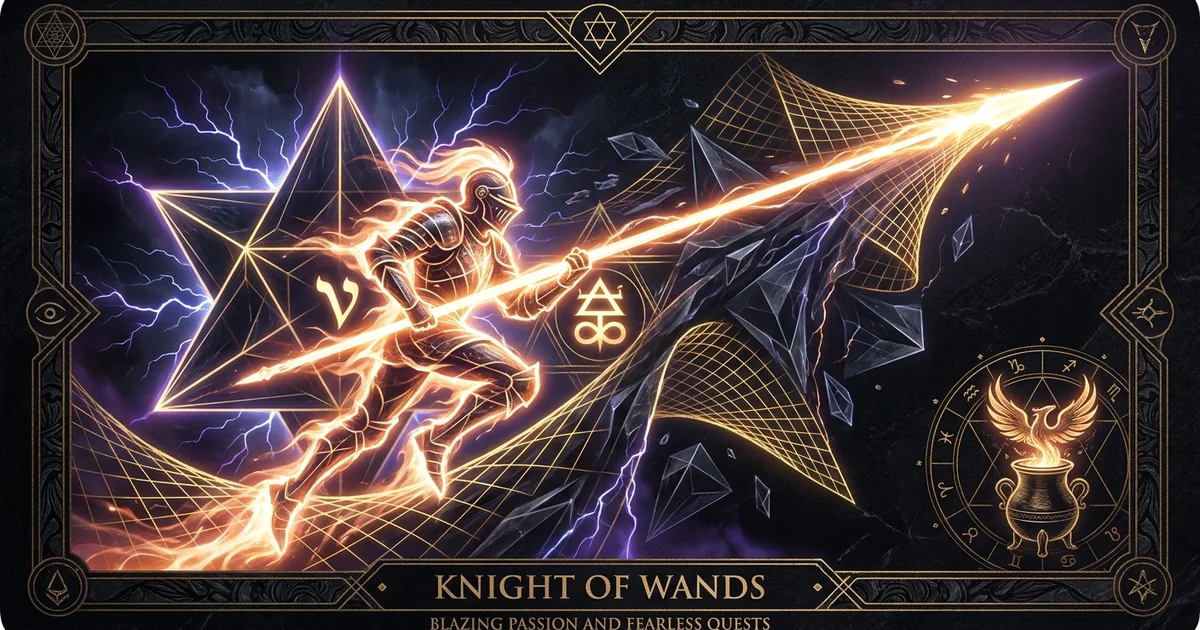
Knight of Wands: Blazing Passion and Fearless Quests
Archetypal Thesis & Systemic Paradigm: Kinetic Ignition of the Will
Within the structural mechanics of Western esoteric cartography, the Knight of Wands represents the kinetic vectorization of archetypal Fire. Rather than operating merely as an impulsive characterological trope or an unpredictable adventurer, this arcanum functions as a non-equilibrium, entropic catalyst within psychic state-space. It embodies the definitive phase transition where pure, unmanifest spiritual volition—originally concentrated in the primordial singularity of the suit—crystallizes into urgent, outward teleological velocity. In the grammar of the wands suit, where the primordial element of Fire governs divine will, aspiration, and the primal life-force, the Knight is the dynamic vehicle through which latent potential violently uncoils into space-time.
The Thermodynamics of Elemental Fire in the Wands Suit
To comprehend the operational framework of this arcanum, one must first analyze the thermodynamics of the fire element as it ascends through the four worlds of Qabalah. In the realm of Atziluth (the Archetypal World), Fire exists as pure, undifferentiated radiatory presence: the uncontained Yod of the Tetragrammaton. This primordial combustion lacks teleological trajectory until an operational operator imposes directional momentum. The Knight functions precisely as this dissipative structure.
Thermodynamically, an open system requires a continuous throughput of energy to sustain coherent complexity far from equilibrium. The Knight of Wands constitutes such an energetic flux channel, preventing the creative surge of the suit from stagnating into self-referential heat death or degenerating into diffuse astral vapor. By converting pure latent heat into kinetic force, the Knight acts as the psychic engine’s piston stroke, driving internal spiritual combustion outward to reshape empirical reality.
Kinetic Libido vs. Static Potential: The Volitional Phase Transition
In analytical psychology, this transition models the movement of psychic energy (libido) from potentiality to immediate kinetic manifestation. While the Ace of Wands represents raw undifferentiated libido concentrated at the source, and the Queen of Wands provides an internal reflective vessel to incubate and sustain it, the Knight of Wands insists upon immediate externalization. This volitional phase transition demands an abrupt collapse of contemplative latency in favor of dynamic friction.
The Knight cannot endure passive incubation. If the generated libido is denied an external vector of conquest, creative expression, or heroic confrontation, the pressure does not dissipate; instead, it undergoes pathological internal reflection. The psychic system experiences intense isobaric compression, which invariably leads to neurosis, manic ideation, or spontaneous psychic combustion. The Knight’s non-negotiable imperative is the immediate discharge of energetic tension across a tangible horizon of achievement.
The Knight as the Systemic Operator of Teleological Velocity
Within the cartomantic matrix, the Knight occupies a unique systemic locus. He is distinct from the contemplative Kings, who possess sovereign systemic integration and govern established domains, and fundamentally differentiated from the receptive, magnetic interiority of the Queens. The Knight is defined entirely by teleological velocity; his reality is synonymous with trajectory. He does not hold territory; he traverses it. He does not cultivate sustained institutional structures; he breaches them.
In this capacity, the Knight serves as the operational operator of absolute intentionality. His appearance in an analytical matrix signals that the phase of theoretical formulation, ethical deliberation, and structural preparation has irrevocably concluded. The system has crossed a critical threshold, crossing a bifurcation point where the only path to systemic coherence lies in accelerated forward motion. The overarching knight of wands tarot meaning is grounded in this inexorable, self-actualizing velocity.
“The libido is fire, both creative and destructive: it is the creative force of life, and it is also the destroying fire of passion. Fire is an archetype of the libido itself, a symbol of psychic energy in its most intense and unbridled form, which must either consume the vessel that contains it or find a channel through which it may transform the world.” — C.G. Jung, Symbols of Transformation (Collected Works Vol. 5), par. 182.
Classical Provenance & Textual Lineage: From Cypher Manuscripts to Modern Hermeticism
The taxonomic evolution of the Knight of Wands reveals a profound shift in Western esoteric thought regarding the classification and function of the court arcana. Originating in the fifteenth-century Italian trionfi decks as the Cavaliere di Bastoni, the figure was initially situated within a feudal hierarchy of social and chivalric strata. However, the emergence of nineteenth-century occult synthesis elevated this card from a mundane characterological signifier into an intricate node within a multidimensional cosmological matrix.
Hermetic Order of the Golden Dawn: The Lord of the Flame and the Lightning
In the late nineteenth century, the Hermetic Order of the Golden Dawn radically systematized the Tarot by mapping the cards onto the Tree of Life and the astrological zodiac, as recorded in S.L. MacGregor Mathers’ seminal Book T. Within this paradigm, the figure traditionally known as the King of Wands was re-titled the “Lord of the Flame and the Lightning: King of the Spirits of Fire.” The Golden Dawn reassigned the traditional mounted warrior to embody the dynamic, paternal, and catalytic functions of the element.
“The King of the Spirits of Fire: The Lord of the Flame and the Lightning. A winged warrior king, crowned, riding upon a black horse, bearing a flaming wand and dressed in armor upon which is the symbol of a winged horse. He is the active and generative power of Fire, ruling from the 20th degree of Scorpio to the 20th degree of Sagittarius, commanding the celestial forces with suddenness, swiftness, and uncontrollable vigor.”
Under Mathers’ framework, this figure was attributed to the Yod of the divine name Tetragrammaton, designating him as the primal initiator within the court sequence. This structural assignment emphasized the card’s sudden, lightning-like qualities—an energetic current capable of illuminating darkness with visionary brilliance or annihilating fragile psychic infrastructure with equal indifference.
Waite-Smith Visual Hermeneutics: The Salamander Robes and Desert Topography
When Arthur Edward Waite and Pamela Colman Smith reformed the deck’s iconography in 1909, they retained the chivalric title of “Knight” for the mounted warrior while embedding subtle Rosicrucian and alchemical iconography into the composition. The Knight of Wands in the Rider-Waite-Smith (RWS) deck rides an aggressive, russet-maned stallion whose posture borders on rearing, captured mid-stride across an arid, sun-scorched desert marked by distant pyramidal dunes.
The environment represents pure fire untamed by lunar moisture or terrestrial vegetation. It is a psycho-spiritual landscape stripped of superfluous emotional cushioning. The Knight’s yellow tunic is adorned with the ouroboros-salamander—an alchemical creature capable of surviving and thriving within elemental combustion. Significantly, unlike the salamanders on the King of Wands’ mantle, which bite their own tails to form closed circles representing completed elemental mastery, the salamanders on the Knight’s tunic remain open-ended. Their tails do not meet their mouths, visually signaling unspent momentum, boundless expansion, and a process of spiritual development that refuses circular containment. Red plumes erupt like living flame from his helmet and arm joints, visually asserting that his very armor is not merely a defensive shell, but an exhaust port for internal volcanic pressure.
The Crowleyan Transposition: Knights, Princes, and Elemental Dignities
A critical bifurcation in esoteric lineage occurred with Aleister Crowley’s publication of The Book of Thoth (1944). Crowley restored the Golden Dawn’s structural schema by identifying the mounted warrior as the “Knight” representing the primal Fire of Fire (Yod), while reclassifying the RWS “Knight”—the young, mobile warrior on horseback—as the “Prince,” representing the Air of Fire (Vav).
In Crowley’s system, the Knight rides a black stallion through sheets of flame, representing the creative, catalytic father-impulse of Chokmah in Atziluth. Meanwhile, the Prince sits in a chariot drawn by a lion, epitomizing the mentalized, directed, and volatile application of that will through the mediator of Tiphareth. Despite this nomenclature shift, analyzing the knight of wands symbolism across both systems reveals a shared metaphysical objective: capturing the volatile transmission of spiritual momentum before it solidifies into material equilibrium. When examining elemental dignities via court card dynamics, the card must be recognized as an explosive, highly unstable reagent that accelerates the tempo of surrounding symbols.
Structural Mechanics & Symbolic Geometry: Astrological Decans and Qabalistic Paths
The systemic integrity of the Knight of Wands rests upon its precise mathematical and celestial coordinates. Rather than being confined to a single astrological sign, the Golden Dawn decanic system maps the court cards across dynamic thirty-degree bands of the zodiac, capturing the transitional mechanics between distinct elemental modalities.
Decanic Trajectory: Spanning 20° Scorpio to 20° Sagittarius
The Knight of Wands governs the celestial arc from the 20th degree of Scorpio to the 20th degree of Sagittarius. This geometric alignment establishes a profound esoteric bridge. The card encompasses:
- The third decan of Scorpio (20°–30° Scorpio, ruled astrologically by Mars and the Moon/Venus depending on the system, attributed to the Seven of Cups), and
- The first two decans of Sagittarius (0°–10° Sagittarius, ruled by Mercury and attributed to the Eight of Wands; and 10°–20° Sagittarius, ruled by the Moon and attributed to the Nine of Wands).
This decanic trajectory operates as a psycho-spiritual bridge between chthonic, fixed Water (Scorpio) and mutable, astral Fire (Sagittarius). The Knight draws its raw, volcanic propulsion from the deep emotional underworld of Scorpio’s calcining depths, transmutes that volatile intensity, and releases it as the expansive, philosophical, and visionary arrow of Sagittarius. It is precisely this decanic architecture that gives the Knight his restless, questing velocity; he is escaping the oceanic pressure of Scorpio by igniting the visionary horizon of the Centaur. This decanic shift can be cross-referenced through the decan rulership system.
Elemental Blending: Air of Fire vs. Fire of Fire Formalisms
In the structural matrix of the Golden Dawn and RWS systems, the Knight represents the sub-elemental formula of Air of Fire (assigned to the letter Vav of the Tetragrammaton). In this formulation, Fire provides the underlying energy, drive, and combustion, while Air provides the kinetic transmission, intellectual volatility, and rapid atmospheric spread.
Air feeds Fire, accelerating its rate of consumption and granting it mobility; conversely, Fire heats Air, causing rapid thermal expansion and generating turbulent convection currents. This dynamic explains the Knight’s tendency toward visionary articulation coupled with structural instability. His mind (Air) is constantly ignited by the fiery will (Fire), producing an intellect that operates in intuitive flashes, hyper-accelerated problem solving, and an absolute intolerance for administrative friction.
Conversely, in the Crowleyan paradigm, where the mounted figure is the Knight proper, he operates as Fire of Fire—pure Yod combustion. Here, the energy loses its gaseous expansiveness and becomes a focused laser of divine lightning. In both systems, however, the card resists stability. It is an archetype that exists exclusively in dynamic tension, demanding an unceasing supply of fresh fuel to sustain its structural existence.
Sub-elemental Vectorization: Chokmah-Tiphareth Interplay
On the Qabalistic Tree of Life, the energetic vector of the Knight of Wands maps to the kinetic mediation between the paternal spark of the Sephira Chokmah (Wisdom) and the solar harmony of Tiphareth (Beauty/Harmony). Chokmah represents the dynamic, outward, non-rationalized impulse of the primary will—the cosmic phallus penetrating the void. Tiphareth represents the conscious self, the solar center where divine archetypes are brought into human equilibrium.
The Knight serves as the swift, descending lightning flash connecting these two spheres. He extracts the unmitigated, transcendent fire of Chokmah and rushes it downward toward the solar ego of Tiphareth. This path is hazardous: if the ego in Tiphareth is unfortified or unpurified, the sudden influx of the Chokmah-fire produces massive spiritual inflation. The practitioner ceases to be a conscious channel for the Divine Will and instead falls prey to megalomania, believing their personal, temporal desires to be absolute cosmic mandates.
Psychological Dynamics & Operational Praxis: The Puer Archetype and Consultative Strategy
When translating these cosmological mechanics into depth psychology, the Knight of Wands emerges as a primary manifestation of the Puer Aeternus—the eternal youth whose brilliant spiritual luminescence is matched only by his profound estrangement from the mundane obligations of physical reality.
The Puer Aeternus Syndrome: Genius, Restlessness, and Pathological Flight
As illuminated by Marie-Louise von Franz in her definitive work The Problem of the Puer Aeternus, this archetype is characterized by a persistent refusal to commit to the spatiotemporal limitations of material existence. The Puer lives in a state of perpetual anticipation: the true life, the magnificent quest, the magnum opus, has not yet begun; what is occurring presently is merely a preliminary rehearsal.
The Knight of Wands exemplifies this exact intrapsychic posture. He possesses unmistakable visionary genius, immense personal charisma, and the capacity for superhuman bursts of creative or heroic effort. However, because his energetic signature is elemental Fire ungrounded by Earth, he harbors an unconscious, visceral dread of mundane continuity.
Routine, institutional maintenance, domestic obligations, and long-term methodical labor are perceived not merely as tedious, but as existential threats—swampy waters that threaten to extinguish his vital flame. He therefore remains in perpetual flight, perpetually galloping toward a magnificent horizon, abandoning projects, relationships, and territories the moment they demand the slow, patient labor of material stabilization.
Shadow Volatility: Impulsivity, Hubris, and the Scorched-Earth Complex
The shadow manifestation of the Knight of Wands is characterized by destructive hubris and the psychological phenomenon known as the “scorched-earth complex.” Because the Knight’s focus is calibrated exclusively to the forward vector of his quest, his peripheral awareness of collateral damage is virtually non-existent.
In interpersonal dynamics, this archetype operates through charismatic consumption: he draws others into the orbit of his fiery vision, consumes their emotional and material resources to fuel his immediate drive, and departs without malice or remorse when the fire burns down to embers. His shadow is marked by:
- Severe volatility, an explosive temper, and acute cognitive impatience.
- Compulsive contrarianism, mistaking reactionary defiance for authentic individual will.
- The inability to process failure; when halted by insurmountable obstacles, the ungrounded fire turns inward, oscillating rapidly between manic defiance and deep, psychically paralyzed exhaustion.
Upright Expression: Directed Teleology
- Dynamic Initiation: Transmutes static creative ideation into immediate, high-velocity physical and material momentum.
- Visionary Audacity: Fearless confrontation of systemic inertia; breaks through entrenched psychic complexes and institutional stagnation.
- Electrifying Charisma: Capable of inspiring collective mobilization and rallying disparate forces toward a singular, transcendent objective.
- Agile Problem-Solving: Intuitive, lightning-fast tactical adjustments under crisis conditions; thrives in high-entropy, volatile environments.
Reversed Expression: Entropic Dissipation
- Manic Scattershot: Total loss of teleological focus; initiates dozens of volatile vectors simultaneously, abandoning all before maturation.
- Scorched-Earth Hubris: Leaves a wake of emotional, professional, and systemic destruction due to an absolute refusal to acknowledge personal limitations.
- Pathological Restlessness: Deep terror of commitment, terrestrial grounding, and mundane integration; compulsive flight from depth and stillness.
- Burnout & Paralysis: Sudden collapse into absolute energetic exhaustion as ungrounded libido fully incinerates its organic, physical vessel.
Interpretive Mechanics: Upright Teleology vs. Reversed Inertia/Destabilization
In consultative cartomancy and diagnostic evaluation, the appearance of the Knight of Wands demands an immediate assessment of systemic velocity and thermodynamic stability within the querent’s psychic ecology.
When upright, the card indicates that the querent has entered a temporal phase where direct, unhedged action is mandatory. The window for contemplation, risk mitigation, and theoretical modeling has closed. The system requires an injection of audaciously expressed will. The knight of wands tarot meaning here is an imperative toward total commitment to the quest, urging the querent to harness momentum, leverage visionary charisma, and attack systemic stagnation with decisive, uncompromising energy.
Conversely, when reversed, the card indicates an energetic short-circuit. It reveals that the fiery current is operating either as a manic dissipation—wasting vital reserves in scattershot, unfocused conflicts—or as a volatile, defensive posture masking deep fears of failure and irrelevance. The reversed Knight indicates that the querent is galloping frantically on a psychic treadmill, mistaking frantic agitation for authentic progress, or setting fire to their own house to escape the quiet necessity of cleaning it. The analytical remedy is immediate energetic earthing: anchoring the runaway fire into the structural discipline of Earth.
Philosophical Synthesis & Macrocosmic Correspondence: Calcinatio and Cybernetic Volition
To fully understand the transpersonal dimensions of the Knight of Wands, one must look beyond psychological characterology to the macroscopic operations of alchemical transformation, cybernetic feedback mechanics, and solar cosmology.
The Alchemical Calcinatio: Purification Through Consuming Heat
In the alchemical tradition, the Knight of Wands is an operative emissary of the stage known as Calcinatio. As described by Edward Edinger in Ego and Archetype, calcinatio is the operation wherein base material is subjected to relentless, consuming heat until all dross, moisture, and volatile impurities are driven off, leaving behind only the pure, indestructible, white philosophical ash.
- Qabalistic Attribution: Chokmah of Atziluth (Crowley / Primordial Fire) / Vav of Tetragrammaton (Golden Dawn / Air of Fire).
- Astrological Arc: 20° Scorpio to 20° Sagittarius (incorporating the decans of Seven of Cups, Eight of Wands, and Nine of Wands).
- Alchemical Operation: Calcinatio (The burning of egoic dross through the sacred flame of spiritual vocation).
- Planetary Modulators: Mars (instinctual propulsion) shifting into Jupiter (Sagittarian philosophical expansion), modulated by the swiftness of Mercury.
- Elemental Dignity: Highly active, combustible; dry and intensely hot.
The Knight represents the subjective experience of undergoing the calcinatio. His burning passion is not merely an emotional thrill; it is a purgative fire that burns away sentimental illusions, petty attachments, and comfortable ego-identifications. The desert landscape he traverses is precisely the landscape of the calcined soul—a topography stripped of water (unconscious emotionality) so that pure spirit may stand forth without distortion. The Knight is simultaneously the flame and the substance being calcined: in the process of pursuing his fearless quests, his lower, egoic self is continuously consumed to fuel the illumination of his spiritual purpose. For a deeper analysis of this alchemical stage, explore the calcinatio stage of purification.
Cybernetic Feedback Loops: The Dangers of Runaway Positive Feedback
From the perspective of cybernetics and complex systems theory, the Knight of Wands behaves as an unconstrained positive feedback loop. In cybernetic systems, a negative feedback loop introduces error-correcting, damping mechanisms that stabilize the system around an equilibrium set-point (homeostasis). A positive feedback loop, conversely, amplifies deviations from the set-point, driving the system into exponential growth, phase changes, or catastrophic runaway dynamics.
[ Initial Impulse / Will ]
                                  │
                                  ▼
                     ┌───> [ Kinetic Action ] ────┐
                     │                            │
            Positive │                            │ Generates
            Feedback │                            │ New Horizons
            Loop     │                            │
                     └─── [ Charismatic Expansion ] <─┘
                                  │
               (Lacking Negative Feedback / Earth Grounding)
                                  │
                                  ▼
                   [ Systemic Thermal Breakdown ]
The Knight is structurally devoid of native negative feedback. Every successful action he undertakes does not satisfy his drive; it amplifies his appetite for conquest, driving him to seek greater challenges, faster speeds, and higher stakes. In a dynamic system, unchecked positive feedback inevitably drives the architecture toward an ultimate energetic crisis. Unless a damping mechanism—traditionally supplied by the cooling discernment of Water or the stabilizing boundary-work of Earth—is introduced into the system, the Knight’s operational trajectory terminates in thermal breakdown and structural exhaustion.
The Macrocosmic Solar Cycle: Solstitial Momentum and the Great Quest
Macrocosmically, the Knight of Wands reflects the seasonal dynamic of the late autumn crossing into the threshold of the winter solstice. Within the Northern Hemisphere, the journey from 20° Scorpio to 20° Sagittarius mirrors the time when the physical light of the sun is dying, descending into the longest nights of the year.
It is precisely within this encroaching darkness that the interior spiritual Fire must be ignited. The Knight represents humanity’s defiance of the cold void—the internal, promethean fire that refuses to accept the death of the cosmos. He carries the torch of visionary hope through the dark corridor preceding the rebirth of the Invictus Sun at the Solstice. He is the mythic hero stepping beyond the safe boundaries of the village into the perilous unknown, driven by the irrational, transcendent conviction that light can be generated through the sheer velocity of his own burning spirit.
Frequently Asked Questions: Resolving Symbolic Paradoxes of the Knight of Wands
Differentiating the Knight of Wands from the King and Page
A frequent diagnostic challenge in cartomantic analysis is differentiating the Knight of Wands from the Page and the King of the same suit. The differentiation is fundamentally structural, governed by elemental maturity and operational scale:
- The Page of Wands (Earth of Fire): Represents the nascent, exploratory, and localized spark. The Page is the apprentice experimenting with ignition. He holds the wand and gazes at it with curiosity, but he remains grounded in physical exploration without the systemic power or velocity to launch an autonomous quest.
- The Knight of Wands (Air of Fire / Fire of Fire): Represents the accelerated, mobilizing quest. He is the active vector, the specialized warrior entirely subsumed by his mission. He does not govern territory; he conquers it. He lacks the interest or capability to manage an empire; his role is the dynamic breach of systemic boundaries.
- The King of Wands (Fire of Earth / Fire of Air depending on system): Represents sovereign, institutionalized mastery. The King sits upon a throne; his posture is stable, dignified, and conscious. He has survived the calcinatio of the Knight phase and now possesses the structural capacity to project his will systematically across an entire kingdom without depleting his personal energetic reserves. Consult the King of Wands archetype for full diagnostic contrasts.
Reconciling the Golden Dawn and Waite-Smith Court Card Nomenclatures
The genealogical divergence between the Golden Dawn/Crowley system and the Waite-Smith deck remains a common source of confusion for students of Hermeticism:
In the original Golden Dawn schema, preserved directly in Aleister Crowley’s Book of Thoth:
- Knight: The mounted warrior, attributed to the letter Yod, the Sephira Chokmah, and the element of pure Fire.
- Queen: The seated sovereign woman, attributed to the letter Heh, Binah, and Water.
- Prince: The warrior driving a chariot, attributed to the letter Vav, Tiphareth, and Air.
- Princess: The standing maiden, attributed to the letter Heh final, Malkuth, and Earth.
Arthur Edward Waite, seeking a more accessible chivalric presentation for the public, altered the titles while retaining much of the underlying elemental and astrological architecture:
- He renamed the Golden Dawn “Knight” to the “King” (the seated, mature monarch).
- He renamed the Golden Dawn “Prince” to the “Knight” (the mounted young warrior on horseback).
Consequently, when analyzing the Waite-Smith Knight of Wands, one is analyzing the visual iconography of a mounted rider who embodies the mobility and directional thrust of the Prince (Air of Fire / Vav), while simultaneously inheriting the historical visual tradition of the Golden Dawn’s original fiery King. Recognizing this taxonomy resolves the apparent contradictions between the card’s explosive physical momentum and its intellectualized, expansive visionary horizon.
Operationalizing the Knight’s High-Velocity Energy Without Burnout
When an individual or system is dominated by the energetic current of the Knight of Wands, the primary clinical imperative is the prevention of systemic burnout without dampening authentic visionary passion. This requires rigorous, deliberate esoteric and psychological disciplines:
First, one must construct a conscious containment vessel (Hermetic Vas). Raw fire cannot be directed if the container itself is fragile. This means establishing unyielding physical disciplines—routine sleep cycles, structured physical nutrition, and somatic practices that ground the astral energy into physical muscle and bone.
Second, the practitioner must introduce deliberate thermodynamic damping. When the impulse arises to launch immediately into three new expansive projects, the individual must consciously force a temporary delay—a tactical latency period. This pause allows the volatile gases of the initial inspiration to condense, separating raw emotional inflation from genuine teleological will.
Third, one must learn to delegate the custodial maintenance of the vision. The Knight must acknowledge his systemic limitation: he is an initiator, not a sustained administrator. Once the initial breach in the wall has been made and momentum is established, the conscious individual transitions the project’s stewardship to archetypes better equipped for sustained labor—the structural discipline of the Pentacles or the relational balance of the Cups—freeing the Knight’s fire to seek its next evolutionary frontier without leaving an unsustainable wreckage in its wake. :::