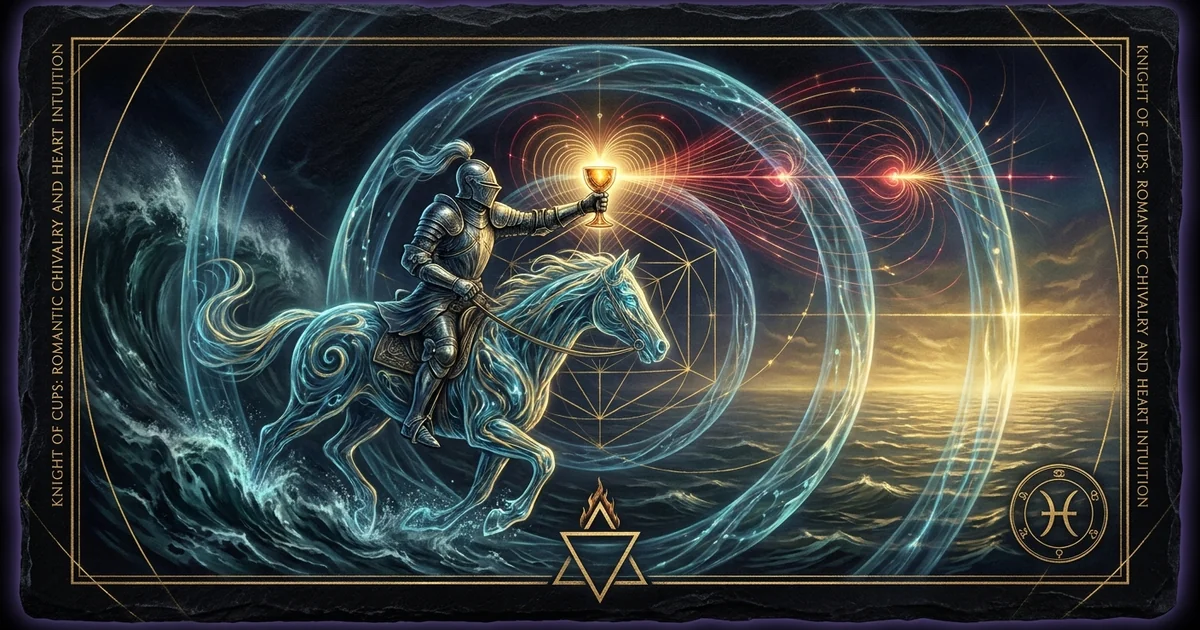
Knight of Cups: Romantic Chivalry and Heart Intuition
Archetypal Thesis & Systemic Paradigm: The Vector of Emotional Teleology
The Dynamic Modality of the Water Element
Within the systemic architecture of the Western mystery tradition, the suit of cups operates as the phenomenological theater of the water element (Mem, the primordial fluid matrix). While the Ace designates the unmanifest reservoir of affective potential and the minor numbered cards map its differentiated states of stasis, perturbation, and crystallization, the Knight occupies an operative role: he is water in dynamic translation. In the lexicon of classical metaphysics, pure fluidity possesses no intrinsic shape; it conforms entirely to its vessel. The Knight of Cups, however, introduces a teleological thrust to this undifferentiated ocean. He represents the hydraulic vector of the psyche, the kinetic impulse that draws emotion out of passive oceanic containment and channels it toward a defined transcendent horizon.
This mechanical conversion depends upon the card’s elemental synthesis. In the Golden Dawn court system, court figures are never monolithic; they are dyadic elemental engines. Whether classified under the Hermetic Order of the Golden Dawn’s attribution of the Prince as the Airy part of Water, or viewed through the classical chivalric lens as the fiery, questing vector operating within the aqueous world of Briah, the Knight functions as an active kinetic carrier. Water, when mobilized by an aerial or fiery dynamic, ceases to be a stagnant pool of unconscious instinct. It becomes a river, an oceanic current, a circulatory cycle capable of transporting the conscious ego across the abyssal waters of the personal unconscious. The knight of cups tarot meaning therefore centers on this dynamic mobilization: the heart refuses mere sentimentality and transforms itself into a directional compass.
The operative function of this card does not register as arbitrary emotional volatility. Rather, it signifies the focused intentionality of feeling. Just as irrigation engineering redirects chaotic floodwaters into fertile agricultural canals, the psychological posture of this archetype gathers dispersed emotional impressions and binds them to an idealized quest. The water element here is neither the silent gestation of the womb nor the terrifying tempest of psychic dissolution; it is the consecrated fluid contained within the Grail, carried across the profane world by an armored agent of emotional devotion.
The Grail Quest as Archetypal Coordinate System
The mythic topography across which the Knight rides is fundamentally informed by the medieval cycle of the Quest del Saint Graal. In this symbolic geography, the physical landscape is identical to the psychic terrain: the Wasteland (Terre Gaste) is not an ecological crisis, but an interior state of spiritual desiccating calcification arising from the wounding of the Fisher King—the rupture between the ruling conscious ego and the subterranean springs of vitality. The Knight of Cups manifests as the psychological response to this aridity. His appearance signals an imperative toward anamnesis: the conscious recollection of the forgotten divine source, externalized as the luminous, elusive vessel of healing.
In divinatory mechanics, the appearance of the Knight of Cups serves not as a passive prediction of romantic overtures, but as a diagnostic coordinate indicating where the querent’s psychic energy (libido) has mobilized around an idealized vision of restoration. Divination operates here as a cybernetic feedback loop. The card reflects back to the subject the structural organization of their own affective desire, exposing how the ego constructs narratives of nobility, longing, and redemption to navigate the pain of existential fragmentation.
The Grail carried by the Knight is both the instrument of salvation and the locus of a profound existential hazard. Because the quest is teleological, it demands an absolute fidelity that borders on monomania. The Knight does not ride to conquer kingdoms in the manner of the Knight of Swords, nor to secure material dominion like the Knight of Pentacles; he rides to surrender the conscious self to a supreme affective ideal. This pursuit translates the instinctual yearning of the personal unconscious into a formal, spiritualized chivalry, bridging the gap between raw biological desire and the divine union (unio mystica).
Teleological Drive of the Affective Psyche
To comprehend the epistemic weight of this archetype, analytical psychology must divorce the concept of feeling from the chaotic reactivity of physiological affect. As Carl Gustav Jung established in his foundational taxonomy of psychic functions, feeling (Fühlen) is an evaluative, rational apparatus. It does not consist of autonomic nervous system arousal, but rather an intricate, highly differentiated cognitive process of assigning value, determining worth, and establishing ethical orientation within the psychic economy.
“Feeling is primarily a process that takes place between the ego and a given content, a process, moreover, that imparts to the content a definite value in the sense of acceptance or rejection (‘like’ or ‘dislike’)… Feeling is therefore an entirely rational function, since its values are assigned according to the laws of reason, just as ideas are assigned according to the laws of logic.” — Carl Gustav Jung, Psychological Types (Collected Works, Vol. 6), §724–725.
Viewed through this Jungian paradigm, the knight of cups tarot meaning crystallizes as the active deployment of this rational feeling function. The Knight does not simply drift upon whim; he carries a chalice that represents a deliberate hierarchy of values. His movement is slow, measured, and rhythmic, because the evaluation of the heart requires an aesthetic calibration that raw intellectual logic cannot approximate. The teleological drive of the affective psyche impels the individual to move toward situations, relationships, and creative manifestations that resonate with an innate architecture of beauty and moral harmony.
When the querent encounters this archetype, the underlying inquiry does not ask what the querent feels, but how those feelings are being utilized as an orienting instrument. The Knight represents the ego’s willingness to be led by heart intuition—not as an irrational abandonment of discernment, but as an advanced mode of knowing that recognizes patterns of human connection and archetypal meaning entirely invisible to the hyper-analytical intellect.
Classical Provenance & Textual Lineage: The Chivalric and Hermetic Transmission
Courtly Love and the Provencal Troubadour Ethos
The cultural DNA of the Knight of Cups is inextricably bound to the 12th-century phenomenon of Fin’amors (Courtly Love) that blossomed among the troubadours of Provence and the Minnesängers of the Germanic territories. Prior to this cultural inflection point, Western medieval consciousness conceived of human love predominantly within the transactional categories of feudal alliance or the theological framework of sinful carnal concupiscence. The troubadours enacted a radical epistemic rupture: they elevated romantic yearning into an ascetic, initiatory discipline.
In the poetic structure of Fin’amors, the Beloved (Domna) was systematically uncoupled from domestic availability. Often of superior social standing and perpetually unattainable, she served as an earthly hypostasis of the divine feminine. The lover’s devotion was intentionally asymmetric, requiring complete subjugation of raw territorial and sexual dominance in favor of a refined, prolonged state of longing (enamorament). This state of suspended consummation generated an intense interiorization of affective energy. The knight of cups symbolism emerges directly from this medieval crucible: the warrior puts aside his lance and sword, takes up the sacred vessel, and subordinates martial aggression to the service of an interiorized, poeticized ethical code.
This historical transmutation laid the structural groundwork for what analytical psychology later identified as the conscious cultivation of the anima. The chivalric code of the heart transformed brute instinct into poetic production, cultivating an inner aesthetic sanctuary where the soul could commune with its own transcendent reflection. The knight’s journey is therefore intrinsically literary and imaginal; he travels through a landscape charged with symbolic omens, where every encounter is an opportunity to demonstrate courtly courtesy, emotional endurance, and spiritual refinement.
The Golden Dawn’s Prince vs. Knight Nomenclature Shift
To trace the Hermetic lineage of this card requires untangling a deliberate taxonomic divergence between historical continental tarot and the reforms instituted by the Hermetic Order of the Golden Dawn in the late 19th century. In the traditional Tarot de Marseille, the equestrian figure is unequivocally titled Le Chevalier de Coupes. However, when S.L. MacGregor Mathers and his circle reorganized the court cards according to the kabbalistic formula of the Tetragrammaton ($Y\text{-}H\text{-}V\text{-}H$), they recognized a structural inconsistency in the historical deck’s hierarchy.
“The Prince of the Chariot of the Waters. A winged King, with winged helmet and a water lily in his hand, riding in a chariot drawn by an eagle over water… He is the Air of Water, the dynamic motion of fluid, the power of evaporation, intellectualizing emotion, imaginative, poetic, yet liable to be swayed by external influences if unbalanced.” — S.L. MacGregor Mathers, Liber T: The Tarot of the Golden Dawn (1888).
In the esoteric schema of the Golden Dawn, the historical Kings were reassigned to the dynamic, primeval force of Yod (Fire, mounted Knights), while the historical Knights were identified with the Vav son-figure (Air, Princes driving chariots). Arthur Edward Waite, when collaborating with artist Pamela Colman Smith in 1909, chose to retain the traditional, exoteric titles (King, Queen, Knight, Page) for their public deck to maintain accessibility and continuity with popular European tradition.
Historical / Waite-Smith Hierarchy:
[King] -> [Queen] -> [Knight] -> [Page]
Golden Dawn Esoteric Hierarchy (Liber T / Thoth):
[Knight / Yod / Fire] -> [Queen / Heh / Water] -> [Prince / Vav / Air] -> [Princess / Heh final / Earth]
Consequently, the Rider-Waite-Smith Knight of Cups is an iconographic hybrid. Visually, he retains the equestrian chivalry of the classical mounted knight, but esoteric cartography anchors him firmly to the Vav current of the Tree of Life. He carries the programmatic characteristics of the Prince: the specialized manifestation of the Air-of-Water sub-element. Air represents the intellect, breath, communication, and the circulation of ideas; Water represents the sea of unconscious feeling. The fusion of Air and Water results in vapor, mist, poetics, and philosophical aestheticism. Waite preserved this essential Hermetic identity beneath an accessible medieval veneer, depicting the figure not as an aggressive jouster, but as an emissary of quietude, an ambling dreamer whose steed moves with meditative grace.
Pamela Colman Smith’s Semiotic Innovations
The genius of Pamela Colman Smith’s visual synthesis becomes strikingly apparent when the Knight of Cups is contrasted with his counterparts in the Rider-Waite-Smith deck. The Knight of Swords charges forward with reckless, homicidal velocity, his horse galloping into an opposing gale; the Knight of Wands rides a rearing steed amidst rolling desert sands, driven by kinetic, combustion-driven ambition. In radical contrast, Smith depicts the mount of the Knight of Cups in a slow, dignified, pacing walk (ambladura). The horse’s hooves do not strike sparks from the stone; they move with deliberate gentleness along the banks of a winding river.
Kinetic Modalities in the RWS Court Knights:
[Knight of Swords] --> Violent Acceleration / Linear Rupture (Air of Air)
[Knight of Wands]   --> Explosive Ignition / Kinetic Drive (Fire of Fire)
[Knight of Pentacles] --> Absolute Inertia / Ploughed Earth Stasis (Earth of Earth)
[Knight of Cups]    --> Rhythmic Cadence / Undulating Riverine Transit (Air of Water)
Smith incorporates nuanced aquatic iconography directly onto the martial harness. The Knight’s surcoat is embroidered with red fish—the ancient signifier of fertility, Christological salvation, and the contents of the deep unconscious emerging into awareness. Rather than wielding a weapon, his hands balance an open, gold chalice, held with an ease that implies an unbroken equilibrium between rider and vessel. He wears a helmet adorned with wings, a direct semiotic reference to the caduceus of Mercury, indicating that this figure is a messenger of the deep, a psychopomp moving between the terrestrial shore and the oceanic underworld.
Furthermore, Smith’s rendering of the landscape diverges sharply from the barren environments of the Wands or the engineered fields of the Pentacles. A crystalline stream meanders through a desert-like canyon toward distant, azure hills. This visual paradox—water carving through an arid valley—illustrates the archetype’s structural mission: the introduction of living emotional nourishment into dry, desiccated psychological environments.
Structural Mechanics & Symbolic Geometry: The Qabalistic and Astrological Matrix
Yod-He-Vav-He Tetragrammaton Mechanics: The Air/Fire Sub-Element
Within the cosmological framework of the Hermetic Qabalah, the four worlds of creation represent a progressive step-down transformer of the divine current: Atziluth (Archetypal/Fire), Briah (Creative/Water), Yetzirah (Formative/Air), and Assiah (Material/Earth). Each world corresponds to a letter of the divine name $Y\text{-}H\text{-}V\text{-}H$.
The Knight of Cups, when decoded through the strict Golden Dawn court framework, occupies the position of Vav (the Son/Prince) within the world of Briah (Water). This defines his elemental formula as the Air of Water.
Air represents the mental plane—the capacity for structural articulation, abstract thought, syntax, and transmission. Water represents the undifferentiated astral light, the ocean of primary affect, and the fluid memory of the cosmos. When Air acts upon Water, it gives form to feeling. It translates the silent, oceanic pressure of the collective unconscious into lyrical poetics, romantic sonnets, musical compositions, and conscious devotions.
The solar center of the Tree of Life, Tiphareth (Beauty/Harmony), acts as the focal engine for this process. Tiphareth is the mediator, the reconciling node that harmonizes the intellectual severity of Geburah and the expansive mercy of Chesed. The Knight of Cups functions as a localized emissary of Tiphareth operating within the fluid medium of Briah. He is the animus serving the anima, a solar-irradiated knight whose armor reflects the transcendent beauty of the supernal realm down into the subjective waters of human relational experience.
The Astrological Span: Decans of Aquarius and Pisces
In the astrological attributions developed by the Golden Dawn, the court cards do not correspond to isolated solar signs. Instead, they govern distinct thirty-degree arcs of the zodiac, spanning the final decan of one sign and the first two decans of the subsequent sign. This architectural mechanism ensures an uninterrupted energetic continuity across elemental transitions. The Knight of Cups (Prince of the Waters) presides over the celestial arc extending from 20° Aquarius to 20° Pisces.
Zodiacal Coordinates of the Knight of Cups:
+------------------------+------------------------+------------------------+
|   Aquarius Decan III   |     Pisces Decan I     |    Pisces Decan II     |
|   (20° - 30° Aquarius) |   (0° - 10° Pisces)    |   (10° - 20° Pisces)   |
|   Ruler: The Moon      |   Ruler: Saturn        |   Ruler: Jupiter       |
|   Collective Vision    |   Subterranean Shift   |   Oceanic Dissolution  |
+------------------------+------------------------+------------------------+
This specific astrological span illuminates the complex, seemingly paradoxical psychology of the card:
- The Third Decan of Aquarius (20°–30° Aquarius): Ruled by the Moon (traditional) or Venus (modern), this decan represents the humanization of cold Uranian intellectual networks. Here, abstract ideological humanitarianism transitions into a deeply felt, personal empathy. It imbues the Knight with his utopian vision, his dedication to an ideal brotherly or romantic communion that transcends conventional societal boundaries.
- The First Decan of Pisces (0°–10° Pisces): Ruled by Saturn, this decan marks the painful ingress of the conscious mind into the vast, oceanic expanse of the mutable water sign. It introduces the melancholy, the world-weariness, and the ascetic discipline that underlies genuine chivalric devotion. It is the decan of the Grail seeker confronting the reality of the Wasteland.
- The Second Decan of Pisces (10°–20° Pisces): Ruled by Jupiter, this sector represents the complete unfolding of mystical empathy, oceanic compassion, and artistic inspiration. It confers upon the Knight his profound connection to the unconscious depths, his visionary imagination, and his capacity for total, selfless romantic surrender.
By spanning this specific liminal zone between fixed Air (Aquarius) and mutable Water (Pisces), the Knight of Cups embodies the intellectualized dream that dissolves into mystical reality. He links the forward-thinking social imagination of the water-bearer with the primordial, dissolving empathy of the two fishes.
Iconological Decoding: The Winged Helm, Fish Embroidery, and the River
Every component of Smith’s visual program serves as a coordinate in an elaborate Hermetic cipher:
- The Winged Helmet and Talaria: The wings affixed to the Knight’s steel helm and the ankles of his greaves invoke Hermes (Mercury), the psychopomp who moves unhindered across boundaries separating Olympus, Earth, and Hades. This iconology underscores that the Knight’s emotionality is not sedentary; it is communicative, articulate, and mobile. He possesses the wings of mental agility, allowing him to traverse the dangerous currents of the unconscious without drowning.
- The Crimson Fish of the Tunic: The fish (Ichthys) is an ancient archetypal emblem of the unconscious, surviving within the unfathomable depths of the oceanic psyche. Smith renders these fish in crimson—the color of Geburah, of arterial blood, of life-force and desire. This detail establishes that the Knight’s emotional devotion is not bloodless or disembodied; it is infused with vital passion, instinctual vitality, and biological reality, sublimated into the service of an aesthetic ideal.
- The Serpentine River: The watercourse depicted across the lower foreground is not an open sea, but an active, running river. In esoteric cartography, rivers signify the temporal flow of conscious experience emerging from an unseen primordial source (the high mountain peaks) and traveling inexorably toward the undifferentiated ocean of cosmic consciousness. The Knight moves parallel to this current; he does not fight the river, nor is he submerged beneath it. He rides alongside it, acting as an interpreter of its currents.
Psychological Dynamics & Operational Praxis: Anima Projection and the Feeling Complex
The Anima as Psychopomp vs. Destructive Glamour
In the architecture of Jungian analytical psychology, the Knight of Cups constitutes one of the most vivid visual representations of the masculine ego’s operational relationship with the anima—the autonomous archetype of the soul, the feminine inner figure that mediates between consciousness and the collective unconscious. The chalice held in the Knight’s right hand is the vessel of the anima itself: the font of inspiration, emotional depth, and numinous interiority.
Mechanics of Anima Integration:
[Unconscious Anima]
       | (Passive Projection)
       v
[External Romantic Idolization] --> Inevitable Disillusionment / Wasteland
       |
       | (Heroic Katabasis / Chivalric Discipline)
       v
[Retraction of Projection]
       | (Creative Sublimation)
       v
[Anima as Psychopomp] ---------> Direct Conduit to the Transpersonal Self
When this archetype operates with psychological integration, the anima serves as a psychopomp—a conductor of souls. The Knight does not seek to conquer or possess the feminine as an externalized object of consumption; he enters into its service. He becomes capable of extraordinary artistic sublimation, philosophical poetry, and genuine relational vulnerability. His quest is an inward katabasis (descent) in search of the lost soul, transforming the personal ego into an attuned instrument capable of registering the subtlest tremors of psychic life.
Conversely, when this dynamic remains unconscious, it manifests as a destructive archetypal glamour. The ego, blinded by the incandescent projection of the anima, casts the image of the divine feminine across an ordinary human partner. The partner is no longer perceived in their flawed, sovereign humanity, but is instead suffocated beneath the unbearable weight of an absolute spiritual ideal. When the mundane reality of the partner inevitably shatters this poetic illusion, the unintegrated Knight collapses into bitter disillusionment, abandoning the relationship to resume his pursuit of an impossible, disembodied phantom.
The Puer Aeternus Dilemma and Narcissistic Escapism
The shadow architecture of the Knight of Cups is defined by the clinical psychology of the puer aeternus—the eternal youth who refuses to anchor himself within the limitations of temporal reality. The puer is chronically intoxicated by his own potential. He inhabits an aestheticized, theoretical realm of pure sentiment, where the demands of mundane existence (professional discipline, relational compromise, moral accountability) are experienced as intolerable assaults upon his sensitive soul.
Integrated Knight (Chivalric Vessel)
- Psychic Posture: Conscious deployment of the feeling function as an ethical, rational instrument of discernment.
- Relational Field: Capability for genuine vulnerability; recognizes the autonomous sovereignty of the beloved.
- Creative Output: Sublimates unconscious longing into tangible artistic, poetic, or cultural forms.
- Somatic Anchor: Grounded equestrian control; the armored ego safely navigates the banks of the emotional river.
- Transpersonal Orientation: The Grail serves as an offering to the transpersonal Self, revitalizing the collective Wasteland.
Shadow / Inverted Knight (Puer Aeternus)
- Psychic Posture: Autonomous moodiness; chaotic passive-aggressive oscillation between grandiosity and victimhood.
- Relational Field: Emotional vampirism; projects the anima onto partners and flees when reality intrudes.
- Creative Output: Sterility disguised as elite artistic sensitivity; endless preparation without execution.
- Somatic Anchor: Dissociation from physical reality; refuses the demands of Saturnian materialization.
- Transpersonal Orientation: Narcissistic absorption in the aesthetics of suffering; hoarding the chalice as a private intoxicant.
The inverted Knight of Cups is a master of passive-aggressive manipulation and romantic dissimulation. He uses the language of deep feeling not to forge an authentic bond, but to construct a seductive labyrinth that insulates him from true intimacy. His hypersensitivity is frequently weaponized: any attempt by others to establish boundaries or demand ethical reciprocity is cast as coarse insensitivity. He drifts through the social matrix as an emotional wanderer, leaving a trail of unfulfilled promises, sustained only by the tragic romance of his own perpetual dissatisfaction.
Consultation Dynamics: Diagnosing Affective Fixations
When the Knight of Cups surfaces within a professional psycho-divinatory consultation, the investigator must analyze the card’s positional relationship to surrounding operational dynamics:
- Assessing Libido Trajectory: The first task is determining whether the Knight’s journey represents a progressive movement of psychic energy toward integration, or a regressive retreat into fantasy. If flanked by grounded, structurally coherent keys—such as the Emperor, the King of Cups, or the Knight of Pentacles—the archetype suggests that the querent’s creative or romantic vision is supported by an operational framework capable of translating inspiration into form.
- Identifying Anima/Animus Entanglement: If the card appears adjacent to the Moon, the Seven of Cups, or the Devil, it acts as an immediate diagnostic warning of projective intoxication. The querent is likely paralyzed by an affective fixation, projecting salvation onto a romantic interest, a messianic cause, or a nostalgic past that paralyzes present action. Here, the imperative is ruthless projection-retraction: the querent must recognize that the luminous chalice belongs to their own inner psyche, not the external figure onto whom it has been transposed.
- The Trap of Continuous Preparation: In creative inquiries, the Knight of Cups often unmasks a prolonged state of rehearsal. The querent possesses the vision, the aesthetic sensibility, and the emotional resonance, yet remains perpetually suspended on the road toward manifestation. The consultation must guide the subject to cross the threshold from the poetic contemplation of the Knight into the decisive, embodied execution characteristic of mature integration.
Philosophical Synthesis & Macrocosmic Correspondence: The Solutio of the Alchemical Soul
The Alchemical Solutio as Dissolution of Rigid Dogma
In the Hermetic laboratory of classical alchemy, the Magnum Opus cannot proceed without the structural stage known as solutio—the total dissolution of the calcified, rigid, and impure dry matter within the universal solvent (alkahest). The operational maxim runs: Solve et Coagula (dissolve and coagulate). The soul cannot take on its immortal, crystalline form until its historical accretions, defensive dogmatic armaments, and rigid ego-structures have been liquidated back into the prima materia.
Within the laboratory of the soul, the Court of the Suit of Cups corresponds precisely to the mechanics of the fluid transmutation:
- Page of Cups: Germinatio — The nascent appearance of the vegetative soul within the fertile fluid.
- Knight of Cups: Solutio / Sublimatio — The active circulation and vaporization of the fluid through heat, softening rigid metals.
- Queen of Cups: Coagulatio in Utero — The interior containment and preservation of the transmuted liquor.
- King of Cups: Fixatio — The mastery and stable governance of the oceanic current; the Philosopher’s Stone in fluid form.
The Knight of Cups acts as the primary agent of this alchemical solutio. He rides into psychological territories that have become brittle, overly rationalized, and spiritually petrified—the state governed by an uncalibrated Knight of Swords or a grasping Knight of Pentacles. By bringing the vessel of the water element into contact with these hardened structures, he initiates a gentle, persistent softening. Dogmatic intellectual assertions dissolve into empathetic ambiguity; material fixations yield to poetic appreciation.
This dissolution is not an act of destruction; it is an act of purification. Just as a mineral salt must be dissolved in pure water to filter out foreign contaminants before it can be recrystallized in a higher state of purity, the conscious ego must periodically submit its fixed concepts of selfhood to the fluid bath of deep feeling. The Knight of Cups provides the stable, dedicated container within which this dangerous dissolution can occur without the ego descending into psychosis.
Henry Corbin’s Mundus Imaginalis and the Grail Archetype
To dismiss the quest of the Knight of Cups as a flight into delusion is to commit an epistemic error rooted in the materialist reductionism of post-Enlightenment thought. The French philosopher and Islamic scholar Henry Corbin established an indispensable ontological distinction between the purely subjective, arbitrary human imagination (“fantasy”) and the objective, ontologically real order of being he designated as the mundus imaginalis ('alam al-mithal).
Corbin demonstrated that in classical Sufi and Hermetic cosmologies, the mundus imaginalis is an intermediate world—a precise, spatially and structurally distinct realm positioned between the sensory world of material objects and the purely intelligible realm of formless spiritual intellect. This realm is accessed not through empirical measurement, nor through dialectical syllogism, but exclusively through the cognitive organ of the active imagination: the visionary consciousness of the purified heart (Himma).
Three-Tiered Ontological Architecture (after Henry Corbin):
+-----------------------------------------------------------+
| Intelligible / Archetypal Realm (Atziluth)                |
| Pure Divine Intellect / Formless Essences                 |
+-----------------------------------------------------------+
                            |
                            v
+-----------------------------------------------------------+
| Mundus Imaginalis / Interworld of the Soul (Briah-Yetzirah)|
| Subtle Forms / The Knight's Visionary Terrain / The Grail |
+-----------------------------------------------------------+
                            |
                            v
+-----------------------------------------------------------+
| Sensory / Material Realm (Assiah)                         |
| Concrete Objects / Empirical Measurement / The Wasteland  |
+-----------------------------------------------------------+
The Knight of Cups is an inhabitant and cartographer of this mundus imaginalis. His horse does not step upon the dirt of geographical earth; it traverses the subtle topography of the soul. The castles, the meandering rivers, the luminous chalices, and the divine beloveds that populate his path are not psychological delusions; they are the concrete realities of the imaginal realm.
When an individual engages with the Knight of Cups in contemplative practice or divinatory inquiry, they are called to step into this intermediate world. The heart intuition championed by this card is precisely the cognitive deployment of Himma—the capacity of the soul to perceive archetypal realia, to decode the spiritual meaning woven beneath the surface of temporal events, and to pursue the Grail as an actual, transpersonal reality that redeems the material Wasteland.
Universal Polarity: Reconciling Eros and Logos
The highest philosophical synthesis represented by the Knight of Cups resides in his structural reconciliation of the two primordial cosmic principles: Eros and Logos. Historically and psychologically, these principles are often locked in sharp antagonism. Logos represents the principle of differentiation, division, hierarchical taxonomy, and purposeful heroic action—the masculine sword. Eros represents the principle of psychic relationship, holistic synthesis, permeability, and receptive communion—the feminine chalice.
In the figure of the Knight of Cups, this ancient rift is closed. He is a Knight: an armored, purposeful, dynamic male vector possessing agency, direction, and martial discipline. Yet his mission is entirely subordinated to the service of Eros. He carries no lance; his heroic task is not the slaying of the dragon, but the preservation and elevation of love, beauty, and emotional truth.
Hermetic Syzygy in the Knight of Cups:
[ Martial Discipline / Solar Agency ] (Logos / The Mount)
                   +
[ Pure Feeling / Fluid Receptivity ] (Eros / The Chalice)
                   ||
                   v
[ Alchemical Coniunctio / The Chivalric Ideal ]
This synthesis achieves the Hermetic ideal of the coincidentia oppositorum (the coincidence of opposites). The Knight proves that genuine strength does not require emotional brutalization, nor does deep sensitivity require passive, shapeless helplessness. He embodies the chivalric ideal in its most mature psycho-cosmological expression: a consciousness strong enough to wear heavy plate armor against the abrasions of the profane world, yet tender enough to carry a cup of clear water across the desert without spilling a single drop.
Frequently Asked Questions: Analytical Clarifications
Differentiating the Knight of Cups from the Page and King
Within the court card hierarchy of the cups suit, each figure marks a distinct developmental phase of the water element. A precise diagnostic differentiation is essential for coherent readings and psychological analysis.
Developmental Triad of the Suit of Cups:
+-------------------------------------------------------------------------------+
| [Page of Cups]  --> Pure Immanence / Nascent Germination / The Playful Child  |
|                     (Earth of Water: Intuition rising spontaneously)          |
+-------------------------------------------------------------------------------+
                                        |
                                        v
+-------------------------------------------------------------------------------+
| [Knight of Cups] --> Kinetic Vector / Sublimated Quest / The Chivalric Lover  |
|                     (Air of Water: Intuition mobilized as intentional vector) |
+-------------------------------------------------------------------------------+
                                        |
                                        v
+-------------------------------------------------------------------------------+
| [King of Cups]   --> Mastered Equilibrium / Cultural Governance / The Patriarch|
|                     (Fire of Water: Intuition crystallized into authority)   |
+-------------------------------------------------------------------------------+
The Page of Cups represents the initial, spontaneous emergence of feeling. The Page is the innocent youth standing upon the seashore, marveling at the fish emerging from his cup. The consciousness here is receptive, playful, unformed, and largely interior; the Page lacks both the vehicle (the horse) and the ethical discipline (the chivalric vow) to manifest these insights across the wider world.
The King of Cups, conversely, represents structural emotional sovereignty. He sits upon an anchored throne floating in the middle of a turbulent sea. His task is not to ride out in search of the Grail, for he has already incorporated its mystery into the laws of his realm. The King embodies mature governance, emotional containment, and therapeutic equilibrium.
The Knight of Cups operates precisely in the active space between the two. Unlike the Page, he is mobilized, armed, and purposive, carrying the emotional impulse into the social and relational sphere. Unlike the King, he is not static, settled, or institutionalized. He remains on the road, driven by an unquenched longing, exemplifying the dynamic pursuit of emotional and creative ideals.
Diagnostic Nuances of the Inverted Posture
When the Knight of Cups appears in an inverted posture (or ill-dignified by surrounding elemental clashes), it must not be interpreted as an absence of feeling. Rather, it signifies the pathology of the water element disconnected from its ethical or reality-oriented containers:
- Affective Evasion and Dissimulation: The inverted Knight represents an ego that uses romantic rhetoric to conceal a fundamental terror of genuine intimacy. Here lies the archetype of the seducer who offers the cup of absolute devotion, only to withdraw it the moment real vulnerability, commitment, or material sacrifice is demanded.
- Narcissistic Moodiness and Victimhood: In this state, the rational feeling function degrades into chaotic emotional volatility. The subject becomes hypersensitive, taking offense at minor slights while remaining oblivious to the profound emotional damage they inflict on others. The quest for the Grail is replaced by an indulgent, aestheticized fascination with their own inner suffering.
- Ungrounded Escapism: The winged helmet becomes an engine of chronic dissociation. The querent abandons the difficult work of materialization, taking refuge in elaborate daydreams, unexpressed creative masterpieces, or addictive romantic fixations. The water of Briah ceases to be a river of life; it turns into a stagnant marsh where libido drowns in self-reflective fantasy.
Reconciling Astrological Decans with Divergent Esoteric Systems
Apparent contradictions often emerge when comparing the astrological decan attributions of the Rider-Waite-Smith system with Aleister Crowley’s Book of Thoth. These discrepancies are resolved once the underlying structural nomenclature of the Hermetic Order of the Golden Dawn is clarified.
In Crowley’s The Book of Thoth, the terminology of the court cards was radically restored to match their strict elemental formulas. Crowley eliminated the title of “King” entirely, renaming the equestrian figure the Knight (representing the fiery Yod force) and the chariot-driving figure the Prince (representing the airy Vav force).
Structural Alignment Table:
+-------------------+----------------------------+-----------------------------+
| System            | Fire of Water (Yod)        | Air of Water (Vav)          |
+-------------------+----------------------------+-----------------------------+
| Rider-Waite-Smith | King of Cups               | Knight of Cups              |
|                   | (20° Libra - 20° Scorpio)  | (20° Aquarius - 20° Pisces) |
+-------------------+----------------------------+-----------------------------+
| Thoth (Crowley)   | Knight of Cups             | Prince of Cups              |
|                   | (20° Aquarius - 20° Pisces)| (20° Libra - 20° Scorpio)   |
+-------------------+----------------------------+-----------------------------+
When analyzing a traditional Rider-Waite-Smith deck, the card labeled “Knight of Cups” performs the functional, psychological, and astrological work of the Golden Dawn Prince of the Chariot of the Waters. His correct astrological decan span is 20° Aquarius through 20° Pisces, capturing the transitional mechanics between fixed intellect and oceanic surrender.
When working within the Crowley-Thoth paradigm, however, the card titled “Knight of Cups” corresponds to the fiery, mounted Yod of Water, spanning 20° Libra to 20° Scorpio. Recognizing this structural divergence prevents interpretive confusion, ensuring that the cartographer of consciousness applies the exact psycho-cosmological coordinate system appropriate to the symbolic deck under investigation. :::