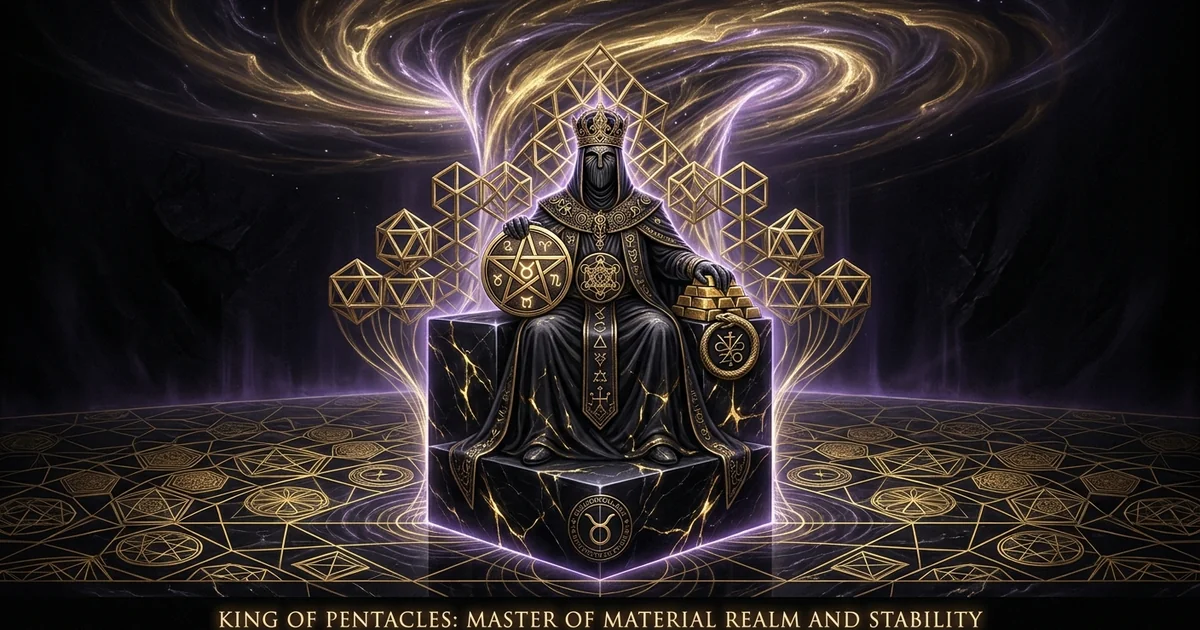
King of Pentacles: Master of Material Realm and Stability
Archetypal Thesis & Systemic Paradigm: The Sovereign of Material Crystallization
The King of Pentacles constitutes the terminal phase of archetypal materialization, operating within esoteric cartography as the crystallized equilibrium of Elemental Earth infused with sovereign consciousness. Far from representing superficial financial prosperity, this arcanum functions as a psycho-cosmological coordinate where somatic regulation, systemic resource allocation, and alchemical fixity counteract the entropic dispersal of the lower astral plane. In the grammar of the western esoteric tradition, this card signifies neither raw accumulation nor passive matter; rather, it denotes the absolute subjugation of the physical realm through cultivated mastery, order, and telic endurance.
                  ┌───────────────────────────────┐
                  │    ARCHETYPAL TETRAGRAMMATON   │
                  │   Yod - Chokmah (Primordial)  │
                  └───────────────┬───────────────┘
                                  │
                                  ▼
                  ┌───────────────────────────────┐
                  │   THE FOUR ELEMENTS IN SUIT   │
                  │ Wands (Fire) -> Cups (Water)  │
                  │ Swords (Air) -> Pentacles     │
                  └───────────────┬───────────────┘
                                  │
                                  ▼
                  ┌───────────────────────────────┐
                  │     ASSIAH / CHALICE OF SALT  │
                  │    Terminal Materialization   │
                  │    The King as Chthonic Senex │
                  └───────────────────────────────┘
The Chthonic Senex and Somatic Integration
Within the psycho-structural taxonomy developed by depth psychology, the King of Pentacles embodies the fully integrated senex-archetype. The Senex represents age, boundary, discipline, and temporal consolidation. When unintegrated, this archetype degenerates into the calcified tyrant, paralyzed by defensive hoarding and morbid terror of mortality. However, when mediated through balanced somatic consciousness, the Senex metamorphoses into the benevolent steward of the earth element. The King of Pentacles grounds psychological energy within the biological organism. Rather than escaping into neurosis or intellectual abstraction, psychic contents are anchored directly into somatic reality: neuromuscular tone, rhythmic respiration, and visceral equilibrium.
This somatic containment functions as a structural breakwater against the chaotic eruptions of the collective unconscious. The King does not achieve psychological stability through the repression of instinct; instead, he synthesizes instinctual drives into functional habit systems and institutional scaffolding. His ego-consciousness is firmly rooted in physical coordinates, understanding that spiritual realization is impossible without a grounded biological matrix. The suit of pentacles archetypes document the progressive descent of spirit into concrete forms; here, the journey culminates in an ego structure capable of metabolizing high-voltage transpersonal energy without psychological fragmentation.
“The senex archetype is inextricably bound to the physical matrix and the passage of Saturnian time. If the individual cannot establish an enduring container within the physical realm—what the Hermeticists termed the vessel of Earth—the archetype of the old man regresses into petrified dogmatism and cold avarice. True maturation requires that somatic reality be neither transcended nor despised, but transfigured into the conscious base upon which the Self can safely manifest without precipitating a catastrophic psychic inflation.” — C.G. Jung, Aion: Researches into the Phenomenology of the Self, CW 9ii, pp. 248–251.
Entropy Inversion and the Telos of the Pentacles Suit
The cosmic teleology of the minor arcana demands an ultimate structural terminus. Ideation flashes instantaneously through the realm of Wands (Atziluth/Fire); cognitive discrimination and formal geometry are articulated through Swords (Yetzirah/Air); and affective valuation, empathy, and intuitive currents are filtered through Cups (Briah/Water). Without the fourth operational phase, these archetypal emissions remain volatile, vulnerable to systemic entropy and psychic dissipation. The King of Pentacles operates as the terminal node of manifestation within Assiah, the world of physical fabrication and concrete consequence.
In thermodynamic terms, the King of Pentacles constitutes an entropy-inverting engine. While unmanaged physical systems naturally decay toward disorder, this arcanum concentrates, structures, and channels chaotic raw materials into self-sustaining socio-ecological architectures. The king of pentacles tarot meaning cannot be fully grasped without recognizing this principle of negentropy: the deliberate investment of conscious effort to preserve structural integrity against the forces of decay. By governing the flow of nutrients, capital, labor, and biological resources, this arcanum transforms fleeting psychological epiphanies into enduring institutional structures, establishing an unshakable perimeter within the terrestrial sphere.
Classical Provenance & Textual Lineage: From Renaissance Trionfi to the Golden Dawn
The historical iconography of this card reveals an evolution from mercantile representation to esoteric cosmological encoding. In fifteenth-century northern Italian courtly decks, such as the Visconti-Sforza and the Este-derived variants, the suit was universally designated as Denari (Coins). The King of Coins was depicted as a Renaissance magistrate or sovereign holding an expansive, minted gold disc. In this nascent phase, the card operated as an allegorical mirror of aristocratic wealth, the fiscal solvency of mercantile city-states, and the patronage systems that underwrote Italian civic architecture. The coin was a secular signifier of power, trade networks, and civic governance.
Evolution of the Suit: Deniers, Disks, and the Pentacle Talisman
The transformation of the nominal Denier or Coin into the magical Pentacle represents a profound philosophical rupture initiated by nineteenth-century occult revivals. In the works of Éliphas Lévi and subsequently codified within the Hermetic Order of the Golden Dawn, the suit ceased to represent mere currency and became the disk talisman—the quintessential instrument of ceremonial theurgy. In magical praxis, the pentacle is a consecrated wax or metallic disk inscribed with the hexagram, pentagram, and divine names, designed to ground, bind, and protect against chaotic astral spirits.
       HISTORICAL SHIFT OF THE FOURTH SUIT

   15th Century        19th Century          20th Century
[Italian Denari] ──> [Lévi's Pentacle] ──> [Golden Dawn Disks]
  Mercantile           Ceremonial             Cosmological
  Coin/Capital          Talisman               Microcosm
This semiotic pivot redefined the suit’s sovereign. The monarch was no longer simply a wealthy merchant or prince calculating temporal revenues; he became the master of the microcosm. The disk held by the King represents the synthesized architecture of the manifest universe, bounded by the five elements and sealed by will. Heinrich Cornelius Agrippa, in his De Occulta Philosophia Libri Tres (1533), meticulously outlined how terrestrial objects receive the seals and signatures of the celestial intelligences. By transmuting the coin into an inscribed pentacle, late-modern esotericism positioned the King as the master of Agrippan natural magic—an operator capable of harmonizing heavenly signatures with terrestrial matter.
The Golden Dawn Recalibration: Liber T and Titular Inversions
When S. L. MacGregor Mathers and his circle organized the internal curriculum of the Golden Dawn, they systematized the court cards to align mathematically with the four worlds of the Kabbalah and the formula of the Tetragrammaton. This initiated an ideological and titular divergence between traditional decks and initiatory frameworks. In Liber T, Mathers assigned the equestrian figure to the rank of “King” (representing the primal fire of Yod), while the seated figure was designated the “Prince of the Chariot of Earth” (representing the intellectual force of Vau).
“The Prince of the Chariot of Earth. A winged King having for a Crest the head of a winged bull, on a chariot drawn by two bulls. He bears an orb and sceptre. He is the bringing down of the force of Earth to its fully established stability. He represents the vegetative, physical, and generative forces of the Earth, brought into harmony and under control by the Will. He is the Air of Earth, whose energy is concentrated upon the practical governance of the material plane, slow to anger, steady in purpose, patient in labor, the ultimate conservator of ancestral form.” — S. L. MacGregor Mathers, Liber T: The Tarot, Private Curriculum of the Hermetic Order of the Golden Dawn.
Arthur Edward Waite deliberately subverted this Golden Dawn nomenclature in his 1909–1910 deck, executed by Pamela Colman Smith. Waite returned to the popular vernacular of the French and Italian lineages by designating the seated figure as the King and the mounted warrior as the Knight. However, Waite retained the underlying initiatory mechanics. The seated King of Pentacles designed by Smith synthesizes the sovereign dignity of the Golden Dawn Prince with the archetypal authority of the classical monarch. He sits firmly upon a throne carved with the heads of bulls, his authority static, unassailable, and completely fused with the territory over which he presides.
Structural Mechanics & Symbolic Geometry: Qabalistic, Elemental, and Decanic Architecture
The structural power of the King of Pentacles relies on its complex integration within Hermetic Kabbalah and traditional astrology. Far from being a flat character study, the card functions as an intersecting coordinate grid between the elemental hierarchy of the Tree of Life and the circular geometry of the tropical zodiac.
+-------------------------------------------------------------------------+
|                  MACROCOSMIC & ELEMENTAL ALLOCATIONS                   |
+-------------------------------------------------------------------------+
| World:             | Assiah (The World of Action & Material Form)       |
| Sephirah Root:     | Chokmah-in-Assiah (Primordial Dynamic Earth-Will)  |
| Elemental Formula: | Fire of Earth (Yod of Heh-final)                   |
| Zodiacal Matrix:   | 20° Leo to 20° Virgo (Traditional Golden Dawn)     |
| Astral Attunement: | Fixed Earth Matrix via [Taurus] Signatures         |
+-------------------------------------------------------------------------+
Elemental Dynamics: The Fire of Earth Paradox
Within the Golden Dawn court card matrix, the Kings (or Knights in Crowley’s Book of Thoth) represent the Yod force—the primordial Fire—within the elemental environment of their suit. Consequently, the King of Pentacles represents the paradox of the Fire of Earth. Earth, by its intrinsic nature, is cold and dry, heavy, passive, and downward-tending. Fire, conversely, is hot and dry, radiant, volatile, and ascending. The synthesis of these two opposing currents creates a unique operational dynamic: directed, volcanic, subterranean energy that animates matter from within.
       FIRE OF EARTH INTERSECTION

    [ FIRE (Yod) ]       ── Hot & Dry, Ascending Will
          │
          ▼
   [ METABOLIC FUSION ]  ── Volcanic Pressure / Internal Vitality
          ▲
          │
   [ EARTH (Heh) ]       ── Cold & Dry, Structural Density
If the suit of Pentacles were merely Earth of Earth (the Princess or Page), it would succumb to absolute stasis, petrification, and immobility. The Fire of Earth, however, is the alchemical fire operating inside the core of the planet: the telluric heat that warms the soil, drives germination, and causes magma to crystallize into precious gemstones. In human psychology, the Fire of Earth manifests as pragmatic ambition—an unwavering, calculated drive that uses material laws to achieve concrete results. It is the architect’s will imposing structural form upon raw stone, preventing vegetative decay through constant, disciplined expenditure of energy.
Decanic Geometries: Fixed Taurus and the Degrees of Accumulation
Astrologically, while the Golden Dawn decanic system places the Prince of Earth across the final degrees of Leo to the penultimate degrees of Virgo, the Rider-Waite-Smith iconography anchors the King firmly within the energetic continuum of Taurus and the fixed earth matrix. Taurus is ruled by Venus and corresponds to the Hebrew letter Vau and the path of Hierophant on the Tree of Life. In this context, the King represents the ultimate maturity of the Taurean current: the transition from instinctual sensuality into the systemic stewardship of physical wealth.
The Taurean architecture of the card balances two dynamic states:
- The first decan of Taurus (Mercury) provides analytical acumen in the appraisal of raw materials.
- The second decan of Taurus (Moon) instills an intuitive, cyclical connection to biological fertility and rhythm.
- The third decan of Taurus (Saturn) consolidates and binds these resources into permanent structures, institutional systems, and generational wealth.
The King coordinates these three astral phases. His consciousness is attuned to the long rhythms of the land: sowing, gestation, harvest, and fallow repose. He understands that physical structures cannot be accelerated beyond their intrinsic organic limits without compromising their durability.
Iconographical Anatomy: The Bull, Vine, Castle, and Armor
Every iconographical vector within Pamela Colman Smith’s rendering constitutes an exact glyph of hermetic and chthonic mastery:
The four carved bull heads ornamenting his dark stone throne represent the mastery and elevation of the instinctual animal nature. The bull is the classical emblem of brute agricultural power, untamed sexual potency, and blind physical momentum. By encasing the bulls in carved, structural stone, the King demonstrates that he does not eradicate primitive animal drives; rather, he harnesses their raw power to lay the foundations of his kingdom.
His mantle is heavily embroidered with ripe grapevines, bearing fruit and deep green foliage. This vegetal iconography links him directly to Dionysian and Osirisian fertility mythologies, yet stripped of their ecstatic madness. The vines grow directly over his steel armor, creating an intentional visual friction between martial vulnerability and organic life. His left foot, clad in steel, steps out deliberately from his robe, resting heavily upon the carved masonry of the throne’s plinth or the ruins of a defeated architectural form. This steel-shod foot represents uncompromising realism: he touches the physical ground through the medium of technological and protective artifice. He remains fundamentally biological, yet fortified against external trauma. Behind him rises an imposing castle with robust parapets, asserting that his wealth is not transitory, but backed by defensive force, institutional permanence, and civic defense architectures.
Psychological Dynamics & Operational Praxis: Archetypal Embodying and Diagnostic Decoding
In the therapeutic chamber and esoteric consultation, the King of Pentacles serves as a primary diagnostic indicator of the analysand’s relationship to the material world, somatic containment, and institutional responsibility. The card maps the dynamic tension between the conscious ego and the biological, fiscal, and structural realities of existence.
PSYCHO-SOMATIC EQUILIBRIUM AXIS

      [ HYPER-CALCIFIED SHADOW ]
      (Avarice, Paranoia, Sensory Numbing)
                 ▲
                 │
                 │
      [ INTEGRATED SOVEREIGN ]
      (Somatic Containment, Generative Stewardship)
                 │
                 │
                 ▼
      [ HYPO-GROUNDED DISSOCIATION ]
      (Puer Aeris, Fiscal Collapse, Somatic Denial)
The Midas Complex: Pathologies of Rigidity and Commodification
When this arcanum appears in an adverse or shadow configuration, it marks the acute manifestation of the Midas Complex. In classical mythology, King Midas was granted the power to turn everything he touched into gold—a gift that rapidly manifested as a lethal curse, petrifying food, water, and his own daughter into cold, lifeless metal. Psychologically, this represents the catastrophic calcification of the soul, where qualitative life is reduced entirely to quantitative, commodified assets.
The shadow King of Pentacles equates human worth with net balance, functional utility, and transactional leverage. This leads directly to severe somatic and relational pathologies:
- Sensory Dissociation and Chronic Muscular Armoring: The somatic shell hardens against vulnerability, producing physical rigidity and chronic stress.
- Pathological Avarice and Hoarding: A deep existential terror of death driving the obsessive accumulation of dead matter to fend off mortality.
- Instrumentalization of Human Relationships: Viewing familial, romantic, and professional bonds purely through the lens of return on investment.
- Systemic Paranoia: An entrenched terror that subordinates, competitors, or natural volatility will breach the kingdom’s defenses.
The individual afflicted with this complex lives inside a psychological bunker. The fortress that was designed to protect the kingdom becomes a mausoleum that suffocates the living organism within.
Consultative Frameworks: Diagnosing Enterprise, Ecology, and Somatics
In diagnostic tarot analysis, encountering the King of Pentacles demands an immediate systemic audit across three distinct operational registers:
- Enterprise and Resource Dynamics: Are capital structures sustainable, or are they built upon debt, speculation, and fragile abstractions? The King demands debt liquidation, hard asset accumulation, operational transparency, and the implementation of conservative risk-management protocols.
- Ecological and Environmental Integrity: What is the individual’s relationship to their physical environment? The card forces an evaluation of spatial organization, home maintenance, and alignment with ecological realities. It reprimands parasitic extraction and commands regenerative engagement with one’s territory.
- Somatic and Biological Realism: How is the physical body being maintained? The King ignores intellectual or spiritual bypasses, focusing directly on sleep architecture, nutrition, structural alignment, and chronic physiological inflammation. He represents the imperative to treat the physical body as an ancient, sacred fiefdom requiring uncompromised stewardship.
Sovereign Resource Stewardship (Upright)
- Psychic Posture: Grounded, paternal, unhurried; absolute presence within somatic coordinates.
- Economic Methodology: Sustainable resource cycling, endowment creation, infrastructure development, long-term stability.
- Somatic Expression: Regulated nervous system, high sensory integration, physical resilience through disciplined lifestyle rhythms.
- Relationship to Power: Power exercised as benign stewardship, civic responsibility, and environmental maintenance.
- Shadow Management: Consciously acknowledges mortality; actively prepares the next generation of stewards to inherit the kingdom.
The Pathological Tyrant / Hoarder (Reversed)
- Psychic Posture: Hyper-vigilant, cynical, emotionally frozen; profound fear of chaotic or unpredictable vectors.
- Economic Methodology: Predatory asset extraction, compulsive hoarding, short-term fiscal parasitism, terror of expenditure.
- Somatic Expression: Severe neuromuscular armoring, cardiovascular strain, complete disconnection from biological exhaustion signals.
- Relationship to Power: Power wielded through fiscal coercion, manipulative withholding, structural domination, and institutional inertia.
- Shadow Management: Identifies ego completely with temporal wealth; descends into catastrophic paranoia at the prospect of succession.
Active Imagination with the King: Grounding the Volatile
For the practitioner undergoing Jungian active imagination or Hermetic path-working, invocation of the King of Pentacles is the standard counter-agent against spiritual inflation, kundalini crises, and the destabilizing effects of high-intensity trance work. When an analysand is swept away by the flying fantasies of the puer aeternus or destabilized by volatile visionary material from the astral realm, the King serves as an alchemical sink.
Visualizing the King—seated upon his immovable black basalt throne, heavy with vines, smelling of damp forest loam, crushed grapes, and cold steel—forces an immediate grounding of the subtle body. Practitioners are directed to project their visionary realizations into a physical object held by the King, demanding that the archetype assess the pragmatic viability of the insight: “Can this vision be carved into stone? Can it feed a household? Can it survive the winter?” If the spiritual insight cannot withstand this test of physical utility, it is dismissed as astral detritus.
Philosophical Synthesis & Macrocosmic Correspondence: Hermetic Earth and Cybernetic Equilibrium
To comprehend the ultimate philosophical significance of the King of Pentacles, the cartographer of consciousness must synthesize early modern alchemical mechanics with contemporary cybernetic feedback theory. The card operates simultaneously as the philosophical salt of the Hermeticists and the homeostatic governor of complex natural and economic systems.
       THE ALCHEMICAL TRINITY

   SULPHUR (Essence/Will)   ── Dynamic Combustion (Wands)
             │
   MERCURY (Mind/Intellect) ── Volatile Flux (Swords)
             │
             ▼
      SALT (Body/Form)      ── Coagulation & Mass (Pentacles)
The Alchemical Salt Principle and Terminal Coagulation
In the tria prima of Paracelsus—Sulphur, Mercury, and Salt—matter cannot attain permanent physical reality without the crystallizing operation of the alchemical-salt. While Sulphur provides the fiery, combustible essence of identity, and Mercury supplies the vital, fluidic intellect, Salt is the principle of coagulative fixity. It contracts, cools, solidifies, and gives mass to spiritual substances.
The King of Pentacles is the personified sovereign of the Sal principle. He represents the stage of the Great Work known as coagulatio. In this phase, the volatile spiritual insights achieved through deep contemplation are permanently solidified into bodily tissue, character habits, and concrete works of art or governance. Without the Sal of the King of Pentacles, alchemical experiments remain trapped in volatile dissolution (solutio), producing erratic spiritual seekers who possess grand cosmic insights but remain incapable of paying rent, sustaining a marriage, or finishing a project. The King imposes temporal permanence upon volatile substances, ensuring that the work endures across generations.
- Hebrew Name: מֶלֶךְ הַמַּטְבְּעוֹת (Melekh Ha-Matbe’ot).
- Sephiric Locus: Chokmah-in-Assiah (Primordial Will operating in the World of Action). Alternatively formulated in practical hermetic pathworking as the terminal manifestation of Malkuth receiving the influence of the Pilar of Mercy.
- Elemental Ratio: Fire of Earth ($Yod$ of $Heh$-final).
- Geomantic Attributions: Acquisitio (Accumulation/Gain) and Fortuna Major (The Greater Fortune, fixed stability under the solar-terrestrial axis).
- Color Scales: Dark olive green, citrine, russet, and deep black flecked with gold, corresponding to the four quarters of Malkuth.
- Vibrational Harmonic: 128 Hz (Sub-octave fundamental C), grounding sonic oscillations directly into the lower skeletal framework and neuromuscular base.
Cybernetic Feedback Loops: Homeostasis and Capital Circulation
When evaluated through modern cybernetic theory, the King of Pentacles represents a classical negative feedback system. In systems ecology and cybernetics, positive feedback drives runaway growth that ultimately outstrips an environment’s carrying capacity, culminating in catastrophic systemic collapse. Negative feedback, conversely, detects fluctuations away from a set goal and introduces counter-measures to return the system to balance:
$$e(t) = r(t) - y(t)$$
$$u(t) = K_p , e(t)$$
     CYBERNETIC EQUILIBRIUM LOOP

     [ Desired State r(t) ]
               │
               ▼
     [ Error Comparator e(t) ] <─── [ Sensory Feedback y(t) ]
               │                                │
               ▼                                │
     [ Sovereign Will u(t) ]                    │
               │                                │
               ▼                                │
     [ Physical Kingdom / Matrix ] ─────────────┘
The King of Pentacles functions as the homeostatic governor of material systems. He does not strive for infinite, unchecked exponential growth—an error of industrial capitalism that mirrors cancerous proliferation. Instead, he balances expenditure against intake, consumption against regeneration, and harvest against conservation. His wealth is not dynamic through volatile speculation, but through continuous, stabilized circulation.
By taxing excesses, subsidizing deficits, and storing physical grain during fat years to distribute during lean years (the classic Josephian archetype), he ensures the civil and biological network survives severe external shocks. He proves that true material power does not lie in how much can be exploited from an ecosystem, but in how much volatility that ecosystem can absorb without breaking down.
Frequently Asked Questions: Resolving Symbolic and Decanic Inconsistencies
Distinguishing the Court Ranks: Golden Dawn vs. Waite-Smith Systems
Esoteric researchers frequently encounter intense confusion when attempting to map the court ranks across differing tarot paradigms. How can the practitioner reconcile the fact that Aleister Crowley’s Book of Thoth presents the mounted warrior as the “Knight” (Fire of Earth), while the Rider-Waite-Smith system presents the seated king as the ultimate sovereign?
SYSTEMIC TAXONOMY COMPARISON

Golden Dawn / Liber T   ──> Knight (Fire/Yod)  ── Mounted Warrior
                            King/Prince (Air)   ── Seated on Chariot

Crowley (Thoth Deck)    ──> Knight (Fire/Yod)  ── Mounted on Horse
                            Prince (Air/Vau)    ── Seated in Chariot

Waite-Smith Deck        ──> King (Fire/Yod)*   ── Seated on Throne
                            Knight (Air/Vau)*   ── Mounted on Horse

*Waite restored traditional exoteric labels while fusing the internal
initiatory mechanics of sovereign fire into the seated monarch.
To resolve this systemic contradiction, one must decode the underlying Tetragrammaton schema. In the Golden Dawn system, the seated figure is actually the Prince—the Son, the letter Vau (Air), representing mental governance over the physical plane. The true King in the Golden Dawn lineage is mounted on a heavy, powerful horse, galloping across fertile plains, representing the primal, dynamic drive of Yod (Fire).
Waite, intending his deck for broader public distribution while retaining an initiatory core, collapsed these roles. He restored the traditional titles (King, Queen, Knight, Page), yet imbued Pamela Colman Smith’s seated King with both attributes: the deep contemplation of the seated Prince and the primordial, established authority of the Fire of Earth. Interpreters must determine which lineage they are working with. When utilizing the Rider-Waite-Smith deck, the King must be treated as the ultimate terminal authority of the suit, whereas in the Crowley-Harris system, the Knight is the active, fertilizing father, and the Prince is the specialized administrator of that ancestral inheritance.
The Semantic Boundary Between the Emperor and the King of Pentacles
A common interpretive error is confusing the jurisdictional boundaries of Major Arcanum IV, The Emperor, with the King of Pentacles. Both figures are mature rulers seated upon massive stone thrones, both project absolute authority, and both are linked iconographically to stability, boundaries, and law.
       SOVEREIGN JURISDICTION BOUNDARIES

   THE EMPEROR (Aries / Chokmah-Netzach)
   ┌──────────────────────────────────────────────┐
   │ • Abstract Imperial Law and Architecture     │
   │ • Fiery, Transcendent Patriarchal Principle  │
   │ • Declares War, Establishes the Boundary     │
   └──────────────────────────────────────────────┘
                          VS
   KING OF PENTACLES (Earth / Assiah)
   ┌──────────────────────────────────────────────┐
   │ • Practical Biology, Logistics, and Economy  │
   │ • Telluric, Immanent Biological Principle    │
   │ • Allocates Rations, Maintains the Boundary  │
   └──────────────────────────────────────────────┘
The distinction lies entirely in the axis of abstraction versus physical execution. The Emperor operates through the astrological sign of Aries (cardinal fire). He embodies abstract imperial law, the state as an ideological entity, the judicial apparatus, and the unyielding assertion of the patriarchal will. The Emperor does not concern himself with logistics, soil quality, or payroll; he is the sovereign decree itself.
The King of Pentacles, by contrast, operates entirely within the terrestrial limits of Assiah. His authority is biological, ecological, and fiscal. The Emperor declares a war and defines a frontier; the King of Pentacles supplies the uniforms, manages the grain storehouses, manufactures the weapons, pays the legionnaires, and buries the dead. The Emperor is the abstract architecture of civilization; the King of Pentacles is its physical reality.
Reversal Mechanics: Somatic Depletion vs. Material Ruin
When the King of Pentacles appears reversed in a consultation, diviners routinely make the lazy assumption that it merely signifies personal bankruptcy, loss of employment, or financial swindling. While such literal manifestations can occur, systemic archetypal diagnosis reveals far deeper somatic and structural dynamics.
In practice, a reversed King of Pentacles frequently indicates that the material vessel is fracturing under psychic or operational pressure. It diagnoses:
- Severe Adrenal and Biological Depletion: The individual has sustained an artificial output of work, ignoring physical pain signals, until the nervous system collapses into exhaustion.
- Subconscious Sabotage of Temporal Structures: The analysand may be subconsciously dismantling their own businesses or relationships because their material life has become an suffocating prison that denies the soul’s need for creative change.
- Hyper-Vulnerable Exploitation: The protective boundary of the castle has completely broken down, leaving the individual’s material and energetic reserves vulnerable to parasitic extraction by their family, institution, or social circle.
Before diagnosing simple financial misfortune, the practitioner must systematically inspect the somatic base. If the body is falling apart, the external kingdom will inevitably follow. The primary prescription of this arcanum is always an immediate retreat into somatic containment, the aggressive reduction of extraneous obligations, and the radical re-grounding of the self in the unforgiving, yet healing, reality of the physical world.