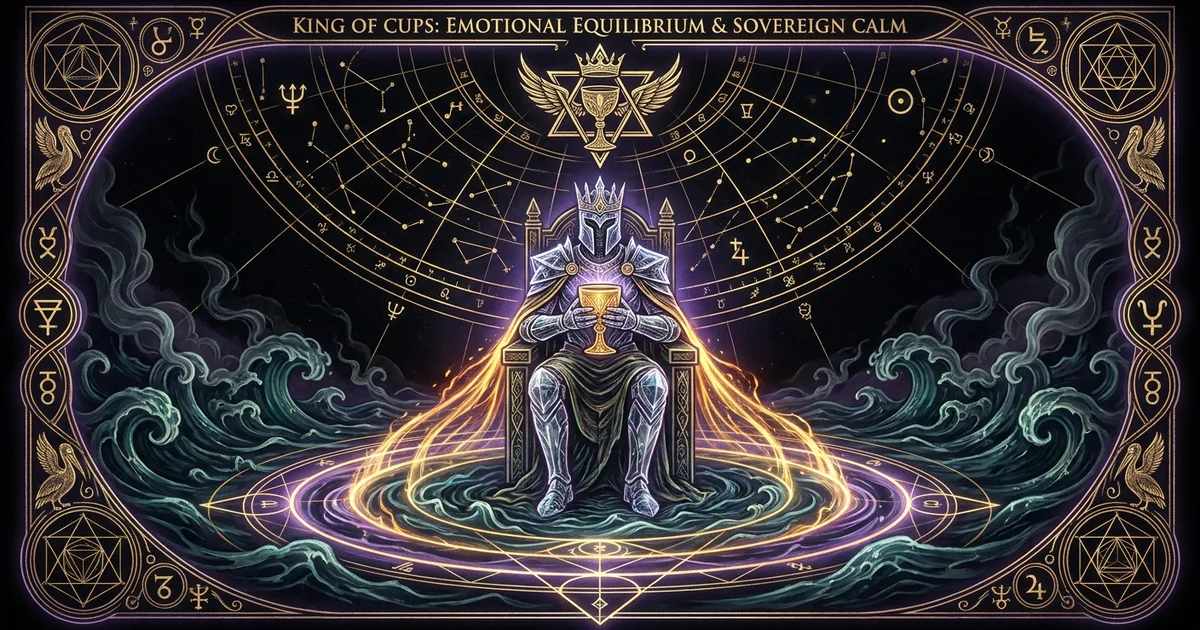
King of Cups: Emotional Equilibrium and Sovereign Calm
Archetypal Thesis & Systemic Paradigm: The Sovereign Governor of the Affective Ocean
The King of Cups occupies a unique position in the cartography of the Western mystery tradition, embodying the paradox of “Fire of Water”—the volitional, ordering principle of Fire (Yod) operating within the primordial, unformed matrix of Water (Heh). Far from symbolizing mere sentimentality, emotional passivity, or artistic indulgence, this court archetype delineates the highest psycho-spiritual sublimation of the water element. Within the systemic architecture of the cups suit archetypes, the King represents sovereign affect regulation: the conscious capacity to contain, calibrate, and direct oceanic unconscious currents without falling victim to psychic inundation or seeking refuge in dissociative numbness.
In esoteric Hermeticism and the Chokmah-Briah cosmology, the King of Cups is formulated through the calculus of the Tetragrammaton ($Y-H-V-H$). He constitutes the pristine Yod force (Archetypal Fire, the primordial creative spark, Father, Chokmah) operating within the macrocosmic world of Briah (the Creative World, Archangelic Realm of pure Elemental Water). The King is thus the sovereign masculine authority (Chokmah) providing structural containment and directional teleology to the universal fluid matrix of the Great Sea (Binah/Briah), generating dynamic homeostatic equilibrium.
Fiery Water and the Chokmah-Briah Dynamic
To understand the dynamic mechanics of the King of Cups, one must analyze the dialectical tension inherent in his elemental attribution: the Fire of Water. In classical elemental physics, fire and water exist in mutual cancellation; unchecked water extinguishes fire, while unchecked fire boils water into dispersed vapor. In Hermetic Kabbalah, however, their synthesis produces an alchemical steam—a pressurized psychic dynamic wherein conscious will (Fire) harnesses the boundless depths of instinctual feeling (Water).
Within the four worlds of Kabbalistic emanation, Briah represents the world of pure creation, associated with the archangel Gabriel and the liquid depths of psychic generation. When the primal Yod—the lightning flash of focused, intentional consciousness originating in the Sephirah Chokmah (Wisdom)—is projected into the Briatic ocean, it does not evaporate the sea. Instead, it acts as a centralizing vortex. The King does not stand outside the water commanding it from an arid shore; he is seated upon the water itself. His consciousness acts as an organizing center of gravity that prevents the oceanic unconscious from collapsing into entropic chaos.
The Sovereign Affect Regulator vs. Dissociative Stoicism
The foundational psychological problem addressed by this card is the differentiation between sovereign emotional equilibrium and neurotic emotional repression. In common divinatory misunderstandings, the King of Cups is frequently misread as a stoic, unfeeling patriarch who has mastered his emotions by extinguishing them. Such an interpretation fundamentally confuses the King of Swords (the air element utilizing intellect to dissect or detach from feeling) with the King of Cups.
The King of Cups maintains absolute affective proximity to the oceanic realm; his sovereign calm is not predicated on the absence of emotional turbulence, but on an immense somatic and psychic capacity to endure the hydraulic pressures of the unconscious. He operationalizes what contemporary affect theory describes as high affective tolerance coupled with autonomous self-regulation. Where the emotionally immature ego undergoes affective flooding—drowning in histrionic swings, panic, or rage—the King of Cups processes affect as vital teleological data. The ego-Self axis remains unshakeable because the ego has surrendered its delusion of total control, choosing instead to serve as the conscious vessel through which the oceanic depths are recognized, felt, and purposefully channeled.
The Cybernetics of the Cups Suit
Within the systemic progression of the minor arcana, the cups suit traces the evolution of psychic water from its pristine archetypal source in the Ace to its socialized, familial crystallization in the Ten. The court cards represent the dynamic, behavioral operationalization of this fluid medium. If the Page of Cups is the tender receptivity to the creative unconscious, the Knight the urgent quest driven by emotional longing, and the Queen the deep, reflective mirror of contemplative interiority, the King serves as the homeostatic governor of the entire complex.
Viewed through the lens of cybernetics, the King of Cups functions as a negative feedback loop that maintains psychic equilibrium within the subjective system. When external stressors or internal complexes threaten to overwhelm the organism with turbulent waves of affect, the King archetype adjusts the system’s internal parameters. He does not build rigid dams that cause psychic pressure to mount to catastrophic rupture points; instead, he modulates emotional currents through responsive, non-reactive navigation. He is the master steersman who uses the raw power of the storm to propel the vessel of consciousness toward its developmental telos.
Classical Provenance & Textual Lineage: Historical Transmutations of the Water King
The structural evolution of the King of Cups reveals a lineage of esoteric debate regarding the nature of spiritual authority, elemental hierarchy, and court card attributions across the major occult fraternities of the late nineteenth and early twentieth centuries.
“He holds a cup in his right hand, a sceptre in his left; his throne rests upon the sea, on one side a ship is riding and on the other a dolphin is leaping. The implicit of this card is reversed by the outward sign; he is graceful and not robust, but he is also powerful. He is the picture of equanimity and self-control. His throne floats upon the sea, but it does not sink; the waves do not submerge him. He represents the quiet of mind which comes from a balance between the emotional and the spiritual nature.” Cross-reference: S. L. MacGregor Mathers, Book T (1888), wherein the equivalent mature seated figure is classified as the “Prince of the Chariot of the Waters,” governing the airy-fiery propulsion of the fluid currents.
The Golden Dawn Tradition: ‘The Prince of the Chariot of the Waters’
In the Hermetic Order of the Golden Dawn’s seminal curricular text, Book T (authored primarily by S. L. MacGregor Mathers in 1888), the court cards were mapped strictly to the letters of the Tetragrammaton: Kings were assigned to Vau (Son/Air), Queens to the first Heh (Mother/Water), Knights to Yod (Father/Fire), and Princesses to the final Heh (Daughter/Earth). Consequently, the mature figure seated in a chariot or throne was designated not as a King, but as the “Prince of the Chariot of the Waters.”
In this original Golden Dawn schema, the Prince of the Waters was assigned to the attribution of Air of Water—the intellectual, directing, communicative breath passing over the face of the deep. Mathers characterized this figure as subtle, artistic, and intellectually gifted, yet warned that without spiritual discipline, he was susceptible to being swayed by unseen emotional currents. The fiery, active aspect of water was assigned to the mounted Knight. This dualistic division created a persistent tension within subsequent esoteric lineages concerning whether the sovereign ruler of the sea was fundamentally an active warrior riding the waves or an established monarch presiding over the deep.
       GOLDEN DAWN / BOOK T (1888)                      WAITE-SMITH REVISION (1910)
  ┌─────────────────────────────────────┐         ┌─────────────────────────────────────┐
  │ Knight: Fire of Water (Mounted)     │         │ King: Fire of Water (Throned)       │
  │ Prince: Air of Water (In Chariot)   │  ====>  │ Knight: Air of Water (Mounted)      │
  │ Queen:  Water of Water (Throned)    │         │ Queen:  Water of Water (Throned)    │
  │ Page:   Earth of Water (Standing)   │         │ Page:   Earth of Water (Standing)   │
  └─────────────────────────────────────┘         └─────────────────────────────────────┘
Waite-Smith Iconographic Canon: Floating Sovereignty Adrift on Open Seas
When Arthur Edward Waite collaborated with artist Pamela Colman Smith to generate the Rider-Waite-Smith (RWS) deck in 1909–1910, he deliberately reorganized the court titles to harmonize with public exoteric convention, restoring the King to the position of mature patriarch while retaining deep layers of Golden Dawn esoteric doctrine. Smith’s graphic composition of the King of Cups departed radically from earlier historic decks, such as the Tarot of Marseilles, where the King sat comfortably within a terrestrial throne room, flanked by standard court iconography.
Smith situated the King’s heavy stone throne directly upon the undulating, cresting surface of the open sea. This iconographic choice is radical: stone, the densest manifestation of the Earth element, does not sink beneath the fluid mass, nor does it anchor itself to an underlying continental shelf. The throne floats entirely through dynamic hydrodynamic equilibrium. Waite intended this image to convey an existential triumph: the human personality, when properly integrated, can establish an immovable spiritual seat amidst the fluctuating, groundless conditions of temporal existence. Smith draped the King in robes of azure and sea-green, lined with fiery crimson, reinforcing the chromatic code of Fire operating as the internal, generative engine of an aquatic mantle.
Crowleyan Divergence: The Knight of Cups as Chivalric Dissolution
In The Book of Thoth (1944), Aleister Crowley rejected Waite’s semantic adaptations and retained the Golden Dawn’s precise kabbalistic attributions, designating the true fiery dynamic of the water suit as the “Knight of Cups.” Crowley’s Knight does not sit upon an unyielding stone throne; he is an armed warrior clad in black armor, mounted upon a white steed, holding a flaming, radiant grail from which a peacock emerges.
Crowley’s interpretation leans into the ecstatic, Dionysian dissolution of the self within the divine ocean. Where Waite emphasizes stability, self-control, and civic-emotional mastery, Crowley characterizes the Fire of Water as the passion of spiritual aspiration seeking total annihilation in the universal waters of the Great Mother (the Amrita or celestial ambrosia). The contrast between the Waite-Smith King and the Crowleyan Knight represents two diverging teleological vectors within the Western esoteric tradition: the former seeks the crystallization of a sovereign, compassionate ego-Self axis capable of ethical agency within the world; the latter seeks the mystical transcendence of the individual ego through ecstatic immersion in the transpersonal current.
Structural Mechanics & Symbolic Geometry: Astrological Decans and Iconographic Vectors
The King of Cups is structurally anchored to the celestial sphere through the decanic architecture of the Hermetic zodiac, governing a specific 30-degree arc that straddles the cardinal-to-fixed elemental shift.
                  ZODIACAL ARC OF THE KING OF CUPS
  ┌───────────────────────────────┬───────────────────────────────┐
  │         LIBRA DECAN 3         │        SCORPIO DECANS 1 & 2   │
  │        (20° to 30° Libra)     │        (0° to 20° Scorpio)    │
  ├───────────────────────────────┼───────────────────────────────┤
  │ Planetary Ruler: Jupiter      │ Planetary Rulers: Mars / Sun  │
  │ Element: Cardinal Air         │ Element: Fixed Water          │
  │ Psychic Quality: Socialized   │ Psychic Quality: Penetrating, │
  │ Justice & Ethical Equilibrium │ Transmutative Chthonic Power  │
  └───────────────────────────────┴───────────────────────────────┘
  20° Libra ──────────────────────────────────────── 20° Scorpio
Astrological Matrix: 20° Libra to 20° Scorpio
In the astrological mechanics of the Golden Dawn system, the King of Cups rules from the 20th degree of Libra to the 20th degree of Scorpio. This placement explains the psychological complexity of the card, synthesizing the socialized, ethical, equilibrating air of Libra’s third decan (ruled by Jupiter) with the penetrating, chthonic, fixed water of Scorpio’s first two decans (ruled by Mars and the Sun, respectively; see the detailed mechanics of these decans in Scorpio decan mechanics).
The segment spanning 20° to 30° Libra infuses the King with a profound sense of balance, civic jurisprudence, and social mediation. Jupiter in Libra expands the drive for harmonious, equitable human relationships. However, as the arc crosses the threshold of the zero degree of Scorpio, the archetype plunges into the underworld of the human psyche. Scorpio’s fixed water represents emotional intensity, instinctual drives, sexuality, mortality, and the raw prima materia of the shadow. The King of Cups does not avoid this underworld; he integrates it. His equilibrium is forged precisely because he has confronted the Scorpionic abyss and subordinated its Martian, reactive impulses to a higher, solar-infused self-discipline.
Vector Analysis of the Scepter, Chalice, and Leaping Fish
Every iconographic vector in the RWS King of Cups represents a precise directional flow of energy. In his right hand—the hand traditionally associated with Chesed (Mercy), conscious exteriorization, and active agency—he holds a broad, closed, lotus-shaped chalice. Unlike the open, overflowing cup of the Ace, the King’s vessel is compact and steady, symbolizing emotional energy that is gathered, preserved, and deliberately contained. The right hand does not spill its contents; it maintains custody of feeling-values.
In his left hand—the hand associated with Geburah (Severity), receptive integration, and inward consciousness—he grasps a slender, lotus-tipped golden scepter. The scepter is an emblem of Fire and elemental Air, representing the conscious will that governs through spiritual authority rather than physical coercion. The directional polarity is vital: the conscious hand holds the emotional vessel, while the receptive hand holds the instrument of will.
Simultaneously, two liminal entities inhabit the marine horizon. To his right, an elemental fish—the classical Ichthys—breaches the crest of a blue wave. In analytical psychology, the fish represents the autonomous content of the unconscious leaping momentarily into the light of conscious awareness. The King does not flinch or reach out to spear it; he observes its emergence without breaking his posture. To his left, a red-sailed ship rides the ocean swells. The vessel symbolizes human cultural commerce, ego-consciousness traversing the transpersonal sea, and the strategic engagement with worldly affairs. Both the biological-instinctual life force (the fish) and the social-technological enterprise (the ship) persist harmoniously within the King’s operational field.
The Stone Throne Floating on the Open Sea: Structural Paradox
The compositional centerpiece of the card is the structural paradox of the floating throne. Stone belongs to the element of Malkuth—dense, heavy, mineralized, unyielding. Water belongs to the world of Yesod and Briah—yielding, formless, frictionless. Under normal conditions of physical gravity, the throne must sink to the ocean floor. That it remains suspended upon the surface signifies the mastery of alchemical levity and balance:
$$\text{Sovereign Equilibrium} = \frac{\text{Conscious Will (Fire)} \times \text{Ethical Containment (Stone)}}{\text{Instinctual Hydrodynamic Pressure (Water)}}$$
The King does not cling to a terra-firma island; there is no land in sight across the entire composition. This absence of terra firma signifies that advanced psycho-spiritual development requires the abandonment of rigid, external defenses. The individual can no longer rely on dogmatic institutional structures or defensive intellectual shields to feel safe. Instead, the stability of the self must be generated dynamically from within, matching the undulating rhythm of the unconscious through constant micro-adjustments of posture. Sovereign calm is not static immobility; it is continuous, fluid equilibration.
Psychological Dynamics & Operational Praxis: The Transcendent Function in Affective Mastery
In the framework of Carl Gustav Jung’s analytical psychology, the King of Cups represents the supreme differentiation of the Feeling function, operating in direct dialogue with the unconscious through what Jung termed the transcendent function.
Sovereign Emotional Containment (Integrated)
- Differentiation of Affect: Translates raw instinctual mood swings into refined, values-based ethical decisions.
- Homeostatic Ego-Self Axis: Serves as a stable, conscious center of gravity capable of holding oceanic unconscious content without ego-dissolution.
- Generative Empathy: Projects non-anxious presence, therapeutic holding environments, and compassionate containment for others.
- Fluid Boundaries: Calibrates interpersonal boundaries through flexible discernment rather than rigid dissociation or enmeshment.
Pathological Affective Distortion (Inverted/Shadow)
- Subterranean Manipulation: Deploys passive-aggression, gaslighting, emotional blackmail, and calculated guilt to dominate environments.
- Affective Flooding or Alexithymia: Alternates unpredictably between histrionic emotional storms and cold, impenetrable dissociation.
- Addictive Evasion: Uses chemical, behavioral, or psychic escapes to avoid confronting the terrifying depths of the inner void.
- Boundary Enmeshment: Obliterates individuation through codependent over-identification, devouring others under the guise of care.
Jungian Integration: Emotional Differentiation vs. Affective Flooding
In Psychological Types (1921) and later in Aion (1951), Jung emphasized that “feeling” is not an irrational spasm of affect, but a rational judging function tasked with assessing the subjective value of experiences, ideas, and relationships. Undifferentiated feeling remains contaminated by primal affect: when triggered, it produces raw physiological reactions—sweating, tachycardia, violent rage, or paralyzing sorrow—wherein the ego is completely submerged by autonomous complexes.
The King of Cups represents the feeling function emancipated from instinctual compulsion. Here, feeling has undergone rigorous psychological refining. The individual does not simply “feel angry” or “feel sad”; rather, they observe the affective surge, extract its teleological meaning, and assign it an ethical value. When the unconscious threatens to overwhelm the conscious personality with archetypal imagery or shadow projections, the King of Cups mobilizes the transcendent function in tarot. He holds the tension of the opposites—the conscious ego’s vulnerability versus the unconscious ocean’s violent surges—until a new, third psychological attitude emerges, restoring equilibrium without repression.
The Shadow King: Passive-Aggression, Subterranean Manipulation, and Enmeshment
When the energy of the King of Cups is inverted, obstructed, or corrupted by the unintegrated shadow, the archetype degenerates into the most insidiously toxic manifestations of the water element. Unlike the open brutality of the shadow King of Wands or the tyrannical cruelty of the shadow King of Swords, the shadow King of Cups operates through subterranean currents, emotional subterfuge, and psychological warfare.
This pathology frequently manifests as the master manipulator: an individual who presents an exterior facade of serene benevolence while pulling hidden emotional strings to induce guilt, dependency, and enmeshment. Because this personality has never truly integrated the Scorpionic fire beneath the surface, it experiences its own vulnerability as an existential threat. It weaponizes silence, utilizes passive-aggressive sabotage, and feigns wounded martyrdom to dominate its social sphere.
In its most desperate iterations, the shadow King turns inward toward catastrophic addiction. Unable to regulate the hydraulic pressure of his internal ocean, he uses alcohol, narcotics, or compulsive escapism to anesthetize his psychic pain, becoming a sunken monarch whose realm is choked by the stagnant weeds of unresolved complexes.
Operational Consultation: Diagnostic Protocols for the King in Divinatory Practice
When the King of Cups surfaces within an operational divinatory consultation, it serves as a strict structural imperative regarding the querent’s relationship to current emotional turbulence. Its diagnostic presence demands the immediate cessation of impulsive, affect-driven reactivity.
DIVINATORY DECISION PROTOCOL
                           [ King of Cups ]
                                  │
         Is the querent experiencing emotional flooding?
                                  │
                 ┌────────────────┴────────────────┐
                YES                               NO
                 │                                 │
                 ▼                                 ▼
   [ Prescribe Holding Environment ]      [ Activate Compassionate Agency ]
   - Cease impulsive reactions.           - Step into diplomatic leadership.
   - Establish emotional boundaries.      - Offer therapeutic holding to others.
   - Engage alchemical containment.       - Balance justice with mercy.
If the querent is embroiled in interpersonal conflict, bureaucratic betrayal, or deep personal grief, the King of Cups does not prescribe emotional avoidance, nor does it condone an explosive emotional release. Instead, it directs the querent to construct a stable “holding environment” within their own psyche. The protocol requires three successive actions:
- Acknowledge the Undercurrent: Consciously admit the full intensity of the emotional reaction (grief, fury, desire) without intellectualizing or minimizing it.
- Engage the Alchemical Vessel: Refuse to immediately exteriorize the emotion into speech, action, or social media communication. Retain the affect within the body, holding the psychic heat until the reactive impulse transforms into clarified insight.
- Execute Sovereign Calibration: Respond to the external circumstance from the place of the floating stone throne—delivering measured, direct, and compassionate boundary assessments that resolve the conflict without escalating the emotional storm.
Philosophical Synthesis & Macrocosmic Correspondence: Hermetic Fluidity and the Alchemical Sovereign
The King of Cups reflects macrocosmic paradigms articulated across centuries of esoteric philosophy, alchemical transformation, and Eastern non-dual traditions, illustrating the universal laws governing conscious authority over chaotic matter.
“The solutio is the return of the differentiated matter to its original state, the prima materia, the fluid state of the unconscious. But if this dissolution is not balanced by the coagulatio, the individual is simply wiped out, drowned in a psychosis or in an infantile mood. The King who can sit upon the waters without sinking is the symbol of the resurrected, alchemical King who has integrated the solutio into his own substance; he has achieved the coagulatio within the very heart of the flood.”
Alchemical Coagula: Solidifying the Universal Dissolvent
In the classical hermetic laboratory, the alchemical opus oscillates continuously between two fundamental operations: solve et coagula—dissolve and coagulate. Elemental Water is the archetypal agent of the solutio: it represents the universal dissolvent, the alkahest, which breaks down rigid, ossified ego-structures, melting them back into the primordial slime of the prima materia.
Most seekers undergo the solutio only to be destroyed by it; their conscious structures disintegrate under the onslaught of repressed trauma, archetypal imagery, or existential dread. The King of Cups, however, exemplifies the miraculous operation of coagulatio occurring within the solutio itself. He is the red sulfur (conscious solar will) that precipitates a permanent crystalline structure out of the mercurial waters. He transforms the chaotic sea into the Aqua Vitae—the Water of Life—proving that true spiritual authority is not attained by avoiding dissolution, but by learning how to crystallize consciousness within the universal solvent.
PRIMA MATERIA                   SOLUTIO                   COAGULATIO
   (Chaos / Unconscious)  ===>  (Dissolution of Rigid Ego) ===>  (Sovereign Crystallization)
   [Raw Oceanic Current]        [Hydraulic Pressure/Crisis]     [King of Cups Equilibrium]
Taoist Wu Wei and the Unshakable Surface of the Mirror-Mind
The philosophical architecture of the King of Cups resonates deeply with the Taoist concept of Wu Wei (effortless action, or non-contending alignment with the Tao) as articulated in the Daodejing and the writings of Zhuangzi. Laozi famously observed that nothing in the world is as soft and yielding as water, yet nothing can surpass it for overcoming the hard and rigid.
The King of Cups is the psychological incarnation of this paradox. He does not wage war against the waves; he offers zero resistance to the natural mechanics of the ocean, thereby rendering the ocean incapable of harming him. In the classical Taoist metaphor of the mirror-mind (xin), the enlightened sage allows all phenomena to pass across his awareness without clinging or pushing away: when the bird flies over the lake, the water mirrors it perfectly; when the bird is gone, the water retains no trace of its image. The King’s stone throne represents this unyielding mirror-mind—a stillness so absolute that the entire cosmos can storm across its surface without disturbing the tranquil depths beneath.
Macrocosmic Resonance: The Sovereign as Bridge Across the Anima Mundi
On the macrocosmic level, the King of Cups acts as an embodied mediator of the Anima Mundi (the World Soul). Hermetic philosophy posits that the subjective emotional life of the individual is not an isolated phenomenon, but an aperture into the transpersonal emotional climate of the planet itself. The collective unconscious is a turbulent ocean continuously roiled by systemic suffering, historical trauma, and archetypal conflicts.
When an individual integrates the King of Cups archetype, they become a stabilizing node within the larger matrix of the Anima Mundi. They are capable of attuning to the profound grief and longing of the human condition without contracting psychic contamination. By holding personal equilibrium amidst collective madness, the sovereign prevents the psychic atmosphere from degenerating into panic or mass hysteria. In this capacity, the King of Cups fulfills the highest ideal of the Great Work: the redemption of the fallen waters of the world through the quiet, unshakeable presence of conscious, compassionate spirit.
Frequently Asked Questions on the King of Cups Archetype
Decan Discrepancies and Golden Dawn Titling
The historical naming discrepancies surrounding the King of Cups stem directly from the ideological rift between the Hermetic Order of the Golden Dawn’s internal cipher and the standardized public release of the Rider-Waite-Smith deck in 1910.
In Mathers’ Book T, the mounted figure is titled the “Knight of the Waters” and assigned the elemental formula of Fire of Water (the Yod of the suit), while the seated figure is named the “Prince of the Chariot of the Waters,” assigned to Air of Water (the Vau of the suit). When Waite designed his deck, he intentionally restored the titles King, Queen, Knight, and Page to conform to historical tarot terminology, but he effectively merged the structural attributes of the Golden Dawn Prince and Knight into his throned King. Consequently, students comparing Aleister Crowley’s Book of Thoth with the Waite-Smith canon must recognize that Crowley’s “Knight of Cups” is structurally and elementally equivalent to the Golden Dawn’s Fire of Water, while Waite’s throned “King of Cups” absorbs that primary paternal authority while presenting it through the seated stability historically reserved for the Prince.
Regarding decanic rulership: Waite maintained the core Golden Dawn attribution assigning this seated ruler to the arc spanning 20° Libra to 20° Scorpio, synthesizing Jupiterian social justice with Scorpionic emotional penetration.
King of Cups vs. Queen of Cups: Structural and Psychological Distinctions
While both figures govern the Briatic realm of the water element, their structural vectors and psychological mechanics are diametrically opposed, reflecting the cosmic polarity of Yod (active/ordering) and Heh (receptive/gestating).
The Queen of Cups embodies “Water of Water.” Her realm is one of total, undifferentiated interiority, contemplative mysticism, and intuitive mirroring. She sits on the shore where the sea meets the land, gazing into an ornate, closed ciborium, fully immersed in her subjective reverie. She does not govern the sea; she is the sea reflecting back upon itself. Her power lies in her absolute capacity for psychic receptivity, somatic attunement, and imaginative gestation.
In stark contrast, the King of Cups embodies “Fire of Water.” He sits directly on top of the open sea, surrounded by undulating waves, holding his cup open to the sky while wielding a golden scepter of will. The King’s function is structural, externalized, and diplomatic. Where the Queen absorbs emotional currents to dream them into artistic forms, the King creates a conscious vessel to channel those currents into ethical leadership, clinical containment, and stable interpersonal stewardship. The Queen is the reflective depths; the King is the sovereign governor who ensures those depths do not inundate the kingdom of the conscious mind.
Navigating the Boundary Between Emotional Equilibrium and Emotional Repression
Distinguishing between authentic emotional equilibrium (the integrated King of Cups) and neurotic emotional dissociation or suppression (the Shadow King of Swords or Cups) requires analyzing somatic, cognitive, and relational markers:
                          DIAGNOSTIC CRITERIA
  ┌─────────────────────────────────┬─────────────────────────────────┐
  │   AUTHENTIC EQUILIBRIUM (KING)  │   NEUROTIC SUPPRESSION (SHADOW) │
  ├─────────────────────────────────┼─────────────────────────────────┤
  │ Visceral, fully felt affective  │ Intellectualized, alexithymic   │
  │ experience in the body.         │ numbness; somatic tension.      │
  │                                 │                                 │
  │ High emotional literacy; names  │ Dismissive of emotional value;  │
  │ states accurately and calmly.   │ calls feelings "illogical."     │
  │                                 │                                 │
  │ Direct, compassionate, and      │ Passive-aggressive leaks,       │
  │ flexible interpersonal bounds.  │ sudden eruptions, or rigidity.  │
  │                                 │                                 │
  │ Calming, non-anxious presence   │ Freezes or destabilizes others  │
  │ that settles environments.      │ through covert manipulation.    │
  └─────────────────────────────────┴─────────────────────────────────┘
The individual operating under genuine King of Cups equilibrium possesses complete somatic awareness: they feel the sorrow, fury, or joy reverberating through their nervous system, but their ego does not fuse with the sensation. They do not say “I am angry”; they recognize that “anger is moving through the vessel of consciousness.” They remain fully capable of expressing vulnerability, warm empathy, and genuine grief when circumstances warrant.
Conversely, the individual in a state of pathological repression has severed the somatic link. Their calmness is brittle, rigid, and defensive. They intellectualize emotional crises, utilize dismissive logic to invalidate emotional expressions, and present an impenetrable mask that chills their environment rather than stabilizing it. Underneath this brittle surface, unresolved affect festers, leaking out through passive-aggressive behaviors, somatic illness, sudden explosive outbursts, or covert addictions. True equilibrium is soft, fluid, and yielding like deep water; repression is brittle stone that will inevitably fracture when the hydraulic pressure of the unconscious reaches its breaking point. :::