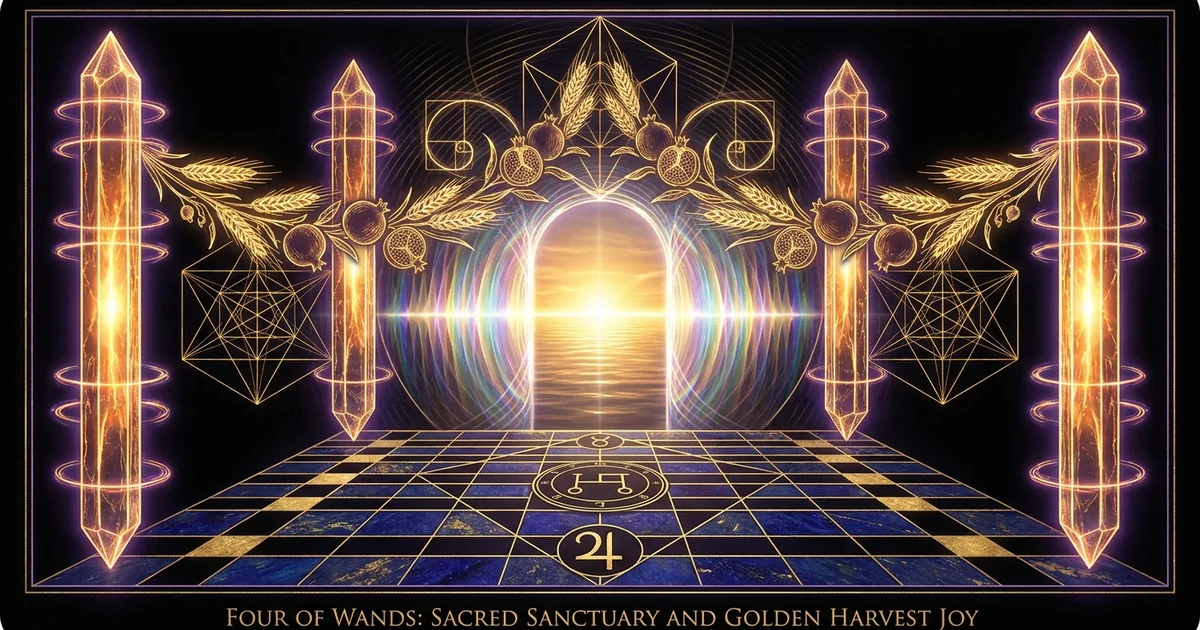
Four of Wands: Sacred Sanctuary and Golden Harvest Joy
Archetypal Thesis & Systemic Paradigm: The Consecration of Volitional Fire
The Quadrate Matrix as an Energetic Governor
The ontological progression of the suit of wands delineates the thermodynamics of divine will descending into manifest reality. In its nascent phases, the fire element displays an acute instability: the radical, unconditioned potential of the Ace explodes into the polarized bifurcation of the Two, which subsequently projects outward as the teleological vector of the Three of Wands. Without an architectural intervention, this kinetic trajectory risks entropic dissolution, burning itself out in an unsustainable centrifugal expansion. The Four of Wands represents the vital structural threshold where pure intentionality achieves dimensional stability. By imposing the geometric rigor of the tetrad upon the incandescent plasma of Atziluthic Fire, this arcanum converts raw combustion into an engine of sustainable work, transmuting volatile impetus into an enduring sanctuary.
Within esoteric cartography, the number four represents the foundational framework of physical and metaphysical coherence. It introduces spatial extension, volumetric integrity, and systemic boundary conditions. In the Four of Wands, this mathematical proportion functions as an energetic governor. The four vertical staves do not suppress the cardinal momentum of the fire element; rather, they serve as conductive pillars that anchor lightning to the earth. This containment establishes an isothermal zone wherein the creative will can operate without destroying its vehicle. By arresting the unrestrained dissipation of energy, the Four of Wands establishes the conditions for psychic and spiritual sedimentation, transforming unchanneled desire into realized sovereignty.
::: diagram Energetic Descent of Volitional Fire


    Chokmah: Undifferentiated Will (Ace/Two)
    Binah: Directed Form / Emergence (Three)
    Chesed: Bounded Structural Harmony (Four)
    Stable Temenos / Perfected Work


:::
Chesed in Atziluth: Archetypal Compassion Structuring Primordial Will
To decipher the four of wands tarot meaning at the qabalistic root, the card must be situated at the intersection of Chesed (the fourth Sephira of the Tree of Life) and the archetypal world of Atziluth. Chesed occupies the position immediately below the Abyss, operating as the first Sephira of the secondary macrocosmic triad. Often translated as Mercy, Lovingkindness, or Majesty, Chesed is the sphere of architectural cohesion, crystallization, and benevolent ordering. While the Supernal triad (Kether, Chokmah, Binah) conceives the transcendental blueprint, Chesed translates that abstract ideation into manifested structural law.
When Chesed operates within Atziluth—the world of pure spirit and primordial fire—it does not produce cold crystallization or rigid calcification. Instead, Chesed functions as a stabilizing chalice that cradles cosmic flame. This dynamic resolves the primary paradox of the Four of Wands: how to maintain the incandescent vitality of the fire element while subjecting it to the structural limits of geometry. The Chesedic influence supplies an expansive, sovereign magnanimity that arrests chaos. It demonstrates that the supreme expression of spiritual authority is not violent subjugation, but the orchestration of disparate energies into harmonious equilibrium. In this Sephira, the creative volition recognizes that lasting triumph requires the voluntary adoption of boundary conditions.
The Temenos as an Alchemical Vessel of Cohesion
Psychologically and phenomenologically, the architectural structure portrayed in the card constitutes a consecrated boundary, known in antiquity and analytical psychology as the temenos. As Carl Jung illuminated, the psyche requires a protected precinct—a circumscribed precinct insulated from the chaotic intrusions of the profane collective and the volcanic pressures of the raw unconscious—in order to execute the transformations of the individuation process. The Four of Wands constructs precisely this precinct. It represents the psychic coordinates where an individual successfully demarcates a zone of coherent interiority, shielding the fragile, nascent fruits of creative endeavor from dissolution.
Within the parameters of the temenos, human consciousness encounters the sacred not as a paralyzing hierophany, but as communal celebration, harvest, and reciprocal integration. The staves operate as four cardinal perimeter markers that define an alchemical retort. Within this retort, the instinctual libido is harmonized through cultural, artistic, and domestic forms. Far from representing domestic complacency, the Four of Wands marks the deliberate construction of an energetic oasis. The joy radiating from this arcanum is the kinetic liberation experienced by the ego when it realizes that its primary volitional drives are no longer under siege, but are instead anchored within an enduring, self-sustaining matrix of psychic order.
Classical Provenance & Textual Lineage: Decanic Lore to the Golden Dawn
The Picatrix and Hellenistic Decans of Aries
The iconographic and astrological heritage of the Four of Wands traces directly to the ancient decanic partitions of the zodiac, specifically the second decanate of Aries (11° to 20°). In the Hellenistic and medieval astrological lineages synthesized in magical compendia such as the Picatrix (Ghayat al-Hakim) and Heinrich Cornelius Agrippa’s Three Books of Occult Philosophy (1533), this specific ten-degree arc of the celestial wheel is assigned to the planetary stewardship of Venus.
::: source S. L. MacGregor Mathers, Book T (1888)
"The Four of Wands: The Lord of Perfected Work. Attribution: Venus in Aries, 11° to 20°. It represents swiftness and strength combined, work completed and brought to a peaceful and successful issue, rest after labor, and the establishment of order."
:::
Agrippa records that the second face of Aries features the image of “a woman clad in a white robe, holding a wand, and adorned with flowers,” an effigy embodying beauty, civil authority, domestic grace, and noble works. In these ancient and medieval sources, the fundamental tension of this decanate is the union of opposites: the martial, aggressive, masculine impetuosity of Aries is softened, tempered, and civilly oriented by the aesthetic, adhesive, and proportioned virtue of Venus. This decanic lore establishes that the four of wands symbolism is steeped in the historical concept of pacification. The decan does not deny the warlike or pioneering genesis of the sign; rather, it marks the exact celestial coordinate where the conqueror lays down arms to survey the conquered territory, construct civic foundations, and initiate civic agriculture.
The Golden Dawn Cipher and the ‘Lord of Perfected Work’
When the Hermetic Order of the Golden Dawn synthesized its esoteric Tarot system in the late nineteenth century via S. L. MacGregor Mathers and W. W. Westcott, they drew upon these decanic lineages to formalize the card’s operational title: The Lord of Perfected Work. Documented in the internal instruction manual Book T, this title reflects the Golden Dawn’s precise technical taxonomy. In this system, the minor cards are not illustrative descriptions of mundane circumstances, but mathematical demonstrations of macrocosmic forces acting through terrestrial vectors.
By designating the card the “Lord of Perfected Work,” Mathers identified this energetic node as the summit of intentional endeavor. The work is “perfected” not because the evolutionary impulse has permanently ceased, but because the teleological aim formulated in the initial ignition of the suit has attained its first objective, physical manifestation. The four staves represent the four letters of the Tetragrammaton (YHVH) operative within the element of Fire, fully realized and held in static majesty. Aleister Crowley, inheriting this formal assignation in The Book of Thoth (1944), similarly observed that in this card, Chesed has established its order within the fiery realm, producing an equilibrium that is stable, authoritative, and majestic, free from the turbulent disruptions that inevitably characterize subsequent energetic shifts.
Pamela Colman Smith’s Secular-Sacred Synthesis in the RWS Paradigm
The pictorial revolution of the Rider-Waite-Smith (RWS) deck, published in 1910 under the intellectual direction of Arthur Edward Waite and executed through the brush of Pamela Colman Smith, fundamentally re-envisioned this card. Smith transmuted the abstract, geometric pip arrangements of the Tarot de Marseille into an evocative, figurative scene laden with classical pastoralism and liturgical allusions. In her rendering, four massive wooden wands, planted firmly in the immediate foreground, are bound together at their summits by a lush, hanging garland of fruits, grains, and floral blossoms.
::: note Architectural & Liturgical Echoes
The central canopy composed of four vertical staves bridged by an organic, hanging archway directly parallels two distinct sacred technologies:
1. The Classical Roman Floralia: An agricultural pagan festival dedicated to Flora, celebrating the flowering of crops and the restoration of life.
2. The Jewish Chuppah: A four-pillared canopy open to the winds on all four sides, signifying hospitality, covenantal sanctuary, and the consecration of a new domestic cosmos.
:::
Behind this grand portal, two female figures clad in flowing tunics, crowns of flowers upon their brows, raise their hands and hold aloft bouquets in a gesture of triumphal greeting. Beyond them, across an open lawn, stands a moated, fortified manor house or castle. Through this composition, Smith fused the esoteric doctrine of the Golden Dawn with archetypal human sociology. The castle in the background marks the established societal foundation—the permanent, structural ego-structure—while the open, four-pillared bower in the foreground hosts an uninhibited, ecstatic communion with the earth’s natural abundance. Smith emphasizes that true sanctuary is not found by retreating behind stone bastions, but is actively woven within the living, dynamic threshold that links the wild natural world with civilized human order.
Structural Mechanics & Symbolic Geometry: Astrological and Qabalistic Coordinates
::: note Qabalistic & Astrological Metric Map
- Sephira: Chesed (Mercy / Expansion within Structural Form)
- World: Atziluth (Archetypal / Primordial Fire)
- Astrological Decan: Second Decan of Aries (11°00' to 20°00' Aries)
- Planetary Ruler: Venus in Aries (Detriment reconciled through artistic sublimation)
- Element: Fire (Cardinal / Fixed-in-form)
- Esoteric Title: Lord of Perfected Work
:::
Venus in Aries: Reconciling Erotic Grace with Pioneering Force
The dynamic structural tension animating the Four of Wands originates in the astrological mechanics of Venus placed within the cardinal fire sign of Aries. In classical astrological taxonomy, Venus occupies her detriment in Aries; she is in the sign opposite her natural diurnal domicile of Libra, a sign ruled by her mythological counter-principle, Mars. Under ordinary circumstances, the detriment of Venus signifies interpersonal volatility, an impatient or demanding emotional register, and an aggressive, impetuous expression of instinctual desire that burns too fiercely to sustain harmonious continuity.
However, when Venus governs the second decanate of Aries, her mitigating, proportionate, and unitive virtues sublimate the raw Martian violence of the host sign. Aries is the sign of the cosmic dawn, the springtime thrust of life cracking open the calcified winter earth. When Venus enters this theater of action, she imposes aesthetic harmony and proportionality upon that primordial force. The result is the pacification of conflict, the crystallization of an artistic or architectural vision, and the channelization of conquest into celebratory hospitality. Rather than a state of wounded dysfunction, this decanic pairing mirrors the esoteric alchemical marriage (coniunctio): the warrior’s spear is anchored in the earth to serve as a trellis for the flowering vine, demonstrating that true spiritual mastery consists of bringing destructive instincts into the service of life-affirming design.
The Geometry of the Tetrad: Pillars, Floral Garlands, and Woven Viticulture
The compositional geometry of the Four of Wands is founded entirely on the metaphysics of the quaternary mandala. The four wands do not merely appear in the image; they construct a three-dimensional peristyle, a physical threshold through which the landscape must be perceived. The number four is universally associated with the cardinal directions (North, South, East, West), the ancient physical elements (Fire, Water, Air, Earth), the seasons (Spring, Summer, Autumn, Winter), and the stabilization of space. In this card, the wands form a four-posted portal that operates as a hyper-dimensional frame, transmuting the profane terrain into an enchanted field.
The garland bridging the vertical staves introduces the vital counter-element to the geometric rigidity of the number four. It is composed of the agricultural trinity of Mediterranean sustenance: wheat, apples, and grapes. The presence of these fruits establishes the theme of realized cultivation. The staves represent raw human will, the vegetative garland represents the responsive, co-creative fertility of nature, and their structural union symbolizes the golden harvest. Viticulture and cereal farming require patience, rhythmic attunement to cosmological cycles, and deliberate, disciplined curation. Thus, the four of wands symbolism transcends mere unearned good fortune; it signifies the joyous arrival at a tangible harvest achieved through the persistent, conscious investment of structural labor.
::: diagram The Quaternary Framework of Manifestation


    North / Earth / Flesh
    South / Fire / Will


                           \                   /
                            \   [ CENTER ]    /
                             \   (Temenos)   /
                            /                 \


    East / Air / Intellect
    West / Water / Soul


:::
The Second Decan of Aries (11°–20°): The Point of Dynamic Stasis
The second decan of Aries occupies an exact psychological and cosmological turning point within the zodiacal cycle. Spanning from 11°00’ to 20°00’ of the sign, this decan represents the middle phase of the cardinal initiation. In the first decan of Aries (ruled by Mars), the ego experiences the shock of emergence, characterized by intense friction, survivalist exertion, and an unmediated impulse to exist. In the third decan (ruled by Jupiter), the pioneering fire expands into philosophical speculation, expansive territorial claims, and institutional ambition.
The second decan, therefore, represents the precise interstitial space of equilibrium between initial emergence and systemic expansion: a state of dynamic stasis. It is the moment when the migratory tribe halts its march, discovers a spring of sweet water, constructs a temporary settlement, and holds a feast of thanksgiving. The fires are not extinguished, but they are gathered into the hearth. This decanic calibration demonstrates that the Four of Wands is not an image of terminal, static crystallization, but of dynamic rest—a vital sabbatical in the ongoing cycle of creative becoming that recharges the psychic batteries before the next developmental threshold.
Psychological Dynamics & Operational Praxis: The Temenos and Integrative Joy
The Jungian Temenos: Containment of Instinctual Libido
Through the lens of analytical psychology, the Four of Wands represents the archetypal construction of the temenos—a consecrated geometric enclosure that preserves the integrity of the conscious ego during moments of profound internal transformation. When the psychic energy, or libido, is uncontained, it swings violently between manic inflation and depressive deflation. The fire element, left unchecked, manifests as inflationary grandiosity, compulsive consumption, and severe psychic fragmentation. The fourfold design of this arcanum acts as a mandala, reflecting the four psychic functions (thinking, feeling, sensation, intuition) organized in a state of harmonious coordination.
Within this bounded mandala, the individual experiences what Jungian psychology terms integrative joy. Unlike the fleeting euphoria derived from egoic conquests, integrative joy arises when the conscious personality successfully integrates an unconscious impulse without being shattered by it. The celebratory figures within the Four of Wands have not transcended the world; they have rooted themselves deeply within it. The card delineates the psychological realization of home: an internal sense of belonging, structural safety, and self-validation that allows the psyche to lower its reactive defenses, lay down its armaments, and celebrate its hard-won maturation.
:::: comparison Thermodynamic Archetypes of Fire
::: column [Dispersed Volition (Unbounded Fire)]
- Entropy through chaotic projection
- Creative burnout and volatile dispersion
- Absence of boundary conditions; ego-inflation
- Ephemeral sparks without architectural legacy
- Vulnerability to sudden psychic fragmentation
:::
::: column [The Perfected Sanctuary (Four of Wands)]
- Energy stabilized within a sacred boundary (temenos)
- Rhythmic regeneration and psychological harvest
- Sustainable creative containment and collective resonance
- Enduring foundations for successive cycles of expansion
- Robust structural integrity under environmental stress
:::
::::
Operational Praxis: Establishing Ritual and Creative Sanctuaries
In clinical, personal, and magical application, working with the Four of Wands requires the deliberate establishment of temporal, spatial, and relational sanctuaries. When this card appears within an operational framework, it mandates the suspension of aggressive outward movement in favor of boundary fortification and milestone consolidation. The practitioner is called to evaluate where their psychic and creative forces are being squandered across ill-defined borders and to construct a container capable of safeguarding their progress.
::: note Structural Protocols for Operational Praxis
1. Spatial Demarcation: The clearing, consecration, and maintenance of an inviolable physical environment dedicated exclusively to creative, contemplative, or communal tasks.
2. Temporal Rhythms: The establishment of structural sabbatical cycles, acknowledging that sustained volitional output demands rhythmic, non-negotiable periods of celebration and recovery.
3. Covenantal Alignment: The cultivation of interpersonal alliances and communal partnerships founded upon mutual values, clear reciprocal boundaries, and shared achievements.
:::
This praxis is not a passive retreat from the field of battle, but an act of strategic consolidation. Just as a commander fortifies an outpost to secure supply lines before advancing, an individual must systematically organize their domestic, financial, and emotional terrain to build a reliable launchpad for future ventures. The Four of Wands serves as an operational mandate to celebrate intermediate milestones, honoring the effort expended thus far and recognizing that an uncelebrated victory leaves the soul depleted and vulnerable to exhaustion.
The Shadow of the Quadrate: The Enclosure as a Stifling Fortress
Every esoteric coordinate contains its inherent pathology, and the Four of Wands is not immune to the corruptions of its own nature. The shadow of the quaternary matrix is the peril of ossification. When the temporary sanctuary ceases to be a dynamic threshold and becomes an exclusionary fortress, the living fire of the spirit is suffocated. The four staves, designed to hold aloft the garland of abundant life, can easily transform into the bars of an ideological, institutional, or relational prison cell.
::: esoteric-warning The Pathological Fortress
When the temenos hardens into an entrenched barricade, the ego succumbs to domestic stagnation, provincialism, and defensive insularity. Consecrated joy deteriorates into the anxious policing of boundaries, transforming a place of life-giving sanctuary into a suffocating tomb of static complacency.
:::
This shadow state manifests psychologically as a terror of change, an aversion to necessary risk, and the premature declaration of ultimate victory. The ego clings stubbornly to its initial milestones, mistaking a temporary waystation for the final destination. In interpersonal dynamics, this pathology generates toxic cliquishness, xenophobic exclusion, and the institutionalization of creative pursuits into lifeless dogmas. When the living garland dries up and the fire within the hearth consumes its own hearthstones, the Four of Wands ceases to be the Lord of Perfected Work and degenerates into the calcified prison of the status quo. This stagnation inevitably summons the destructive friction of the Five of Wands to violently dismantle the calcified enclosure.
Philosophical Synthesis & Macrocosmic Correspondence: The Golden Harvest of Will
The Hermetic Principle of Measure: Harmony as Necessary Friction
In the deep currents of Hermetic philosophy, matter and spirit are not antagonistic forces locked in dualistic combat, but complementary polarities on a continuous metaphysical spectrum. The third Hermetic principle, the Principle of Vibration, asserts that everything moves and vibrates, while the Principle of Polarity reveals that extremes meet and opposites are identical in nature, differing only in degree. The Four of Wands exemplifies the Hermetic doctrine of Measure (Mensura), wherein spiritual power realizes its highest perfection precisely when bounded by mathematical proportion and geometric harmony.
::: citation C. G. Jung, Psychology and Alchemy (1944, CW 12, par. 41)
"The temenos is a sacred precinct, a circumscribed space, within which the alchemical transformation can safely occur without being disturbed by the uncontrolled intrusion of outside influences... It is the condition of peace necessary for the great work."
:::
Form is not the enemy of spirit; it is its necessary vessel. Unbounded flame is an entropic hazard; flame housed within a furnace powers the alchemical engine of the cosmos. The Four of Wands teaches that divine will achieves enduring majesty not by obliterating boundaries, but by creating forms of exceptional elegance, hospitality, and resilience. True freedom is not the absence of all constraints, but the voluntary surrender to harmonious, self-imposed measures that allow the full spectrum of creative life to bloom without devouring its own source.
I Ching Hexagram Correspondences: Hexagram 11 (Tai / Peace) and Hexagram 20 (Guan)
The systemic mechanics of the Four of Wands find an illuminating structural analogue in the classical Chinese I Ching (Book of Changes), most notably in Hexagram 11, Tai (Peace or Harmony). In the visual and energetic architecture of Tai, the trigram for Earth (Kun) rests above, while the trigram for Heaven (Qian) sits below. Because the natural energetic vector of Heaven is to ascend, and the natural vector of Earth is to descend, their positions in this hexagram initiate a continuous, reciprocal communion:
::: diagram Energetic Polarity of Hexagram 11 (Tai)
<div class="diagram-flow flex flex-col items-center gap-3 my-4 w-full">
  <div class="diagram-row flex flex-wrap items-center justify-center gap-3">
    <div class="diagram-node px-4 py-2 rounded-xl bg-elevated border border-gold/30 text-primary font-mono shadow-md transition-all">Hexagram 11: Tai / Peace</div>
  </div>
</div>
Top Trigram:    -- -- (Kun / Earth)   ==> Vector: Descending Grace
                -- --
                -- --
-------------------------------------------------------------------
Bottom Trigram: ----- (Qian / Heaven) ==> Vector: Ascending Fire
                -----
                -----
:::
Heaven and Earth move toward one another, intermingling their essences to produce universal flourishing, social peace, and agricultural fertility. This mirrors precisely the alchemical mechanics of the Four of Wands, where Atziluthic Fire descends into the earthly architecture of Chesed to cultivate a shared sanctuary.
A secondary, complementary macrocosmic alignment emerges in Hexagram 20, Guan (Contemplation or The View). In Guan, the four yin lines at the base support two strong yang lines at the summit, mirroring an elevated tower, open altar, or sacred pavilion from which ruler and cosmos regard one another with reverence. Like the open, four-posted canopy of the Four of Wands, Guan presents a structural vantage point—an elevated spiritual platform that invites divine contemplation and communal harmony, securing order without resorting to brute coercion.
Macrocosmic Cycles: Spring Equinox Consummation and Solar Architecture
On the macrocosmic wheel of the agricultural year, the Four of Wands maps to the period immediately following the Vernal Equinox, extending into the heart of mid-spring. It corresponds to the historical agricultural festivals of renewal—such as Beltane in the Celtic lineage and the Floralia in the Roman tradition—wherein communities celebrated the irreversible return of light and vegetative vigor. During this celestial window, the raw, violent surge of life that cracked the winter ground during early Aries stabilizes into the organized, lush growth of leaves, stalks, and blooms.
::: note Cosmological Correspondence Matrix
- Seasonal Transition: Mid-Spring Consolidation (Mid-Aries)
- Micro-Historical Motif: Pastoral Foundation and Temple Consecration
- Elemental Integration: Fire anchored into Wood and Soil
- Cyclic Purpose: The Consecration of the Initial Harvest
:::
This macrocosmic rhythm reflects an essential law of solar architecture: civilizations do not survive on the unmitigated heat of midsummer, nor the stark freeze of midwinter, but upon the rhythmic, proportioned distribution of warmth that allows human life to plan, plant, and gather. The Four of Wands represents the solar ray entering the architectural sanctum of the earth at an angle that does not scorch, but fructifies. It marks the seasonal and metaphysical alignment where celestial fire becomes an intimate companion to terrestrial existence, inviting humanity to participate consciously in the ongoing cosmic symphony of renewal.
Frequently Asked Questions: Resolving Symbolic Paradoxes of the Four of Wands
Navigating the Tension of Venus in Her Detriment
Why does the Four of Wands convey consummate joy and harmony when Venus is technically in her astrological detriment in Aries?
In classical astrological theory, a planet in detriment occupies a sign diametrically opposed to its natural rulership, creating an inherent tension between the planet’s core agenda and the environmental conditions of the sign. Venus, whose nature is unitive, receptive, balanced, and diplomatic, finds herself in Aries forced to operate through a martial medium defined by fiery self-assertion, conflict, speed, and aggressive separation. On the surface, this would suggest structural volatility rather than harmony.
However, within the esoteric decanic architecture formulated by the Golden Dawn and grounded in the Picatrix, the specific placement of Venus in the second decan of Aries functions as an alchemical counter-weight. The second decan represents the exact point where the initial, destructive velocity of the Aries spark requires moderation. Venus here does not behave as an enfeebled wanderer; rather, she operates as a civilizing sovereign. She introduces beauty, rhythm, proportion, and relational harmony to an element that would otherwise burn itself out. The detriment here does not signify debasement, but rather the creative tension generated when passion is subordinated to aesthetic and social order, transmuting the warrior’s spear into a floral arbor.
Differentiating the Four of Wands from the Three and Five of Wands
How does the structural energy of the Four of Wands mediate between the visionary reach of the Three and the chaotic friction of the Five?
The transition from the Three to the Four and subsequently to the Five of Wands reflects an inevitable cycle of expansion, consolidation, and crisis within the fire element:
::: diagram The Dialectical Cycle of Fire


    Three of Wands: Visionary Expansion (Binah)


    │


    ↓


    Four of Wands: Structural Consolidation (Chesed)


    │


    ↓


    Five of Wands: Disruption of Form (Geburah)


:::- Three of Wands (Binah in Atziluth): This card represents outward projection, visionary anticipation, and the formulation of long-range trajectories. The individual stands at the edge of the world, dispatching ships into the unknown. The energy is expansive, expectant, and speculative; it operates in the register of forward movement and discovery, yet its fruits remain distant possibilities on the horizon.
- Four of Wands (Chesed in Atziluth): Here, the speculative ships of the Three have returned to port laden with cargo. The horizon collapses into the immediate foreground. The energy turns inward and downward, consolidating its gains, establishing a sanctuary, and enjoying the fruits of labor. It is a moment of stable, structured equilibrium, where the fiery will rejoices in tangible manifestation.
- Five of Wands (Geburah in Atziluth): Because the Four represents a temporary perfection within a dynamic cosmos, its form cannot remain permanently fixed without slipping into decay. When the evolutionary pressure resumes, the structural harmony of the Four fractures under the corrective influence of Geburah. The Five introduces competitive friction, unrestrained struggle, and tests of strength, forcibly dismantling the sanctuary so that stagnant energy can be reclaimed for the next spiral of growth.
Evaluating the Card’s Meaning in Solitary or Introspective Layouts
How should the Four of Wands be interpreted when it appears in a consultation focused on intense solitude, monastic retreat, or deep internal psychological work, given its typical imagery of communal celebration?
A common interpretative pitfall is to reduce the Four of Wands exclusively to external sociological occurrences—such as weddings, housewarmings, domestic milestones, or civic celebrations. While its iconography in the Rider-Waite-Smith system explicitly depicts social and communal rejoicing, its esoteric and psychological core remains the establishment of an internal temenos.
When the Four of Wands emerges within a solitary or introspective context, it indicates the achievement of inner sovereignty and psychological integration:
- Integration of the Four Functions: It signifies that the consultant has successfully harmonized the four Jungian functions (Thinking, Feeling, Sensation, and Intuition), transforming an internal state of neurosis or conflict into an integrated psychic sanctuary.
- Sanctuary of the Self: The four staves represent the boundaries the solitary practitioner has established around their spiritual life, shielding their core values and contemplative practices from external psychic pollution or intrusive societal noise.
- Self-Consecrated Harvest: In this context, the joy of the card is not dependent on social validation or collective applause; it is the serene, autonomous peace of an individual who has brought their creative will into direct alignment with their spiritual center, building a quiet, immovable home within the sanctuary of the sovereign self.