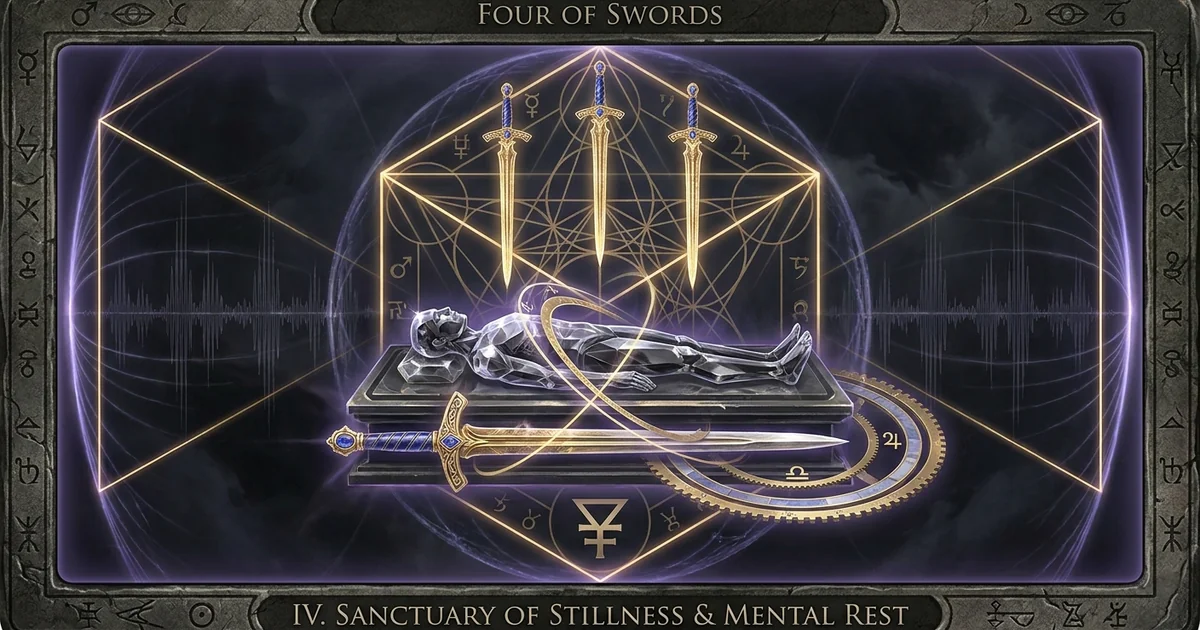
Four of Swords: Sanctuary of Stillness and Mental Rest
Archetypal Thesis & Systemic Paradigm: The Architecture of Mental Quiescence
In the psycho-cosmological matrix of the Hermetic Tarot, the Four of Swords establishes the necessary thermodynamic arrest of volatile mental entropy. Operating within the dynamic mechanics of the swords suit, this card represents neither vegetative inertia nor absolute biological cessation. It embodies the systemic stabilization of the mind, wherein the acute intellectual lacerations and epistemic ruptures sustained in the Three of Swords are systematically contained, quarantined, and metabolized.
The card’s functional imperative is the generation of structural containment. Within the developmental trajectory of consciousness, the unfettered operation of the air element generates ideological hyper-reactivity, catastrophic rumination, and systemic exhaustion. The Four of Swords provides the energetic boundary condition that arrests this downward cognitive spiral, erecting an impermeable sanctuary within the mental plane.
          [ BINAH ]
      (Cosmic Sorrow / 3)
             │
             ▼
          [ CHESED ]  <=== [ FOUR OF SWORDS ]
    (Architectural Mercy / 4)   (Yetziratic Stabilization)
             │
             ▼
         [ GEBURAH ]
     (Disruption / Strife / 5)
Chesed in Yetzirah: The Merciful Ordering of Volatile Air
The macrocosmic mechanics of the Four of Swords emerge from the structural descent of Chesed (the fourth Sephira of Mercy, architectural cohesion, and stabilizing authority) into Olam Yetzirah, the Formative World of the astral substance and discursive intellect. While Chesed in Atziluth (the Archetypal World) radiates boundless, benevolent expansion, its operation within Yetzirah serves as an architectural ballast.
Air is inherently fluid, dispersive, and prone to rapid phase shifts; left unregulated, it manifests as intellectual conflict, paranoia, and fragmented hyper-vigilance. Chesed imposes an architectural floor upon this volatilization. The benevolent, fourfold structural framework crystallizes the swirling winds of the mind into a sanctified, geometric stasis.
This sephirotic imposition halts the bleeding of psychic energy. By projecting Chesed’s expansive, cohesive grace into the Yetziratic framework, the Four of Swords transforms volatile cognition into a self-insulating matrix. This containment does not extinguish intellectual vitality; rather, it gathers the dispersed fragments of the psyche into an organized enclosure, preserving cognitive integrity against entropy.
The Principle of Epoche: Deliberate Cognitive Suspension
Viewed through the lens of classical epistemology and phenomenology, the Four of Swords demonstrates the formal mechanism of epoche—the conscious, deliberate suspension of judgment and discursive reactivity. As articulated in Pyrrhonian skepticism and later formalized in Edmund Husserl’s transcendental phenomenology, epoche is not ignorance or intellectual apathy; it is an active, highly disciplined withdrawal from the compulsion to affirm, negate, or react to incoming cognitive stimuli.
The mind, conditioned to wage war across the dialectical battlegrounds of the psyche, is commanded to lower its analytical weaponry. This deliberate non-engagement breaks the addictive dopamine-cortisol loops of existential alarm.
By bracketing external perceptions and ideological disputes, the subject retreats into an unassailable epistemic stillness. In the context of the four of swords tarot meaning, this phenomenological reduction strips the ego of its hyper-reactive defense mechanisms. The sword of consciousness ceases its bilateral cutting action and rests, transforming from an instrument of dissection into an axis of internal contemplation.
Qabalistic Attribution: Chesed (Mercy / Sovereign Architecture) within Olam Yetzirah (World of Formation / Air).
Structural Dynamics: The benevolent quaternary geometry of four ($4$) introduces an irreducible architectural foundation to the gaseous volatility of the Swords suit. This structural floor arrests the emotional and mental hemorrhage initiated in the Three of Swords before it descends into the systemic rupture of the Five of Swords.
The Temenos of the Intellect: Mitigating Discursive Exhaustion
Analytically, the Four of Swords signifies the construction of an impenetrable psychological temenos—a consecrated, demarcated perimeter designed to insulate the fragile ego-consciousness from ideological feedback loops and collective sensory over-saturation. Carl Gustav Jung emphasized that without such a sealed vessel, the psyche remains vulnerable to inflation, fragmentation, and exhaustion.
The mind trapped in an unmitigated Swords state expends vast quantities of psychic libido in preemptive strikes, defensive rationalizations, and discursive conflict. The Four of Swords erects a protective barrier around the wounded mental substrate, turning awareness inward toward psychic consolidation.
Within this temenos, the autonomous complexes of the unconscious can no longer provoke an immediate behavioral or neurochemical reaction. The sanctuary of stillness serves as a metabolic chamber where psychic toxins are neutralized through radical disengagement. The card dictates that real cognitive power is preserved not by relentless intellectual mobilization, but by the strategic defense of interior quietude against the intrusive demands of the profane world.
Classical Provenance & Textual Lineage: From ‘Rest from Strife’ to the Convalescent Knight
The historical transmission of the Four of Swords reveals a deliberate evolutionary shift. The motif transitioned from an abstract geometric armistice in esoteric hermeticism into an explicit iconographic tableau of convalescence, sanctuary, and monastic suspension in twentieth-century esoteric cartography.
“Four of Swords: The Lord of Rest from Strife. Jupiter in Libra. Chesed in the Sphere of Air. Rest from sorrow; yet after and through it. Quiet, retreat, ease, recovery, temporary peace, yet not final. Sickness, convalescence, change of life, or solitude. It represents a cessation of hostilities, an armistice, or a truce established by higher authority or mutual exhaustion.”
— S. L. MacGregor Mathers, The Golden Dawn Cypher Manuscripts & Book T (1888)
The Golden Dawn Tradition and ‘The Lord of Rest from Strife’
In the esoteric curricular architecture of the Hermetic Order of the Golden Dawn, as codified by S. L. MacGregor Mathers in Book T, the Four of Swords carries the formal title of “The Lord of Rest from Strife.” This designation is hermeneutically precise. It does not promise perpetual nirvana or absolute peace; rather, it articulates an earned cessation of hostility—a temporary armistice enforced by higher systemic laws or physical limits.
The Golden Dawn’s attribution of the card to Jupiter in Libra indicates that this rest is mediated by divine equity, philosophical moderation, and a structural pause in the cosmic war of Yetzirah.
Mathers characterized the card as “rest from sorrow; yet after and through it.” This distinction firmly binds the Four of Swords to its developmental predecessor, the Three of Swords. The rest granted is not the naive quietude of the innocent, but the battle-scarred recuperation of the combatant who has looked directly into the abyss of sorrow and survived. The cessation of conflict is systemic: the psychological machinery has redlined, necessitating an intervention of Chesedic benevolence to preserve the organism from self-destruction.
The Pictorial Shift: Pamela Colman Smith’s Tomb Effigy and Christian Monasticism
When Arthur Edward Waite directed Pamela Colman Smith to illustrate the card for the 1911 Rider-Waite-Smith (RWS) deck, they decisively broke with the non-figurative, intersecting floral blades of the Tarot de Marseille tradition. Smith composed a visual narrative grounded in medieval Christian monasticism, depicting the stone effigy of an armored knight recumbent upon a tomb within a church or cathedral chantry.
The knight’s hands are clasped in the posture of prayer or interior devotion (ordo orationis). This posture conveys that while the outer physical vehicle is immobilized, the internal mental faculties remain actively engaged in transcendental contemplation.
[ Stained Glass Window ]
       (Pax / Celestial Grace)
                  │
        ┌─────────┴─────────┐
        ▼                   ▼
[ Three Suspended ]    [ Horizontal Sword ]
(Latent Complex)       (Dormant Intellect)
        └─────────┬─────────┘
                  │
                  ▼
         [ Recumbent Knight ]
       (The Plinth / Sanctuary)
Smith integrates an ecclesiastical stained-glass window in the upper left quadrant. It depicts a haloed figure alongside the word PAX (Peace), drawing upon the iconography of the medieval right of sanctuary (asylum). Under this medieval legal-spiritual doctrine, a fugitive or wounded warrior crossing the threshold of a consecrated church fell under divine protection, rendering secular weapons and pursue-parties legally impotent.
The scene is neither a morgue nor a site of despair; it is a secured spiritual fortress. The recumbent posture signifies the deliberate lowering of the body into alignment with the earth’s gravity, discharging static psychic tensions into the architectural plinth.
Crowley’s ‘Truce’: The Frail Equilibrium of Intellectual Weapons
In The Book of Thoth (1944), Aleister Crowley strips the Four of Swords of Smith’s medieval Christian narrative, returning the card to its severe geometric foundations under the title “Truce.” Illustrated by Lady Frieda Harris, the card depicts four ornate swords whose tips converge precisely upon the petals of a central, stylized lotus blossom. Crowley’s vision exposes the underlying tension native to the Swords suit. This peace is not an organic, pastoral state, but an artificially maintained equilibrium of opposing, highly volatile armaments.
Crowley recognized that in the realm of Yetzirah, pure intellectual harmony is an unstable paradox. The swords are held at bay only through a rigid, symmetrical application of force:
“The swords… their points meet in the centre of a fully opened rose of eight petals… this card represents a truce; it is a temporary rest from strife, which can only be maintained by the active, continuous, and vigilant balance of the forces involved.”
— Aleister Crowley, The Book of Thoth
The Thoth depiction strips the card of sentimental escapism. It demonstrates that mental stillness requires tremendous internal discipline. The moment the central, harmonizing focus (the lotus of Chesed-in-Libra) falters, the four blades will snap inward, reigniting intellectual and relational warfare. The truce is a technical, engineered ceasefire within the psyche, holding ideological crossfire in suspension.
Structural Mechanics & Symbolic Geometry: Astrological Decans and Qabalistic Coordinates
The functional mechanics of the Four of Swords rest upon an intricate matrix of astrological, geometric, and iconographical coordinates. Far from being an arbitrary illustration of fatigue, the card functions as an energetic engine calibrated by the mathematical symmetries of the Hermetic cosmos.
Jupiter in the Third Decan of Libra: Philosophical Moderation and Jurisprudence
The astrological engine driving the Four of Swords is the placement of Jupiter in the third decan of Libra (spanning 20° to 30° of the cardinal Air sign). In traditional astrology, as cataloged by Heinrich Cornelius Agrippa in De Occulta Philosophia, this decan is associated with equilibrium, judicial balance, and quiet intellectual rest gained through the application of moral philosophy.
Libra is cardinal air: the primal impulse to harmonize, litigate, balance, and align opposing polarities. Jupiter is the Greater Benefic: the cosmic principle of expansion, grace, jurisprudence, and structural coherence.
When Jupiter operates within the third decan of Libra, it expands the sign’s harmonizing function into absolute judicial armistice. The cutting, dialectical friction of the Air element is brought before the supreme court of the intellect and ordered to stand down. Jupiter supplies the philosophical wisdom necessary to realize that continued intellectual aggression will cause mutual destruction.
This decanic placement elevates the mental faculties above localized dispute, anchoring consciousness in overarching philosophical principles that render smaller intellectual grievances irrelevant. It is the peace of the sovereign magistrate, not the surrender of the defeated.
The Geometry of the Quaternary: The Stabilizing Cube and the Fourfold Breath
The number four ($4$) operates structurally as the sacred quaternary: the number of space, dimensionality, physical foundation, and solid containment. In Pythagorean tetractys mathematics, the four represents the completion of the manifestation cycle ($1+2+3+4=10$) and the creation of the structural solid (the tetrahedron and cube).
Within the Swords suit, which is inherently ungrounded, cutting, and turbulent, the intrusion of the number four functions as an anchor dropped into a storm-tossed sea.
       [ 1: Point ]
            │
            ▼
       [ 2: Line ]
            │
            ▼
      [ 3: Surface ]
            │
            ▼
   [ 4: Solid / Cube ]  <=== [ The Four of Swords ]
This geometric grounding stabilizes the runaway oscillations of thought. The quaternary provides the architectural walls, floor, and ceiling required to construct a safe haven.
In esoteric yogic physiology, this corresponds to the practice of sama vritti pranayama—the fourfold square breath:
- Inhalation (Puraka)
- Internal Retention (Antara Kumbhaka)
- Exhalation (Rechaka)
- External Retention (Bahya Kumbhaka)
The Four of Swords marks the Kumbhaka—the breathless, suspended stillness between ideological movements, wherein the nervous system ceases its oscillatory firing and stabilizes in the vacuum of non-action.
Iconographic Decomposition: The Plinth, Three Suspended Blades, and the Horizontal Sword
A rigorous semiotic deconstruction of Pamela Colman Smith’s composition reveals the precise operational dynamics governing the four of swords symbolism:
+--------------------------------------------------+
|  [Stained Glass: PAX]                            |
|                                                  |
|    |           |           |  <-- Three Swords   |
|    V           V           V      Pointed Down   |
|                                                  |
|   =======================     <-- Horizontal     |
|  [     Knight/Tomb       ]        Sword Beneath  |
+--------------------------------------------------+- The Plinth and Sarcophagus: The knight rests upon a stone plinth, an architectural representation of Malkuth (the physical realm) acting as a grounding agent for Yetzirah (the mind). The cold stone acts as an electrical ground, drawing out the hyper-thermal agitation of the intellect. It emphasizes the temporary entombment of the physical senses.
- The Three Suspended Swords: Arranged vertically above the recumbent figure, three swords point downward toward the knight’s head, heart, and throat. These blades represent the lingering scars of the Three of Swords: unresolved cognitive dissonance, emotional trauma, and the memory of battle. Crucially, they are fixed to the wall and do not strike. The mind does not deny the existence of these painful realities; rather, it suspends their immediate psychological impact, containing them outside the immediate field of active thought.
- The Horizontal Sword: A fourth sword is carved in relief upon the horizontal plane beneath the knight’s body, or resting parallel to his physical frame. This blade represents the subject’s own active operational intellect, laid down in a horizontal posture of repose. It remains unsheathed, signaling that the capacity for discernment has not been broken, lost, or surrendered; it is preserved in cold storage, immediately available for deployment the moment the period of incubation reaches its natural conclusion.
Psychological Dynamics & Operational Praxis: The Therapeutics of Incubation and Ego-Reconstitution
The Four of Swords provides a blueprint for psychological survivability under conditions of high psychic stress. In practical hermeneutics, the card serves as a diagnostic indicator of systemic exhaustion, demanding deliberate withdrawal from external conflicts to allow the unconscious to execute its restorative protocols.
Upright Orientation
- Voluntary Retreat: Intentional withdrawal into a consecrated temenos for the preservation of cognitive coherence.
- Parasympathetic Activation: The neural substrate shifts out of chronic sympathetic hyper-arousal into deep cellular recovery.
- Active Incubation (Enkoimesis): Yielding the ego to the compensatory architecture of the autonomous unconscious.
- Strategic Boundary Maintenance: Erection of definitive energetic barriers against intrusive collective and relational demands.
- Epistemic Suspension: Deliberate practice of epoche—suspending judgment, dialectical combat, and immediate reactions.
Reversed Orientation
- Forced Isolation: Incarceration by neurosis, chronic bedridden exhaustion, or acute clinical burnout.
- Premature Emergence: Rushing back onto the psychological battlefield prior to the completion of cognitive healing.
- Claustrophobic Stagnation: The protective temenos degenerates into a psychic prison or agoraphobic avoidance mechanism.
- Hyper-Vigilant Insomnia: The inability to disarm the mental weapons, leaving the three swords suspended dangerously low over consciousness.
- Systemic Collapse: Total depletion of the somatic vessel through sustained resistance to necessary operational rest.
Jungian Incubation and the Autonomous Self: Withdrawing Projections
In analytical psychology, the Four of Swords corresponds to the ancient, archetypal ritual of enkoimesis—incubation. Practiced across antiquity within the sacred subterranean chambers of Asklepian healing sanctuaries, incubation required the afflicted to lie down upon the earth, enter sensory deprivation, and sleep. Healing was not delivered through conscious intellectual reasoning, but by dreams sent directly by the god.
Carl Gustav Jung emphasized that when the conscious ego exhausts its solutions and lands in a psychological cul-de-sac, it must surrender its operational primacy to the autonomous Self.
       [ Exhausted Conscious Ego ]
                    │
                    ▼
         ( Surrender of Primacy )
                    │
                    ▼
[ Incubation / Deep Sensory Deprivation ]
                    │
                    ▼
[ Regenerative Dream Integration via the Autonomous Self ]
The Four of Swords marks the exact psychological moment this surrender occurs. The recumbent knight acknowledges that discursive thought can no longer heal the wounds inflicted upon the mind. The ego stops projecting its shadow, hostilities, and neurotic anxieties onto external adversaries.
By pulling back these psychic projections, the subject allows the unconscious to balance its own energetic ledger. The knight sleeps upon his own tomb, dying to the immediate demands of his daily neuroses so that a more integrated psychological structure may be born.
Clinical Convalescence: The Parasympathetic Shift in Neuro-Archetypal Space
From the perspective of clinical neurobiology interpreted through archetypal models, the Four of Swords represents the mandatory transition from chronic sympathetic dominance to restorative parasympathetic tone. The Swords suit, by default, correlates to the neurochemical signature of stress: sustained adrenaline, elevated baseline cortisol, hyper-vigilance, and an overactive amygdala scanning the environment for ideological or physical threats.
Sustained too long, this state induces allostatic overload, degrading synaptic plasticity, fragmenting memory, and breaking down physical tissue.
Chronic Sympathetic Overdrive (Swords)
[ Adrenaline / Cortisol / Hyper-vigilance ]
                    │
                    ▼
         { Four of Swords Intervention }
                    │
                    ▼
Parasympathetic Dominance
[ Vagal Nerve Activation / Allostatic Discharge / Defragmentation ]
The Four of Swords marks the biological and psychic circuit-breaker. It is the vagal nerve asserting sovereign command over the adrenal cortex. The horizontal posture of the knight is physically required to lower blood pressure, normalize heart rate variability, and allow the lymphatic system of the brain (the glymphatic system) to clear metabolic waste accumulated during intense intellectual effort.
The card dictates that this biological convalescence is not a luxury or a recreational indulgence; it is an unavoidable physiological debt that must be settled to prevent total biological collapse.
Diagnostic Interpretation: Discerning Upright Sanctuaries from Reversed Stagnation
In divinatory praxis and clinical archetypal assessment, the orientation of the Four of Swords reveals the operational integrity of the subject’s recuperative strategy.
When the card appears in an upright orientation, it prescribes deliberate, unyielding non-action. The querent is commanded to step off the operational field, enforce absolute personal boundaries, disconnect from ideological debates, and enter cognitive sanctuary. It validates that stillness is currently the most potent, strategic, and aggressive action available.
Conversely, the reversed Four of Swords acts as an alarm signaling that the delicate machinery of rest has broken down:
[ REVERSED FOUR OF SWORDS ]
            │
    ┌───────┴───────┐
    ▼               ▼
[ Premature Mobilization ]   [ Morbid Stagnation ]
(Return to conflict while     (Sanctuary becomes a tomb;
 mind remains fractured)      neurotic avoidance of reality)
In the first reversed variation, the subject rushes prematurely back into conflict. Driven by a compulsive terror of stillness, they re-engage with external friction while their mental substrate remains fractured, ensuring catastrophic failure in the adjacent Five of Swords.
In the second reversed variation, the sanctuary degenerates into a tomb. The querent utilizes “rest” and “self-care” as pathological masks for agoraphobic dread, depressive immobilization, and chronic avoidance of life’s necessary struggles. Here, the knight remains trapped beneath his stone effigy, calcifying the living psyche into a monument of fear.
Philosophical Synthesis & Macrocosmic Correspondence: The Principle of Rhythm and Chronobiological Rhythms
The Four of Swords transcends individual psychology. It is an expression of universal Hermetic and cosmological mechanics, reflecting macrocosmic laws that dictate that all systems must cycle periodically between outward exertion and inward consolidation.
“When the conscious attitude finds itself in an impasse, the libido is withdrawn into the unconscious. There, in the stillness of deep incubation, the archaic archetypal foundations of the objective psyche reconstitute the fragmented ego. To resist this rhythm of withdrawal is to invite the total disintegration of the vessel.”
— Marie-Louise von Franz, The Interpretation of Fairy Tales (1970)
The Hermetic Axiom of Rhythm: Measure and Counter-Measure in Mind
The card operates as a direct structural manifestation of the fifth Hermetic Principle: the Principle of Rhythm. As preserved in The Kybalion:
“Everything flows, out and in; everything has its tides; all things rise and fall; the pendulum-swing manifests in everything; the measure of the swing to the right is the measure of the swing to the left; rhythm compensates.”
Within the realm of human cognition, the pendulum cannot swing perpetually toward discursive analysis, debate, and intellectual generation. The violent, expansive swing of the mind into the lacerating dialectic of the Three of Swords demands an equal, compensatory swing into deep, concentrated quietude.
The Four of Swords is the conscious realization of this rhythm. It is the tactical decision to yield to the returning tide of the mental pendulum. The adept recognizes that fighting this natural rhythm by demanding continuous mental output produces intellectual madness. Stillness is not the antithesis of the intellect; it is the rhythmic substrate that restores the sharpness of its blade.
Chronobiology and the Necessity of the Refractory Period
In the systems architecture of nature and chronobiology, the Four of Swords mirrors the absolute biological requirement of the refractory period. In physical neurology, after an action potential fires across a neuronal membrane, there exists an absolute and relative refractory phase—a brief period during which the sodium channels are entirely inactivated, rendering the neuron incapable of firing, regardless of how intense the incoming stimulus may be.
[ Membrane Action Potential ] ──> [ Firing Event ]
                                          │
                                          ▼
                              [ Absolute Refractory Period ]
                              (Inactivated Ion Channels)
                                          │
                                          ▼
                              [ Systemic Hyperpolarization ]
Without this temporary polarization and enforced silence, the biological substrate falls into excitotoxicity, a lethal pathology wherein excessive neurotransmitter release triggers cellular death.
The Four of Swords acts as the macrocosmic refractory period of human consciousness. It is the systemic hyperpolarization of the intellect, temporarily shutting down cognitive ion channels so that the delicate chemical, psychic, and energetic gradients can reset their baseline thresholds.
Hesychasm and the Cloud of Unknowing: The Apophatic Air
Mystically, the Four of Swords corresponds to the Western and Eastern traditions of apophatic contemplation—the via negativa of intellectual asceticism. In the Christian mystical tradition of the fourteenth-century treatise The Cloud of Unknowing, along with the practice of Hesychasm within the Philokalia, spiritual realization is attained not through intellectual discourse, theological debate, or visual meditation, but by quieting all images, concepts, and discursive thoughts.
KATAPHATIC WAY                  APOPHATIC WAY
(Images, Arguments, Concepts)   (Stillness, Silence, Emptiness)
             │                                │
             ▼                                ▼
    [ Swords in Battle ]           [ Four of Swords: PAX ]
The Hesychast descends with the mind into the heart, cultivating hesychia—divine quietness, inner stillness, and the cessation of rational thoughts.
The Four of Swords is the apophatic chamber of the Tarot. The Air element, usually noisy with arguments, opinions, and analysis, purifies itself through radical silence. The three suspended swords above the knight are thoughts stripped of their disruptive charge, frozen within the cloud of unknowing. The mind rests in the primordial substrate of Being, realizing that beneath the incessant noise of cognition lies an eternal stillness that no conflict can alter.
Frequently Asked Questions: Resolving Symbolic and Interpretive Complexities
Hermeneutic Disambiguation: Physical Death Versus Mental Convalescence
A persistent interpretive error across amateur Tarot hermeneutics is the literal conflation of the Four of Swords with physical death. This confusion stems largely from Pamela Colman Smith’s visual use of the knight’s funerary monument (gisant), evoking the atmosphere of a tomb or crypt.
However, textual provenance and esoteric lineage dismantle this simplistic reading:
[ PHYSICAL DEATH: Key XIII / Death ]
Dissolution of Form, Transformative Rupture, Putrefaction.
                       ≠
[ SYSTEMIC REST: Four of Swords ]
Convalescent Suspension, Preservation of the Vessel, Tactical Incubation.
In the Qabalistic framework, physical mortality and radical transformation are governed by Key XIII (Death / Nun) and the structural destruction of the Tower (Key XVI / Peh).
The Four of Swords occupies Chesed in Yetzirah: an expansive, merciful Sephira whose primary function is the preservation of form and the maintenance of life.
The knight’s tomb represents the death of the outer persona’s involvement in conflict, not the death of the physical organism. The recumbent posture mirrors the ritual death practiced in traditional initiatory rites, wherein the neophyte lies in a sarcophagus to undergo symbolic ego-death, emerging reconstituted.
The clasped hands of the knight indicate living, conscious interiority. The Four of Swords represents the temporary entombment of the ego’s defenses to allow the internal spiritual self to repair the nervous system.
Decanic Paradox: Why Cardinal Air Manifests as Immobile Stillness
Astrological scholars frequently encounter a theoretical paradox within the Four of Swords: Libra is an active, initiating Cardinal sign governed by the Air element, which is the most dynamic, volatile, and communicative of the four classical elements. Why, then, does its combination with expansive, optimistic Jupiter manifest as absolute immobility and sanctuary?
The resolution of this decanic paradox lies in the intersection of Jupiterian jurisprudence with Cardinal Air’s drive toward balance:
- Cardinal Air does not seek perpetual, chaotic movement; its initiating impulse is to move toward equilibrium. It is the initial blast of wind that balances atmospheric pressure.
- The Third Decan of Libra represents the final, perfected phase of this balancing act, where opposing forces achieve parity.
- Jupiter, as the cosmic patron of the law, delivers the ultimate verdict that halts intellectual litigation.
When expansive Jupiter is placed into the cardinal air of balanced justice, it expands the concept of peace until it fills the entire operational field. It does not cause lethargic stagnation, but active, enforced harmony.
The immobility of the Four of Swords is the absolute stillness of a gyroscope spinning at maximum velocity. It appears completely motionless only because its internal polarities are in absolute, consummate balance.
Praxis Guidance: Discerning Dynamic Contemplation from Passive Escapism
In practical psychological consultation and divinatory assessment, determining whether a subject is engaged in functional therapeutic retreat (authentic Four of Swords) or maladaptive avoidance (neurotic escapism) requires precise diagnostic metrics. The practitioner must evaluate the structure of the retreat along four axes:
[ CONSTRUCTIVE SANCTUARY ]
* Permeable, intentional boundaries
* Time-bound incubation with a clear restorative goal
* Disengagement reduces systemic allostatic load
* Unsullied inner focus, preparing for return

               VS.

[ MALADAPTIVE ESCAPISM ]
* Rigid, reactive, agoraphobic walls
* Indefinite procrastination and avoidance of life
* Lingering avoidance that spikes anxiety upon thought of action
* Depressive rumination, burying the intellect
- Intentionality vs. Reaction: Authentic Four of Swords retreat is initiated consciously as a strategic necessity. Neurotic escapism is a compulsive flight from reality triggered by fear of failure or emotional conflict.
- Structural Demarcation: The functional sanctuary is bound by clear parameters. The knight lies in prayer; the horizontal sword remains present, ready for future mobilization. The escape artist locks the doors, throws away the blade, and enters indefinite dissociation.
- Neuro-Metabolic State: Authentic contemplation lowers baseline cortisol, elevates parasympathetic tone, and restores cognitive clarity. Avoidant stagnation fuels internal agitation, generating guilt, shame, and escalating anxiety regarding the world left behind.
- Relationship to the Battle: The authentic convalescent knight rests to return to the quest with restored honor and power. The escapist seeks to abandon the quest entirely, pretending the outer world does not exist.
The Four of Swords is not an abdication of life; it is the sacred pause that makes the conscious continuation of life possible.