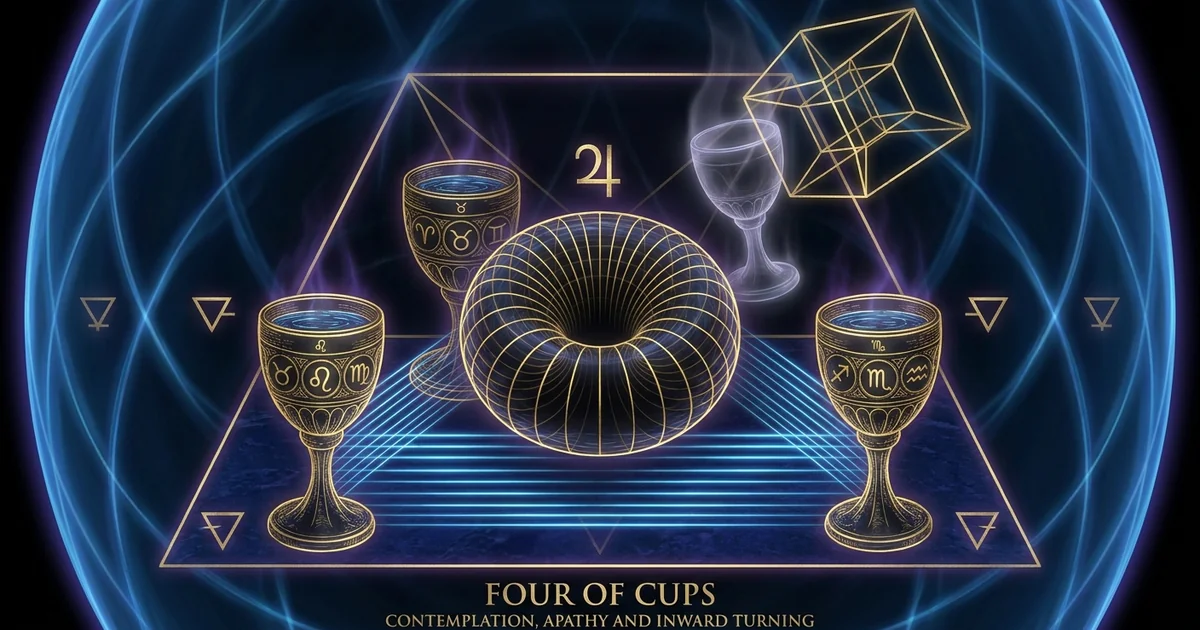
Four of Cups: Contemplation, Apathy and Inward Turning
Archetypal Thesis & Systemic Paradigm: The Entropy of Satiation
Chesed in the Water Element: The Architecture of Receptive Stagnation
The Four of Cups represents the structural saturation and necessary stasis of the water element, manifesting systematically as the stabilization of Chesed within the world of Briah. In Hermetic Qabalah, Chesed constitutes the fourth Sephirah on the Tree of Life—the initial manifestation of cohesive form below the Supernal Abyss, governed by the archetypal force of boundless mercy, expansion, and architectonic organization. When this expansive, benign structuralizing impulse operates within Briah, the World of Creation characterized by the fluid, mutable substance of the water element, an intrinsic metaphysical paradox emerges. The mechanics of this convergence are thoroughly detailed within /qabalah/chesed-briah-mechanics, illustrating how unbounded flowing current is arrested by formal geometric boundary.
Water, by its primordial nature, demands dynamic movement, cyclical evaporation, precipitation, and perpetual transformation. Chesed imposes upon this fluid matrix a condition of sudden, absolute security, architectural delimitation, and expansive sufficiency. Within the macrocosmic order of the cups suit, this imposition crystallizes as an affective cul-de-sac. The ecstatic communion and kinetic dispersion witnessed in the /tarot/three-of-cups-meaning are drawn to a halt. Chesed arrests the centrifugal celebration of the triad, converting dynamic flow into a sedentary, enclosed reservoir.
This containment is not intrinsically malevolent; rather, it is the cosmological implementation of equilibrium. However, because the water element resists permanent boundary, its artificial containment within the rigid quadrant of the quaternary initiates a process of energetic stagnation. The expansive benevolence of Chesed floods the receptive vessel to its absolute volumetric capacity. Once this capacity is achieved, the fluid ceases to circulate, the surface tension solidifies into an impermeable barrier, and the living waters begin to cultivate sediment. The resulting state is the structural entropy of satiation: a condition wherein an excess of emotional security and affective luxury suspends the evolutionary trajectory of the soul.
+-------------------------------------------------------------------------+
|                  SEPHIRIC ATTRIBUTIONS: CHESED IN BRIAH                |
+------------------------------------+------------------------------------+
| Qabalistic Sephirah                | Chesed (Mercy / Formative Grace)  |
| Astrological Decan                 | Cancer III (20°00' - 29°59' Can)   |
| Elemental Matrix                   | Water of Water (Briah Archetype)   |
| Hermetic Title                     | The Lord of Blended Pleasure       |
| Primary Archetypal Mechanism       | Libido Retroversion / Saturation   |
| Cybernetic Function                | Negative Feedback Homeostasis      |
+------------------------------------+------------------------------------+
The Dynamic Defense: Apathy as Autonomic Containment
Within standard divinatory interpretation, this card is frequently misdiagnosed as simple psychological indolence, depressive paralysis, or behavioral petulance. A rigorous archetypal interrogation reveals that apathy functions here not as a pathological absence of emotion, but as an autonomic defensive containment strategy of the human psyche. When the emotional apparatus is subjected to sustained exogenous stimulation, relational demands, or an overabundance of affective input, the psychic organism approaches an acute saturation threshold. To prevent catastrophic ego dissolution—a state clinical psychology identifies as emotional flooding—the psyche deploys affective numbness as an immunological barrier.
Apathy, etymologically rooted in the Greek apatheia (freedom from suffering or passion), operates within this matrix as an involuntary homeostatic circuit breaker. The soul, having integrated the social and emotional triumphs of the prior minor arcana arc, recognizes that any further intake of external reality will result in psychological indigestion. The conscious ego retreats behind an impenetrable psychic carapace, refusing exogenous input precisely because the internal processing capacity has been entirely commandeered by the unconscious.
This state mirrors biological dormancy; it is the deliberate reduction of metabolic exchange with the external environment to preserve internal systemic integrity. The subject appears paralyzed, disaffected, and unmovable, yet this behavioral inertia conceals a hyper-active internal reconfiguration. The apathy is dynamic: it actively resists the intrusion of the world to defend the fragile emergence of endogenous meaning.
The numerical value Four (the Quaternary) functions across Hermetic systems as the foundation of concrete manifestation, stability, and spatial enclosure (the Cube, the Cross, the four elements). When mapped to Chesed in Briah, the Quaternary signifies the containment of the fluidic Astral Light within the vessel of the demiurgic matrix. Under demiurgic containment, Water ceases to be oceanic (Kether) or torrential (Binah) and becomes domestic, measured, and vulnerable to psychological eutrophication.
The Transcendent Cup: Unsolicited Influx versus Interior Resistance
The visual and conceptual hinge upon which the four of cups tarot meaning turns is the structural dialectic between the three earthly vessels resting upon the terrain and the solitary, transcendent fourth cup extended from the ether. The three terrestrial cups represent accumulated experiential capital: past emotional investments, realized desires, societal validations, and familiar relationship dynamics. These vessels reside fully within the subject’s established field of awareness; they are known, mastered, and subsequently drained of numinous potency. Because the ego has extracted all immediate libidinal nutrients from these structures, they no longer inspire psychological momentum.
Conversely, the fourth cup emerges from outside the temporal plane, borne by an angelic hand issuing directly from a localized cloud. This vessel symbolizes unearned, unsolicited grace—an exogenous metaphysical offer that introduces an entirely new emotional and spiritual paradigm. Yet, the foundational semiotic tension of the card lies in the subject’s profound disinterest in this miraculous delivery. The figure does not actively reject the cup through aggressive repudiation; rather, the figure renders the miraculous invisible through the sheer gravity of inward focus.
This interior resistance represents a critical juncture in the individuation process. The psyche cannot integrate a novel transpersonal revelation while its internal architecture is choked with the unprocessed residues of past fulfillments. The refused cup illustrates that external spiritual gifts, no matter how elevated or pure their provenance, remain impotent if the individual’s subjective container has reached absolute saturation. The refusal is an act of spiritual self-preservation: the ego intuitively understands that accepting the transcendent vessel before clearing the three terrestrial forms would precipitate the catastrophic rupture documented in the /tarot/five-of-cups-meaning.
Classical Provenance & Textual Lineage: From Luxury to Blended Dissatisfaction
The Golden Dawn Cipher: ‘The Lord of Blended Pleasure’
The formal esoteric lineage of the Four of Cups was first systematized within the late-nineteenth-century curriculum of the Hermetic Order of the Golden Dawn. In their internal instructional documents, derived fundamentally from the decoded Cipher Manuscripts, S. L. MacGregor Mathers and W. W. Westcott attributed the card to the third decan of Cancer, designating it with the mystical title: “The Lord of Blended Pleasure.” This nomenclature requires exacting textual analysis. The word “blended” does not denote a harmonious synthesis, but rather a dilution and corruption of purity through excessive compounding.
“Chesed in the Sphere of Water. Cancer III: 20° to 30°. The Lord of Blended Pleasure. Satiety; loss of pleasure in that which is attained. Luxury followed by disgust; deceit and disappointment in matters of love and friendship. To some extent it signifies quietude and retirement, but it is the quietude of surfeit and fatigue rather than that of peaceful contemplation.” — S. L. MacGregor Mathers & W. W. Westcott, The Golden Dawn Cypher Manuscripts & Ritual Grade Papers (1888)
The Order’s technical doctrine posited that while the initial influx of the water element in the Two and Three of Cups produced genuine harmony and fellowship, the arrival of Chesed introduced an excess of passive receptivity. The pleasure became “blended” with its own shadow: satiety. In the Golden Dawn’s astrological mechanics, the blending of lunar and cardinal water forces within this decan produces a hyper-sensitized internal landscape where external reality fails to match the subject’s idealized affective projections, yielding an inevitable drift toward quietist dissatisfaction.
Waite-Smith Semiotics: The Seated Contemplative and the Cloud-Hand
When Arthur Edward Waite collaborated with artist Pamela Colman Smith to generate the iconic imagery of the 1910 Rider-Waite-Smith (RWS) deck, they radically altered the interpretive trajectory of the card. Departing from the unpeopled, purely geometric pips of the historic Tarot de Marseille, Smith introduced the visual archetype of the young contemplative seated cross-legged beneath a lush, stylized tree on an elevated grassy knoll.
[ Metaphysical Cloud / Hand ]
                     |
                     v
             ( Transcendent Cup )  --- [ Unintegrated Grace ]
                     |
           ( Psychic Resistance )
                     |
   [ Contemplative: Folded Arms / Cross-Legged ]
            /                 \
           /                   \
[ Three Earthly Vessels ]  [ Grounded Reality / Satiety ]
Waite’s critical contribution was the deliberate codification of posture. The figure sits with arms folded tightly across the thoracic cavity, an unambiguous anatomical emblem of psychic defensiveness, closed boundary conditions, and the refusal of energetic exchange. The legs are crossed in a seated variant of the swastika or the Hermetic sulfur sign, anchoring the consciousness to the physical earth while sealing the lower chakras against external influence.
The contemplative’s downward gaze is directed neither at the three terrestrial cups standing proximate to his feet, nor toward the luminous cloud-hand presenting the fourth vessel at eye level. Instead, the eyes are fixed upon an indeterminate midpoint in empty space, indexing deep interior reflection. Waite notes in The Pictorial Key to the Tarot (1910) that the figure expresses “an inward turning of the mind,” warning that this disposition produces an ephemeral discontent wherein “a gift of grace is offered, but the recipient sees it not.” Smith’s pictorial composition establishes an unresolved geometric tension between the horizontal plane of terrestrial satisfaction (the three grounded cups) and the vertical axis of divine intervention (the suspended fourth cup), perfectly encapsulating the structural deadlock of the subject’s consciousness.
Crowley’s Attribution: Luxuria and the Decadence of Cancer III
In stark, calculated divergence from the quietist psychological melancholia depicted by Waite and Smith, Aleister Crowley, in The Book of Thoth (1944), stripped the card of its sentimental narrative, returning to its raw elemental and astrological mechanics. Crowley designated the card unequivocally as “Luxury,” utilizing the Latin Luxuria with all its traditional connotations of decadence, debauchery, and inevitable putrefaction.
Crowley analyzed the Four of Cups as the mathematical descent of the element Water into its most dangerous phase: absolute stillness. In Crowley’s cosmology, Water requires continuous agitation by the fiery will of the Magus or the expansive breath of Spirit; when left to the passive, indulgent benevolence of Chesed, it degenerates. The four cups depicted in Lady Frieda Harris’s dynamic, Art Deco watercolor for the Thoth deck are arranged as rigid sea-anemone-like vessels standing upon a stagnant sea. Water no longer pours forth dynamically from an upper source into lower vessels; instead, it trickles weakly, choked by predatory water lilies whose stems bind the cups in suffocating coils.
Crowley asserted that this decan represents the dangerous rot of emotional security. When an individual achieves total emotional safety, devoid of challenge, tension, or dialectical opposition, the soul begins to prey upon itself. For Crowley, the card is not an invitation to peaceful meditation, but a dire esoteric warning: the waters of the spirit have become brackish. Without the violent, transformative intervention of the five—which will arrive via the martial disruption of Geburah—the soul risks rotting within the gilded cage of its own accumulated satisfactions.
Structural Mechanics & Symbolic Geometry: Astrological Decans and Qabalistic Form
The Third Decan of Cancer: Moon-Neptune Dialectics in the Cardinal Water Matrix
The astrological underpinnings of the Four of Cups reside precisely in the third decan of Cancer, encompassing the celestial coordinates from 20°00’ to 29°59’ of the sign. In the classical Chaldean order of planetary rulerships, preserved by Claudius Ptolemy in his Tetrabiblos (c. 150 CE), this final segment of the cardinal water sign is governed directly by the Moon. The structural implications of this assignment are profound: the Moon functions as both the domicile ruler of the entire sign of Cancer and the specific decanic ruler of these culminating ten degrees.
- Zodiacal Span: 20°00’ – 29°59’ Cancer
- Chaldean Decan Ruler: The Moon
- Modern Astrological Affiliation: Neptune / Jupiter (Triplicity modification)
- Temporal Calibration: July 12 – July 21 (Northern Hemisphere)
- Ptolemaic Decanic Classification: A decan of sensory accumulation, interior retreat, domestic preservation, and acute psychic defensiveness.
This dual lunar dignity concentrates the fluidic, reflective, and instable qualities of the celestial body to an absolute extreme. Cancer is the cardinal archetype of the crab—an organism fundamentally defined by the possession of an impenetrable external chitinous exoskeleton surrounding an exceptionally soft, vulnerable interior core. In /astrology/cancer-decan-3, the cardinal impulse of the sign (the seasonal initiation of summer, the forward drive of affective bonding) reaches its structural limit. The crab has gathered all necessary resources, brought them into its subterranean burrow, and sealed the entrance against the tidal shifts of the ocean.
Modern astrological synthesis incorporates the sub-influence of Neptune, the higher octave of the water element, within this decanic terrain. The interaction between the Chaldean Moon and the Neptunian current produces a psycho-spiritual feedback loop: the subject becomes mesmerized by their own internal oceanic depths, finding the mundane realities of external existence profoundly mundane and flat. The external world loses its luster; it feels coarse, demanding, and spiritually devoid of substance. The carapace of the third decan of Cancer becomes an acoustic chamber where the subject listens exclusively to the subjective echo of their own inner tides, systematically filtering out the external cosmos.
The Geometry of the Tetrahedron: The Stabilization of Fluid Dynamics
To apprehend the structural architecture of the card, one must examine its core sacred geometry. The numerical sequence of the tarot pips represents the progressive crystallization of divine energy through dimensional space. The Ace is the dimensionless point (Kether); the Two constitutes the line drawn between two poles (Chokmah); the Three constructs the plane, establishing the dynamic, communicative triangle (Binah). The Four completes the first cycle of physical manifestation by introducing depth, precipitating the solid geometric form of the tetrahedron.
[ ACE: Monad / Point ]
                            |
                            v
                  [ TWO: Dyad / Line ]
                            |
                            v
                 [ THREE: Triad / Plane ]
                            |
                            v
             [ FOUR: Tetrad / Tetrahedron ]
          * Stabilizes & Encloses Fluid Matrix *
          * Kinetic Flow Arrested into Mass *
In the realm of sacred geometry, the tetrahedron represents the absolute minimum structural requirement for three-dimensional physical volume. It confers boundaries, mass, and structural permanence upon reality. When this geometric operation is executed upon the water element, an unavoidable mechanical conflict occurs. Water, by defined physics, possesses no native structural form; it assumes the precise geometry of whatever container it occupies.
The imposition of the quaternary upon water acts as a hydraulic valve abruptly closed against a pressurized current. The dynamic, generative flow of the Three of Cups is violently arrested. The fluid is confined within the four rigid triangular faces of the tetrahedron. It can no longer flow; it can only occupy its allotted spatial coordinates. The fluid dynamic stabilizes into absolute equilibrium, but the cost of this thermodynamic stabilization is the absolute termination of kinetic energy. The fluid becomes captive to the geometry that preserves it.
Vector Analysis of the Fourth Offer: Exogenous Grace versus Endogenous Fortification
The spatial topography of the Four of Cups, as crystallized in the Hermetic tradition, operates along two perpendicular vector axes that map the state-space of the subject’s consciousness:
- The Horizontal Axis of Temporal Satiety: Defined by the three cups situated upon the earth. These vessels are aligned along the terrestrial baseline, signifying historical time, mundane achievements, past relationships, and the accumulated artifacts of the personal ego. They are structurally grounded, but spiritually inert.
- The Vertical Axis of Transpersonal Grace: Defined by the descending hand emerging from the nephomorphic aperture (the cloud) bearing the singular fourth cup. This axis cuts perpendicularly through the horizontal plane, representing atemporal, vertical intervention—the unsolicited entry of the divine into the mundane continuum.
The dynamic core of the card resides in the complete energetic severance between these two vectors. The contemplative sits at the precise geometric intersection of these axes, yet his bio-energetic orientation—manifest through the closed circuit of folded arms and averted ocular focus—creates an energetic deflector shield. The vertical influx of transpersonal grace fails to ground because the receiver refuses to provide the energetic polarity necessary to draw it down. The endogenous fortification of the ego is so profound that even the supernatural offer of redemption is neutralized. The four of cups symbolism demonstrates that transpersonal intervention cannot override the absolute sovereign autonomy of an introverted, defensively saturated ego.
Psychological Dynamics & Operational Praxis: The Shadow of Libidinal Ennui
Jungian Introversion: Libido Retroversion and the Activation of the Unconscious
From the standpoint of analytical psychology, formulated by Carl Gustav Jung, the phenomenon visualised in the Four of Cups is the textbook pictorial representation of libido retroversion. In his seminal work, Psychological Types (1921), Jung defines libido not merely as sexual drive, but as undifferentiated, generalized psychic energy. Under normative conditions, this energy moves outward toward external objects, facilitating adaptation, relational bonding, and cultural production—a process Jung terms psychic progression.
However, when an individual exhausts the developmental possibilities of an external life stage, or when the external world fails to provide symbols capable of commanding psychic interest, the forward movement of the libido collapses. The energy retreats backward from the object:
This regression of libido is not an inherently degenerative collapse; it is an instinctual evolutionary necessity. Deprived of external targets, the psychic energy flows downward and inward, pooling in the unconscious where it activates the dormant archetypal residues of the deep self.
The contemplative beneath the tree appears detached, indifferent, and apathetic precisely because the totality of his energetic budget has been reallocated to subterranean operations. The conscious ego experiences this internal energy drain as a sudden, inexplicable loss of motivation, an pervasive sense of boredom, and an inability to care about circumstances that previously elicited passion. The four of cups tarot meaning, viewed through this lens, indexes a mandatory period of inward incubation: the individual cannot take up the fourth cup because their hands and minds are completely occupied with holding the conscious perimeter against the rising contents of the unconscious sea.
The Clinical Continuum: Differentiating Depression, Acedia, and Fertile Incubation
In operational psychology and spiritual direction, the clinician or esoteric practitioner must exercise rigorous diagnostic discernment when encountering the energetic field of the Four of Cups. This psychological state occupies a precarious position along a complex continuum of interior stillness:
Contemplative Incubation
- Psychic Orientation: Conscious inward turning; libido intentionally withheld from external commitments to facilitate the integration of deep unconscious material.
- Energetic Expenditure: High internal metabolic utilization; active dreaming, creative synthesis, philosophical reflection, and boundary reclamation.
- Relational Stance: Deliberate, temporary boundary setting; clear preservation of sovereign identity while processing past relational saturation.
- Prognosis: Cyclical resolution; leads organically to transformative realization and renewed outward engagement.
Pathological Acedia
- Psychic Orientation: Unconscious, involuntary paralysis; the classic daemon meridianus (noonday demon) characterized by spiritual torpor, nihilism, and radical disgust.
- Energetic Expenditure: Low energetic throughput; systemic lethargy, cognitive paralysis, repetitive rumination, and somatic exhaustion.
- Relational Stance: Resentful alienation; projection of insufficiency onto the external environment, rendering the world permanently drained of value.
- Prognosis: Chronic stasis; requires surgical psychological disruption or external structural crisis to break the feedback loop.
Historically, Christian desert monastics diagnosed this state as acedia—a spiritual condition distinct from somatic melancholia. Evagrius Ponticus described acedia as a radical psychic exhaustion occurring at midday, wherein the monk finds his cell intolerable, his books devoid of wisdom, and the passage of time excruciatingly slow.
In contemporary secular clinical practice, this presentation is frequently mislabeled as Major Depressive Disorder. While it can devolve into clinical pathology if prolonged indefinitely, the Four of Cups fundamentally represents a non-pathological, necessary phase of psychological wintering. It is the fertile void, the essential depressive position that Donald Winnicott identified as a mandatory prerequisite for the emergence of genuine personal agency and creative capacity.
Operational Divinatory Praxis: Diagnostic Vectors in the Consultative Field
When the Four of Cups emerges within an analytical consultation, it functions as an imperative diagnostic vector commanding immediate boundary consolidation. The querent is almost invariably suffering from an acute crisis of over-extension, emotional saturation, or unacknowledged psychic fatigue.
- The Mandate for Active Refusal: The practitioner must advise the client that their current apathy is not a moral failing or a neurochemical deficit, but an intelligent somatic revolt. The psyche is explicitly demanding an absolute halt to all new acquisition. The querent must cease accepting exogenous invitations, taking on new professional obligations, or attempting to forcibly manufacture enthusiasm for relationships that have reached their natural point of satiety.
- The Prohibition Against Premature Seizure: Querents frequently fixate upon the floating fourth cup, anxiously inquiring how they might grasp this miraculous opportunity before it vanishes. The consultant must instruct the client that attempting to seize the fourth cup while their arms remain defensively crossed will result in psychic rupture. The fourth cup is ungraspable precisely because the client’s hands are full of the past. The work signaled by this card is not the acquisition of the new, but the conscious, slow digestion of the three cups already resting at their feet.
- Spatial and Environmental Prescriptions: The archetype demands physical seclusion. The client must be directed to mirror the geometry of the figure: find a solitary space, establish clear physical boundaries against interruptions, sit quietly upon the earth, and permit the emotional tides to settle until the sediment clears and the water returns to crystalline transparency.
Philosophical Synthesis & Macrocosmic Correspondence: Hermetic Equilibrium
The Principle of Rhythm: The Inevitable Recoil of the Pendulum
The dynamic architecture of the Four of Cups is structurally validated by the Second Hermetic Principle articulated within classical esoteric philosophy: the Principle of Rhythm. As the ancient Hermetic axiom states, “The measure of the swing to the right is the measure of the swing to the left; rhythm compensates.”
   ( Three of Cups: Centrifugal Expansion )
                     \
                      \   [ Swing of the Pendulum ]
                       \
                        v
   ( Four of Cups: Centripetal Inertia / Inward Recoil )
Within the sequence of the Minor Arcana, the Three of Cups represents the maximum centrifugal swing of the emotive pendulum: celebration, social synthesis, expansive communal joy, and the extroverted sharing of psychic waters. By ironclad metaphysical law, this outward expulsion of emotional energy cannot sustain itself indefinitely without violating the conservation of psychic energy.
The Four of Cups constitutes the inevitable, compensatory inward recoil of that same pendulum. The magnitude of the contemplative’s interior withdrawal is directly proportional to the magnitude of the preceding social and emotional expenditure. To condemn the apathy of the Four of Cups is to demand that the pendulum remain permanently suspended at the zenith of its outward arc—a physical and metaphysical impossibility. The apathy is the deceleration of the pendulum, the necessary stillness that must occur at the nadir of the swing before kinetic energy can accumulate to initiate the next evolutionary cycle.
Cybernetic Attractors: Homeostatic Feedback Loops in the Emotive Sphere
In modern systems theory and cybernetics, complex dynamic systems maintain their operational viability through feedback loops designed to preserve homeostatic equilibrium. When a system is subjected to excessive positive feedback—runaway growth, continuous stimulation, uninterrupted acceleration—it inevitably crosses a catastrophic tipping point that leads to systemic collapse.
The card operates as a localized negative feedback dampener within the human emotive complex. Its mechanical function is to dramatically increase resistance against incoming external signals, thereby arresting an unstable positive feedback loop of runaway affective expenditure, and driving the psychological system toward a stable homeostatic attractor.
The Four of Cups serves as an internal governor. When the emotive self is inundated by relational demands, empathetic resonance, or creative outpourings, the psychic regulatory apparatus triggers a negative feedback loop: it dials down sensitivity. The subjective experience of this cybernetic damping is flatness, boredom, indifference, and a total cessation of desire. It is the system deliberately rendering itself unreactive to external inputs in order to cool its internal processors and reorganize its systemic subroutines. Far from being a broken state, the Four of Cups is proof of an exquisitely functioning homeostatic regulatory architecture.
Macrocosmic Parallels: Estivation and the Seasonal Torpor of Nature
The macrocosmic manifestation of the Four of Cups is inscribed across the biological order through the phenomena of estivation and seasonal dormancy. While the modern urbanized consciousness expects continuous, uninterrupted productivity across all seasons, the natural world operates through rigorous periods of calculated stasis.
“When the libido is withheld from the objective world, it retreats into the subjective realm; it activates the contents of the unconscious, which then assert their reality. The withdrawal of energy from the object is therefore not a sterile ending, but a necessary phase in the rhythm of psychic life, without which no new adaptation, no creative restructuring of the personality can take place.” — Carl Gustav Jung, Psychological Types, Collected Works of C.G. Jung, Vol. 6, §427
Estivation is the physiological strategy utilized by organisms—such as specific species of mollusks, desert crabs, and amphibians—to survive prolonged periods of excessive heat, dryness, or resource saturation. These creatures do not battle the external environment; instead, they dig into the earth, secrete a protective mucus cocoon, drastically lower their metabolic rate, and enter a state of dormant torpor. They remain impervious to their surroundings until the environmental crisis abates.
Similarly, seed dormancy dictates that a seed must remain completely inactive, resisting the moisture and warmth of the soil, until an internal enzymatic clock completes its prescribed cycle. If the seed breaks dormancy prematurely, it will perish in an inhospitable climate. The contemplative in the Four of Cups embodies this exact biological wisdom: he is estivating within the protective cocoon of his own ego, refusing to respond to the surrounding environment until the internal psychological season transforms.
Frequently Asked Questions on the Four of Cups
Diagnostic Nuance: Distinguishing Apathy from Spiritual Contemplation
A central diagnostic challenge in professional esoteric consultation is determining whether a client sitting under the aegis of the Four of Cups is trapped in a destructive dissociative state or engaging in a sacred, protective hermetic retreat. The distinction does not reside in the outward behavior—as both states present identically as social withdrawal, quietude, and behavioral cessation—but in the internal phenomenological vector of the psychic energy.
In destructive dissociation, the client’s inward turning is driven by terror, ego-fragmentation, and a total refusal to inhabit the somatic vessel. The individual feels completely severed from the body, experiencing the world as entirely unreal, hostile, or dead; the three terrestrial cups are perceived not with satiety, but with terror and revulsion.
Conversely, when the Four of Cups operates as genuine spiritual contemplation, the subject is deeply anchored in the physical somatic reality (demonstrated by the figure seated firmly upon the grassy earth beneath the tree). The withdrawal is driven not by fear, but by deep fullness. The contemplative has simply recognized that the external theater has nothing further to teach them for the moment. The practitioner must inquire: “Does your quietude feel like an empty, suffocating tomb, or does it feel like a heavy, protective womb?” If the latter, the querent must be granted explicit permission to remain silent, unmoving, and entirely unavailable to the world.
Reversal Mechanics: The Rupture of the Hermetic Vessel
When the Four of Cups appears in a reversed orientation within a structural layout, the Hermetic system indicates a critical disruption of the quaternary boundary conditions. There are two primary modalities through which this reversal operates, dependent upon the surrounding spread architecture:
[ FOUR OF CUPS REVERSED ]
                             |
         +-------------------+-------------------+
         |                                       |
         v                                       v
[ Premature Vessel Rupture ]           [ Organic Resolution ]
- Libido expelled outward              - Internal incubation complete
- Satiety forced into activity         - Arms uncross; fourth cup seized
- High risk of burnout / crash - Libido returns to progression- Premature Vessel Rupture: The most common pathological manifestation of the reversal. The client, terrified by the stillness, boredom, and lack of external validation inherent in the upright posture, prematurely uncrosses their arms and forces themselves back into the external arena. They accept invitations they do not want, take on projects they lack the energy to complete, and frantically attempt to manufacture enthusiasm. The protective cocoon is ripped open before the metamorphic process is complete, exposing the unformed psyche to the raw elements and precipitating immediate emotional exhaustion.
- Organic Resolution and Receptivity: Under positive, supportive structural conditions, the reversal indicates the natural, organic culmination of the contemplative cycle. The digestive process is finalized; the three terrestrial cups have been fully integrated into the baseline self; the libido shifts from retroversion back to progression. The contemplative finally lifts his gaze, uncrosses his arms, and extends his hand to claim the fourth cup. The period of necessary apathy dissolves naturally, replaced by a crystalline clarity and an authentic, non-reactive readiness to participate once more in the cosmic dance.
Elemental Interplay: Reconciling Chesed’s Fiery Expansion with Cardinal Water
One of the most complex theoretical paradoxes within the Hermetic Qabalah is the placement of Chesed—a Sephirah characterized by Jovian expansion, architectural benevolence, and an intrinsically expansive, quasi-fiery nature—within the Cardinal Water sign of Cancer. Practitioners frequently query how an expansive planetary archetypal force can produce the quietist stasis, emotional inertia, and apathetic withdrawal seen in the Four of Cups.
The resolution to this metaphysical problem lies in the structural mechanics of containment. Chesed’s expansive drive is intrinsically benevolent and abundant. However, when this infinite, pouring abundance is directed into the finite, receptive vessel of Briah (Water), it swiftly fills the vessel to its absolute physical brim. Once the vessel is filled to capacity, Chesed does not cease its expansive downpouring. The vessel cannot expand further without rupturing its elemental boundary; consequently, the internal pressure stabilizes, creating an equilibrium of absolute saturation.
Furthermore, Cancer is a Cardinal sign, meaning it represents the sudden, forceful seasonal initiation of an element. Cardinal Water is the surging mountain stream or the breaking wave. When the Jovian benevolence of Chesed encounters this cardinal water, it does not accelerate the current; it domesticates it. It constructs a grand reservoir, building massive demiurgic dams to capture every drop of the divine influx.
The resulting card is the visual and psychological portrait of that completed reservoir. The water is vast, deep, and extraordinarily abundant—yet it is totally immobile. The fiery, expansive drive of Jupiter-Chesed has been entirely subsumed by the monumental task of holding the structural perimeter of the dam. The stillness of the Four of Cups is not an absence of energy; it is the absolute equilibrium of massive opposing forces held in static, geometric suspension. :::