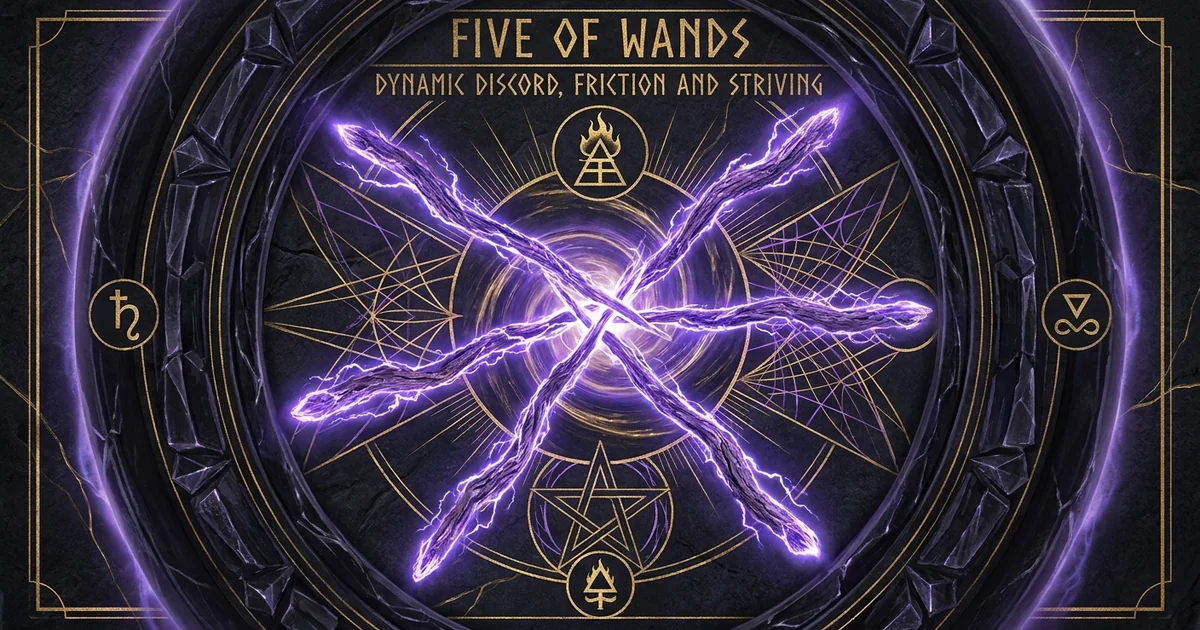
Five of Wands: Dynamic Discord, Friction and Striving
Archetypal Thesis & Systemic Paradigm: The Agon of the Will
The Five of Wands represents the vital disruption of static equilibrium through dynamic discord, translating the descent of pure Volition into the turbulent thermodynamic friction of the phenomenal world. Within the architecture of the Western esoteric tradition, this card does not signify catastrophic collapse or terminal rupture; rather, it delineates the emergence of an agonistic field. In this domain, undifferentiated creative impulse encounters the structural resistance of manifest reality.
Operating at the intersection of Geburah (the fifth Sephira of Severity and Correction) and Atziluth (the Archetypal World of pure emanation and primordial Fire), the card dramatizes the cosmological necessity of kinetic opposition. When the creative drive descends from the pristine archetypal realm into concrete expression, it cannot remain a monolithic, uncontested vector. It must fracture into multiplicity, subjecting its constituent elements to the crucible of competition, testing, and mutual refinement.
Thermodynamic Agitation and the Dissipative Structure of Fire
From the perspective of non-equilibrium thermodynamics, the Five of Wands embodies the behavior of an open system driven far from equilibrium. The element of Fire, which finds its initial manifest stability in the architectural enclosure of the Four of Wands, becomes constrained by its own structural boundaries. Left undisturbed, a closed thermodynamic system inevitably falls prey to entropic decay. The introduction of the Geburic five-force acts as an injection of radical thermal agitation, shattering the perimeter of the previous stage.
The fire element within the wands suit cannot persist as an inert or perpetually harmonious flame; it requires fuel, atmospheric circulation, and the friction of combustible forces to sustain its luminance. In the Five of Wands, this dynamic manifests as high internal entropy, forcing the system into what chemist Ilya Prigogine termed a dissipative structure. The discord depicted is the precise mechanism by which energy reorganizes itself, transforming what appears to be chaotic turbulence into a higher order of operational complexity.
Geburic Disruption: The Necessary Shattering of Chesed’s Stasis
To comprehend the structural mechanics of the Five of Wands, one must grasp the dialectical relationship between Chesed (Mercy/Expansion) and Geburah (Severity/Contraction) within the Tree of Life. The Four of Wands represents Chesed’s benign, expansive crystallization: an Edenic consolidation of creative energy, social consensus, and established boundary lines. However, uninterrupted Chesed yields an environment of stagnant overgrowth and unearned privilege—a spiritual entropy wherein the initial will loses its incisive momentum.
Geburah intervenes as the cosmic surgeon. As the fifth Sephira, Geburah applies corrective pressure, pruning the excess of Chesed through radical severing, limitation, and kinetic confrontation. When this Geburic severity floods the world of Atziluth, the pure will experiences its first encounter with internal division. The will is no longer a single, coherent stream of intent; it splits into rivaling currents, each asserting its sovereign legitimacy. This disruption is an ontological necessity: without the crucible of Geburic correction, the will remains untested, sentimental, and structurally incapable of securing the solar synthesis that awaits in Tiphareth, the Six of Wands.
The Teleology of Conflict: Heraclitean Strife as Creative Genesis
The philosophical underpinnings of the Five of Wands are anchored in the pre-Socratic cosmology of Heraclitus of Ephesus, particularly his doctrine of polemos—strife as the father and king of all things. Heraclitus posited that manifest existence is sustained not through passive harmony, but through the tension of opposites (palintropos harmonie, an attunement of opposite tensions, like that of the bow and the lyre). In this schema, peace without tension is death; vitality is generated exclusively through the agon of conflicting vectors.
In analytical psychology, this dynamic corresponds to the indispensable friction between ego-complexes and unconscious archetypal forces during the process of individuation. Carl Gustav Jung observed that consciousness emerges only through collision: the ego encounters an obstinate outer reality or an autonomous inner complex, and through that abrasive collision, the threshold of awareness expands. The five of wands tarot meaning, therefore, denotes this productive, developmental struggle. It is not an omen of defeat, but an operational blueprint for psychological maturation, wherein competing desires and unintegrated sub-personalities must engage in active dialogue to forge an authentic, resilient identity.
Qabalistic Sephira: Geburah (גבורה - Severity, Justice, Kinetic Power)
Cosmological World: Atziluth (אֲצִילוּת - Archetypal World / Primordial Fire)
Formulaic Divine Name: Elohim Gibor (God of Strength and Moral Rectitude)
Astrological Decan: First Decan of Leo (0°00’ – 09°59’ Leo)
Decanic Planetary Ruler: Saturn (Sub-ruler of the Leo Decanate via Golden Dawn Hermetic Chaldean Order)
Macrocosmic Element: Fire (Yod of Tetragrammaton, Absolute Volition)
Esoteric Title: The Lord of Strife
Structural Dynamics: The contraction of Binah mediated through the severity of Geburah, acting upon the prime creative fires of the wands suit, precipitating structural resistance and thermodynamic agitation.
Classical Provenance & Textual Lineage: From Strife to Conscious Agon
The historical development of the Five of Wands reveals a profound shift in hermeneutic perspective. The card evolved from a fatalistic emblem of raw physical combat into a sophisticated psychological model of play, testing, and creative friction. In early continental cartomancy and the Italian tarocchi lineage, the suit of Batons often registered mundane labor, agrarian burden, or physical altercations devoid of metaphysical interiority. It was not until the synthesis of the Hermetic Order of the Golden Dawn in late-nineteenth-century England that the card received its precise mathematical, astrological, and Qabalistic architecture.
Golden Dawn Cyphers and the Title of the ‘Lord of Strife’
In the esoteric instruction manuscripts penned by Samuel Liddell MacGregor Mathers and William Wynn Westcott, the Five of Wands was christened the “Lord of Strife.” Rooted in the Hermetic attribution of Geburah in the suit of Fire, the Golden Dawn’s assessment was distinctly severe. Mathers viewed the card through the lens of unmediated kinetic force operating without the balanced counterweight of Chesedic mercy or Tipharethic illumination.
In the Golden Dawn cyphers, the card represents the raw, unrefined collision of wills—a state of discord where individuals or localized energies contend for dominance without any overarching teleological consensus. The Golden Dawn focused on the essential tragedy of the uncoordinated will: when pure intention descends into the world of action without centralized governance, it cancels itself out through chaotic interference patterns. The “Lord of Strife” depicted a metaphysical impasse where energy is exhausted in mutual friction rather than channeled into coherent manifestation.
The Waite-Smith Innovation: Mimetic Play versus Lethal Combat
When Arthur Edward Waite collaborated with artist Pamela Colman Smith to generate the iconic 1909 Rider-Waite-Smith (RWS) deck, he deliberately altered the visual iconography of the card away from lethal combat. Smith’s rendering presents five youths, clothed in varying, un-uniformed tunics, brandishing heavy wooden staves. Crucially, the wands are not raised as deadly weapons designed to crush the skull of an adversary; they do not strike flesh, nor do they assume organized battle formations. Instead, they are held loosely, haphazardly, almost playfully, clashing in mid-air in what appears to be an athletic competition, a sham fight, or a ritualized tournament.
Waite understood that Geburah acting within Atziluth does not necessarily descend into the physical butchery characteristic of the lower astral or material planes (which belongs properly to the suit of Swords). By contextualizing the scene as “competition, as it were a friendly play,” Waite and Smith introduced a crucial psychological insight: human beings require agonistic arenas to cultivate capacity. The card captures the ludic dimension of existence—play as a safe, ritualized staging ground where ego-complexes measure their strength, establish dynamic boundaries, and calibrate their faculties without the consequence of ultimate destruction.
Mathers (The Golden Dawn Inner Manuscripts, 1888):
“Five of Wands: Lord of Strife. Geburah in Atziluth. Quarrelling, fighting, violent strife, contest, competition, labor, difficulty. Also boldness, lust, unbridled desire, according to the dignity with which it is accompanied. Violent and fierce passions.”
Waite (The Pictorial Key to the Tarot, 1910, Part II, Section 3):
“A posse of youths are brandishing staves, as if in sport or strife. It is mimic warfare, and hereto correspond the divinatory meanings: Imitation, as, for example, sham fight, the strenuous competition and struggle of the search after riches and fortune. In this sense, it connects with the battle of life. But it is also competition, as it were a friendly play; contest, and even suit or law-plea.”
Crowley’s Thoth Formulation: Saturnine Obstruction in the Royal Sign
Aleister Crowley, writing in The Book of Thoth (1944) with artistic execution by Lady Frieda Harris, took a starkly mechanistic and philosophically rigorous approach to the card. Reverting to the title “Strife,” Crowley stripped the image of figurative characters, constructing an abstract geometry of forces. He organized the composition around the astrological decan: Saturn in Leo.
In Crowley’s vision, the radiant, expansive sovereignty of Leo (represented by the golden wands of the adept and the major solar emblems) is hemmed in, obstructed, and subjected to the petrifying influence of Saturn (represented by heavy, crude wooden clubs crossing over them). For Crowley, the Five of Wands reflects an agonizing stage in the development of the Will: the royal fire of the solar ego encounters the cold, unyielding limit of cosmic law. It is the exhaustion that accompanies the realization that sovereign desire is not omnipotent; it must submit to the grinding friction of material circumstances, structural resistance, and the obstinate reality of other competing wills.
Structural Mechanics & Symbolic Geometry: The Decanic Matrix
The operational mechanics of the Five of Wands cannot be fully appreciated without analyzing its structural location within the celestial and glyphic geometry of the Western Hermetic tradition. The card is generated by the precise confluence of an astrological decan, a Qabalistic emanation, and a unique topological arrangement of vectors.
Astrological Decan Architecture: Saturn in Leo (0°–10° Leo)
The Five of Wands governs the first decan of the fixed fire sign Leo (spanning 0°00’ to 09°59’ of the zodiacal band). In the classical Chaldean order of planetary rulerships, this decan is assigned to Saturn. This pairing produces an acute psycho-spiritual contradiction:
- Leo is the diurnal throne of the Sun, signifying sovereign creative power, vitality, radiant self-expression, and the heroic impulse of the individual ego. It is an unreserved projection of identity.
- Saturn, by contrast, is the principle of contraction, boundaries, temporal limitation, calcification, and systemic resistance. Saturn is the planet of exile and discipline, traditionally considered in its detriment or fall within the signs of the Sun.
When Saturn governs the first decan of Leo, the initial burst of the lion’s radiant self-assertion immediately slams into an unyielding wall of structural gravity. The creative will does not experience an open sky; instead, it encounters an obstacle course. Saturn acts as an auditor, testing whether the sovereign fire of the solar ego possesses structural integrity or is merely vain theatrics. This decanic balance generates the psychological experience of frustration, heavy striving, and intense competitive pressure. Every inch of creative progress must be earned through overcoming the drag of material inertia.
Qabalistic Topography: Geburah Descending into Atziluth
On the Tree of Life, Geburah occupies the central position on the Pillar of Severity, standing directly beneath Binah (Cosmic Form/Understanding) and directly across from Chesed (Mercy/Growth). Geburah is the radical pruning shears of the cosmos. Its energy is red, martian, kinetic, and uncompromisingly discerning. It is the immune system of the Divine Body, dismantling that which is structurally unviable or overly complacent.
When Geburah operates within Atziluth—the world of pure spirit and creative ignition—it does not create physical violence or emotional despair. Instead, it creates volitional competition. The unified impulse of the Ace of Wands, which was calibrated into duality in the Two, directed into vision in the Three, and organized into community in the Four, is here tested for internal coherence. Geburah subjects the fire to a trial by combat. The fire element must prove that it can maintain its essential flame while undergoing the turbulent crosscurrents of divergent evolutionary trajectories.
Iconographic Anatomy: Divergent Vectors and Unanchored Staves
The symbolic geometry of the Five of Wands reveals a profound mechanical principle: vector cancellation. In the Rider-Waite-Smith depiction, each of the five staves is pointed in a distinct, divergent direction. None of the staves are planted into the earth; they float unanchored in the physical terrain, raised above the ground plane by the hands of the youths.
   \   |   /     <-- Competing Vectors (Unanchored)
    \  |  /
  ---- X ----    <-- Dynamic Kinetic Friction (No Grounding)
    /  |  \
   /   |   \
This lack of grounding is significant. In physics, when multiple vectors of equal or comparable magnitude intersect without a unifying directional vector, the net velocity of the center of mass remains zero, while the internal kinetic energy and temperature of the system skyrocket. This is the exact condition of the Five of Wands: maximum agitation with minimum directional advancement. The participants exhaust immense energetic reserves, yet they do not move the collective enterprise forward because their vectors are in active opposition. Only when a unifying axis is introduced—as occurs through the solar king in the Six of Wands—can these divergent vectors align into coherent velocity.
Psychological Dynamics & Operational Praxis: The Shadow of Competition
Transposed into the territory of clinical psychology and conscious individuation, the Five of Wands ceases to be an external predictive symbol and emerges as an incisive diagnostic of internal psychic topography and systemic group dynamics.
Intra-Psychic Friction: The Clashing Archetypal Complexes
The primary psychological condition indicated by the Five of Wands is the state of the divided self (intra-psychic civil war). In this condition, the individual’s psychic energy (libido, in the Jungian sense) is fragmented across autonomous complexes that possess mutually exclusive agendas. One part of the psyche drives relentlessly toward creative visibility and external dominance; another insists on ascetic retreat; a third demands absolute ethical perfection; while a fourth acts out primal appetites.
When the querent encounters the Five of Wands, they typically experience an overwhelming sense of cognitive overload, restlessness, and internal agitation. They are expending tremendous effort, yet feeling spiritually exhausted without clear progress. This is the hallmark of internal vector cancellation. The ego is attempting to suppress competing archetypal voices, resulting in a state of chaotic resistance. The operational task is not to eliminate these discordant voices through authoritarian repression, but to bring them into the open crucible of active imagination, allowing each sub-personality to articulate its claim upon the total self.
Carl G. Jung, The Transcendent Function (1958, CW 8, par. 189):
“The confrontation between the conscious and the unconscious produces a third, dynamic thing, which cannot be grasped rationally, but can be expressed only in symbols. This is the transcendent function… The operational prerequisite for this function is the total refusal to resolve the tension through premature compromise or violent suppression. The ego must hold the tension of opposites until the transformation occurs.”
René Girard, Violence and the Sacred (1972, Johns Hopkins University Press):
“Rivals do not fight because they are fundamentally different; they fight because they are fundamentally identical. Their conflict arises from the fact that they desire the same object through mimetic imitation. As they converge upon the same point, their proximity intensifies their mutual antagonism, transforming them into reciprocal doubles.”
Mimetic Desire and Girardian Rivalry in Group Dynamics
On the interpersonal and sociological plane, the Five of Wands acts as a precise cartography of René Girard’s theory of mimetic desire. Girard demonstrated that human desire is rarely autonomous; rather, it is mediated by the other. We desire what our peers desire, not because of the intrinsic value of the object, but because the other’s desire signals to us that the object is worthy of pursuit.
The Five of Wands captures the acute phase of mimetic rivalry. The youths on the card are dressed in roughly identical attire, holding identical weapons, occupying the identical patch of ground. They are not separated by fundamental ideological cleavages; they are separated by their proximity. They have become Girardian “monstrous doubles,” locked in symmetrical competition for recognition, status, and control within a shared social field.
In corporate, familial, or artistic collectives, this card flags the presence of egoic turf wars, factional posturing, and competitive posturing where the original mission of the collective has been forgotten in favor of the immediate thrill of interpersonal dominance.
Navigating the Crucible: Operational Hermeneutics in Divination
When the Five of Wands appears within an operative divinatory consultation, its presence functions as a strategic diagnostic rather than an omen of doom. The card instructs the practitioner to adopt an attitude of conscious agonism. The practitioner must analyze the inquiry through three specific diagnostic questions:
- Where is energy being wasted in reactive friction rather than directed into manifest work? The card highlights areas where the querent is caught in defensiveness, unnecessary arguments, or unproductive bureaucratic maneuvering.
- What structural limits (Saturn) is the sovereign creative project (Leo) refusing to integrate? The discord present is usually the result of the querent attempting to bypass the necessary architectural friction of testing, regulatory compliance, or collaborative compromise.
- Is the conflict actual or performative? Operating in accordance with Waite’s insight of “mimic warfare,” the consultant must discern whether the querent is mistaking healthy professional or intellectual competition for existential threat. If the competition is merely an athletic tournament designed to sharpen capacity, the querent must stop weeping over bruised ego-structures and engage the game with rigorous sportsmanship.
Philosophical Synthesis & Macrocosmic Correspondence: Order Through Chaos
The metaphysics of the Five of Wands transcends the boundaries of Western Hermeticism, demonstrating structural congruence with ancient pre-Socratic ontology, modern complexity science, and the binary cosmology of the Far East.
Tarot: Five of Wands
- Sephiric Attribution: Geburah in Atziluth (Fiery Kinetic Severity)
- Cosmic Function: The disruption of static consolidation through competitive testing and vector collision.
- Operational Key: Productive struggle; the cultivation of capacity through friction; rejection of false, entropic peace.
- Shadow: Attritional exhaustion; zero-sum mimetic warfare without teleological aim.
I Ching: Hexagram 38 (睽 - K'uei)
- Trigram Structure: Fire (Li) above, Lake (Tui) below.
- Cosmic Function: The divergent motion of elements; Fire moves upward while the Lake sinks downward.
- Operational Key: Mutual opposition and alienation; retaining individuality and sovereignty while working within discordant structures.
- Judgment: “In small matters, good fortune.” Comprehensive synthesis is impossible; small calibrations are paramount.
Human Design: Gate 38 (The Fighter)
- Somatic Center: Root Center (Pressure and Adrenal Stress).
- Cosmic Function: The pressure to struggle for individual purpose and existential meaning against the tribal collective.
- Operational Key: Discerning what is worth fighting for; converting mechanical resistance into spiritual sovereignty.
- Shadow: Blind aggression; fighting indiscriminately merely to feel alive; unnecessary friction with the environment.
Heraclitus and Polemos: War as Father of All Things
The deepest metaphysical core of the Five of Wands is found in Fragment 53 of Heraclitus: Polemos pantōn men patēr esti, pantōn de basileus (“War is the father of all and the king of all; some he shows as gods, some as men, some he makes slaves, some free”). Heraclitus did not use Polemos to glorify military cruelty; rather, he identified strife as the ontological engine of differentiation.
Without the counter-pull of opposing forces, the universe would collapse back into an undifferentiated, homogenous cosmic fire (ekpyrosis), terminating all individuation, beauty, and consciousness. The Five of Wands is the active manifestation of this principle within the wands suit. It is the cosmic tension that prevents life from stagnating. The friction between the youths is the precise mechanism by which they develop their musculature, refine their balance, and discover the absolute limits of their individual strength. Strife is the crucible from which true distinction emerges.
Prigogine’s Non-Equilibrium Thermodynamics and Conscious Evolution
The correspondence between the Five of Wands and Ilya Prigogine’s Nobel Prize-winning work on non-equilibrium thermodynamics offers a profound scientific validation of Hermetic cosmology. Prigogine demonstrated that in systems driven far from equilibrium, fluctuations can become so violent that they disrupt the pre-existing structure entirely. At this bifurcation point, the system faces two absolute outcomes: it will either collapse into total entropy, or it will execute a spontaneous, self-organizing leap into a higher order of complexity—a dissipative structure.
The Five of Wands captures a system at this exact bifurcation threshold. The comfortable, four-walled domestic tranquility of the Four of Wands has been destabilized by the thermal influx of Geburah. The system is shaking with internal turbulence. If the participants attempt to freeze the system or flee the friction, decay ensues. However, if the friction is sustained with awareness, the turbulence reorganizes the participants into a coherent team, paving the way for the emergence of the true leader and the unified solar vector depicted in the Six of Wands. Conflict is not the antithesis of order; it is the non-linear bridge through which higher order is achieved.
Cross-Systemic Triangulation: I Ching Hexagram 38 (K’uei / Opposition)
In the divinatory cartography of the I Ching (The Book of Changes), the exact structural homologue to the Five of Wands is found in Hexagram 38: 睽 (K’uei / Opposition). The visual and systemic structure of Hexagram 38 is formed by the trigram Li (Fire) above and the trigram Tui (Lake/Mist) below.
The commentary on the Image states: Above, fire; below, the lake: The image of Opposition. Thus the superior man, amid all fellowship, retains his individuality.
Fire burns and rises toward heaven, while the waters of the lake move downward toward the earth. These two elements, dwelling within the same energetic space, move in diametrically opposite directions. Their nature is fundamentally incompatible; they cannot merge into a comfortable unity without destroying each other (fire boiling water, or water extinguishing fire).
Yet, the I Ching does not view this opposition as an unmitigated disaster. The hexagram explicitly notes: In small matters, good fortune. The text advises that while grand systemic consolidations are impossible during a period of opposition, the friction itself is invaluable for testing boundaries, clarifying identity, and purging illusions of false consensus.
Like the Five of Wands, Hexagram 38 instructs the sovereign individual to remain rooted in their central axis while navigating an environment characterized by divergent trajectories, petty misunderstandings, and reciprocal friction.
Frequently Asked Questions: Advanced Decodings of the Five of Wands
Differentiating the Fives: Wands, Cups, Swords, and Pentacles
The four Fives of the Minor Arcana each articulate the impact of Geburic severity within their respective elemental matrices. Understanding the unique character of the Five of Wands requires triangulating it against its three structural siblings:
- Five of Wands (Geburah in Fire): Operates on the level of kinetic energy, will, and creative striving. It is non-lethal, dynamic, athletic, and exploratory. The friction is externalized, playful, or competitively ambitious. It represents agon—the test of strength that refines capacity.
- Five of Cups (Geburah in Water): Operates on the level of emotional attachment, relational investment, and grief. Here, Geburic severity severs an emotional bond, spilling three vessels while leaving two standing behind the grieving figure. It is an experience of bereavement, disappointment, and the painful necessity of letting go of illusions.
- Five of Swords (Geburah in Air): Operates on the level of intellect, ego-sovereignty, and the rational mind. Air under the severity of Geburah produces calculated cruelty, zero-sum competition, and cynical self-interest. The swordsman gathers the weapons of his humiliated peers; it is a hollow, pyrrhic victory where the social fabric has been permanently torn apart by hostility.
- Five of Pentacles (Geburah in Earth): Operates on the level of material resource, somatic health, and institutional inclusion. Severity descending into the dense world of Assiah manifests as physical deprivation, poverty, exclusion from the temple, and exposure to the unforgiving elements. It is the testing of somatic and material resilience.
Whereas the Five of Swords leaves bodies and broken trust in its wake, and the Five of Cups plunges the soul into a silent swamp of mourning, the Five of Wands remains essentially vitalistic. Its wounds are sweat, minor bruises, and the clean exhaustion of the athletic field.
Shadow Integration: When Friction Becomes Malignant Attrition
While the conscious archetype of the Five of Wands is that of heroic agonism and developmental play, its unintegrated shadow manifests as malignant attrition.
When an individual or collective refuses to allow the conflict to resolve toward a higher synthesis (Tiphareth), the strife becomes chronic, obsessive, and ultimately entropic. In this shadow state, the ego becomes addicted to the adrenaline of conflict. The individual interprets every boundary, divergent opinion, or procedural obstacle as a mortal offense requiring immediate tactical retaliation.
In organizational dynamics, this shadow produces bureaucratic gridlock: committees that exist solely to obstruct other committees, endless rounds of political infighting, and the complete paralysis of the institution’s generative mission. The fire element, denied its solar ascent, turns inward and consumes its own container. Integrating this shadow demands that the querent drop their stave and ask whether they are fighting to manifest a transcendent vision or merely to avoid the terrifying vulnerability of peace.
Reversal Mechanics: Repression of Conflict versus Spontaneous Harmony
The reversed Five of Wands exhibits two distinct interpretive branches, depending upon the operational dignity and contextual placement within a reading:
- The Repression of Necessary Friction (The Path of False Peace): This is the more insidious and common manifestation of the reversal. The querent, terrified of interpersonal discord, suppresses their genuine dissent, competitive drives, and sovereign boundaries in a desperate attempt to maintain an external illusion of harmony. This results in the toxic internalization of Geburic severity. The conflict does not vanish; it transforms into passive-aggressive posturing, covert sabotage, psychosomatic illness, and pervasive resentment. The reversed card in this position demands that the querent stop fleeing from conflict and step directly into the arena, recognizing that authentic peace is earned only through the conscious confrontation of divergent interests.
- The Cessation of Strife (The Exhaustion of the Agon): In a favorable context, the reversal indicates that the period of testing and competition has fulfilled its teleological function. The dissipative structure has completed its cycle; the divergent vectors have successfully calibrated their relative strengths; and the participants have recognized the futility of continued opposition. Here, the youths lower their staves not out of fear, but out of mature realization. The path is cleared for the emergent leader or the unifying vision of the Six of Wands to assume governance over the field.
The Master Matrix of Concordances
To conclude this research monograph, the complete multidimensional correspondences governing the Five of Wands are synthesized in the master concordance table below:
| System / Dimension | Primary Coordinate / Value | Phenomenological Manifestation |
|---|---|---|
| Qabalistic Sphere | Geburah (גבורה) | Kinetic Severity, Correction, Pruning of Excess |
| Elemental World | Atziluth (אֲצִילוּת) | Primordial Fire, Pure Archetypal Volition |
| Astrological Decan | 1st Decan of Leo (0°–10° Leo) | Solar sovereignty encountering Saturnine limits |
| Chaldean Decan Ruler | Saturn | Structural resistance, friction, temporal gravity |
| Golden Dawn Title | Lord of Strife | Collision of uncoordinated vectors of will |
| Pey-Letter Engine | Mars-attributed path | Kinetic disruption of static form |
| I Ching Hexagram | Hexagram 38 (睽 - K’uei) | Opposition; Fire above, Lake below; Divergence |
| Human Design Gateway | Gate 38 (The Fighter) | Pressure to find existential meaning through struggle |
| Thermodynamic Mode | Dissipative Structure | Far-from-equilibrium chaos forcing self-organization |
| Psychological State | Intra-psychic Vector Discord | Tension between autonomous complexes awaiting synthesis |
| Interpersonal Mode | Girardian Mimetic Rivalry | Symmetrical competition between un-individuated doubles |
| Subsequent Transition | Six of Wands (Tiphareth in Fire) | Solar synthesis, victory, and alignment of vectors |