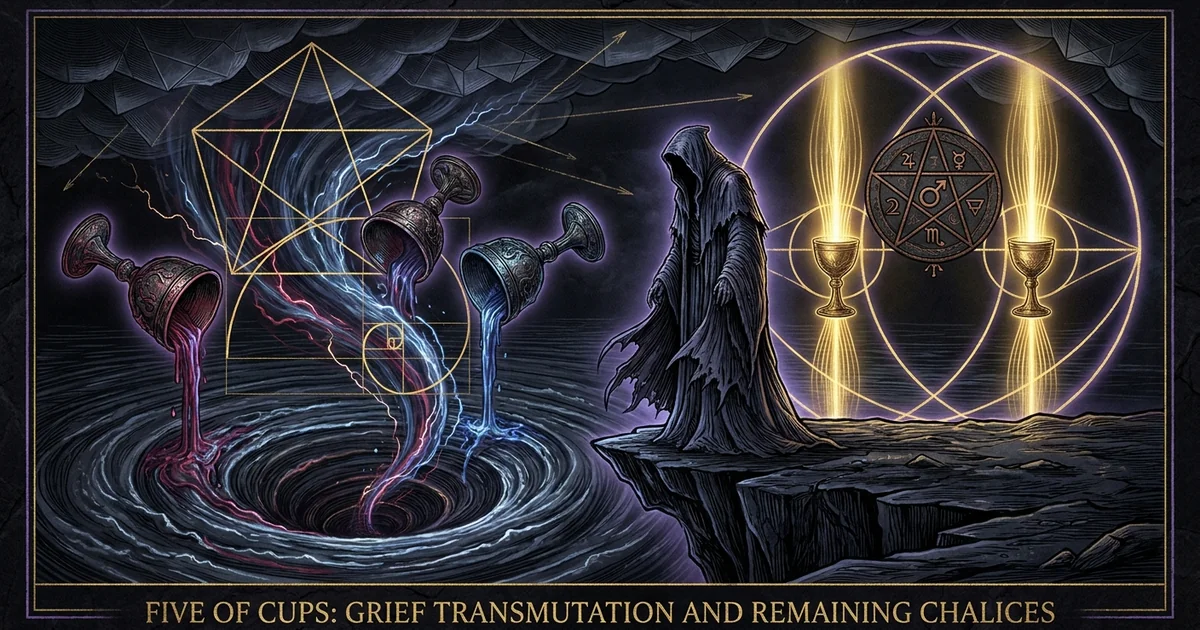
Five of Cups: Grief Transmutation and Remaining Chalices
Archetypal Thesis & Systemic Paradigm: The Catabolic Alchemy of Geburah in Briah
The Five of Cups does not signify a catastrophic rupture of ontological being, nor does it denote meaningless victimhood under an indifferent cosmos. Within the structural architecture of Hermetic Qabalah, this arcanum registers as the catabolic descent of the fifth Sephira, Geburah (Severity, Judgment, and Dynamic Dissolution), into the formative continuum of Briah, the World of Creation governed entirely by the water element. To comprehend the five of cups tarot meaning is to chart the functional mechanics of structural stress applied to emotional containment. When the martial, incisive potency of Geburah impacts Briah, it disrupts the psychic homeostasis established in the preceding Four of Cups. The resulting condition is an inevitable thermodynamic purge of crystallized sentiment, unsealing rigid vessels to release libidinal currents that have outlived their evolutionary utility.
- Sephira: Geburah (Divine Rigor, Judgment, Radical Pruning, Dynamic Force).
- World: Briah (The Archangelic World of Creation, assigned elementally to Water/Cups).
- Hermetic Title: The Lord of Loss in Pleasure.
- Structural Dynamic: The imposition of martial, entropic friction upon the receptive, formative currents of the Astral Matrix, precipitating the catabolic liquidation of outmoded affective investments.
Geburic Severity and the Dissolution of Emotional Inertia
The manifestation of Geburah within the suit-of-cups generates an acute, systemic friction. Water, by its fundamental topological nature, tends toward cohesion, equilibrium, and quiescent containment. It seeks the lowest energetic baseline, conforming passively to the boundaries of the vessel in which it resides. When Geburic fire and martial severity strike this fluid equilibrium, the systemic outcome is not tranquil evaporation, but violent displacement.
The three overturned chalices visible within the card’s traditional composition represent the systematic collapse of an outmoded emotional triad. This triad comprises affective idealizations, historical projections, and the calcified psychic investments that tether an ego to an unviable past. Geburah does not act out of arbitrary malice; its role within the cosmic economy is corrective surgery. It excises that which cannot sustain living evolutionary tension. In Briah, this severity strips the querent of sentimental illusions, shattering the fragile equilibrium of localized pleasure to prevent ultimate psychic stagnation. The water element is liberated from its calcified containers through structural trauma, forcing the subjective apparatus to confront the void left by sudden decompression.
The Energetics of Bereavement: Cathexis, Rupture, and Psychic Entropy
Viewed through psycho-cosmological mechanics, grief represents a catastrophic thermodynamic redistribution. The psychological construct of cathexis delineates the process whereby libidinal energy is bound to external imagoes, institutions, or interpersonal dynamics. When the physical or archetypal correlative of that cathexis is obliterated, the psychic charge does not instantly dissipate into the ether. It pools, uncontrolled, within the conscious perimeter, generating the felt experience of melancholy and disorientation.
The spillage of the fluids—traditionally tinted red and green to signify vitality, generative drive, and somatic feeling—represents the entropic bleed of this unmoored cathexis. The subject encounters an apparent loss of systemic coherence, experiencing the severing of emotional attachments as a threat to ego integrity. However, this catabolism is a thermodynamic necessity. Until the fixed libido bound to obsolete emotional structures is bled off, the psyche remains incapable of dynamic restructuring. Bereavement, within this systemic frame, functions as an energetic decompression phase: an acute collapse of local structural integrity that establishes the prerequisite vacuum for higher-order reintegration.
The Transmutation Vector: From Spilled Fluids to Latent Reserves
The operative pivot of the Five of Cups resides in its spatial topology: the existential tension between the three fallen chalices and the two standing vessels positioned behind the observer’s central axis. While the uninitiated gaze fixates upon the catabolic runoff saturating the earth, the card’s underlying geometry models a path of transmutation. The fallen vessels have surrendered their contents to the soil, a symbolic return of individual emotional output to the undifferentiated collective unconscious.
The two standing chalices remain fully charged, uncorrupted by the Geburic assault. They represent the irreducible scintilla—the structural reserve of soul-will and transpersonal love that survives all localized trauma. The transmutation vector requires an intentional conversion of psychic attention: shifting the scopic focus away from the entropic decay of dead forms toward the latent, stable reservoirs that endure behind the spinal plane. This movement is not an escapist denial of sorrow, but a profound metabolic assimilation of the loss, allowing the grief-stricken consciousness to transition from an unsustainable fixation on the spilled past toward the regenerative promise codified in the Six of Cups.
Classical Provenance & Textual Lineage: Historical Glyphs of the Lord of Loss in Pleasure
The historical emergence of the Five of Cups within the Western Mystery Tradition marks a decisive pivot from late-medieval ludic iconography to rigorous, esoteric cartography. While the early Italian tarocchi decks (such as the Visconti-Sforza) treated the suit of cups through relatively straightforward ornamental arrays of chalices, the late-nineteenth-century synthesis engineered by the Hermetic Order of the Golden Dawn systematically mapped the minor arcana to the decanates of the tropical zodiac and the Tree of Life. This programmatic innovation radically transformed the card from an ambivalent marker of domestic misfortune into a precise diagram of psycho-spiritual crisis.
“The 5 of Chalices is the Lord of Loss in Pleasure. Therein rule the Great Angels Livoyah and Veleh. It is the influence of Geburah in the sphere of Water; the decay of that which was pleasant, yet not completely destroyed; an unexpected interruption of delight; frustration of hopes, yet with some remaining comfort.” — S. L. MacGregor Mathers & W. W. Westcott, The Golden Dawn: The Inner Hermetic Order of the Golden Dawn (1888).
“This card is attributed to Geburah in the sphere of Water… It is the unmitigated influence of Mars in Scorpio, the most violent and bitter aspect of the element. The pleasure is turned to rot; the expectations are frustrated; the wine has soured to vinegar… Yet the card still indicates that two cups remain erect, showing that the foundational will to live is not utterly eradicated.” — Aleister Crowley, The Book of Thoth: A Short Essay on the Tarot of the Egyptians (1944).
The Golden Dawn Attribution and the Mars-Scorpio Synthesis
The Hermetic Order of the Golden Dawn, drawing upon the Hellenistic astrological lineages preserved in the works of Claudius Ptolemy and the Picatrix, assigned the Five of Cups to the first decan of the fixed water sign of Scorpio (0° to 10°). This decanate is governed directly by Mars, generating a volatile fusion of forces categorized within the order’s inner curriculum under the title “The Lord of Loss in Pleasure.” This assignation was not arbitrary; it joined the martial, severing force of Geburah with the fixed, abyssal currents of the astrological sign associated with the eighth house of mortality, shared resources, and radical psychological transformation.
Under this decanic regime, the martial impulse does not strike outward against external adversaries, as it might in the fiery decans of Aries or Leo. Instead, it is submerged within the deep, unyielding matrix of Scorpio. The planetary ruler turns inward upon itself, operating as an endogenous blade that cuts through sentimental attachments and superficial emotional equilibria. S. L. MacGregor Mathers and his collaborators encoded this mechanism into the card’s esoteric design: the martial principle acts as an alchemical reagent within the emotional waters of Briah, terminating conditions of stagnant pleasure to initiate the painful process of systemic purification.
Pamela Colman Smith’s Iconography: The Cloaked Figure, River, and Bridge
When Arthur Edward Waite directed the production of the 1909 Rider-Waite-Smith deck, he tasked artist Pamela Colman Smith with externalizing these dense, abstract Hermetic attributions into intuitive, archetypal tableaus. Smith’s rendering of the Five of Cups established an iconic visual syntax that defined modern esoteric interpretation.
[ Fortified Keep ]
                                          |
                                    [ Arch Bridge ]
                                          |
                                   ~~~~~~~~~~~~~~~
                                  [ River: Styx / Lethe ]
                                   ~~~~~~~~~~~~~~~
                                          |
  [ 2 Upright Chalices ] <---- [ Cloaked Mourner ] ----> [ 3 Spilled Chalices ]
      (Latent Reserve)           (Spinal Plane / Axis)       (Entropic Runoff)
Smith depicted a solitary figure, swathed in an unbroken, light-absorbing black mantle, standing in an austere landscape. The figure’s posture is bowed in profound, unyielding contemplation of three overturned chalices resting in the foreground, their liquid contents—symbolic of arterial life and fertile essence—leaking unrecoverably into the pale gray earth.
Behind the figure’s right flank, obscured entirely from its forward-facing scopic field, stand two upright chalices, untarnished and filled with uncorrupted sustenance. Separating this foreground of bereavement from the distant horizon is a rushing blue river, commonly understood in esoteric cartography as a symbolic convergence of the mythological Styx (severance) and Lethe (amnesia). Spanning this watery gulf is an arched, stone bridge leading directly to a fortified keep or monastery perched upon the opposing bank. Smith’s spatial arrangement provides a visual grammar of initiation: the mourner is not trapped within a dead end, but is halted at a liminal staging ground, temporarily blinded by the shadow of their own mantle to the structural avenues of passage and replenishment that surround them.
Aleister Crowley’s ‘Loss in Pleasure’: The Putrefaction of Tiphareth’s Harmony
In contrast to Smith’s figurative narrative of mourning, Aleister Crowley, collaborating with Lady Frieda Harris in the execution of The Book of Thoth, rendered the arcanum through uncompromising, non-anthropomorphic geometry. In the Thoth deck, the card is named simply Loss in Pleasure. Crowley situated the card as the direct catabolic unraveling of the solar harmony established in the Six of Cups or the luxurious satiety of the Four of Cups. The structural layout of the five chalices on the Thoth card forms an inverted pentagram—a traditional Hermetic glyph signifying the subjugation of spirit by elemental matter, balance disrupted by the violent intrusion of unbalanced force.
Crowley depicted the cups as dry, broken, and decaying, surrounded by dying lotus blossoms whose petals fall into a murky, poisoned sea. The liquid trickling from the vessels is neither water nor wine, but an unwholesome, putrid fluid, reflecting the alchemical phase of putrefactio. For Crowley, the first decan of Scorpio under Mars marks the exact juncture where emotional indulgence curdles into spiritual poison. The pleasure experienced in previous iterations of the suit-of-cups undergoes an organic, inevitable rot. This rot, however, is not treated by Crowley as an absolute damnation; it represents the tragic yet mandatory dissolution of the form, without which no higher distillation of the true will can be extracted.
Structural Mechanics & Symbolic Geometry: Spatial Topology and Decanic Astronomy
A precise geometric and astrological analysis of the Five of Cups reveals that its power does not stem from decorative visual elements, but from a calculated matrix of spatial vectors and celestial mechanics. The visual architecture functions as an open cybernetic circuit waiting for an operational change in perspective to close the loop and restore structural equilibrium.
Spatial Topology of the Arcanum: The Horizon, the Black Mantle, and the Crossing
The topological architecture of the Five of Cups is governed by a strict planar asymmetry designed to manipulate the viewer’s proprioceptive alignment. The canvas is divided into three distinct spatial planes: the foreground zone of entropic spillage, the middle threshold of water and bridge, and the background sanctuary of the fortified keep. The central figure occupies the nexus of these planes, functioning as a vertical axis that bisects the horizontal vista.
The black mantle worn by the central figure acts as a total optical barrier. In the language of archetypal psychology, it is an envelope of acute sensory deprivation—a voluntary or involuntary retraction of consciousness from peripheral reality. Because the figure’s craniosacral axis is bent downward at an angle of roughly forty-five degrees, its optical field is mechanically restricted to the quadrant containing the three spilled cups. This design encodes the phenomenon of perceptual narrowing under conditions of acute psychic shock.
Directly behind the figure’s blind spot lies the stone bridge. In sacred architecture, the bridge represents the pontifex: the instrument of transitional consciousness capable of spanning the chasm between lower ego-states and the higher, fortified domains of the Self. The bridge across the river demonstrates that the impediment to spiritual transit is not environmental, but perceptual. The path to the stone keep is structurally unobstructed; it requires only a ninety-degree lateral pivot to be perceived, and a one-hundred-and-eighty-degree somatic rotation to be traversed.
Astrological Decan Mechanics: Mars in Scorpio (0°–10°)
The astrological mechanics informing this card operate at the thermodynamic interface of Mars and Scorpio. In traditional astrological dignity tables, Scorpio serves as the nocturnal domicile of Mars. Unlike the diurnal, thrusting, and kinetic expressions of Mars in Aries, Mars within the fixed water sign of Scorpio acts with immense hydraulic pressure. The decan (0°–10° Scorpio), known in classical texts through the decanic face of the martial warrior armed with a spear, introduces an agonizing contradiction: the drive toward dynamic, aggressive expression is contained within a fixed, non-compressible watery medium.
+--------------------------------------------------------------------------+
| DECANIC MECHANICS: MARS IN SCORPIO (0°00' - 09°59')                      |
+--------------------------------------------------------------------------+
| Element: Fixed Water (Deep, psychic, unyielding, oceanic undercurrents)  |
| Planetary Governor: Mars (Catabolic heat, severing blade, raw libido)    |
| Operational Dynamics:                                                    |
|  1. Inward trajectory of martial energy: Self-directed catharsis         |
|  2. Hydraulic containment: Inability of water to compress leads to burst |
|  3. Radical surgery: The blade severs rotting emotional dependencies    |
+--------------------------------------------------------------------------+
When this decanic dynamic intersects Geburah, the result is an endogenous explosion. The martial heat boils the Scorpic waters from within, generating steam and internal pressure that shatters the weakest structural vessels. The three fallen chalices illustrate the failure points where this internal pressure exceeded the tensile strength of the ego’s attachments. The planetary energy does not destroy for the sake of annihilation; it violently purges the psychic system of unviable forms, compelling the individual to abandon the fantasy of permanent, static pleasure within a dynamic, fluctuating universe.
The Chalice Polarities: Asymmetry of the Triad and the Dyad
The numeric configuration of the Five of Cups rests upon a fundamental mathematical asymmetry: the structural split of the number five into an unstable triad ($3$) and an enduring dyad ($2$). In Western esotericism, five is the number of the Pentagram, the figure of humanity, dynamic motion, and the crisis that shatters the static perfection of the quaternary (the Four). The five of cups symbolism translates this mathematical reality into a profound visual lesson on structural resilience.
The triad of spilled chalices forms a triangle whose apex points downward toward the soil—the traditional symbol for the water element in its descending, de-stabilized vector. This fallen triangle corresponds to the lower emotional triad of human psychology: personal vanity, localized affection, and transient comfort. These vessels have fallen because they were arranged in an unstable configuration that could not endure the martial descent of Geburah.
Conversely, the two upright chalices behind the mourner represent the dyad: the fundamental polarity of being, the alchemical pillar of mercy paired with severity, the balance of male and female, or the conscious ego anchored to its transpersonal guide. The dyad does not need complex geometric support; it stands upright precisely because it is simple, fundamental, and free from the overextended projections that doomed the triad. These two standing cups retain their fluid integrity; they contain the necessary sustenance to support the traveler during the crossing of the river, provided the subject ceases attempting to reassemble the shattered shards of the fallen triad.
Psychological Dynamics & Operational Praxis: The Archetypal Processing of Grief
Within the clinical paradigm of analytical psychology pioneered by Carl Gustav Jung, the Five of Cups mirrors an identifiable stage in the individuation process: the descent into the underworld of the unconscious precipitated by the collapse of a long-standing ego-ideal. The card maps the precise moment when the conscious personality is confronted with the shadow of its own vulnerability, tempting the individual toward a chronic condition of melancholic stagnation.
Fixated Melancholia (Entropy)
- Psychic Mechanism: Compulsive repetition-compulsion; unconscious identification with the wounded ego-imago; the Scapegoat Complex.
- Directional Focus: Unilateral retrospective fixation upon the unrecoverable past (the three overturned chalices).
- Energetic Signature: Entropic leakage of libido into unfertile guilt, resentment, and chronic existential despair.
- Card Element: Spilled fluids draining uselessly into the mud; absolute encapsulation within the light-absorbing black mantle.
Active Transmutation (Alchemy)
- Psychic Mechanism: Conscious integration of the catabolic phase; mourning understood as somatic metabolism; discovery of the scintilla.
- Directional Focus: Somatosensory realignment of the scopic field toward the enduring transpersonal foundations (the two standing chalices).
- Energetic Signature: Dynamic redirection of psychic energy across the bridge of transitional consciousness toward the fortified keep.
- Card Element: The two intact vessels containing uncorrupted vital fluid; engagement with the stone bridge spanning the river of the unconscious.
Analytical Psychology: The Scapegoat Complex and Scintilla Recognition
When the ego encounters an acute loss—whether through bereavement, relational divorce, or ideological collapse—it regularly falls prey to what Jungian psychology identifies as the Scapegoat Complex. The individual internalizes the catastrophe as an intrinsic moral or existential failing, wrapping themselves within the black mantle of melancholia. The cloaked figure on the Five of Cups embodies this state of psychic inflation-in-reverse: the subject becomes narcissistically fascinated by their own ruin, treating their grief as an absolute, singular monument that excuses them from further engagement with life.
In this pathological posture, the psyche actively represses awareness of the two remaining chalices. To acknowledge their existence would disrupt the ego’s identification with the role of the martyr. The alchemical task inherent in the five of cups tarot meaning is the extraction of the scintilla—the divine spark, the indestructible core of consciousness—from the ashes of the ruined complex. Jung emphasized in The Archetypes and the Collective Unconscious (1954) that the descent into darkness (nigredo) is meaningless unless it yields an awareness of the underlying, indestructible archetypal core. The two standing chalices are precise visual glyphs for this scintilla: they signify that even after the catastrophic expenditure of personal emotion, the fundamental capacity for psychological connection, meaning, and creative action remains fully intact.
The Shadow of Retrospective Fixation: Tunnel Vision and Perceptual Anchoring
The phenomenon of retrospective fixation illustrated by the arcanum correlates directly with modern cognitive models of perceptual anchoring and attentional tunneling. Under high-stress conditions or profound affective trauma, the nervous system constricts its peripheral processing capabilities to focus exclusively on the perceived source of failure or threat. The mourner’s somatic architecture in the card exemplifies this neurological anchoring: the gaze is locked onto the point of impact where the three chalices were overturned.
This perceptual lock generates an illusion of absolute finality. Because the conscious field is occupied entirely by the fallen vessels, the subjective experience is that all vessels have fallen. The reality of the two standing chalices does not penetrate the cognitive threshold, not because they are absent, but because the neural circuitry has filtered out all visual data that contradicts the dominant affective state of loss. The operational shadow of this card is the refusal to lift the eyes—an obstinate fidelity to dead forms that converts natural, fluid grief into rigid, calcified neurosis.
Praxis in Divinatory Operations: Reorienting the Scopic Field
In professional divinatory consultation, the emergence of the Five of Cups functions as a critical cybernetic diagnostic signal. It does not instruct the querent to passively accept defeat, nor does it encourage them to engage in toxic positive bypass by pretending the three chalices were never spilled. The card acts as a profound mirror of their present attentional distribution.
OPERATIONAL PRAXIS: THE 180-DEGREE PERCEPTUAL SHIFT
Step 1: Confront the Spillage (Catharsis) -> Acknowledge the loss of the 3 cups without minimization.
Step 2: Cease the Re-cathexis -> Terminate attempts to scoop spilled fluid back into broken vessels.
Step 3: Somatic Rotation (The Pivot)   -> Execute an intentional 180-degree turn of conscious focus.
Step 4: Engage the Standing Reserves  -> Anchor the surviving ego-will to the 2 intact chalices.
Step 5: Bridge Transit (Action)        -> Cross the structural bridge toward the sovereign keep.
The esoteric practitioner must guide the querent through a multi-stage cognitive and somatic realignment. The initial step demands an unvarnished audit of what has truly been lost. The three chalices are down; their fluid has seeped into the earth; they cannot be stood upright and refilled with the same water. Any attempt to scoop the fluid back into the vessels yields only mud.
Once this catabolic finality is accepted, the praxis demands an intentional somatosensory rotation: the querent must be systematically challenged to identify the two standing chalices within their current operational sphere. What relationships, capacities, transpersonal commitments, and structural resources remain upright, neglected only because they do not match the nostalgic aesthetic of the fallen triad? The divinatory vector shifts dynamically: the arcanum ceases to be an omen of loss and transforms into an urgent directive to activate the bridge of passage.
Philosophical Synthesis & Macrocosmic Correspondence: Hermetic Solutio and Alchemical Putrefaction
To comprehend the Five of Cups at the highest level of Hermetic philosophy, one must view its mechanics through the macrocosmic operations of classical laboratory and internal alchemy. In the Great Work (Magnum Opus), the raw, unrefined material of human consciousness (prima materia) cannot be transmuted into the incorruptible Philosopher’s Stone without undergoing systematic structural disassembly. The Five of Cups is the quintessential tarot emblem of the alchemical operation of solutio paired with the initial stages of putrefactio.
“The operation of Solutio is essentially the dissolution of a solid, rigid, or calcified state into a liquid medium. Psychologically, this corresponds to the liquefaction of a hardened ego attitude which has become an impediment to growth… But if the conscious ego resists this dissolution, the Solutio is experienced as a catastrophic drowning, a tragic spillage of the vital fluids, which leads directly to the blackness of Putrefactio and the agony of the Nigredo. It is, however, an absolute prerequisite: that which cannot be dissolved cannot be purified.” — Edward F. Edinger, Anatomy of the Psyche: Alchemical Symbolism in Psychotherapy (1985).
The Hermetic Axiom of Polarity in the Watery Silo
The second principle of the Hermetic Philosophy, codified in the ancient aphorism of Polarity, asserts that “Everything is Dual; everything has poles; everything has its pair of opposites.” In the watery silo of the cups suit, this axiom finds its operational testing ground within the Five of Cups. Emotional reality cannot exist in a state of unilateral, unbroken expansion. If the light, connective, ecstatic aspects of the water element (seen in the Two and Three of Cups) were to continue indefinitely without the corrective polarity of contraction, the consequence would be profound psychic inflation—an undifferentiated oceanic state incapable of structural work.
Geburah provides the polar counterbalance to this risk. The three spilled chalices represent the seasonal contraction that balances previous emotional expansion. The Hermetic scholar does not weep over the swing of the pendulum; they recognize it as an invariant cosmological rhythm. The loss depicted in the Five of Cups is the very mechanism that restores dynamic mobility to the emotional life. The vessel that cannot be emptied cannot be refilled; the soul that has never experienced the catabolic purge of its desires remains an infantile consumer of spiritual milk, incapable of assimilating the strong meat of the higher mysteries.
The Chemical Wedding and Solutio: Liquefaction of the Fixated Ego
In alchemical treatises such as the Chymical Wedding of Christian Rosenkreutz, the royal figures must undergo decapitation, dissolution, and putrefaction before their resurrection in glorified bodies can occur. The Five of Cups represents the laboratory flask wherein this solutio takes place. The calcified ego, having built its self-concept upon transient emotional constructs (the three cups), must have those constructs shattered so that the life-force can be liberated into the broader systemic medium.
The spilled liquid is not waste; it is the alkahest—the universal solvent—doing its necessary work. By sinking into the earth, the spilled water moistens the dry, arid soil of the material plane, fertilizing the deeper ground of the unconscious for future creative cycles. The mourner believes the water is ruined because it is no longer safely stored within their private, proprietary cups. The alchemist, observing the same operation from a macrocosmic elevation, understands that the water has merely been returned to the broader hydrological cycle of the soul. The fixation has been liquidated; the false identity is undergoing putrefactio; the stage is meticulously set for the distillation of the true essence.
Cosmological Resonance: From Scorpic Depths to the Bridge of Transmutation
The macrocosmic progression of the minor arcana traces an uninterrupted trajectory of consciousness through the fabric of the cosmos. Emerging from the self-absorbed, stagnant luxury of the Four of Cups, the soul requires the severe, martial intervention of the Five of Cups to shake it from its lethargy. The Scorpic depths of this decan compel an encounter with the truth of transience.
THE BRIATIC TRANSMUTATION ARC
[ Four of Cups: Apathy / Stagnation ]
                  │
                  ▼ (Geburic Rupture)
[ Five of Cups: Solutio / The Scorpic Crucible ]
                  │
                  ▼ (Attentional Realignment)
[ Six of Cups: Tiphareth Restored / Regenerative Sun ]
The bridge spanning the river leads not backward toward the broken vessels, but forward toward the Six of Cups, where the sun of Tiphareth illuminates the cleansed waters of Briah. In that succeeding card, the chalices reappear, no longer broken, but overflowing with white blossoms, integrated within the garden of a regenerated psyche. The bridge in the Five of Cups is the precise structural pathway facilitating this evolutionary transit. Without traversing the sorrow of the five—without confronting the empty shells of the fallen triad and leaning into the structural endurance of the remaining dyad—the innocent, sovereign grace of the six remains permanently out of reach. The Scorpic crucible is the gateway through which all authentic spiritual transformation must pass.
Frequently Asked Questions: Advanced Divinatory and Archetypal Inquiries
Does the Five of Cups Invariably Presage Literal External Loss?
The Five of Cups does not function as an absolute predictor of deterministic, external catastrophe. Within a rigorous psycho-cosmological reading, the card operates primarily as an architectural diagnostic of an internal shift in cathexis. While external synchronistic events—such as the dissolution of a romantic partnership, the termination of a professional alliance, or the loss of material security—may trigger the appearance of this arcanum, the card’s essential locus is psychic, not phenomenal.
It frequently surfaces during periods where an external situation remains ostensibly intact, but the subject’s idealization of that situation has suffered irreversible systemic collapse. The three chalices that fall are often psychic projections: expectations of perfection, romantic illusions, or subconscious agreements that can no longer be sustained by the underlying energetic reality. The card diagnoses an entropic readjustment within the world of Briah; whether that adjustment manifests as external bereavement or as an internal, quiet surrender of an outmoded emotional fantasy depends entirely upon the degree of conscious awareness the querent maintains.
What Differentiates the Grief of the Five of Cups from the Ten of Swords or Three of Swords?
The differences between these arcana are defined strictly by their elemental taxonomy and Qabalistic architecture. The Three of Swords represents the descent of Binah (Understanding/Sorrow) into the mental world of Yetzirah (Air). Its crisis is an intellectual cleavage: the agonizing realization that two mutually incompatible truths exist simultaneously, resulting in a sudden, sharp laceration of the cognitive paradigm. It is an analytical, geometric pain—the scalpel of reality slicing through mental illusions.
+--------------------------------------------------------------------------+
| ELEMENTAL TAXONOMY OF CRISIS                                             |
+--------------------------------------------------------------------------+
| Card: Three of Swords                                                    |
|  * Element / World: Air / Yetzirah (Mind, Intellect, Paradigm)           |
|  * Mechanical Dynamic: Cognitive cleavage, dialectical conflict,       |
|    the blade of harsh reality severing a cherished mental model.         |
+--------------------------------------------------------------------------+
| Card: Ten of Swords                                                      |
|  * Element / World: Air / Malkuth (Terminal Rupture of Thought)          |
|  * Mechanical Dynamic: Total exhaustion of an overextended mental loop;  |
|    the absolute, unrecoverable terminus of an ideological trajectory.    |
+--------------------------------------------------------------------------+
| Card: Five of Cups                                                       |
|  * Element / World: Water / Briah (Emotion, Cathexis, Connection)        |
|  * Mechanical Dynamic: Entropic dissipation of fluid libido; structural  |
|    liquefaction (solutio) preserving two intact, functioning reserves.   |
+--------------------------------------------------------------------------+
The Ten of Swords marks the terminal collapse of the mental suit within Malkuth, the material realm. It depicts total structural exhaustion—the ruin of a mental narrative that has run itself into an absolute dead end. In the Ten of Swords, there are no standing swords left; the entire ideological apparatus has been pinned to the earth.
The Five of Cups, operating entirely within the water element, deals not with concepts, but with affective currents. Its sorrow is fluid, somatic, and deeply chemical. Crucially, unlike the totalizing finality of the Ten of Swords, the Five of Cups retains immediate, active salvific architecture. Its crisis is not one of mental annihilation, but of emotional reallocation. The presence of the two standing cups and the bridge underscores that the life-force is neither extinguished nor trapped; it has simply been radically pruned to liberate the soul from dead forms.
How Does the Orientation (Reversed) Shift the Vector of the Chalices?
When the Five of Cups appears in a reversed or ill-dignified posture, the traditional interpretations often resort to platitudes of “new alliances” or “return of hope.” An analytical Hermetic approach, however, evaluates the reversal through the physical mechanics of spatial topology. The inversion of the card fundamentally alters the visual vector: the two standing chalices, previously resting at the subject’s back, are rotated into the primary field of perception.
REVERSED VECTOR MECHANICS
Upright:
  - Focus: Three fallen chalices in immediate visual field.
  - Blind Spot: Two upright chalices behind the spinal plane.
  - Directional Movement: Stagnation at the threshold of the river.

Reversed:
  - Focus: Immediate confrontation with the two surviving chalices.
  - Blind Spot: The three fallen chalices recede out of primary awareness.
  - Directional Movement: Active bodily alignment toward the bridge.
The reversal signals the actualization of the 180-degree somatic rotation. The consciousness of the mourner ceases its compulsive retrospective gaze upon the three spilled vessels and actively registers the enduring reality of the two standing chalices. The entropic drain of libido terminates; the individual turns their back upon the spilled runoff and faces the bridge.
However, in an ill-dignified context, the reversal can warn of a premature bypass: an individual desperately spinning around to grasp the remaining chalices without having fully metabolized the grief of the fallen triad. True transmutation demands that the mourner stand before the empty, overturned cups until their lessons have been integrated into the somatic marrow. Only then does the reversal represent an organic, grounded step across the stone bridge toward spiritual reintegration.