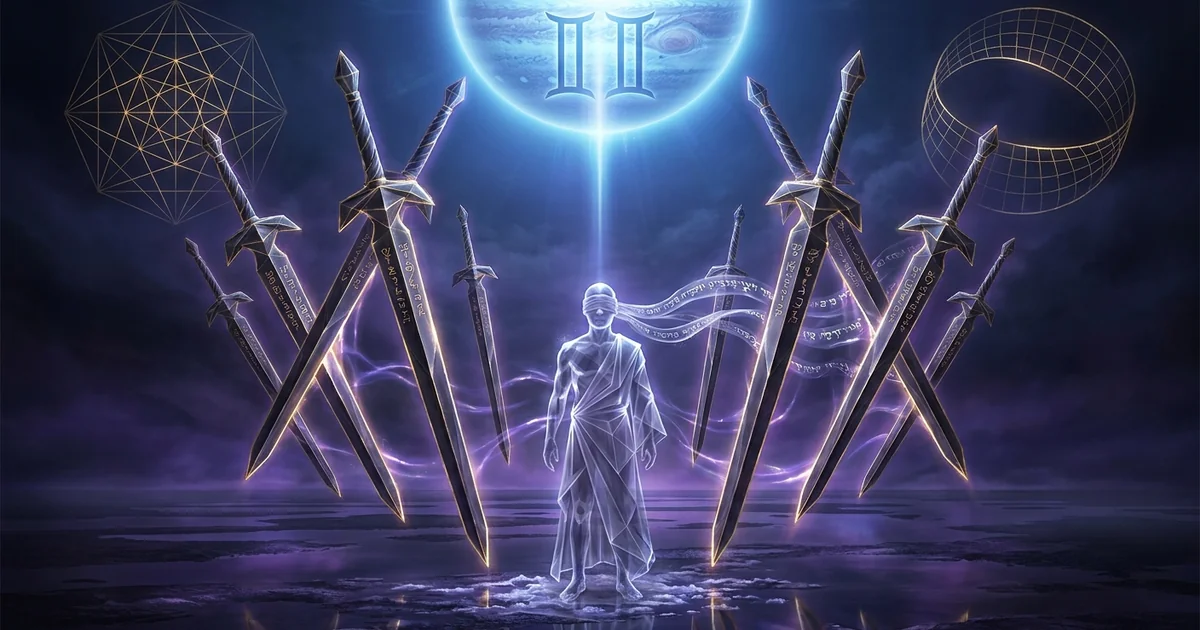
Eight of Swords: Breaking Mental Traps and Self-Release
Archetypal Thesis & Systemic Paradigm: The Epistemological Labyrinth of Yetzirah
The Hermeneutics of Self-Imposed Paralysis
The Eight of Swords functions within Western esoteric cartography not as an index of circumstantial victimization or physical bondage, but as a precise diagnostic diagram of epistemological self-entrapment. Positioned within the formative world of Yetzirah, the card crystallizes the structural moment when discursive consciousness, severed from higher integrative intuition, constructs an autonomous linguistic labyrinth and mistakes its own operational models for immutable ontological frontiers. The card’s essential dialectic lies in the tension between perceived immobility and actual functional freedom. The subject appears bound, blindfolded, and ringed by iron blades; yet analytical inspection of the spatial geometry reveals that the structural constraints are provisional, unanchored, and maintained entirely by the subject’s internalized belief in their permanence.
This dynamic represents a failure of metacognition. The rational faculty, when untethered from systemic teleology, operates via recursive analytical bifurcation, slicing reality into increasingly granular antinomies until dynamic action becomes impossible. In the lexicon of archetypal psychology, the figure is paralyzed not by an external oppressor, but by an internalized psychomachia. The eight swords constitute an externalized ideological palisade: each weapon marks a defensive cognitive presupposition that has inverted its function, transforming from an instrument of boundary maintenance into an architecture of isolation.
+-----------------------------------------------------------------------------------+
|                        THE PARADOX OF COGNITIVE ENCLOSURE                         |
|                                                                                   |
|  [ Ideational Proliferation ] ===> [ Reified Boundaries ] ===> [ Aporia/Paralysis ]|
|            ^                                                           |          |
|            |                                                           v          |
|            +----------------- [ Somatosensory Egress ] <---------------+          |
+-----------------------------------------------------------------------------------+
The Epistemic Shadow of the Swords Suit
Within the elemental taxonomy of the Minor Arcana, the swords suit governs the air element—the domain of syntax, logic, discrimination, communicative exchange, and the generative intellect. The primary virtue of Air is analytical clarity (diakrisis), the capacity to sever truth from falsehood, signal from noise, and subject from object. However, the systemic shadow of this diagnostic blade is alienation. Where the Fire of Wands unifies through kinetic intention and the Water of Cups synthesizes through affective resonance, the Air of Swords operates through division.
In the evolution of the suit across the decans, this analytical blade turns inward. By the time consciousness manifests at the scale of the eight, the sharpening of categorical divisions has severed the ego from its somatic, emotional, and transpersonal foundations. The eight of swords tarot meaning cannot be separated from this structural trajectory: it maps the precise nexus where the intellect exhausts its sovereign utility and degenerates into hyper-reflective rumination. The mind becomes an engine that consumes its own structural integrity, generating phantom threats that validate its pre-existing terror of kinetic exposure.
The Informational Feedback Loop of Cognitive Enclosure
Viewed through modern cybernetics and complex systems theory, the Eight of Swords models an informational trap driven by positive feedback loops of negative anticipation. The psyche constructs an internal predictive model of catastrophic failure; to avoid this projected trauma, it curtails motor output and exploratory behavior. This retreat reinforces the validity of the internal model, as the absence of external sensory testing prevents the disconfirmation of the underlying catastrophic hypothesis. The epistemic loop closes: the model preserves its internal coherence precisely by engineering the paralysis of the agent.
Breaking this mental trap requires deconstructing the observer-observed boundary within the Air element, shifting from discursive obsession to immediate existential apprehension. The blades do not press against the flesh; they merely cast perceptual shadows that the blindfolded consciousness populates with existential dread. Liberation is thus not an energetic conquest demanding martial force, but an epistemic shift—the deliberate cessation of belief in the objective authority of one’s self-generated cognitive architectures.
“An autonomous complex of this kind forms, as it were, a miniature psyche within the larger one, possessing its own intentions, its own dynamic, and an insidious capacity to distort conscious perception. When an ideational content becomes charged with autonomous affect, it inevitably projects itself into the phenomenological field. The subject perceives as an external, insurmountable obstacle that which is nothing other than the fossilized geometry of his own unintegrated psychic architecture. The conscious ego, hypnotized by this self-constructed phantom, surrenders its volitional capacity and yields to an illusory fatality.” — Carl Gustav Jung, Aion: Researches into the Phenomenology of the Self (Collected Works, Vol. 9, Part 2), §24–26.
Classical Provenance & Textual Lineage: From ‘Lord of Shortened Force’ to Waite-Smith Iconography
The Golden Dawn Cipher: Lord of Shortened Force
The modern divinatory understanding of the Eight of Swords descends directly from the esoteric transmissions of the Hermetic Order of the Golden Dawn. In their foundational manual, Book T: The Tarot, S. L. MacGregor Mathers and Moina Mathers titled the card the “Lord of Shortened Force.” This title carries profound thermodynamic and metaphysical implications. “Shortened force” does not denote the total extinction of kinetic energy; rather, it signifies an acute throttling, structural impedance, or vector dissipation. The dynamic, radiant impulse that originated in the fiery initiation of the suit has, upon reaching the intellectualized frequency of the eight, encountered an impedance mismatch that arrests forward translation.
“The Eight of Swords: The Lord of Shortened Force. First decan of Gemini. Jupiter in Gemini. Hod in Yetzirah. Meaning: Too much force applied to small things; waste of energy; excessive attention to detail at the expense of the whole. Ill-fortune, but temporary; labor lost; narrowness; restriction; unlooked-for impediment; petty ways, small mind. Yet it may indicate acute perception within narrow boundaries, though lacking synthetic power.” — S. L. MacGregor Mathers & Moina Mathers, Book T: The Tarot (1888).
The Golden Dawn mapped this condition to a critical structural friction: the application of immense, expansive expansive potential to microscopic concerns, precipitating structural stagnation. The intellect obsesses over marginal variables, losing the synthetic macrocosmic vision required to execute long-range will.
Pamela Colman Smith’s Visual Syntax: Slack Cords and Watery Thresholds
When Arthur Edward Waite directed Pamela Colman Smith to execute the iconic rendering for the 1909–1910 deck, Smith introduced architectural and spatial nuances that transformed the card from an abstract glyph of frustration into a sophisticated psychological tableau. The eight of swords symbolism embedded by Smith centers upon intentional structural inconsistencies designed to signal operational egress to the perceptive eye.
- The Architecture of the Enclosure: The eight swords are planted firmly into the earth, forming a palisade. Crucially, however, the blades do not form an enclosed cage. There is no sword behind the figure; the vector of retreat or pivot is entirely unobstructed. Furthermore, the swords do not intersect over her head, leaving her vertical channel to Kether fundamentally open.
- The Physics of the Bindings: The white linen wrapping the subject’s torso and arms is conspicuously loose. The bindings are wrapped without complex knots; they do not cut into the flesh or immobilize the skeletal levers. A single decisive flexion of the shoulder girdle and elbows would cause the entire winding sheet to fall away.
- The Fluid Substrate: The subject stands not upon arid stone or within an iron cell, but upon a damp, grey-blue tidal marsh. Her feet are immersed in shallow pools of water. In the Qabalistic schema, water represents the unconscious, the affective core, and somatic intuition. Her boots are wet; she is directly in contact with the elemental substrate of the somatic unconscious.
- The Distant Citadel: High upon the crag in the upper background stands an austere castle—the structural home of the discursive, strategic ego. The subject has walked, or been driven, away from the fortress of high intellectual abstraction down into the liminal, low-lying margins of the sensory world. Her salvation lies not in returning to the castle of discursive intellect, but in stepping further through the marshland toward the open sea.
Crowley’s Decanic Geometry: The Atrophy of Will in Thoth
In stark contrast to Smith’s narrative and somatic tableau, Aleister Crowley and Lady Frieda Harris approached the card through non-representational, hyper-geometrical mechanics in The Book of Thoth (1944). Renaming the card simply “Interference,” Crowley stripped away the human figure to expose the mathematical anatomy of the mental impasse.
Crowley’s Eight of Swords depicts two tall, formidable martial sabers pointing downward, flanked and crossed by six smaller, curved scimitars. The geometric composition portrays the active, focused Will (represented by the dominant central swords) obstructed, deflected, and compromised by peripheral petty concerns, social conditionings, and ideological distractions (the smaller blades). The background is a dense, gray, chaotic web of geometric lines, evoking the prison of an over-complicated analytical matrix. Crowley observed that the card demonstrates the precise limitation of the discursive faculty: when the intellect attempts to resolve moral and metaphysical dilemmas purely through its own formal mechanics without reference to the true, transcendental Will, it generates self-canceling interference patterns. The energy does not move; it crystallizes into mental petrifaction.
Structural Mechanics & Symbolic Geometry: Astrological Decans and Qabalistic Coordinates
Jupiter in Gemini: The Inflation of Discursive Multiplicity
To understand the dynamic mechanics of the eight of swords tarot meaning, one must analyze its astrological governor: Jupiter commanding the first decan of Gemini (0° to 10° Gemini). In classical astrology, Jupiter is the principle of magnification, synthesis, theological architecture, and expansive coherence. Gemini, conversely, is an elemental Air sign governed by Mercury—mutable, bicorporal, analytical, hyper-focused on duality, syntax, local communication, and the immediate division of phenomena into manageable categories.
- Hierarchical Placement: Hod in Yetzirah (Splendor/Intellect within the Formative/Astral Plane).
- Astrological Matrix: Jupiter in the 1st Decan of Gemini (0°00’ – 09°59’ Gemini).
- Elemental Modality: Air of Air (Formative, discursive, double-layered intellectualization).
- Decanic Rulership: Classical: Jupiter; Triplicity: Air (Mercury/Saturn); Esoteric Title: Lord of Shortened Force.
- Octonary Geometry: The eightfold division of the circle; stabilization of form threatening hyper-crystallization.
When Jupiter is placed within Gemini, it suffers its detriment. The expansive, cosmic vision of the Greater Benefic is compressed into a fractured linguistic nursery. Jupiter attempts to expand, but Gemini forces this expansion through an array of micro-categories, logical proofs, doubts, and linguistic permutations. The result is a hyper-proliferation of mental constructs: the mind envisions every potential flaw, every possible objection, every semantic contingency simultaneously. The Jovian optimism inverts into an infinity of theoretical hazards. Analysis paralyzes kinetic volition: the subject possesses too many conceptual alternatives, rendering definitive selection impossible.
Hod in Yetzirah: Rationality Severed from Binah’s Formative Architecture
On the Tree of Life, the number Eight universally aligns with the eighth Sephirah, Hod (Splendor, Intellectual Discrimination, Hermetic Science). Hod is the laboratory of the cosmos, the sphere where the fluid, imaginal currents flowing down from Yesod and Tiphareth are measured, codified, categorized, and translated into symbolic systems.
When Hod descends into the world of Yetzirah (the Astral/Air plane), it operates in its own pure, unmitigated element: Air of Air. This creates a dangerous hyper-concentration of intellectual energy. Hod is designed to serve as a communicative conduit, reflecting the luminous, structural understanding of Binah (the Great Mother/Higher Intellect) down into the physical manifestation of Malkuth. However, when Hod in Yetzirah becomes insulated from the higher supernal triad, it operates as an enclosed, self-referential system.
The mind mistakes the symbol for the thing symbolized; it venerates the map while ignoring the terrain. Severed from Binah’s intuitive realization of cosmic unity, Hod’s discursive faculty turns in upon itself, constructing brittle cognitive prisons out of logic, dogma, and syntactic formalism.
The Chromatic and Geometric Syntax of the Air Element
The visual and symbolic grammar of the card reflects this octonary stasis. Eight is structurally the number of the octagram—an emblem of formal stability, systemic balance, and systemic completion. However, in the context of the volatile, dynamic Air element, octonary stability is an unnatural, pathological condition. Air is inherently convective, atmospheric, kinetic; it requires movement, gradient differences, and circulation to sustain life.
When Air is stabilized into an octonary grid, it becomes stagnant, suffocating the psyche. The chromatic frequencies associated with Hod in Yetzirah in the Golden Dawn King and Queen Scales consist of cold purples, muddy ochres, and slate greys, accented by the sharp, reflective gleam of cold steel. The eight swords stand as perpendicular vectors of intellectual force, an array of lightning rods drawing down mental tension without any grounding path into the dynamic current of life.
Psychological Dynamics & Operational Praxis: Somatic Grounding and Cognitive Decoupling
Neurosis as Linguistic Entanglement: Deconstructing Learned Helplessness
From the vantage point of clinical cognitive psychology and psychotherapeutic archetypal analysis, the Eight of Swords is the definitive symbolic representation of learned helplessness and recursive linguistic entanglement. The subject does not experience objective physical captivity; rather, she experiences an acute cognitive distortions matrix characterized by:
- Catastrophizing: The mental projection that any kinetic movement will drive the perimeter swords into the flesh.
- Externalization of Agency: The conviction that the bonds are absolute, requiring an external savior, despite their obvious slackness.
- Selective Abstraction: Total cognitive fixation upon the proximity of the steel blades, while systematically filtering out the broad corridors of open ground between them.
The subject is trapped within an autonomous complex. As Carl Jung posited, an autonomous complex behaves like an independent entity within the psyche, consuming the ego’s volitional energy to sustain its own narrative architecture. In the Eight of Swords, this complex articulates itself as the inner prosecutor, a hyper-vigilant surveillance apparatus that insists confinement is the only rational response to an inherently hostile reality.
The Sensorium of the Blindfold: Somatosensory Re-orientation
The most critical diagnostic element in Pamela Colman Smith’s composition is the blindfold. The blindfold represents the voluntary or defensive occlusion of direct, unmediated empirical perception. Because the figure cannot—or chooses not to—look upon the phenomenological reality of her environment, she relies entirely upon her internal cartography of the threat environment. This internal map is corrupted by trauma-induced cognitive distortions and Jovian-Geminian hyper-rumination.
Liberation begins when the subject abandons internal mental simulation and anchors herself in immediate somatosensory reality. Her eyes are covered, but her neuromuscular system, proprioception, and peripheral nerve endings remain intact. Her feet stand directly in the water and mud of the tidal flats.
To break the spell of the Eight of Swords, the individual must drop attention downward from the hyper-aroused default mode network of the brain into the tactile substrate of the physical body. What does the somatic field actually report? It reports cold water, soft mud, the ambient air on the skin, and the loose, non-constricting pressure of the linen wrappings. It does not report the bite of cold steel. Somatic grounding shatters the veracity of the catastrophic cognitive model.
The Algorithmic Sequence of Self-Release
The operational praxis demanded by the Eight of Swords can be codified into an actionable cognitive-somatic protocol for clinicians, tarot practitioners, and esoteric initiates confronting severe mental blockages:
- Acknowledge Epistemic Exhaustion: Recognize that the intellectual faculty has reached a state of aporia—an insurmountable impasse where continued thinking merely reinforces the geometry of the trap.
- Cease Analytical Movement: Terminate all internal debates, defensive calculations, and strategic projections. Any movement initiated by the discursive mind within this space merely tangles the slack cords further.
- Descend into Proprioception: Shift conscious awareness from the ocular/mental field down to the soles of the feet. Experience the sensation of the earth, the water, the pull of gravity—reclaiming the visceral here-and-now over the speculative then-and-there.
- Test the Physical Perimeter: Execute a physical micro-movement without mental pre-authorization. Flex the wrists; expand the thoracic cage; shift the balance of weight. This empirical input provides immediate evidence of the slackness of the bindings.
- Step Along the Open Vector: Move physically along the unoccupied axis. The swords are static markers; the subject is a dynamic organism. A single step backward or forward along the watery path breaks the spatial illusion of containment, rendering the ideational swords instantly obsolete.
Elemental Transitions: Dialectics Across the Swords Octave
The Triad of Mental Attrition: Seven, Eight, and Nine of Swords
The Eight of Swords cannot be fully comprehended in isolation; it constitutes the dialectical fulcrum within the central developmental triad of the Air suit: the Seven of Swords, the Eight of Swords, and the Nine of Swords. This triad maps the progressive degeneration of the isolated analytical intellect as it drifts further from its spiritual source.
Seven of Swords: Unstable Effort
- Astrological Coordinate: Moon in Aquarius.
- Psychological Paradigm: Tactical evasion, ideological isolationism, clandestine strategy.
- The Epistemic Illusion: “I can outmaneuver systemic reality through clandestine intellectual calculation.”
- Operational Vector: Kinetic evasion, dynamic deception, fragmented containment.
Eight of Swords: Shortened Force
- Astrological Coordinate: Jupiter in Gemini.
- Psychological Paradigm: Structural paralysis, cognitive aporia, hyper-reflective entrapment.
- The Epistemic Illusion: “I am fundamentally powerless, trapped by an objective matrix of threats.”
- Operational Vector: Complete kinetic arrest, structural stasis, ungrounded ideation.
Nine of Swords: Cruelty / Despair
- Astrological Coordinate: Mars in Gemini.
- Psychological Paradigm: Acute existential anguish, somatic panic, unmitigated psychological crisis.
- The Epistemic Illusion: “The nightmare of my own cognitive creation has consumed objective reality.”
- Operational Vector: Somatic agony, nocturnal panic, deep emotional rupture.
The Mechanics of Decanic Transition: From Moon in Aquarius to Mars in Gemini
The progression across these decans exhibits an inexorable astronomical and metaphysical logic. In the Seven of Swords (Moon in Aquarius), the mind attempts to navigate its environment through detached cleverness, stealth, and intellectual arrogance. The subject steals away with five swords while leaving two behind, believing he can escape the consequences of incomplete integration through clever tactical maneuvers.
In the Eight of Swords (Jupiter in Gemini), this tactical evasion collapses. The five stolen blades, combined with the two abandoned blades and the blade of the intellect itself, coalesce into the eight swords of the current entrapment. The Jovian inflation of Geminian multiplicity reveals that one cannot out-think an existential dilemma using the same fractured intellect that generated it. The clandestine schemes of the Seven freeze into the paralyzing labyrinth of the Eight.
If the emancipatory protocol of the Eight of Swords is ignored—if the subject refuses somatic grounding and remains bound within her self-spun cognitive cocoon—the decanic current shifts inexorably into the Nine of Swords (Mars in Gemini). Here, the expansive Jovian doubt of the Eight is superseded by the aggressive, piercing steel of Mars. The phantom threats reified in the Eight become the nocturnal phobias, panic states, and unendurable psychic agonies of the Nine. The swords no longer stand passively in the ground around the subject; they hang suspended in the dark above her bed, stabbing directly into her heart and mind. The Eight of Swords is thus the critical window of systemic intervention: the point where the mental knot must be untied before it hardens into somatic crisis.
Air Element Dialectics: Dissolving Static Ideation into Kinetic Movement
The dialectical resolution of the Swords suit requires transmuting static Air back into kinetic, convective Air. Air in its pure state is breath, spirit (pneuma, ruach), an ungraspable medium of life and communication. When Air becomes the Eight of Swords, it mimics the immobility of Earth while retaining none of Earth’s fertile, grounding capacity.
To liberate the Air element from its octonary stasis, it must be introduced to its complementary elemental forces. It requires the Water of the marsh (emotional vulnerability, affective release) and the Earth beneath the feet (somatic reality, pragmatism) to cool the hyper-heated friction of the discursive brain. By surrendering the futile struggle to resolve the mental trap mentally, the intellect dissolves its own defensive perimeter, allowing the sovereign consciousness to step free into the broad horizons of unmediated existence.
Philosophical Synthesis & Macrocosmic Correspondence: Maya, Aporia, and Hermetic Polarity
The Phenomenological Epoché and the Hermetic Principle of Polarity
The structural mechanics of the Eight of Swords precisely mirror Edmund Husserl’s philosophical concept of the epoché—the phenomenological reduction. In Husserl’s formulation, the philosopher must bracket or suspend all naive assertions regarding the objective reality of the external world to examine the pure structures of consciousness that construct meaning. The Eight of Swords presents consciousness in a state of failed epoché: the subject has bracketed external reality (the blindfold), but instead of recognizing her own agency in constituting her world, she has reified her internal representations into an objective prison.
Here, the Hermetic Principle of Polarity—as codified in classical Hermeticism and modern occult philosophy—serves as the primary engine of liberation:
“Thesis and antithesis are identical in nature, but different in degree; opposites are the same, differing only in their vibration.”
The very instrument of entrapment—the sharp analytical focus of the mind—is isomorphic with the instrument of liberation. The sword that severs the individual from reality when pointed inward is the exact same sword that slices the slack linen cords when turned toward the knots. Emancipation does not require the acquisition of new, external tools; it demands only a radical 180-degree phase shift in the polarity of the conscious intellect.
“If then thou dost not make thyself equal to God, thou canst not understand God: for the like is intelligible only to the like. Increase thyself into an immeasurable greatness, leaping clear of all body; free thyself from all time, become eternity: and then thou wilt understand God. Think that for thee also nothing is impossible; look upon thyself as immortal, and able to comprehend all, all arts, all sciences, the nature of every living thing. Become higher than all height, and lower than all depth; collect into thyself all impressions of all that is made, of fire and water, of dry and moist; be at the same time everywhere, in the earth, in the sea, in the sky; be not yet born, be in the womb, be young, be old, be dead, be beyond death. And when thou hast understood all this at once, their times, places, things, qualities, quantities, thou mayest understand God. But if thou shuttest up thy soul in the body, and debasest thyself, and sayest, ‘I understand nothing, I can do nothing, I fear the sea, I cannot climb up to heaven, I know not what I was, I know not what I shall be’: what hast thou to do with God?” — Corpus Hermeticum: Libellus XI (Mind Unto Hermes), §20–21.
The Vedantic Veil of Maya: Intellectual Self-Deception
In the non-dual traditions of the East, particularly Advaita Vedanta, the predicament encoded in the Eight of Swords is recognized as the classic error of adhyasa—the superimposition of the unreal upon the real, the prototypical illusion of the rope mistaken for a snake. The subject stands in an open clearing, yet superimposes the terrifying architecture of an iron cage upon her open phenomenological field. This superimposition is the essence of Maya (cosmic illusion) working at the micro-scale of individual psychology.
The mind creates its own bindings through the power of conceptual identification (ahamkara). It tells itself: “I am bound; I am helpless; I am surrounded by threats.” The suffering (dukkha) experienced by the figure is acutely real, yet its foundation is entirely insubstantial. The Advaitic antidote to this condition is jnana—direct, liberating knowledge achieved through ruthless self-inquiry (Atma-Vichara). When the subject asks, “Who is it that is bound?”, the illusory boundaries begin to dissolve. The blindfold is woven from conceptual narrative; it cannot survive the direct, penetrating gaze of non-dual awareness.
[ PURE CONSCIOUSNESS: Transcendent Observer / Ketheric Axis ]
                                    |
            +-----------------------+-----------------------+
            |                                               |
            v                                               v
[ True Form: Unbounded Space ]               [ Maya / Adhyasa: Superimposition ]
            |                                               |
            v                                               v
[ Liberation / Direct Gnosis ]               [ The Eight Blades of Aporia ]
                                                            |
                                                            v
                                             [ Phenomenological Entrapment ]
Transmutation of Air: From Weaponized Intellect to Clear Gnosis
The ultimate macrocosmic lesson of the Eight of Swords is that consciousness cannot be permanently bound by the products of its own ideation once the transcendental observer awakens to its inherent sovereignty over the Yetziratic field. The eight swords, when transmuted, cease to be weapons of self-inflicted siege. Stripped of reactive psychological projection, they reveal their true Hermetic nature: the eight structural pillars of discerning reason, the octonary rays of crystalline clarity that illuminate the path toward structural autonomy and unconditioned gnosis.
Frequently Asked Questions: Hermeneutic and Divinatory Disambiguations
Distinguishing the Eight of Swords from the Devil (XV) and Hanged Man (XII)
Diviners and archetypal psychologists frequently conflate the restrictive motifs of the Eight of Swords, The Devil (Key XV), and The Hanged Man (Key XII). Precision demands a rigorous ontological differentiation between these three expressions of limitation:
+-----------------------------------------------------------------------------------+
|                         ONTOLOGY OF MYSTICAL RESTRICTION                          |
|                                                                                   |
|  [ EIGHT OF SWORDS ]       [ THE DEVIL (XV) ]          [ THE HANGED MAN (XII) ]   |
|   Epistemic / Cognitive     Ontological / Material      Transpersonal / Egoic     |
|   Phantom Constraint        Instinctual Fixation        Voluntary Ego-Surrender   |
|   Air / Yetzirah            Earth / Assiah              Water / Briah             |
|   Slack Linen Bindings      Iron Chains to Pedestal     Suspended by Ankle        |
+-----------------------------------------------------------------------------------+- The Eight of Swords operates purely within the Yetziratic/mental sphere. Its constraints are ideological, linguistic, and cognitive. The bindings are loose; the cage is incomplete. The entrapment is maintained entirely by false perception and learned helplessness.
- The Devil (Key XV) operates within the Assiatic/material sphere. Here, the chains are thick, iron, and anchored to an altar of physical matter. The bondage represents systemic addiction, instinctual capture, fixation on sensory phenomena, and the reification of the ego within the animalistic substrate. The subjects often remain willingly, seduced by primal appetites or structural co-dependence.
- The Hanged Man (Key XII) represents not a pathology, but a deliberate, high-level spiritual initiation. The figure is suspended willingly within the fluid, Briatic currents of universal surrender. His immobilization is not an aporia of doubt, but a conscious sacrifices of the personal will to divine necessity. He is bound by the foot, but his head is halos-illuminated with the radiant gold of supernal gnosis.
The Reversal Mechanism: Organic Liberation or Deepened Dissociation?
When the Eight of Swords appears in a reversed orientation in a professional divinatory consultation, its interpretation demands acute diagnostic discrimination. Tarot reversals do not operate as binary inversions; they signal directional shifts, structural breakdowns, or internalized escalations of the core dynamic:
- Organic Emancipation (The Upward Vector): In classical divinatory hermeneutics, the reversal of the card causes the swords to fall from the earth via gravity, the blindfold to slip from the face, and the slack cords to drop away. This interpretation heralds the spontaneous dissolution of cognitive distortions, the sudden cessation of recursive ruminations, the dismantling of a self-limiting belief system, and the reclamation of sovereign agency. The querent takes the decisive physical step out of the marshland.
- Psychological Dissociation (The Downward Vector): In clinical or trauma-informed consultations, the reversal can signal an acute escalation of the card’s pathology. When the figure is inverted, she is plunged headfirst into the cold tidal marsh—a symbolic depiction of total affective overwhelm, severe clinical dissociation, or an intellectual retreat so profound that the individual loses all empirical grounding in physical reality. Rather than removing the blindfold, the subject severs her remaining connection to somatic feedback, retreating deeper into the illusory labyrinth of the fractured mind. The reader must determine the active vector by examining adjacent structural cards within the spread.
Reading the Minor Arcana through Non-Dual Epistemology
When consulting or interpreting the Minor Arcana, particularly the volatile suit of Swords, practitioners must abandon naive, externalized fatalism. The cards do not map external interventions inflicted upon a passive victim by an arbitrary universe; they map the current coordinates of consciousness within the systemic matrix of the psyche.
When the Eight of Swords appears, the esoteric interpreter must strictly avoid validating the querent’s narrative of objective victimization or insurmountable imprisonment. To confirm their belief in the immobility of their situation is to actively assist in tightening the phantom cords and sharpening the projection of the swords.
Instead, the interpreter leverages the visual and structural anatomy of the card to initiate non-dual inquiry:
- Direct attention to the loose wrapping of the linen.
- Highlight the vast, unobstructed corridors of land between the vertical blades.
- Emphasize the proximity of the grounding water beneath the feet.
The task of the esoteric cartographer is not to predict when an external liberator will arrive to sever the cords. It is to hold up the mirror of Yetziratic mechanics until the querent realizes that the jailer, the prisoner, and the iron swords are all localized fabrications of the same divided, beautiful, and fundamentally sovereign mind. The moment this realization dawns, the cords drop, the swords revert to inert metal, and the long journey across the marshland back to unconditioned wholeness begins.