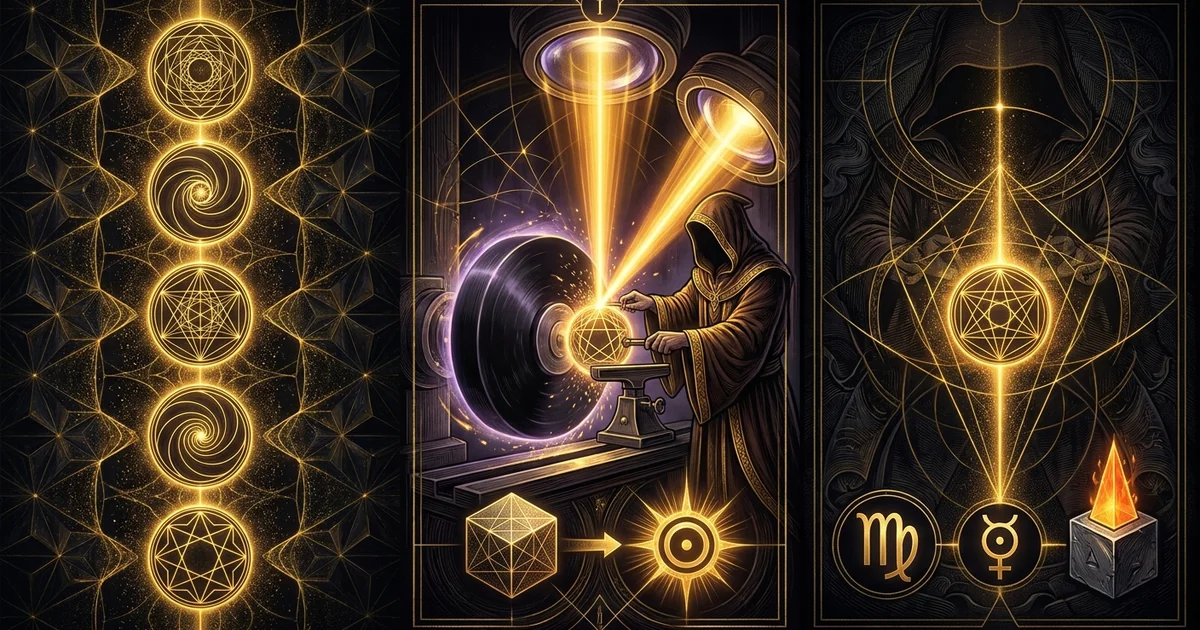
Eight of Pentacles: Dedicated Mastery and Deliberate Art
Archetypal Thesis & Systemic Paradigm: The Metaphysics of Deliberate Craft
Hod in Assiah: The Intellectual Vector of Materialization
The Eight of Pentacles occupies a precise, critical nexus within Hermetic Kabbalah: the operation of the eighth Sephira, Hod (Glory, Splendor, and Intellective Order), within the material realm of Assiah, the physical world of action and tangible manifestation. To comprehend the complete eight of pentacles tarot meaning, one must abandon the trivializing modern depiction of this arcanum as mere repetitive drudgery or mechanical toil. Within the architectural geometry of the Tree of Life, Hod represents the intellective, differentiating, and structuring capacity of consciousness. It is the realm of language, methodology, taxonomy, and technical protocol. When the volatile, communicative, and analytical forces of Hod descend into Assiah—the elemental domain of the earth element—the abstract nature of the mercurial mind undergoes a profound deceleration. Thought is forced to reckon with the unyielding resistance of physical matter.
In this Sephiric framework, the Eight of Pentacles demonstrates how pure intellect ceases to be a theoretical exercise and becomes an embodied praxis. It is the crystallization of intentionality through the hands, the chisel, and the eye. Where the higher mental sephiroth conceptualize abstract forms, Hod in Assiah translates these geometric blueprints into somatic coordinates. The mind does not float above the material plane in passive contemplation; rather, it embeds itself directly into the grain of wood, the temper of steel, or the molecular structure of the physical disc. The card thus portrays the absolute antithesis of chaotic, unchanneled inspiration. It rejects the romantic fallacy that creative mastery is an unearned gift from the supernal realms. Instead, it asserts that the true splendor of the divine mind is realized only when subjected to the exacting friction of tangible media, wherein every error is made instantly visible and must be methodically corrected through disciplined physical intervention.
The Eight of Pentacles synthesizes the informational vector of Hod with the tangible densities of Assiah under the astrological governance of the first decan of Virgo, which is ruled by the Sun. In this cosmological framework:
- Sephira: Hod (Splendor / Rational Formulation / Methodological Taxonomy)
- World: Assiah (The Material Plane of Action, Friction, and Manifest Form)
- Astrological Coordinates: Sol in Virgo (0°00’ to 9°59’ Virgo)
- Operational Mode: The descent of Solar conscious awareness into the granular micro-structures of Mutable Earth, facilitating the systemic perfection of the vessel through deliberate iteration.
The Temenos of the Workshop: Demarcating Sacred Space from Civic Noise
Crucial to the structural composition of the archetype is the radical spatial separation between the artisan and the surrounding socio-cultural matrix. In the classical iconographic formulation rendered by Pamela Colman Smith, the artisan is seated outside and away from the fortified city visible on the distant horizon. This architectural choice is not accidental; it delineates the construction of an operational temenos—a sacred, demarcated precinct insulated from the collective demands, political machinations, and economic hysteria of the civic sphere. The city represents the realm of social status, commercial exchange, and the chaotic noise of consensus reality. To execute the Great Work of self-refinement, the practitioner must intentionally sever themselves from this ambient interference, establishing a localized sanctuary where attention can be held in sustained, uninterrupted coherence.
The establishment of this temenos marks a profound psycho-spiritual milestone in the individuation process. Within the sanctuary of the workshop, the practitioner is shielded from the psychological inflation that so often accompanies public performance and social validation. The validation loop of the artisan is entirely self-contained, mediated solely through the objective feedback of the object under construction. The distant city wall represents the collective ego, whereas the bench upon which the artisan sits represents the stable bedrock of individual reality, carved out of conscious withdrawal. The mastery depicted in this card is therefore auto-didactic, solitary, and fundamentally monastic. It requires the voluntary renunciation of immediate civic accolades in exchange for the deep, slow-burning fire of developmental competence. By closing the door to the collective, the craftsman opens an interior conduit through which the higher faculties of consciousness can systematically discipline the somatic apparatus.
Classical Provenance & Textual Lineage: From ‘Lord of Prudence’ to the Modern Artisan
Golden Dawn Cryptography and the Book T Attribution of Prudence
In the esoteric hierarchy of the Hermetic Order of the Golden Dawn, as codified in MacGregor Mathers’ Book T, the Eight of Pentacles is designated with the formal title “The Lord of Prudence.” This archaic designation frequently puzzles contemporary practitioners who associate “prudence” with moralistic hesitation, financial frugality, or excessive caution. However, within the Golden Dawn’s syncretic synthesis of classical Latin philosophy and Kabbalistic theurgy, prudentia signifies foresight, practical wisdom, and the deliberate application of reasoned discernment to the management of material reality. It is the capacity to anticipate systemic consequences and to align one’s present, micro-level actions with overarching, macrocosmic laws.
The Golden Dawn’s visual schema for the Small Cards deliberately avoided human drama, favoring instead pure, talismanic configurations of geometric force. In the early manuscripts, the eight pentacles were arranged as two vertical columns of four, balanced symmetrically and interlaced with the vegetative motifs of elemental Earth. This geometric austerity was designed to evoke the impersonal, objective mechanisms of the cosmos: the card did not depict a craftsman working at a bench, but rather the structural equilibrium of material resources gathered, conserved, and directed by a precise, calculating will. The “Lord of Prudence” represented the antithesis of speculative gamble, economic dissipation, or reckless expansion. It codified the absolute necessity of laying an impenetrable foundation through systematic planning, establishing the exact material prerequisites required for sustained magical and spiritual development.
S. L. MacGregor Mathers, The Golden Dawn (Book T) (1888):
“The 8 of Pentacles: The Lord of Prudence. Sol in Virgo. Over-carefulness in small things at the expense of the great: ‘Penny wise and pound foolish.’ Yet also skill in small matters, and industry; also avarice and lack of enterprise. Everything depends upon whether the card is well or ill dignified.”
Arthur Edward Waite, The Pictorial Key to the Tarot (1910):
“An artist in stone at his work, which he exhibits in the form of trophies. It signifies work, employment, commission, craftsmanship, skill in craft and business, perhaps in the preparatory stage. Divinatory Meanings: Work, employment, commission, craftsmanship, skill in an artisan or in any profession or business, often in its initial stages. Reversed: Voided ambition, vanity, cupidity, exaction, usury. It may also signify the possession of skill, in the sense of the ingenious mind turned to cunning and sharp practice.”
The Waite-Smith Iconographic Revolution: Transmuting Geometric Emblems into Human Praxis
The publication of the Rider-Waite-Smith deck in 1909 marked a revolutionary departure from the non-scenicked pips of the Tarot de Marseille and the abstract, talismanic diagrams of the Golden Dawn. Arthur Edward Waite, working in close artistic collaboration with the visionary artist Pamela Colman Smith, systematically transformed the sterile geometric emblems of the minor arcana into vivid theatrical stages populated by human archetypes engaged in profound psychomotor activities. In the Eight of Pentacles, this iconographic shift was radical. Smith swept away the rigid, symmetrical array of unworked coins, replacing them with a living human operator: a determined young artisan dressed in the modest, functional tunic of a medieval stonemason or engraver, hunched over his bench with hammer and chisel in hand.
This transformation fundamentally altered the card’s epistemology. By incarnating the abstract Hermetic concept of “Prudence” into the concrete praxis of an artisan, Smith and Waite situated mastery within the biological reality of the human nervous system. The unmanifest potential of the Marseille pattern—where the coins sat as static representations of systemic balance—was suddenly activated. The pentacles were no longer mere tokens of wealth or astrological coordinates; they became both the raw material and the finished trophies of deliberate, repetitive labor. In Smith’s rendering, we observe the card as an operational epistemology: knowledge is not simply possessed as theoretical dogma; it is forged, measured, and verified through the direct kinetic confrontation between muscle, tool, and unyielding substance.
Structural Mechanics & Symbolic Geometry: Astrological Decanates and Qabalistic Architecture
Sol in Virgo: Illuminating the Sub-Atomic Nuances of Form
The precise astronomical and astrological assignment for the Eight of Pentacles is the first decan of the zodiacal sign Virgo (0° to 10° Virgo), an ingress under the planetary rulership of the Sun. This specific celestial configuration produces a profound energetic synthesis. Virgo, a mutable earth sign traditionally ruled by Mercury, possesses an innate affinity for taxonomy, critical analysis, diagnostic deconstruction, and the relentless pursuit of functional purity. It is the sign of the grain harvest, demanding the rigorous separation of the wheat from the chaff through methodical labor. When the supreme, life-giving, and self-conscious energy of Sol penetrates this analytical terrestrial domain, an extraordinary psychological focus is born.
The Sun represents the radiant core of the conscious ego, the seat of dynamic will, creative vitality, and clear, uninterrupted illumination. Transposed into the humble, detail-oriented architecture of Sun in Virgo Decan 1, this solar brilliance does not express itself through majestic, theatrical displays of autocratic power (as seen in Leo). Instead, the solar consciousness condenses its beam, functioning like a high-powered microscope. Sol illuminates the sub-atomic nuances of material form. Under this influence, the practitioner becomes acutely aware of the microscopic tolerances of their work: the micro-fractures in the stone, the imperceptible deviation of the engraver’s line, the fractional variations in pressure applied by the somatic musculature. The Sun in the first decan of Virgo demands nothing less than absolute perfection through the conscious sanctification of the mundane, ensuring that every minute detail of the material vessel is purified until it can fully transmit the supernal light.
The Geometry of Repetition: The Linear Column versus the Dynamic Working Plate
The visual composition of the Smith-Waite rendering contains an explicit Hermetic geometry that encodes the temporal mechanics of skill acquisition. The eight pentacles are divided into three distinct operational states:
-
The Vertical Column (The Archive of Stored Capital): Six pentacles are mounted in a rigid, vertical axis along a wooden post or pillar at the left side of the frame. This column represents completed labor—psychological capital that has been permanently crystallized into somatic memory and objective achievement. It serves as an architectural record of the artisan’s developmental trajectory. Each completed disk embodies a previous phase of error, calibration, and final mastery. The verticality of the post echoes the Middle Pillar of the Tree of Life, signifying that through disciplined repetition, the practitioner is erecting a stable axis of structural competence within their reality.
-
The Dynamic Plate (The Present Locus of Consciousness): The seventh pentacle rests directly between the craftsman’s hands, braced upon the wooden bench and currently receiving the kinetic impact of the hammer and chisel. This coin represents the absolute present moment (kairos). All the experience encoded in the previous six disks is focused down to a singular, razor-sharp point of contact between tool and material. Consciousness is neither trapped in nostalgic contemplation of the finished trophies nor dissociated into future fantasies of completion; it is entirely subsumed within the immediate, tactile demands of the current stroke.
-
The Unfinished Ground (The Unmanifest Potential): The eighth pentacle rests on the ground at the artisan’s feet, unworked, waiting its turn. It serves as an enduring reminder of humility and ongoing developmental necessity. It indicates that the Opus is incomplete; that mastery is not a static endpoint where one rests upon one’s laurels, but a continuous, unending process of refinement that extends into future time.
This triadic arrangement explicitly embodies the ancient alchemical operational axiom of Solve et Coagula (Dissolve and Coagulate). Each strike of the artisan’s tool performs a dual function: it dissolves the gross, irregular, and unworked contours of the raw material (solve), while simultaneously coagulating the pure, geometric archetype of the five-pointed star into the dense matrix of physical matter (coagula). The repeating pattern of the pentagram itself—the five-pointed symbol of the quintessence dominating and balancing the four base elements of fire, water, air, and earth—demonstrates that deliberate practice is the precise technology through which spirit asserts functional dominion over chaotic physical substance.
Psychological Dynamics & Operational Praxis: The Neuro-Archetypal Engine of Mastery
Deliberate Practice and Cognitive Flow: The Convergence of Depth Psychology and Neuroscience
When translated into contemporary cognitive psychology and neurobiology, the Eight of Pentacles serves as an astonishingly accurate visual model of what cognitive psychologist K. Anders Ericsson termed “deliberate practice.” In his seminal 1993 research, Ericsson established that expert performance is not the byproduct of innate, immutable genius or mindless, passive repetition. Rather, it is the direct consequence of sustained, highly demanding engagement with activities specifically designed to optimize performance through immediate, granular error-correction. Ordinary mechanical repetition frequently solidifies mediocrity; deliberate practice, by contrast, requires intense, uninterrupted cognitive focus, the continuous evaluation of structural flaws, and the immediate somatic calibration required to eliminate them.
       [ Routine Repetition ]                   [ Deliberate Practice ]
(Passive habituation, cognitive ease,       (Continuous friction, error-detection,
  autopilot, stagnation of ability)           somatic recalibration, true mastery)
This psychological posture directly mirrors the flow state identified by Mihaly Csíkszentmihályi, yet it purges the concept of its modern, passive connotations of effortless ease. The flow of the Eight of Pentacles is a state of active, demanding friction. Within this cognitive space, the self-referential executive networks of the brain—specifically the Default Mode Network (DMN), which is responsible for neurotic rumination, status anxiety, and existential dread—undergo profound downregulation. The artisan’s personal ego-complex collapses into the objective demands of the external task. The craftsman does not experience self-consciousness; they experience only the resonance of the hammer, the trajectory of the chisel, and the unfolding symmetry of the metal. Through this complete somatic engagement, the Eight of Pentacles acts as an operational defense against psychological fragmentation, offering an empirical, grounded path to internal mental equilibrium.
K. Anders Ericsson et al., The Role of Deliberate Practice in the Acquisition of Expert Performance (1993):
“The acquisition of expert performance requires individuals to engage in deliberate practice, which entails focused efforts to improve specific aspects of performance through tasks designed with clear objectives, direct feedback, and opportunities for repetition and correction of errors. Unlike play or mere work, deliberate practice demands high levels of mental effort and sustained concentration, often lacking immediate inherent enjoyment, yet serving as the primary determinant of long-term competence.”
Carl Gustav Jung, Psychology and Alchemy, CW 12 (1953):
“The opus will not take place without the persistent engagement of the whole human being. The alchemist must endure the physical, unyielding nature of the materia prima, for it is precisely this resistance of the material world that prevents the mind from losing itself in mere inflation and subjective fantasy. The craft forces the psychic energy down into the earth, where alone the true stone can be born.”
The Shadow of the Workbench: Perfectionist Paralysis, Obsessive Compulsion, and Creative Isolation
Every archetypal territory contains its corresponding psycho-pathological shadow. For the Eight of Pentacles, this dark night of the soul emerges from the pathological distortion of Virgonian precision and Hod’s analytical compartmentalization. When the archetype is corrupted or over-dignified, it manifests as clinical anankastic perfectionism: an obsessive-compulsive dread of failure that utterly paralyzes productive output. In this state, the artisan becomes incapable of ever declaring a piece of work complete. The microscope of the Sun in Virgo is turned inward with savage, punitive scrutiny, dissecting every minute flaw in the self and the work until spontaneous creative expression is choked out entirely.
Furthermore, this shadow manifests as the tragic loss of the macrocosm within the microcosm—the proverbial inability to see the forest for the trees. The practitioner becomes so fanatically obsessed with the technical tolerances of a single engraved line that they completely lose sight of the card’s ultimate purpose or the greater holistic architecture to which it belongs. Craft degenerates into sterile, pedantic technique; the living soul of the work evaporates, leaving behind only the cold, dead shell of flawless mechanics. Finally, the protective temenos of the workshop can easily transform into a voluntary prison of profound psychological alienation. By severing all links with the civic community and the relational warmth of the human collective, the isolated artisan risks succumbing to profound schizoid detachment, emotional atrophy, and a cynical disdain for the imperfect, messy realities of human life beyond the immaculate perimeter of the workbench.
Philosophical Synthesis & Macrocosmic Correspondence: Coagulatio and the Alchemical Opus
Coagulatio: Grounding the Volatile Spirit in Fixed Matter
Within the rigorous symbolic methodology of Western Hermetic alchemy, the Eight of Pentacles corresponds directly to the crucial operation of coagulatio. In the alchemical sequence, the work begins with materials that are coarse, toxic, and dispersed; it proceeds through stages of dissolution, calcination, and sublimative evaporation, wherein the fixed becomes volatile. However, an opus that terminates in mere sublimation remains an ephemeral, disembodied failure. The volatile, heavenly spirit must be captured, disciplined, and permanently anchored into a stable, physical matrix. It must be coagulated. As the Tabula Smaragdina (The Emerald Tablet) famously proclaims: “Its power is integrating, if it be turned into earth.”
   [ Volatile Spirit / Sublimation ]  --->  Unanchored Intellect & Inflation
                    |
                    v  (The Eight of Pentacles / Coagulatio)
   [ Fixed Matrix / Manifest Stone ]  --->  Embodied Competence & Grounded Mastery
Coagulatio is fundamentally the operation of the Earth element. It is the coagulating of the wandering, mercurial mind into the permanent, immutable vessel of the physical form. Psychologically, coagulatio represents the sobering confrontation with the reality principle. It is the ultimate therapeutic cure for spiritual inflation, the manic flight into intellectual abstraction, and the delusion of unearned spiritual attainment. The Eight of Pentacles demonstrates that true spiritual initiation is not accomplished by escaping the dense boundaries of physical reality, but rather by driving the supernal consciousness down through the nervous system, down through the somatic muscular fibers, until the divine will is etched irreversibly into the dense fabric of Assiah. The body of the craftsman, the bench, the steel of the chisel, and the cold metal of the coin together form the true crucible in which the Lapis Philosophorum—the Philosopher’s Stone—is steadily brought into objective existence.
Three of Pentacles: Socialized Apprenticeship
- Kabbalistic Attribution: Binah in Assiah (Formative structure within matter).
- Sociological Matrix: Collaborative, institutional, and hierarchical. Involves the triad of the Guild Master, the Mason, and the Ecclesiastical Patron.
- Source of Authority: External validation; certified through institutional consensus, socio-religious sanction, and civic architectural commissions.
- Locus of Consciousness: Collective integration; constructing the communal cathedral within the public boundaries of the city.
- Evolutionary Phase: Initial developmental recognition; transition from raw initiate to socially recognized apprentice.
Eight of Pentacles: Autonomous Mastery
- Kabbalistic Attribution: Hod in Assiah (Intellective refinement within matter).
- Sociological Matrix: Solitary, self-directed, and monastic. The practitioner operates in deliberate isolation outside the civic boundaries.
- Source of Authority: Internal calibration; verified purely through the immediate physical friction between tool, hand, and medium.
- Locus of Consciousness: Intrinsic hyper-focus; producing individual trophies of competence via self-directed deliberate practice.
- Evolutionary Phase: Advanced technical autonomy; the craftsman functions simultaneously as architect, operative, and supreme critical judge.
Comparative Archetypal Mechanics: The Three versus the Eight of Pentacles
To rigorously map the Suit of Pentacles, one must systematically contrast the Eight of Pentacles with its developmental predecessor, the Three of Pentacles. While both cards explicitly portray the theme of human labor and material construction, their structural and psychological mechanics operate on radically different planes of the Tree of Life. The Three of Pentacles embodies the Sephira Binah (Understanding/Form) operating within Assiah. It delineates the socialized, collective, and institutional architecture of labor. In the Three, the mason stands inside the cathedral, actively consulting with an architect and a monastic patron. Here, competence is mediated, defined, and validated through social hierarchy, institutional credentials, and collaborative communion. The work is public, collective, and structurally dependent upon consensus reality.
The Eight of Pentacles, by profound contrast, dismantles this collective apparatus. By transitioning from the Triad of Binah to the individual intellectual agency of Hod, the craftsman steps entirely outside the institutional cathedral. There is no supervising master, no consulting architect, and no paying patron present to monitor or validate the work. The artisan of the Eight has internalized the master, the architect, and the critic within his own cognitive architecture. He has achieved self-directed, auto-didactic autonomy. Where the Three of Pentacles is an archetype of socialized apprenticeship and civic belonging, the Eight is an archetype of profound, monastic individuation through technical mastery. The Eight proves that genuine transcendent expertise can never be granted by institutional degree or social acclaim; it can only be extracted from the solitary, silent forge of the workshop, where the individual consciousness contends directly and honestly with the unrelenting truth of raw material.
Frequently Asked Questions: Navigating the Nuances of the Eight of Pentacles
Decoupling the Archetype from Exploitative Labor
In contemporary professional consultations, the Eight of Pentacles is frequently misinterpreted as an encouragement to accept routine, alienated wage labor within oppressive capitalist systems. This reading represents an egregious failure to grasp the esoteric mechanics of the archetype. The core prerequisite of the Eight of Pentacles is intrinsic agency and sovereign control over the means of developmental iteration. In classic Marxist terms, the tragedy of the alienated proletariat is that they are severed from both their tools and the ultimate product of their labor; their kinetic energy is extracted to serve a mechanical system over which they hold no cognitive or creative sovereignty.
The artisan in the Eight of Pentacles, conversely, demonstrates complete, undivided ownership of his praxis. He sits in his own demarcated sanctuary (temenos), utilizes his own tools, directly controls the speed and intensity of his strikes, and retains possession of the finished products, which he proudly mounts upon his own pillar as developmental trophies. Therefore, when this card appears regarding modern professional dynamics, it does not advise the querent to passively endure soul-crushing corporate exploitation. Rather, it demands that the individual cultivate an autonomous technical mastery, a sovereign expertise, or a creative discipline that belongs entirely to them—a craft that can never be commodified, outsourced, or expropriated by external institutions because it has become an indivisible part of their somatic and cognitive identity.
Navigating Reversals: Burnout versus Misdirected Effort
When the Eight of Pentacles appears reversed in a structural spread, it signals a severe disruption in the cybernetic feedback loop between Hod’s intentionality and Assiah’s physical execution. The diagnostic analysis of this reversal branches into two distinct operational extremes, both of which require precise therapeutic intervention:
-
The Paralysis of Perfectionist Neurosis: In this manifestation, the analytical, self-critical blade of the Sun in Virgo has cut too deeply. The individual is trapped in hyper-analytical paralysis, obsessing over minor, insignificant flaws and refusing to release their work into the world out of an unacknowledged terror of external judgment. The loop of error-correction has become pathological, devouring the will to manifest.
-
The Degeneration into Mindless Routine: Conversely, the reversal can signify the complete absence of deliberate practice. The individual has succumbed to passive, rote habituation—striking the chisel without presence, without cognitive focus, and without active error-detection. This is labor reduced to deadening, mechanical drudgery that yields no developmental expansion. It is the tragedy of ten years of mere attendance masquerading as ten years of evolutionary experience.
-
Technical Deception and Sharp Practice: Following Waite’s classical notation in The Pictorial Key, the reversal can also reveal the perversion of the intellectual craftsman: the brilliant, agile mind of Hod unmoored from the structural integrity of earth, manifesting as counterfeiting, industrial fraud, technical charlatanism, and the cynical exploitation of specialized knowledge to deceive the unwary.
Resolving the Planetary Dissonance of Sol in Virgo
The allocation of the Sun—the supreme cosmic monarch, the radiant sovereign of the macrocosm—to the humble, quiet, and service-oriented sign of Virgo initially appears to be an astrological paradox. Why should the majestic solar light be forced to compress its vast, expansive radiance into the narrow, painstaking micro-mechanics of an artisanal workbench?
The esoteric resolution to this problem lies at the very heart of the Western Mystery tradition. True Solar sovereignty is not proven through empty, theatrical pomp, or ungrounded, manic displays of power; it is proven through the deliberate, humble descent of consciousness into the physical depths of the creation, and its subsequent labor to elevate and sanctify that material matrix. By willingly submitting its infinite light to the precise boundaries, limitations, and discipline of Virgo, the Sun demonstrates its supreme dignity. It proves that the supernal light is not afraid of the dust; rather, it loves the dust so profoundly that it is willing to enter into it, pick up the hammer and the chisel, and labor with quiet, unyielding patience until the lowest substance of Assiah shines with the pristine, radiant brilliance of the absolute.