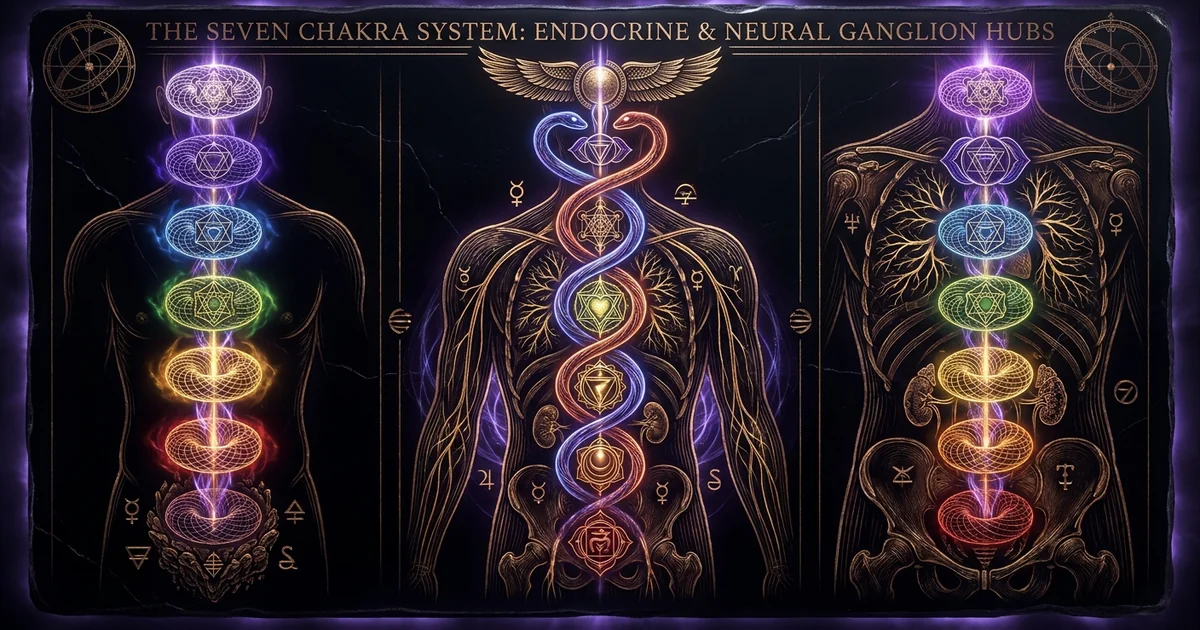
The Seven Chakra System: Endocrine & Neural Ganglion Hubs
Metaphysical Thesis & Epistemological Opening: The Transduction of Subtle Anatomy into Somatic Flesh
The Transductive Interface: Sūkṣma Śarīra and Gross Biological Substrates
The classical Tantric septenary system constitutes a rigorous, pre-modern phenomenology of bio-energetic transduction. It articulates the precise interface where trans-dimensional subtle vitality (prāṇa-vayu) precipitates across dimensional thresholds into gross somatic physiology (sthūla śarīra). Far from operating as arbitrary metaphors, poetic abstractions, or anatomically naive fantasies, the seven energy centers function as phase-transition thresholds. In this zone, higher-order metaphysical geometries condense into electrochemical, cellular, and hormonal phenomena.
Within the non-dual ontological architecture of Kashmir Shaivism, physical flesh is not an ontological antithesis to spirit. It is the crystallization (saṅkoca) of supreme consciousness (cit) into mass through intermediary gradations of density. The sūkṣma śarīra (subtle body) operates as a dynamic field of informational vectors (nāḍīs) coalescing into dense vortices termed cakras. These wheels of concentrated vitality mediate between the unmanifest ground of being—analogous to the Gnostic pleroma—and the biological vessel.
Trans-Dimensional Ground (Pleroma / Śiva-Tattva)
                     │
                     ▼
          Sūkṣma Śarīra (Subtle Body)
                     │
         [Prāṇic Conduit / Nāḍī System]
                     │
                     ▼
        Transductive Vortex / Cakra
                     │
   ┌─────────────────┴─────────────────┐
   ▼                                   ▼
Autonomic Neural Ganglia       Endocrine Glandular Hub
 (Action Potentials)             (Hormonal Cascades)
   └─────────────────┬─────────────────┘
                     ▼
       Dense Flesh (Sthūla Śarīra)
Through this framework, the seven chakra system endocrine glands neural plexus subtle anatomy demonstrates a coherent biofield topology. It maps precisely where non-local informational fluxes are brought into local physiological governance.
The structural integrity of Tantric somatic science relies upon three ontological designations fundamentally distinct from post-Theosophical adaptations:
- Sūkṣma Śarīra (Subtle Body): The non-atomic, psychoperceptual vehicle comprising the eighteen-fold aggregate of subtle elements (tanmātras), internal mental organs (antaḥkaraṇa), and sensory-motor capacities (indriyas). It serves as the morphological template of physical manifestation.
- Nāḍī (Transductive Conduit): Not material nerve fibers, but non-physical hydro-energetic channels through which distinct vectors of prāṇa-vayu (vital wind) circulate. They form a complex matrix traditionally numbering 72,000 pathways that intersect at major ganglionic crossroads.
- Bindu (Concentrated Informational Nucleus): A non-dimensional point of maximal energetic tension and creative potential. It acts as both the focal origin of a given vortex and the metaphysical zero-point where trans-dimensional intent translates into biological form.
Modern somatic investigations into /consciousness/subtle-anatomy-biophotonics confirm that the human organism is fundamentally liquid-crystalline and bio-electromagnetic. Consequently, dismissing the ancient operational maps of the sūkṣma śarīra strips medical science of an integrated explanatory model for psycho-visceral coherence.
The chakras represent non-material nodes of coherence that coordinate biological self-organization. By maintaining a constant bidirectional dialogue between subtle informational templates and neurovisceral feedback loops, these structures transduce subtle vital currents into biological reality. The subtle body precedes and outlasts the somatic casing, yet while enfleshed, it orchestrates physical form with mathematical precision.
Refuting Cartesian Dualism and Biological Reductionism in Esoteric Somatics
The academic and clinical discourse surrounding the subtle body has long suffered under an epistemic double-bind. It is routinely trapped between Cartesian dualism and modern mechanistic materialism.
Cartesianism severs the res cogitans (thinking substance) from the res extensa (extended substance). This framework reduces the physical body to an insentient hydraulic apparatus, completely untethered from subtle energetic fields.
Conversely, crude biological reductionism seeks to flatten the chakras entirely into the physical tissues of the peripheral nervous system. It insists that a chakra is “nothing more than” the celiac plexus or the thyroid gland. This perspective commits a fundamental category error.
          [ Epistemic Fallacy 1: Cartesian Dualism ]
     Res Cogitans (Spirit) ───[SEVERED]─── Res Extensa (Body)
                               │
               (Subtle anatomy dismissed as ungrounded fantasy)

          [ Epistemic Fallacy 2: Physical Reductionism ]
  Trans-Dimensional Vortex ───[COLLAPSED]─── Anatomical Ganglion
                               │
             (Metaphysical field reduced to mechanical matter)

                               ▲
                               │
          [ The Non-Dual Tantric Synthetic Correction ]
  Prāṇic Biofield ───[PHASE TRANSDUCTION]─── Somatoganglion-Endocrine Complex
Both paradigms fail to comprehend the mechanics of esoteric somatics. The seven chakra system endocrine glands neural plexus subtle anatomy is neither a purely subjective psychological projection nor an aggregate of static post-mortem tissues. A cakra cannot be physically excised during an autopsy, not because it is imaginary, but because it is an active state of organizational hydrodynamics. It is a dissipative informational structure that collapses once the animating subtle vitality departs the physical vessel.
Confining chakras to symbolic fantasy ignores clinically demonstrable sympathetic-parasympathetic entrainment, cutaneous bio-impedance variances at classical acupuncture and marman loci, and the neurovisceral architecture documented in /spirituality/tantric-emanational-systems. These vortices anchor consciousness into matter. They do not merely mirror anatomical structures; they project them.
The Semiotics of the Vortex: Prāṇic Hydrodynamics and Spatialized Consciousness
The Sanskrit word cakra designates an axis of circular rotation, a wheel, or a dynamic vortex. This term captures the hydrodynamics of subtle energy as it navigates structural constraints within the physical body.
A wheel of energy vortices does not function as a closed mechanical gear. Rather, it operates as an open thermodynamic system that draws upon trans-dimensional potential to organize somatic matter.
According to Tantric cosmology, these centers govern two simultaneous energetic vectors:
              Descending Cascade: PRAVṚTTI
   [Cosmological Potency] ──► Condensation into Mass
                                 │
                            CENTRAL AXIS
                            (Suṣumṇā Nāḍī)
                                 │
     Ascending Vector: NIVṚTTI ◄── [Dissolution into Void]
- Pravṛtti (The Descending Emanative Cascade): Unconditioned conscious potency (śakti) condenses into form, step-down transforming through subtler psychic spaces into hormonal, muscular, and dense cellular architecture.
- Nivṛtti (The Ascending Evolutionary Return): Somatic vitality is transmuted, purified, and uncoiled from the pelvic floor back toward the unitive field above the crown of the head.
These vectors flow along the central axis of the spine through the suṣumṇā nāḍī, which functions as the primary informational conduit of the human organism. Each cakra along this spinal axis serves as a step-down transformer for specific frequencies of prāṇa.
By regulating the localized velocity, spin, and geometric coherence of these currents, the vortices coordinate localized cellular processes with expansive states of awareness. Spatialized consciousness is thus distributed throughout the entire somatosensory landscape.
The human body emerges not as a static shell, but as a living instrument of theurgy. It transduces celestial and trans-dimensional archetypes directly into the physical matrix of the nervous system.
Primary Codices & Historical Transmission: Textual Genealogy of the Seven-Hub System
The Kaula and Nath Lineages: Textual Exegesis of the Ṣaṭ-Cakra-Nirūpaṇa
The codification of the internal energy centers into a standardized septenary schema is largely the product of the late medieval Kaula and N膩th lineages, culminating in foundational works such as the sixteenth-century Ṣaṭ-Cakra-Nirūpaṇa (Investigation into the Six Bodily Centers) composed by Pūrṇānanda Yati in 1577 CE.
Textual analysis reveals that earlier Tantric treatises did not enforce a rigid, universal seven-center model. In texts such as the Kubjikāmatatantra, the Mālinīvijayottaratantra, and Abhinavagupta’s encyclopedic Tantrāloka, one encounters dynamic, context-dependent internal maps detailing five, six, nine, or even twelve energetic stations:
[Earlier Tantric Corpora] ──► Variable schemas (5, 6, 9, 12, or 16 loci)
 (Kubjikāmata, Tantrāloka)    Tailored for specific meditational theurgy

[Pūrṇānanda Yati (1577)]   ──► Codification of the Ṣaṭ-Cakra System
 (Ṣaṭ-Cakra-Nirūpaṇa)          Standardized six spinal hubs + crown terminal

[Arthur Avalon (1919)]     ──► Western Bridge to Bio-Mechanistic Integration
 (The Serpent Power)           Chakras mapped directly to plexuses and glands
These early textual systems were meditative maps designed for distinct theurgic contemplations (bhāvanā) and ritual installations (nyāsa). The practitioner internalizes specific phonemes of the Sanskrit syllabary (mātṛkā), presiding deities, and elemental tattvas into different bodily zones.
Pūrṇānanda’s synthesis established an enduring paradigm. It detailed six primary spinal centers along the central column (suṣumṇā), with the thousand-petaled Sahasrāra above the crown serving as the transcendent, unitive terminus.
This model caught on because it systematically united the internal micro-cosmology with the physical spine, providing a somatic ladder for internal energetic ascension.
Verse 4 (On the Mūlādhāra):
“The Mūlādhāra-Cakra is attached to the mouth of the Suṣumṇā, and stands below the genitals and above the anus. It has four petals of red color, on which are the four letters from Va to Sa, with the Bindu upon them. Here shines the triangle (Traipura) which is the beloved resting-place of the fiery energy; within it dwells the dynamic Svayambhu-Liṅga… inside it reigns the Supreme Sovereign Kuṇḍalinī, sleeping in three and a half coils, brilliant as lightning.”
Verse 41 (On the Sahasrāra):
“The Sahasrāra Padma—the thousand-petaled lotus—is bright and whiter than the full Moon. It has its head turned downwards, and its clusters of filaments are tinged with the color of the young Sun. Within it is the full Moon, devoid of the mark of the hare, which diffuses its rays profusely… Here constantly falls that supreme Nectar which flows in an unbroken stream from the eternal union of Śiva and Śakti.”
The Western Esoteric Synthesis: Leadbeater, Woodroffe, and the Theosophical Transmutation
The transmission of this system to the West occurred through a complex, cross-cultural synthesis that heavily altered its interpretive frame. A pivotal moment was the 1919 publication of The Serpent Power by Sir John Woodroffe (writing under the pseudonym Arthur Avalon).
Woodroffe provided an annotated translation of Pūrṇānanda’s Ṣaṭ-Cakra-Nirūpaṇa and the Pādukā-Pañcaka. His translation bridged traditional Kaula-Śākta metaphysics with Western empirical and esoteric models.
Simultaneously, Theosophical figures—most notably C.W. Leadbeater in his 1927 tract The Chakras—assimilated these translations into a modern occult worldview:
Tantric Sanskrit Text (Ṣaṭ-Cakra-Nirūpaṇa)
            │
            ▼
Avalon / Woodroffe Translation (1919)
 (Cross-cultural linguistic synthesis)
            │
            ├────────────────────────────────────────┐
            ▼                                        ▼
   Leadbeater & Theosophy                 Western Biological Sciences
(Rainbow spectrum, occult aura)        (Autonomic nervous plexuses, glands)
            │                                        │
            └───────────────────┬────────────────────┘
                                ▼
         Contemporary Unified Somatic-Esoteric Paradigm
Leadbeater introduced alterations that lacked classical Tantric precedent, such as imposing the optical rainbow color spectrum (red to violet) onto the centers and viewing the chakras as external sensory organs belonging to the clairvoyant etheric vehicle.
Yet, as religious historian Wouter J. Hanegraaff points out in New Age Religion and Western Culture (1996), this Western esoteric adaptation reflected a deep intellectual drive to reconcile sacred, traditional cosmologies with the emerging biological sciences.
Rather than viewing Avalon’s alignment of chakras with autonomic nervous plexuses as mere corruptive syncretism, we can understand it as an early attempt to decipher an authentic bio-energetic reality. These thinkers used the primary anatomical frameworks available to the late-modern intellect to ground classical traditions.
Historical Filtering: Stripping and Re-Imposing the Endocrine-Ganglion Model
As the chakra model permeated twentieth-century medical and esoteric counter-cultures, it underwent a systematic conceptual stripping. Traditional mantras, protective divinities, and subtle geometry (yantra) were removed. In their place emerged a simplified physiological schema:
[ Traditional Tantric Vortex ] ──(Reduction)──► [ Pure Glandular/Neural Organ ]
               ▲                                                │
               │                                                │
               └──────────(Modern Re-Integration)───────────────┘
                     Coherent Psycho-Physical Interface
Western commentators began defining the centers almost exclusively by their proximity to prevertebral neural ganglia and endocrine glands.
This conceptual drift posed serious intellectual risks. It frequently collapsed rich non-dual phenomenology into an anachronistic medical reductionism.
Yet, this cross-disciplinary mapping revealed an undeniable underlying structural correspondence. The physical placement of the major autonomic nervous plexuses and the primary ductless endocrine glands matches the traditional Tantric mappings of the spinal nodes with remarkable accuracy.
The ancient yogins mapped subjective perceptual geography onto the body through rigorous introspective phenomenological practice. Through this deep meditative self-observation, they directly felt the major neuro-endocrine nodes without requiring surgical dissection.
Consequently, modern attempts to align subtle anatomy with neurobiology do not corrupt ancient wisdom. Rather, they recover an authentic bodily interface that the ancients intuited through deep internal practice, and which contemporary clinical sciences can now measure at the biological level.
Ontological Architecture & Cosmological Models: The Septenary Plexus-Gland Matrix
Neuro-Anatomical Mapping: Prevertebral Ganglia and Cranial Nervous Complexes
The human nervous system is stratified into central, peripheral, and autonomic architectures. The autonomic nervous system—subdivided into the sympathetic thoracolumbar trunk and the parasympathetic craniosacral axis—serves as the primary physical bridge for the seven chakra system endocrine glands neural plexus subtle anatomy.
At each structural level of the spinal axis, localized aggregations of unmyelinated postganglionic neural cell bodies, known as prevertebral and paravertebral plexuses, govern somatic visceral activity:
[ Sahasrāra ]  ◄──► Cerebral Cortex / Neocortical Matrix
[ Ājñā ]       ◄──► Cavernous Plexus & Optic Chiasm
[ Viśuddha ]   ◄──► Pharyngeal, Laryngeal & Cervical Plexuses
[ Anāhata ]    ◄──► Cardiac & Pulmonary Plexuses
[ Manipūra ]   ◄──► Celiac (Solar) & Superior Mesenteric Plexuses
[ Svadhiṣṭhāna]◄──► Inferior Mesenteric & Pelvic Plexuses
[ Mūlādhāra ]  ◄──► Coccygeal Plexus & Sacral Ganglia
At the base of the spine, the Mūlādhāra chakra corresponds to the coccygeal plexus, the sacral nervous complex, and the pudendal nerve pathways that control the pelvic floor and ano-rectal sphincter tone.
Ascending toward the sacrum, the Svadhiṣṭhāna corresponds directly with the pelvic and inferior hypogastric plexuses. These pathways control the reproductive organs, the urinary bladder, and urogenital autonomic functions.
The Manipūra, situated at the epigastrium, aligns with the celiac (solar) plexus. This massive neurovascular network—often termed the “abdominal brain”—radiates from the level of the first lumbar vertebra to control gastric motility, hepatic metabolization, and enteric nervous system coordination.
The Anāhata correlates with the cardiac and pulmonary plexuses. It orchestrates intrinsic cardiac rhythmicity, cardiopulmonary synchronization, and vagal brake regulation.
The Viśuddha is positioned at the pharyngeal and laryngeal plexuses, which stem from the cervical sympathetic chain and the lower cranial nerves (specifically the glossopharyngeal, vagus, and accessory nerves). This node governs vocalization, swallow reflexes, and bronchial patency.
The Ājñā chakra corresponds anatomically to the cavernous plexus, the optic chiasm, the superior cervical ganglion, and the regulatory nuclei of the brainstem and diencephalon.
Finally, the Sahasrāra spans beyond localized peripheral ganglia. It corresponds to the cerebral cortex itself, specifically the unitive neocortical networks that integrate whole-brain activity.
Endocrine Hierarchies: The Hypothalamic-Pituitary-End-Organ Feedback Loop
While the nervous system communicates across physical synapses via millisecond electrical impulses, the endocrine system coordinates systemic physiological changes via biochemical messengers released directly into the bloodstream.
The autonomic neural ganglia work in tandem with the human endocrine hierarchy. This gland system acts as a dense physical transducer for subtle prāṇic currents:
                       Trans-Dimensional Bindu
                                  │
                                  ▼
               Hypothalamus (Central Biofield Interface)
                                  │
                  (Releasing/Inhibiting Factors)
                                  │
                                  ▼
                   Pituitary Gland (Master Conductor)
                                  │
      ┌──────────────┬────────────┴────────────┬──────────────┐
      ▼              ▼                         ▼              ▼
Thyroid/Para.     Adrenals                  Gonads       Cellular Tissues
(Metabolism)   (Stress/Survival)      (Creation/Vitality)   (Growth)
At the apex of this somatic hierarchy sits the hypothalamic-pituitary-adrenal/gonadal axis (HPA/HPG).
The hypothalamus reads input from the autonomic nervous system and converts it into neurohormonal releasing factors. These signals direct the anterior and posterior lobes of the pituitary gland (Ājñā).
The pituitary gland functions as a physiological command center. It releases tropic hormones that systematically regulate the lower endocrine glands:
- The thyroid and parathyroids (Viśuddha), which govern metabolic rate, heat production, and systemic calcium homeostasis;
- The thymus gland (Anāhata), which directs T-cell maturation and immune defense;
- The endocrine islets of Langerhans within the pancreas (Manipūra), which regulate glucose dynamics via insulin and glucagon;
- The gonads—ovaries and testes (Svadhiṣṭhāna)—which secrete steroid hormones that direct biological reproduction, sexual differentiation, and basic cellular drive;
- The adrenal medulla and cortex (Mūlādhāra), which generate adrenaline, noradrenaline, aldosterone, and cortisol, regulating acute survival responses, electrolyte balance, and basic life-support reflexes.
This endocrine hierarchy mirrors the esoteric doctrine of emanations. Higher regulatory commands descend sequentially down the spinal axis to sustain homeostatic order throughout the physical body.
Psychological Development Stages Mapped Across the Somatosensory Axis
The alignment of the seven chakras with physical ganglia and endocrine hubs directly underlies human psychosexual and cognitive development.
The evolutionary journey traced along this vertical axis runs parallel to modern developmental psychology models, including Erik Erikson’s epigenetic lifecycle and Jean Piaget’s cognitive milestones.
Human consciousness matures by systematically integrating these distinct psycho-somatic centers:
[ Transcendent / Cosmic Unity ]     Sahasrāra: Transpersonal Meta-Awareness
              ▲
              │
[ Abstract Cognitive Logic ]        Ājñā: Executive Prefrontal Function
              ▲
              │
[ Linguistic Symbolic Expression ]  Viśuddha: Symbolic Communication & Creative Will
              ▲
              │
[ Relational / Limbic Empathy ]     Anāhata: Interpersonal Coherence & Prosocial Bonding
              ▲
              │
[ Egoic Individuation ]             Manipūra: Volitional Agency & Enteric Autonomy
              ▲
              │
[ Affective / Relational Desire ]   Svadhiṣṭhāna: Interpersonal Sexuality & Creative Play
              ▲
              │
[ Somatic Biological Grounding ]    Mūlādhāra: Sensorimotor Survival & Grounded Homeostasis
- Mūlādhāra: Governs the perinatal and early infancy stages. Psychological health here centers on basic sensorimotor survival, physical stability, and primal trust versus existential dread.
- Svadhiṣṭhāna: Emerges alongside emotional awareness, interpersonal desire, sexual differentiation, and creative exploration.
- Manipūra: Coincides with the toddler-to-juvenile transition into egoic selfhood. It coordinates personal will, behavioral agency, social boundaries, and self-directed action.
- Anāhata: Reflects the emergence of higher limbic integration, genuine empathy, and self-transcending social bonds.
- Viśuddha: Bridges affective inner states with conceptual thought through clear vocal articulation, symbolic reasoning, and creative communication.
- Ājñā: Corresponds to mature metacognition, abstract structural thinking, and integrated intuition, directed by the prefrontal cortex.
- Sahasrāra: Transcends developmental identity entirely. It marks the awakening of transpersonal realization, where individual ego dissolves into unconditioned cosmic consciousness.
1. Lower Somatic Ground (Centers I–III)
- Mūlādhāra (Root):
- Neural Ganglion: Coccygeal Plexus, Sacral Ganglia.
- Endocrine Gland: Adrenal Medulla & Cortex.
- Primary Hormones: Adrenaline, Noradrenaline, Aldosterone, Cortisol.
- Developmental Stage: Sensorimotor Infancy (0–1.5 yrs); Grounded Survival, Somatosensory Security.
- Svadhiṣṭhāna (Sacral):
- Neural Ganglion: Pelvic & Inferior Hypogastric Plexuses.
- Endocrine Gland: Gonads (Ovaries / Testes).
- Primary Hormones: Estrogen, Progesterone, Testosterone.
- Developmental Stage: Early Childhood (1.5–3 yrs); Affective Emergence, Psychosexual Differentiation.
- Manipūra (Solar Plexus):
- Neural Ganglion: Celiac (Solar) Plexus, Enteric Matrix.
- Endocrine Gland: Pancreatic Islets of Langerhans.
- Primary Hormones: Insulin, Glucagon, Somatostatin.
- Developmental Stage: Early Individuation (3–6 yrs); Volitional Autonomy, Personal Will, Metabolic Drive.
2. Upper Transpersonal Axis (Centers IV–VII)
- Anāhata (Heart):
- Neural Ganglion: Cardiac & Deep Pulmonary Plexuses.
- Endocrine Gland: Thymus Gland.
- Primary Hormones: Thymosins, Atrial Natriuretic Peptide (ANP).
- Developmental Stage: Socialization & Middle Childhood (6–12 yrs); Empathetic Resonance, Relational Bonding.
- Viśuddha (Throat):
- Neural Ganglion: Pharyngeal, Laryngeal & Cervical Plexuses.
- Endocrine Gland: Thyroid & Parathyroid Glands.
- Primary Hormones: Thyroxine (T4), Triiodothyronine (T3), Calcitonin, Parathyroid Hormone (PTH).
- Developmental Stage: Adolescence (12–18 yrs); Symbolic Communication, Linguistic Agency, Creative Truth.
- Ājñā (Third Eye):
- Neural Ganglion: Cavernous Plexus, Superior Cervical Ganglion.
- Endocrine Gland: Pituitary Gland (and Hypothalamus).
- Primary Hormones: Anterior Pituitary Tropins (ACTH, TSH, LH, FSH), Oxytocin, Vasopressin.
- Developmental Stage: Adulthood & Metacognitive Maturity; Executive Cognitive Integration, Intuitive Synthesis.
- Sahasrāra (Crown):
- Neural Ganglion: Cerebral Cortex, Neocortical Unitive Matrix.
- Endocrine Gland: Pineal Gland (Epithalamus).
- Primary Hormones: Melatonin, Pinoline, trace Endogenous Tryptamines (e.g., 5-MeO-DMT).
- Developmental Stage: Transpersonal Individuation; Mystical Non-Duality, Integrated Cosmic Consciousness.
Phenomenological Mechanics: Glandular Hormonal Synchronization and Autonomic Transduction
Glandular Hormonal Synchronization Chakras and Peptidergic Signalling Networks
The bridge linking conscious intent, subtle energetic vortices, and somatic biology operates largely through peptidergic signaling networks. The pioneering work of neuroscientist Candace B. Pert (Molecules of Emotion, 1997) revealed that neuropeptides and their receptors form an informational matrix throughout the body.
These biochemical messengers transcend the traditional boundaries between the brain, the autonomic ganglia, and the immune system:
            [ Conscious Tantric Intent / Prāṇāyāma ]
                                │
                                ▼
         Bi-Directional Enteric & Vagal Perturbations
                                │
                                ▼
         Widespread Neuropeptide Release Across Nodes
   (Endorphins, Oxytocin, Vasoactive Intestinal Peptide)
                                │
                                ▼
Synchronized Endocrine Cascade (HPA/HPG/Cardiovascular)
                                │
                                ▼
      Systemic Homeostasis & Epigenetic Cellular Balance
Neuropeptides do not originate solely within the cranium. They are synthesized and received dynamically within the celiac enteric nervous system (Manipūra), the intrinsic cardiac nervous network (Anāhata), and the reproductive mucosa (Svadhiṣṭhāna).
The glandular hormonal synchronization chakras demonstrate that rhythmic, intentional autonomic modulation—achieved through classical prāṇāyāma (breath control) and deep meditative states—regulates this somatic neuropeptide flow.
By using conscious breathing to cultivate parasympathetic tone via the vagus nerve, a practitioner calms sympathetic fight-or-flight signals originating from the adrenal medulla (Mūlādhāra).
This shift triggers a synchronized endocrine cascade:
- Cortisol levels stabilize;
- The pancreas balances insulin release;
- Atrial natriuretic peptide (ANP) calms vascular tension across the cardiac plexus;
- The hypothalamic-pituitary-thyroid system adjusts overall metabolic rate.
Far from being isolated endocrine silos, these glands continuously synchronize their outputs. They generate a harmonious biochemical baseline that supports elevated, coherent states of consciousness.
Piezoelectric Fascia and Liquid-Crystal Biophoton Conduction
To fully grasp how trans-dimensional subtle energy (prāṇa) interfaces with physical tissue, one must examine the living fascial matrix. Fascia is not an inert biological wrapping. It is a continuous, body-wide liquid-crystalline semiconductor composed of dense collagen fibrils suspended in a glycosaminoglycan ground substance.
This collagen matrix possesses distinct piezoelectric properties: mechanical pressure, muscular shear, and the acoustic vibrations of vocalized mantras convert directly into coherent electrical currents:
$$\Delta V = d_{ijk} \cdot \sigma_{jk}$$
This electromechanical equation demonstrates how mechanical and acoustic stress tensors ($\sigma_{jk}$) directly generate electrical potentials ($\Delta V$) through fascial piezoelectric coefficients ($d_{ijk}$).
Mantric Sound / Prāṇic Tension (Mechanical/Acoustic Force)
                           │
                           ▼
          Piezoelectric Fascial Lattice
 (Deformation generates systemic micro-currents)
                           │
                           ▼
  Liquid-Crystal Collagen Matrix (Proton Pathways)
 (High-speed signal propagation bypassing synaptic delay)
                           │
                           ▼
Autonomic Neural Prevertebral Ganglia / Endocrine Axis
 (Rapid neurovisceral and hormonal balance)
Furthermore, research into /spirituality/kundalini-awakening-neurobiology demonstrates that water molecules form ordered, structured exclusion-zone (EZ) layers along the surface of these collagen fibers. These pathways allow rapid proton transmission along the fascial network, moving information far faster than unmyelinated peripheral nerve fibers can manage.
The fascial lattice acts as an integrated biological antenna. It directly receives, focuses, and conducts subtle bio-electromagnetic signals and biophoton emissions.
When a practitioner activates a chakra, they do not merely fire a local nerve bundle. They generate a localized piezoelectric charge and biophotonic field that cascades through the fascial network. This signal communicates instantly across the entire fascial web, preparing the endocrine glands and autonomic ganglia to respond in unison without waiting for typical synaptic delays.
The Pineal-Pituitary Circuit: Neurochemical Bridge to Non-Local Information Fields
At the cranial summit, the subtle-to-dense energetic conversion culminates in the neurochemical relationship between the pituitary gland (hypophysis) and the pineal gland (epiphysis cerebri). In the esoteric literature, this pairing forms the bio-electric circuit of the third eye (Ājñā).
The pituitary acts as the active, somatic conductor of this circuit, orchestrating metabolic and hormonal processes across the body. Meanwhile, the pineal gland acts as a sensitive sensory and magnetic transducer.
       [ Pineal Gland / Sahasrāra Axis ]
      Calcite Micro-Crystals (Piezoluminescence)
                          │
  (Decodes subtle ambient & non-local frequencies)
                          │
                          ▼
             Biochemical Transmutation
 (Serotonin ──► Melatonin ──► Pinoline / Endogenous Tryptamines)
                          │
                          ▼
       [ Pituitary Gland / Ājñā Vortex ]
   Hypothalamic Neurohormonal Cascade Triggered
                          │
                          ▼
Master Endocrine Distribution Throughout Lower Centers
The pineal gland contains microscopic calcite micro-crystals within its interstitial space. These micro-crystals exhibit both piezoelectric and piezoluminescent qualities. Under the mechanical stresses produced by specific yogic breath-retention (kumbhaka) and rhythmic vocalizations, these calcite formations produce localized, coherent electromagnetic micro-fields.
The pineal metabolizes serotonin into melatonin to govern circadian rhythms, yet under specific non-ordinary states it can also produce methylated compounds such as pinoline and trace endogenous tryptamines.
These neurochemical compounds temporarily reorganize visual and somatosensory processing in the brain. They silence the default mode network (DMN), opening the door to non-ordinary, unitive experiences.
This cranial circuit functions much like the informational control systems described by Jacques Vallée in Messengers of Deception (1979). Vallée demonstrated that spontaneous anomalous experiences—what he termed high-strangeness phenomena—often unfold through sudden shifts in human biophysical and perceptual fields.
The pineal-pituitary circuit serves as the biological receiver for these non-local fields. When properly activated, it translates trans-dimensional reality into conscious, somatic awareness.
Initiatic Synthesis & Philosophical Implications: Psychosomatic Sovereignty and the Transformed Vessel
The Epistemological Peril of Premature Awakenings: Kundalini-Induced Autonomic Storms
The process of awakening the subtle energy system carries genuine physiological and psychological risks.
Classical Tantric and Hatha codices consistently warn against forcing open these internal centers through violent or premature methods:
Unprepared / Forcible Subtle Energy Activation
                     │
                     ▼
Breakdown of Biological Step-Down Capacities
                     │
                     ▼
Severe Sympathovagal Autonomic Storm
                     │
     ┌───────────────┴───────────────┐
     ▼                               ▼
Autonomic Neuropathy         Extreme Neurochemical Surges
(Tachycardia, Dysautonomia)  (Bipolarity, Psychotic Break)
     └───────────────┬───────────────┘
                     ▼
Total Somatopsychic Destabilization (Kundalini Syndrome)
When an untrained practitioner attempts to force subtle vitality through the suṣumṇā nāḍī before purifying the physical nervous system and peripheral tissues, the subtle-to-physical transductive interface breaks down.
The autonomic nervous system can be driven into severe, uncontrolled sympathovagal excitation—an autonomic storm. The clinical symptoms of this destabilization, often referred to in modern psychiatry and transpersonal psychology as the “Kundalini syndrome,” closely mirror severe functional dysautonomia:
- Paroxysmal supraventricular tachycardia;
- Radical shifts in blood pressure;
- Severe gastrointestinal distress;
- Chronic paresthesias and burning sensations along peripheral nerve tracks;
- Debilitating sensory overload accompanied by structural ego breakdown.
The physical nervous system acts as a step-down transformer for high-voltage energetic currents. If a practitioner bypasses disciplined biological preparation, the body’s neural and endocrine circuits are overwhelmed. The result is somatic distress rather than mystical illumination.
The intentional activation of dormant somatic vitality (kuṇḍalinī-śakti) must never be approached as a casual self-help or recreational practice.
Prematurely forcing subtle energies into the autonomic nervous system risks severe neuro-endocrine crises, including:
- Adrenal Exhaustion & Catecholamine Storms: Forcing lower-chakra energetic flows can trigger continuous sympathetic activation, exhausting the adrenal cortex and flooding the brain with excess catecholamines. This state frequently leads to panic disorders, chronic insomnia, and intense fight-or-flight agitation.
- Thyrotoxic & Neuropeptide Surges: Forcing energy into the cervical plexus (Viśuddha) can cause erratic metabolic swings, throat constrictions, cardiac arrhythmias, and profound emotional dysregulation.
- Psychotic Fragmentation vs. Ego-Inflation: If intense subtle currents hit the cranial centers (Ājñā and Sahasrāra) before a practitioner has cultivated psychological maturity, the mind often responds with severe inflation, messianic delusions, or a total break from consensus reality.
Practitioners must build a strong somatic foundation, balance the nervous system, and clear structural physical tensions before attempting internal energetic work.
Somatic Hermeticism: Re-Enchanting the Microcosm-Macrocosm Axis
A rigorous understanding of the seven chakra system endocrine glands neural plexus subtle anatomy restores the foundational Hermetic axiom: quod est inferius est sicut quod est superius (“that which is below is like that which is above”).
For centuries, Western dualism has degraded the physical body into an inconvenient, fallen machine. Conversely, secular materialism treats it as an evolutionary accident devoid of deeper meaning.
By recovering the authentic transductive mechanics of the subtle body, we can heal this rift through what may be called a Somatic Hermeticism:
MACROCOSM (Cosmic Hierarchy / Emanational Spheres)
                       │
       [ Hermetic Microcosm-Macrocosm Axis ]
                       │
 MICROCOSM (Soma / Autonomic Ganglia / Endocrine Matrix)
The human body emerges as an alchemical vessel. The seven chakras mirror the seven classical celestial spheres, the seven planetary metals of traditional alchemy, and the emanational octaves of sacred cosmology.
Far from being an obstacle to spiritual realization, somatic flesh is the exact ground where cosmic forces achieve self-awareness. Physical physiology is sacred geometry made visible.
Every autonomic ganglion is an altar; every endocrine hormone is an alchemical messenger; every breath is an invocation.
By exploring this integrated perspective through /esoteric-cosmology/hermetic-microcosm-macrocosm, the practitioner ceases to chase disembodied spiritual escapism. Instead, they begin the great work of sanctifying their living flesh, turning the body into an integrated vehicle for spiritual light.
Technological Flesh: Human Sovereign Autonomy in an Era of Synthetic Fields
In an era increasingly shaped by ubiquitous synthetic electromagnetic radiation, pervasive digital communications, and algorithmically engineered psychological conditioning, human biological coherence faces unprecedented pressures.
Modern telecommunications networks, ambient microwave frequencies, and constant sensory overstimulation interact continuously with the human biofield:
[ Ambient Synthetic EMF & Digital Conditioning ]
                       │
                       ▼  (Perturbation)
[ Piezoelectric Fascial Lattice & Interstitial Fluid ]
                       │
                       ▼  (Destabilization)
[ Subtle-to-Endocrine Transductive Cascades ]
                       │
                       ▼  (Resistance / Reclamation)
[ Disciplined Somatic Realignment / Chakra Integration ]
                       │
                       ▼
[ Sovereign Psycho-Energetic Coherence ]
Because living fascia is an exquisitely sensitive liquid-crystalline antenna, ambient electromagnetic pollution can induce low-grade incoherence across autonomic nervous plexuses and endocrine cascades.
The consequence is a pervasive cultural condition of mild, chronic dysautonomia: persistent adrenal activation, disrupted pineal melatonin secretion, shallow thoracic breathing, and continuous attentional fragmentation.
Cultivating direct, internal sovereignty over the seven chakra system endocrine glands neural plexus subtle anatomy is therefore no longer a luxury for secluded ascetics. It has become an essential practice for biological and spiritual autonomy.
By systematically tuning these internal centers, practitioners insulate their autonomic nervous systems against external disruption. One stabilizes the physical body from the inside out, establishing an internal biological sanctuary.
Sovereignty requires refusing to reduce human life to an automated data node. It calls us to awaken the living transductive vessel—transmuting the pressures of the modern technological landscape into the raw material for conscious integration.
Frequently Asked Questions: Ontological and Neuro-Esoteric Inquiries
Do Chakras Truly Exist Materially, or Are They Experiential Constructs?
Chakras do not exist as static, post-mortem anatomical objects that can be excised with a scalpel. Viewing them as physical organs commits a category error.
Yet, reducing them to mere psychological imagination is equally false.
A cakra is a dynamic, localized biofield vortex—an open thermodynamic dissipative structure formed at the intersection of non-physical subtle currents (prāṇa-vayu) and the physical body:
Gross Somatic Materialism        Tantric Realism           Subjective Idealism
      (Dead Tissue)            (Living Biofield)          (Imaginary Metaphor)
            │                          │                            │
[Static Physical Organs] ◄──► [Dynamic Energy Vortices] ◄──► [Symbolic Constructs]
These centers are anchored in physical physiology through the prevertebral neural ganglia, the endocrine glands, and the piezoelectric fascial matrix.
During life, a chakra produces measurable biological effects: localized changes in skin impedance, focused biophotonic emissions, altered micro-circulatory blood flow, and concentrated electromagnetic fields.
When life departs the physical form, the animating vitality uncoils and leaves the body. The vortex dissolves back into the unmanifest field, leaving only the dense physical nervous tissues behind.
Chakras are objectively real phenomena. They are standing waves of conscious energy that continuously organize living tissue.
How Does Autonomic Balancing Correlate to Kundalini Awakening?
The movement of awakened vitality (kuṇḍalinī-śakti) up the spinal column represents an extreme, highly coherent synchronization across the entire autonomic nervous system.
Under normal day-to-day conditions, the sympathetic and parasympathetic branches of the autonomic nervous system operate in a seesaw dynamic: when one branch activates, the other retreats.
During advanced meditation and deep prāṇāyāma, this alternating pattern gives way to a rare state of high-tone autonomic co-activation:
Normal Everyday State:
 Sympathetic (Active)  ◄────────[SEE-SAW DYNAMIC]────────►  Parasympathetic (Passive)
Awakened Kuṇḍalinī State:
Sympathetic Maximum  ▲                                    ▲  Parasympathetic Maximum
│                                    │
└───[HIGH-TONE AUTONOMIC COHERENCE]──┘
│
▼
Intense, Sustained Spinal Energy Flow
In this state, profound parasympathetic stillness (deep, restorative bradycardia and vagal tone) combines with peak sympathetic alertness (complete sensory and central nervous system vigilance).
This co-activation creates an energetic standing wave along the spinal axis. As this intense current moves upward, it illuminates each ganglionic and endocrine station along its path.
The practitioner experiences this state as an intense, ecstatic surge of physical heat, internal luminescence, and unitive consciousness. It marks the complete integration of the nervous system, turning the physical spine into a direct highway for spiritual realization.
Can Synthetic Electromagnetic Fields Disrupt the Subtle-Endocrine Axis?
Because the human organism is fundamentally bio-electromagnetic, synthetic electromagnetic radiation can directly disrupt the subtle-endocrine axis:
[ Exogenous Pulsed EMFs ]
            │
            ▼
[ Piezoelectric Collagen Matrix Perturbation ]
            │
            ▼
[ Voltage-Gated Calcium Channels (VGCCs) Disrupted ]
            │
            ▼
[ Lower Endocrine Secretions (Melatonin / Cortisol) Impaired ]
            │
            ▼
[ Subtle Energetic Incoherence & Attentional Fragmentation ]
Research in biophysics confirms that cell membranes utilize voltage-gated calcium channels (VGCCs) that respond to subtle environmental electromagnetic cues.
The body’s liquid-crystalline fascial lattice transmits these frequencies directly to the autonomic ganglia and endocrine glands.
Ambient microwave radiation, pulsed radiofrequency fields, and continuous screen flicker can disturb this delicate network. They disrupt natural pineal melatonin production, overstimulate the adrenal-sympathetic axis, and create subtle informational static across the nervous system.
Practicing intentional subtle-body disciplines counteracts these modern environmental stressors. Techniques such as conscious breath control (prāṇāyāma), physical grounding, mantric chanting, and visualization restore internal coherence.
By consciously strengthening the natural biofield, practitioners protect their neuro-endocrine axis from ambient interference, preserving their biological health and spiritual sovereignty.
To explore the convergence between ancient somatic phenomenology and modern neurobiology, consult the following foundational studies:
- Neurocardiology & Enteric Autonomy: Armour, J. A. (2008), Neurocardiology: Anatomical and Functional Principles, Oxford University Press. Demonstrates the intrinsic, semi-autonomous nervous system of the heart (Anāhata), confirming ancient insights into cardiac-centered consciousness.
- Liquid-Crystal Biosemiconduction: Ho, M.-W. (1998), The Rainbow and the Worm: The Physics of Organisms, World Scientific. Details the piezoelectric, liquid-crystalline properties of the living collagen matrix that facilitate rapid, non-synaptic biophoton conduction.
- Historical Analysis of Esoteric Physiology: Hanegraaff, Wouter J. (1996), New Age Religion and Western Culture: Esotericism in the Mirror of Secular Thought, E.J. Brill. Offers a critical historical investigation into how Tantric subtle anatomy was transmitted, translated, and integrated into modern Western frameworks.