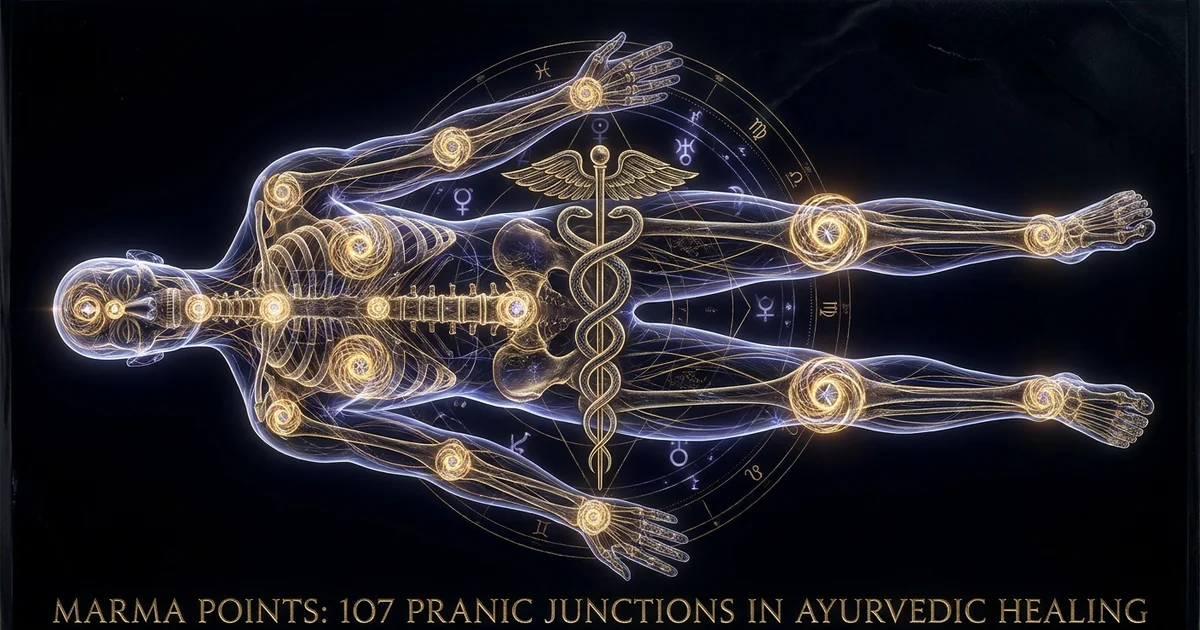
Marma Points: 107 Pranic Junctions in Ayurvedic Healing
Metaphysical Thesis & Epistemological Opening: The Trans-Somatic Nexus
The Epistemological Limitations of Somatocentric Reductionism
Western biological materialism operates upon an unexamined presupposition: that somatic organization is exclusively downstream of genomic instruction sets and closed-loop biochemical signaling. Within this strictly mechanistic framework, tissue morphogenesis, wound healing cascades, and system-level autonomic regulation are interpreted as purely self-assembling physical processes governed by molecular collisions.
Yet this somatocentric paradigm exhibits critical explanatory deficits when confronted with the non-linear speed of cellular signaling, system-level bioelectrodynamics, and the precise mathematical distribution of structural vulnerabilities across the human frame. The living form cannot be modeled merely as an aggregate of metabolizing matter. It is an open, dissipative thermodynamic structure sustained by an underlying field architecture.
Classical Indian epistemology, codified across the Vedic and Tantric lineages, addresses this lacuna through an operative vitalism wherein anatomical grossness (sthula) is permanently subordinate to, and informed by, the trans-physical field (sukshma). At the core of this physiology lies the recognition of marma points: 107 vital energy intersections in Ayurveda codified by the surgeon Sushruta.
These sites do not originate as nominal neurological or vascular coordinates; rather, they mark loci where the primordial unmanifest vital substrate (avyakta prana) irrupts into the physical domain, precipitating as dense matter. Somatocentric medicine views an anatomical vulnerability as a mechanical failure mode; classical Ayurveda understands it as a topological node where the morphogenetic field intersects physical tissue planes.
Etymology of Marana: The Ontological Threshold Between Vitality and Dissolution
The word marma derives from the Sanskrit verbal root mṛ (मृ), signifying to perish, to die, or to slay. In derivative grammatical configurations, it yields marana (death or dissolution). This etymological genesis is not merely metaphorical or diagnostic; it is explicitly ontological. To designate an anatomical nexus as a marma is to designate it as an active threshold between somatic persistence and entropic dissolution.
A marma is an ontological fault line. It constitutes a localized structural vulnerability precisely because it serves as the physical anchoring point for the conscious principle (jiva) within gross matter. The disruption of a marma does not merely rupture capillaries or sever nerve fibers; it severs the subtle bio-electrical and bio-energetic cohesion that prevents the physical vehicle from decomposing into its baseline elemental components (panchamahabhutas).
The root mṛ denotes more than somatic cessation; it signifies the threshold where the localized conscious agent (jiva) uncouples from its somatomorphic vessel. A marma is classified fundamentally as a sandhi-sthana—not merely a structural articulation or joint in the skeletal sense, but a junctural site where distinct dimensional planes intersect. Because these 107 nodes maintain the phase-conjugate lock between unmanifest vital current (avyakta prana) and cellular architecture, mechanical or energetic disruption at these loci induces an immediate decoherence of localized consciousness, precipitating rapid physiological collapse.
These 107 coordinates demonstrate that embodiment is an acquired and inherently unstable equilibrium. The somatic form is sustained solely through a matrix of informational tension. By mapping these specific geographic locations of mortality across the body, early Ayurvedic masters were mapping the precise tether-points of conscious embodiment. Each marma is an aperture through which life force is distributed, but through which it can also escape with irreversible velocity.
The Pranamaya Kosha as an Informational Intermediary
Within the Vedantic doctrine of the pancha-kosha (the five energetic sheaths of human identity), the gross anatomical body (annamaya-kosha) cannot interface directly with the mental (manomaya-kosha) or causal (vijnanamaya-kosha) layers without an intermediary transducing medium. This operational bridge is the pranamaya-kosha, the vitality sheath composed of an intricate network of 72,000 energetic conduits designated as nadis. The marma points function as the physicalized macroscopic nodes of this subtle circulatory grid.
Where modern systems biology attempts to explain macroscopic biological coherence through epigenetic feedback and chemical diffusion gradients, Ayurvedic metaphysics recognizes the agency of this subtle morphogenetic-field. Prana is an informational current that possesses an internal organizing intentionality. The marma points operate as step-down transformers: they capture the high-frequency informational dynamic of the nadis and transduce it into low-frequency, somatic regulatory signals.
Every prana junction brings together fascia, ligaments, bones, vessels, and muscles into a unified functional unit. Through this bi-directional energetic aperture, internal psychological states project into physical tissue structures, while physical trauma immediately alters the informational geometry of the subtle body.
Primary Codices & Historical Transmission: From Vedic Battlefield to Surgical Cartography
Sushruta Samhita: Battlefield Traumatology and the Sixth Chapter of Sharira Sthana
The primary source for marma doctrine is the Sushruta Samhita, an essential compendium of the Ayurvedic medical canon attributed to Sushruta, an ancient surgeon-philosopher working in the holy city of Kashi (Varanasi). While the broader text codifies the fundamentals of surgery (Shalya Tantra), internal medicine, and toxicology, its definitive energetic treatises are located in the Sharira Sthana (Section on Anatomy). Chapter Six of this section, titled Pratyeka Marma Nirdesha, provides an exhaustive, mathematically rigorous cartography of the 107 vital energy intersections.
Sushruta’s codification of these points arose out of the harsh empirical realities of ancient warfare. As chief surgeon to military forces, Sushruta observed wounds inflicted by arrows, spears, swords, and bludgeons. His mapping of the marma points was developed to predict trauma outcomes: which exact strike locations would cause instant mortality, which would lead to gradual death via systemic septic or hemorrhagic collapse, which would yield permanent functional debility, and which could be surgically explored without fatal consequence.
The text classifies the human form into six structural regions (shadanga): four extremities, the trunk (consisting of the thorax and abdomen), and the head and neck (shirogriva). Across these anatomical territories, Sushruta meticulously distributed the 107 marmani, transforming battlefield empirical data into an enduring system of therapeutic and surgical navigation.
Mamsa-sira-snayu-asthi-sandhi-sannipatas-teṣu svabhavata eva visheshatah prana tishtanti, tasmat marmasv-abhighata-bahulam maranam-upalaksyate… “Marma points represent the structural confluence of muscle (mamsa), vascular channels (sira), ligaments/tendons (snayu), bone (asthi), and joints (sandhi). By nature, the vital currents (prana) reside uniquely and specifically within these intersections. Consequently, any acute traumatic lesion to these marma points produces substantial systemic dissolution or death…” — Translated with reference to the commentary of Dalhana and K. L. Bhishagratna (1907).
The classical text emphasizes that these points are not homogenous energetic nodes. Sushruta explicitly states that the universal cosmological principles—Soma (the cooling, cohesive, lunar current), Marut or Vata (the kinetic, cellular-dispersing wind principle), and Tejas or Pitta (the transformative, bio-thermodynamic fire principle)—are anchored within these five-tissue matrices. Furthermore, the three primordial psychological qualities (gunas: sattva, rajas, and tamas), alongside the localized conscious soul (bhutatman), are perpetually seated at these nodal matrices.
The Tamil Siddha Paradigm: Varma Kalai and the Esoteric Weaponization of Prana
Operating parallel to, yet historically distinct from, the Northern Sanskritized Ayurvedic lineage, the Dravidian Siddha medical and martial tradition preserved a dynamic repository of vital point lore known as Varma Kalai (The Art of the Vital Point). Attributed to the mythical sage Agastya, who is said to have received the transmission directly from the deity Murugan (Kartikeya), Varma Kalai developed as both an esoteric healing art (Varma Cikitsa) and a lethal martial science (Varma Adi).
Where Sushruta focuses on surgical prognosis and preservation of life during operative interventions, the Siddha texts classify these loci based on bio-energetic vulnerability and mechanical manipulation:
- Padu Varmam: 12 primary structural points that are inherently lethal or incapacitating when struck with calibrated force.
- Thodu Varmam: 96 points activated by touch or precise percussive pressure, predominantly manipulating autonomic responses.
- Thattu Varmam: Percussive points requiring specialized rhythmic strikes to disrupt vital current flow.
- Nokku Varmam: The legendary and guarded methodology of affecting an opponent’s energetic matrix through concentrated intention and ocular focus.
The Siddha corpus views the human body not simply as an individual biological organism, but as a microcosm mirroring the alchemical structure of the universe (andam-pindam). In this paradigm, marma points are volatile switches. Applied with the violent velocity of martial action, a strike halts or disperses the circulation of vasi (the Tamil equivalent of prana), causing instant nervous paralysis, cardiopulmonary arrest, or energetic depletion. Applied with therapeutic precision, pressure or warm medicated oils can restart an energetic circuit that has stagnated, restoring systemic homeostatic balance.
Hermeneutic Distortion in Translation: Dalhana to Modern Ayurvedic Synthesis
The epistemological purity of the marma doctrine suffered significant attrition during the historical transmission from classical antiquity through medieval commentaries to colonial-era translations. Dalhana, writing his Nibandha Samgraha commentary on the Sushruta Samhita around the 11th century CE, performed valuable philological harmonization. However, his work initiated a shift toward physicalizing what were originally multidimensional descriptions.
Dalhana sought to align every energetic statement with the observable anatomical structures accessible to medieval surgical tools. In doing so, he often reduced descriptions of subtle vital forces (pranavaha srotas) to physical blood vessels and mechanical connective tissues.
This materialist flattening intensified during the British colonial period. Philologists such as K. L. Bhishagratna, while preserving foundational texts through translation, were forced to use Victorian medical nomenclature to legitimize Ayurvedic science in the eyes of Western empiricism.
Consequently, sira was uniformly translated as “vein” or “artery,” snayu as “ligament” or “nerve,” and marma as “fatal point” or “neurovascular junction.” Modern Indian institutional Ayurveda further consolidated this distortion by trying to map all 107 marmani directly onto Western anatomical charts, correlating them exclusively with peripheral nerve plexuses, arterial bifurcations, or lymph nodes.
This reductionist synthesis discards the trans-dimensional reality of the codices. The marma point is not merely a neurovascular bundle; it is an open thermodynamic conduit where subtle information crystallizes into somatic matter.
Ontological Architecture & Cosmological Models: The Fivefold Somatic Confluence
The Quintuple Structural Substrate: Mamsa, Sira, Snayu, Asthi, and Sandhi
Central to Sushruta’s anatomical thesis is the assertion that a marma cannot be reduced to a single histological tissue type. A marma is fundamentally a panchatmaka structure—a biological matrix requiring the functional and spatial coexistence of five organic tissues:
- Mamsa: The muscular substrate, representing physical density, mechanical contraction, and structural containment.
- Sira: The vascular, tubular, and fluid dynamics infrastructure, facilitating energetic distribution, cellular nutrition, and biophotonic propagation via liquid channels.
- Snayu: The ligamentous, fascial, and tendinous networks, governing tensegrity, physical binding, structural memory, and directional force transmission.
- Asthi: The osseous scaffolding, providing structural permanence, grounding, mineralized matrix stability, and protection for central energetic pathways.
- Sandhi: The articulations and junctural spaces, providing functional mobility, inter-tissue clearance, and spatial volume for dimensional translation.
[ Unmanifest Prana (Avyakta) ]
                     │
         [ Pranamaya Kosha / Nadis ]
                     │
   ┌─────────────────┴─────────────────┐
   │         MARMA CONFLUENCE          │
   │  ┌───────┬────────┬───────┬──────┐│
   │  │ Mamsa │  Sira  │ Snayu │Asthi ││
   │  │(Muscle│(Vessels│(Fascia│(Bone)││
   │  └───────┴────────┴───────┴──────┘│
   │               Sandhi              │
   │            (Joint/Space)          │
   └─────────────────┬─────────────────┘
                     │
  [ Piezoelectric / Biophotonic Signaling ]
                     │
       [ Gross Somatic Architecture ]
Although all five tissue types are present at every marma site, they do not appear in identical proportions. Sushruta categorizes the 107 points into five structural classes named after the dominant tissue present at the locus: Mamsa Marma (10 points, such as Talahridaya), Sira Marma (41 points, such as Nabhi and Sthapani), Snayu Marma (27 points, such as Kurcha and Ani), Asthi Marma (8 points, such as Katiktarika and Nitamba), and Sandhi Marma (20 points, such as Janu and Karpura).
The dominant tissue determines how a given point absorbs and discharges force. A Snayu Marma, dominated by dense connective tissue, reacts to mechanical trauma with widespread neuromuscular spasm and deep somatic contraction, while a Sira Marma causes systemic bio-energetic shock through sudden hemodynamic and pranic collapse.
Elemental Prognostics: Sadhyo Pranahara, Kalantara, Vishalyaghna, Vaikalyakara, and Rujakara
The systemic danger of a marma injury is categorized through a rigorous prognostic taxonomy based on the time it takes for entropic collapse to occur. This diagnostic framework directly reflects the thermodynamic balance of elemental forces (mahabhutas) anchored within that coordinate:
Sadhyo Pranahara Marma (Agni-Dominant)
- Time to Dissolution: Instantaneous to within seven days post-trauma.
- Elemental Principle: Governed primarily by Tejas (Agni / Fire); highly volatile, expansive, and transformative.
- Pathophysiology: Trauma results in rapid thermodynamic decoherence. The intense heat of localized Agni vents the vital prana outward, terminating systemic coherence.
- Exemplar Points: Shringataka (cranial venous confluence), Adhipati (vertex of skull), Hridaya (heart nexus).
Vaikalyakara Marma (Soma-Dominant)
- Time to Dissolution: Does not cause acute mortality; induces permanent structural/functional debility.
- Elemental Principle: Governed primarily by Soma (Water / Lunar); stable, cold, cohesive, and sustaining.
- Pathophysiology: Because the cold, nourishing properties of Soma resist instant vaporization, vital force is retained, but the physical framework sustains functional damage.
- Exemplar Points: Kurpara (elbow joint), Janu (knee joint), Kurchashira (base of foot/hand).
Beyond these two polarities, Sushruta defines three additional prognostic categories:
- Kalantara Pranahara Marma (33 points): Governed by a dynamic balance of Agni and Soma. Trauma causes gradual dissolution over a period ranging from two weeks to one month. The vital energy slowly drains as the fiery principle destabilizes while the lunar principle attempts to maintain cohesion.
- Vishalyaghna Marma (3 points): Governed by Vayu (Air / Kinetic energy). These points display a specific physiological paradox: as long as the foreign object (such as an arrow tip or puncture shrapnel) plugs the wound, the patient survives. The moment the object is extracted, the internal pressure seals breach, allowing the contained Vayu to escape, which causes instant death.
- Rujakara Marma (8 points): Governed by a mixture of Agni and Vayu. These points cause persistent, intractable somatic pain (ruja) without tissue death, directly overstimulating sensory neural pathways and disturbing the pain-processing balance of the subtle body.
The Structural Microcosm: Somatotopic Distribution and Sefirotic Parallels
The distribution of the 107 marma points is neither arbitrary nor purely dictated by mechanical survival needs; it follows an intentional, fractal distribution across the somatic form. Of the 107 points:
- 44 reside within the extremities (11 in each limb: 22 in the legs, 22 in the arms)
- 12 reside in the thoracic and abdominal cavity
- 14 reside in the dorsal back region
- 37 reside in the neck and cranial vaults (shirogriva)
This concentration of 37 points within the cranium reveals a clear functional hierarchy: the head (Uttamanga) functions as the primary root of the human tree (urdhvamulam adhashakham), where vital prana enters from macrocosmic dimensions before descending into the extremities.
This spatial arrangement matches the emanational descent of the divine current found in Western esoteric traditions, such as the Kabbalistic Tree of Life. In Kabbalah, the primary energetic node Kether (the Crown) precipitates down the central column through Tiphereth (the Heart) to Yesod (the Reproductive/Sacral Center) and finally grounds in Malkuth (the Material Matrix).
This directly parallels the Ayurvedic central axial channel (sushumna), where the crown marma (Adhipati) acts as Kether, the cardiac nexus (Hridaya) acts as Tiphereth, the umbilical-solar center (Nabhi) correlates with the lower astral conduits, and the perineal center (Guda) anchors the entire structure to Malkuth.
The marma points are the localized sub-stations through which the cosmic blueprint steps down through successive densities, anchoring macrocosmic principles within the micro-geography of human flesh.
Phenomenological Mechanics & Interdimensional Interaction: Fascial Tensegrity and Subtle Meridians
Piezoelectric Connective Tissue: Liquid Crystalline Collagen as Informational Grid
To explain how non-physical pranic currents interact with physical tissue without violating thermodynamic laws, we must look to the bio-physics of the extracellular matrix (ECM) and the collagenous fascial network. Research demonstrates that fascia is not an inert structural packing material, but a continuous, body-wide, liquid-crystalline semiconductor.
Collagen type I, which comprises the bulk of human connective tissue, possesses a triple-helical structure characterized by regular dipole moments. Under mechanical pressure, stretching, or thermal variation, these collagen fibers generate endogenous electric signals—a phenomenon known as piezoelectricity.
The fascial network operates as an integrated tensegrity (tensional integrity) system. Tension applied to an isolated region of the fascia transmits informational signals across the entire system at the speed of sound in water, bypassing the slower electrochemical conduction of the central nervous system.
Surrounding this crystalline lattice is a structured hydration shell consisting of organized exclusion-zone (EZ) water layers. These coherent water pathways serve as protonic highways that support rapid proton transfer (the Grotthuss mechanism).
Marma points are anatomical regions where these fascial sheets cross, anchor, and thicken into dense structural septa. Consequently, every marma point serves as a powerful piezoelectric transmitter, transmuting mechanical touch into electromagnetic, biophotonic, and protonic signaling cascades across the living organism.
Isomorphisms Across Traditions: Classical Marmani and Chinese Acu-Point Meridians
The anatomical and functional convergence between the Ayurvedic marma system and the jing-luo (meridian) system of Traditional Chinese Medicine (TCM) points to a shared empirical observation of human energetic anatomy. Both systems describe the body using an organized topographical map of responsive energetic loci:
- The marma point Sthapani, located at the glabella between the eyebrows, directly matches the classical extraordinary point Yintang. Both are classified as critical regulators of mental stability, ocular function, and the subtle eye of visionary insight.
- The marma point Adhipati, located at the parietal apex of the skull where the sagittal and lambdoid sutures meet, correlates precisely with Baihui (GV-20). Both are understood as crown apertures that connect the human energy system to macrocosmic currents.
- The marma point Hridaya, situated at the center of the sternum over the cardiac organ, functions identically to Danzhong (CV-17), serving as the central reservoir of chest prana/qi and the emotional regulator of the somatic matrix.
- The marma point Nabhi, located at the umbilicus, is mirrored by Shenque (CV-8). Both systems explicitly prohibit deep surgical lancing at this coordinate, recognizing it as an original embryonic nutrient gateway that links the physical form to its primordial source.
- The marma point Talahridaya, found in the central depression of the palm, aligns anatomically and functionally with Laogong (PC-8), operating as an active port for projecting and venting vital warmth.
This deep isomorphism confirms that these classical traditions were not inventing speculative systems. Independent civilizations, working with sophisticated phenomenological observation, mapped the exact same underlying physiological and subtle energetic reality: a macroscopic grid of responsive, high-conductivity nodes embedded within the body’s connective tissues.
Marma Cikitsa: Resonator Tuning, Informational Feedback, and Subconscious Unwinding
Building on this structural reality, the therapeutic application known as Marma Cikitsa (marma therapy) moves far beyond standard structural manipulation or physical vital point massage. It operates as an informational tuning mechanism.
When a practitioner applies calibrated manual pressure, warm medicinal decoctions, essential oils (tailams), or focused energetic attention to a marma point, they introduce a coherent vibrational input into a distorted biological system.
Psychosomatic trauma, unresolved emotional stress, and environmental toxicity generate localized distortions in fascial tension. This cellular stress dysregulates the regional micro-currents of the fascia, causing the local prana to stagnate (prana-sangha). This stagnation starves surrounding tissues of coherent informational input, leading to physical inflammation, pain, and cellular decay.
By applying precise, rhythmic pressure to the affected marma, the therapist generates targeted piezoelectric impulses that travel through the liquid-crystalline fascial matrix. This stimulation clears localized energetic stagnation, unwinds subconscious trauma held in physical tissue memory (samskaras), and resets the autonomic nervous system.
The practitioner does not mechanically force somatic change; they introduce an informational signal that allows the patient’s system to reorganize itself into higher-order coherence.
Initiatic Synthesis & Philosophical Implications: Reality Architecture and Somatosensory Sovereignty
The Human Somatic Matrix as an Interdimensional Transceiver
When viewed through a non-dual metaphysical lens, the human body is not a biological cage housing a separate, detached soul. It is an intentional, highly articulated interdimensional transceiver.
The physical flesh is the dense, visible end of an unbroken energetic continuum that extends upward into the subtlest frequencies of cosmic consciousness. The 107 marma points serve as the structural anchor-pegs that stabilize this multi-layered matrix within the physical parameters of localized spacetime.
Every sensory experience, every pulse of emotional awareness, and every awakening of spiritual vision depends directly on the balance of forces flowing through these nodes. The flow of kundalini—the primordial evolutionary current coiled at the base of the spine—cannot ascend safely through the central channel without the coordinated opening and stabilization of these 107 marmani.
If these nodes remain blocked by accumulated tissue toxicity (ama) or psychological contraction, rising subtle energies encounter severe resistance, resulting in neurological instability, emotional volatility, or deep energetic fatigue. Mastering the marma matrix is an essential step toward achieving somatosensory sovereignty: the conscious stabilization of the physical vehicle as a clear, receptive vessel for transpersonal awareness.
Cybernetic Control Systems: Jacques Vallée’s Paradigm Applied to Energetic Vulnerabilities
The informational dynamics of the marma network can be understood with exceptional clarity through the cybernetic control system hypothesis advanced by astrophysicist and information scientist Jacques Vallée. In his analyses of anomalous phenomena and human consciousness interactions, Vallée posits that reality operates as an information-based control system. This system generates specific physical and psychological feedback loops to regulate, limit, and shape human cultural and cognitive evolution.
Applying this framework to esoteric somatic anatomy, the 107 marma points function as the internal, biological control system of the human organism. They act as regulatory feedback loops built into our physical architecture to enforce human perceptual limits.
When an individual’s conscious awareness or subtle energetic output threatens to destabilize their localized biological framework, these vulnerable nodes register the excess energetic charge. They respond by generating somatic symptoms—such as fatigue, disorientation, acute pain, or autonomic down-regulation—which forces the conscious agent back into baseline somatic equilibrium.
[ Universal Consciousness / Cosmic Prana ]
                           │
                ▲          ▼          ▲
   High-Strangeness / Spiritual Expansion Inputs
                │                     │
                └──────────┬──────────┘
                           │
             [ Marma Cybernetic Regulator ]
                           │
    ┌──────────────────────┴──────────────────────┐
    │                                             │
Excess Pranic Charge                     Homeostatic Balance
    │                                             │
    ▼                                             ▼
 Autonomic Down-Regulation /               Systemic Coherence /
 Pain / Somatosensory Check                Perceptual Sovereignty
This biological mechanism explains why experiences of genuine spiritual awakening or anomalous phenomena (high-strangeness) are often accompanied by intense, unexplained physical symptoms: sudden heart palpitations, involuntary muscle tremors, or deep pressure at the cranial sutures. These are not merely conversion reactions; they are the somatic control system reacting to external informational surges at key marma junctures.
The marma system sets the operational boundaries of our physical reality. It ensures that consciousness remains safely tethered to its biological support system until the physical form is systematically purified and strong enough to integrate higher frequencies of conscious awareness.
Therapeutic Theurgy and the Realization of Non-Dual Embodiment
When marma therapy is understood in this context, it transcends conventional symptomatic medicine and transforms into an act of somatic theurgy—the conscious invocation and alignment of divine energies within material form. The therapist or meditating yogi does not merely manipulate tissue; they participate in the ongoing harmonization of reality itself.
Aggressive, forceful, or uninitiated manipulation of primary marma points—most critically the Sadhyo Pranahara category and the cranial vertex (Adhipati)—poses severe physiological and psychological risks. Misapplied force can induce profound autonomic dysregulation, cardiac arrhythmias, or sudden psychological decompensation.
Furthermore, because these nodes act as open informational gateways between the physical body and trans-dimensional environments, forceful intervention in an impure or ungrounded state can leave the individual’s energy field vulnerable to external subtle disturbances or egregoric interference. These points must be approached with ethical purity, mental stillness, and precise anatomical and energetic understanding.
By working with these points, the practitioner systematically clears the frozen memory patterns (samskaras) and karmic debris that have crystallized within the patient’s connective tissue matrix. This clearing dissolves the false experiential boundary between the internal self and the external universe.
The body stops experiencing itself as an isolated, fragile biological object trapped in a hostile physical world. It reveals itself as an open, fluid, and luminous node within the unified field of universal consciousness. Embodiment is no longer seen as a spiritual limitation, but as the ground where non-dual liberation (jivanmukti) is realized in physical form.
Frequently Asked Questions: Ontological and Philological Inquiries
Sushruta’s Anatomical Precision vs. Esoteric Energy Body Discrepancies
A recurring debate in comparative hermeneutics concerns the apparent tension between the physical anatomical descriptions found in Sushruta’s Sharira Sthana and the non-physical energy maps described in classical Tantric texts.
Sushruta describes the heart (Hridaya Marma), for instance, with concrete visceral characteristics: an inverted lotus-shaped muscular pump connected to hemodynamic vessels, whose physical injury results in sudden death. Conversely, Tantric yogic treatises such as the Shiva Samhita describe the heart center (Anahata Chakra) as an ethereal twelve-petaled lotus containing the seed syllable Yam, divorced from any direct surgical anatomy.
This discrepancy resolves when we recognize that Sushruta and the Tantric yogis were documenting the same energetic structures from different points along the dimensional spectrum. Sushruta’s system operated from the outside in: his traumatological mandate required him to map where subtle energetic vectors terminate in dense, dissectible tissue.
The Tantric masters operated from the inside out: their meditative practices allowed them to experience these centers from within the subtle body (sukshma sharira), focusing on their subjective energetic frequencies. The marma point is the physical bridge where the subtle chakra distributes its dynamic energy into the nervous, circulatory, and fascial systems. Far from contradicting one another, the two models form a complete continuum of human anatomy, bridging the gap between physical dissection and inward meditative realization.
The 108th Marma Controversy: Mind (Manas) and Somatic Totality
While the Sushruta Samhita explicitly numbers 107 marma points, later commentaries, regional lineages, and esoteric oral traditions frequently reference a mysterious “108th marma.” This additional coordinate has sparked long-standing philological and practical debates across Ayurvedic institutions.
Some traditions identify this 108th point with an actual anatomical location, such as the perineal center (Perineum/Guda), the pineal gland, or a point within the ventricular system of the brain. However, the most profound philosophical interpretation identifies the 108th marma as the Mind (Manas) itself, or the entire somatic sheath experienced as a unified, living whole.
Langevin, H. M., & Yandow, J. A. (2002). “Relationship of acupuncture points and meridians to connective tissue planes.” The Anatomical Record, 269(6), 257–265.
This pioneering study utilized ultrasound imaging to demonstrate that human acupuncture points and meridians—which match the Ayurvedic marma system—correspond with remarkable statistical significance to connective tissue cleavage planes. The research established that mechanical manipulation of these sites initiates cellular responses through cytoskeletal remodeling and purinergic signaling, validating non-neural communication networks across the body’s connective tissues.
In this integrative view, the physical body is the ultimate marma point: an overall vulnerability through which unmanifest Spirit (Purusha) binds itself to experiential material form (Prakriti). Just as the number 108 holds profound cosmological and mathematical significance across Indian sacred traditions—representing the 108 stages of cosmic unfolding—the 107 individual marmani function as localized structural nodes, while the 108th marma is the overarching field of conscious awareness that animates and unifies them.
Comparative Mechanisms: Marma Therapy Versus High-Velocity Osteopathic Manipulation
Modern therapeutic medicine frequently questions how Marma Cikitsa differs in its fundamental mechanisms from contemporary physical therapies, such as high-velocity, low-amplitude (HVLA) chiropractic adjustments or modern osteopathic manipulation. While all these modalities address physical somatic dysfunction, their underlying principles and mechanisms of action remain fundamentally distinct.
HVLA manipulation relies on high-velocity mechanical leverage. It targets joint subluxations to overcome the resistance of surrounding muscle spindles, restoring normal biomechanical range of motion and modulating local spinal reflex arcs.
Marma therapy, by contrast, operates primarily through subtle bio-informational resonance. Instead of using mechanical force to shift skeletal structures, the marma practitioner applies focused, gentle, and sustained hydrostatic pressure to specific intersections of fascia, ligaments, and vessels.
This process stimulates the tissue’s piezoelectric properties, sending coherent informational signals through the liquid crystalline matrix of the fascia. Rather than forcing the body into alignment through external mechanical torque, marma therapy clears localized energetic blockages, shifts the autonomic nervous system into deep parasympathetic balance, and allows the body’s innate intelligence to realign its own tissues from within.
Mechanical therapies adjust the physical framework from the outside; marma therapy restores the energetic and informational field that creates and sustains the physical form.