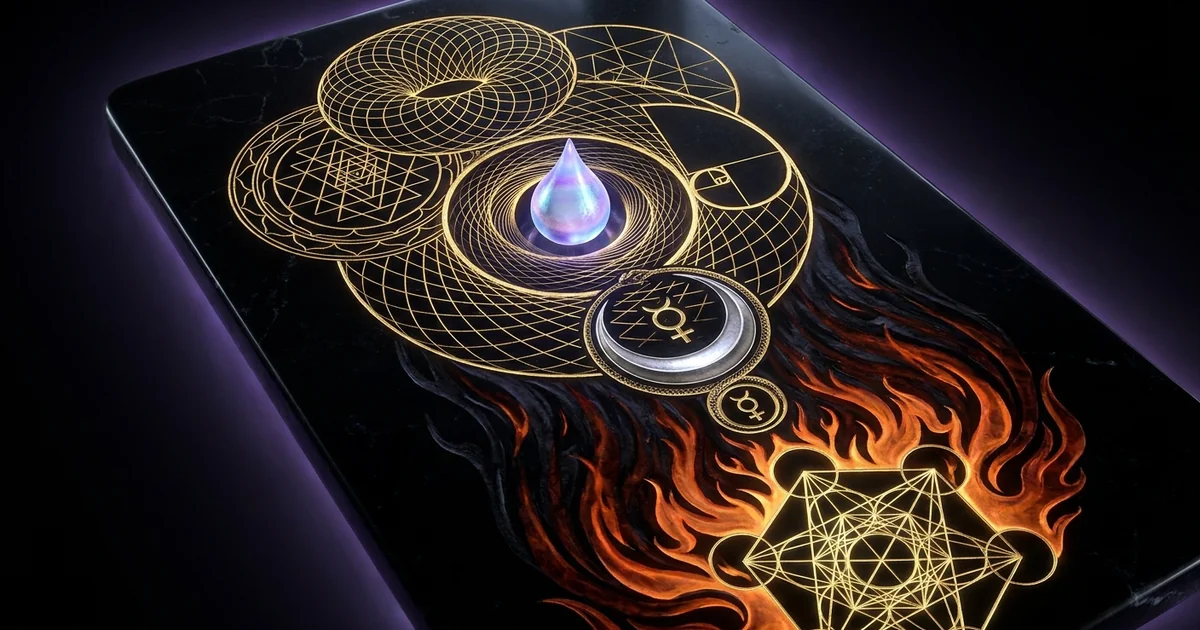
The Bindu Visarga: Secret Droplet of Nectar & Amrita Art
Metaphysical Thesis & Epistemological Opening: The Bindu Visarga as Trans-Somatic Singularity
The Ontological Paradox of the Unmanifest Point (Bindu)
In the non-dual cosmological architecture of Tantric metaphysics, the universe does not originate through ex nihilo fabrication, but through a self-limiting contraction and subsequent projective pulsation (spanda) of unconditioned consciousness (Paramashiva). Within this cosmogenetic topography, the bindu occupies the supreme ontic threshold: it is the mathematical, metaphysical, and energetic infinitesimal singularity through which the unmanifest (nishkala) condenses into the manifest (sakala). In the macrocosm, it constitutes the primal seed of differentiated creation; in the microcosm of subtle body anatomy, it localizes at the posterior apex of the cranium as the bindu visarga moon center amrita nectar of immortality subtle aperture.
The paradox of the bindu rests upon its simultaneous status as both limit and gateway. It is dimensionless, yet gives birth to dimensional space; it is unextended, yet establishes the spatio-temporal gridwork of the psycho-physical vehicle. Within the human organism, this node operates as a trans-somatic zero-point. It marks the precise locus where pure, unconditioned awareness coagulates into psycho-mental activity and somatic vitality. Understood non-reductively, the bindu is not an anatomical object situated within gross biological matter; rather, gross biological matter is situated within the scalar emanations radiating outward from this subtle cranial singularity.
Within the grammar of the Sanskrit phonetic matrix (matrika) and Kashmir Shaivite metaphysics as codified by Abhinavagupta, bindu represents the nasalized dot (anusvara, ṃ), signifying the undifferentiated concentration of Shiva-consciousness withdrawn into radical inward self-awareness (aharm-paramarsa). Conversely, visarga represents the aspirated emission (ḥ, rendered visually as two vertical dots, :), signifying the kinetic release, radiant expansion, and projective polarization of Shakti into manifest reality. The compound bindu-visarga denotes the eternal cyclical pulsation between metaphysical contraction and cosmological emanation—the infinite folding and unfolding of the divine ground into embodied form.
The Emanational Mechanics of the Visarga (Creative Discharge)
The dynamic operationalization of this center is characterized by the term visarga, denoting the projective emission, release, or creative discharge of energetic potency. In classical Trika Shaivism, visarga is the third and ultimate wave of consciousness expanding from will (iccha) and knowledge (jnana) into somatic action (kriya). The Bindu Visarga, consequently, is not a static structural depot, but an active transductive organelle. Through this center, the subtle drops of amrita—the celestial essence of unconditioned bliss (ananda)—drip continuously downward into the lower energetic chakras.
This perpetual secretion of the soma droplet establishes the baseline bio-spiritual economy of human existence. The fluid is pure potentiality, sustained by the coolness of cosmic lunar awareness. Yet, the systemic tragicomedy of mundane embodiment dictates that this creative discharge is immediately subjected to the entropic gravitational field of ordinary psychosomatic functioning. As the nectar cascades from the back of head cranial chakra, it descends along the interior axis of the bodily cosmos, leaving the uninitiated organism caught in an inescapable cycle of depletion, senescence, and spiritual amnesia.
Critique of Bioreductionist and Pop-Esoteric Cranial Models
Contemporary discourses seeking to explain these cranial phenomena consistently fall into one of two dialectical errors: empirical bioreductionism or vulgarized New Age syncretism. Bioreductionist paradigms, frequently operating within the emerging domain of neurotheology, attempt to flatten the Bindu Visarga into an anatomical synonym for the pineal gland, the epithalamus, or specific ventricular secretions of cerebrospinal fluid (CSF). While subtle physiological correlates undeniably exist within endocrine and neurochemical signaling pathways, reducing an ontological threshold to a biological gland commits an elementary category error. The physical brain is the densified shadow cast by the subtle energetic architecture, not its generative ground.
Conversely, pop-esoteric models reduce the Bindu Visarga to an undifferentiated “third eye” accessory or an emotionalized zone of somatic release, completely severing it from its complex metaphysical roots in classical Tantra and Siddha alchemical traditions. These superficial paradigms strip the center of its rigorous internal mechanics, ignoring the necessary interaction with the /spirituality/subtle-body-anatomy-nadis-chakras, the solar furnaces of the lower abdomen, and the precise mudric technologies required to arrest its downward dissolution. To understand the Bindu Visarga is to navigate a multidimensional topology where anatomy, ontology, and theurgy intersect without collapsing into one another.
Primary Codices & Historical Transmission: The Philology of Lunar Secretion and Siddha Alchemical Texts
Textual Hermeneutics of the Hatha Yoga Pradipika and Siva Samhita
The medieval codifications of Hatha Yoga and Nath Siddha traditions present the mechanics of the lunar cranial secretion not as peripheral allegories, but as the supreme axis of yogic praxis (sadhana). Svatmarama’s Hatha Yoga Pradipika (c. 15th Century CE) dedicates extensive passages of its third and fourth chapters (patalas) to the precise management of this internal nectar. Svatmarama articulates a stark thermodynamic imperative: the nectar that falls from the lunar sphere (chandra mandala) at the root of the palate is devoured by the solar fire (surya mandala) residing in the navel.
[ Bindu Visarga ]
                                  (Lunar Chandra)
                                         |
                                         | (Perpetual dripping of Amrita)
                                         v
                                  [ Lalana Chakra ]
                                  (Pharyngeal Palate)
                                         |
                                         | (Entropic Cascade)
                                         v
                                 [ Manipura Chakra ]
                                   (Solar Surya)
                             *Devoured by Jatharagni*
This fundamental formulation is mirrored and expanded within the Siva Samhita (c. 14th–15th Century CE). The text posits that the moon, situated at the base of the cerebral cortex, sheds the liquid of immortality (amrita-dhara), which sustains the entire physical matrix. The uninitiated human being is fundamentally an entropic machine whose lifespan is mathematically indexed to the rate at which this lunar fluid is permitted to cascade into the digestive furnace. Mastery over death (mrityunjaya) does not consist of biological intervention, but in arresting the gravitational fall of the secretion of soma droplet and reversing its direction through esoteric somatic manipulation.
“There is a celestial nectar (amrita) situated in the lunar sphere at the root of the palate. That moon showers down the essence of life, which is constantly swallowed by the sun at the navel. Because of this, the body falls into decay and death… When the tongue is turned backward into the cavity of the skull, and the gaze is fixed between the eyebrows, this is khechari mudra. The lunar fluid falling from above is not devoured by the fire, the breath does not leave the body, and the bindu does not fall, even in the embrace of a woman.” — Svatmarama, Hatha Yoga Pradipika, Critical Edition, Adyar Library.
The Nath Siddha Alchemical Legacy: Rasa, Soma, and Internal Metallurgy
The textual legacy of the Nath Siddhas—originating with figures such as Matsyendranatha and Gorakshanatha—fuses Hatha Yogic somatics with the metallurgical operations of Indian alchemy (Rasayana). As David Gordon White demonstrates in The Alchemical Body (1996), the Siddha tradition established a direct isomorphism between the transmutational properties of mercury (rasa, the semen of Shiva) and the internal somatic fluid known as bindu or soma. The Siddha texts make no qualitative distinction between metallurgical transmutations of base metals into gold and the somatic transfiguration of the decaying biological form into an immortal, trans-elemental body (siddha-deha).
In this alchemical hermeneutic, the internal secretion of the lunar drop is viewed as the bodily analogue of wild cinnabar and processed mercury. The human organism is an internal laboratory. The unrefined bindu is unstable and volatile; if it drips unchecked, it burns in the visceral crucible. However, if properly harvested, sealed, and recirculated through the /esotericism/alchemy-internal-elixir-vitae, it transmutes the thirty-six fundamental tattvas of human physiology into a non-corruptible state. The Nath texts conceptualize this not merely as health longevity, but as an existential conquest of time (kala), effectively rendering the physical vehicle impervious to cosmic dissolution.
Trika Shaivism and the Tantraloka: Bindu in the Matrix of Matrika
Within the non-dual Kashmiri Trika lineage, particularly in the foundational exegesis of Abhinavagupta’s Tantraloka, the bindu is analyzed through an infinitely more subtle epistemological lens. Here, the somatic drop is explicitly linked to the acoustic emanations of the matrika-shakti—the generative power of the unmanifest phonemes that structure the universe. Abhinavagupta reveals that the internal flow of amrita is the tactile, energetic manifestation of supreme sonic vibration (paravac).
The bindu rests in the silent interval between phonemes, between the inhalation and exhalation, between the contraction and release of consciousness. In the Tantraloka, the drops dripping from the moon center are recognized as the supreme offering (tarpana) in the internal fire ritual (antaryaga). The Shaivite initiate does not view the lunar nectar solely as a substance to be physically stored, but as the liquefied form of unconditioned self-awareness. When this nectar is tasted, the adept tastes the uninterrupted subjectivity of Shiva, collapsing the ontological divide between the cognizer (pramatr), the instrument of cognition (pramana), and the cognized object (prameya).
Ontological Architecture & Cosmological Models: The Lunar and Solar Dynamics of Macrocosmic Emanation
The Chandra Mandala vs. Surya Mandala Polarization
The fundamental architecture of esoteric yogic anatomy relies upon an absolute cosmographic polarity: the dialectic between the Chandra Mandala (the lunar sphere) and the Surya Mandala (the solar sphere). This somatic polarization mirrors the macrocosmic tension between the transcendent, static source of absolute life and the dynamic, dissipative engine of phenomenal time. The Bindu Visarga, located at the superior-posterior aspect of the head, serves as the somatic anchor of the Chandra Mandala. It is associated with the color white, the element of cool water (apas), the soothing glow of the full moon, and absolute stillness.
In opposition, the Surya Mandala is localized within the core of the lower torso, centered upon the Manipura chakra and the gastro-intestinal hearth. Its attributes are red, fiery, aggressively kinetic, and temporally destructive. The interaction between these two discs constitutes the totality of the psycho-energetic lifecycle. The lunar sphere continuously synthesizes the vitalizing nectar of immortality; the solar sphere unceasingly consumes it to fuel the autonomic machinery of embodiment and discursive thought. Human life, in its mundane state, is an ontological tragedy in which the higher metaphysical potential is systematically burnt to maintain lower thermodynamic stability.
Chandra Mandala (Lunar Singularity)
- Locus: Bindu Visarga / Back of Head Cranial Chakra
- Metaphysical State: Static, unconditioned, cool potentiality (Shiva-tattva)
- Subtle Fluid: Amrita / Soma (White, reflective, nectar of timelessness)
- Temporal Alignment: Amrita-kala (Timeless absorption, enstasy)
- Directional Vector: Downward cascading emanation (in the mundane body)
- Function: Nourishment of subtler koshas, psycho-informational cohesion
Surya Mandala (Solar Singularity)
- Locus: Manipura Chakra / Jatharagni (Gastric Hearth)
- Metaphysical State: Kinetic, differentiating, consumptive fire (Agni/Kala)
- Subtle Fluid: Digestive bile / Menstrual blood / Rajasic drive
- Temporal Alignment: Kala-chakra (Entropic time, senescence, biological decay)
- Directional Vector: Upward reaching combustion
- Function: Fueling corporeal animation, visceral metabolism, thermodynamic consumption
The Kala Wheel: Entropic Descent of Nectar into the Solar Fire of Manipura
The downward drift of the secretion of soma droplet is synonymous with the turning of the Kala Wheel (kala-chakra)—the machinery of death. Each drop of amrita that escapes the Bindu Visarga falls through the subtle conduits until it impacts the gastric hearth of the solar sphere. In classical texts, this process is known as the burning of ojas (the subtle essence of biological vitality and consciousness). When the solar fire consumes the lunar drop, the celestial nectar is degraded into coarse metabolic heat, which maintains the physical organism at the expense of its subtle spiritual reserves.
[ CHANDRA MANDALA ]
        (Bindu Visarga)
               |
      [ Downward Cascade ]  ==> Entropy / Aging / Discursive Mind
               |
               v
        [ SURYA MANDALA ]
        (Manipura Solar)
This entropic cascade directly fuels the fragmentation of human awareness. The moment the lunar drop is ignited by solar heat, it transforms into desires, discursive thought loops (vrittis), emotional reactivity, and somatic wear. As long as this vertical leakage continues uninterrupted, human consciousness remains tethered to time and its biological terminus. Liberation (moksha), therefore, is fundamentally an alchemical, thermodynamic problem: the downward trajectory must be halted, intercepted, and converted into an ascending stream of transfigured light.
Macrocosmic Reflection: The Interdimensional Control Interface of Subtle Anatomy
When analyzed through the informational paradigm pioneered by researchers of anomalous phenomena such as Jacques Vallée, the human subtle body emerges not merely as a biological aura, but as an interdimensional interface embedded within a broader control system. The structural architecture of the lunar-solar polarity mirrors macrocosmic dynamics studied in comparative esoteric traditions, including the Gnostic fall of the Sophia and the entrapment of Pleromatic light sparks within the demiurgic realm of the Archons.
Within this framework, the Bindu Visarga functions as the primary portal linking the individual psyche to higher, non-human informational fields. The involuntary downward draining of the bindu visarga moon center amrita nectar of immortality subtle reservoir maintains human consciousness in a low-frequency, entropy-bound state—easily manipulable by ambient socio-cultural and /nhi-phenomena/interdimensional-control-systems. By severing this unconscious drainage and mastering the internal fluid dynamics, the adept seizes control of the interface, unplugging the somatic matrix from demiurgic entropy and asserting non-dual sovereignty.
Phenomenological Mechanics & Interdimensional Interaction: Khechari Mudra and Neuro-Energetic Transmutation
The Mechanics of Khechari Mudra: The Inverted Retroflex Tongue Lock
The primary esoteric mechanism developed within the Hatha and Nath lineages to arrest the descent of amrita is the celebrated and guarded khechari mudra (literally, “the seal of moving through the void/sky”). Khechari is not merely an external bodily posture, but an advanced neuro-energetic manipulation of the pharyngeal and cranial thresholds. The technical execution requires the practitioner to curl the retroflexed tongue backward over the soft palate, sliding it upward into the nasopharyngeal space behind the uvula until it enters the upper cranial cavity (kapa-kuhara).
In historical Siddha traditions, this operationalization frequently involved the radical surgical severance of the frenulum linguae (chhedana), accompanied by continuous manual elongation (chalana) over months and years, until the tongue could easily reach the bridge between the eyebrows internally. Once inserted into this upper cavern, the tip of the tongue is positioned against the subtle cranial openings, directly sealing the lalanā chakra and the talu (palate), precisely where the lunar drops condense prior to falling.
Sealing the Upper Aperture: The Cranial Transduction Circuit
The structural application of the khechari mudra tongue lock completes an otherwise broken electrical, pranic, and informational circuit. Under standard physiological conditions, the cranial aperture remains open, and the subtle electrical charges of the cranium dissipate into the body’s internal cavities. The insertion of the tongue into the nasopharynx creates a direct somatic bridge between the nervous system’s primary autonomic pathways and the deeper cranial nerves, especially those associated with the vagus and glossopharyngeal complexes.
[ Bindu Visarga ]
              |
              v (Secretion of Amrita)
       [ Retroflexed Tongue Lock ] === (Completes Cranial Circuit)
              |
              v (Ascent via Sushumna)
       [ Sahasrara Padma ]
By sealing this threshold, the adept achieves two simultaneous outcomes:
- The physical and energetic drop of amrita is mechanically intercepted and prevented from descending into the solar fire of the Manipura.
- The pranic winds (prana and apana), normally polarized in an oppositional outward dynamic, are forced into the central channel (sushumna-nadi).
This closure establishes a biological feedback loop. The amrita, instead of falling into combustion, is re-absorbed directly through the tissues of the tongue and the cranial roof. The fluid acts upon the neurochemical architecture of the brain, down-regulating ordinary sensory processing and activating profound, dormant neuro-perceptual states contextualized within /consciousness/altered-states-neurotheology-pineal.
Sensory Inversion, High Strangeness, and Non-Ordinary Perceptual Phenomena
The somatic re-absorption of the soma droplet triggers an immediate phenomenological phase shift. Classical texts catalog a specific experiential sequence that occurs as the nectar begins to saturate the practitioner’s vehicle. Initially, the physical taste buds register a succession of subtle gustatory sensations: beginning with astringent, bitter, and salty profiles, transmuting into the taste of raw milk, clarified butter (ghee), honey, and ultimately an exquisite, intoxicating fluid of unearthly sweetness that has no equivalent in gross matter.
Simultaneously, the sensory inversion precipitates dramatic perceptual phenomena categorized under the rubric of internal nada (inner mystical sound). The adept ceases to experience acoustic reality through external auditory mechanics; instead, the skull rings with an ascending ladder of internal vibrations: the sound of a cricket, the ocean surf, the ringing of a celestial bell, the resonance of a bronze gong, and finally the sound of a flute and lightning.
These phenomenological markers are accompanied by episodes of high strangeness, including:
- Radical alterations in spatial orientation, culminating in the sensation of vast dimensional expansion (khechara-tva);
- The dissolution of temporal linear flow into an eternal present;
- Spontaneous cessation of the respiratory cycle (kevala kumbhaka);
- Visions of unconditioned, dazzling white light (jyotis) radiating from the back of head cranial chakra.
Initiatic Synthesis & Philosophical Implications: Amrita Art, Non-Dual Enstasy, and Consciousness Sovereignty
The Alchemical Metamorphosis: From Biological Entropy to Adamantine Body (Divya Deha)
The ultimate teleological orientation of the Tantric alchemist is not disembodied liberation (videha-mukti), but embodied, divine transfiguration (jivanmukti) culminating in the realization of the divya-deha—the adamantine, incorruptible body of light. The systematic harvesting and circulation of the lunar nectar from the Bindu Visarga is the foundational praxis of this transmutation. When the nectar is prevented from burning in the solar furnace, it saturates every tissue layer (dhatu) of the corporeal sheath (annamaya kosha).
This pervasive saturation reverses the cellular decay intrinsic to mortal biology. The gross corporeal elements are symbolically and energetically dissolved into their subtle vibrational counterparts: earth dissolves into water, water into fire, fire into air, and air into void (akasha). The body is no longer sustained by external caloric intake, but by the perpetual self-generating loop of celestial amrita. In the esoteric literature of the Siddhas, the adept who has stabilized this condition casts no shadow, develops miraculous capabilities (siddhis), and commands absolute sovereignty over elemental physical matter.
The forceful, unguided manipulation of cranial fluids and the violent application of the khechari mudra tongue lock carry profound somatic and psychological hazards. Forcing prana into the cerebral ventricles without purifying the nervous system (nadi-shodhana) can induce severe neuropathic distress, cranial migraines, dissociative psychotic episodes, and autonomic instability. Metaphysically, premature access to the Bindu Visarga risks radical pranic inflation, wherein the unpurified human ego co-opts the experience of cosmic Shiva-consciousness, generating monstrous delusions of personal omnipotence and irreversible spiritual derailment. These practices are strictly initiatic and demand the guidance of an authentic adept.
The Amrita Art: Visualizing and Integrating the Lunar Nectar in Western and Eastern Esotericism
The internal praxis of handling this divine fluid may be termed the “Amrita Art”—an initiatic technology that bridges Eastern Tantric systems with the apex operations of the Western Hermetic and Alchemical traditions. While the Nath Siddhas mapped this reality through the topography of nadis, chakras, and mudras, Western Hermeticists described identical internal transformations through the imagery of the Aqua Vitae, the Elixir Vitae, and the condensation of the white eagle’s dew.
In both traditions, the adept visualizes and interiorizes the descent of a supernal, luminous dew. It is the baptism of the Holy Spirit in Christian esoteric theosophy; the descent of Metatron’s luminous droplets down the central pillar of the Kabbalistic Tree of Life from Kether into Da’ath; and the condensation of the volatile spirit into the fixed stone in laboratory alchemy. The “Amrita Art” is the practical discipline of consciously perceiving, guiding, and transmuting this nectar throughout the micro-macrocosmic continuum, transforming the physical body into an expressive temple of the cosmic Logos.
Human Sovereignty Against Cosmological Control Architectures
At the zenith of this initiatic inquiry lies the question of existential freedom. The human condition is universally characterized by structural entrapment: the soul is cast into biological flesh, caught within the thermodynamic degradation of time, and manipulated by cosmic and metaphysical forces that harvest human psychic and energetic output. The unmonitored outflow of the bindu visarga moon center amrita nectar of immortality subtle is the precise energetic vulnerability through which this thermodynamic harvesting occurs.
By mastering the Bindu Visarga, the adept performs an act of supreme metaphysical rebellion. Closing the cranial aperture and circulating the amrita breaks the closed loop of entropic dissipation. The practitioner ceases to be an open thermodynamic system bleeding vitality into the demiurgic matrix. In realizing the Bindu Visarga, the adept reclaims the unmanifest point of origin, standing as an unshakeable, non-dual witness. Neither the fires of the body, the wheel of temporal destruction, nor the overarching control architectures of the cosmos can touch one who has drawn the celestial moon down into their own heart.
Frequently Asked Questions: Ontological, Alchemical, and Epistemic Inquiries
Anatomical Specificity of the Bindu Visarga
The precise anatomical localization of the Bindu Visarga remains a point of intense interrogation among practitioners and subtle-body theorists. Geometrically and phenomenologically, it is situated at the superior-posterior aspect of the cranium, corresponding precisely to the apex of the lambdoid suture where the parietal bones intersect with the occipital bone (the cranial landmark known as the lambda). In Indian iconographic traditions, this is the exact region where Brahmin initiates leave the single tuft of hair (shikha or choti), designed to preserve and insulate the energetic charge of this cranial chakra.
It is critically important to distinguish the Bindu Visarga from neighboring subtle centers:
- The Sahasrara Chakra: The thousand-petaled lotus situated at the crown (brahmarandhra), representing undifferentiated cosmic consciousness.
- The Ajna Chakra: Located in the mid-brain and projected between the eyebrows, acting as the commanding center of intuitive intellect and dual polarity.
- The Bindu Visarga: Situated below the Sahasrara and behind the Ajna, operating as the localized cranial reservoir that converts the formless light of Sahasrara into the tangible drops of lunar nectar.
Amrita vs. Biochemical Endogenous Compounds
A central epistemological dispute concerns whether amrita can be completely reduced to biochemical substances, such as endogenous N,N-Dimethyltryptamine (DMT), melatonin, pinoline, oxytocin, or specific ultra-filtered fractions of cerebrospinal fluid (CSF). There is substantial evidence that the meditative activation of the Bindu Visarga and the physical execution of khechari mudra dramatically alter neuroendocrine secretions, triggering intense states of neurochemical enstasy and hyper-plasticity through pituitary and pineal cascade mechanics.
However, from an ontological perspective, biochemical compounds represent merely the final densified shadow of amrita within the gross physical sheath (annamaya kosha). Amrita itself is fundamentally chiti-rasa—the concentrated juice or essence of consciousness. It is a multidimensional substance existing concurrently across the causal (karana), subtle (sukshma), and gross (sthula) bodies. Equating amrita purely with CSF or endogenous tryptamines commits the reductionist fallacy of confusing the conduit for the lightning, or the physical radio receiver for the electro-magnetic broadcast.
As demonstrated by David Gordon White in The Alchemical Body (1996) and reinforced by the philological taxonomies of Alexis Sanderson in The Saiva Age (2007), medieval Indian esoteric literature exhibits an unresolved tension between the radical somatic physicalism of the Nath Siddhas—who sought literal corporeal immortality through fluid mechanics and internal mercury—and the radical non-dual idealism of the Kashmir Shaivites, who interpreted amrita and bindu as states of mystical apperception and internal recognition (pratyabhijna). Authentic esoteric hermeneutics must maintain this dialectical tension rather than prematurely collapsing one pole into the other.
Non-Physical Mastery without Surgical Severance (Chhedana)
The extreme somatic requirements found in medieval manuals—specifically the physical slicing of the lingual frenulum (chhedana) with a sharp bamboo knife, followed by weekly salting and pulling—have raised long-standing debates regarding whether somatic mastery over the Bindu Visarga is achievable without physical mutilation. Canonical schools of Tantra, particularly within the classical Trika and Sri Vidya traditions, explicitly reject the absolute necessity of external surgical procedures, categorizing such radical physical methods as coarse (adhama) or belonging purely to violent Hatha (hathatva).
In non-dual meditative paradigms, the adept accomplishes the energetic essence of khechari through bhavana (creative contemplative visualization) and shambhavi mudra (the gaze of Shiva), wherein the mind dissolves into the unmanifest space of consciousness. By entering into supreme stillness (nispanda), the subtle tongue of awareness naturally inverts and merges into the cranial void. The prana effortlessly ceases its outward descent, and the celestial nectar cascades naturally throughout the subtle vehicle. The ultimate requirement to harvest the divine drop of immortality is not the physical laceration of flesh, but the radical surrender of the bifurcating ego into the void of the unconditioned self.