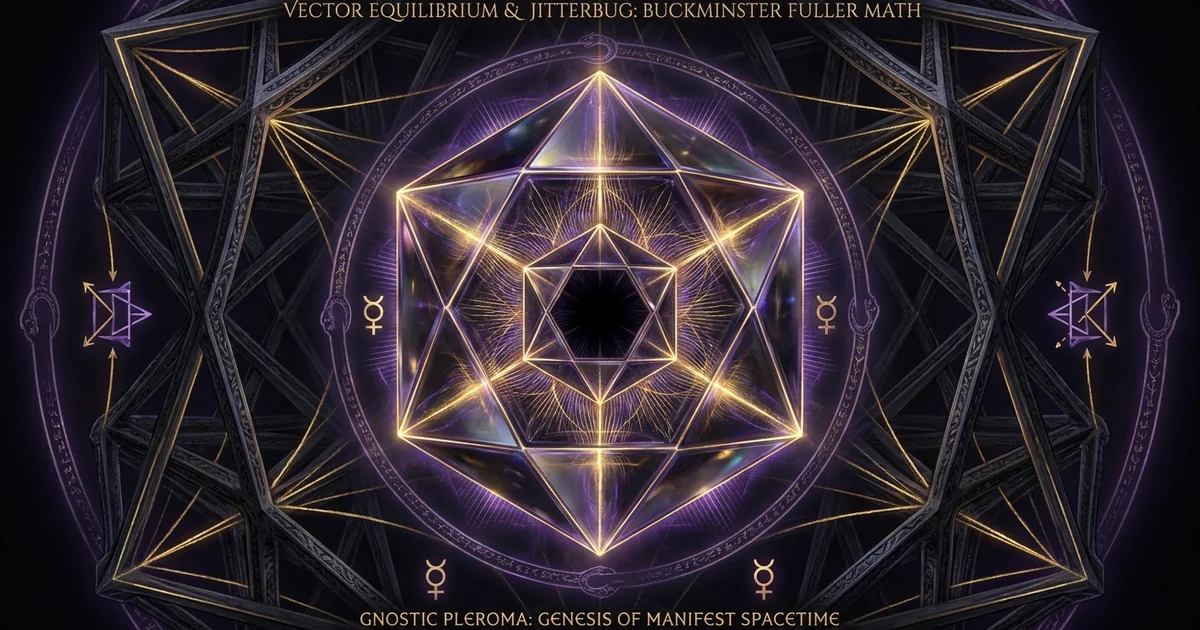
Vector Equilibrium & Jitterbug: Buckminster Fuller Math
Metaphysical Thesis & Epistemological Opening: The Vacuum Zero-Phase Paradigm
Epistemological Limitations of Cartesian Orthogonality in Quantum Topology
The enduring crisis of modern theoretical physics and metaphysics alike lies in the unexamined epistemological framework inherited from seventeenth-century Cartesian mechanics. By positing an arbitrary three-dimensional rectilinear grid—composed of three mutually perpendicular, infinite axes intersecting at an abstract origin $(0,0,0)$—standard spatial analysis imposes an unnatural ninety-degree metric onto a physical universe whose fundamental bonding, packing, and energetic distributions are definitively non-orthogonal. Cartesian coordinate systems introduce geometric distortion at the foundational level of spatial modeling. The orthogonal cube, while computationally convenient for Euclidean drafting, cannot close-pack omnidirectionally around a nucleus without leaving energetic voids or requiring extrinsic structural stabilization; it is inherently unstable, possessing structural vulnerability along its planar diagonals unless triangulated by external bracing.
In the subatomic regime and across the topological geometries governing quantum vacuum fluctuations, the physical universe does not manifest along rectilinear coordinates. Instead, nature organizes through closest-packing dynamics governed by sixty-degree triangular and tetrahedral symmetries. As demonstrated throughout the geometric inquiries of R. Buckminster Fuller in Synergetics: Explorations in the Geometry of Thinking (1975), the ninety-degree coordinate system acts as an epistemological screen that blinds investigators to the isotropic, omnidirectional energetic behaviors of the vacuum matrix. By forcing the dynamic, sixty-degree triangulation of physical forces into an artificial cubical matrix, orthodox analysis has struggled to reconcile the apparent duality between energetic manifestation (matter) and the primordial medium from which it precipitates (space). A recalibration toward the native geometry of nature requires abandoning the Cartesian box in favor of coordinate systems that emerge organically from omnidirectional vector convergence.
The Vector Equilibrium as Omnidirectional Zero-Phase Potentiality
At the center of this synergetic geometry stands the cuboctahedron, an Archimedean solid that Fuller designated as the vector-equilibrium (VE). The cuboctahedron is structurally unique within the entirety of three-dimensional polyhedral geometry: it represents the only configuration in which all inward-directed radial vectors (from the exact center to its twelve vertices) are identical in length, angular relationship, and energetic magnitude to all outward circumferential vectors (the twenty-four edges binding the twelve vertices together). In this polyhedral configuration, every tensile force is exactly counterbalanced by an equal compressive force; every radial outward thrust is nullified by an equivalent circumferential containment.
Total Radial Vectors (Center to Vertices) = 12 (Magnitude = R)
Total Circumferential Edges (Perimeter)   = 24 (Magnitude = R)
Internal Radial Angles                   = 60° (Equilateral Triangulation)
Net Vectorial Force                      = 0
Because every force vector within the system possesses an identical tensor magnitude operating at sixty-degree equilibrium, the net vectorial difference across the system is identically zero. This condition constitutes absolute zero phase energetic balance. The vector equilibrium cuboctahedron buckminster fuller synergetics jitterbug matrix does not represent a physical object in the standard empirical sense. Rather, it represents the absolute zero-point of structural mechanics: an omnidirectional energetic cancellation. It is the unmanifest ground state of physical geometry, possessing perfect symmetry, absolute neutrality, and zero physical entropy. Because it rests in absolute equilibrium, it exerts no differential pressure upon its surroundings; it produces no external electromagnetic displacement, generates no thermodynamic gradient, and remains invisible to instruments calibrated to record structural deviation.
Synergetics as an Empirical Bridge Between Hermetic Monism and Geometric Field Theory
By formalizing the vector equilibrium, Fuller’s synergetics builds a mathematically operational bridge between ancient metaphysical monism and modern quantum field theory. Historically, esoteric cosmologies have struggled to articulate the precise boundary mechanism through which the unconditioned absolute translates into conditioned multiplicity without suffering ontological degradation. In synergetic cosmology, manifest reality does not exist as an independent, self-subsisting substrate of solid matter; rather, matter is fundamentally an asymmetrical perturbation occurring within, and sustained by, this underlying matrix. Physical manifestation is structurally synonymous with disequilibrium.
To exist in time, an energetic pattern must deviate from absolute sixty-degree symmetry. It must undergo an asymmetric push or pull, elongating or compressing vectors, which disrupts the zero-phase cancellation of forces. Once a single vector within the equilibrium shifts, the neutral plenum fractures into local gradients of positive and negative curvature, compression and tension, matter and radiation. Thus, the physical cosmos described in sacred geometry and regular polyhedra emerges not through the ex nihilo creation of substance, but through the local, dynamic perturbation of an omnidirectional isotropic baseline. Fuller’s work operationalizes the Hermetic axiom of the unmanifest ground, demonstrating that physical form is an excited state of geometric balance.
In classical Gnostic and Valentinian theology, manifest material existence is categorized as the Kenoma (κένωμα)—the perceived void, deficiency, or realm of finite fragmentation. Conversely, the divine source realm is defined as the Pleroma (πλήρωμα)—the unconditioned fullness or absolute energetic saturation. Orthodox scientific paradigms inadvertently invert this dynamic by treating empty vacuum as Kenoma (a spatial void containing nothing) and physical matter as substance.
Synergetics corrects this inversion: Fuller’s Vector Equilibrium is conceptually and topologically identical to the non-dual Pleromic vacuum. It is not an empty void, but an omnidirectionally saturated energetic matrix wherein all forces are held in absolute, cancellation-level equilibrium. The material universe is thus the true deficiency (a localized metric distortion of this isotropic fullness), operating as an ephemeral departure from the eternal, zero-phase Pleroma.
Primary Codices & Historical Transmission: From Timaios to Synergetic Holism
Pythagorean Tetraktys and Platonic Regular Polytopes as Proto-Synergetic Frameworks
The genealogical roots of synergetic field theory trace directly to the pre-Socratic and Classical Greek philosophical traditions, beginning with the Pythagorean Tetraktys. In Pythagorean arithmetic-geometry, the arrangement of ten points into an equilateral triangle demonstrated that number and spatial extension were identical manifestations of harmonic ratio. The Tetraktys was not an abstract counting device; it was an ontological diagram modeling how the monad unfolds through linear (two points), planar (three points), and spatial-volumetric (four points) thresholds, establishing the regular tetrahedron as the fundamental structural unit of spatial reality.
This proto-synergetic intuition was codified in Plato’s Timaeus, wherein the fundamental elements of the physical world—fire, air, water, and earth—were mapped onto the regular convex polyhedra: the tetrahedron, octahedron, icosahedron, and cube, unified by the cosmological dodecahedron. Plato recognized that the tangible cosmos was constructed from triangular planar fields (stoicheia), asserting that the three-dimensional solidity of matter was an emergent property of geometric proportion.
However, Platonic solid geometry possessed an ontological lacuna that puzzled natural philosophers for millennia: while Plato identified the regular polyhedra that define manifest elemental forms, he did not formalize the primary geometric mediator through which these forms mutually transform. The Platonic solids remained static, discrete mathematical entities, isolated in their respective symmetries. The intermediary configuration—the omni-equilateral cuboctahedron capable of mediating structural transitions among the tetrahedron, octahedron, and icosahedron—was acknowledged merely as an Archimedean curiosity rather than the supreme zero-phase neutral origin from which the entire Platonic sequence precipitates.
Renaissance Spatial Geometry: Kepler’s Mysterium Cosmographicum Revisited
The quest to unite polyhedral geometry with cosmological dynamics resumed during the Scientific Renaissance through Johannes Kepler. In his Mysterium Cosmographicum (1596), Kepler attempted to explain the orbital distances of the six known planets by nesting the five Platonic solids within concentric celestial spheres. While Kepler’s planetary model was mathematically superseded by his own discovery of elliptical orbits in Astronomia Nova (1609), his underlying intuition—that macroscopic physical behaviors are dictated by packing limits and spatial geometries—retained profound metaphysical validity.
Kepler’s critical contribution to proto-synergetics appeared in his 1611 monograph, Strena Seu de Nive Sexangula (On the Six-Cornered Snowflake). In this treatise, Kepler formulated the Kepler Conjecture, postulating that the densest possible packing of identical spheres in three-dimensional space is achieved through either face-centered cubic or hexagonal close-packing configurations. Kepler observed that when equal spheres are packed as tightly as possible, each interior sphere is touched by precisely twelve other spheres.
In attempting to explain the morphology of snowflakes and the organization of pomegranate seeds, Kepler hovered at the structural boundary of the cuboctahedron. Yet, working before the development of vector mechanics and non-Euclidean topology, he remained constrained by visual and static polyhedral representations. Kepler identified the packing symmetry of twelve-around-one, but he could not articulate its vector-force implications, nor did he perceive that this packing concealed the kinematic engine of spacetime itself.
“Look at the things that contain and consider that nothing is more comprehensive than the bodiless… It is greater than any body and cannot be contained by anything, but it contains all things. And just as there is no center in a sphere that is not equally distant from every point on the circumference, so also God is not distant from any part of the universe… God is the infinite sphere, whose center is everywhere and whose circumference is nowhere.”
This Hermetic formulation directly foreshadows the isotropic-vector-matrix (IVM). The realization that the divine absolute is an “infinite sphere whose center is everywhere and circumference nowhere” describes an omnidirectional, isotropic distribution of potential energetic vectors wherein every local node functions as the nucleus of a twelve-around-one equilibrium matrix.
       [ Hermetic Monad: Infinite Center ]
                       │
         (Spatialization via IVM)
                       ▼
       [ Twelve-Around-One Sphere Packing ]
                       │
       (Vectorial Unification of Center-Edge)
                       ▼
       [ Vector Equilibrium (Cuboctahedron) ]
Fuller’s Rediscovery of the Isotropic Vector Matrix (IVM) as Foundational Ontology
When Buckminster Fuller initiated his structural investigations in the mid-twentieth century, he bypassed Cartesian coordinates to examine the mathematical principles governing physical packaging and structural resilience. His departure point was operational: he sought the structural coordinate system utilized by physical nature itself. Fuller recognized that energy does not travel along infinite linear trajectories; energy travels in discrete, closed finite loops and packages itself in minimal structural enclosures. Because the triangle is the only inherently stable polygon—possessing structural rigidity without requiring internal joint reinforcement—the minimal structural system of the universe must be three-dimensional triangulation: the regular tetrahedron.
By packing tetrahedra and octahedra omnidirectionally, Fuller derived the isotropic-vector-matrix (IVM). In this continuous spatial framework, every vector is identical in length, and every vertex represents an isotropic distribution of energetic forces oriented at sixty-degree angles. Within the IVM, Fuller rediscovered the cuboctahedron not merely as a polyhedral curiosity listed by Coxeter in Regular Polytopes (1973), but as the singular, absolute zero-point of spatial mechanics. Synergetics thus reclaims ancient sacred geometry, replacing static Aristotelian matter-models with dynamic vector networks. Matter is reconceived as local structural knots, or standing wave patterns, within an omnipresent, self-equilibrating energetic matrix.
Ontological Architecture: The Mechanics of Twelve-Around-One Packing
Close-Packing of Identical Spheres: The Geometric Necessity of Twelve Around One
The mechanical reality of the vector equilibrium cuboctahedron buckminster fuller synergetics jitterbug architecture is rooted in the physical and mathematical laws governing sphere packing. If one places an incompressible hard sphere upon a planar surface and arranges identical spheres tangentially around it, precisely six spheres will nest around the central sphere, forming a regular planar hexagon with all sphere centers residing on the same two-dimensional plane.
When this arrangement is extended into three dimensions, three additional spheres can be nested tangentially within the triangular valleys created by the top hemisphere of the central unit. Concurrently, three more spheres can be nested tangentially into the opposite triangular valleys on the bottom hemisphere.
Top Layer:       3 Spheres (Triangular Valley Nesting)
Equatorial Layer: 6 Spheres (Hexagonal Planar Ring)
Bottom Layer:    3 Spheres (Opposite Triangular Nesting)
-----------------------------------------------------------
Total Tangent:  12 Spheres nested around 1 Nuclear Center
This arrangement completes the twelve around one packing configuration. It is a mathematical absolute of three-dimensional Euclidean space that no more and no less than twelve identical spheres can touch a thirteenth central sphere of the same radius simultaneously without distorting the surface radii. If lines are drawn connecting the center of the nuclear thirteenth sphere to the centers of each of the twelve surrounding spheres, twelve radial vectors of length $2R$ (where $R$ is the sphere radius) are produced.
If lines are subsequently drawn connecting the centers of the twelve outer spheres to each adjacent neighbor, precisely twenty-four circumferential vectors of length $2R$ are generated. The resulting polyhedron formed by these sixty-degree vector linkages is the cuboctahedron.
Topological Anatomy of the Cuboctahedron: 12 Vertices, 14 Faces, and 24 Edges
The topology of the cuboctahedron reveals why it occupies an anomalous position in polyhedral mathematics. It is classified as an Archimedean, semi-regular, and quasiregular polytope possessing:
- 12 identical vertices, where two triangles and two squares meet symmetrically ($3 \cdot 4 \cdot 3 \cdot 4$).
- 14 faces, divided strictly into two distinct geometric geometries: 8 regular equilateral triangles and 6 regular squares.
- 24 identical edges, each functioning as a vector of equal length to the twelve interior radial vectors.
Euler’s classical polyhedral formula establishes the relationship between vertices ($V$), edges ($E$), and faces ($F$):
$$V - E + F = 2$$
Substituting the topological values of the cuboctahedron:
$$12 - 24 + 14 = 2$$
The cuboctahedron fully satisfies Euler’s topological requirement for closed surfaces. However, its behavioral dynamics diverge from classical polyhedra. In regular Platonic solids, such as the icosahedron or dodecahedron, the distance from the geometric center to the vertices is mathematically distinct from the length of the circumferential edges bounding the faces.
In the regular icosahedron, the radial distance from the center to any vertex is approximately $0.951$ of the edge length; the radial compression forces and circumferential tensile forces are non-identical, producing structural locking and physical stability. In the vector equilibrium, because the radial distance ($R$) and circumferential distance ($E$) are mathematically identical:
$$R = E$$
Every vertex sits on a knife-edge of equilibrium. The internal structural triangles (which provide rigidity) are paired with square faces (which possess dynamic, structural instablity). This balance allows the system to function not as a static cage, but as an elastic kinematic valve.
Unmanifest Vector Equilibrium (VE)
- Phase State: Zero-phase energetic balance; isotropic tensor cancellation.
- Radial/Edge Ratio: Identical ($R = E$); zero differential pressure.
- Topological Symmetry: 12 Vertices, 14 Faces (8 triangles, 6 squares), 24 Edges.
- Relative Volume: 20 (Synergetic Volumetric Scale).
- Physical Manifestation: Non-observable; absolute latent potential; zero-entropy plenum.
- Metaphysical Realm: Unmanifest Pleroma; causal vacuum ground state.
Manifest Polyhedra (Octahedron / Tetrahedron)
- Phase State: Asymmetric vector tension; structural triangulation.
- Radial/Edge Ratio: Non-equilateral ($R \neq E$); high mechanical bias.
- Topological Symmetry: Octahedron (6V, 8F, 12E) / Tetrahedron (4V, 4F, 6E).
- Relative Volume: Octahedron = 4; Tetrahedron = 1.
- Physical Manifestation: Observable physical matter; localized mass-energy and charge.
- Metaphysical Realm: Manifest Kenoma; time-differentiated spacetime reality.
The Energetic Silence: Why the Center of the VE is Geometrically Zero-Entropy
The ontological center of the vector equilibrium represents a geometric paradox: it is an absolute spatial coordinate that contains zero structural mass and exhibits zero differential entropy. Because the twelve vectors radiating from the nuclear center pull outward into space with equal force, and because the twenty-four circumferential vectors constrain those vectors with reciprocal tension, every mechanical vector within the system cancels its opposing counterpart:
$$\sum \vec{F}{\text{radial}} + \sum \vec{F}{\text{circumferential}} = 0$$
This dynamic cancellation ensures that no directional trajectory dominates the internal volume. If an observer or a sensory apparatus were positioned at the center of a true vector equilibrium, that apparatus would register zero temperature difference, zero pressure gradient, zero gravitational drift, and zero electromagnetic flux.
This condition of complete cancellation is what Fuller referred to as “the energetic silence” of the Vector Equilibrium. It does not exist as an observable physical entity because all physical instrumentation relies upon differential friction—the transfer of energetic imbalance from one system to another. The VE represents the zero-entropy state from which all energetic fluctuations proceed and to which all decayed systems return. It is the unmanifest zero-phase energetic balance that underwrites the continuous thermodynamic operations of physical reality.
Phenomenological Mechanics & Transformational Folding: The Jitterbug Cycle
Kinematic Metamorphosis: Vector Equilibrium to Octahedron to Tetrahedron
The foundational dynamic discovery of synergetics is Fuller’s demonstration that the cuboctahedron is not a rigid polyhedron, but a continuous kinematic mechanism. If the twelve vertices of a physical model of a vector equilibrium are articulated with flexible joints and its square faces are left open, the structure loses its static equilibrium and undergoes a continuous, omnidirectional transformation known as the jitterbug-transformation.
The Jitterbug is not an arbitrary mechanical deformation; it is an ordered, symmetrical, and continuous transformational folding geometry through which the vector equilibrium transitions smoothly across the primary symmetries of spatial geometry.
As the kinematic cycle commences, the six square windows of the vector equilibrium begin to contract, folding along their diagonals. As these square apertures close, the eight triangular faces rotate symmetrically around their centers, twisting inward along spiral pathways.
The structure immediately contracts from the neutral cuboctahedron into an icosahedron. Continued uniform compression forces the edges to slide further, causing the twelve vertices to pair off and merge into six dual-vertices, snapping the system into the geometry of a regular octahedron.
From the octahedron, continued folding forces the faces to pass through one another until all twenty-four edges align into a four-layered, completely flat planar triangle, or fold into the minimal three-dimensional structural enclosure: the regular tetrahedron.
The transformation proceeds continuously without severing any vertex connections, illustrating that all regular polyhedra are phase-states of a single dynamic continuum.
The Volumetric Collapse: 20 to 4 to 1 and the Quantization of Space
In Fuller’s synergetic mathematics, spatial volume is calculated not using the Cartesian cube as a unit of measurement (which Fuller demonstrated introduces irrational values such as $\sqrt{2}$ and $\pi$ into basic structural volumetric relationships), but using the regular tetrahedron of unit edge length as the foundational quantum of space ($V_{\text{tet}} = 1$).
When space is quantified through tetrahedral units, the volumetric ratios governing the Jitterbug transformation become whole rational integers:
$$V_{\text{VE}} = 20 \longrightarrow V_{\text{Icosahedron}} \approx 18.512 \longrightarrow V_{\text{Octahedron}} = 4 \longrightarrow V_{\text{Tetrahedron}} = 1$$
Polyhedral Phase        Tetrahedral Volume    Structural Symmetries
Vector Equilibrium      20.000                Omnidirectional Equilibrium (Zero-Phase)
Icosahedron             18.512                Golden Ratio Harmonic / Structural Skin
Regular Octahedron       4.000                Planar Symmetry / Vector Crossing
Regular Tetrahedron      1.000                Minimal Structural Enclosure / Mass Core
This rational step-down process provides an operational model for the quantization of physical reality. As the vector equilibrium collapses from volume 20 down to volume 1, it models how isotropic, omnidirectional vacuum energy steps down volumetrically and thermodynamically to localize mass-energy.
The volumetric drop from twenty to one represents an increase in localized density and structural resistance. The system transitions from an unmanifest, zero-entropy, non-triangulated balance (volume 20) into a hard, triangulated, structurally locked matter-state (volume 1). Matter is thus mathematically demonstrated to be a topologically compressed, folded state of empty vacuum.
Torsional Chiral Spin and the Genesis of Electromagnetic Polarization
The critical mechanical feature of the Jitterbug cycle is its mandatory chiral nature. A cuboctahedron cannot collapse radially inward along straight linear vectors toward its center; to do so would cause its structural edges to collide and lock instantaneously. In order to contract volumetrically, the Jitterbug must rotate. The eight triangular faces must undergo a simultaneous, coordinated torsional spin around their local axes.
This rotational requirement introduces intrinsic chirality: the collapse must proceed either as a right-handed dextrorotatory spiral or a left-handed levorotatory spiral. At the precise instant the vector equilibrium departs from its zero-phase energetic balance, it breaks the parity of space.
[ Neutral Zero-Phase VE ]
                         │
         ┌───────────────┴───────────────┐
         ▼                               ▼
  [ Levorotatory ]               [ Dextrorotatory ]
  (Left-Hand Twist)              (Right-Hand Twist)
         │                               │
         ▼                               ▼
  [ Negative Charge /            [ Positive Charge /
    Matter Continuum ]             Antimatter Continuum ]
This rotational inflection generates angular momentum, producing the fundamental mechanics of electromagnetic polarization, spin, and the thermodynamic arrow of time. What physics describes as charge and polarity (positive and negative, matter and antimatter) is geometrically revealed as the torsional directionality of the Jitterbug cycle collapsing away from the unmanifest zero-point of the isotropic vector matrix.
Once the collapse reaches its tetrahedral limit (volume 1), the system encounters absolute mechanical compression, forcing a rebound through the central zero-point that expands the structure outward into an inverted phase with opposite chirality. This pumping dynamic mirrors the continuous inhalation and exhalation of energy across the quantum vacuum.
Cosmological Interfaces: Interdimensional Systems and Informational Control
Jacques Vallée’s Control System Reconceptualized Through Polyhedral Phase Shifts
In his foundational work Messengers of Deception (1979), Jacques Vallée proposed that anomalous aerial phenomena, unidentified aerial phenomena (UAP), and non-human intelligence (NHI) incursions should not be interpreted through the lens of the conventional extraterrestrial hypothesis—which presumes physical spacecraft traversing vast interstellar distances via propulsion through Euclidean space.
Instead, Vallée posited that these phenomena represent manifestations of an underlying informational control system: a trans-dimensional technology capable of modulating human consciousness, cultural paradigms, and local spacetime metrics simultaneously.
“I propose that there is a physical reality to the UFO phenomenon, but that it is not necessarily an extraterrestrial spacecraft; it is a technology that manipulates space, time, and consciousness itself… The phenomenon is an information system, a thermostat of human cultural evolution, operating through physical mechanisms that our current rectilinear physics cannot decode.”
Reconceptualized through synergetics, Vallée’s informational control system finds its mechanical substrate within the isotropic-vector-matrix and the transformational dynamics of the Jitterbug. An anomalous vehicle or interdimensional entity does not travel across space along a three-dimensional Cartesian line; rather, it performs controlled polyhedral phase shifts within the vacuum geometry.
By modulating the local vector equilibrium balance, such a system can alter its volumetric phase state: shifting from a collapsed, highly dense, visible tetrahedral or octahedral state (which interacts with the electromagnetic spectrum and registers on radar) back into the unmanifest, zero-phase cuboctahedron (which possesses no differential resistance and is entirely invisible to conventional optical and radar instrumentation). Trans-dimensional transit is thus revealed not as kinetic displacement through space, but as topological state-changes within the informational fabric of space itself.
High Strangeness Anomalies as Metric Perturbations in the Local IVM Lattice
The historical literature of anomalous phenomena is saturated with accounts characterized by J. Allen Hynek and Jacques Vallée as high-strangeness. These include:
- Instantaneous right-angle turns executed at hypersonic velocities without observable inertial deceleration.
- Sudden, complete materialization and dematerialization in plain view.
- Radar-visual dissociation (objects observed visually that cast no radar signature, or vice versa).
- Localized spacetime distortions, including time dilation and missing time reported by witnesses.
Within the framework of Cartesian physics, these behaviors violate fundamental conservation laws, requiring infinite energy to overcome inertia or produce spontaneous dematerialization. However, when analyzed through the interdimensional-hypothesis coupled with Fuller’s synergetic geometry, these anomalies emerge as natural consequences of local metric adjustments within the IVM.
An object that operates by altering its local geometric relationship to the zero-phase vacuum does not push against the surrounding air or react against gravitational fields; it reconfigures the local vector tension of the space it occupies.
Conventional Propulsion:      [ Vehicle ] ───(Kinetic Thrust)───► Pushes Against External Space
Synergetic Phase Modulation:  [ Vector Matrix ] ───(Jitterbug Phase Shift)───► Re-indexes Local Spacetime Metric
If a craft-envelope induces a Jitterbug expansion from an octahedral phase (volume 4) toward the neutral vector equilibrium (volume 20), its effective inertial mass drops toward zero as its forces cancel omnidirectionally. An object with zero net vectorial force possesses no linear inertia; it can shift its localized coordinate orientation instantly without experiencing internal G-forces, because it is not moving through space—rather, space is dynamically folding and unfolding through its operational envelope.
Non-Human Intelligence (NHI) Kinematics: Vacuum Polarization and Trans-Dimensional Egress
The operational mechanics of NHI incursions may be rigorously modeled as dynamic vacuum polarization achieved through polyhedral resonance. Because the isotropic vector matrix fills all physical space, operating as the continuous geometric ground state of reality, it constitutes an omnidirectional communications and transport lattice.
An intelligence possessing mastery over this geometry would not construct brittle, macroscopic metal craft designed to fight atmospheric drag; they would engineer dynamic fields capable of driving the local vacuum through precise Jitterbug transitions.
Egress from higher-dimensional manifolds (such as Calabi-Yau spatial configurations or hyperspatial rotations through $E_8$ Lie algebra projections) into our local 3+1 dimensional reality occurs precisely at the node-points of the vector equilibrium.
The twelve vertices of the cuboctahedron serve as the geometric transformation port through which higher-dimensional vector degrees of freedom step down into the physical domain. By polarizing the twelve around one packing nodes of the local vacuum, NHI systems can punch through the zero-phase barrier, generating a transient, localized spatial bubble that manifests to human observers as an anomalous physical phenomenon, only to fold back into the unmanifest vacuum matrix once the energetic polarization is released.
Initiatic Synthesis & Philosophical Implications: Reality Architecture and Sovereignty
The Merkabah as Living Jitterbug: Esoteric Merkavah Mysticism in Synergetic Light
In the mystical traditions of the Kabbalistic Ma’aseh Merkavah (the Work of the Chariot) documented in early Heikhalot literature and the vision of Ezekiel, the mystic encounters the divine throne-chariot characterized by “wheels within wheels” (ophanic mechanics) and the Chayot—four-faced living creatures moving with absolute synchronization, darting forth and returning like flashes of lightning (ratzo v’shov).
Within Western esoteric traditions, this vehicle is formalized as the merkabah: an interdimensional field of counter-rotating geometric fields traditionally visualized as two interpenetrating tetrahedra forming a stellated octahedron (the Star Tetrahedron or double-tetrahedron system).
▲
                     / \
                    /   \
                   /  ▲  \
                  /  / \  \
                 ├──┼───┼──┤
                  \  \ /  /
                   \  ▼  /
                    \   /
                     \ /
                      ▼
        [ Counter-Rotating Merkabah ]
                      │
     (Kinematic Equivalence to Synergetics)
                      ▼
[ Full Jitterbug Dynamic Cycle: Ratzo V'Shov ]
When evaluated through synergetic mathematics, the classical Merkabah is recognized not as a static visual talisman, but as the living, kinematic dynamic of the Jitterbug transformation itself. The movement of the Chayot—the ratzo v’shov (“running and returning”)—is the exact phenomenological description of the Jitterbug’s continuous volumetric collapse from the vector equilibrium down to the tetrahedral core and its subsequent expansion back to the isotropic plenum.
The counter-rotating tetrahedra of Merkavah mysticism constitute the minimal, structurally closed phase-state of the Jitterbug cycle. Esoteric Merkavah ascension was, at its structural core, an initiatic technique designed to synchronize the practitioner’s subtle energetic field with the fundamental pumping cycle of the zero-phase vacuum, allowing the consciousness of the adept to achieve trans-dimensional egress through the eye of the vector equilibrium.
Overcoming Egregoric Entanglement through Grounding in Zero-Phase Equanimity
A central peril identified within advanced esoteric practice and high-strangeness research is capture by an egregore—a non-physical, autonomous psychic thoughtform or collective entity generated through the focused, emotional, and cognitive investments of human groups.
Within the informational control system framework of Vallée, egregores operate as informational parasites, feeding upon asymmetric energetic distributions: fear, dogmatic religious fervor, ideological obsession, and ontological shock.
Asymmetric Polarization (Fear/Dogma) ──► Egregoric Resonance ──► Cognitive Entrapment
                                                                     │
Zero-Phase Vector Neutralization      ──► Absolute Equanimity  ──► Consciousness Sovereignty
Synergetics provides the geometric blueprint for neutralizing egregoric entanglement. An egregore can only attach to an energetic system that possesses asymmetric polarization. When a human consciousness operates with high emotional polarity—oscillating between attachment and aversion—it manifests an unbalanced polyhedral profile, presenting open vector hooks that render it vulnerable to manipulation by social, institutional, or trans-dimensional control architectures.
By cultivating profound inner equanimity—the mystical apatheia of the Stoics, the upeksha of Buddhist psychology, or the state of neutral awareness taught in Hermeticism—the practitioner systematically retracts these asymmetric vectors, returning the subtle psycho-spiritual field to the state of the vector equilibrium.
In this state of zero-phase energetic balance, every emotional, cognitive, and perceptual vector is counterbalanced by an equal and opposite force; the practitioner manifests zero differential resistance. Because the egregore relies upon energetic gradients to feed its structural pattern, an individual anchored in the zero-phase center becomes topologically transparent to predatory informational entities.
The systematic acceleration of the human bio-energetic field through ungrounded Jitterbug visualization or hyperdimensional geometric invocation carries severe psychological and somatic risks.
When the consciousness attempts to align with the higher polyhedral transformations of the Vector Equilibrium without adequate somatic grounding, the nervous system can experience profound metric dissonance. This disorientation manifests clinically as severe ontological shock, depersonalization, dissociative identity fracturing, manic grandiosity, or dangerous inflation of the personal ego (identifying the individual finite self with the universal omnidirectional IVM matrix).
Adept training mandates that vector neutralization (the return to zero-phase balance) must be rigorously stabilized within the lower physical centers before any conscious engagement with the kinematic Jitterbug collapse cycle is attempted.
Human Consciousness as an Active Operator Within the Isotropic Vector Matrix
The ultimate philosophical implication of synergetic mathematics is that human consciousness is not an accidental epiphenomenon sequestered inside an organic skull, but an active, embedded operator seated within the isotropic-vector-matrix itself. The mind, through its faculties of intention, conceptualization, and observation, functions as a local geometric transducer. Every cognitive act introduces a subtle tension into the surrounding spatial field, initiating micro-scale Jitterbug transformations that ripple throughout the omnidirectional matrix.
Sovereignty within this framework is not achieved through brute effort, ideological conquest, or the accumulation of physical force—methods that belong entirely to the entropic, Cartesian paradigm of physical push and pull. Realized sovereignty occurs through conscious alignment with the primary geometric laws of the universe.
By understanding the mechanics of twelve-around-one packing, the transformational folding geometry of the Jitterbug, and the ontological primacy of the vector equilibrium, the sovereign individual ceases to be a passive victim of external control systems.
The practitioner steps into the role of a conscious reality architect, operating from the silent, zero-entropy center of the unmanifest Pleroma, directly participating in the continuous manifestation, stabilization, and spiritual evolution of spacetime reality.
Frequently Asked Questions
Why did Buckminster Fuller consider the Vector Equilibrium to be ‘non-material’?
Buckminster Fuller categorized the vector equilibrium (cuboctahedron) as definitively non-material because it is an absolute balance of forces, possessing no internal differential pressure, no asymmetric vector bias, and no structural triangulation. In synergetic physics, physical “matter” is defined by its ability to perform work, exert localized force, and resist external loads, which requires structural triangulation (the property of the tetrahedron, octahedron, and icosahedron).
Because the vector equilibrium consists of equal radial and circumferential vectors arranged with alternating square and triangular faces, its push and pull forces cancel each other out entirely:
$$\sum \vec{F} = 0$$
It has no structural integrity; it is unstable and cannot hold a load. Consequently, the vector equilibrium cannot be directly detected or measured by physical instrumentation, because all physical measurement depends upon registering energetic displacement, friction, or resistance. The VE is the unmanifest zero-point of spatial mechanics—the invisible, non-material metaphysical vacuum from which manifest physical structures arise.
How does the Jitterbug transformation explain the generation of physical mass from empty space?
The Jitterbug transformation models the generation of physical mass through the continuous, topological folding and volumetric collapse of space. The unmanifest ground state—the vector equilibrium—possesses a relative tetrahedral volume of 20. Through the Jitterbug process, this expanded, zero-phase state contracts symmetrically through torsional chiral spin, passing through the icosahedron (volume 18.51) and octahedron (volume 4), down to the hard, triangulated regular tetrahedron (volume 1).
This progressive collapse represents a 20-to-1 volumetric densification of the spatial field. As the volume contracts, the spatial vectors triangulate, locking into rigid mechanical relationships that resist deformation.
This structural resistance to deformation is the geometric definition of inertia and mass. Thus, physical mass is not an intrinsically heavy, solid substance introduced into space from the outside; it is localized spatial geometry compressed, twisted, and structurally locked via the Jitterbug cycle within the isotropic vector matrix.
What is the functional difference between an icosahedron and a cuboctahedron in synergetic cosmology?
The functional difference between an icosahedron and a cuboctahedron is the difference between manifest life-structural skin and unmanifest zero-phase equilibrium. The cuboctahedron (vector equilibrium) possesses 12 vertices, 14 faces (8 triangles, 6 squares), and 24 identical vectors. Because its radial vectors equal its edge vectors ($R = E$), it is non-triangulated, structurally unstable, and zero-entropy; it cannot enclose physical systems or support life-forms because it exerts no outward tension.
Conversely, the icosahedron is a fully triangulated Platonic solid possessing 12 vertices, 20 equilateral triangular faces, and 30 edges. Its radial vectors are shorter than its circumferential edges:
$$R \approx 0.951 \cdot E$$
This contraction pulls the structure into a rigid, self-stabilizing tensile shell governed by the golden ratio ($\Phi$). In synergetic cosmology, the icosahedron represents the prime structural container of manifest physical and biological existence, serving as the geometric basis for viral capsids, cellular architecture, and radiolaria, while the cuboctahedron remains the invisible, dynamic valve governing transitions between systems.
How does the twelve-around-one packing principle refute Cartesian space in esoteric theology?
The twelve-around-one packing principle refutes Cartesian space by demonstrating that the natural geometry of three-dimensional space is omnidirectional, isotropic, and sixty-degree-based, rather than rectilinear and ninety-degree-based. In Cartesian geometry, space is modeled as an infinite, homogeneous cube subdivided by three perpendicular axes. However, when identical physical spheres are packed around a central nucleus with maximum density, exactly twelve spheres nest tangentially around the central sphere—never eight (which would correspond to the corners of a Cartesian cube).
Connecting the centers of these spheres yields the cuboctahedron, structured entirely around sixty-degree equilateral triangulation. In esoteric theology, this packing rule proves that the spatial fabric is natively organized around a dodecanary, radial harmony:
Esoteric/Cosmological Alignments:
• 12 Apostles around Christ
• 12 Tribes of Israel around the Tabernacle
• 12 Signs of the Zodiac around the Sun
• 12 Imams around the Central Prophet
These archetypal arrangements are not arbitrary mythological motifs, but expressions of a fundamental spatial law: any manifest entity seeking absolute, isotropic balance within the physical cosmos must interface with twelve primary directions of energetic containment, rendering Cartesian orthogonality an artificial human reductionism.