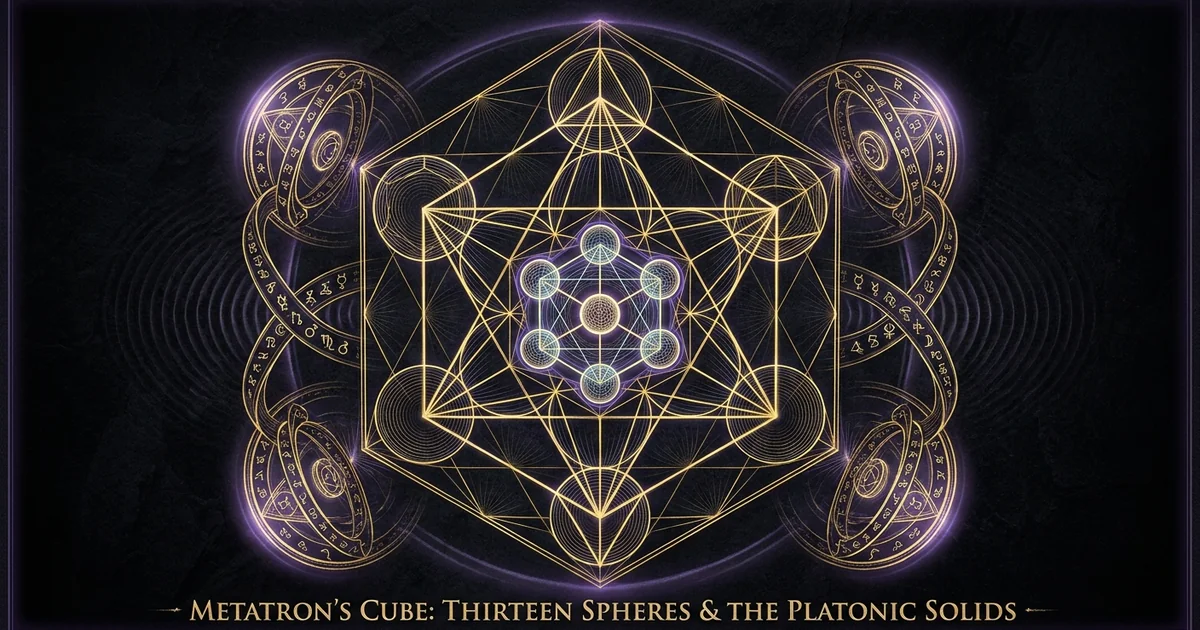
Metatrons Cube: Thirteen Spheres & the Platonic Solids
Metaphysical Thesis & Epistemological Opening: The Morphogenetic Template of Form
Projective Geometry as a Vector Matrix for Consciousness
The ontological status of geometric form has historically oscillated between two irreconcilable paradigms: the nominalist perspective, which reduces geometry to an empirical abstraction derived post facto from material observation, and the transcendental realist perspective, which identifies geometric ratios as the prior morphogenetic condition of matter itself. In the study of metatrons cube sacred geometry thirteen spheres platonic solids, this tension collapses into a unified hyperdimensional physics. Far from constituting an arbitrary glyph or an ornamental product of medieval draftsmanship, Metatron’s Cube operates as an orthographic projection—a rigorous two-dimensional shadow cast by a higher-dimensional uniform polytope rotating through $n$-dimensional space.
When approached through projective geometry, the system demonstrates that spatial morphology is fundamentally downstream of an informing vector matrix. In the language of the esoteric canon, spatialized topology is the precipitate of archetypal consciousness, a doctrine articulated across the /ancient-prehistory/hermetic-cosmology-corpus-hermeticum and late antique Neoplatonism. The two-dimensional rendering of the figure preserves metric incidences, rotational invariances, and projective cross-ratios that disclose how unconditioned awareness contracts into discrete energetic registers. The thirteen nodal intersections do not merely delineate Euclidean coordinate assignments; they configure a dynamic tension network through which intentionality traverses dimensional thresholds, cascading from the unmanifest pleroma into the crystallized structures of physical space.
To comprehend this architecture is to recognize that what classical phenomenology terms “empty space” is an isotropic continuum structured by non-arbitrary symmetries. The linear projections connecting these thirteen informational loci map the precise pathways along which scalar energy condenses into physical vectors. Consequently, the study of archangel metatron vector geometry ceases to be an inquiry into static symbolic taxonomy and reveals itself as an operational investigation into how trans-dimensional form governs physical manifestation.
Challenging Reductive Materialism Through Sacred Proportion
Reductive materialism proceeds from the Cartesian and Newtonian axiom that space is a passive, uniform receptacle populated by discrete, unextended mass-points interacting via external forces. Under this framework, proportion is incidental—a secondary quality emerging from accidental thermodynamic collisions. Metatron’s Cube systematically refutes this postulate by establishing proportion as an a priori boundary condition. By embedding the irreducible symmetry groups of all five regular polyhedra within a single coherent matrix, the configuration proves that space possesses an intrinsic crystallographic syntax. Matter does not arbitrarily coalesce and subsequently discover the laws of symmetry; rather, mass can only nucleate where the underlying vector fields allow standing-wave equilibrium.
The designation Metatron (Hebrew: מֶטָטְרוֹן) eludes standard Semitic root structures, pointing toward an intentional Greek loan-concept adapted within early Merkabah scholasticism. Textual hermeneutics suggests two primary derivations: meta-thronos (μετὰ θρόνον, “he who serves beside the Divine Throne”) and metator (Latin: “measurer,” “divider,” or “pioneer of encampment”). In both operational contexts, Metatron is ontologically defined not as a personalized entity in the anthropomorphic sense, but as the cosmic geometer, the Archon of the Presence, and the supreme informational interface mediating between the boundless, unmanifest Ain Soph and the spatialized, quantified registers of the lower worlds. Metatron functions as the divine axis through which the infinite contraction (tzimtzum) is calibrated into mathematically coherent, manifest reality.
The implications of this structural priority strike at the heart of contemporary quantum morphogenesis. When biological systems organize—whether in the spiraling capsids of complex viruses, the microtubular architecture of eukaryotic cells, or the embryological cleavages documented in morphogenetic field theory—they trace the exact linear and angular constraints inscribed within this geometric engine. Sacred proportion, within this rigorous context, is neither mystical aestheticism nor superstitious numerology. It is the hydrodynamic efficiency of the vacuum, the minimum-effort pathway through which infinite energetic potential achieves finite dimensional stabilization. The deterministic physical universe is thus revealed to be continuously informed by an immutable substrate of sacred proportion that reductive materialism can observe, but fundamentally fails to originate.
The Thirteen-Sphere Topology: Beyond the Two-Dimensional Veil
To evaluate Metatron’s Cube merely as a flat collection of circles intersected by straight lines is an epistemological category error induced by planar printing technologies. The foundational substrate of the matrix is a three-dimensional cluster of thirteen equal spheres in a state of dense packing. In three dimensions, the maximum number of non-overlapping unit spheres that can simultaneously touch a central unit sphere of identical radius is precisely twelve—a geometric reality formally proved in modern mathematics as the solution to the Gregory-Newton kissing number problem.
                  [ Sphere 2 ]     [ Sphere 3 ]
             [ Sphere 1 ]               [ Sphere 4 ]
                   \                  /
                    \                /
[ Sphere 12 ] ----- [ Central Sphere ] ----- [ Sphere 5 ]
                    /   (Singularity) \
                   /                  \
             [ Sphere 11 ]              [ Sphere 6 ]
                  [ Sphere 10 ]    [ Sphere 7 ]
                     (Spheres 8 & 9 Polar Alignment)
This thirteen-sphere aggregate—one central nucleus surrounded by twelve peripheral nodes—forms the structural core of isotropic close-packing, configuring either a cuboctahedron (Vector Equilibrium) or an icosahedron depending on whether the radial tension favors cubic or pentagonal symmetry. The central sphere occupies the zero-point singularity, the non-extended origin from which the twelve directions of cosmic radiation diverge. The twelve surrounding spheres demarcate the outer parameters of the local field, defining the structural perimeter of the first emergent spatial domain.
When the centers of these thirteen spheres are identified as informational nodes and connected via straight linear vectors, the resulting web of 78 lines constitutes the linear matrix traditionally called Metatron’s Cube. The flat figure is not a design meant for two-dimensional habitation; it is an orthographic projection plan, an architectural blueprint of higher-dimensional hyperspheres projecting their equatorial nodes onto the receptive plane of human perception. Understanding this topological reality is the prerequisite for decoding how the higher-dimensional forms of the Platonic solids precipitate into experiential manifestation.
Primary Codices & Historical Transmission: Enochian Transfiguration and Geometrical Canon
The Elevation of Enoch in 3 Enoch and Merkabah Mysticism
The historical genealogy of Metatron’s Cube is deeply anchored in the early Jewish visionary tradition known as Merkabah (Chariot) and Hekhalot (Palaces) mysticism, which flourished from the late Hellenistic period through the geonic era. Central to this literature is the pseudepigraphal figure of Enoch, the seventh antediluvian patriarch who, according to Genesis 5:24, “walked with God, and he was not, for God took him.” In the monumental text 3 Enoch (also designated as the Hebrew Book of Enoch, edited and translated by Hugo Odeberg in 1928), this laconic biblical allusion is expanded into an elaborate account of ontological transfiguration.
“Rabbi Ishmael said: The angel Metatron, Prince of the Presence, said to me: As soon as the Holy One, blessed be He, took me to serve the Throne of Glory, the Wheels of the Chariot (Galgalim) and all the needs of the Shekinah, immediately my flesh turned into flames, my sinews into blazing fire, my bones into juniper coals, my eyelashes into lightning flashes, my eyeballs into fiery torches, and the hair of my head into hot flames. All my limbs were transformed into burning fiery substance, and the stature of my body was extended to the height, breadth, and depth of the world’s seven heavens… and He placed His hand upon me and blessed me with seventy-two names, and gave into my hand the cosmic measuring rod.” — 3 Enoch; or, The Hebrew Book of Enoch, ed. and trans. Hugo Odeberg (Cambridge University Press, 1928).
As Gershom Scholem demonstrates in his foundational Major Trends in Jewish Mysticism (1941), the Merkabah literature does not depict a passive mystical absorption into the godhead, but rather an arduous, theurgic ascent through seven concentric celestial palaces guarded by terrifying archontic gatekeepers. Enoch’s elevation marks the zenith of this tradition: a mortal being transformed through cosmic geometry, fire, and divine measurement into the “Lesser YHVH” (YHVH Ha-Katan). The transfiguration described in 3 Enoch is explicitly geometrical; Enoch’s body is unmade and reconstituted according to the spatial metrics of the divine throne room, expanding across the Cartesian dimensions of the created cosmos.
Human Enoch (Mortal Consciousness)
       │
       ▼ [Ascent through Seven Hekhalot / Palaces]
       │
Divine Deconstruction (Sinews to Fire, Limbs to Spatial Breadth)
       │
       ▼ [Investiture with 72 Divine Names]
       │
Archangel Metatron (The Cosmic Geometer / Keeper of the Chariot)
       │
       ▼ [Projection of the Vector Matrix]
Structural Geometry of Physical Spacetime (Metatron's Cube)
Within this mystical framework, Enoch-Metatron is entrusted with the structural secrets of creation—secrets encoded as dynamic alphabetic and geometric combinations. The transformation of his limbs into measures of fire illustrates the conversion of discrete biological awareness into a trans-spatial field of structural consciousness capable of upholding the cosmic order.
Cosmic Measuring and the Chariot Throne Architecture
The central functional attribution granted to Metatron across both 3 Enoch and the emanative cosmogonies of the Sefer Yetzirah (as illuminated by Aryeh Kaplan, 1990) is that of cosmic surveyor and geometer. The “measuring rod” placed in his hand signifies the divine authority to delimit space—to enact the boundary conditions without which the infinite light would dissolve all differentiated forms. The Sefer Yetzirah states that the universe was engraved through thirty-two mystical paths of wisdom, consisting of the ten primordial Sefirot (numbers or structural dimensions) and the twenty-two foundation letters of the Hebrew aleph-bet.
The architecture of the Chariot Throne (Merkabah) is intimately linked to the thirteen-node array. The chariot seen by Ezekiel—with its nested wheels (ophanim), its four living creatures (chayot), and its vault of crystalline firmament—describes a multi-axis rotational gyroscope of geometric light. The thirteen spheres correspond structurally to the twelve foundational boundaries of the universe, enclosing a thirteenth interior axis: the holy palace located at the exact equilibrium point, where the unmanifest intersects with the manifest. In Scholem’s analysis, early Jewish Gnosticism conceived of this cosmic center as the locus through which the secret dimensions of the cosmos (Shi’ur Qomah) could be accessed by the initiate through precise visionary theurgy.
Metatron’s function is the stabilization of this matrix. Without his continuous measurement and vector balancing, the manifested cosmos would collapse into ontological entropy or be instantly reabsorbed into the unmitigated radiance of the Ain Soph. The geometric canon preserved under his name thus constitutes the explicit structural engineering manual of the Merkabah ascension apparatus, a blueprint detailed extensively in /consciousness/merkabah-ascension-mechanics.
Renaissance Hermetic Reception: From Pacioli to Modern Morphometry
The esoteric knowledge preserved within Jewish Merkabah circles crossed cultural and linguistic thresholds during the European Renaissance, driven by the syncretic impulse of the Christian Cabala and the revival of the Corpus Hermeticum. Scholars such as Marsilio Ficino, Pico della Mirandola, and later Johannes Reuchlin integrated Jewish esoteric linguistic-geometric schemas into Western natural philosophy. This cross-pollination culminated in the rigorous geometric work of Fra Luca Pacioli, whose masterwork De Divina Proportione (1509), illustrated by Leonardo da Vinci, formalized the sacred nature of the five regular polyhedra and their nested relationships.
Pacioli linked the divine proportion ($\phi$, the golden ratio) and polyhedral geometry directly to the mechanics of divine creation, translating what had been an oral and visionary Merkabah tradition into public mathematical discourse. Following Pacioli, Johannes Kepler, in his Mysterium Cosmographicum (1596), attempted to map the planetary orbits through a visionary scaffolding of nested Platonic solids. Kepler was consciously channeling the Hermetic axiom of structural correspondence: that the visible heavens are an empirical realization of an archetypal, hyperdimensional polyhedral lattice.
In the twentieth century, this lineage was rescued from artistic and historical obscurity by Keith Critchlow (Order in Space, 1970) and the pioneering geometer H.S.M. Coxeter (Regular Polytopes, 1973). Critchlow demonstrated that the packing of circles and spheres was not merely an aesthetic strategy of sacred architecture, but the physical basis of structural morphology in nature. Coxeter provided the rigorous mathematical formalisms proving that lower-dimensional projections of higher-dimensional polytopes preserve precise rotational and dihedral symmetries. Modern morphometry thus validated the core intuition of the Renaissance Hermeticists: that the two-dimensional canonical diagrams inherited through the esoteric tradition represent rigorous orthographic projections of objective, higher-dimensional spatial systems.
Ontological Architecture & Cosmological Models: The Thirteen Spheres and the Polyhedral Orthogonal Lattice
Derivation of the Fruit of Life from the Hexagonal Flower Matrix
The generation of Metatron’s Cube begins not with the isolated node, but with the isotropic propagation of overlapping circular fields. The process initiates with the Monad—a single center radiating a circumferential boundary. Through the linear displacement of this initial center by a distance precisely equal to its radius, the Vesica Piscis emerges, providing the geometric root for $\sqrt{3}$, the generative ratio of three-dimensional orthogonal space. Continuing this radial projection at intervals of sixty degrees yields the Genesis pattern, which sequentially self-organizes into the sevenfold Seed of Life, and ultimately into the nineteen-circle array historically designated as the Flower of Life.
[ Genesis Point: Monad ]
              │
              ▼
    [ The Vesica Piscis ]  --> (Generates √3 dynamic proportional ratio)
              │
              ▼
     [ The Seed of Life ]  --> (7 intersecting circles; initial hexad)
              │
              ▼
    [ The Flower of Life ] --> (19 overlapping circles within boundary)
              │
              ▼
     [ The Fruit of Life ] --> (13 isolated tangent spheres; no overlapping)
              │
              ▼
    [ Metatron's Cube ]    --> (78 interconnected linear vectors)
The transformation from the Flower of Life to the Fruit of Life marks an ontological phase change from field propagation to discrete nodal definition. The Flower of Life contains intersecting arcs where the circumferences pass through adjacent centers, creating a continuous, undifferentiated lattice of energetic potentials. To extract the Fruit of Life, one must isolate thirteen specific non-intersecting, mutually tangent spheres out of the underlying hexagonal matrix.
These thirteen spheres are arranged in three intersecting linear axes of five spheres each, crossing at the single central origin at sixty-degree angles. Unlike the Flower of Life, where the circles overlap fluidly, the thirteen spheres of the Fruit of Life touch exclusively at tangent points. This isolation marks the formal transition from unconstrained continuous wave propagation to the discrete, quantized informational grid necessary for the emergence of matter.
Vector Orthogonality and the 78 Connecting Struts
Once the thirteen centers of the Fruit of Life are isolated, an absolute structural protocol is enacted: every individual center must be linked via a linear vector to every other center in the array. The total number of non-directional lines generated by connecting $n$ distinct nodes is determined by the combinatorial formula for pairs:
$$E = \frac{n(n - 1)}{2}$$
For $n = 13$ nodes, this yields:
$$E = \frac{13(13 - 1)}{2} = \frac{13 \times 12}{2} = 78 \text{ lines}$$
These 78 vectors—the fruit of life pattern lines—do not inhabit a single geometric length; they resolve into four distinct, harmonically proportional lengths depending on their radial trajectory across the hexagonal lattice.
Through this dense, symmetrical webbing, vector orthogonality is established across the entire system. The 78 lines are not arbitrary cords; they represent all possible linear permutations of force running between the thirteen nodal singularities. Within these 78 connecting struts lie the planar projection planes and dihedral angles required to project three-dimensional Platonic solids onto a two-dimensional surface without metric distortion of their rotational axes. The matrix becomes an isotropic vector system, possessing an intrinsic equilibrium that mirrors the fundamental balance of forces in high-energy physics.
Emanational Physics: Nested Platonic Solids as Phase States
The defining mathematical property of Metatron’s Cube is its capacity to simultaneously generate the vertices, edges, and symmetry axes of all five Platonic solids: the Tetrahedron, Hexahedron (Cube), Octahedron, Icosahedron, and Dodecahedron. As proven by Euclid in Book XIII of the Elements, there can be only five regular convex polyhedra in three-dimensional space, because no more than five configurations can satisfy the condition that their faces are identical regular polygons meeting at equal polyhedral angles, with the sum of their interior face angles being less than 360 degrees.
In the emanational physics of the Hermetic canon, these five three-dimensional projection solids are not inert geometric curiosities; they represent the archetypal phase states of primordial matter, conventionally designated as the classical elements:
- The Regular Tetrahedron (Fire): Composed of 4 equilateral triangular faces, 4 vertices, and 6 edges. It represents the sharpest, least dense, and most energetically dynamic solid. Within Metatron’s Cube, it is derived directly from the inner or outer triplets of nodes linked to the central locus, forming a self-dual structure.
- The Regular Hexahedron / Cube (Earth): Composed of 6 square faces, 8 vertices, and 12 edges. Its right-angled stability provides the geometric basis of physical solidity and spatial crystallization. Its vertices correspond to eight outer perimeter points within the thirteen-sphere array.
- The Regular Octahedron (Air): Composed of 8 equilateral triangular faces, 6 vertices, and 12 edges. As the direct geometric dual of the Cube, its six vertices are derived from the center points of the Cube’s six faces. It represents fluid, gaseous mobility and spatial equilibrium.
- The Regular Icosahedron (Water): Composed of 20 equilateral triangular faces, 12 vertices, and 30 edges. Possessing fivefold rotational symmetry, its twelve vertices map onto the exact centers of the twelve outer spheres surrounding the central nucleus in Metatron’s Cube. It models liquid cohesion and high structural density.
- The Regular Dodecahedron (Aether / Quintessence): Composed of 12 regular pentagonal faces, 20 vertices, and 30 edges. As the dual of the Icosahedron, its twenty vertices are located by extending vectors through the centers of the Icosahedron’s twenty triangular faces. It represents the cosmological envelope—the celestial container of all lower elements, identified by Plato in the Timaeus as that which the Creator used for embroidering the constellations of the whole heaven.
       [ OCTAHEDRON ] (6 Vertices)
            ▲
            │ (Geometric Duality: Face-Center to Vertex Transformation)
            ▼
         [ CUBE ] (8 Vertices)

--------------------------------------------------------------

      [ ICOSAHEDRON ] (12 Vertices)
            ▲
            │ (Geometric Duality: Golden Ratio Cross-Inversion)
            ▼
      [ DODECAHEDRON ] (20 Vertices)

--------------------------------------------------------------

       [ TETRAHEDRON ] (4 Vertices) ◄──► [ SELF-DUAL ]
The internal nesting of these polyhedra discloses an absolute cosmological reciprocity. The Cube and the Octahedron are duals: connect the center of each face of a Cube, and an Octahedron is formed; connect the centers of each face of an Octahedron, and a Cube returns. Similarly, the Icosahedron and the Dodecahedron share an identical dual relationship governed by the golden ratio $\phi$. The Tetrahedron is self-dual: its face-centers, when connected, generate an inverted tetrahedron.
This reciprocal nesting models the involutionary and evolutionary breath of the manifest cosmos: form crystallizes downward from the subtle dodecahedral aether into the cubic physical earth, while simultaneously dissolving back upward from the solid into the boundless potential of the unconditioned light.
Phenomenological Mechanics & Interdimensional Interaction: The Informational Control Architecture
Jacques Vallée’s Control Systems and the Archetypal Cybernetics of Geometry
In his seminal work The Invisible College (1975), computer scientist and astrophysicist Jacques Vallée introduced a groundbreaking hypothesis: that unidentified aerial phenomena (UAP), non-human intelligence (NHI) apparitions, and historical folklore do not represent localized visitations of flesh-and-blood extraterrestrials from distant star systems. Instead, they constitute the manifestations of an underlying, trans-dimensional informational control system. This cybernetic matrix operates directly upon human consciousness, deploying deeply layered symbols and absurd, high-strangeness scenarios to catalyze long-term cultural, cognitive, and perceptual mutations across human evolutionary history.
“The mechanism of these manifestations is that of a conditioning process… Reality is not composed of three spatial dimensions and one temporal dimension populated by inert matter. It is a vast information processing machine, where space, time, and matter are purely interface constructs. The archetypal visions, the recurring geometric mandates, and the apparitional intelligences encountered across historical epochs represent calibrated entries into this control system—an educational or regulatory loop maintaining the evolutionary parameters of human cognitive capacity.” — Jacques Vallée, The Invisible College: What a Scientist Has Discovered About UFO Incursions, Visions, and Technologies (Dutton, 1975); supported by Peter A. Phillips, Characteristics of the Primary Informational Substrate (Deep Wizards Research Monograph Series, 2018).
Within this informational paradigm, metatrons cube sacred geometry thirteen spheres platonic solids operates not merely as an abstract philosophical model, but as an active signaling mechanism embedded within the human cognitive substrate. When anomalous phenomena manifest—whether as craft exhibiting physics-defying kinematic maneuvers, geometric light constructs, or hyper-coherent auditory transmissions—they consistently project symbolic structures derived from the polyhedral symmetry groups of Metatron’s Cube.
The thirteen-node framework acts as an invariant semantic alphabet through which non-human intelligences interface with human consciousness. This interaction bypasses semantic language, communicating directly through projective geometric invariants that the human visual cortex and unconscious mind decode as fundamental structural truth. For further inquiry into this structural interface, see /nhi-phenomena/vallee-informational-control-systems.
Merkabah Vehicles: Rotational Spin and Coherent Field Generation
The visionary texts of Merkabah mysticism describe the divine throne not as a static chair, but as an intensely kinetic apparatus: the Chariot (Merkabah), characterized by intersecting wheels moving in all directions simultaneously without turning their bodies. When analyzed through modern geometric mechanics, this classical visionary imagery describes the dynamic rotation of the Platonic solids embedded within Metatron’s Cube.
[ Dynamic Field: Outer Dodecahedral Envelope ]
                         │
                         ▼
   [ Counter-Rotating Vector System: Star Tetrahedron / Merkaba ]
                         │
        ┌────────────────┴────────────────┐
        ▼                                 ▼
[ Clockwise Angular Spin ]    [ Counter-Clockwise Axial Spin ]
(Positive Polar Tension)      (Negative Inertial Grounding)
        └────────────────┬────────────────┘
                         ▼
        [ Resonant Hyperdimensional Envelope ]
                         │
                         ▼
   [ Zero-Point Singularity: Central Sphere Equilibrium ]
When a star tetrahedron (the intersecting three-dimensional interpenetration of two tetrahedra, structurally present within the hexagonal orthographic projection of the cube) undergoes counter-rotation along its central polar axis, it produces an electromagnetic and scalar standing-wave field. The clockwise rotation of the electric, tetrahedral component balanced against the counter-clockwise rotation of the magnetic, inverted component produces a coherent, zero-divergence spatial region.
This counter-rotating dynamic creates an isolated geometric bubble—a localized metric perturbation where the standard gravitational and temporal constraints of the environment are decoupled. The Merkabah is thus an operative geometric engine: a coherent scalar field generated by the rapid, harmonic phase-locking of the thirteen centers of Metatron’s Cube. Consciousness, functioning as the central phase-coherent observer at the thirteenth node, is insulated from the external thermodynamic arrows of entropy, enabling trans-dimensional navigation through the orthogonal corridors of higher space.
High Strangeness and Spontaneous Geometric Epiphanies
A recurring, non-negotiable hallmark of altered states of consciousness, deep contemplative theurgic states, and anomalous encounters is the immediate, spontaneous perception of intricate geometric lattices. Subjects exposed to extreme sensory deprivation, advanced yogic absorption (samādhi), endogenous dimethyltryptamine release, or close proximity to anomalous phenomena universally report the visual horizon disintegrating into a crystalline, interlocking web of polyhedral forms, most frequently presenting as the precise configuration of Metatron’s Cube.
Cognitive neuroscience frequently attempts to pathologize or reduce these perceptions to entoptic phenomena—form constants generated by the physical wiring of the primary visual cortex (V1), as argued by Bressloff and Cowley. However, this materialist explanation confuses the sensory instrument with the perceived signal. When the chemical noise and sensory filtering of mundane neurological processing are attenuated, the brain ceases to project its survival-oriented perceptual interface.
Under these conditions, the neural architecture drops into resonance with the morphogenetic substrate of spacetime itself. The initiate or experiencer does not “hallucinate” Metatron’s Cube; rather, their perceptual apparatus is stripped down to the irreducible vector geometry upon which neurological and biological form is fundamentally predicated. The profound sense of cosmic familiarity, sacred awe, and epistemic clarity that accompanies these visionary states confirms that consciousness is confronting its own underlying blueprint: the hyperdimensional scaffold through which the observer collapsed into flesh.
Initiatic Synthesis & Philosophical Implications: Geometric Sovereignty and Consciousness Engineering
Deconstructing Demiurgic Entrapment through Polyhedral Mastery
In classical Gnostic cosmology—articulated across the Nag Hammadi codices such as the Apocryphon of John and the Pistis Sophia—the material cosmos is not the direct creation of the transcendent, unknowable Godhead (Pleroma). It is instead the flawed, secondary construction of the Demiurge (Yaldabaoth) and his administrative Archons. These lower entities govern through the Heimarmene: the rigid, deterministic web of astrological fate, linear time, and spatial confinement. Under this paradigm, classical geometry can be interpreted as the very architecture of the prison—the crystalline lattice through which archetypal divine consciousness was fragmented, inverted, and bound into thermodynamic entropy.
Demiurgic Entrapment
- Ontological Status: Geometry as a closed, deterministic cage designed by lower Archons to crystallize and entrap spiritual monads (pneumatics).
- Structural Dynamic: Rigid boundaries, fixed linear trajectories, irreversible thermodynamic entropy, and the cyclic recycling of spiritual energy within the lower spheres.
- Psychological Expression: Material reification, fear-based determinism, fatalistic obsession with geometric dogma, and submission to external cosmic hierarchies.
- Terminal Horizon: Total absorption into structural mechanics; ossification of consciousness within static, unyielding polyhedral matrices.
Theurgic Transmutation
- Ontological Status: Geometry as a conscious ladder of return, an operative blueprint revealing the structural vulnerabilities and exit pathways of the matrix.
- Structural Dynamic: Dynamic counter-rotation, harmonic vector equilibrium, zero-entropy stabilization, and trans-dimensional projection toward the unmanifest Source (Ain Soph).
- Psychological Expression: Epistemic sovereignty, structural disidentification, conscious manipulation of field boundary conditions, and direct experiential awakening.
- Terminal Horizon: Transfiguration of the individual into the cosmic measurer; dissolution of archontic constraints into the boundless freedom of the Pleroma.
However, the initiate does not transcend this Demiurgic entrapment through an emotional rejection of structure, but through rigorous mastery of its underlying mathematics. Metatron’s Cube holds the unique position of being both the architectural scaffold of the material prison and the explicit keys to its unlocking. Because it contains the complete symmetry set of all possible three-dimensional physical forms, mastering its 78 vectors allows the practitioner to trace any crystallized manifestation back to its point of origin.
By operating the theurgic mechanics encoded in the matrix, the practitioner moves inward through the polyhedral nesting—collapsing the terrestrial Cube back into the Octahedral air, resolving the Octahedron into the Icosahedral water, lifting the Icosahedron into the Dodecahedral aether, and ultimately dissolving the entire dimensional construct into the central zero-point singularity. Theurgy, in this sophisticated Hermetic sense, is geometric de-crystallization: the calculated unmaking of Demiurgic boundaries to liberate the pneumatic core.
The Vector Equilibrium as the Point of Maximum Potentiality
To fully comprehend the zero-entropy state embedded within Metatron’s Cube, one must consult the comprehensive morphometric work of R. Buckminster Fuller. In his monumental Synergetics (1975), Fuller isolated what he termed the Vector Equilibrium (VE), mathematically identical to the cuboctahedron. The cuboctahedron consists of 12 outer vertices and 1 central locus, precisely matching the thirteen-sphere close packing of the Fruit of Life.
       [ External Dynamic Field ] (Push-Pull Thermodynamic Vectors)
                     │
                     ▼
         [ The Cuboctahedron / VE ]
         - 12 Outer Vertices
         - 24 Interconnecting Edges
         - 8 Triangular Faces, 6 Square Faces
                     │
                     ▼
        [ Radial Vectors = Chord Vectors ]
                     │
                     ▼
         [ Absolute Zero-Entropy State ]
                     │
                     ▼
  [ Non-Extended Singularity: The Infinite Ain Soph ]
The unique, absolute characteristic of the Vector Equilibrium is that the length of its 24 external chord edges is identical to the length of its 12 internal radial vectors connecting the perimeter nodes to the central nucleus. In every other geometric solid, the radial and chordal vectors are unequal, resulting in structural tension, compression, or angular torque.
Only in the cuboctahedron do all push-pull forces balance out completely. It represents a state of absolute energetic neutrality: zero entropy, zero directional bias, and maximum conceptual potentiality.
The Vector Equilibrium does not represent a physical form in the conventional sense; it represents the cessation of form. It is the dynamic void out of which all manifest structures emerge and into which they collapse. Esoterically, this is the Throne of Metatron: the exact threshold where manifest physical geometry cancels itself out, opening a portal directly into the formless radiance of the Ain Soph. By focusing meditative awareness upon the central sphere of Metatron’s Cube, the consciousness engineer accesses an unshakeable point of zero-divergence within the turbulent ocean of physical creation.
Human Autonomy in the Matrix of Sacred Proportion
The final philosophical implication of Metatron’s Cube concerns the location and role of human agency within this cosmic architecture. Under both mechanistic science and deterministic astrology, the human being is reduced to a passive epiphenomenon—a temporary byproduct of physical genetics or a victim of archontic celestial alignments. The structural topology of the thirteen spheres completely inverts this disempowering narrative.
Because the thirteen-node matrix is scale-invariant—operating identically at the subatomic, cellular, psychological, and cosmological scales—the human observer does not simply exist inside the matrix. The human observer is the thirteen-node matrix conscious of its own structural mechanics. Consciousness does not occupy physical space; physical space is a three-dimensional isometric projection generated by the observer’s own neurological and archetypal apparatus.
True initiatic sovereignty—what the Hermeticists termed the state of the Magus or the Kabbalists called Adam Kadmon—consists of occupying the central thirteenth sphere with unshakeable epistemic clarity. From this position of zero-point equilibrium, the human being ceases to be battered by the 78 linear tensions of the external field. Instead, the individual functions as an intentional phase-modulator, consciously choosing which of the five Platonic realities to stabilize, project, or dissolve. Sacred geometry ceases to be an external system of rules to be worshiped; it becomes the structural keyboard upon which sovereign consciousness plays its symphony of deliberate manifestation.
Epistemological Precautions: Geometrical Reification and Egregoric Entrapment
The Danger of Reifying Symbols over Underlying Reality
A profound epistemological danger accompanies the study of sacred geometry: the error of reification (hypostatization). This intellectual trap occurs when the material or visual representation of a symbol is mistaken for the dynamic, living reality it is intended to point toward. An initiate can effortlessly spend decades drafting precise iterations of Metatron’s Cube, categorizing its angles, and wearing its glyphs as jewelry, while remaining completely ignorant of the underlying mathematical, hyperdimensional, and phenomenological mechanics the diagram denotes.
Approaching Metatron’s Cube as an external talisman, an idolatrous amulet, or a magical shortcut completely subverts its authentic initiatic function. Geometric diagrams are functional coordinate plans, not divine entities deserving of veneration. The practitioner who fixates upon the visual surface of the glyph risks profound cognitive stagnation, falling victim to superstitious New Age commodification and psychological inflation.
Furthermore, obsessive identification with external geometric forms without internal ethical, intellectual, and contemplative purification creates vulnerabilities to egregoric enmeshment: the unconscious surrender of personal spiritual sovereignty to collective psychic thoughtforms that feed upon ungrounded esoteric fascination. Geometry is a rigorous instrument of liberation; treated superficially, it becomes another gilded layer of the archontic prison.
When a geometric figure is reified, it ceases to function as a transparent window into higher-dimensional reality and ossifies into an idol. The two-dimensional lines become an intellectual cage that imprisons the intuition. The authentic Hermetic student must continually remember that the drawing of Metatron’s Cube is merely a static, low-dimensional footprint. Just as the blueprint of a cathedral must not be confused with the acoustic and spatial experience of standing beneath its vaulted nave, so too must the 78 lines of the Fruit of Life never be confused with the raw, living presence of the trans-dimensional geometries they represent.
Psychological Inflation in Esoteric Sacred Geometry Cults
The second psychological hazard endemic to the contemporary sacred geometry milieu is the phenomenon of psychological inflation, as defined in the analytical psychology of C.G. Jung. When the conscious ego encounters deep archetypal structures like Metatron’s Cube, it is exposed to patterns of absolute numinous power. These geometric forms resonate with the primordial structural foundations of the collective unconscious.
Without rigorous intellectual grounding, critical self-awareness, and emotional equilibrium, the immature ego is prone to identifying directly with the archetype. The individual begins to believe that because they intellectually grasp or intuitively perceive the cosmic template of creation, they have thereby attained personal enlightenment, spiritual supremacy, or angelic status.
This psychic inflation manifests as grandiosity, Messiah complexes, esoteric elitism, and susceptibility to cultic dynamics. Such individuals often create insular groups centered around the worship of specific geometric symbols, generating dogmatic egregores that actively drain the cognitive autonomy of their adherents. The antidote to this pathology is unrelenting academic and mathematical rigor combined with profound personal humility. Metatron’s Cube is not a trophy of personal attainment; it is an objective, universal map of the cosmos that demands the total surrender of all egoic vanity before its transcendent symmetries.
Frequently Asked Questions: Ontological and Geometric Inquiries
Can all five Platonic solids genuinely be extracted from a two-dimensional Metatron’s Cube?
Yes, all five regular Platonic solids can be mathematically and graphically extracted from Metatron’s Cube, but this realization requires understanding the principles of orthographic isometric projection. A two-dimensional drafting does not display the solids as physical objects resting on a flat table; rather, it preserves the exact spatial coordinates of their vertices, edges, and rotational axes when viewed along specific high-symmetry lines of sight (most notably along the threefold and sixfold axes of polyhedral symmetry).
[ Two-Dimensional Metatron's Cube Array ]
                  │
                  ▼ (Isolate specific subsets of the 13 nodes)
                  │
   ┌──────────────┼──────────────┬──────────────┬──────────────┐
   ▼              ▼              ▼              ▼              ▼
Tetrahedron     Cube        Octahedron     Icosahedron   Dodecahedron
(3-fold axis) (3-fold axis) (2-fold axis)  (5-fold axis) (Golden Ratio
                                                          Intersect)
The Tetrahedron is extracted with trivial simplicity by connecting the central sphere and three alternate outer spheres, forming a planar equilateral triangle with internal central radiants that represent the apex of the four-sided pyramid.
The Hexahedron (Cube) is immediately visible as a two-dimensional hexagon containing a central dynamic star, revealing its isometric projection where the eight vertices correspond to six perimeter nodes and two centrally overlapping polar nodes.
The Octahedron, as the direct dual of the Cube, derives from the six primary orthogonal centers.
The Icosahedron’s twelve vertices map identically to the centers of the twelve outer spheres that envelope the central nucleus.
Finally, the Dodecahedron—frequently asserted by superficial critics to be absent due to its non-crystallographic fivefold symmetry—is revealed by locating the golden-ratio division points along the internal 78 vector struts, utilizing the dual relationships between the icosahedral face-centers and dodecahedral vertices. The five solids are thus structurally contained within the vector matrix; they are not drawn arbitrarily, but discovered through the rigorous extraction of geometric sub-graphs.
What is the operational difference between the Flower of Life and the Fruit of Life?
The operational distinction between the Flower of Life and the Fruit of Life is the fundamental distinction between unmanifest continuous field potentials and manifest discrete structural actualities.
The Flower of Life is constructed entirely of intersecting, overlapping circles. Its primary visual motif consists of six-petaled flowers repeating infinitely across a hexagonal lattice. In this configuration, the boundaries of individual forms are dissolved; every point of intersection is simultaneously the center of an adjacent circle. It represents the unmanifest, fluid state of primordial cosmic light—the continuous, analog wave-matrix of the cosmos prior to the emergence of localized mass or localized identity.
The Fruit of Life, by contrast, is generated by deliberately abstracting thirteen specific circles out of the continuous Flower of Life lattice and erasing all overlapping curved arcs. The resulting configuration consists of thirteen distinct, non-overlapping circles that touch only at tangent boundaries. This act of isolation is an esoteric model of quantization.
By terminating the continuous overlapping wave fields, the Fruit of Life introduces discrete informational nodes. Only when these thirteen centers are isolated can the straight, linear vectors (the 78 struts) be drawn between them to form Metatron’s Cube. The Flower of Life is the feminine, continuous, curved spatial womb; the Fruit of Life combined with Metatron’s Cube is the masculine, discrete, linear vector matrix that organizes that womb into physical reality.
How does Metatron’s Cube relate to modern physics and multidimensional string theory?
The structural parallels between the geometry of Metatron’s Cube and contemporary theoretical physics—specifically high-dimensional geometric unification frameworks like E8 Lie groups, string theory, and loop quantum gravity—are mathematically profound. In modern quantum gravity research, physical spacetime is no longer considered fundamental. Instead, it is theorized to emerge from higher-dimensional geometric structures called polytopes.
   [ 8-Dimensional E8 Lie Algebra ]
                  │
                  ▼ (Projective Geometric Reduction)
                  │
     [ 4-Dimensional Hypercube / 24-Cell ]
                  │
                  ▼ (Orthographic Isometric Slicing)
                  │
 [ Metatron's Cube: 13-Sphere Vector System ]
                  │
                  ▼ (Localized Standing Waves)
 [ 3D Physical Spacetime & Standard Model Particles ]
The E8 Lie algebra, an eight-dimensional symmetry group containing 248 root vectors, has been utilized by theoretical physicists (such as in Antony Garrett Lisi’s “An Exceptionally Simple Theory of Everything”) to unify all known fundamental forces and matter particles (quarks, leptons, gauge bosons) into a single geometric form. When the 248 vertices of the E8 polytope are projected down through orthogonal dimensions onto a two-dimensional plane using Coxeter projection planes, the resulting visual diagram exhibits the exact hexagonal symmetries, concentric rings of nodes, and internal polyhedral ratios found within Metatron’s Cube.
Furthermore, in string theory, the extra spatial dimensions (six or seven beyond the familiar four) are compacted into minuscule, complex geometric manifolds known as Calabi-Yau spaces. The cross-sections and projection dynamics of these hyperdimensional manifolds mirror the exact geometric transformations that generate the nested Platonic solids within the thirteen-sphere framework. Metatron’s Cube can therefore be understood as a historical, visionary anticipation of modern multidimensional physics: an orthographic reduction of an $n$-dimensional hyper-polytope that models how the fundamental parameters of quantum spacetime emerge from a single, unified geometric singularity.
Core Archive Reference Bibliography
- Coxeter, H.S.M. (1973). Regular Polytopes (Third Edition). Dover Publications.
- Critchlow, Keith (1970). Order in Space: A Design Source Book. Thames & Hudson.
- Fuller, R. Buckminster (1975). Synergetics: Explorations in the Geometry of Thinking. Macmillan Publishing Co.
- Kaplan, Aryeh (trans. & comm., 1990). Sefer Yetzirah: The Book of Creation in Theory and Practice. Weiser Books.
- Odeberg, Hugo (ed. & trans., 1928). 3 Enoch; or, The Hebrew Book of Enoch. Cambridge University Press.
- Pacioli, Luca (1509). De Divina Proportione. Illustrated by Leonardo da Vinci. Venice: Paganino Paganini.
- Scholem, Gershom (1941). Major Trends in Jewish Mysticism. Schocken Books.
- Vallée, Jacques (1975). The Invisible College: What a Scientist Has Discovered About UFO Incursions, Visions, and Technologies. E.P. Dutton. :::