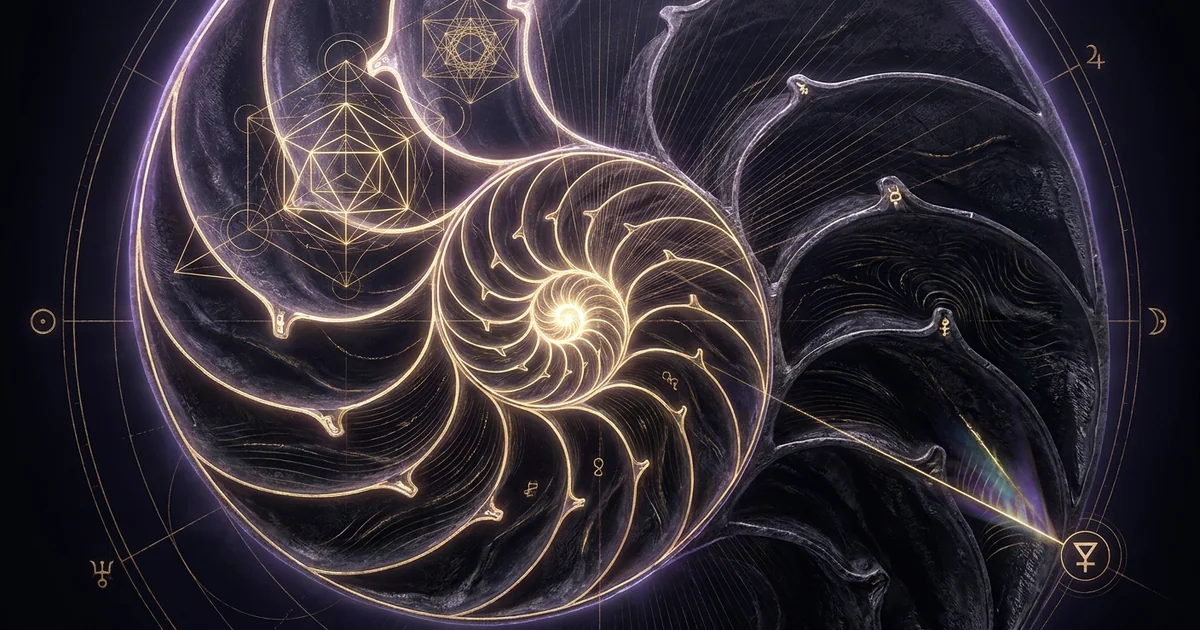
The Golden Ratio (Phi): Divine Proportion in Living Shells
Metaphysical Thesis & Epistemological Opening: The Morphogenetic Monad and the Arithmetic of Becoming
The Ontological Status of Incommensurability: Beyond Reductionist Materialism
The persistent appearance of non-repeating, irrational relations in biological morphology presents an intractable challenge to mechanistic biophysics. Where classical reductionism demands that morphological formation arise strictly from bottom-up molecular collisions and functional optimization, the structural presence of the golden ratio ($\Phi \approx 1.6180339887\dots$) exposes the operation of top-down geometric archetypes within dynamic matter.
In mechanistic models, functional convergence is ascribed entirely to natural selection filtering random variation along pathways of thermodynamic minimum resistance. Yet, when confronted with the self-similar accretion patterns of living shells, reductionist biophysics fails to explain why natural systems consistently negotiate their developmental limits through a mathematically irrational invariant. In biological accretion, the golden ratio represents an informational boundary condition where continuous magnitude and discrete multiplicity intersect.
The ontological status of incommensurability—first recognized by the Pythagorean brotherhood through the diagonal of the unit square and the pentagram’s self-intersecting segments—is not an arithmetic defect or an empirical approximation. Rather, incommensurability marks the precise mathematical threshold where pure quantity yields to qualitative relation. In the domain of rational numbers ($\mathbb{Q}$), dynamic continuity is fragmented into isolated, commensurable units. The discovery of magnitudes that resist expression as a ratio of integers reveals that reality is not fundamentally granular or atomistic; it is relational and continuous.
When biological life constructs skeletal architecture through accretion, it confronts the physical dilemma of temporal growth: how to expand in mass without altering essential form. Materialist models view this conservation of form as a secondary consequence of metabolic efficiency, but ontologically it demonstrates the priority of geometric relation over material substrate. The living organism does not generate geometry out of blind chemical necessity; it deploys chemistry as an instrument to instantiate a pre-existing geometric invariant.
In Hellenic ontology, logos (λόγος) denotes an inward rational constitution, while analogia (ἀναλογία) signifies proportion—the identity of relationship across diverse ontological strata. When Euclid codified the division of a line segment into “extreme and mean ratio” (ἄκρος καὶ μέσος λόγος) in Book VI of the Elements, he designated a condition of unique self-reference: the whole segment is to the greater segment as the greater is to the lesser ($A/B = B/(A-B)$).
Unlike arithmetic progression, which increases through the external addition of uniform units ($n + 1$), and geometric progression, which multiplies through an external coefficient, the extreme and mean ratio is self-generative: subtraction of the lesser from the greater reproduces the original relation ad infinitum. In classical Neoplatonism, this proportion forms the bridge between the Monad’s indivisible identity and the indefinite Dyad’s generative multiplicity. The ratio mediates between the absolute unicity of the intelligible world and the fragmented multiplicity of sensory phenomena.
Emanation Versus Construction: The Platonic Receptacle and Organic Accretion
The distinction between technological fabrication and biological ontogenesis corresponds to the metaphysical divergence between mechanical assembly and emanational unfolding. In the Timaeus, Plato delineates the chōra (χώρα)—the Receptacle or spatial matrix—wherein the Demiurge introduces order to chaotic prime matter by imposing geometric configurations. Modern technics operates through additive construction: distinct, pre-fabricated components are joined by external force to form a static whole. Organic growth, by contrast, operates through continuous accretive emanation.
The molluscan mantle does not construct a shell the way an artisan builds a wall; it secretes calcium carbonate and organic conchiolin along a generative boundary line. The shell is not an assembled tool, but the petrified wake of the organism’s spatial unfoldment through time. This accretion traces the emanational dynamic articulated within Hermetic cosmology, wherein the higher ontological order projects its invariants downward into the physical plane. The calcified matrix acts as an earthly mirror of immaterial geometric principles.
Because accretion occurs exclusively at the outer edge, the historical record of the shell’s development remains physically visible in its structure. This continuous preservation of developmental history distinguishes molluscan morphology from vertebrate skeletal remodeling, where bone tissue is continuously resorbed and reformed. The shell is an accretionary vector of duration, rendering time spatial.
Each growth ring marks a temporal boundary condition, and the overall morphology preserves the initial form throughout scalar expansion. If this expansion occurred via simple additive increments, the organism would outgrow its protective architecture or disrupt its center of gravity. The preservation of formal identity through scalar expansion requires an intrinsic geometry: a gnomonic transformation where the appended segment alters the organism’s size without modifying its proportional relations.
Phi as an Archetypal Invariant in the Interface of Pleroma and Physis
In the ontological architecture of Gnosticism and late Neoplatonism, the universe unfolds across a vertical hierarchy extending from the Pleroma (the divine fullness of intelligible archetypes) down into Physis (the dynamic realm of physical nature). Within this framework, mathematical constants are not subjective cognitive inventions, but objective trans-dimensional signatures.
The golden ratio $\Phi$, defined by the quadratic root $(1 + \sqrt{5})/2$, acts as an archetypal invariant operating precisely at the interface where intelligible ideals crystallize into material phenomena. The emergence of the golden ratio phi 1.618 divine proportion nature phyllotaxis across disparate natural orders is not a series of isolated historical coincidences. It reveals the presence of an underlying geometric code governing matter’s instantiation.
       PLEROMA (Intelligible Realm)
                  │
          Unmanifest Monad
                  │
   Extreme & Mean Ratio (Logos / Archetype)
                  │
                  ▼
         THEURGIC INTERFACE
                  │
      Discrete Integer Ascents
      (Fibonacci / Lucas Approximations)
                  │
                  ▼
        PHYSIS (Sensory Realm)
                  │
   Continuous Gnomonic Accretion
                  │
         Manifest Form
 (Equiangular Shells / Botanical Phyllotaxis)
The living organism does not maintain contact with the Pleroma through abstract intellectual contemplation, but through bodily morphology. In physical nature, the ideal ratio cannot appear as an absolute, static number because material manifestation requires friction, viscosity, metabolic limitation, and cellular volume.
Instead, physical life deploys dynamic trajectories that target this metaphysical attractor. The golden ratio represents an infinite informational asymptote: physical forms reach toward it, organizing chaotic environmental energy into self-similar orders that resist thermodynamic entropy. Biological accretion is the physical expression of this metaphysical reaching, translating the dimensionless proportion of the intelligible order into three-dimensional, calcified form.
Primary Codices & Historical Transmission: From Pythagorean Theurgy to De Divina Proportione
Euclid’s Definition and the Neoplatonic Geometrization of Reality
The rigorous mathematical codification of the extreme and mean ratio appears in Euclid’s Elements (Book II, Proposition 11; Book VI, Proposition 30; and Book XIII), yet its philosophical transmission was shaped primarily by the Neoplatonic academy. In his Commentary on the First Book of Euclid’s Elements, the fifth-century philosopher Proclus Lycius rejected the secularized interpretation of geometry as an empirical surveying tool. Proclus argued that Euclid did not assemble the Elements merely to train merchants or land surveyors, but to construct a complete theological cosmogony terminating in the construction of the five Platonic solids and sacred geometry.
For Proclus, geometric forms are immaterial realities (logoi) residing in the soul’s essential nature. When human intellect constructs external geometric proofs, it recovers latent memories of the intelligible world.
Euclid’s formulation of the extreme and mean ratio, which provides the foundation for constructing the regular icosahedron and dodecahedron in Book XIII, was understood by Proclus not as an arbitrary division, but as the mathematical dynamic through which the Demiurge orders prime matter. The division of a whole magnitude into extreme and mean segments mirrors the primordial differentiation of the Pythagorean Monad and the Tetractys: an indivisible unity divides within itself to generate dynamic relation without shattering its underlying oneness.
[ A + B ] ─────── Extreme Whole ───────
┌─────────────────────────┬────────────┐
│      Segment A (Mean)   │ Segment B  │
└─────────────────────────┴────────────┘
     (A + B) / A  =  A / B  =  Phi (1.618033...)
Pacioli, da Vinci, and the Renaissance Synthesis of Christology and Hermeticism
This late-antique mathematical mysticism experienced a major intellectual renewal during the Italian Renaissance through the collaboration of Franciscan friar Luca Pacioli and Leonardo da Vinci. In their 1509 treatise, De Divina Proportione, the extreme and mean ratio was explicitly christened with the title of divinity. Pacioli did not treat mathematics as distinct from theology; instead, he synthesized Christian Trinitarianism, Hermetic cosmology, and Euclidean rigor into a unified system.
"To our aforementioned proportion, most illustrious Duke, it seems fitting to ascribe the title of Divine, owing to the manifold correspondences it bears to God Himself… Just as God cannot be defined in physical terms, nor comprehended through finite human words, so too is our proportion incapable of being determined by a rational number, nor expressed through any finite quantity, but remains ever secret and occult, termed by mathematicians ‘irrational’.
Furthermore, as God is entirely one in essence, yet three in persons—Father, Son, and Holy Ghost—so does this divine section consist of three terms: the whole, the greater part, and the lesser part, all inextricably bound in a single unbroken analogia."
Pacioli articulated five distinct theological attributes that justify designating the proportion as divine:
- Singularity: It reflects the unique oneness of God, standing as a singular mathematical invariant that defines its own reciprocal ($\Phi - 1 = 1/\Phi$).
- Trinity: It requires exactly three terms (the whole, the major segment, and the minor segment) to complete its relation, mirroring the Triune godhead.
- Ineffability: It is mathematically irrational and incommensurable, mirroring the ineffable nature of the Divine Essence, which human intellect cannot capture through finite calculation.
- Omnipresence: It retains self-similarity across scalar shifts, maintaining identity in both the macroscopic cosmos and the microscopic seed.
- Essentiality: It is required to construct the regular dodecahedron—the geometric solid associated in the Timaeus with the celestial ether and the quintessence of the universe.
Leonardo da Vinci’s sixty mechanical and transparent illustrations for De Divina Proportione concretized this vision. Leonardo translated Pacioli’s abstract Euclidean proofs into physical forms, demonstrating how spatial proportion governs structural integrity. This Renaissance synthesis was not an aesthetic diversion; it was a deliberate operationalization of Hermetic philosophy. Within this framework, man the microcosm decodes the divine section paciali da vinci celebrated, reading the signature of the cosmic architect inscribed directly upon the architecture of creation.
The Kabbalistic Sefirot and Kepler’s ‘Precious Jewel’: Mathematical Mysticism
The historical trajectory of the divine proportion extended beyond the Italian peninsula into German mathematical mysticism, notably through Johannes Kepler. In his 1611 treatise Strena Seu de Nive Sexangula (The Six-Cornered Snowflake) and his 1619 cosmological masterwork Harmonices Mundi, Kepler identified the golden ratio as an active morphogenetic principle shaping material nature:
“Geometry has two great treasures: one is the Theorem of Pythagoras; the other, the division of a line into extreme and mean ratio. The first we may compare to a measure of gold; the second we may name a precious jewel.”
Kepler perceived that the regular dodecahedron and icosahedron, both structured by the divine proportion, could not generate planar lattices like the triangle, square, or hexagon. Instead, fivefold symmetry—and by extension the golden ratio—is reserved for living, generative forms.
While the dead mineral world crystallizes into sixfold planar grids (as observed in the hexagonal snowflake), animate nature deploys fivefold configurations and golden section geometries to sustain growth without crystallographic stagnation.
This mathematical distinction aligns with the Kabbalistic doctrine of the Sefirot. In Kabbalistic cosmology, creation proceeds from the infinite unmanifest (Ein Sof) through ten emanational vessels. The transition between the upper triad (Keter, Chokhmah, Binah) and the lower reality involves an ongoing balance between expansive force (Chesed) and restrictive form (Gevurah).
The golden ratio represents the mathematical signature of Tiferet—the sixth sefirah of beauty, balance, and harmony. Tiferet mediates between opposing polarities, preventing expansive force from dissolving into boundless chaos and restrictive form from calcifying into static death. In the living shell, this same equilibrium permits calcium carbonate to accrete continuously while preserving its formal geometry.
Ontological Architecture & Cosmological Models: The Golden Rectangle, Dynamic Symmetry, and Phyllotaxis
Gnomonic Growth: Preservation of Proportional Essence Amid Continuous Material Influx
The operational geometry governing biological accretion depends upon the concept of the gnomon. As formulated by Hero of Alexandria, a gnomon is any figure which, when added to an original figure, produces a new figure similar in shape to the original. In the Aristotelian framework of hylomorphism, physical objects consist of substantial form (morphe) actualized within prime matter (hyle).
Normally, an influx of new material alters an object’s spatial proportions. Gnomonic accretion, however, permits an organism to ingest material from the environment, metabolize it, and append it to its skeletal structure without altering its overall proportional form.
┌─────────────────────────────────┬──────────────┐
│                                 │              │
│                                 │   GNOMON     │
│       Original Rectangle        │  (Appended   │
│           (1 : Phi)             │   Spatial    │
│                                 │  Increment)  │
│                                 │              │
└─────────────────────────────────┴──────────────┘
│◄────────────── (1 + Phi) = Phi² ──────────────►│
When applied to the golden rectangle—whose sides exhibit the ratio $1 : \Phi$—the gnomon takes the form of an appended square whose side equals the longer dimension of the original rectangle. By continually appending these square gnomons, a composite rectangle is generated that maintains the exact proportional relationship $1 : \Phi$ at every step:
$$\Phi^2 = \Phi + 1$$
This quadratic property reveals that the golden rectangle is self-generating: spatial expansion is structurally identical to formal preservation.
For an organism dependent on calcified shielding, this dynamic is a developmental imperative. If a mollusk’s outer chamber expanded at a rate disproportionate to its inner chambers, the animal’s hydrodynamics, center of buoyancy, and soft-tissue geometry would destabilize. The golden rectangle golden spiral continuum provides the theoretical geometric framework through which continuous material influx is organized into a preserved formal identity.
The Fibonacci Sequence as a Discrete Approximator of the Continuous Transcendence of Phi
The primary paradox of biological accretion is that physical organisms operate within discrete, particulate steps, whereas the golden ratio is a continuous, irrational invariant. A cell cannot secrete half a molecule or half a calcium ion; biological accretion is necessarily quantized at the micro-scale. Nature resolves this gap between continuous geometry and particulate matter through integer approximations, specifically via the sequence identified by Leonardo of Pisa (Fibonacci):
$$F_0 = 0, \quad F_1 = 1, \quad F_n = F_{n-1} + F_{n-2} \quad \text{for } n \ge 2$$
The ratio between successive terms in this integer series ascends toward $\Phi$ as a mathematical limit:
$$\lim_{n \to \infty} \frac{F_{n+1}}{F_n} = \Phi \approx 1.6180339887\dots$$
This sequence provides a discrete ladder through which physical nature climbs toward the continuous irrationality of the divine section.
At lower orders ($1/1, 2/1, 3/2$), the approximation oscillates around the golden ratio with notable variance. As the sequence expands ($5/3 = 1.666\dots$, $8/5 = 1.6$, $13/8 = 1.625$, $21/13 \approx 1.6153$, $34/21 \approx 1.6190$), the oscillations narrow, converging on the ideal invariant.
Living systems cannot manifest the pure irrational number immediately; they manifest a discrete trajectory that approximates it. The organism lives in the realm of numbers, but it is organized by the transcendental principle that governs them. The integer series serves as matter’s physical approach toward an ideal mathematical attractor.
Botanical Packing Singularities: Phyllotaxis as Minimum Energy Informational Geodesics
The structural role of this approximation is clearly evident in botanical phyllotaxis—the arrangement of leaves, scales, and florets around a central axis. In botanical morphology, new primordia emerge sequentially from the apical meristem, moving radially outward as they grow. To maximize exposure to sunlight, optimize rain collection, and minimize self-shading, each successive primordium must diverge from the previous one by an angular offset that prevents overlapping.
If the divergence angle were a rational fraction of a full circle ($360^\circ$), such as $1/2$ ($180^\circ$), $1/3$ ($120^\circ$), or $1/4$ ($90^\circ$), the emerging organs would form vertical rows, leaving large unutilized spaces between them and shading the lower tiers. Even higher-order rational fractions inevitably produce discrete alignment rows. The optimal divergence angle must therefore be an irrational multiple of the circle: the golden angle ($\psi$).
$$\psi = 360^\circ \times (1 - \frac{1}{\Phi}) = 360^\circ \times (2 - \Phi) \approx 137.507764^\circ$$
By diverging at precisely $137.5^\circ$, each primordium falls into the largest available gap left by its predecessors. Because the golden ratio is the “most irrational” number—its continued fraction expansion consists entirely of ones:
$$\Phi = 1 + \cfrac{1}{1 + \cfrac{1}{1 + \cfrac{1}{1 + \dots}}}$$
—it converges more slowly through rational approximations than any other mathematical value. This extreme irrationality prevents the emergence of resonant periodicities.
In sunflowers (Helianthus annuus) and pinecones (Pinus), this dynamic generates intersecting families of logarithmic parastichies, whose counts correspond to adjacent pairs of the Fibonacci sequence (e.g., 34 spirals clockwise, 55 counterclockwise; or 55 clockwise, 89 counterclockwise). This pattern is not an arbitrary aesthetic motif; it is a physical solution for packing efficiency, an informational geodesic that minimizes cellular stress while maximizing metabolic space.
Phenomenological Mechanics & Anomalistics: The Nautilus Fallacy and the Informational Control System
The Nautilus Controversy: Dissecting the Divergence from Phi 1.618
A widespread misconception within popular occultism and contemporary New Age literature is the unverified assertion that the chambered nautilus (Nautilus pompilius) constructs its shell according to the exact parameters of the golden spiral. In these accounts, the cross-section of a nautilus shell is presented as empirical proof that the golden ratio is directly reproduced in marine biology.
Rigorous empirical analysis reveals this assertion to be factually incorrect. When the cross-sections of Nautilus pompilius are measured, the ratio of expansion per whorl ($360^\circ$ revolution) does not match the growth factor of the true golden spiral.
A true golden spiral, constructed from interconnected golden rectangles, expands by a factor of $\Phi^4 \approx 6.854$ every full turn ($360^\circ$ or $2\pi$ radians), or by $\Phi \approx 1.618$ every quadrant ($90^\circ$ or $\pi/2$ radians).
Detailed morphometric surveys conducted by malacologists and mathematicians demonstrate that the expansion ratio per full revolution in Nautilus pompilius typically ranges between $3.0$ and $3.5$. This yields an expansion ratio per quadrant of approximately $1.316$ to $1.368$ ($\sqrt[4]{3.0} \approx 1.316$; $\sqrt[4]{3.5} \approx 1.368$), which is lower than the true golden ratio of $1.618$.
If a living nautilus grew using the exact expansion factor of the true golden spiral, its outer aperture would widen so quickly that the shell would become an unmanageable, broadly open horn. The animal would be unable to seal its body inside, establish hydrostatic equilibrium through its siphuncle, or protect its soft mass from predation.
Ideal Golden Spiral (Phi = 1.618033...)
- Expansion Coefficient: Radius increases by a factor of $\Phi \approx 1.618$ per $90^\circ$ turn, and by $\Phi^4 \approx 6.854$ per $360^\circ$ whorl.
- Angular Divergence: Governed strictly by the golden angle ($\approx 137.5^\circ$) and the continued fraction of ones ($[1; 1, 1, 1\dots]$).
- Physical Dynamics: Operates as an idealized, dimensionless mathematical attractor in non-resistive geometric space.
- Metaphysical Function: Embodies the uncompromised archetypal invariant within the Pleroma; represents pure informational symmetry.
Empirical Nautilus Growth (Equiangular Logarithmic)
- Expansion Coefficient: Radius increases by a factor of approximately $1.31$ to $1.36$ per $90^\circ$ turn, and by $3.0$ to $3.5$ per $360^\circ$ whorl.
- Angular Divergence: Exhibits variable spiral pitch angles ($\alpha \approx 78^\circ$ to $82^\circ$), tuned to hydrodynamics and chamber buoyancy.
- Physical Dynamics: Mediates between geometric growth and material constraints: fluid friction, shell mass, and siphuncle suction.
- Metaphysical Function: Represents the dynamic translation of the archetypal principle into the physical plane, demonstrating life’s adaptation within matter.
Logarithmic Growth Mechanics: Isometric Spirals Versus the True Golden Spiral
This divergence does not invalidate the underlying metaphysical principle; rather, it clarifies the physical mechanics of biological accretion. The chambered nautilus constructs an equiangular spiral, a geometry first analyzed by René Descartes in 1638 and celebrated by Jakob Bernoulli in his formulation Spira mirabilis (“the marvelous spiral”). The defining property of an equiangular or logarithmic spiral is that the angle $\alpha$ between the tangent to the curve at any point and the radial vector from the origin remains constant throughout its growth:
$$r(\theta) = a e^{b\theta}, \quad \text{where } b = \cot(\alpha)$$
The true golden spiral is simply one particular iteration of this infinite family of logarithmic spirals—the specific case where $b = \frac{\ln(\Phi)}{\pi/2} \approx 0.30635$.
The nautilus shell logarithmic growth uses a different value of $b$ (typically between $0.17$ and $0.19$, corresponding to an angle $\alpha$ of approximately $79^\circ$ to $80^\circ$). The essential morphic property preserved here is not the specific numerical value $1.618$, but the principle of dynamic self-similarity. The shell grows isometrically: the relative proportions of its internal septa, the curvature of its calcified walls, and the volume distribution of its gas-filled buoyancy chambers remain identical across every scale of maturity.
The nautilus uses the general principle of the equiangular spiral—of which the golden spiral is the idealized archetype—to solve a specific environmental challenge: maintaining neutral buoyancy while continuously expanding in body mass within a pressurized marine environment.
EQUIANGULAR (LOGARITHMIC) SPIRAL
               . - ~ ~ ~ - .
           . '               ' .
         /          /\           \
        /          /  \           \
       /     r    /    \           \
      |          /      \           |
      |         O--------\----------|
      |           \   α   \         |
       \           \       \       /
        \           \       \     /
         \           ▼       \   /
           . '                 '
               . - ~ ~ ~ - .
     Constant Angle:  Angle(Radius, Tangent) = α</code></pre>
Morphogenetic Control Systems: Biological Morphisms as Trans-Dimensional Signatures
The realization that biological systems approximate, scale, and adjust mathematical archetypes aligns with Jacques Vallée’s framework of reality as an informational control system. Vallée proposes that anomalous and morphogenetic phenomena do not operate as isolated mechanical events, but as systemic feedback mechanisms—informational control loops that structure physical reality while remaining elusive to crude empirical observation.
Applied to morphogenetic fields, biological organisms do not merely collide like mechanical billiard balls; they navigate non-local fields of informational coherence, a dynamic conceptualized within the framework of morphogenetic fields and non-local coherence.
The golden ratio and the broader family of logarithmic spirals act as tuning metrics within this morphic control system. When embryonic cells differentiate and secrete extracellular structures, they respond to field dynamics that prevent physical form from drifting into chaotic entropy.
Life negotiates between two constraints: the unyielding, friction-free geometry of the intelligible realm and the thermodynamic drag of the physical world. The divergence of Nautilus pompilius from the absolute value of $\Phi$ is not an empirical failure, but an engineering adaptation. It reveals a dynamic control system modifying an archetypal ideal to function within the material parameters of ocean depth, calcium availability, and hydrostatic pressure.
Initiatic Synthesis & Philosophical Implications: Sarcophagus of Time and theurgy of Form
Petrified Time: The Molluscan Shell as Concrete Memory and Spatialized Eternity
The morphology of the chambered mollusk provides a material metaphor for the soul’s relationship to temporal incarnation. As the cephalopod grows, its body mass expands beyond the capacity of its current dwelling. It does not destroy or remodel the outgrown chamber; instead, it moves forward, secretes a transverse septum of organic and mineral layers behind its soft visceral mass, and establishes a new chamber. The siphuncle—a living strand of tissue—passes through perforations in each septum, maintaining metabolic and pneumatic contact with every past chamber, pumping gas and fluid to regulate buoyancy across its developmental history.
The shell functions as a petrified record of its own emergence—a concrete manifestation of memory. The mollusk lives exclusively in its newest chamber, the open aperture facing the external world, while dragging its history behind it as an integrated flotation system.
If it abandoned its past chambers, it would sink to the ocean floor and be crushed by ambient hydrostatic pressure; if it failed to vacate them, its growth would stall. In the perspective of esoteric Hermeticism, the molluscan architecture embodies the process of temporal descent and spiritual ascent: the soul inhabits the immediate present, yet relies on its integrated history to navigate the pressures of the material world.
[ Chamber 1 (Past) ] ──> [ Chamber 2 ] ──> [ Chamber 3 ] ──> [ Living Aperture (Present) ]
         │                      │                 │                         │
         └──────────────────────┴── Siphuncle ────┴─────────────────────────┘
                    (Living Filament of Memory / Continuity)
Epistemological Pitfalls: Rejecting Procrustean New Age Geometrical Fallacies
To maintain intellectual integrity, esoteric philosophy must guard against the cognitive biases that frequently undermine contemporary alternative scholarship. Pop-spirituality often succumbs to the Procrustean fallacy: arbitrarily superimposing golden rectangles and logarithmic spirals onto works of art, architecture, and biological specimens without mathematical rigor or historical evidence.
Proponents often draw spirals over photographs of human faces, the Parthenon, Renaissance paintings, and galactic discs, forcing the lines to align with chosen features while ignoring points that contradict the premise.
This apophenic tendency degrades authentic sacred geometry from a rigorous metaphysical discipline into an exercise in confirmation bias. Galaxies, for instance, are not shaped by accretive biological growth; their spiral arms are density waves governed by gravitational dynamics and dark matter distributions, typically tracing different mathematical forms rather than the golden spiral.
Similarly, the Parthenon’s builders utilized rational proportions based on classical Doric modules ($4:9$ ratios) rather than the irrational ratio $\Phi$. Misidentifying mathematical relationships where they do not exist obscures the genuine, verifiable locations where nature does deploy these principles. Metaphysical inquiry must rely on precise measurement and textual hermeneutics, recognizing that sloppy approximations compromise both scientific and esoteric understanding.
Initiates of sacred geometry must resist the psychological urge toward unverified pattern completion (apophenia). The arbitrary superimposition of the golden rectangle onto historical artifacts, human faces, or non-accretive natural phenomena frequently relies on scaling the visual overlay until arbitrary landmarks coincide with the spiral’s vertices.
Such practices undermine genuine esoteric science. A form only manifests the golden ratio when its proportional relationships yield the specific mathematical invariant $(1 + \sqrt{5})/2$ under rigorous measurement, or when its development traces the logarithmic dynamics of extreme and mean sectioning. Without verifiable coordinates, claims of sacred architecture represent psychological projection rather than objective structural reality.
Theurgic Attunement: Contemplative Realization of Morphic Harmonics in Human Sovereignty
When freed from superficial assumptions, the study of the divine proportion in biological shells functions as an operative path of theurgy (theourgia). In late Neoplatonism, particularly within the systems of Iamblichus and Proclus, theurgy does not consist of human attempts to manipulate divine forces through arbitrary ritual. Rather, it is the deliberate attunement of human consciousness to the divine signatures (synthemata) embedded throughout the natural world. Geometry is not an abstract human invention; it is the structural vocabulary through which the divine orders reality.
By contemplating the preservation of form through continuous scalar expansion—the equiangular spiral within molluscan shells and the golden angle in botanical phyllotaxis—the human intellect (nous) aligns its internal processing with the generative architecture of the cosmos. This realization carries direct ontological consequences for human sovereignty.
Subjected to the disorienting, atomized conditions of modern life, the individual consciousness is frequently severed from its metaphysical center. By internalizing how living organisms preserve their essential proportions while expanding through time, the practitioner learns to navigate the material plane without formal degradation. The living shell stands as an enduring stone glyph: an accretionary blueprint demonstrating that even within the densest material realms, physical matter can remain transparent to intelligible divine order.
Frequently Asked Questions: Resolving the Ontological and Empirical Dilemmas of Phi
Does the Nautilus Shell Actually Exhibit the Exact 1.618 Golden Ratio?
No. Empirical measurements confirm that the chambered nautilus (Nautilus pompilius) does not build its shell using the exact golden ratio $\Phi \approx 1.618$. The shell of Nautilus pompilius is an equiangular (logarithmic) spiral, but its expansion factor per quadrant ($90^\circ$ rotation) is typically between $1.31$ and $1.36$, corresponding to an expansion factor of approximately $3.0$ to $3.5$ per full $360^\circ$ revolution.
In contrast, a true golden spiral expands by a factor of $\Phi \approx 1.618$ per quadrant and $\Phi^4 \approx 6.854$ per full revolution. If the nautilus grew using the exact golden ratio, its living aperture would expand twice as rapidly as it actually does, producing an unmanageable open flare that would undermine the animal’s buoyancy, hydrodynamics, and survival.
The popular myth that the nautilus shell directly matches the golden ratio arose in the early twentieth century through uncritical conflations of the general logarithmic spiral with the specific golden spiral, a mistake popularized in casual artistic and metaphysical literature. The nautilus manifests the principle of dynamic self-similarity (the equiangular spiral), but tunes the precise numerical coefficient to its physical environment.
“The shell of the Nautilus is an equiangular spiral, but it is not the golden spiral… The ratio of the radii separated by a right angle in Nautilus pompilius is on average about 1.33, whilst for the true golden spiral it should be 1.618. The wonder of the shell lies not in its adherence to an arbitrary mystical number, but in its strict preservation of the equiangular property: the constant angle at which the whorl meets the radius vector, whereby the form of the interior chambers remains precisely the same throughout the entire life of the creature.”
Why Did Renaissance Masters Term This Proportion ‘Divine’ Rather Than Merely Aesthetic?
Luca Pacioli and his contemporaries did not designate the extreme and mean ratio as “divine” for decorative reasons; they did so because its mathematical properties mirror the theological attributes of God within Christian Neoplatonism and Hermetic philosophy. In De Divina Proportione (1509), Pacioli outlined five specific correspondences:
- Ineffability: The ratio is irrational, meaning it cannot be expressed as a fraction of integers or captured by finite calculation, reflecting the incomprehensible nature of God.
- Singularity: It is uniquely self-referential; its reciprocal is found simply by subtracting unity ($\Phi - 1 = 1/\Phi$), reflecting the absolute unicity of the Divine Being.
- Trinity: It requires exactly three terms (whole, greater part, lesser part) to complete its relationship, mirroring the Triune nature of the Godhead.
- Omnipresence: It is scale-invariant, preserving its proportional dynamic at every scale, which Renaissance humanists saw as an earthly reflection of divine omnipresence.
- Cosmogonic Essentiality: It is required to construct the regular dodecahedron—the geometric solid identified in Plato’s Timaeus as the archetype used by the Demiurge to delineate the cosmos. To Renaissance humanists, this proportion was the geometric signature of the Creator imprinted directly into creation.
How Does Phyllotaxis Distinguish Between Physical Determinism and Esoteric Geometry?
The emergence of the golden angle ($\approx 137.5^\circ$) and Fibonacci parastichies in botanical phyllotaxis demonstrates the intersection between biochemical determinism and non-material geometry. Reductionist biophysics explains phyllotaxis through the biochemical dynamics of the phytohormone auxin and mechanical pressure within the apical meristem.
According to the Hofmeister-Snow hypotheses, new primordia (leaf or seed buds) form in regions with minimal auxin depletion and maximum physical clearance from older primordia. As each primordium develops, it acts as an auxin sink, drawing the hormone away from its immediate perimeter and preventing the growth of adjacent buds.
       MERISTEM GROWTH APEX (PHYLLOTAXIS)

                       [ Apex ]
                      /        \
               ( Primordium N+3 )
                   /              \
         ( Primordium N+1 )         ( Primordium N+2 )
             /                          \
   ( Primordium N )             Auxin Depletion Zone
          │                               │
          ▼                               ▼
   Divergence Angle: 137.5077° ──> Optimal Non-Resonance
While this biochemical mechanism explains how the plant cells divide, it does not explain why this mechanical process consistently converges on the golden angle. The physical system is constrained by space: the golden angle is the mathematical value that prevents the formation of overlapping vertical rows, offering the most efficient structural packing.
Biochemical mechanics (auxin transport and cellular pressure) function as the material instrument, while the golden ratio serves as the non-material mathematical attractor. Far from disproving sacred geometry, botanical phyllotaxis demonstrates that physical forces naturally settle into geometric invariants, using biochemical mechanisms to instantiate archetypal form within matter. :::