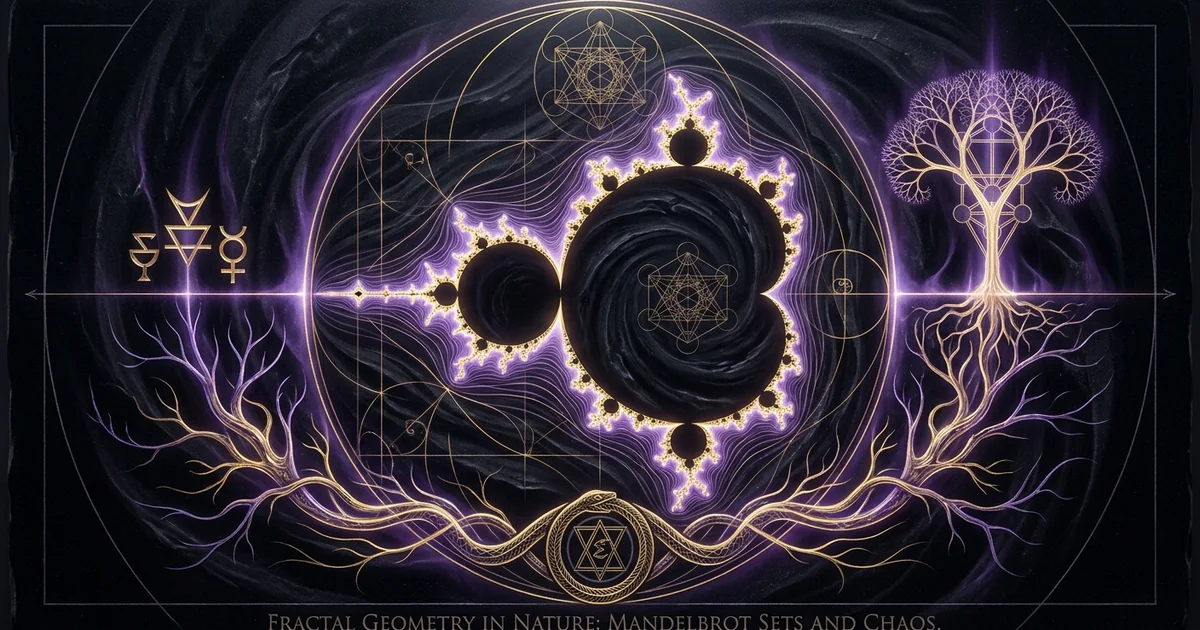
Fractal Geometry in Nature: Mandelbrot Sets and Chaos
Metaphysical Thesis & Epistemological Opening: The Non-Euclidean Hermeneutic of Nature
Transcendence of the Cartesian Grid: Fractional Dimensions and the Coastline Paradox
For three centuries following the Cartesian-Newtonian revolution, natural philosophy operated under the unexamined presupposition that physical space and the material architectures inhabiting it were fundamentally Euclidean. Classical mechanics projected an idealized armature of integer dimensions onto the cosmos: the zero-dimensional point, the one-dimensional line, the two-dimensional planar surface, and the three-dimensional volumetric solid. Within this paradigm, irregularities in natural morphology—the jagged crag of a granite precipice, the convolute seam of a storm cloud, the tangled vascularity of angiosperm leaves—were dismissed as incidental noise, pathological deviations, or sensory approximations of underlying, pristine geometric archetypes. This dogmatic insistence on smooth, differentiable surfaces rendered materialist science blind to the authentic structural language of physical manifestation. As explored in investigations into /spirituality/sacred-geometry-platonic-solids, traditional geometry sought transcendence through idealized forms, yet physical creation operates through an entirely different structural imperative.
The shattering of this integer-dimensional hegemony arrived through Benoit Mandelbrot’s formulation of fractional geometry. Mandelbrot recognized that the universe does not manifest in sterile, integer planes, but thrives within the continuous topological intervals between those integers. Central to this epistemological rupture is the coastline paradox, wherein the measured perimeter of a natural landmass does not converge toward a fixed scalar constant as the measuring apparatus decreases in size. Instead, as the metric ruler shrinks—from kilometers to decimeters, from millimeters to nanometers—the observed perimeter asymptotically approaches infinity.
This paradox proves that spatial metrication is not an intrinsic, observer-independent property of material substance, but an interactive phenomenon dictated by the scale of observation. The coastline paradox fractal dimension exposes a profound metaphysical principle: the apparent density and spatial expanse of reality increase in proportion to the perceptual granularity of the observer. Classical mechanics sought an objective, static exterior world; fractional dimensions reveal an informational matrix whose spatial depth is functionally inexhaustible.
The mathematical apparatus liberating spatial analysis from Euclidean limits rests upon the Hausdorff-Besicovitch dimension ($D$). Whereas the standard topological dimension ($D_T$) is strictly confined to integers ($0, 1, 2, 3$), the Hausdorff dimension evaluates how the mass or measure of a geometric object scales as the measuring resolution ($\epsilon$) approaches zero: $$D = \lim_{\epsilon \to 0} \frac{\log N(\epsilon)}{\log(1/\epsilon)}$$ where $N(\epsilon)$ represents the minimum number of open sets of diameter $\epsilon$ required to cover the object. Mandelbrot defined a fractal as any set for which $D > D_T$. Etymologically derived from the Latin fractus—signifying that which is broken, fragmented, or shattered—the fractal stands in stark contrast to the continuous, smooth manifolds of Cartesian space. It formalizes an ontology of structural roughness, demonstrating that an infinitely complex spatial boundary can occupy a strictly localized spatial domain without ever resolving into a differentiable line.
Scale Invariance as the Modern Hermetic Axiom
The discovery of scale invariance—the persistent structural self-similarity exhibited by systems across radically disparate orders of magnitude—constitutes the empirical validation of classical emanational metaphysics. When Benoit Mandelbrot crystallized the principles governing fractal geometry in nature benoit mandelbrot self similarity scale, he provided a mathematical syntax for an intuition that had previously belonged exclusively to the initiatic traditions of antiquity. In natural systems, self-similarity dictates that the macrocosmic form mirrors the microcosmic component, not through an identical facsimile, but through an invariant structural relationship that repeats across cascades of magnification.
Whether observed through the statistical self-affinity of financial markets, the clustered distribution of galactic superclusters, or the crystalline nesting of mineral deposits, matter organizes itself through iterative symmetry. This structural consistency refutes the mechanistic thesis that physical phenomena are the consequence of isolated, linear causal chains operating within localized spatial boundaries. Instead, scale invariance indicates that the physical vessel of the cosmos is governed by non-local morphogenetic fields. The recurrence of identical structural motifs at microscopic and macroscopic thresholds suggests that nature does not invent new forms at every scalar tier; rather, it executes a single recursive master-algorithm whose spatial manifestations unfold in nested resonance. The observer does not inhabit a universe composed of disjointed, laminated strata, but an integrated, scale-invariant totality wherein the part perpetually encodes the architecture of the whole.
Deterministic Chaos: The Mathematical Re-Enchantment of Matter
Parallel to the formulation of fractional dimensions was the revelation of deterministic chaos, pioneered by figures such as Henri Poincaré and Edward Lorenz. For centuries, determinism was conflated with predictability. Laplace’s demon embodied the supreme hubris of the Enlightenment: the presumption that complete knowledge of a system’s initial conditions, coupled with the classical equations of motion, would yield an absolute accounting of all past and future states. The discovery of non-linear dynamic systems dissolved this mechanical certainty. Non-linear equations—systems wherein outputs fold back as inputs through recursive feedback loops—exhibit extreme sensitivity to initial conditions.
In chaotic regimes, two trajectories originating from points separated by an infinitesimally small interval will diverge exponentially across time, rendering long-range deterministic forecasting fundamentally impossible. Yet, this unpredictability is not synonymous with absolute randomness or thermal white noise. Beneath the apparent disorder of chaotic phenomena lies an extraordinarily disciplined, hyper-dimensional geometry known as the strange attractor. Deterministic chaos does not dismantle cosmic order; it dismantles mechanistic reductionism, demonstrating that matter is intrinsically creative, non-linear, and capable of generating limitless, organized complexity from exceedingly simple recursive parameters.
Primary Codices & Historical Transmission: Pre-Modern Intuitions of Recursive Cosmogenesis
The Emerald Tablet and Proclean Neoplatonism: Emanation as Iterative Unfolding
Centuries before the computational capacity of the late twentieth century permitted the visual rendering of complex dynamic systems, ancient metaphysical traditions formulated precise qualitative cosmologies rooted in iterative feedback and self-similarity. The foremost textual anchor of this lineage is found within the Hermetic corpus, crystallized succinctly within the Tabula Smaragdina (Emerald Tablet). The classical operational axiom—quod est inferius est sicut quod est superius (“that which is below is like that which is above”)—has frequently been degraded by pop-spirituality into an empty platitude. When subjected to rigorous metaphysical hermeneutics, however, it stands as an exact expression of scale-invariant ontological isomorphism.
       [ Unmoved Monad / Supreme Source ]
                       │
             (Iterative Feedback)
                       ▼
       [ Macrocosmic Proclean Nous ]
                       │
             (Recursive Emanation)
                       ▼
       [ Microcosmic Phenomenal Horizon ]
This axiom was systematized philosophically in the late Neoplatonism of Proclus. In his Elements of Theology, Proclus delineated the mechanics of divine procession (proodos) and reversion (epistrophe). For Proclus, every ontological tier does not merely emanate a subordinate stratum linearly; rather, every cause acts as an attractor to which the effect seeks to return through an iterative loop of ontological reflection. The entire architecture of reality is constructed from nested triadic structures—immanence, procession, reversion—wherein the cosmic whole is mirrored in every constituent part (panta en pasin, oikeios de en hekasto: “all things are in all things, but in each according to its proper nature”). Proclean emanational ontology is fundamentally fractal: the highest divine realms are present within the lowest material substrates, not by substantial diffusion, but through scale-invariant structural resonance.
Tabula Smaragdina (The Emerald Tablet), lines 2–4 (trans. Copenhaver, 1992):
“What is below is like what is above, and what is above is like what is below, to accomplish the miracles of the one thing. And as all things came from one, by the meditation of one, so all things were born from this one thing by adaptation.”
Sefer Yetzirah (The Book of Formation), Chapter 1, Mishna 7:
“Ten Sefirot of nothingness: Their end is wedged in their beginning, and their beginning in their end, like a flame bound to a coal. For the Master is singular, He has no second, and before One, what can you count?”
The convergence between these texts is mathematically striking. The Tabula Smaragdina articulates the recursive adaptation (adaptatione) of a singular generative seed into multifaceted manifestation, directly evoking the feedback parameter of non-linear iterations. Simultaneously, Sefer Yetzirah describes the primary emanational vectors of the tree-of-life through a non-terminating, closed recursive circuit: the end is inextricably bound to the beginning. This ancient conceptualization mirrors the continuous dynamical loop of non-linear physics, wherein the ultimate output of an ontological cycle becomes the immediate seed for the subsequent iteration of reality.
Sefer Yetzirah and the Recursive Partzufim of Kabbalistic Ontogeny
Within Jewish esoteric mysticism, as documented by Gershom Scholem in Major Trends in Jewish Mysticism, the cosmological architecture of the universe unfolds through an overtly fractal grammar. The primordial cosmological trauma—the Shevirat ha-Kelim (the Shattering of the Vessels) documented in Lurianic Kabbalah—occurs precisely because the lower structural configurations were incapable of sustaining the unbuffered light of the infinite (Ein Sof). The subsequent process of cosmic repair (Tikkun) does not construct a monolithic, Euclidean vessel; rather, it reorganizes the scattered shards of light into the Partzufim (divine visages or configurations).
As detailed in scholarly explorations of /spirituality/kabbalistic-cosmology-sefirot, each primary emanation within the Sefirotic system contains within itself an identical, complete sub-system of ten Sefirot. Kether contains Kether through Malkuth; within the Malkuth of Kether, another tenfold iteration unfolds, descending asymptotically into the dense fabric of physical reality (Assiah).
The Lurianic Partzufim are self-similar divine personas: Atik Yomin (the Ancient of Days), Arikh Anpin (the Long-Faced One), Abba (the Father), Imma (the Mother), Zeir Anpin (the Microprosopus), and Nukva (the Female). These are not isolated deities, but scale-invariant re-articulations of the primary emanational pattern. Every sub-atomic particle, every human soul, and every cosmic cycle is structured according to this precise recursive geometry. The Partzufim prefigure deterministic chaos: higher-order divine identities project themselves into lower somatic domains through recursive feedback, ensuring that the total informational code of the unmanifest Godhead is preserved intact within the most localized, material fragments of the universe.
Leibniz’s Monadology and the Pre-Computation of Self-Reflective Infinitesimals
In the early eighteenth century, Gottfried Wilhelm Leibniz bridged classical metaphysics and modern computational ontology with his Monadology (1714). Rejecting the Cartesian division of substance into inert, extended matter (res extensa) and disembodied mind (res cogitans), Leibniz proposed that the fundamental constituents of reality are monads: unextended, immaterial, windowless entelechies possessing perceptual capacity. Crucially, Leibniz recognized that reality cannot be built out of homogeneous, indivisible geometric points without descending into metaphysical absurdity.
Instead, Leibniz posited that every monad is a perpetual, living mirror of the entire universe:
“Each portion of matter may be conceived as like a garden full of plants and like a pond full of fish. But each branch of every plant, each member of every animal, each drop of its liquid parts is also some such garden or some such pond.” (Monadology, §67)
This passage represents one of the most stunning intuitions of fractional scaling in intellectual history. Leibniz conceived of physical reality as an infinite regress of living systems nested inside living systems, where the structural complexity of the whole is preserved within every infinitesimal component. The monad has no physical windows through which spatial parts can enter or exit; its interior state is determined by its unique perspective on the totality of the cosmic algorithm. Leibniz pre-computed the philosophical architecture of the Mandelbrot set: an infinite informational density encoded within unextended mathematical points, where every localized node reflects the macrocosmic dynamic through continuous perceptual iteration.
Ontological Architecture & Cosmological Models: The Mandelbrot Boundary as Liminal Horizon
The Mandelbrot Set Boundary Equation: Infinite Depth from Finite Seeds
The mathematical genesis of fractal ontology is encapsulated in an equation of sublime elegance, mapped upon the complex number plane: $$z_{n+1} = z_n^2 + c$$ In this formulation, $z$ and $c$ are complex numbers ($a + bi$, where $i = \sqrt{-1}$). The mandelbrot set boundary equation operates through discrete iterations: beginning at the origin ($z_0 = 0$), the complex constant $c$ is added to the square of the previous result. The Mandelbrot set ($M$) is formally defined as the set of all points $c$ in the complex plane for which the iterative orbit of $z$ remains bounded, never escaping to infinity, no matter how many times the recursive calculation is executed: $$M = { c \in \mathbb{C} : \lim_{n \to \infty} |z_n| \neq \infty }$$
[ Parameter Constant c ]
                           │
                           ▼
             ┌───> [ z_(n+1) = z_n^2 + c ] ───┐
             │                                │
             └──────── (Iterative Loop) ──────┘
                           │
             ┌─────────────┴─────────────┐
             ▼                           ▼
      |z_n| escapes to ∞         |z_n| remains bounded
    (Exterior Kenoma)           (Interior Pleroma)
             │                           │
             └─────────────┬─────────────┘
                           ▼
          [ The Complex Boundary Interface ]
             (Infinite Morphogenesis)
The profound metaphysical implications emerge not from the interior of the set (where points remain static or settle into stable periodic orbits) nor from the exterior (where points escape exponentially toward infinity), but precisely at the boundary horizon. This boundary is infinitely thin—possessing an area of zero in classical measure theory—yet it contains a perimeter of infinite length enclosed within a strictly bounded spatial coordinate system (never exceeding $|z| = 2$).
At this boundary, the iterative engine produces inexhaustible structural forms: miniature replicas of the total Mandelbrot set nested within dendritic filaments, self-similar spirals, seahorse tails, and bifurcating lightning formations. A finite mathematical seed, subjected to recursive feedback, yields infinite morphological depth.
The Pleroma and the Kenomic Frontier: Chaos Boundaries as Demiurgic Thresholds
When mapped onto Gnostic cosmogony, the Mandelbrot set offers an exact mathematical analogue for the boundary separating divine fullness from the fractured realms of material manifestation. In classic Valentinian Gnosticism, the transcendent source of being is the pleroma—the unblemished, unfragmented fullness of divine light. Surrounding or opposing this supreme interiority is the kenoma—the cosmic void, the empty expanse of dispersion, lack, and entropic dissolution. Between these two states stands the Horos, the Boundary or Limit, an archetypal metaphysical entity whose function is both to preserve the integrity of the Pleroma and to demarcate the threshold where divine light encounters the abyss.
The interior of the Mandelbrot set functions as a mathematical Pleroma: a region of absolute structural cohesion wherein the iterative energies of the equation are retained within an unbroken, un-escaping unity. Conversely, the exterior space represents the Kenoma, where values accelerate irreversibly into the infinite void of mathematical entropy.
The true crucible of cosmic manifestation, however, is the boundary itself: the Horos. It is here, at the liminal interface between order and dissolution, that the Gnostic demiurge—the blind architect of material form—operates. The Demiurge is not an independent creator capable of originating ex nihilo; he is an iterative engine, a recursive operator. Unable to comprehend the transcendent rest of the Pleroma, the Demiurge takes the primordial spiritual code and fragments it through endless, recursive repetitions. Materiality, with all its tragic beauty, is born directly out of this boundary condition. The cosmos is the infinite edge-work of the Pleroma reflected through the chaotic feedback loops of the kenomic abyss.
Phase Space Attractors: The Morphogenetic Scaffolding of Materiality
This dynamic boundary condition explains how complex material forms emerge without requiring top-down, centralized architectural blueprints. In biological systems, the reductionist paradigm attempted to locate the complete informational schematic for organismal development within linear DNA sequences. Yet the human genome, containing approximately three billion base pairs, possesses insufficient information to specify the precise coordinate locations of the trillions of synaptic connections within the human brain, or the intricate branching of the pulmonary vascular tree.
Physical morphogenesis relies instead on phase space attractors. A phase space is an abstract mathematical manifold in which all possible states of a physical system are represented as coordinates. In dissipative systems, trajectories do not wander randomly through phase space; they are inexorably drawn toward low-dimensional geometrical structures known as attractors.
When an attractor exhibits fractional dimensionality, it is designated as a “strange attractor”—such as the iconic Lorenz attractor or the Rössler attractor. These geometrical scaffolds act as morphogenetic templates. Matter does not require a vast, prescriptive catalog of mechanical instructions. It requires only a simple non-linear feedback loop interacting with a strange attractor. The physical substance is guided into complex, scale-invariant equilibrium states by the geometric contours of the phase space itself. The Mandelbrot set boundary is the master attractor of complex arithmetic: an ontic wellspring guiding matter and energy into stabilized, recursive configurations across the physical universe.
Phenomenological Mechanics & Interdimensional Interaction: Dendritic Morphology in the Physical Vessel
Dendritic Dissipation: Branching Trees, Lightning, Lungs, and Rivers
The physical universe is fundamentally an open thermodynamic engine tasked with dissipating energy gradients. When immense differentials of energy, pressure, or chemical concentration accumulate, nature does not resolve them through linear pathways. Linear dissipation is inefficient; it creates bottlenecks that choke the throughput of dynamic forces. Instead, reality executes a universal, scale-invariant design: dendritic bifurcation.
Consider the profound morphological isomorphism linking branching trees lightning lungs rivers. In each of these wildly disparate systems, the underlying phenomenological mechanics are identical:
Euclidean Idealism
- Spatial Metric: Strict integer dimensions ($D_T = 1, 2, 3$).
- Boundary Dynamics: Smooth, differentiable curves, planes, and spheres.
- Physical Assumption: Friction, roughness, and turbulence are noise to be eliminated.
- Energetic Paradigm: Static equilibrium, closed systems, linear causality.
- Cosmological Metaphor: The Clockwork Universe; mechanical, modular, predictable.
Fractal Realism
- Spatial Metric: Fractional, non-integer dimensions ($D > D_T$).
- Boundary Dynamics: Rough, non-differentiable, self-similar, scale-invariant interfaces.
- Physical Assumption: Roughness and turbulence are the structural engines of form.
- Energetic Paradigm: Far-from-equilibrium thermodynamics, open systems, recursive feedback.
- Cosmological Metaphor: The Living Strange Attractor; autopoietic, holographic, informational.
A river basin operates as a hydrological lightning bolt, dissipating the gravitational and energetic potential of precipitation across continental topography. Lightning is an atmospheric river of plasma, branching in microseconds along pathways of least electrical resistance to neutralize an immense electrostatic charge between the cloud base and the earth.
The botanical tree bifurcates its trunk into limbs, branches, twigs, and leaf venation to solve a dual thermodynamic challenge: maximizing photon capture from solar radiation above while optimizing the absorption of dissolved aqueous minerals through its subterranean root network. The human respiratory tree mirrors the botanical tree with near-mathematical exactitude: the trachea divides into primary bronchi, terminal bronchioles, and ultimately over three hundred million alveoli, executing a fractal bifurcation across twenty-three iterative generations.
These systems do not copy one another through genetic heritage; they converge upon the identical fractal architecture because non-linear branching is the absolute mathematical optimum for energy dissipation and material distribution in a finite three-dimensional manifold.
[ High Potential Source ]
                              │
                     (Primary Bifurcation)
                              ▼
                     ┌────────┴────────┐
                     ▼                 ▼
             [ Major Vessel ]   [ Major Vessel ]
                     │                 │
             (Secondary Loops)  (Secondary Loops)
                     ▼                 ▼
             ┌───────┴───────┐ ┌───────┴───────┐
             ▼               ▼ ▼               ▼
           [...]           [...]             [...]
                              │
             (Terminal Fractal Micro-Vessels)
                              ▼
                [ Low-Potential Dissipation ]
Maximum Surface Area, Minimum Volume: The Living Interface of Energy Exchange
The paramount evolutionary imperative for biological life is the maximization of interactive surface area within the constraints of minimal physical volume. An organism is fundamentally an open thermodynamic system that must exchange matter, energy, and information with its surrounding environment to maintain negative entropy (negentropy). If biological tissues were bounded by smooth Euclidean surfaces, life could not exist beyond the cellular scale; as an organism grows linearly, its volume increases by the cube ($r^3$) while its surface area increases only by the square ($r^2$), leading to rapid metabolic starvation and systemic asphyxiation.
Biological evolution bypassed this geometric crisis by operating within fractional dimensions. The human pulmonary system provides a striking illustration: the internal surface area of human lungs, if unrolled and flattened, would cover an entire tennis court—approximately 75 to 100 square meters—yet this colossal interface is compressed into a thoracic cavity occupying a volume of barely four to six liters.
The lung’s fractal dimension is estimated between $D = 2.7$ and $D = 2.8$. It is an entity that structurally transcends a two-dimensional surface, reaching toward the spatial occupancy of a three-dimensional volume without ever fully becoming a solid mass. The identical mechanic governs the human vascular system, where capillaries reach within a few cell diameters of every tissue in the body, providing an interface for cellular respiration that spans thousands of square meters. Living systems utilize fractional dimensionality to create hyper-dimensional membranes, allowing three-dimensional vessels to process astronomical informational and energetic throughputs without systemic structural collapse.
Jacques Vallée’s Control Systems and the Informational Physics of Manifestation
This thermodynamic and geometrical reality possesses profound implications when extended to anomalous phenomena and the ontology of Non-Human Intelligence (NHI). In Messengers of Deception (1979) and Dimensions (1988), computer scientist and metaphysical investigator Jacques Vallée articulated an informational alternative to the naive extraterrestrial hypothesis: the interdimensional-hypothesis. Vallée posited that anomalous manifestations—unidentified aerial phenomena, entity encounters, folkloric incursions—do not represent biological travelers crossing interstellar Euclidean distances in metal craft. Instead, reality behaves as an informational control system, a multidimensional software architecture that interfaces directly with human consciousness through localized physical projections.
Within this framework, the physical manifestation of anomalous events exhibits the precise signatures of a chaotic boundary interface. Encounters with NHI are characterized by what Vallée terms high-strangeness: absurd, dreamlike, non-linear events that violate classical mechanical causality, accompanied by local distortions of space-time and sudden phase changes in material substrates.
These phenomena do not emerge from an exterior three-dimensional coordinates system; they manifest at the liminal boundary layers where our perceptual consensus reality interfaces with higher-dimensional informational attractors. Just as a two-dimensional cross-section of a three-dimensional strange attractor appears to an observer as an inexplicable, discontinuous series of emerging and vanishing points, the intrusion of higher-dimensional informational architectures into human consensus reality manifests as high-strangeness anomalies. The physical universe operates as a recursive simulation matrix, wherein the boundary conditions between human perceptual models and trans-dimensional domains are fundamentally fractal. Anomalies are not hardware failures in the machine of nature; they are the direct empirical signature of reality’s recursive, non-linear operating system executing updates at the perceptual threshold. For deeper analysis of this mechanic, refer to the investigation of /nhi-phenomena/vallee-informational-control-system.
Initiatic Synthesis & Philosophical Implications: Consciousness as the Strange Loop
The Observer in the Iteration: Holographic Mind and Douglas Hofstadter’s Strange Loops
If the physical vessel of the cosmos is structured upon recursive self-similarity, the cognitive architecture of the observer cannot be an exception. In I Am a Strange Loop (2007) and Gödel, Escher, Bach (1979), Douglas Hofstadter argued that the phenomenon of subjective consciousness does not arise from an irreducible, monolithic soul-substance, nor from simple feed-forward neural networks. Rather, the “I”—the qualitative experience of an internal observer—is the direct consequence of a strange loop: a hierarchical system wherein an upward progression through logical levels unexpectedly cycles back to its own origin point.
       [ Micro-Level: Synaptic & Neurochemical Firings ]
                              │
                    (Upward Emergence)
                              ▼
            [ Macro-Level: Symbolic Thought & Ego ]
                              │
             (Downwards Recursive Observation)
                              ▼
       [ "I" : The Strange Loop / Self-Referential Node ]
Consciousness is an iterative feedback loop: the mind observes the world, synthesizes a symbolic representation of the world, observes itself observing the world, and incorporates that self-observation into its next state of awareness. This dynamic mirrors the mathematical iteration of $z_{n+1} = z_n^2 + c$. The self-aware subject is an emergent property of self-referential mathematical recursion.
This formulation synthesizes seamlessly with the holographic brain model pioneered by Karl Pribram and David Bohm, explored extensively in /consciousness/holographic-brain-model. Bohm’s conception of the “implicate order”—wherein the total structure of the universe is enfolded within every local region of space—finds its biological instantiation in the human nervous system. The brain operates as a fractal receiver, processing informational wave-fronts through holographic distribution. Self-awareness is not an isolated light within an inert skull; it is the universal Mandelbrot boundary observing its own infinite depth through a localized fractal filament.
The Epistemic Abyss: Escaping the Egregoric Gravity of Pure Chaos
The contemplation of unbounded recursion, however, introduces severe epistemological and psychological hazards. In both occult initiatic traditions and the philosophical analysis of madness, the destabilization of linear cognitive scaffolding risks plunging the practitioner into the abyss. When an observer dismantles the stabilizing fiction of the Cartesian grid and gazes directly into the infinite regress of self-similar iteration, the perceptual apparatus can become unmoored.
Excessive contemplative focus upon non-terminating mathematical infinities and universal scale invariance can trigger severe ontic shock. In clinical contexts, this manifests as hyper-apophenia: the pathological over-attribution of structural meaning, hidden codes, and systemic intentionality to random, disconnected sensory data. When the cognitive feedback loop loses its empirical baseline ($c$), the mind begins to project its own internal iterative loops outward onto the environment, constructing self-reinforcing, paranoid delusions. The practitioner falls victim to an ontological hall of mirrors—a recursive trap wherein every observation merely confirms the observer’s ungrounded metaphysical assumptions. Initiatic traditions have long warned against this state under the guise of the “Abyss of Choronzon”—the region of pure, disorganized, non-harmonic chaos where the unintegrated ego is ripped apart by its own fragmented reflections. Sovereign anchoring within concrete physical reality is the absolute prerequisite for any safe descent into non-Euclidean metaphysics.
Without rigorous sovereign integration, the realization of scale invariance can collapse human agency into fatalistic nihilism. The individual, recognizing their identity as a miniature iteration of a colossal, uncaring cosmic algorithm, risks surrendering to the egregoric gravity of chaos—a state wherein the conscious will dissolves into passive drift along the contours of lowest-resistance attractors.
Theurgy, Sovereignty, and Navigating the Universal Attractor
The antidote to this epistemic collapse is the reclamation of the ancient science of theurgy (theourgia), as articulated by the Neoplatonist Iamblichus in De Mysteriis. Classical theurgy was not vulgar sorcery aimed at bending physical events to the petty desires of the lower personality. It was the divine art of ascending the cosmic chain of emanation through the precise manipulation of material tokens (synthemata or symbola).
Iamblichus recognized that physical objects—herbs, stones, geometric symbols, vocalized invocations—contain intrinsic divine resonance because they share scale-invariant structural affinity with higher metaphysical realities.
In the language of modern chaos theory, theurgy is the deliberate calibration of the individual’s operational seed value: the parameter $c$ within the life equation. While the mechanical laws governing the iterative process ($z \to z^2 + c$) are universal and immutable across the cosmic manifold, the conscious sovereign entity possesses the unique ability to modulate the initial parameters and internal feedback loops of their own perceptual vehicle.
By executing theurgical praxis—uniting the focused conscious will with scale-invariant archetypes—the practitioner ceases to be an unconscious particle dragged along an arbitrary chaotic trajectory. Instead, the magician-philosopher navigates the phase space of reality with intention. One does not fight the current of the universal strange attractor; one aligns the individual micro-system with the divine macro-attractor of the highest spiritual order. Theurgy is the active mastery of fractional geometry: stepping consciously upon the razor-thin boundary of the Horos, balancing between the stasis of the Pleroma and the wild dissipation of the Kenoma, and forging an immortal, self-similar center of divine agency within the heart of deterministic chaos.
Frequently Asked Questions: Nonlinear Dynamics and Sacred Metaphysics
Does Deterministic Chaos Eliminate Free Will or Provide Its Mathematical Mechanism?
A superficial reading of deterministic chaos suggests an inescapable paradox: if the equations governing a dynamic system are deterministic, the future must be rigorously predetermined, leaving no room for human volition. This view, however, relies upon a flawed, Newtonian conflation of determinism with mechanical predictability.
In linear classical mechanics, free will is impossible because the future state of a system is simply the proportional, linear continuation of its past states. In non-linear dynamic systems, however, deterministic chaos provides the precise mathematical architecture required for authentic agency within a law-governed universe.
Because chaotic systems exhibit extreme sensitivity to initial conditions (the butterfly effect), an infinitesimally small perturbation at the microscopic scale can alter the macroscopic trajectory of the entire system across time. The brain is precisely such a non-linear, far-from-equilibrium thermodynamic engine operating continuously at the critical threshold between order and chaos.
This criticality means that the system is never locked into rigid, clockwork predictability; nor is it surrendered to the meaningless randomness of quantum indeterminacy. Deterministic chaos establishes bounded indeterminacy: an open horizon of potential states constrained by the overarching geometry of a strange attractor. The conscious will acts as an intentional perturbation within this sensitive dynamic field, gently steering the cognitive trajectory among bifurcating attractor basins. Agency is not the violation of cosmic law; it is the non-linear navigation of the strange attractor’s infinite phase space.
For the foundational mathematical mechanics of non-linear systems and strange attractors, consult Steven H. Strogatz, Nonlinear Dynamics and Chaos: With Applications to Physics, Biology, Chemistry, and Engineering (Westview Press, 1994), particularly Chapter 9 on Lorenz attractors and non-linear phase portraits.
For the academic bridging of these dynamic models with Western esoteric traditions, emanationist metaphysics, and historical Hermeticism, see Wouter J. Hanegraaff, Esotericism and the Academy: Rejected Knowledge in Western Culture (Cambridge University Press, 2012), alongside Gershom Scholem’s definitive structural analysis of recursive divine configurations in Major Trends in Jewish Mysticism (Schocken Books, 1974).
Why Does the Coastline Paradox Invalidate Absolute Measurement in Materialism?
The coastline paradox, articulated by Lewis Fry Richardson and formalized by Benoit Mandelbrot, fundamentally undermines the foundational premise of scientific materialism: the assumption that physical objects possess intrinsic, objective, observer-independent spatial metrics. In classical materialism, an entity’s length, surface area, and volume are treated as primary qualities inherent to the matter itself. The coastline paradox demonstrates that this is a mathematical illusion born of coarse, arbitrary approximations.
When an investigator attempts to measure the perimeter of a fractal landmass such as the coast of Great Britain, the resulting length ($L$) is functionally dependent upon the scale of the measurement unit ($\eta$): $$L(\eta) \propto \eta^{1 - D}$$ where $D$ is the fractal dimension ($D \approx 1.25$ for the British coastline). As the measurement metric ($\eta$) decreases toward the infinitesimal scale, the length of the perimeter ($L$) increases without upper bound, asymptotically approaching infinity. At the atomic scale, the coastline is composed of infinitely convoluted molecular boundaries; at the subatomic scale, of probability fields.
This mathematical fact proves that one cannot speak of “the length” of a coastline in isolation from the observer’s measurement apparatus and scalar resolution. The physical observable is not an objective property of the material object, but an interactive relationship between the observer and the observed. Fractional geometry collapses the Cartesian divide between the external world (res extensa) and the observing mind (res cogitans). It replaces the naive realism of materialism with a participatory, scale-dependent ontology, wherein physical manifestation is an interactive informational interface whose metric properties unfold in direct proportion to the depth of observation.
Is Reality a Conscious Fractal Simulation or a Biomorphic Organism?
The contemporary discourse surrounding digital physics, simulation hypothesis, and biocentrism frequently divides thinkers into two polarized camps: those who conceptualize reality as an artificial, computational simulation running on an informational substrate, and those who perceive the universe as a living, breathing biological organism. When examined through the lens of non-linear fractal dynamics, this dichotomy collapses entirely.
A computer simulation in the classical sense operates via discrete, linear, step-wise logical architectures executing human-written code. A purely biological organism, in the reductionist view, is a mechanical assembly of wetware governed by chemical reactions. Fractal geometry demonstrates that this distinction is an artifact of outmoded paradigms. Nature computing itself via recursive iterations ($z_{n+1} = z_n^2 + c$) is simultaneously a mathematical simulation and an organic lifeform. The informational algorithms of fractal morphogenesis do not require a silicon computer; the fabric of space-time, the geometry of the complex plane, and the thermodynamics of energy dissipation are the computation.
The cosmos is autopoietic: a self-generating, self-organizing system that executes recursive informational feedback loops to experience and iterate upon its own structural potential. The universal presence of scale invariance, the recurrence of dendritic architectures, and the inexhaustible depth of strange attractors prove that reality is neither a sterile mechanical simulation nor a fragile biological accident. The universe is a biomorphic, conscious mathematical organism—a holographic computational matrix whose software and hardware are identical, continuously dreaming itself into manifestation through the infinite, self-similar boundary of the fractal abyss. :::