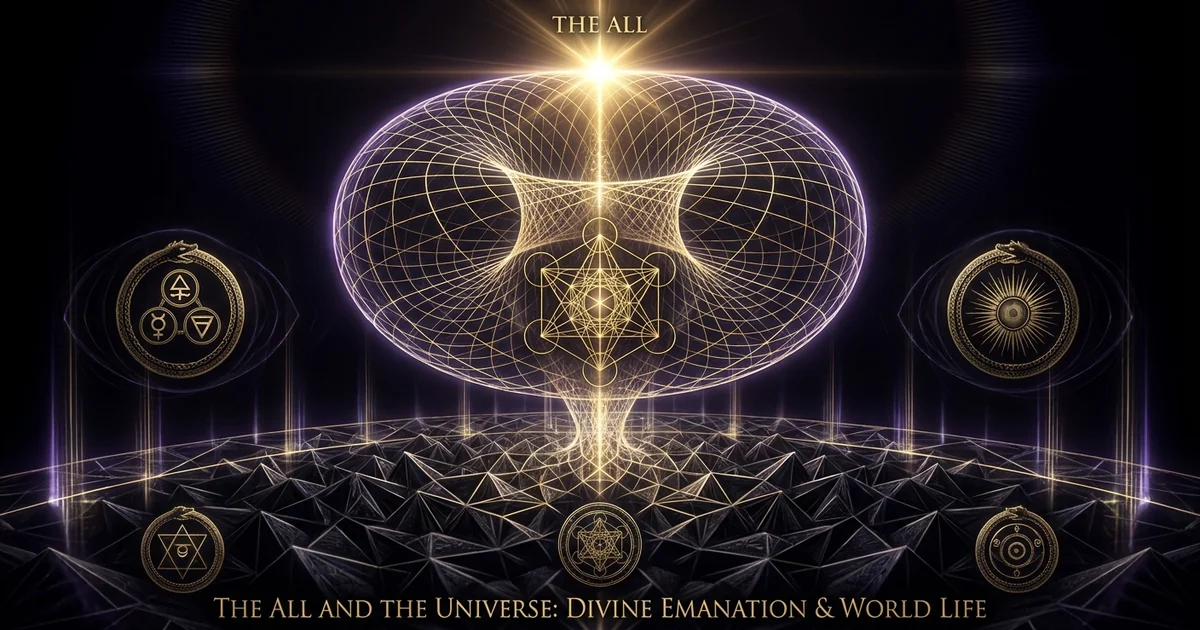
The All and the Universe: Divine Emanation & World Life
Metaphysical Thesis & Epistemological Opening: The Unmanifest Reality and Non-Dual Substrate
Epistemological Limits of Hylic Reductivism
The crisis of contemporary physicalism stems from an intractable category error: the presumption that consciousness can be derived from an arrangement of non-conscious, mechanical quanta. In attempting to bridge the “hard problem” of consciousness, hylic reductivism posits matter as the self-sufficient, ontological ground of being, reducing intentionality, qualitative experience, and subjective awareness to mere epiphenomena of neurological architecture. This materialist axiom fails precisely because it constructs an explanatory bridge from an unverified foundation. Matter, observed through the instruments of physical inquiry, is never encountered as an unmediated thing-in-itself; rather, it presents solely as a series of cognitive perceptions, measurements, and perceptual models rendered within the field of awareness.
To posit dead matter as an absolute primitive is to privilege an abstraction over the immediate condition of apprehension. When analyzed through modern epistemological critiques and trans-dimensional ontology, the physicalist paradigm collapses under its own recursive assumptions. Quantum mechanics has demonstrated that the localized properties of particles cannot be completely disentangled from the measurement apparatus and the observer, a dynamic addressed in investigations of /consciousness/mentalism-and-quantum-observer-effect. By treating the objective universe as an isolated, closed system of mechanical interactions, reductionism ignores the anterior field of presence within which physical measurements occur. Consequently, physicalism remains fundamentally incapable of addressing cosmogenesis, for it seeks the origins of reality within the differentiated products of manifestation rather than in the unified substrate that precedes differentiation.
Defining The All: The Ineffable Substantial Reality
To transcend the blind alleys of hylic reductivism, Western esotericism, classical Neoplatonism, and Kabbalistic metaphysics posit an unconditioned, self-subsistent source: The All (To Pan). The All cannot be categorized as an entity among entities, nor can it be comprehended through the discursive taxonomies of finite logic. Because every definition relies upon delimitation—setting an object apart from what it is not—The All resists categorical circumscription. It possesses no boundary, no external point of reference, and no temporal sequence. It is the unmanifest reality nature that underpins, contains, and animates all relational phenomena while remaining unaffected by cosmological transitions.
                  THE INEFFABLE GROUND
                   [ To Pan / Ein Sof ]
                            │
               (Apophatic Void / Pure Spirit)
                            │
        ┌───────────────────┴───────────────────┐
        ▼                                       ▼
Cataphatic Assertion                    Apophatic Negation
("The All is Mind")                    ("Not this, not that")
The cognition of finite entities, adapted to process relative differences, fragments when turned toward this absolute source. Epistemologically, approaching The All demands an apophatic methodology—the via negativa championed by Pseudo-Dionysius and Plotinus. Human discursive reason can only articulate what The All is not: it is not spatial, not temporal, not composite, not changeable, and not subject to entropy. Yet, this apophatic void does not signify non-existence or nihilistic absence; rather, it denotes a state of super-essential plenitude (pleroma). It is the unmanifest ground of pure potentiality, possessing such infinite intensity of being that any specific determination would constitute an ontological diminution. In the lexicon of initiatic metaphysics, the all kybalion divine emanation unmanifest reality nature signifies that reality is not an accidental confluence of particulate matter, but the continuous output of an infinite, self-referential Absolute.
The Greek To Pan (Τὸ Πᾶν), foundational to the Hermetic treatises of Roman Egypt, denotes the totality of existence, not as a numerical aggregation of disparate parts, but as an indivisible, organic unity within which every sub-system subsists. This conceptual architecture finds a direct parallel in the Lurianic Kabbalistic doctrine of Ein Sof (אין סוף)—literally “Without End” or “Infinite.” Both designations signify the absolute, unmanifest ground of being anterior to the primary contraction (Tzimtzum) or the initial divine ideation. Neither To Pan nor Ein Sof can be invoked as a personal deity; they designate the unconditioned, trans-ontological foundation from which both the archetypal realms and the material cosmos hierarchically emanate.
The Principle of Mentalism as Foundational Ontology
If the unmanifest Absolute is infinite, non-composite, and self-subsistent, it cannot create reality out of an external substance, for no exteriority exists beyond the boundless. Nor can it divide itself into fragments, for infinity divided remains infinite, and the absolute admits of no structural fissure. The philosophical resolution to this cosmological enigma is the Principle of Mentalism: reality is psychical. The universe is not an aggregation of solid, independently existing objects, but a coherent mental projection sustained within the divine intellect of The All.
This metaphysical assertion does not reduce the cosmos to human solipsism; it asserts that objective physical laws, atomic structures, and astronomical cycles are stable thought-forms within the cosmic intellect. Matter is not discarded; rather, it is reconceptualized as mental energy vibratorily decelerated to the point of perceptible solidity. The cosmos exists within the Mind of The All as an author’s narrative exists within their conscious imagination, or as an intricate virtual matrix exists within the processing architecture of a computational substrate. Within this framework, every physical event is an informational transaction, every organic structure is an expression of archetypal geometry, and the entirety of cosmological space-time represents the interior ideation of an indivisible, living Absolute.
Primary Codices & Historical Transmission: From Alexandrian Hermetism to Modern Synthesis
The Corpus Hermeticum: Poimandres and the Ideational Cosmos
The emanational cosmogony that grounds this non-dual ontology was comprehensively systematized during the early centuries of the Common Era within the syncretic crucible of Greco-Egyptian Alexandria. In the Corpus Hermeticum, attributed to the mythic adept Hermes Trismegistus, the genesis of the cosmos is explicitly rendered as an ideational descent from the transcendent Mind (Nous). The primary treatise, Libellus I: Poimandres, records an initiatic vision wherein the narrator encounters the archetypal, self-begotten Mind. Poimandres demonstrates that before physical manifestation arose, a luminous ideation existed: a boundless light within which an archetypal cosmos was conceived through the divine Word (Logos).
         NOUS (The Archetypal Mind)
                     │
         LOGOS (The Directing Word)
                     │
       DEMIURGE (The Craftsman of Spheres)
                     │
    HEPTANOIC SPHERES (Fate / Heimarmene)
                     │
     THE HYLIC REALM (Phenomenal Matter)
Within the Poimandres, the creation of the sensible world is not a mechanical assembly or an ex nihilo fiat, but an emanational cascading. The supreme Nous, who is Life and Light, gives birth to a second Nous Demiurgos—the craftsman-intellect. This secondary intelligence fashions seven governors or celestial spheres (the Heptad), which encompass the sensible world and administer the apparatus of fate (heimarmene). Crucially, the cosmos is characterized as an animate, sentient being. The divine presence does not withdraw from its creation; it permeates every tier of the cosmological descent. As detailed in the historical analysis of /ancient-prehistory/alexandrian-syncretism-and-theurgy, this Alexandrian synthesis fused the Egyptian comprehension of dynamic cosmic magic with the Platonic theory of transcendent forms, ensuring that the phenomenal cosmos was understood as the visible icon of an invisible, mental reality.
“Look at the things through me and contemplate the cosmos lying before your eyes; embrace its beauty, a body kept pure, than which nothing is more ancient, always at peak vigour and young, or rather even more vigorous and younger. See also the seven worlds lying beneath it, arranged in an eternal order, running their courses across eternity with different paths… All these things are full of soul, and all are set in motion… Observe how heaven and earth are sustained within the mind of God… God is not insensible, nor is he lacking in understanding; all things exist in God as if created within his mind, for this is the power of God, to contain all things in thought.” — Hermes Trismegistus, trans. Brian P. Copenhaver (Cambridge University Press, 1992)
Neoplatonic Vectors: Plotinus, Proclus, and the Emanational Arc
Concurrent with the Hermetic codices, late antique Neoplatonism provided the rigorous dialectical architecture governing this emanational framework. Plotinus, writing in the Enneads, formulated a tripartite metaphysical taxonomy that remains the most sophisticated model of non-dual procession in the Western canon. At the apex rests The One (To Hen), an absolute unity beyond being, identity, and thought. By virtue of its inexhaustible plenitude, The One overflows, not through a temporal choice or deliberate act of will, but by ontological necessity—analogous to the manner in which the sun emanates light without suffering an exhaustion of its source.
This overflow crystallizes into the first hypostasis: Nous (Divine Intellect), which contains within itself the entirety of intelligible forms (eide). As Nous contemplates its source, it reflects upon itself, generating multiplicity-in-unity. From Nous proceeds the third hypostasis: Psyche (the World-Soul), which acts as the intermediary between the intelligible realm and the phenomenal world. The later Neoplatonist Proclus, in his Elements of Theology, formalized this dynamic into the triadic cycle:
- Mone (abiding in the source),
- Proodos (procession into differentiated forms),
- Epistrophe (reversion or return to unity).
Under this Neoplatonic arc, divine emanation operates continuously; it is not a historical event located in the remote past, but an eternal present. Matter (hyle) marks the outermost boundary of this procession—the point where the light of the emanative source fades into mere receptivity, yet remains bound to the archetypal laws stamped into it by the World-Soul.
The 1908 Kybalionic Redaction: New Thought Syncretism vs. Classical Hermetica
At the turn of the twentieth century, the classical Hermetic doctrine underwent a dramatic vernacular translation with the publication of The Kybalion (1908), penned by the pseudonymous “Three Initiates” (now widely recognized as William Walker Atkinson). While historical purists frequently emphasize the text’s immersion in Victorian New Thought, mesmerism, and late-nineteenth-century mental science, The Kybalion retains structural continuity with classical emanational doctrine. It translated the ontological axioms of the Alexandrian and Neoplatonic lineages into a pragmatic metaphysical framework centered on the seven Universal Principles: Mentalism, Correspondence, Vibration, Polarity, Rhythm, Cause and Effect, and Gender.
       CLASSICAL HIERARCHY                 KYBALIONIC DYNAMICS
     ┌──────────────────────┐            ┌──────────────────────┐
     │ To Hen / The One     │  ───────►  │ The All (Mentalism)  │
     ├──────────────────────┤            ├──────────────────────┤
     │ Nous / Intellect     │  ───────►  │ Vibration & Polarity │
     ├──────────────────────┤            ├──────────────────────┤
     │ Psyche / World-Soul  │  ───────►  │ Rhythm & Gender      │
     ├──────────────────────┤            ├──────────────────────┤
     │ Hyle / Material World│  ───────►  │ Cause and Effect     │
     └──────────────────────┘            └──────────────────────┘
The Kybalion’s primary conceptual contribution was the rigorous popularization of the phrase “THE ALL is MIND; The Universe is Mental.” Atkinson stripped Alexandrian Hermetism of its elaborate celestial hierarchies and theurgic rituals, recasting the emanational cosmos as a dynamic, informational architecture governed by precise mental laws. Where the Poimandres articulated cosmogenesis through mythological imagery of light, darkness, and demiurgic craftsmanship, The Kybalion synthesized these motifs with contemporary physics, asserting that what science designates as matter and energy are merely descending rates of mental vibration. In doing so, it preserved the core Alexandrian postulate: the phenomenal universe is a mental projection of the cosmos, an internal ideation held within the infinite intellect of the unmanifest Absolute.
Ontological Architecture & Cosmological Models: Hierarchical Emanation and the Informational Matrix
The Mechanics of Divine Emanation: From Ein Sof to the Phenomenal Plane
To understand how the unmanifest Absolute projects the sensible cosmos without fracturing its non-dual nature, the operational mechanics of divine emanation must be distinguished from the theological dogma of creatio ex nihilo. In the creationist model, an ontological gulf forever separates the transcendent Creator from the created artifact. In an emanationist ontology, the cosmos is an unbroken continuum of being. The transition from the absolute to the relative is achieved through progressive, hierarchical stepping-down of ontological intensity.
This process mirrors the Lurianic Kabbalistic doctrine of the Sefirot, wherein Ein Sof projects the primary light (Ohr Ein Sof) through ten sequential vessels, as mapped in /spirituality/corpus-hermeticum-cosmogenesis. Each successive emanative stage acts as a filter or dimensional stepped-down transformer:
$$\text{Intensity} \propto \frac{1}{\text{Dimensional Distance from the Pleromic Center}}$$
The higher hypostases retain direct apprehension of unity, while the lower strata, descending through the etheric, astral, and physical planes, experience an increasing sense of separation and density. Yet, throughout this procession, there is zero ontological loss or degradation within the Absolute itself. The source does not diminish when it projects; the ocean is not depleted by the arising of its waves. Matter represents the condensation of Spirit—the terminus of the emanative ray where the vibrational velocity of divine ideation slows to the point of apparent fixity, forming the arena of physical incarnation.
The Universe as a Mental Projection of the Cosmos
Conceiving the universe as a divine ideation illuminates the structural consistency of physical law. Physical phenomena are governed by mathematical constants, geometric symmetries, and immutable principles precisely because they are the structural features of an infinite, hyper-rational mind. If the universe were an unguided accident of mechanical collisions, the ubiquity of mathematical order would remain an inexplicable anomaly. In contrast, within an emanative ontology, the laws of physics are the operating syntax of a cosmic simulation sustained by the divine intellect.
Under this model, space and time are not absolute containers housing inert matter; they are relational coordinates generated by the cosmic mind to facilitate the unfolding of differentiated experience. The cosmos functions as a self-referential mental holographic projection: every finite node within the projection contains an implicit representation of the entire matrix. This explains the Hermetic axiom of Correspondence—“As above, so below; as below, so above.” The macrocosm (the universe) and the microcosm (the individual consciousness) are structurally isomorphous because both are fashioned from the same mental substrate and governed by the same emanational dynamics. The localized mind of the human observer is not an isolated spectator set over against an alien, mechanical environment; it is a localized aperture through which The All experiences its own continuous ideation.
Cybernetics and High Strangeness: The Valléean Informational Control Substrate
When the universe is recognized as a mental projection, modern scientific paradigms regarding the nature of information, cybernetics, and anomalous events converge with esoteric metaphysics. The computer scientist and astrophysicist Jacques Vallée, in works such as Messengers of Deception, revolutionized the study of non-human intelligence (NHI) and anomalous phenomena by proposing that anomalous encounters and high strangeness events are not extraterrestrial incursions from distant physical planets, but localized modulations of an overarching informational control system. Vallée’s work, analyzed comprehensively in /nhi-phenomena/vallee-informational-control-system, suggests that phenomenal reality operates as an information-rich matrix designed to steer human cultural and cognitive evolution through precisely calibrated anomalies.
       PHENOMENOLOGICAL REALITY AS AN INFORMATIONAL SYSTEM
  ┌────────────────────────────────────────────────────────┐
  │         Divine Ideation (The Mental Substrate)         │
  └───────────────────────────┬────────────────────────────┘
                              │ Informational Code
                              ▼
  ┌────────────────────────────────────────────────────────┐
  │       The Phenomenal Matrix (Physical Constants)       │
  └───────┬────────────────────────────────────────┬───────┘
          │ Feedback Loop                          │ Feedback Loop
          ▼                                        ▼
  ┌───────────────┐                        ┌───────────────┐
  │   Consensus   │ ◄──── Intersect ─────► │   Anomalies   │
  │    Reality    │     (Vallée Control)   │    & NHI      │
  └───────────────┘                        └───────────────┘
Vallée’s hypothesis maps directly onto the Hermetic and Neoplatonic conception of the cosmos. If reality is mental and informational rather than material, then what we designate as the “physical universe” is a controlled perceptual interface. Anomalies, synchronicities, interdimensional intelligences, and high strangeness events are systemic intrusions: moments when the underlying psychic architecture of the matrix bypasses standard sensory filtering mechanisms to alter the consciousness of the localized observer. Non-human intelligences—whether anciently classified as angels, archons, daemons, or modernly categorized as interdimensional entities—act as administrative subroutines within the World-Soul, regulating the informational thresholds of the incarnational plane. High strangeness is the subjective phenomenology of consciousness confronting the computational, mental machinery that sustains the projection of space-time itself.
Phenomenological Mechanics & Interdimensional Interaction: The Divine Paradox and World Life
Resolving the Divine Paradox: The All in All vs. All in The All
A central dilemma of idealist and non-dual philosophies is the reconciliation of absolute transcendence with empirical reality. If the universe is a mental projection within The All, does it possess any substantial reality, or is it an empty, nihilistic illusion? The Hermetic answer is formulated as the Divine Paradox:
“While All is in THE ALL, it is equally true that THE ALL is in All.”
This paradox demands a bi-focal epistemology. From the Absolute Standpoint, the universe is an ephemeral, transient thought within the divine mind; it possesses no independent self-existence, no permanence, and no separation from its source. Measured against the eternal plenitude of The All, the cosmos is as insubstantial as a dream.
               THE DIVINE PARADOX
   ┌────────────────────────────────────────┐
   │         THE ABSOLUTE STANDPOINT        │
   │      "All is contained in THE ALL"     │
   │  (The universe as divine imagination)  │
   └───────────────────┬────────────────────┘
                       │
             ONTOLOGICAL COINCIDENCE
                       │
   ┌───────────────────┴────────────────────┐
   │         THE RELATIVE STANDPOINT        │
   │        "THE ALL is within All"         │
   │  (The universe as absolute empirical   │
   │    reality for localized entities)     │
   └────────────────────────────────────────┘
However, from the Relative Standpoint—the ontological coordinates of the localized observer operating within the dimensional framework of the matrix—the universe is real, its physical laws are binding, and its causal chains are inescapable. To confuse the absolute standpoint with the relative standpoint produces spiritual delusion. The statement “matter is an illusion” does not authorize the incarnated being to disregard the laws of physics, for those laws are the sustained, coherent thoughts of God. The Divine Paradox teaches that the phenomenal plane is an operational reality for incarnated consciousness, sustained by the absolute reality of The All.
Absolute Standpoint (Reality as Pure Spirit / The All)
- Ontological Status: Transcendent, non-dual, immutable, timeless, indivisible.
- Cosmic Perception: The universe is an internal, ephemeral mental projection with no independent self-existence.
- Causality: Non-existent; all potentiality is realized simultaneously within an eternal, unmanifest present.
- Identity: The All alone is; total collapse of subject-object differentiation into pure, unconditioned awareness.
Relative Standpoint (Reality as Phenomenal Law / World Life)
- Ontological Status: Dimensional, dualistic, mutable, temporal, highly differentiated.
- Cosmic Perception: The universe is an inescapable, solid, lawful environment demanding rigorous physical and energetic adaptation.
- Causality: Absolute determinism; structured by the immutable Hermetic principles of Cause and Effect, Rhythm, and Polarity.
- Identity: Differentiated, localized consciousness navigating an informational matrix of non-human entities and physical limits.
Transcending Material Illusions Without Falling into Hylic Nihilism
A profound hazard within esoteric systems is the descent into hylic nihilism—a corrupt variation of Gnostic cosmogony wherein the material cosmos is derided as an evil, worthless aberration engineered by an antagonistic demiurge. When the metaphysical concept of maya (illusion) is misinterpreted as total vacuity, the adept frequently abandons ethical responsibility, incarnational engagement, and bodily integration.
Transcending material illusions does not require denying their operational validity; it requires piercing their claims to self-sufficiency. The illusion lies not in the experience of the material world, but in the false ontological assumption that matter exists independently of consciousness. When an entity realizes that the phenomenal sphere is a nested matrix of mental light, matter ceases to be a prison. It becomes a structured laboratory for spiritual consciousness. The world is not an accidental prison house of light, but an intentional gymnasia designed for the development of individual souls. By recognizing that physical density is merely decelerated mental frequency, the adept avoids both the naive realism of the materialist and the ungrounded escapism of the nihilist, maintaining full sovereignty and operational clarity within the relative field.
The World Life: Hylozoism, Panpsychism, and the Living Matrix
Because the cosmos proceeds from an absolute, non-dual Mind, it follows that life and consciousness are not rare accidents localized to biological organisms on Earth. Instead, the universe is governed by the principle of hylozoism—the ancient doctrine that all matter is intrinsically alive and conscious. There is no dead matter anywhere in the cosmos. Every atom, mineral crystal, planetary sphere, and interdimensional vector possesses a localized degree of conscious apprehension appropriate to its dimensional octave.
                    THE SPECTRUM OF WORLD LIFE
     [ Absolute Nous ] ──► Pure Self-Apprehending Mind
            │
     [ Stellar / Planetary ] ──► Macro-Intelligences / Anima Mundi
            │
     [ Biological Organisms ] ──► Cellular, Reflexive, Discursive
            │
     [ Mineral / Subatomic ] ──► Inherent Proto-Mental Vibration
This Hermetic hylozoism prefigures the most sophisticated variants of modern panpsychism and analytic idealism. The World Life (Anima Mundi) is the vital, psychic network that coordinates the living matrix. From the spinning of electrons around a nucleus to the orbit of star systems within galactic disks, the universe breathes, pulsates, and evolves as a single organism. The high strangeness phenomena documented across interdimensional paradigms—such as sentient plasma, biological UFO appearances, and place-memory hauntings—are explicable through this hylozoic lens. The environment itself is psychically receptive and responsive. When the localized consciousness of an investigator intersects with the living matrix under conditions of heightened vibrational resonance, the World Life responds, producing events that materialist science dismisses as impossible, but which esoteric science recognizes as the natural behavior of a sentient universe.
Initiatic Synthesis & Philosophical Implications: Mental Transmutation and Sovereign Deification
Mental Transmutation as Applied Metaphysics
The ultimate objective of Hermetic cosmology is not passive contemplation, but active ontological transformation. If reality is a mental projection, then mind possesses primacy over physical structure. The Kybalion defines mental transmutation—often termed mental alchemy—as the art of changing mental states, forms, and conditions into others. This practice must be distinguished from vulgar attempts at material manipulation or pop-spirituality “manifestation.” Hermetic transmutation is the systematic application of universal laws to reshape one’s localized consciousness and its immediate environment.
                        THE ALCHEMICAL RETUNING
    [ Low Frequency State ]                      [ High Frequency State ]
          (Discord)                                      (Harmony)
              │                                              ▲
              ▼                                              │
    [ Polarity Shift ] ───► [ Rhythm Harmonization ] ───► [ Mastered Output ]
Because all phenomena reside on a continuum of vibration, the adept does not attempt to destroy an undesirable condition or battle a physical obstacle with direct hylic force. Instead, following the Principle of Polarity, they shift the vibrational frequency of their own mental state. Fear is not eliminated by suppression; it is converted into courage by shifting its operational polarity. By mastering the interior mental currents, the adept ceases to be an unthinking automaton tossed by the waves of collective emotion and cultural programming. By understanding that external conditions are the objective projections of underlying mental blueprints, the practitioner realigns their interior architecture with divine archetypes, thereby precipitating precise changes in the external phenomenal matrix.
Theurgic Alignment and the Reclamation of Human Sovereignty
To move beyond the status of a passive spectator in an informational matrix, the practitioner must engage in what the Neoplatonic tradition termed theurgy (theourgia—divine work). Formulated by Iamblichus in De Mysteriis, theurgy acknowledges that the human ego cannot elevate itself through discursive intellectualization alone. Instead, the adept must utilize the living symbols, geometric signatures, and divine resonances embedded within the material world to establish an ontological circuit with higher emanational hypostases.
The profoundest hazard in applying the Principle of Mentalism lies in the solipsistic confusion of the ego with The All. When an initiate realizes that “reality is mental,” the unintegrated psyche frequently attributes the omnipotence of the transcendent Absolute to the finite, historical personality. This catastrophic cognitive error produces psychological inflation, megalomania, and spiritual psychosis—the classical “Luciferian collapse.” The adept must remember that while the universe exists in the mind of The All, the localized human ego is a projected thought within that cosmic ideation. The human vessel does not command the cosmos through egoic will; it participates in cosmic sovereignty only to the degree that the ego is subordinated and aligned with the divine Nous.
Through theurgic alignment, the human being transcends the determinism of the lower matrix. In Alexandrian Hermetism, humanity occupies a unique, ambilateral position: while the physical vehicle is subject to fate (heimarmene) and the astrological mechanisms of the planetary spheres, the human soul contains a spark of the unmediated divine Mind. When an individual achieves awakening (gnosis), they reclaim their original sovereignty. They are no longer a passive node trapped in the Archontic machinery of physical constraints; they become a conscious co-creator within the cosmos. Sovereignty is reclaimed not by fighting the system, but by discovering the foundational code of the mental simulation, elevating the locus of one’s identity from the localized avatar to the eternal witness.
The Soteriological Destiny: Theosis and the Return Arc
The grand trajectory of the cosmos is governed by the Neoplatonic return arc: epistrophe. The universe does not emanate outward indefinitely into entropy and dissolution; its outward procession (proodos) is balanced by an internal yearning for reintegration (theosis). Every individualized node of consciousness descending into the material plane is on a cosmic journey of return, tasked with experiencing differentiation, mastering the laws of the phenomenal plane, and voluntarily returning to the source carrying the harvest of its incarnational experience.
       THE COSMIC BREATH (MANVANTARA & PRALAYA)
  Absolute Ground ────── Outward Breath (Proodos) ─────► Material Plane
         ▲                                                      │
         │                                                      ▼
  Reintegration ◄────── Inward Breath (Epistrophe) ────── Gnostic Awakening
   (Theosis)
This soteriological destination is not an annihilation of individuality, nor is it a regressive absorption into a featureless void. In genuine Hermetic deification (theosis), the individualized soul realizes its identity with The All while maintaining its unique experiential vantage. The return arc represents the conscious awakening of the divine Mind within its own projected creation. As individual souls wake up within the simulation, the matrix ceases to be an opaque, alien environment and reveals itself as the living garment of God. Incarnated life is the great alchemical process wherein the unmanifest ground knows itself through the dynamic, multidimensional tapestry of its own living universe.
Frequently Asked Questions: Metaphysical Dialectics on The All and Creation
Ontological Status of Evil and Discordance in a Monistic Mind
If the unmanifest reality nature of The All is the absolute source of every phenomenon, and if reality is fundamentally psychical, how do malevolence, systemic evil, and excruciating discordance exist without indicting the divine intellect as inherently psychopathic or broken?
The answer within emanative metaphysics rests upon the principle of privation (privatio boni), developed extensively by Plotinus and Saint Augustine. Evil possesses no independent ontological substance. It is not an autonomous, self-begotten power set over against the Absolute. Rather, evil is the localized absence, privation, or distortion of the Good, emerging naturally as the light of divine emanation descends into increasingly dense, fragmented degrees of manifestation.
               THE SPECTRUM OF MANIFESTATION
   Center of Pleroma ──────────────────────────────► Outer Boundary
   [ Coherence / Unity / Good ]                     [ Friction / Entropy / Evil ]
As the emanative ray extends into the furthest perimeters of dimensional existence, the sense of unity and non-dual coherence weakens. Individualized nodes of consciousness, blinded by the illusion of absolute separation, act in ignorance of their interconnectedness with the whole. This ignorance breeds fear, grasping, and aggression—the psychological roots of malevolence. Furthermore, what appears as discordance at a micro-level is frequently systemic friction required for evolutionary growth and dynamic complexity within a localized matrix. Without polarity, resistance, and the dialectic between contraction and expansion, no experiential world could unfold. Evil is the shadow cast by the light of the Absolute as it passes through the prism of phenomenal differentiation; it is an operational parameter of the lower dimensions, lacking any independent reality within the eternal plenitude of The All.
Distinction Between Hermetic Panentheism and Eastern Advaita Vedanta
How does the emanational cosmogony of classical Hermetism differ from the radical non-dualism (Advaita) of Eastern metaphysics, particularly regarding the ontological validity of the phenomenal universe?
While both systems are rigorously non-dual and locate the ultimate ground of reality within an indivisible, transcendent substrate (The All in Hermetism, Brahman in Advaita Vedanta), their assessments of the cosmos diverge significantly. In certain historical interpretations of classical Advaita, particularly the extreme acosmic schools influenced by Gaudapada, the phenomenal universe is categorized as mithya (an illusion, fundamentally unreal), an illegitimate superimposition (adhyasa) upon the rope of Brahman, which must be dissolved entirely to realize liberation.
       ADVAITIC ACOSMISM                  HERMETIC PANENTHEISM
    ┌──────────────────────┐            ┌──────────────────────┐
    │  Brahman = REAL      │            │  The All = SOURCE    │
    │  Universe = UNREAL   │            │  Universe = EMBODIED │
    │  (Total Denial)      │            │  (Living Matrix)     │
    └──────────────────────┘            └──────────────────────┘
Hermetism, conversely, is an unapologetic panentheism (“all-in-God”). While acknowledging that the universe is an ephemeral mental projection when viewed from the Absolute Standpoint, Hermeticism asserts that the universe is simultaneously a real, holy, and vital expression of the divine intellect from the Relative Standpoint. Hermetism celebrates the material world as an animate icon of the invisible deity—a living book of nature (Liber Mundi) to be deciphered, loved, and transfigured. Rather than seeking an ascetic dissolution of the universe, the Hermetic adept seeks to harmonize the lower with the higher, transmuting the base metal of phenomenal existence into the spiritual gold of conscious, embodied divinity.
“Western esoteric traditions have historically operated not through the radical dualism of matter versus spirit, nor through an acosmic monism that denies the reality of the sensible world, but through a dialectical panentheism. In this framework, the cosmos is perceived as an organic, living, and divinized reality that participates directly in the transcendent source from which it continually emanates, preserving both the sovereignty of the transcendent source and the profound dignity of the cosmos as its living manifestation.” — Wouter J. Hanegraaff, Esotericism and the Academy: Rejected Knowledge in Western Culture (Cambridge University Press, 2012)
Mechanisms of High Strangeness in an Emanationist Universe
If the phenomenal universe is a mental simulation, what are the precise operational mechanics that trigger high strangeness, poltergeist phenomena, and encounters with interdimensional Non-Human Intelligences (NHI)?
In an emanationist and informational paradigm, consensus physical reality is sustained by a shared, subconscious mental consensus—a cognitive filter tuned to a specific vibrational bandwidth. This filtering mechanism limits human perception to three dimensions of space and linear time, shielding the embodied psyche from the overwhelming informational density of the surrounding pleroma. High strangeness events occur when this filtering mechanism experiences a localized puncture or informational phase transition.
            INFORMATIONAL FILTERING AND PHASE TRANSITION
   ============================================================= (Pleroma)
     │                     ▲                    │
     ▼ (Sensory Filter)    │ (Threshold Spike)  ▼ (Direct Incursion)
   -------------------------------------------------------------
     Consensus Reality Bandwidth ──► [ Phase Shift ] ──► Anomalous NHI
   -------------------------------------------------------------
These phase transitions can be induced by geomagnetic anomalies, focused ritual or theurgic actions, intense emotional stress, technological field manipulations, or the deliberate intervention of NHI operating from higher emanational octaves. When this boundary thins, the underlying psychical mechanics of the matrix surface into conscious perception. Matter behaves plastically: solid objects levitate or apport, temporal sequences distort, subjective imagery takes on objective, physical density, and non-human intelligences materialize in shapes adapted to the cultural expectations of the observer. These events are not violations of physical law; they are demonstrations that physical law is a subordinate software program running within a broader, mental operating system. High strangeness is the direct signature of the cosmos revealing its true, emanated, psychical nature to the astonished gaze of the incarnated observer.