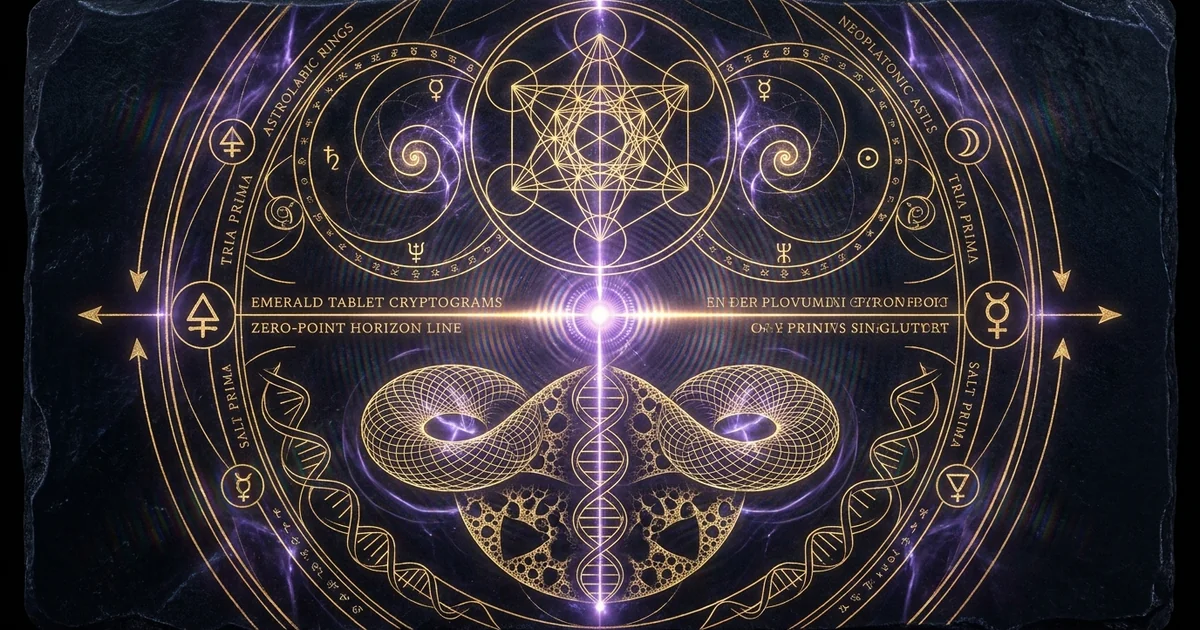
The Principle of Correspondence: As Above So Below Matrix
Metaphysical Thesis & Epistemological Opening: The Holographic Axiom
Deconstructing the Flatlander Fallacy: Beyond Naive Materialist Realism
Classical Cartesian-Newtonian physics presupposes a disjointed ontology, bisecting reality into an inert, objective spatial theater (res extensa) and an unextended, epiphenomenal subjective observer (res cogitans). This bifurcation suffers from what may be termed the “Flatlander fallacy”—an epistemic myopia that interprets higher-dimensional systemic invariants purely through localized, horizontal projections. By treating the physical plane as an isolated, causal vacuum, naive materialist realism fails to explain the systematic, structural congruence observed between subjective phenomenological interiors and external geometric configurations.
When the local observer perceives an isolated phenomenon, classical reductionism presumes that causality moves exclusively from the bottom up, via localized energetic exchanges across microscopic vectors. However, this mechanistic premise fractures when confronted with non-local correlations, non-linear system dynamics, and the deep isomorphism that bridges cognitive syntaxes with physical topologies. To address these operational anomalies, metaphysical inquiry must transition from atomized, scale-bound materialism to a scale-free informational ontology. In this paradigm, reality is understood not as an aggregate of colliding particles within an inert void, but as a dynamic informational substrate whose operations are scale-invariant.
The axiom of correspondence rejects the flatland paradigm by demonstrating that local phenomena are boundary-conditions of universal geometries. The macrocosmic architecture does not exert a tyrannical, unilateral force over the microcosm; rather, both domains manifest as concurrent projections of a unified, self-referential semantic architecture.
       [ MACROCOSM / IMPLICATE GEOMETRY ]
                      ▲  │
   Phase Conjugation  │  │  Topological Projection
   (Ascending Vector) │  │  (Descending Vector)
                      │  ▼
       [ MICROCOSM / EXPLICATE PHENOMENA ]
The Informational Isomorphism: Recursive Scale-Invariance
Codified as the second hermetic principle, the Principle of Correspondence establishes that different ontological registers—the somatic, the psychoid, and the metaphysical—exhibit rigorous morphological symmetries. Under this doctrine, the macrocosm and microcosm do not constitute causally severed, independent jurisdictions separated by an impassable ontological chasm. Instead, they represent fractal self similarity planes executing identical systemic algorithms at disparate dimensional densities.
The universal substrate maintains continuity across scale through recursive invariance. Just as the logarithmic spiral of the Mandelbrot set preserves its geometric invariants across infinite magnitudes of magnification, the structural laws governing celestial mechanics, the energetic topology of biological cellular networks, and the introspective ideations of human noetics preserve an invariant relational matrix. This scale-invariance implies that an ontological structural shift within an interior psychological manifold instantaneously reflects within its corresponding exterior phenomenal field. The macrocosm microcosm correlation is therefore not a poetic analogy, but an operational isomorphism: a structural mapping between systems wherein the relational integrity of the components remains strictly invariant across changes in scale, medium, and vibrational frequency.
Subject-Object Non-Duality in the As Above So Below Matrix
This recursive scale-invariance directly prefigures contemporary holonomic and implicate models of cosmic order, such as those advanced in the physics of David Bohm. In Bohm’s topological formulation of reality, detailed in his foundational work on the implicate order and holographic mind, the explicate world of discrete, separated objects constitutes an unfolded, localized manifestation of an enfolded, unbroken totality. Every localized spatial coordinate in the explicate realm contains the holographic signature of the totality enfolded within its internal structure.
The classical boundary between the perceiving subject and the perceived object dissolves within this framework. When interiority (the “so below” of psychic intentionality) and exteriority (the “as above” of environmental contingency) are recognized as phase-conjugate aspects of an unbroken informational continuum, the principle of correspondence as above so below kybalion inner outer polarity reveals itself as a structural dynamic:
$$I_{\text{totality}} = \oint_{\partial \Omega} \Psi_{\text{inner}} \otimes \Phi_{\text{outer}} , d\sigma$$
The observer does not merely gaze upon an external world; the observer is the sensory interface through which the cosmic totality models, maps, and recalibrates its own systemic configurations. Consciousness is an active transducer, translating implicit macrocosmic geometries into explicate microcosmic experience, and recursively reflecting local interior realizations back into the universal architecture.
The conceptual lineage of scale-invariant ontological terms originates in the Hellenic compound Makrokosmos (μακρόκοσμος, from μακρός “large” and κόσμος “ordered universe”) and Mikrokosmos (μικρόκοσμος, from μικρός “small”). These terms were formulated by the Pre-Socratics and systematized in the Platonic Timaeus to articulate the living universe as an ensouled anthrōpos, and humanity as a recapitulated cosmos.
This Greek structural framework was later adapted into Medieval Arabic alchemy. In the foundational recension of the Tabula Smaragdina preserved within Pseudo-Apollonius of Tyana’s (Balīnas) eighth-century treatise Kitāb sirr al-khalīqa (The Book of the Secret of Creation), this structural correspondence was codified as:
“mā fawqa ka-mā taḥta wa-mā taḥta ka-mā fawqa” (ما فوق كما تحت وما تحت كما فوق) “That which is above is like that which is below, and that which is below is like that which is above.”
This formula served not as an abstract metaphysical simile, but as an operative operational protocol for qualitative physical and spiritual transmutations.
Primary Codices & Historical Transmission: From Balinas to The Kybalion
The Textual Genealogy: From the Tabula Smaragdina to the Corpus Hermeticum
The historical genesis of the correspondence axiom traces a transmission vector that defies the modernist assumption that the doctrine was merely an invention of nineteenth-century occultism. While popularized in contemporary counter-culture through occult primers, the core formulation resides within the foundational currents of Hellenistic Egypt, where Egyptian Thoth-theology intersected with late Platonic, Stoic, and Pythagorean philosophies. In the monumental historiographical investigations conducted by André-Jean Festugière (La Révélation d’Hermès Trismégiste), this Hermetic literature is shown to bifurcate into two interconnected streams: popular (operative, astrological, alchemical) Hermetism and philosophical (theological, noetic) Hermetism.
The definitive epigrammatic codification of the correspondence principle appears within the Tabula Smaragdina (The Emerald Tablet). Long surviving solely in Latinized medieval manuscripts, Twentieth-century archival scholarship by Julius Ruska and Paul Kraus traced the text’s earliest extant written recension to the eighth-century Arabic alchemical corpus: specifically the Kitāb sirr al-khalīqa wa-ṣan’at al-ṭabī’a attributed to Balīnas (Pseudo-Apollonius of Tyana), operating within the intellectual orbit of the Jābir ibn Ḥayyān school.
The text was subsequently translated into Latin during the twelfth century by figures such as Hugh of Santalla, disseminating throughout the Scholastic networks of Western Europe. Within the philosophical core preserved in the Corpus Hermeticum—most notably the Poimandres and the Asclepius—this structural axiom undergirds the cosmological narrative: the human being does not merely inhabit the world, but contains the cosmos within the noetic structures of their mind (Nous), reflecting the primary archetypes of the celestial sphere down to the terrestrial realm.
Arabic Recension (Balīnas, Kitāb sirr al-khalīqa, c. 8th Century CE):
إن الذي في الأعلى هو من جنس الذي في الأسفل، والذي في الأسفل هو من جنس الذي في الأعلى، يعملان عجائب الشيء الواحد. “Verily, that which is in the highest is of the nature of that which is in the lowest, and that which is in the lowest is of the nature of that which is in the highest, operating the wonders of the One Thing.”
Latin Vulgata Recension (Medieval Scholastic Tradition, 12th Century CE):
“Quod est superius est sicut quod inferius, et quod est inferius est sicut quod superius, ad perpetranda miracula rei unius.” “That which is above is like that which is below, and that which is below is like that which is above, to perform the miracles of the one thing.”
The grammatical deployment of the comparative particle sicut (“just as”, “in the manner of”) alongside the copula emphasizes structural, relational isomorphism rather than static qualitative identity. It confirms that the realms operate through proportional equivalence (analogia) rather than crude material equivalence.
Renaissance Theurgy: Marsilio Ficino, Pico della Mirandola, and Bruno’s Astral Mirrors
The rediscovery and translation of the Corpus Hermeticum by Marsilio Ficino in 1463 under the patronage of Cosimo de’ Medici fundamentally transformed the intellectual landscape of the Italian Renaissance. It displaced the ossified Aristotelian scholasticism of the era in favor of a dynamic, panpsychic ontology. Ficino, synthesizing Hermetic insights with late Neoplatonists such as Iamblichus and Proclus, operationalized the macrocosm-microcosm correlation via the mechanics of natural magic and theurgy (theurgia). In his seminal work De vita libri tres, Ficino posits the existence of the Anima Mundi (World Soul), which acts as an active, intermediary metaphysical medium binding the physical realm below to the intelligible forms above.
Ficino’s system relied upon sympathetic resonance: terrestrial objects, minerals, flora, and human organs possessed specific occult qualities or “signatures” that corresponded directly to celestial spheres and planetary intelligences. By fashioning physical talismans, attuning harmonic musical intervals, and calculating precise astrological moments, the theurgist could realign the local microcosm with the universal macrocosm, drawing down celestial graces (spiritus) into the terrestrial plane. Giovanni Pico della Mirandola broadened this synthesis by integrating Christian Cabala, constructing a linguistic and mathematical ladder of correspondence between Hebrew letters, angelic hierarchies, and the elemental strata.
As Frances Yates demonstrates in Giordano Bruno and the Hermetic Tradition, this Hermetic-theurgic trajectory reached its radical apex in the cosmic vision of Giordano Bruno. Bruno shattered the geocentric, bounded cosmos of antiquity, replacing it with an infinite, decentered universe populated by infinite worlds, each vibrating with life. For Bruno, the principle of correspondence was no longer anchored to a static, hierarchical Ptolemaic sphere; it became an omnipresent astral engine. Bruno conceived of human memory and imagination as internal astral mirrors. By constructing complex mnemonic wheels imprinted with macrocosmic archetypal images, the Hermetic magus internalized the total structural dynamics of the infinite cosmos, realizing absolute noetic operational sovereignty through the correspondence between the internal mind and the infinite universe.
The New Thought Syncretism: William Walker Atkinson and the Kybalion Codification
At the dawn of the twentieth century, the historical Hermetic tradition intersected with the emerging American mentalist movements, New Thought, and late-Victorian spiritualism. This syncretic convergence culminated in the publication of The Kybalion: A Study of The Hermetic Philosophy of Ancient Egypt and Greece in 1908, authored anonymously by the “Three Initiates”—now definitively identified by intellectual historians as William Walker Atkinson, a prolific writer, occultist, and pioneer of the New Thought movement. Atkinson extracted the fragmented, theologically dense, and historically diverse currents of Western Esotericism and refined them into an axiomatic operational system consisting of seven cosmic laws.
Within this modernized structure, the Principle of Correspondence was formalized as the Second Hermetic Principle:
“As above, so below; as below, so above.”
Atkinson stripped the axiom of its medieval scholasticism and early modern astrological machinery, framing it within an idealistic, mentalist ontology. The Kybalion asserted that this principle served as an epistemological instrument of exceptional utility: an intellectual universal joint that permitted the human intellect to reason rigorously from the known to the unknown.
By analyzing the observable phenomena of the physical plane, the practitioner could deduce the operational laws of unobservable mental and spiritual dimensions. Although Atkinson’s text modernized the philosophical terminology, it preserved the essential antique premise: the universe is a mental projection of “THE ALL,” and the human mind—being an authentic microcosmic fractal of that divine mentation—operates using the same fundamental principles that govern the architecture of reality itself.
Ontological Architecture & Cosmological Models: The Multi-Planar Topology
                  THE PLEROMA / THE ALL
                           │
      ===========================================
      [  THE SPIRITUAL PLANE: DIVINE ARCHETYPES  ]
      ===========================================
                           ▲
                           │  Recursive Correspondence
                           ▼
      ===========================================
      [    THE MENTAL PLANE: PSYCHOID FIELDS     ]
      ===========================================
                           ▲
                           │  Scale-Invariant Resonance
                           ▼
      ===========================================
      [   THE PHYSICAL PLANE: SOMATIC PARTICLES  ]
      ===========================================
The Triune Dimensional Stratification: Physical, Mental, and Spiritual Planes
To elucidate the operational domain of correspondence, Hermetic cosmology models the cosmos as a stratified, multi-planar continuum rather than an undifferentiated ontological soup. The Kybalion categorizes these strata into Three Great Planes:
- The Great Physical Plane
- The Great Mental Plane
- The Great Spiritual Plane
These divisions are not discrete spatial locations piled atop one another like geological strata; rather, they are qualitative dimensional gradations distinguished by their fundamental vibrational frequency. The Physical Plane encompasses phenomena ranging from gross baryonic matter, through chemical affinities, to classical forces and subtle radiative energies. The Mental Plane spans the spectra of instinctive drives, subconscious matrices, conceptual ideations, and synthetic intellectual architectures, including the collective psychic entities classical occultism designates as an egregore. The Spiritual Plane encompasses the transcendental forms, unconditioned noetic states, and divine archetypal powers that exist beyond individualized personality.
Critically, each Great Plane recursively replicates this triune division internally. The Physical Plane contains its own physical, mental, and spiritual sub-octaves, just as the Spiritual Plane possesses an internal structural graduation reflecting the lower strata. This recursive internal subdivision means that the macrocosm-microcosm correlation operates horizontally within each plane as well as vertically across the dimensional continuum. An ideological impulse crystallizing on the Mental Plane must cast an operational shadow upon the Physical Plane according to the harmonic laws governing that lower vibrational density. The planes are bound together through scale-invariant resonance; an adjustment in the tonal tuning of the spiritual archetype forces a phase-shift across all subsequent mental and physical manifestations.
Fractal Self-Similarity and Non-Linear Symmetry Breaking
The geometric vernacular required to articulate this multi-planar architecture with academic precision is found within fractal geometry and non-linear dynamics. A fractal is characterized by scale-invariance: it exhibits self-similarity regardless of the scale at which it is observed. Benoit Mandelbrot’s formalization of non-Euclidean structures reveals that deterministic, non-linear equations can generate infinite, boundary-defying geometric complexities that preserve their identity throughout endless scalar iterations.
Applied to Hermetic cosmology, the Principle of Correspondence functions as the deterministic operator of a cosmic fractal equation. The cosmos does not require separate, contradictory sets of laws to govern atomic behavior, human psychological dynamics, and galactic kinematics. Instead, the universe runs an invariant algorithm that undergoes non-linear symmetry breaking as it descends through dimensional densities.
Symmetry breaking occurs when the primordial, unified informational state—what Gnosticism terms the pleroma—is projected into the spatio-temporal conditions of the lower planes. While the pristine, isotropic symmetry of the divine archetype is refracted by the constraints of space, time, and physical resistance, the underlying topology remains strictly self-similar. Local micro-systems spontaneously reproduce global macro-geometries without the mediation of classical, linear energy transmission lines. The microcosm mirrors the macrocosm because both are geometric iterations of the identical underlying fractal attractor.
The Sefirotic Echo: Kabbalistic Jacob’s Ladder as a Correspondence Engine
This multi-planar topology finds a profound systemic equivalent in the mystical architecture of Kabbalah, particularly within the doctrine of the Four Worlds and the Sefirot. The Kabbalistic tree-of-life maps ten divine emanations (Sefirot) through which the unknowable absolute (Ein Sof) projects the phenomenal universe. This process does not occur within a single dimensional register, but descends through four distinct, interrelated cosmological worlds:
- Atziluth (The World of Emanation / Divine Archetypes)
- Beriah (The World of Creation / Archangelic Intellects)
- Yetzirah (The World of Formation / Astral-Psychic Patterns)
- Assiah (The World of Action / Physical-Material Manifestation)
        ATZILUTH (Divine / Archetypal)
                 │
                 ▼
        BERIAH   (Noetic / Creative)
                 │
                 ▼
        YETZIRAH (Astral / Formative)
                 │
                 ▼
        ASSIAH   (Physical / Material)
The operational continuity binding these Four Worlds is Jacob’s Ladder (Sulam Ya’akov). This cosmological model explicitly demonstrates how correspondence operates as an emanationist necessity. The Sephirah Malkhut (the physical Kingdom) of the highest world, Atziluth, does not terminate the systemic chain; instead, it serves as the Sephirah Keter (the Crown) of the subsequent world, Beriah.
This cascade replicates down through Yetzirah and into Assiah. Each world is a structural replica of the others, operating at a different scalar density. The Sefirotic tree is a correspondence engine: a structural blueprint wherein any movement, meditative intention, or ritual theurgy enacted upon the lower branches of Assiah reverberates upwards through the astral and angelic worlds, reshaping the informational flows of the highest divine reality.
Phenomenological Mechanics & Interdimensional Interaction: The Transducer Interface
Jacques Vallée’s Informational Physics and the Psychoid Boundary
When the Principle of Correspondence is deployed as an analytical framework for non-ordinary experiences, it resolves many of the deadlocks inherent to the study of anomalistic encounters. Modern ufology and anomalous phenomenology have long been crippled by the false binary between naive psycho-social reductionism (the claim that anomalous phenomena are purely hallucinations or cultural fabrications) and naive nuts-and-bolts extraterrestrial hypotheses.
Jacques Vallée fundamentally disrupted this impasse by proposing that such anomalies represent an informational control system. Vallée posits that reality is structured like a vast relational database, where meaning, symbolism, and consciousness are fundamental physical variables rather than secondary biological epiphenomena.
       INFORMATIONAL FIELD (Meaning-Dense Matrix)
                     ▲
                     │ [Phase-Conjugate Projection]
                     ▼
       PSYCHOID THRESHOLD (Interface Zone)
         │                         │
         ▼                         ▼
   SUBJECTIVE MIND           OBJECTIVE PHENOMENON
   (Archetypal Symbol)       (Physical Trace / Metric)
This informational paradigm directly intersects with Carl Jung’s concept of the “psychoid” boundary: an ontological realm where the distinction between the psychic and the somatic dissolves into an acausal, meaning-dense matrix. The interdimensional-hypothesis advanced by Vallée indicates that anomalous manifestations are physical-symbolic interfaces.
Phenomena intersect with human consciousness precisely along the correspondence gradient: the external phenomenon down-samples its dimensional topology into terms native to the witness’s cognitive, cultural, and archetypal vocabulary. The encounter is neither purely physical nor purely mental; it is a psychoid event manifesting through the operational bridge linking inner cognitive space with the outer dimensional theater.
Morphogenetic Resonance, Synchronicity, and Acausal Correspondence
The physical mechanism underpinning this acausal linkage was thoroughly explored in the groundbreaking dialogue between the quantum physicist Wolfgang Pauli and Carl Jung. Their collaboration yielded the formalization of synchronicity: an acausal connecting principle that accounts for the meaningful intersection of internal psychological states with external chronological occurrences.
Pauli recognized that quantum phenomena—such as the collapse of the wave function upon observation and the non-local correlation of entangled particles—demonstrated that physical reality at its fundamental base is fundamentally non-deterministic and holistic. Jung and Pauli recognized that synchronicity is nothing less than the operational modernization of the ancient Hermetic axiom of correspondence:
$$\text{Meaning} \iff \Delta(\text{Psyche}) \cap \Delta(\text{Physis})$$
This dynamic is further reinforced by Rupert Sheldrake’s hypothesis of morphogenetic fields and formative causation. Sheldrake posits that natural systems inherit a collective memory through scale-free, acausal resonance (morphogenetic resonance). The geometric and behavioral patterns of crystals, biological organisms, and social structures are not hard-coded exclusively within local molecular machinery; they are non-locally stabilized by morphic fields that span space and time.
Morphogenetic resonance functions as the biological counterpart to the Principle of Correspondence. A localized systemic mutation or behavioral shift within a micro-population resonates instantaneously across the entire morphic field, triggering congruent adaptations across distant populations without direct physical contact. The microcosm does not need to send a localized signal to the macrocosm; it simply alters the collective resonance pattern of the shared morphic field.
Newtonian-Cartesian Linear Causality
- Operational Logic: Mechanistic, reductionist, deterministic.
- Vectors of Influence: Localized, continuous, temporally delayed, energetic.
- Epistemic Model: Hard separation between observer (res cogitans) and observed object (res extensa).
- Metric Constraints: Governed by the inverse-square law; force attenuates across spatial distance.
- Directionality: Unilateral, bottom-up physical aggregation.
Hermetic Correspondence & Acausal Synchronicity
- Operational Logic: Semiotic, fractal, non-local, participatory.
- Vectors of Influence: Scale-invariant, instantaneous, topological, informational.
- Epistemic Model: Non-dual isomorphism; subject and object are phase-conjugate aspects of one field.
- Metric Constraints: Scale-free; operational efficiency is determined by harmonic resonance and semantic density.
- Directionality: Bi-directional; recursive feedback between macrocosm and microcosm.
High Strangeness and Non-Human Intelligence as Macrocosmic Mirrors
A defining characteristic of anomalous and interdimensional phenomena is what J. Allen Hynek and Jacques Vallée categorize as high-strangeness—the presence of deeply absurd, surreal, and hyper-symbolic elements within encounters that nevertheless leave physical traces upon the environment. These encounters deliberately violate classical Aristotelian logic, operating instead through dream-logic and oneiric geometry.
When evaluated through the matrix of the Principle of Correspondence, high-strangeness reveals itself to be a structural signature of Non-Human Intelligence (NHI) manipulating reality along the correspondence gradient.
[ UNFILTERED NHI PHENOMENON / HIGHER-DIMENSIONAL ]
                              │
                              ▼
           [ THE TRANSDUCER INTERFACE / PSYCHOID ]
             Down-sampled via cultural & psychic metrics
                              │
                              ▼
   ┌──────────────────────────┴──────────────────────────┐
   ▼                                                     ▼
[ INNER PSYCHISM ]                              [ OUTER THEATER ]
Vision, Altered States,                        Physical Metrology,
Archetypal Imprints                             UAP Traces, High-Strangeness
NHI interactions do not operate as standard physical visitations; they function as active, dynamic cosmic mirrors. The macrocosmic intelligence projects its reality through the prism of the witness’s subconscious and archetypal programming. If the cultural zeitgeist operates within medieval Christian parameters, the correspondence manifests as demonic assaults or Marian apparitions; if the zeitgeist operates within an industrial or space-age technological framework, the mirror recalibrates to manifest metallic craft and extraterrestrial biological entities.
The phenomenon adopts the cognitive and psychic clothes of the observer to engineer a precise, destabilizing shock to consensual reality. The external manifestation mirrors the deep, unintegrated contents of the collective human unconscious, forcing an evolutionary recalibration of the boundary that separates the “inner” mind from the “outer” universe.
Initiatic Synthesis & Philosophical Implications: Operative Sovereignty
The Alchemy of the Mirror: Transmuting Outer Circumstance via Inner Alignment
Within the disciplines of operative Hermeticism and classical alchemy, the cosmos is approached not as an adversarial, foreign exteriority to be subjugated through brute mechanics, but as an externalized, living mirror of the adept’s internal noetic architecture. The historical alchemist recognized that the magnum opus executed within the laboratory’s glassware (microcosm) was fundamentally indivisible from the spiritual purification occurring within the alchemist’s own soul (psyche), both mirroring the cosmic cycles of universal redemption (macrocosm). This foundational perspective—that outer circumstance is the unfolded crystallization of interior geometry—forms the basis of Hermetic sovereignty.
True transmutation does not involve manipulating the reflections within the mirror; it requires an ontological shift within the consciousness that projects those reflections. The untrained mind remains trapped within a reactive loop, attempting to reorganize physical manifestations through external force, only to generate friction, resistance, and systemic exhaustion.
The sovereign initiate approaches external turbulence as diagnostic data, reading the environment as a precise, unvarnished index of unintegrated subconscious patterns, suppressed energetic vectors, and misaligned mental paradigms. By utilizing disciplined interior practices—such as meditative purification, theurgical invocations, and semantic realignment—the initiate adjusts the internal attractor state:
UNINITIATED REACTIVE CYCLE:
  [ External Phenomena ] ──(Force/Struggle)──> [ Internal Agitation ] ──> (Fractured Projection) ──┐
          ▲                                                                                         │
          └─────────────────────────────────────────────────────────────────────────────────────────┘
HERMETIC THEURGIC OPERATIVE:
[ Internal Self-Correction ] ──(Phase-Shift)──> [ Coherent Field ] ──> [ Structural Realignment ]
▲                                                                           │
└─────────────────────(Harmonic Feedback Loop)──────────────────────────────┘
Once this internal alignment is stabilized, the Principle of Correspondence dictates that the external physical matrix must undergo an equivalent structural reorganization to match the new interior frequency.
The historical and psychological danger attending the operationalization of the Principle of Correspondence is the catastrophe of psychological inflation, known in esoteric literature as the Demiurgic trap. When the human ego-complex encounters the realization that the outer world structurally reflects interior states, it frequently falls prey to solipsistic megalomania. The ungrounded practitioner falsely equates their personal, conditioned ego (persona) with the transcendental Macrocosmic Divine Mind (Nous / The All).
This narcissistic distortion yields two toxic epistemological pathologies:
- Solipsistic Omnipotence: The absurd delusion that the individual ego directly controls the movements of the universe, leading to cognitive dissociation, profound hubris, and mental collapse.
- Victim-Blaming Determinism: The weaponization of correspondence to assert that every localized physical catastrophe, historical atrocity, or structural oppression experienced by an individual is purely the direct, intended consequence of their personal subconscious “vibrational frequency.”
True Hermeticism emphasizes that the individual soul is an emanation within the cosmic ecology, not its total author. The personal ego is entirely subordinate to the sovereign will of overarching metaphysical systems, ancestral lines, and universal macrocosmic laws. Initiatic alignment requires humble submission of the individual will to the Divine Will, not the aggrandizement of the mortal personality.
Epistemological Pitfalls: The Narcissistic Solipsism of Pop-Hermeticism
The contemporary commodification of esoteric literature has generated a degraded parody of the second hermetic principle, popularized through modern “Law of Attraction” marketing and pop-spiritual media. This reductionist interpretation strips the Principle of Correspondence of its ontological depth, its moral weight, and its demanding ascetic obligations, transforming a sacred cosmology into a transactional consumerist technology. Within this pop-hermetic paradigm, the profound structural axiom as above, so below is degraded into a simplistic slogan: if you think positive thoughts, the universe is obligated to deliver material wealth and personal comfort.
This trivialization commits severe epistemological errors. First, it completely ignores the principle of dimensional down-sampling and physical inertia. The physical plane operates under specific, time-delayed physical metrics—gravitational forces, biological senescence, evolutionary dynamics, and thermodynamics—which provide the necessary friction for material existence. The external world is not a direct, immediate printout of conscious, superficial wishes; it is the slow, collective crystallization of deep, transpersonal archetypal fields, vast ancestral lineages, and the overarching cosmic plan.
Second, pop-hermeticism completely disregards the systemic necessity of suffering, decay, and the alchemical nigredo. By pathologizing negative emotional experiences as “low vibrational failures,” this commodified facsimile isolates the individual in a state of hyper-vigilant cognitive dissonance, blinding them to the realization that the downward spiral of descent, dissolution, and confrontation with the shadow is structurally essential for spiritual resurrection.
The Theurgic Imperative: Co-Creating with the Cosmic Matrix
Beyond the extremes of passive, deterministic fatalism and solipsistic megalomania lies the authentic, royal path of classical Hermetism: theurgic co-creation. The fully integrated adept does not seek to bend the cosmos to satisfy personal, material desires; rather, they recognize their functional role as an axis mundi—a conscious, living transducer situated precisely at the intersection of the terrestrial and celestial realms. The initiate understands that reality is an incomplete masterpiece that relies on the awakeness of human consciousness to fully articulate its divine nature.
This constitutes the theurgic imperative: humanity is tasked with the cosmic duty of completing the work of creation on the terrestrial plane. The macrocosm provides the primordial archetypes, the divine geometries, and the unrefined spiritual currents; the human microcosm provides the focused intentionality, the physical hands, and the creative crucible through which those archetypes are embodied in physical culture, sacred architecture, high art, and balanced social structures.
By purifying the internal microcosm of base passions, ideological illusions, and systemic conditioning, the initiate becomes a clean conduit for the divine forces above. In this state of active, operational sovereignty, the adept functions as a co-creator within the cosmic matrix. The practitioner stands between the heavens and the earth, singing the harmonies of the higher planes into the dense fabrics of the lower, realizing the ancient alchemical dream: transmuting the lead of unconscious, mechanical existence into the pure gold of enlightened, participatory cosmos.
Frequently Asked Questions: Deep Hermetic Hermeneutics
Does the Principle of Correspondence imply complete hard determinism across all planes?
No. The Principle of Correspondence establishes structural isomorphism and harmonic resonance, not fatalistic mechanistic determinism. Mechanistic determinism is a feature of linear, Newtonian causality, where every action is rigidly dictated by preceding material causes within a closed system. Correspondence, conversely, describes a field of acausal, meaning-driven relationships that operate through degrees of operational freedom.
As an entity ascends the scalar ladder from the Great Physical Plane to the Great Mental and Spiritual Planes, the constraints of dimensional density loosen. On the physical plane, the structural law manifests as thermodynamic and gravitational bounds; on the mental plane, it manifests as psychological archetypes and cognitive patterns; on the spiritual plane, it operates as pure creative potential.
The degree of operational sovereignty an individual possesses is directly proportional to the plane from which they consciously operate. If an individual lives entirely identified with their physical somatic machinery, their existence is overwhelmingly determined by physical cause and effect. If, however, the initiate elevates their center of operational awareness to the mental and spiritual planes, they achieve what The Kybalion terms mastery: they learn to use higher operational laws against lower ones, transcending the rigid determinism of the lower planes while remaining fully obedient to the fundamental structural laws of the cosmic matrix.
OPERATIONAL FREEDOM GRADIENT:
[ The Spiritual Plane ] ────> MAXIMUM FREEDOM (Archetypal, Creative Agency)
         ▲
         │
[ The Mental Plane ]    ────> INTERMEDIATE FREEDOM (Cognitive & Egregoric Reprogramming)
         ▲
         │
[ The Physical Plane ]  ────> MINIMUM FREEDOM (Classical Mechanics, Somatic Resistance)
How does the Kybalion’s correspondence principle differ from classical Gnostic cosmological dualism?
While both systems recognize a profound stratification of reality and acknowledge that the material world is currently shrouded in ignorance and mechanical suffering, their ontological foundations are fundamentally divergent. Classical Gnosticism (as articulated in texts such as the Apocryphon of John) posits an ontological rupture: the material cosmos is the catastrophic product of a cosmic mistake, engineered by a blind, illegitimate, and malevolent false god (the Demiurge or Yaldabaoth). Consequently, the material world is fundamentally severed from the divine light (Pleroma). In radical Gnostic dualism, the physical plane is a cosmic prison, and the human spirit is an alien prisoner that must escape matter entirely.
Hermeticism, conversely, rejects radical ontological dualism in favor of an emanationist, panpsychic monism. The material cosmos is not an illegitimate counterfeiting of the divine; it is the living, breathing physical body of God, an intrinsically sacred manifestation of THE ALL. The Poimandres clearly describes the creation of the cosmos as an orderly, harmonic descent of the Divine Logos through the celestial spheres.
There is no structural evil inherent to matter; the “fall” of humanity is an act of deep, ecstatic love between the Anthropos and the nature it beholds. Therefore, in Hermeticism, the Principle of Correspondence guarantees the continuous, unbroken sanctity of all planes. Matter is simply spirit at its lowest vibrational frequency, and spirit is simply matter at its highest. The objective of the Hermetic adept is not to flee the material cosmos in apocalyptic rejection, but to transfigure, clarify, and sanctify the physical plane by bringing it into harmonious correspondence with the beauty of the celestial realm.
Can the Principle of Correspondence be modeled mathematically using modern chaos theory and quantum non-locality?
Yes. Modern advances in theoretical physics, fractal mathematics, and non-linear dynamics provide the rigorous quantitative tools necessary to formally model the Hermetic correspondence axiom. In chaos theory, the study of non-linear dynamical systems demonstrates the phenomenon of scale-invariance and fractal dimensions.
The Mandelbrot and Julia sets are defined by recursive complex polynomials:
$$Z_{n+1} = Z_n^2 + C$$
These equations demonstrate that localized sections of a system—regardless of their level of magnification—spontaneously reproduce the structural contours, self-similarity, and bifurcation profiles of the entire macro-system. This provides a precise mathematical foundation for how a local microcosm can replicate the totality of a macrocosm without direct linear communication.
Furthermore, within quantum mechanics, the phenomenon of quantum non-locality—empirically validated through violations of Bell’s Inequalities—demonstrates that two entangled particles remain intrinsically correlated regardless of the spatial distance separating them. A measurement performed on particle $A$ instantaneously determines the state of particle $B$.
David Bohm’s holomovement mechanics formalizes this by proving that particles do not communicate across space via classical signals; instead, their apparent separateness is an illusion created by our observation of the explicate order. In the deeper implicate order, both particles remain unified within a single, higher-dimensional wave function.
Chaos theory accounts for the scale-invariant fractal forms of correspondence, while quantum non-locality and holonomic cosmology account for its instantaneous, acausal operational connectivity across dimensional scales.
In his foundational academic taxonomy of Western Esotericism, Antoine Faivre identifies “The Idea of Correspondences” as the first and most indispensable of the four fundamental characteristics that define esoteric modes of thought:
“There are symbolic and real correspondences (there is no room for distinction here between them) among all parts of the universe, both seen and unseen. (‘As above, so below.’) We find again here the ancient idea of the microcosm and the macrocosm, or if one prefers, the principle of universal resonance… The universe is an immense theater of mirrors, an ensemble of hieroglyphs to decipher; everything is a sign, everything conceals and reveals a mystery.” — Antoine Faivre, Access to Western Esotericism (State University of New York Press, 1994, pp. 10–11).
Building upon this framework, Wouter J. Hanegraaff clarifies that correspondence does not function as an irrational leap of faith, but as a rigorous, alternative epistemology—a “participatory knowledge” operating through structural resonance, analogical imagination, and semiotic continuity across apparent ontological boundaries (Western Esotericism: A Guide for the Perplexed, Bloomsbury Academic, 2013).
What separates authentic Hermetic macrocosm-microcosm alignment from modern ‘Law of Attraction’ teachings?
The division between historical Hermeticism and the contemporary “Law of Attraction” rests on four fundamental systemic distinctions:
AUTHENTIC HERMETIC INITIATION:
  Ascetic Purification (Catharsis) ──> Theurgic Receptivity ──> Alignment with Cosmic Will

CONTEMPORARY "LAW OF ATTRACTION":
  Egoic Desire ──> Transactional Manipulation ──> Subjugation of Reality for Personal Gain
-
The Nature of the Operational Agent: The “Law of Attraction” is structurally anchored in the human ego-personality. Its operations are driven by mundane desire: the acquisition of material wealth, social status, romantic conquest, and physical comfort. Hermeticism, conversely, views the undisciplined ego as a severe structural defect—a source of psychic blindness that must be systematically dismantled through ascetic purification (catharsis) and noetic discipline. The operational agent in genuine Hermeticism is not the mortal ego, but the Higher Self or the divine Nous awakened within the initiate.
-
The Vector of Alignment: The modern manifestation movement assumes a transactional, utilitarian posture toward the cosmos. The universe is conceptualized as an inanimate cosmic vending machine that mechanically fulfills egoic desires if the correct “vibrational frequency” or positive visualization technique is deployed. Hermetic initiation asserts the exact inverse: the goal of the adept is not to subjugate the cosmos to the whims of the individual, but to subordinate the individual to the cosmic order (The All). The adept does not demand that God conform to human appetite; the adept purifies their interior life so they may become an open, transparent vessel through which the divine architecture can manifest on earth.
-
Ontological Epistemology: Pop-spirituality relies on toxic emotional positivity, treating grief, melancholy, spiritual crisis, and structural death as operational failures. Classical Hermeticism is grounded in alchemical realism. It recognizes that true transformation requires passing through the nigredo—the terrifying, blackening putrefaction of the ego within the cosmic crucible. The descent into the underworld, the confrontation with mortality, and the endurance of physical friction are recognized as structurally irreplaceable phases of spiritual maturation.
-
Ethical and Theurgic Responsibility: Modern manifestation is radically hyper-individualistic, divorcing the practitioner from cosmic duty, ancestral responsibility, and communal ethics. Historical Hermeticism is thoroughly theurgic and communal. The initiate undergoes the transformative work not for private narcissistic enjoyment, but to serve as a cosmic custodian. The adept acts as a healing physician to the wounded physical world, actively mediating celestial harmony into terrestrial forms to restore balance to a fractured reality. The Principle of Correspondence is not an instrument of personal acquisition; it is a sacred covenant of universal responsibility.