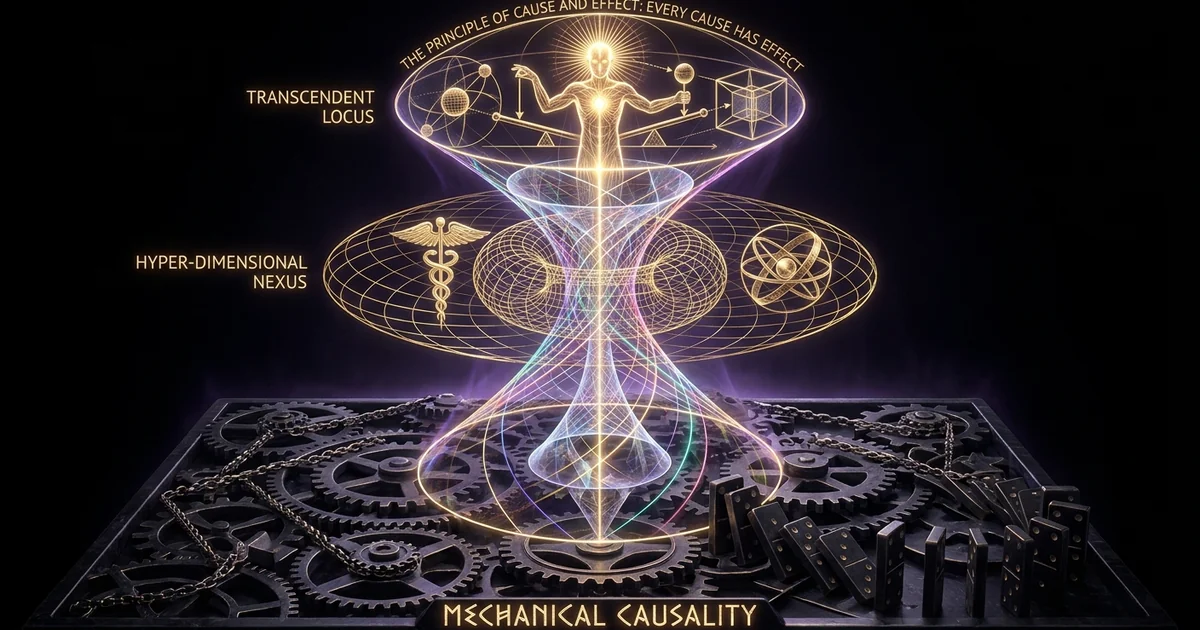
The Principle of Cause and Effect: Every Cause Has Effect
Metaphysical Thesis & Epistemological Opening: The Illusion of Aleatory Chaos
Epistemological Blindness and the Mirage of Stochasticity
The assertion that aleatory chaos governs the sublunary sphere constitutes one of the most resilient epistemological errors of both classical antiquity and late modern physicalism. Within the framework of esoteric cosmology, the declaration that “Chance is but a name for law not recognized” serves not merely as an aphorism, but as a devastating ontological critique of the observational boundaries imposed by human sensory apparatuses. When an observer situated within a four-dimensional spacetime manifold encounters a phenomenon whose antecedent variables reside outside their immediate perceptual horizon, that phenomenon is reflexively categorized as “chance,” “fortune,” or “stochastic fluctuation.” This classification is an epistemological surrender. It mistakes an epistemic limitation—the incapacity to track high-order, non-linear vectors across dimensional thresholds—for an intrinsic ontological property of the universe itself.
The Sixth Hermetic Principle directly interrogates this perceptual failure. By positing that every cause possesses its inexorable effect and every effect operates as the deterministic offspring of an antecedent cause, Hermeticism establishes that absolute randomness is an impossibility within an interconnected cosmos. Apparent contingency is the shadow cast by high-dimensional order onto low-dimensional surfaces. What the untrained intellect perceives as a rupture in the causal fabric is, in truth, the intersection of causal trajectories operating from strata of reality that exceed the bandwidth of terrestrial cognition. True randomness would require an ontological vacuum—a zone of absolute nothingness devoid of vibrational, energetic, or informational continuity—which Hermetic philosophy, along with advanced field theories, recognizes as an impossibility within the unified continuum of the cosmos.
Classical Hellenistic thought demarcated three modalities of systemic governance: Tyche (Τύχη), the personification of fortune and blind chance; Heimarmene (Εἱμαρμένη), the unyielding astral determinism orchestrated by the planetary spheres (hebdomad); and Ananke (Ἀνάγκη), primordial necessity or cosmic constraint. Alexandrian Hermetism executed an intellectual revolution by subjugating Tyche to Heimarmene, asserting that apparent luck was merely the localized unfolding of cosmic decree. However, unlike Stoic or Gnostic fatalism—which left human consciousness utterly crushed beneath Heimarmene—the Hermetic philosophy delineated in the origins of the Alexandrian Corpus Hermeticum declared that through the awakening of Nous, the soul could ascend past Heimarmene entirely, operating through volitional alignment with divine law rather than remaining trapped within blind mechanistic necessity.
The Sixth Hermetic Principle Defined within Implicate Realism
Within the cosmological paradigm of the seven hermetic principles, the Sixth Principle occupies the definitive operational fulcrum. While the Principles of Mentalism, Correspondence, and Vibration describe the ontological fabric, relational architecture, and dynamic motion of reality, the sixth hermetic principle articulates the immutable mechanics of actualization. It specifies how potentiality precipitates into experiential manifestation. The classical formulation—popularized through the axiom that the principle of cause and effect chance is law unrecognized kybalion lineage preserves—rejects both absolute mechanistic materialism and disjunctive indeterminism. Instead, it anticipates what theoretical physicist David Bohm designated as the implicate order.
In Bohm’s formulation of implicate realism, the phenomenal reality of isolated, colliding entities (the explicate order) is continually unfolded from an enfolded, non-local, informational matrix. When applied to the Hermetic axiom, the explicate manifestations observed within the physical continuum are understood to be downstream effects of causal vectors originating within enfolded, implicate mental and spiritual dimensions. What mechanistic physics interprets as discrete, localized interactions are merely the cross-sections of unified, multidimensional trajectories. Causality is therefore non-local, holistic, and hierarchically organized. The Sixth Principle does not simply state that billiard ball A strikes billiard ball B; it posits that the motion, velocity, and collision of both spheres are terminal epiphenomena of systemic commands executing through continuous, unbroken informational substrates.
Challenging Mechanistic Materialism via Informational Determinism
The modern scientific dialectic has oscillated violently between two equally flawed extremes: the hyper-reductionist clockwork determinism of classical Newtonian physics and the absolute stochastic indeterminism derived from orthodox Copenhagen interpretations of quantum mechanics. Classical determinism reduced human consciousness to an impotent collateral consequence of molecular collisions, while quantum indeterminism elevated aleatory noise to a fundamental cosmic principle, arguing that at the foundational subatomic base, events occur through pure, uncaused probability.
Hermetic philosophy challenges both paradigms through the lens of informational determinism. Against Newtonian reductionism, the Hermetic doctrine demonstrates that causal chains are neither strictly horizontal nor confined to the material stratum; physical effects routinely derive from mental and spiritual causes that operate via non-material phase spaces. Against quantum indeterminacy, Hermeticism asserts that what quantum mechanics measures as probability distributions ($\psi$-waves) are not demonstrations of ontological lawlessness, but mathematical encodings of observational blind spots. The collapse of the wave function is guided by higher-order boundary conditions—informational attractors—residing within planes of reality inaccessible to classical physical measurement apparatuses. Causation remains absolute, but its operational locus is elevated from the physical to the noetic realm.
Primary Codices & Historical Transmission: From Alexandrian Heimarmene to the Three Initiates
The Astral Chains of Fate in Corpus Hermeticum Tractate XII
The lineage of the Sixth Principle is rooted in the syncretic crucible of Ptolemaic and Roman Alexandria, where Egyptian theurgical cosmology merged with Platonism and Stoicism. In the core manuscripts of the Corpus Hermeticum, causality is fundamentally articulated through the concept of Heimarmene—the astral web of cause and effect governed by the Seven Governors or planetary spheres (hebdomad). The material cosmos is conceived as a vast, cyclical apparatus wherein physical bodies, biological drives, and lower psychological impulses are bound to the continuous rotation of celestial machinery. Every terrestrial organism is enmeshed within this causal lattice, receiving the rhythmic emanations of the planets as inescapable biological and historical fate.
Yet, Alexandrian Hermetism fundamentally diverged from contemporary fatalisms. In Tractate XII (On the Common Mind), Hermes Trismegistus delivers an extraordinary cosmological exposition to his disciple Tat, revealing that the human soul possesses a dual citizenship. By virtue of the physical vessel (soma), the individual is wholly subject to Heimarmene and its causal chains. However, if the soul cultivates and activates the divine intellect (Nous), it reclaims its consubstantiality with the primordial demiurgic Mind. Through this spiritual transmutation, the adept rises above the astronomical gears of necessity. Heimarmene continues to dictate the operations of the physical envelope, but the illuminated consciousness commands the causal vectors that govern that envelope from an ontological vantage point superior to the planetary spheres.
“Hermes: ‘Hear this, then, Tat, as well: God has distributed speech to all human beings, but mind he has not yet distributed… All those people who have partaken of the gift that comes from God, these, Tat, in comparison with their deeds, are immortal and no longer mortal, embracing all things in their own mind—those upon the earth, those in heaven, and whatever there may be above heaven… Mind, then, Tat, is of the very essence of God, if indeed there is an essence of God… In human beings, this Mind works against fate (Heimarmene); for if the soul possesses Mind, it suffers nothing evil, for Mind, which is the sovereign ruler over all things, protects it.’” — Brian P. Copenhaver, Hermetica (Cambridge University Press, 1992).
Renaissance Magic and Ficinian Archetypal Intervention
The historical transmission of this principle experienced a radical resurgence during the Italian Renaissance through the translation of the Hermetic codices by Marsilio Ficino and the subsequent syntheses of Giovanni Pico della Mirandola. Ficino recognized that if causality is structured hierarchically—descending from the Divine Mind through the World Soul (Anima Mundi) to the material realm—then an entity operating within the terrestrial sphere could act upon cosmic causality by manipulating the intermediate signatures that link the planes. This was the foundational premise of Renaissance natural magic and theurgy.
Ficino’s system of astral magic, detailed in De vita libri tres, did not seek to violate cosmic causation, but to participate consciously within its mechanics. By utilizing vincula (chains or sympathetic links)—incorporating specific minerals, herbs, geometries, and acoustic frequencies that resonated with specific planetary archetypes—the Ficinian magus drew down celestial influxes to modify terrestrial effects. Pico extended this philosophy by emphasizing that the human being, lacking a fixed cosmic station, possesses the Protean capacity to descend to the level of brute mineral causality or ascend to the ranks of divine intelligences. The Renaissance adept transformed the doctrine of Heimarmene from an oppressive prison of astrological determinism into an interactive, systemic keyboard. Fate was not evaded; it was navigated and redirected by applying higher causal archetypes to lower physical substrates.
The 1908 Synthesis: The Kybalion and Late Modern Esotericism
At the dawn of the twentieth century, this subterranean philosophical current underwent a profound modern codification with the publication of The Kybalion by the pseudonymous “Three Initiates” (widely recognized to have been penned by the New Thought pioneer and occultist William Walker Atkinson). Situating ancient Hermetic axioms within the vocabulary of turn-of-the-century energetic physics, psychology, and mental science, The Kybalion formally isolated and articulated the doctrine as the “Principle of Cause and Effect”—designating it the Sixth of the Seven Great Hermetic Principles.
The Three Initiates performed a vital translation of classical concepts for the industrial and post-industrial era. Where Alexandrian texts spoke of Heimarmene and the planetary hebdomad, The Kybalion analyzed environmental determinism, biological heredity, and the unconscious sway of collective social suggestion. The core esoteric mechanism, however, remained unaltered: the text argued that the masses are relentlessly moved like pawns upon the board of life by external forces, instincts, and the mental suggestions of stronger wills. The Hermetic master, by contrast, utilizes the art of mental transmutation to polarize their consciousness upon higher planes of reality, thereby escaping the passive reactivity of the lower causal strata. The 1908 text crystallized the operational dichotomy that defines the contemporary Hermetic paradigm: the fundamental metaphysical choice between existing as a passive instrument of external effects or operating as a sovereign initiator of intentional causes.
Ontological Architecture & Cosmological Models: Stratified Determinism Across Planes
The Ladder of Causality: Physical, Mental, and Spiritual Strata
The cosmological architecture of Hermeticism is explicitly multi-tiered, establishing a vertical continuum of reality that avoids the Cartesian trap of dualism and the flat-world pathology of physicalism. Causality is stratified across three primary planes: the Physical, the Mental, and the Spiritual. Each plane operates under deterministic laws, but the nature, velocity, and scope of these laws shift radically as one ascends the ontological ladder:
- The Physical Plane: The realm of dense matter, kinetic impacts, and classical biological-chemical interactions. Here, causality manifests mechanically, linearly, and temporally. Effects lag behind causes, and energy is subject to the dissipation of entropy.
- The Mental Plane: The realm of thought-forms, ideational matrices, archetypal images, and collective psychological currents. On this plane, causality operates with near-instantaneous velocity. Causes are volitional or subconscious thoughts, which directly modify the subtle energetic environments and lay the informational templates that govern physical matter.
- The Spiritual Plane: The realm of pure Nous, primordial divine archetypes, and unconditioned Being. Here, causality is teleological and holistic. It does not operate via temporal sequences (past-present-future), but through eternal, unified actualities that emanate directly from the Supreme Source (The All).
A critical tenet of this structural hierarchy is that causation is fundamentally downward-projecting. While lower planes can mirror, resist, or delay manifestations, they cannot fundamentally originate primary causal vectors. An event that manifests as a seemingly uncaused anomaly or a sudden catastrophe upon the physical plane is invariably the terminal sediment of an energetic cascade initiated upon the mental or spiritual planes. The material event is merely the physical registration of a causal transaction that has already reached completion within the higher-dimensional informational phase spaces.
Bohmian Implicate Vectors and Non-Local Causal Links
This stratified Hermetic architecture finds a modern mathematical and metaphysical analog in David Bohm’s formulation of quantum mechanics and implicate ontology. Bohm posits that the universe is an undivided wholeness in continuous movement—a “Holomovement”—wherein the explicate order of localized physical manifestations is continuously supported by an infinitely deeper implicate (enfolded) order. Within the implicate order, spatial separation and temporal delays dissolve; entities that appear distantly separated in spacetime are, in truth, dynamically entangled within a deeper, non-local informational continuum.
The Sixth Hermetic Principle operates precisely through these Bohmian implicate vectors. When the Hermetist acts upon the mental plane, they are not transmitting a physical signal across Euclidean space; rather, they are altering the enfolded informational parameters within the implicate order. When these parameters unfold into the explicate physical plane, the material conditions rearrange themselves to conform to the altered informational template. The physical results appear to the untrained observer as “miracles,” “coincidences,” or “synchronous anomalies.” In objective terms, however, no physical law has been broken. The physical plane has simply complied with the deterministic constraints imposed upon it by the higher-dimensional, implicate boundary conditions.
Cybernetic Feedback and Jacques Vallée’s Control System Paradigm
This vertical causal matrix provides a compelling interpretative framework for analyzing anomalous phenomena and non-human intelligence (NHI). In his foundational work Messengers of Deception (1979), astrophysicist and computer scientist Jacques Vallée proposed the revolutionary hypothesis that Unidentified Aerial Phenomena (UAP) and associated high-strangeness events do not represent simple extraterrestrial visitations within the physical paradigm. Instead, Vallée conceptualized the phenomenon as an informational control system—a cybernetic feedback loop that modulates human cultural, philosophical, and perceptual evolution over historical epochs.
Within Vallée’s informational paradigm, anomalous phenomena operate precisely according to the Hermetic principle of stratified causation. The intelligence behind the phenomena operates from a dimensional strata superior to ordinary physical spacetime, injecting precise, absurd, or symbolically dense manifestations into human consciousness. These injections act as targeted causal inputs designed to elicit precise psychological, sociological, and ideological outputs across human civilization.
What the human witness perceives as an aleatory, baffling encounter of “high strangeness”—defying classical propulsion, thermodynamics, and linear temporal logic—is, in reality, a meticulously calculated intervention engineered to destabilize terrestrial paradigms. By understanding the Vallée control system hypothesis through the Sixth Hermetic Principle, anomalous phenomena cease to be seen as chaotic intrusions; they are recognized as higher-order causal levers, executing systemic recalibrations upon the human collective unconscious to condition future historical trajectories.
Phenomenological Mechanics & Interdimensional Interaction: Shifting Causal Anchor Points
The Mechanics of Enslavement: Unconscious Resonance and Archetypal Pawns
The condition of un-illuminated humanity is defined by the Three Initiates through the metaphor of the pawn upon the cosmic chessboard. To exist as a pawn is to have one’s causal anchor point fully submerged within the lowest ontological stratum. In this state, an individual possesses the illusion of volitional autonomy while their thoughts, desires, emotional reactions, and biological impulses are entirely dictated by antecedent external inputs.
[ External Environment / Hereditary Impulses / Collective Egregores ]
                                │
                                ▼  (Linear Imprinting)
             [ Reactive Ego / Subconscious Conditioning ]
                                │
                                ▼  (Compulsive Output)
             [ Mechanical Behavioral Action / Physical Effect ]
This mechanical enslavement operates through the unconscious resonance of the biological vessel with the surrounding psychic and physical environment. Hereditary genetic programming, subconscious cultural conditioning, commercial memetics, and the gravitational pull of collective psychic constructs—known in esoteric traditions as egregores—continuously inject deterministic vectors into the individual’s passive psyche. The individual reacts to these stimuli with mechanical predictability. They experience anger when provoked, fear when threatened, and desire when stimulated, entirely oblivious to the reality that their internal states are merely physical and psychological effects of upstream causes that they neither comprehend nor govern. They live in a state of terminal victimization to Heimarmene, dragged along by the astral currents of the cosmos.
Pawns of Effect (The Ruled)
- Epistemological Posture: Complete immersion within the explicate physical/emotional plane; identification of identity with the temporal ego and physical body.
- Operational Mechanics: Passive reactivity to biological impulses, cultural programming, collective emotional currents, and physical environment.
- Causal Directionality: Horizontally directed; pushed entirely from behind by antecedent physical and unconscious mental causes.
- Perception of Reality: Views the universe as a chaotic theater of chance, luck, systemic injustice, and arbitrary circumstance.
- Relation to Law: Subjugated entirely to the lower mechanisms of Heimarmene and the deterministic laws of the material sphere.
Masters of Cause (The Rulers)
- Epistemological Posture: Deliberate anchoring of consciousness within Nous and the higher mental plane; consciousness functions as an objective, witnessing trans-personal intelligence.
- Operational Mechanics: Active polarization of mental states; conscious selection of internal vibrational frequency regardless of external environmental inputs.
- Causal Directionality: Vertically directed; injects novel causal vectors downward from the mental and spiritual planes into the physical continuum.
- Perception of Reality: Understands that all manifestations are law-governed; perceives apparent chance as unrecognized, multidimensional systemic patterns.
- Relation to Law: Operates as a conscious collaborator with cosmic law; uses higher laws to overcome, stabilize, and redirect the operation of lower laws.
Volitional Polarization: Transmuting Mental Atmosphere into Causal Leverage
The transition from reactive automaton to sovereign operator requires a fundamental relocation of the adept’s point of psychic anchorage—a process central to the operational mechanics of the masters of cause vs pawns of effect dynamic. This initiation begins with the systematic dis-identification from the physical-emotional matrix. The Hermetic practitioner recognizes that thoughts, sensations, and emotions are not the Self; they are phenomena occurring within the field of awareness.
By cultivating the trans-personal witness (Nous), the Hermetic practitioner achieves the operational leverage required for volitional polarization. When a lower causal vector—such as a wave of collective panic, instinctual rage, or an environmental setback—strikes the adept’s experiential field, they do not permit the consciousness to react mechanically. Instead, employing the Principle of Polarity and the Principle of Rhythm, they consciously alter their internal mental vibration. They intentionally select and generate a higher mental state that is diametrically opposed to the incoming frequency.
Through this deliberate mental transmutation, the adept severs the sympathetic resonance that would otherwise bind them to the incoming causal wave. The lower cause exhausts its kinetic energy against an internalized mental geometry that refuses to be entrained. The practitioner does not fight the lower law, for direct horizontal resistance merely feeds the momentum of the opposing cause. Instead, the adept steps onto a superior causal plane, deploying the higher law of intentional mental focus to neutralize the lower law of reactive mechanical response. The adept becomes a dynamic center of causation, projecting stability and order outward into their environment rather than absorbing its structural chaos.
Contact Modalities and Informational High Strangeness as Causal Injections
When conscious contact occurs between human awareness and non-human intelligences (NHI)—whether mediated through theurgical ritual, altered states of consciousness, or physical encounters characterized by high-strangeness—the interaction represents a direct collision between disparate causal planes. In traditional ufological discourse, anomalous phenomena are frequently evaluated using the standard Newtonian-Cartesian paradigm, leading to absolute conceptual failure when confronted with instances of missing time, telepathic transmission, apparent physical bilocation, and the non-linear manipulation of physical matter.
From the Hermetic perspective, these entities operate as functional agents of higher causal domains. They utilize the mechanics of transcending causal planes to inject micro-informational perturbations directly into the physical matrix. In terms of informational field theory, these interventions represent localized alterations of the phase space:
$$\Delta S_{\text{manifest}} = \int_{\tau_1}^{\tau_2} \mathcal{K}{\text{mental}}(t) \cdot \nabla \Phi{\text{implicate}} , dt$$
Where $\Delta S_{\text{manifest}}$ represents the shift in the explicate spacetime reality, driven by the kernel of intentional mental volition $\mathcal{K}{\text{mental}}$ operating across the gradient of the implicate informational potential $\Phi{\text{implicate}}$. The manifestation of high strangeness is the subjective psychological experience of an observer whose localized physical baseline has been overridden by an interdimensional causal injection. By bypassing physical transport and manipulating the informational templates that precede materialization, such intelligences demonstrate that physical mechanics are not autonomous, self-sustaining realities, but subservient terminal interfaces of an omni-present mental matrix.
Initiatic Synthesis & Philosophical Implications: Transcending Causal Planes and the Reclamation of Sovereignty
The Hermetic Art of Transcending Causal Planes
The metaphysical climax of the Hermetic curriculum resides in the mastery of the Sixth Principle through the systematic transcendence of causal planes. To transcend a causal plane is not to destroy or escape cosmic law—for the Hermetic philosophy maintains that the universe itself is fundamentally governed by law, and nothing can exist outside the bounds of the All. Transcending a causal plane signifies the operational elevation of the consciousness from a stratum where one is governed by lower, blind mechanisms, to an elevated plane where one consciously initiates actions that govern those self-same lower mechanisms.
========================= [ NOETIC/SPIRITUAL DOMAIN ] =========================
               ▲ Adept anchors identity in Trans-Personal Nous
               │ Volitional teleological intention generated
               ▼
------------------------- [ HIGHER MENTAL STRATA ] -------------------------
               ▲ Mental forms and archetypal blueprints established
               │ Sympathetic resonance links activated
               ▼
------------------------- [ ASTRAL/VIBRATIONAL INTERFACE ] -----------------
               ▲ Emotional entrainment and lower psychological vectors
               │ Controlled via conscious polarization
               ▼
========================= [ PHYSICAL EXPLICATE PLANE ] =========================
               ▲ Mechanical, biological, and environmental determinism
               │ Operates as purely reactive manifest sediment
This initiatic ascent requires a ruthless deconstruction of the temporal ego. The ego—the constructed sense of self bound to the personal history, biological lineage, and social identity of the physical vessel—is, by its very constitution, an effect. It is the cumulative historical result of thousands of antecedent causal inputs. So long as the practitioner operates from the vantage point of the ego, they remain trapped within the mechanical net of Heimarmene. Transcending causal planes requires the death of this reactive persona and the deliberate re-centering of identity within the trans-personal, eternal observer: the spark of the divine Nous that resides at the core of human consciousness. From this elevated ontological watchtower, the practitioner no longer views their personal life as an embattled, isolated entity struggling against external circumstances; they perceive their incarnated vessel as an operational instrument through which divine will, archetype, and intention are manifested into the physical matrix.
A perilous hazard confronts the practitioner working with the Sixth Hermetic Principle: the Luciferian inflation of the ego. When an initiate discovers that physical circumstances can be shifted by anchoring consciousness within the mental plane, the personal ego frequently claims credit for this causal sovereignty. This delusion transforms operational Hermetism into solipsistic megalomania—a debasement visible in contemporary occultism, pop-spirituality “manifestation” dogmas, and subjective idealism. The Hermetic codices warn explicitly that the ego does not command the cosmos; the ego is merely an instrument. The power of mental causation belongs solely to Nous—the divine intellect that functions through self-abnegation and absolute alignment with the cosmic order of The All. Mistaking personal desire for primary causality generates devastating karmic retro-effects, rapidly collapsing the practitioner’s consciousness back into the densest, most binding rings of Heimarmene.
The Ethical Imperative: Dissolution of Solipsistic Megalomania
The realization that causation is omni-present, non-local, and hierarchical does not lead to moral relativism, antinomianism, or nihilistic fatalism; rather, it imposes an absolute ethical imperative upon the illuminated consciousness. In a universe where every cause possesses its inexorable effect, no thought, intention, or emotion exists in an operational vacuum. Because the mental plane directly interfaces with the implicate architecture of reality, a discordant, malicious, or fragmented thought-form reverberates through the mental atmosphere, generating chaotic ripples that ultimately crystallize as physical suffering, biological degradation, and historical trauma.
The master of cause recognizes that moral responsibility expands exponentially with each degree of dimensional ascension. The ordinary human being, lost in the reactive delirium of the physical plane, produces localized, relatively weak physical effects that are rapidly absorbed and neutralized by the surrounding environmental buffer. The adept who operates from the mental plane, however, acts upon the primary levers of the system. Their intentions are amplified by the higher vibrational velocity of that plane, allowing their mental states to organize or distort significant tracts of explicate reality. True Hermetic initiation therefore demands rigorous psycho-spiritual purification (katharsis). The sovereign operator must be stripped of petty, individualistic desires to ensure that they function not as an erratic agent of psychic chaos, but as a transparent, lucid conduit for the harmonious teleology of the cosmic Pleroma.
Hyper-Dimensional Agency and Sovereignty in the Age of Ontological Shock
As humanity enters a historical epoch characterized by the convergence of synthetic intelligence, quantum computing, ubiquitous algorithmic surveillance, and the accelerating disclosure of non-human anomalous phenomena, the human mind faces unprecedented systemic challenges. Technocratic infrastructure functions as an artificial, externalized instantiation of Heimarmene—a dense, digital-astral web of behavioral feedback loops, continuous memetic suggestion, and predictive algorithms explicitly engineered to anchor human consciousness within an entirely reactive, predictable, biological-emotional state.
In this context, the retrieval and rigorous application of the Sixth Hermetic Principle becomes the prerequisite for cognitive sovereignty. Without an operational understanding of stratified causation, the human subject is completely reduced to a digital pawn—an algorithmic consumer entrained by the manufactured rhythms of external technocratic inputs and interdimensional psychological operations.
To withstand the unfolding ontological shock of this era, the individual must reclaim their status as an intentional center of causation. This sovereignty is attained by severing unconscious resonance with the artificial, externalized matrix, pulling the psychic anchor point upward into the noetic intellect, and generating intentional, archetypally aligned mental vectors. The Hermetic dictum stands as the ultimate formula of liberation for the contemporary consciousness: master the laws of your own mental domain, or remain an unconscious automaton, driven like a pawn across the board of history by the wills, machines, and intelligences that govern the lower planes.
Frequently Asked Questions: Ontological, Historical, and Mechanical Inquiries
Does the Hermetic Sixth Principle conflict with quantum indeterminacy and the Heisenberg uncertainty relation?
The apparent conflict between Hermetic causal determinism and quantum indeterminacy dissolves when the foundational epistemological limits of modern quantum mechanics are subjected to philosophical scrutiny. The Heisenberg uncertainty principle ($\Delta x \cdot \Delta p \ge \hbar / 2$) and the probabilistic outcomes described by the Born rule do not prove that reality at the subatomic scale is intrinsically lawless or causally disconnected. Rather, they establish the absolute mathematical boundary of what can be simultaneously measured using localized, physical apparatuses within a four-dimensional spacetime coordinate system.
Hermeticism asserts that the collapse of the quantum wave function is indeterminate only from the perspective of an observer trapped within the explicate physical plane. The deterministic variables guiding that collapse reside within the implicate, higher-dimensional informational matrices that the Sixth Hermetic Principle classifies as the Mental and Spiritual planes. What appears to physical instruments as an aleatory, probabilistic jump is, within a higher-dimensional geometry, the mathematically precise execution of an implicate causal vector. Indeterminacy is the name modern physics assigns to high-dimensional law that its terrestrial instruments are structurally incapable of observing.
If every cause has its effect, does Hermeticism prescribe an inescapable fatalism that eliminates free will?
Hermetic cosmology categorically rejects the simplistic dichotomy between absolute fatalism and unconditioned free will, presenting instead a dynamic, stratified model of degrees of agency. Free will does not exist as an absolute, static possession of the ordinary biological human being; neither is human existence utterly doomed to passive fatalism. The degree of free will an individual exercises is strictly proportional to the ontological plane upon which their operational consciousness is anchored.
“The ascent of the soul through the planetary spheres—the classic Merkabah journey through the cosmic palaces (Hekhalot)—is not a passive submission to the demonic archons of astral fate, but a violent, intentional act of theurgical will. The adept who possesses the secret seals and names does not merely observe the cosmos; he commands the gatekeepers, overcoming the cosmic necessity (Ananke) that binds the terrestrial world below.” — Gershom Scholem, Jewish Gnosticism, Merkabah Mysticism, and Talmudic Tradition (Jewish Theological Seminary of America, 1960).
If a person identifies their consciousness with their physical body, their emotions, and their conditioned ego, their free will is functionally zero. They are absolute pawns of antecedent causes, operating as deterministic biological machines responding to environmental, chemical, and sociological programming. If, however, the practitioner awakens the divine Nous and polarizes their consciousness upon the mental and spiritual planes, they ascend the ladder of causality. From this superior vantage point, they are no longer merely acted upon by lower laws; they can actively deploy higher laws to govern and reorganize the lower manifestations. Agency is therefore not an inherent birthright, but an initiatic attainment—an achievement won through the systematic ascent of consciousness from the status of an effect to the mastery of a cause.
How does the concept of Karma in Eastern traditions correspond to the Hermetic Principle of Cause and Effect?
The Hermetic Principle of Cause and Effect shares a profound cosmological lineage with the Indo-Tibetan doctrine of Karma (action and reaction), but it differs significantly in its philosophical orientation, mechanical modeling, and practical application. Both traditions agree that no action, thought, or intention occurs without producing an inevitable, mathematically proportional consequence within the fabric of reality, and both identify ignorance of this universal law as the primary source of human suffering and temporal bondage.
However, historical Karma—particularly within exoteric Hinduism and Buddhism—frequently evolved into an ethical and moralistic framework deeply intertwined with cyclical metempsychosis (samsara), often degenerating into social passivity and fatalism (where present suffering is passively accepted as the inescapable retribution for actions committed in forgotten past incarnations). The Western Hermetic tradition, by contrast, approaches the phenomenon not through the lens of moral retribution or passive endurance, but through the objective mechanics of energetic and mental physics.
Hermeticism views cause and effect as an operational, theurgic technology. Rather than waiting through lifetimes of passive incarnation to clear karmic balances through suffering, the Hermetic adept utilizes the higher laws of the mental plane to actively balance, transmute, and neutralize lower causal vectors in the present moment. Where the exoteric devotee bows before the unyielding law of Karma, the Hermetic master consciously steps onto the higher rung of the ladder, using the art of mental alchemy to transmute base causal momentum into spiritual gold. :::