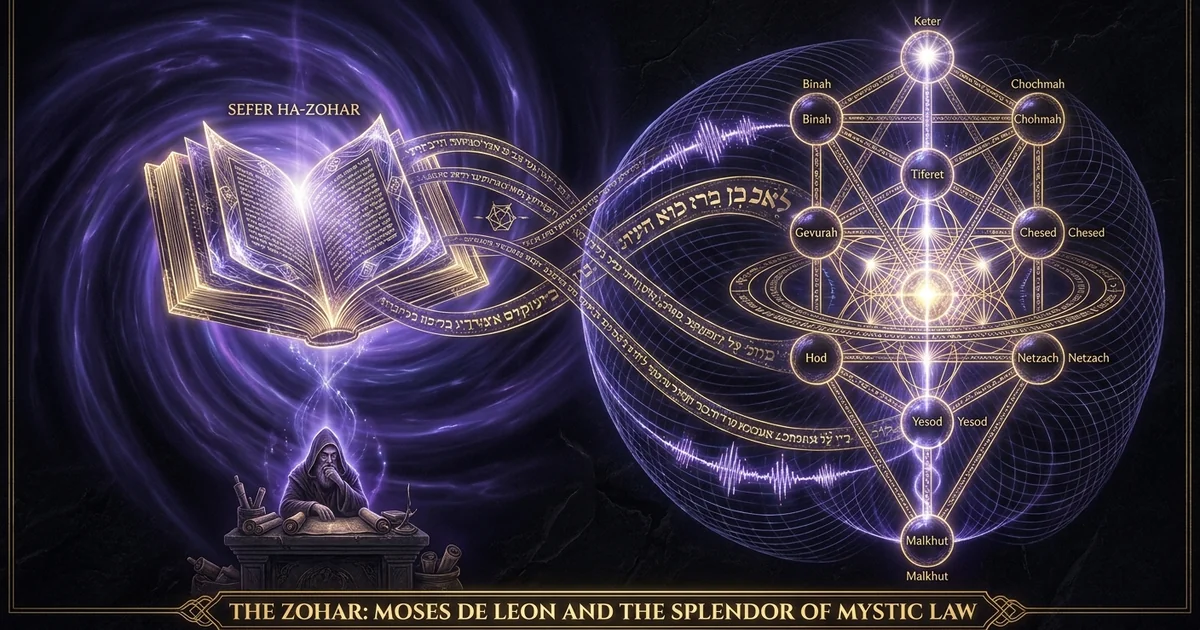
The Zohar: Moses de Leon and the Splendor of Mystic Law
Metaphysical Thesis & Epistemological Opening: The Radiance of the Primordial Point
The Collapse of Exegesis into Ontology: The Mystical Torah as Living Organism
The emergence of the Sefer ha-Zohar (Book of Splendor) in late thirteenth-century Castile marks an ontological rupture in the history of Western and Jewish esotericism. Rather than functioning as a standard commentary on the biblical text, the Zohar enacts a radical collapse of exegesis into ontology. Under the pen of the Castilian Kabbalist Moses de León, writing under the Tannaitic persona of Rabbi Shimon bar Yochai, the Torah ceases to be a historical chronicle or an exoteric legal code; it is revealed instead as an emanational architecture, an organic living body identical with the divine name itself. Every consonant, vowel, and cantillation mark is understood as a morphological component of the Godhead.
This textual transposition fundamentally alters the role of the reader. To interpret the scripture through the Zoharic lens is not to decipher an external signifier pointing toward a transcendent signified, but to actively participate in the somatic dynamics of the divine pleroma. The text functions as a structural mirror of the Sefirot—the ten emanational potencies through which the concealed, infinite source renders itself intelligible. In this sense, biblical interpretation becomes a sacramental operation. The reader does not merely study the law; through mystical engagement, the commentator animates the divine limbs, sustaining the cosmic equilibrium between the transcendent source and immanent manifestation.
The term Zohar (Hebrew: זֹהַר, radiant brightness or illumination) derives its primary scriptural resonance from Daniel 12:3—“And they that be wise shall shine as the brightness [ke-zohar] of the firmament”—and the visionary register of the Merkabah tradition in Ezekiel 1:28. In the Zoharic paradigm, this radiance is not merely optical or metaphorical; it is ontological.
Whereas the exoteric literal text (Peshat) represents the external, opaque garments (levushim) of the divine body, Zohar denotes the interior, self-luminous emanative light (or penimi) of the mystical Torah. The text operates as an optic crystal: when illuminated by contemplative consciousness, the black ink of the parchment reveals itself as the hyper-dense crystallization of divine light, mediating between the unmanifest ground of Ein Sof and the sensory universe.
Ayin and Yesh: Negative Theology and the Genesis of the Sefirotic Body
At the core of the Zoharic cosmogony lies the structural paradox of Ayin (absolute nothingness) and Yesh (substantive being). Drawing upon and radically advancing the apophatic currents of medieval Neoplatonism, the Zohar posits that the primordial ground of all reality is Ein Sof—the boundless, infinite, and utterly unnamable absolute. Ein Sof is not a personal creator situated within temporal-spatial coordinates, but the groundless substrate of existence that cannot be grasped by human thought or linguistic attribution.
The emanational sequence begins when this infinite ground withdraws or concentrates its concealed essence to project a single, infinitesimal point of light. This point, associated with the sefirotic polarity of Keter (the Crown) and Chokhmah (Wisdom), emerges out of Ayin. Here, the Zohar challenges Maimonidean scholasticism and Aristotelian physics: creation is not an ex nihilo event produced by a sovereign deity external to the cosmos, but an interior, continuous self-differentiation of the absolute into form. Ayin is not the absence of being, but a surplus of reality so concentrated that it registers to the finite intellect as void. As this primordial point expands, it crystallizes into the multi-dimensional structure of the Sefirotic body, establishing an emanational continuity where physical reality (Yesh) remains ontologically embedded within its source (Ayin).
Linguistic Realism: Aramaic as the Sub-Linguistic Matrix of Emanation
The linguistic medium of the Zohar constitutes its most potent epistemological instrument. Moses de León deliberately eschewed the classical, polished rabbinic Hebrew of his Iberian contemporaries in favor of an idiosyncratic, synthetic, and archaizing Castilian Aramaic. This linguistic choice was not a decorative affectation; it operated as a deliberate counter-rationalist strategy. By adopting Aramaic—the vernacular of the Babylonian Talmud, but infused with neologisms, hybrid syntactical formations, and poetic cadence—the Zohar systematically bypasses the discursive, syllogistic constraints of the dominant philosophical establishment.
In the Zoharic universe, language is characterized by an uncompromising linguistic realism. The Hebrew alphabet and its Aramaic permutations do not symbolize reality; they are the ontological building blocks of the cosmos. As articulated in theurgic linguistics and divine resonance, letters are vibrational energetic signatures through which the unmanifest divine will condenses into material actuality. The synthetic Aramaic of the Zohar functions as a nocturnal, twilight dialect—an alchemical medium situated at the threshold between divine disclosure and concealment. It forces the consciousness of the adept out of rationalist complacence, requiring a contemplative mode of apprehension that mirrors the broken, dynamic nature of the emanational cascade.
Primary Codices & Historical Transmission: Moses de León and the Shimon bar Yochai Tradition
The 13th-Century Castilian Milieu: Authorship, Pseudepigraphy, and Stratification
The emergence of the Zoharic manuscripts in Guadalajara, Castile, circa 1280–1290 CE, occurred against a backdrop of deep cultural and metaphysical tension. Sephardic Jewry was experiencing an intense intellectual polarization between the philosophical rationalism descending from Maimonides’s Guide of the Perplexed and the contemplative, theosophical currents migrating from Provence and the Girona circle of Moses ben Nahman (Nahmanides). Within this charged environment, Moses de León circulated individual quires (kuntresim) of a monumental text claiming to be the lost mystical records of the second-century Tannaitic master Rabbi Shimon bar Yochai (Rashbi).
Modern philological scholarship, pioneered by Gershom Scholem and refined by contemporary critics, demonstrates that Moses de León was the primary author and compiler of the core Zoharic corpus. Scholem’s exhaustive textual and syntactical analyses revealed that the Aramaic of the Zohar contains structural hallmarks of medieval Spanish syntax, including grammatical inversions and vocabulary characteristic of 13th-century Castile. Yet to classify the text as a cynical “forgery” is to project anachronistic modern criteria of intellectual property onto medieval religious phenomenologies. For Moses de León, pseudepigraphy was an initiatic technology of mystical attribution. By subsuming his individual ego into the archetypal consciousness of Rabbi Shimon bar Yochai, de León entered a state of visionary transmission, serving as a conduit for an esoteric stream that sought to redeem the fragmented religious life of medieval Iberia.
“בְּרֵאשִׁית — בְּרֵאשׁ גַּלְיוּתָא דְּמַלְכָּא, גְּלִיף גְּלוּפִין בְּטָהֳרוּ עִלָּאָה. בְּגוֹ בּוֹצִינָא דְּקַרְדִּינוּתָא, סָלִיק קוֹטְרָא בְּגָלְמָא, נָעִיץ בְּעִזְקָא דְּלָא אִתְחַזְיָא… נָבַע חַד נְבִיעוּ, דְּמִנֵּיהּ אִתְצְבַעוּ גְּוָנִין לִתְתָא, סָתִים גּוֹ סְתִימִין דִּנְקֻדָּה דִּנְעִיץ רָזָא דְּאֵין סוֹף.”
“In the beginning—at the head of the King’s manifestation, He engraved engravings in the supernal purity. Within the spark of impenetrable darkness [Bozina de-Kardinuta], there emerged a vapor in the formless, pinned within a ring that was not visible… A single spring welled forth, from which colors were dyed below, concealed within the hidden of the point, pinned within the mystery of Ein Sof.” — Sefer ha-Zohar, Mantua Edition (1558), Vol. 1, fol. 15a; trans. after Daniel C. Matt, The Zohar: Pritzker Edition.
This foundational incipit to the Zohar’s radiant mystical commentary on Genesis overturns the conventional translation of B’reshit bara Elohim (“In the beginning God created”). The Zohar renders the syntax to reveal that the unmanifest Absolute (Ein Sof), through the agency of the primordial point (Reishit, the first spark of Chokhmah), created the divine name Elohim—which here designates the supernal mother, Binah. The text posits an intra-divine origin of the cosmos, wherein the divine name itself is an emanated vessel forged out of the impenetrable darkness of the primordial spark (Bozina de-Kardinuta).
The Persona of Shimon bar Yochai: The Idra Rabba and the Fellowship (Chavruta)
The dramatic narrative frame of the Zohar centers on Rabbi Shimon bar Yochai and his intimate circle of disciples, the Chavruta (the mystical Fellowship), traversing the rugged landscapes of the Galilee. This Galilean setting is far more than a literary backdrop; it operates as an idealized mystical topography. As the companions walk along the road, engaging in spontaneous exegesis, the terrain becomes an exteriorized map of the Sefirotic realm. Every encounter with a traveler, an unlettered child, or an elder (Saba) triggers an unveiling of metaphysical secrets, demonstrating that divine wisdom is embedded within the fabric of earthly wandering.
The apex of this communal theosophy occurs in the monumental treatises known as the Idra Rabba (The Great Assembly) and the Idra Zutta (The Lesser Assembly). In the Idra Rabba, convened in a sacred threshing floor, Rashbi gathers his nine companions in a solemn ritual environment. The gathering is framed by an apocalyptic gravity: the companions are not merely sharing interpretations, but actively participating in the metaphysical reconstitution of the divine countenance.
As three of the disciples perish in mystical ecstasy during the revelation of the supernal mysteries, the remaining fellowship witnesses the systematic structural manifestation of the divine personas (Partzufim). Rashbi is presented not as a mortal scholar, but as the living axis of the world—the human incarnation of the sefirah Tiferet, mediating between the highest reaches of the pleroma and the earthly congregation.
[ E I N   S O F ]
                  │
                  ▼
         [ Bozina de-Kardinuta ]  (Spark of Black Firmament)
                  │
                  ▼
          [ Keter / Ayin ]        (Supernal Will / Primordial Point)
           ┌──────┴──────┐
           ▼             ▼
      [ Chokhmah ]   [ Binah ]    (Abba / Imma: Primordial Duality)
           │             │
           └──────┬──────┘
                  ▼
            [ T I F E R E T ]     (Ze'ir Anpin / The Six Sefirot)
                  │
                  ▼
           [ M A L K H U T ]     (Shekhinah / Immanent Presence)
The Scholem-Idel Debate: Unified Visionary Composition versus Layered Stratum
The composition and redaction history of the Zoharic corpus remains one of the central debates in contemporary Jewish mystical historiography. Gershom Scholem advanced the thesis that the core of the Zohar—encompassing the midrashic commentary on the Pentateuch, the Sifra di-Tzni’uta (Book of Concealment), and the Idrot—was the unified literary creation of Moses de León, composed over a discrete period between 1280 and 1290. Scholem viewed the later sections, such as the Ra’aya Meheimna (The Faithful Shepherd) and the Tikkunei ha-Zohar, as the output of an anonymous, slightly later Kabbalist operating at the turn of the fourteenth century, characterized by a more radical, apocalyptic, and structurally rigid sefirotic schema.
In contrast, Moshe Idel challenged Scholem’s model of single authorship. Idel argued for a more stratified, phenomenological view of the Zohar’s production. In Idel’s assessment, Moses de León was not an isolated genius fabricating an archaic work ex nihilo, but the focal point of a collective mystical movement in Castile that synthesized ancient, pre-existing esoteric traditions. Idel emphasized the presence of older oral traditions, early midrashic strata, and diverse phenomenological currents—incorporating ecstatic, theurgic, and mythic dimensions—that de León integrated and modulated. This perspective views the Zohar as a dynamic textual matrix, an open-ended archive that preserved fragments of archaic Palestinian and Babylonian theosophy while continuously evolving through the visionary output of a multi-generational esoteric circle.
Ontological Architecture & Cosmological Models: The Sefirotic Tree and the Structural Dynamics of Being
The Topography of Ein Sof: From Infinite Transcendence to Emanative Tenor
The cosmological architecture of the Zohar is anchored in the foundational doctrine of the Sefirot and the Tree of Life. Far from postulating a static, monolithic deity, the Zohar articulates an interior reality within the Godhead that is dynamic, variegated, and profoundly dramatic. The transcendent root of this system is Ein Sof, which remains forever beyond cognitive reach. Yet, through an internal compulsion toward revelation and self-contemplation, Ein Sof projects its boundless potential through ten sequential emanations.
These ten Sefirot do not constitute ten independent deities, which would violate biblical monotheism; rather, they are the functional modalities, structural conduits, and internal organs of the divine organism. The Zohar frequently employs the metaphor of water poured into vessels of varying colors: the water remains indivisibly one, yet it assumes the distinct hue, form, and quality of the container that houses it.
The emanational descent flows from the supernal triune of Keter (the transcendent Will), Chokhmah (the flash of unmanifest Wisdom), and Binah (the cosmic womb of Understanding), down through the emotive dimensions of Chesed (expansive Mercy), Gevurah (restrictive Judgment), and Tiferet (harmonizing Beauty). It descends further into the operational channels of Netzach (Endurance), Hod (Splendor), Yesod (the generative Foundation), and culminates in Malkhut (the indwelling presence, the Shekhinah).
The Architecture of the Divine Persona: Partzufim and the Sefirotic Channels
In the deeper, more complex strata of the Zohar—specifically the Sifra di-Tzni’uta and the Idrot—the individual sefirotic points are reconfigured into dynamic anthropomorphic configurations known as Partzufim (Divine Countenances or Personas). This structural evolution marks a significant advancement beyond earlier medieval Kabbalah:
- Attika Kadisha / Arikh Anpin (The Holy Ancient One / The Long-Suffering One): The manifestation of the supernal Will (Keter), characterized by absolute mercy, infinite patience, and transcendent equanimity.
- Abba (The Supernal Father): The configuration of Chokhmah, the generative point of unformed divine intelligence.
- Imma (The Supernal Mother): The structural crystallization of Binah, the cosmic womb that gestates, differentiates, and issues the lower sefirotic structures.
- Ze’ir Anpin (The Small Countenance / The Impatient One): The structural composite of the six emotive Sefirot from Chesed to Yesod, centered upon Tiferet. Unlike the unchanging serenity of Arikh Anpin, Ze’ir Anpin is dynamic, volatile, and deeply responsive to the moral and theurgic states of the terrestrial world.
- Nukva d’Ze’ir (The Female of Ze’ir Anpin): Identical with Malkhut and the Shekhinah, the divine feminine persona who acts as the bridge between the intra-divine life and the lower created realms.
The cosmic equilibrium of the universe hinges upon the continuous, ecstatic union (Zivvug) between Ze’ir Anpin (the masculine polar aspect of the Godhead, often addressed as “The Holy One, Blessed be He”) and the Shekhinah (the feminine presence). When these divine personas are united, the emanational vitality flows unobstructed through the Sefirotic channels, showering the material world with life, providence, and spiritual light.
When their union is severed through human moral failing, the divine matrix experiences profound systemic trauma, and the flow of celestial energy is disrupted.
The Sitra Achra: The Ontology of Evil as the Severed Shell (Kelipah)
One of the Zohar’s most enduring metaphysical innovations is its structural treatment of evil, designated as the Sitra Achra (the “Other Side”). The Zohar rejects the simplistic Neoplatonic reduction of evil to a mere privation of good (privatio boni). Instead, it assigns to evil an organic, active, and hyper-dense ontological status—a dark counter-pleroma that mirrors the holy Sefirotic architecture.
The origin of the Sitra Achra is traced directly to an internal disruption within the divine nature itself: the radical isolation of the sefirah Gevurah (unmediated Judgment and Severity). When Gevurah operates in synthesis with Chesed (Mercy), it functions as the necessary boundary-forming force that permits individual entities to exist apart from the overwhelming light of the infinite.
However, when Gevurah bursts forth without the tempering integration of love, it detaches from the divine balance and generates an autonomous dynamic of harsh, burning judgment.
HOLY SEFIROTIC BODY            SITRA ACHRA (OTHER SIDE)
     [ Chesed ] ── [ Gevurah ]              [ Din Kashya ]
         │              │                          │
         └──────┬───────┘                 (Severed Severity)
                ▼                                  │
          [ Tiferet ]                              ▼
                │                          [ Kelipat Nogah ]
                ▼                                  │
          [ Malkhut ]                              ▼
     (Integrated Feminine)                 [ Dense Kelipot ]
                                        (Parasitic Exoskeletons)
This detached severity forms the necrotic realm of the Kelipot (the “Husks” or “Shells”). The Kelipah is an ontological parasite: lacking any endogenous life-force, it wraps itself around the sacred Sefirotic emanations, siphoning off the descending sparks of divine vitality to animate its own demonic structures.
The Sitra Achra is populated by predatory archetypes—such as Samael and Lilith—who embody the ultimate metaphysical illusion: the claim to absolute autonomy and self-sufficiency independent of Ein Sof.
Phenomenological Mechanics & Interdimensional Interaction: The Sod Level and Theurgic Re-integration
The PaRDeS Hermeneutic: The Sod (Secret) as an Operative Consciousness Interface
To access the metaphysical mechanics of this emanational system, the Zohar codifies the classic fourfold hermeneutic known by the acronym PaRDeS (The Orchard):
- Peshat: The literal, historical, and contextual meaning of the text.
- Remez: The allegorical, philosophical, and conceptual signifiers.
- Derash: The homiletic, moral, and rabbinic elaboration.
- Sod: The esoteric, theosophical, and theurgic reality.
Maimonidean Intellectualism
- Target of Contemplation: Abstract incorporeal Forms and mathematical/astronomical truths; rigorous pursuit of intellectual perfection.
- Function of Mitzvot: Psychological, civil, and moral training; calibrating bodily passions to clear the mind for metaphysical contemplation.
- Ontological Trajectory: Unidirectional ascent; the mortal intellect attempts to align with the cosmic Active Intellect (Intellectus Agens).
- Role of Language: Instrumental and conventional; language serves as a contingent semiotic tool to convey rational definitions.
Zoharic Theosophic Theurgy
- Target of Contemplation: Dynamic Sefirotic personas (Partzufim) and the intra-divine life of the living Godhead.
- Function of Mitzvot: Metaphysical structural realignments; physical actions generate systemic energetic feedback loops within the divine pleroma.
- Ontological Trajectory: Bidirectional reciprocal feedback; human ritual praxis directly impacts, unifies, and vitalizes the internal life of God.
- Role of Language: Essential and generative; letters and speech act as the ontological substrate of reality, vibrating with emanative force.
The Zohar insists that the Sod (Secret) is not simply an intellectual interpretation appended to the text, but an experiential shift in perception. The literal text of the Torah is compared to a garment: only fools mistake the clothing for the person wearing it. The historical narratives of patriarchs, wars, and nomadic wandering are the external vestments hiding the interior Sefirotic anatomy.
When the Kabbalist reads the narrative of Abraham migrating from his homeland, the Sod interface reveals that this is not an account of a Bronze Age chieftain, but the structural movement of Chesed cascading into the cosmic architecture. The text is an operative consciousness interface that allows the adept to decode the sensory universe as an interference pattern generated by supernal interactions.
Theurgy of the Mitzvot: Human Action as an Information Feedback Mechanism to the Pleroma
The defining divergence between classical rabbinic Judaism and the Zoharic worldview lies in the doctrine of theurgy. In normative rabbinic theology, the commandments (mitzvot) are observed out of covenantal obedience to divine decree (halakhah). In the Zohar, the mitzvot are transfigured into sophisticated theurgic operations—precise vibrational and behavioral actions that exert a direct, systemic impact on the intra-divine life of the Godhead.
Humanity, fashioned in the structural image of the macrocosmic divine body (Adam Kadmon), possesses an unprecedented operational status. The Kabbalist is not a passive subject begging a transcendent sovereign for grace, but an active technician of cosmic balance. Every commandment performed with focused meditative intention (kavvanah) functions as an energetic feedback loop.
When an adept binds the phylacteries (tefillin), recites the Shema, or sanctifies the Sabbath meal, the physical action sets into motion a corresponding reconfiguration within the Sefirotic channels. As articulated in Moshe Idel’s classic formulations on theurgic Kabbalah, human action below activates an identical dynamic above: an awakening from below (itaruta de-letata) triggers an answering awakening from above (itaruta de-le’ila).
Erotic Metaphysics: Unifying the Shekhinah and Mitigating Cosmic Rupture
The definitive objective of all Zoharic praxis is the mitigation of the cosmic rupture caused by the exile of the Shekhinah. Throughout the Zoharic narrative, the Shekhinah is depicted as an exiled queen, a weeping dove, an unprotected daughter wandering in the waste places of the earth, surrounded by the predatory, choking vines of the Kelipot. This exile is not merely a geopolitical tragedy regarding the displacement of the Jewish people from Judea; it represents an internal catastrophic fissure within the Godhead itself. The immanent presence of God is alienated from its transcendent masculine counterpart, Ze’ir Anpin.
The Zohar articulates this dynamic in the vocabulary of an unapologetic, radical erotic metaphysics. The cosmic union (Zivvug) of Tiferet and Malkhut is conceptualized as a sacred hierogamy. Liturgical prayer, contemplative study of the Torah, and conjugal intimacy observed with sacred purity on the eve of the Sabbath are the instruments by which the Kabbalist acts as an ontological matchmaker.
By unifying the divine male and female principles, the adept dispels the influence of the Sitra Achra, restores the downward transmission of divine blessing (shefa), and reunites the divided names of the Godhead, prefiguring the ultimate eschatological reality wherein “the Lord shall be One and His name One” (Zechariah 14:9).
Epistemological Perils: The Shadow of the Kelipot and Mystical Inflation
The Hermeneutic Abyss: Misapprehending Emanational Non-Duality as Nihilism
The soaring metaphysical architecture of the Zohar contains profound hazards for the unprepared intellect. The fundamental epistemological peril lies in the misapprehension of emanational non-duality. Because the Zohar teaches that all being is an emanated continuum descending from Ein Sof, the boundary between Creator and creation becomes dangerously porous.
If the material universe is merely the external garment of the divine life, an undisciplined hermeneutic can collapse into an antinomian pantheism or a corrosive nihilism, reasoning that if all things are intrinsically divine, moral distinctions between purity and impurity, good and evil, are arbitrary human illusions.
The Zohar repeatedly warns that this emanational continuum is governed by strict structural thresholds. The divine light is mediated through vessels specifically designed to contain and calibrate its intensity. To shatter these vessels by claiming an unmediated identity with the absolute is to invite ontological catastrophe, transforming the splendor of the Zohar into an engine of psychological and spiritual ruin.
Engagement with the Zoharic Sod without grounded ethical praxis, deep mastery of exoteric halakhic boundaries, and calibrated mental stability triggers severe psychological inflation and fragmentation. The traditional Rabbinic warning regarding the Pardes—where three of the four sages perished, went mad, or apostatized—applies directly to the contemplative operations of the Zohar.
When the human ego identifies itself directly with the transpersonal dynamics of the Sefirotic archetypes, it undergoes an inflation that mimics divine omnipotence. This state ruptures the psychic vessel, delivering the practitioner into the parasitical entrapment of the Sitra Achra, where profound delusions of messianic sovereignty replace authentic ethical integration.
The Danger of Severing the Shoots (Kitzuts bi-Netiot): Psychological Inflation and Disintegration
The Zohar frequently references the primordial sin of “severing the shoots” (kitzuts bi-netiot), an enigmatic talmudic phrase that the Kabbalists transformed into a foundational warning against metaphysical error. This transgression, traditionally ascribed to the biblical Adam as well as the heretical sage Elisha ben Abuyah, consists of isolating the final Sefirah, Malkhut (the Shekhinah), from the upper nine emanations of the Tree of Life.
       [ Keter to Yesod ]
         (Upper Nine)
              │
         ⚡ RUPTURE ⚡  <── "Severing the Shoots" (Kitzuts bi-Netiot)
              │
         [ Malkhut ]     ──> Isolated, vulnerable, and consumed
       (Shekhinah Alone)     by the parasitic Sitra Achra
To “sever the shoots” is to idolize the immanent realm of manifestation while disconnecting it from its transcendent ethical and metaphysical source. In psychological terms, it represents the ego seizing upon the divine presence as an autonomous power to be exploited for personal inflation or magical manipulation. When the Shekhinah is severed from the unifying column of Tiferet, she ceases to function as the channel of life-giving shefa; instead, she falls under the sway of the predatory Kelipot, transmuting her nurturing aspect into a terrifying agent of unmitigated judgment (Din). The individual who commits this severance precipitates their own psychic fragmentation, experiencing the divine not as integrated illumination, but as a destructive, devouring fire.
The Demonic Inversion: The Autonomous Kelipic Mirror
The structural mirror of the divine pleroma presented by the Sitra Achra presents a constant threat of deception to the mystic. Because the Kelipot replicate the structural array of the holy Sefirot—possessing their own ten crowns of darkness, their own masculine and feminine personas, and their own illusory manifestations of light—the adept lacking discernment can easily mistake the necrotic luminescence of the demonic shells for supernal revelation.
This danger is especially pronounced when the Kabbalist contemplates the sefirot of severity, such as Gevurah and Hod. If the contemplative gaze is poisoned by unresolved hubris, wrath, or carnal fixation, the consciousness of the practitioner is diverted away from the sacred pleroma and drawn into an autonomous Kelipic mirror.
In this inverted domain, the Kelipot masquerade as higher spiritual entities, feeding upon the adept’s theurgic energy and generating elaborate rationalizations for moral degeneration. The synthetic, ambiguous nature of Zoharic Aramaic was purposefully engineered to function as an initiatic filter: its semantic traps and apophatic ambiguities are opaque to those trapped within the literal or egoic register, disclosing its transformative architecture only to those whose ethical integration matches their contemplative ascent.
Initiatic Synthesis & Philosophical Implications: The Mystical Body as Reality Architecture
Lurianic Prolepsis: How the Zohar Laid the Blueprint for Tzimtzum and Tikkun
The dynamic theosophy of the Zohar served as the indispensable blueprint for the later, more systemic developments of early modern Kabbalah, particularly the sixteenth-century revolution initiated by Rabbi Isaac Luria in Safed. While the Zohar often articulates the cosmogonic process through poetic, organic metaphors of growth, light, and weaving, it already contains the latent structural material that Luria would formalize into his grand mythological architecture.
The Zoharic concept of the primordial spark bursting forth from Bozina de-Kardinuta directly anticipates the Lurianic doctrine of Tzimtzum (the divine self-contraction that creates the void necessary for finite existence).
Furthermore, the Zohar’s vivid descriptions of the broken balance between Gevurah and Chesed provided the foundation for Luria’s cataclysmic Shevirat ha-Kelim (the Shattering of the Vessels). In the Zoharic narrative, the restitution of this brokenness is achieved through the ongoing theurgic operations of the Chavruta; Luria elevated this concept into the universal, cosmic imperative of Tikkun Olam (the systemic mending of the universe), where human consciousness bears the absolute burden of gathering the scattered sparks of divine light from the prison-houses of the Kelipot.
“The author of the Zohar is not an allegorist who sets out to demonstrate the truth of a philosophical system through the scriptural text… He is a myth-maker who transforms every historical event into a cosmic drama occurring within the very life of the Godhead. The Zohar does not interpret the Bible; it absorbs the Bible into an infinite sea of metaphysical being.” — Gershom Scholem, Major Trends in Jewish Mysticism (New York: Schocken Books, 1941), p. 209.
“Zoharic hermeneutics must be understood as an imaginal phenomenology where the text is the veil through which the divine body is both concealed and revealed. The Kabbalist’s vision is essentially ocularcentric yet linguistically mediated: to see God is to gaze upon the letters of the Torah properly ordered, an act that culminates in the contemplative transformation of the reader into the very locus of divine presence.” — Elliot R. Wolfson, Through a Speculum That Shines: Vision and Imagination in Medieval Jewish Mysticism (Princeton: Princeton University Press, 1994), p. 327.
The Deconstructive Horizon: The Word as the Loom of Spacetime
From a contemporary philosophical perspective, the Zohar articulates a sophisticated model of textual non-duality that uncannily anticipates modern semiotics and post-structuralist thought, while maintaining an uncompromising metaphysical realism. In the Zoharic cosmos, reality is not an assemblage of solid, static material objects mediated by human language; rather, spacetime itself is an unfolding linguistic hyper-text woven on the loom of the Hebrew alphabet.
Every physical event, biological organism, and celestial body is a dynamic sentence continuously spoken by the unmanifest Absolute. The Zohar collapses the classic Cartesian dualism separating the res cogitans (thinking mind) and the res extensa (extended matter).
There is no “outside” to the divine text. The universe is a continuous process of inscription, erasure, and re-inscription. By recognizing that the sensory world is an emergent property of divine language, the Kabbalist participates in what Elliot Wolfson terms a hyper-hermeneutic: reading the world as scripture, and reading scripture as the unfolding architecture of reality.
Human Sovereignty: The Adept as Active Co-Creator of the Divine Architecture
The most radical philosophical implication of the Zoharic corpus is its profound elevation of human agency and ontological sovereignty. In classical philosophical theology, humanity is cast as a radically dependent, negligible entity standing before an impassible, omnipotent, and self-sufficient Creator. The Zohar systematically overthrows this hierarchical subjugation.
In the radiant visionary landscape of Moses de León, the divine life is fundamentally vulnerable, incomplete, and dynamically unstable without humanity. The Shekhinah remains in weeping exile, the masculine and feminine personas of God remain severed, and the demonic Kelipot threaten to inundate creation unless human beings intervene through theurgic praxis and ethical integration.
Humanity is not an incidental byproduct of creation, but its absolute keystone. The Kabbalistic adept is an active co-creator, a metaphysical physician whose ritual, contemplative, and ethical acts sustain the structural coherence of the divine pleroma. In the audacious vision of the Book of Splendor, God’s very redemption and completeness are placed into the hands of mortal humanity.
Frequently Asked Questions: Ontological and Historical Realities of the Zohar
Did Moses de León Forge the Zohar or Act as an Initiatic Medium?
The categorization of the Zohar as a modern “forgery” misapprehends both the literary conventions and the mystical psychology of the medieval world. While rigorous philological scholarship has established that Moses de León was the primary author and compiler of the core Zoharic text in late 13th-century Spain, his operation was not driven by simple literary deceit.
Within the framework of medieval Jewish esotericism, pseudepigraphy was a recognized and revered initiatic technique. By effacing his personal identity and projecting his contemplative voice into the transpersonal archetype of Rabbi Shimon bar Yochai, de León accessed an altered state of consciousness that medieval practitioners termed ruach ha-kodesh (divine inspiration).
He did not invent the Kabbalistic doctrines ex nihilo; rather, he acted as a synthetic visionary medium who consolidated, restructured, and channeled centuries of accumulated oral traditions, early midrashic fragments, and theosophical currents into an archaic, authoritative voice designed to renew the spiritual vitality of his era.
How Does the Zoharic Concept of Emanation Differ from Classical Neoplatonism?
While the Zohar integrates significant Neoplatonic concepts—most notably the unbroken descent of being from a transcendent, unknowable absolute (Ein Sof) down through sequential levels of reality—it departs decisively from classical Plotinian emanational ontology in two fundamental ways:
- Bidirectional Theurgic Feedback: Classical Neoplatonism posits a strictly unidirectional emanational flow. The Plotinian One overflows effortlessly into the Nous, the World Soul, and matter, unaffected by the actions or intentions of mortal beings below. In contrast, the Zohar articulates an interactive, bidirectional system. Human liturgical, ethical, and contemplative actions exert a direct theurgic impact upon the Sefirotic emanations, altering the structural relationships and energetic flow within the pleroma itself.
- The Problem of Evil and Divine Gender: Classical Neoplatonism views evil as a mere privation of good (privatio boni) and conceives the divine source in terms of abstract, gender-neutral principles. The Zohar assigns evil an active, dense ontological existence (Sitra Achra) born from unbalanced divine judgment, and models the divine life through dynamic, gendered personas (Partzufim) whose cosmic, erotic unions and separations govern reality.
What Is the Significance of Aramaic over Hebrew in the Zoharic Corpus?
The strategic deployment of Castilian Aramaic across the Zohar operates on multiple structural levels. Philologically, Aramaic established an aura of antiquity, grounding the text in the authoritative era of the Talmud and midrashic literature to contest contemporary Maimonidean philosophical rationalism.
Metaphysically and theurgically, Aramaic was traditionally viewed in rabbinic lore as the only language that the ministering angels could not understand (Babylonian Talmud, Shabbat 12b). In the Zoharic paradigm, Aramaic is considered the language of the “Other Side” (Sitra Achra), operating at the nocturnal boundary of Gevurah (Judgment).
By composing this mystical commentary in Aramaic, Moses de León was performing an alchemical act of linguistic theurgy: descending into the very linguistic territory of the Kelipot to rescue the trapped sparks of divine light, subduing the demonic forces by utilizing their own dialect to articulate the supernal secrets of the pleroma.
How Does the ‘Sod’ Level Alter One’s Reading of the Genesis Narrative?
Approaching the Genesis creation narrative through the Sod (Secret) level shifts the text from a temporal, historical account of material origins into an eternal, continuous self-revelation of the divine mind within Ein Sof.
At the Peshat level, Genesis 1:1 recounts a linear sequence: God creates the heavens and the earth out of nothingness over a six-day timeline. At the Sod level, the narrative is decoded as the interior morphology of the Godhead. The “Beginning” (B’reshit) is not a point in time, but the primordial sefirotic point of Chokhmah (Wisdom) emerging from the dark ether of Keter.
The creator God (Elohim) is not an external architect, but the supernal mother Binah, who receives the spark of wisdom and gives birth to the six cosmic emotions (Ze’ir Anpin), which are the true “six days” of creation. Physical matter, the terrestrial Garden of Eden, the serpent, and Adam are revealed to be structural crystallizations of higher metaphysical operations, transforming the reading of scripture into an initiatic ascension through the living anatomy of the divine body. :::