Sefer Yetzirah: The Book of Formation & 22 Letters Math
Metaphysical Thesis & Epistemological Opening: The Informational Monism of the Thirty-Two Paths
The Sefer Yetzirah (Book of Formation) constitutes the most radical ontological departure within late antique and early medieval cosmological literature. In place of a continuous, ex-nihilo substantialism or a purely mythological emanationism, the treatise advances a rigorous informational monism. Physical and metaphysical reality is not composed of an undifferentiated, prime materia animated by extrinsic divine volition; rather, reality is computed. It is assembled through the discrete, mathematical combinatorics of thirty-two structural vectors designated as the Netivot Peliyot Chokhmah—the thirty-two mysterious paths of wisdom.
These paths comprise an integrated architectural matrix: ten non-phenomenal parameters (Sefirot Belimah) and the twenty-two foundational consonants of the Hebrew abjad (Autiyyot Yesod). By positing that the architecture of being is coextensive with an operative orthography, the text formulates a cosmos whose fundamental substrate is digital, discrete, and linguistic.
Total Paths: 32 = 10 Sefirot Belimah (Vector Dimensions) + 22 Autiyyot Yesod (Foundational Letters)
The metaphysical consequences of this model are sweeping. If the universe is generated through discrete alphabetic and numerical permutations, material reality cannot be regarded as an irreducible ontological baseline. Instead, the sensible world operates as a downstream sensory projection, continuously rendered through the syntactic execution of cosmic code.
Centuries before modern computational metaphysics began theorizing our universe through discrete cellular automata and the simulation hypothesis, the Sefer Yetzirah posited that reality is an ongoing, linguistic-mathematical calculation.
The Transmutation of Being: From Creatio Ex Nihilo to Linguistic Orthography
Traditional monotheistic creation paradigms resolve cosmogony through the doctrine of creatio ex nihilo (creation out of nothingness), wherein an omnipotent sovereign speaks phenomenal matter into existence through absolute fiat. The Sefer Yetzirah profoundly recalibrates this paradigm. Divine speech is not an ephemeral acoustic command that leaves a static material artifact in its wake. Rather, speech is an intrinsic mechanics of continuous, infrastructural computation.
The author constructs a reality wherein the act of being is synonymous with the act of inscription. The text states that the Creator engraved, carved, weighed, and inverted the foundational letters, generating every entity that exists and every entity destined to be formed.
This inscription process operates as an ontological phase transition. Non-being (Ayin) does not abruptly transition into brute, inert matter; rather, it passes through an intermediate, quasi-computational filter of linguistic orthography before precipitating as sensible reality (Yesh). The 22 letters serve as the primal phonemic switches whose spatial combinations assemble reality from the void.
This linguistic cosmogony dismantles the boundary between signifier and signified. In the semiotic framework of the Sefer Yetzirah, the Hebrew consonant does not represent an external material referent. The consonant is the structural atom itself—an energetic, topological nexus through which transcendent reality crystallizes into immanence.
To manipulate the letter is to act directly upon the ontological wireframe of the universe, anticipating the operational premises that later underwrote medieval theurgy and the practical mechanics of Merkabah ascent.
The Ten Sefirot Belimah: Ontological Void and Dimensional Polarities
Crucial to the architecture of the Sefer Yetzirah is the strict isolation of the Ten Sefirot Belimah from the pantheistic or mythological personifications common in later medieval theosophy. Here, the term Sefirot does not denote the dynamic, anthropomorphic hypostases of the Zoharic tree-of-life. Instead, they are primordial mathematical boundaries—ineffable limit-states that establish the dimensional coordinate system within which any cosmological extension becomes geometrically possible.
The text qualifies the ten Sefirot with the apophatic epithet Belimah. While historically derived from the Book of Job (Toleh eretz al-belimah—“He suspends the earth upon nothing”), the treatise uses the term as an ontological compound: Bli-mah (“without whatness,” or “without substance”). The Sefirot are dimensionless dimensionalities. They possess neither mass, location, nor sensible extension.
Instead, they function as an abstract ten-dimensional hyper-space configured as five pairs of polar coordinates: the depth of beginning and the depth of end (temporal axis), the depth of good and the depth of evil (moral or axiological axis), the depth of above and the depth of below (vertical spatial axis), the depth of east and the depth of west (longitudinal axis), and the depth of north and the depth of south (latitudinal axis).
The ontological mechanics of the Sefer Yetzirah are grounded in the radical polysemy of the triconsonantal Hebrew root S-F-R (ס-פ-ר), which generates four operational concepts:
- Sepher (סֵפֶר): The inscription, topological boundary, or spatial vessel.
- Sephar (סְפָר): The enumeration, algorithm, mathematical ratio, or quantitative limit.
- Sippur (סִפּוּר): The narrative, vocalized vibration, temporal articulation, or semantic output.
- Saphir (סַפִּיר): The luminescent radiance, optical transparency, or crystal interface.
Combined with the term Belimah (בְּלִימָה)—derived from Bli-Mah (בְּלִי מַה), meaning “without whatness” or “substanceless”—the Sefirot Belimah are established not as physical entities, but as non-phenomenal, informational limit-states. They execute mathematical coordinate functions within the void (Ayin), demonstrating that numerical calculation (Sephar) and narrative articulation (Sippur) are functionally identical at the base layer of reality.
These ten dimensional vectors frame an ontological coordinate system of limit and orientation. The text insists that their end is embedded in their beginning, and their beginning in their end, “like a flame bound to a burning coal.”
They represent a closed topological system that prevents the cosmos from degenerating into unbounded chaotic dispersion. By establishing the perimeter of phenomenal existence, the ten Sefirot create the ontological vacuum within which the twenty-two letters execute their combinatorial work.
Deconstructing Continuous Materialism via Discrete Informational Quanta
By asserting that reality is generated through discrete paths, numbers, and consonants, the Sefer Yetzirah mounts a structural critique against continuous materialism centuries before the advent of modern quantum theory. Within classical Aristotelian and Hellenistic materialist frameworks, substance (ousia) is conceived as fundamentally continuous, smooth, and infinitely divisible.
The Sefer Yetzirah repudiates this spatial continuity. It models the cosmos as an informational output computed from thirty-two discrete registers, anticipating John Archibald Wheeler’s “It from Bit” proposition—the postulate that every physical quantity derives its ultimate meaning from discrete binary choices and informational bits.
Matter (Yesh) does not emerge from an undifferentiated substrate; it is carved, weighed, and permuted into existence. The treatise employs distinctly artisanal yet algorithmic metaphors: letters are “quarried” like stone from an invisible quarry, “fashioned” into phonemes, and combined across a rotational circular matrix.
This conceptual framework directly prefigures the digital physics simulation hypothesis, which models cosmic spacetime as a cellular automaton operating on discrete boundary updates.
Within this operative grammar of divine emanation, every material object is fundamentally a localized phonetic packet—a precise alphanumeric sequence held in stable oscillation by the uninterrupted computation of the foundational letters.
Primary Codices & Historical Transmission: Textual Stratigraphy of the Formation Recensions
The textual transmission of the Sefer Yetzirah is marked by significant historical stratigraphy. Unlike many pseudepigraphic texts of late antiquity that entered circulation with complete mythic backstories intact, the Book of Formation survives across several fundamentally distinct manuscript recensions.
Text-critical analysis, pioneered in modern scholarship by A. Peter Hayman and contextualized within the history of Jewish mysticism by Gershom Scholem, demonstrates that the treatise cannot be reduced to a single authorial voice. Instead, it represents an evolving intellectual continuum that crystallized between late antiquity and the early Islamic period.
Textual Taxonomy: The Short Version, Long Version, and Saadian Recension
Textual scholars categorize the surviving manuscripts of the Sefer Yetzirah into four major recensional families:
- The Short Version: Ranging between 1,000 and 1,300 words, this text is characterized by its terse, aphoristic prose and relative absence of extensive cosmological glosses. Many modern text-critical scholars, including Hayman, consider this recension closer to an early layer of the text, preserving its stark, proto-computational syntax.
- The Long Version: Approximately twice the length of the Short Version, this recension incorporates expanded lists of macrocosmic, temporal, and somatic correspondences, systematically linking the letters to anatomical organs, planets, and constellations. It includes explanatory additions that seek to harmonize the text’s radical combinatorics with rabbinic biblical hermeneutics.
- The Saadian Recension: Preserved and rigorously organized by the prominent Geon of Sura, Saadia Gaon (882–942 CE), who translated it into Judeo-Arabic (Kitab al-Mabadi) and appended an extensive philosophical commentary. Saadia restructured the text into eight systematic chapters, muting its more overt theurgic overtones in favor of a rationalist, anti-dualist cosmology compatible with early Islamic Kalam and Neo-Platonic logic.
- The Gra-Ari Version: A hybrid synthesis established by early modern Kabbalists, most notably Isaac Luria (the Ari) and later formalized by Elijah ben Solomon Zalman, the Gaon of Vilna (the Gra, 1720–1797). This version harmonizes textual variations from the Long and Short recensions to align with the canonical system of Lurianic Kabbalah, becoming the primary vehicle for operative and meditative study in Central and Eastern European esoteric circles.
בִּשְׁלֹשִׁים וּשְׁתַּיִם נְתִיבוֹת פְּלִיאוֹת חָכְמָה חָקַק יָהּ יְהוָה צְבָאוֹת אֱלֹהֵי יִשְׂרָאֵל אֱלֹהִים חַיִּים וּמֶלֶךְ עוֹלָם אֵל שַׁדַּי רַחוּם וְחַנּוּן רָם וְנִשָּׂא שׁוֹכֵן עַד וְקָדוֹשׁ שְׁמוֹ מָרוֹם וְקָדוֹשׁ הוּא וּבָרָא אֶת עוֹלָמוֹ בִּשְׁלֹשָׁה סְפָרִים בְּסֵפֶר וּסְפָר וְסִפּוּר׃
“In thirty-two mysterious paths of wisdom, Yah, the Lord of Hosts, the God of Israel, the living God and King of the Universe, El Shaddai, merciful and gracious, high and exalted, dwelling in eternity, whose name is holy—lofty and holy is He—engraved and carved His universe through three media of inscription: through Sepher (the book/text), Sephar (number/calculation), and Sippur (story/articulated speech).” — Sefer Yetzirah 1:1 (Critical synthesis of Short and Saadian Codices)
The Late Antique Milieu: Merkabah Mysticism, Hellenistic Grammar, and Babylonian Mathematics
Dating the composition of the earliest core of Sefer Yetzirah remains one of the most contentious debates in the history of Western esotericism. Traditional rabbinic attribution assigns authorship to the patriarch Abraham, with secondary redaction credited to the 2nd-century Tannaitic master Rabbi Akiva.
Modern academic scholarship places its historical emergence across a wider horizon, ranging from the 2nd century to the 8th century CE. A. Peter Hayman argues for a compositional window in the early Islamic period, pointing to grammatical shifts and vocabulary congruent with early medieval Abbasid science.
Conversely, scholars like Gershom Scholem and Aryeh Kaplan trace the linguistic and conceptual architecture directly to late antique Palestine or Roman Syria (between the 2nd and 4th centuries CE).
The intellectual context reveals a synthesis of three distinct cultural streams:
- Merkabah Mysticism: The ecstatic ascent tradition centered on the chariot throne of Ezekiel, from which the Sefer Yetzirah borrows its vision of trembling cosmic entities running and returning (ratzo v’shov) before the divine throne.
- Hellenistic Grammar and Semiotics: The Alexandrian and Stoic theories of language, wherein the stoicheia (a term designating both grammatical letters and physical elements) were viewed as cosmological building blocks. This philological tradition directly informs the text’s understanding of proto-Sinaitic script origins.
- Babylonian Sexagesimal and Astronomical Mathematics: An ancient near-eastern spatial framework that treated celestial observation not as detached geometry, but as the tracking of dynamic, numerical relationships mapped across the planetary nodes.
The treatise reconciles these historical streams into an autonomous metaphysical system that refuses pantheism while rejecting standard mythological narrative structures.
The Gra-Ari Transmission and the Renaissance Cabala Shift
As the treatise traveled through the High Middle Ages, its interpretive trajectory fractured. Commentators such as Shabbethai Donnolo (913–c. 982) and Dunash ibn Tamim read the text as an astronomical and biological manual, a scientific treatise analyzing the mechanics of physical generation.
However, with the dawn of the Christian Cabala in the Italian Renaissance—championed by figures such as Giovanni Pico della Mirandola and Johannes Reuchlin—the Sefer Yetzirah was re-evaluated as an operational grimoire detailing the mathematically encoded architecture of the divine mind.
This esoteric trajectory culminated in the meticulous recension constructed by the Gaon of Vilna. The Gra stripped the Sefer Yetzirah of centuries of accreted scribal corruptions, restoring what he viewed as the pristine, mathematically integrated text.
Under the Gra’s hermeneutic lens, the treatise became an operative blueprint for meditative theurgy. It was no longer studied merely to understand the structure of the cosmos; it was engaged as an initiatory manual capable of attuning human consciousness to the computational engine of creation, setting the stage for operative anthropogenesis via the Golem rituals.
Ontological Architecture & Cosmological Models: The Tripartite Letter Division and Spatial Topology
The twenty-two foundational letters (Autiyyot Yesod) are not arbitrary phonetic expressions. They constitute an ontologically closed system—an alphanumeric periodic table that organizes all potential variations of sound, form, and material manifestation.
The Sefer Yetzirah stratifies this alphabet into a hierarchical 3-7-12 architecture: Three Mothers (Iymot), Seven Doubles (Kfulot), and Twelve Simples (Peshutot). This division constructs an absolute topological mapping that encompasses the elements, astronomical spheres, temporal divisions, and human physiological anatomy.
Foundational Consonants: 22 = 3 Mothers (Elemental Trinitarian Axes) + 7 Doubles (Planetary / Polar Dynamics) + 12 Simples (Zodiacal Boundary Arms)
The Three Mothers (Alef, Mem, Shin): Primordial Elements and Triadic Dialectics
At the apex of the linguistic hierarchy stand the Three Mothers (Alef, Mem, Shin—א, מ, ש). These letters correspond to the primordial elements that constitute the structural substrate of the cosmos:
- Shin (ש): Corresponds to primordial Fire (Esh), associated with sound that hisses like steam. It embodies the upward-striving, expansive, energetic pole of creation.
- Mem (מ): Corresponds to primordial Water (Mayim), associated with phonetics that hum silently. It embodies the downward-settling, receptive, cohesive, and cooling pole of matter.
- Alef (א): Corresponds to primordial Air (Ruach), phonetically pronounced as a gentle aspirated whisper between the vocal cords. It acts as the reconciling, mediating middle term.
This triadic dialectic operates as an early precursor to Hegelian tripartite logic (thesis, antithesis, synthesis). Fire and Water stand in perpetual, mutually annihilating ontological opposition. Left unchecked, their unmediated contact would collapse the manifest universe into either undifferentiated energetic radiation or inertial entropic dissolution.
The mother letter Alef descends between them as the spirit of Air, creating an energetic equilibrium. This dynamic balance permits distinct dimensions of matter to emerge and co-exist.
The Seven Doubles (BGD KPRT): Polar Oppositions and Planetary Nodes
Directly beneath the primary elemental axes operate the Seven Doubles (Beit, Gimel, Dalet, Kaf, Peh, Resh, Tav—ב, ג, ד, כ, פ, ר, ת). These letters possess an inherent phonological duplicity: they can be articulated in both a hard, plosive mode (historically marked by a dagesh) and a soft, aspirate mode. This dual phonetic nature equips them to govern the polar dualities that structure terrestrial existence:
- Life and Death (Chayim / Mavet)
- Peace and War (Shalom / Ra)
- Wisdom and Folly (Chokhmah / Ivelet)
- Wealth and Poverty (Osher / Oni)
- Fertility and Desolation (Zera / Shemamah)
- Grace and Ugliness (Chen / Kiyur)
- Dominance and Subjugation (Memshalah / Avdut)
Cosmologically, the Seven Doubles project into the astronomical register as the seven classical wandering planets (Saturn, Jupiter, Mars, Sun, Venus, Mercury, Moon). In the structural layout of space, they establish the six external dimensional directions (North, South, East, West, Height, Depth), anchored around a sacred Seventh Point: the Holy Palace (Heikhal Ha-Kodesh) positioned at the exact equilibrium center of manifest space.
By operating as dynamic switches between polar conditions, the Seven Doubles govern the rhythmic, cyclical shifts that prevent the manifest world from freezing into stasis.
The Twelve Simples: Constellations and the Cube of Space Geometry
The base of the letter architecture is anchored by the Twelve Simples (Heh, Vav, Zayin, Chet, Tet, Yud, Lamed, Nun, Samekh, Ayin, Tzadi, Qof—ה, ו, ז, ח, ט, י, ל, נ, ס, ע, צ, ק). Unlike the Doubles, these consonants possess only a single phonetic mode of articulation. They correspond directly to the twelve constellations of the celestial zodiac, the twelve lunar months of the year, and the twelve primary organs and instinctual drives of the human organism.
Geometrically, the Twelve Simples construct one of the most sophisticated topological devices in esoteric literature: the Cube of Space. The twelve letters are mapped onto the twelve diagonal boundaries or edges (Gevulei Alakhson) of a three-dimensional cube.
This cube is not a simple solid figure; it functions as a hyper-dimensional coordinate container for sensible reality, directly interfacing with the geometry of sacred geometry and platonic solids.
The Twelve Simples form the structural frame that prevents the three dimensions of manifest space from dissolving back into the boundless ether. They hold the six planar faces of the universe rigid, defining the volumetric arena in which temporal and physical life unfolds.
Phenomenological Mechanics & Interdimensional Interaction: Combinatorial Linguistics and the 231 Gates
The Sefer Yetzirah does not conceptualize creation as a finished, static historical event. It models cosmogony as an ongoing, operational algorithmic process driven by the combinatoric wheel of speech: the Galgal.
Reality is generated and sustained through the calculated permutations of the 22 foundational letters, which circle and combine in a dynamic computational loop to project sensory existence into the mind of the observer.
The Algorithm of Permutation: Tzeruf and the 231 Gates (Sha’arei Galgal)
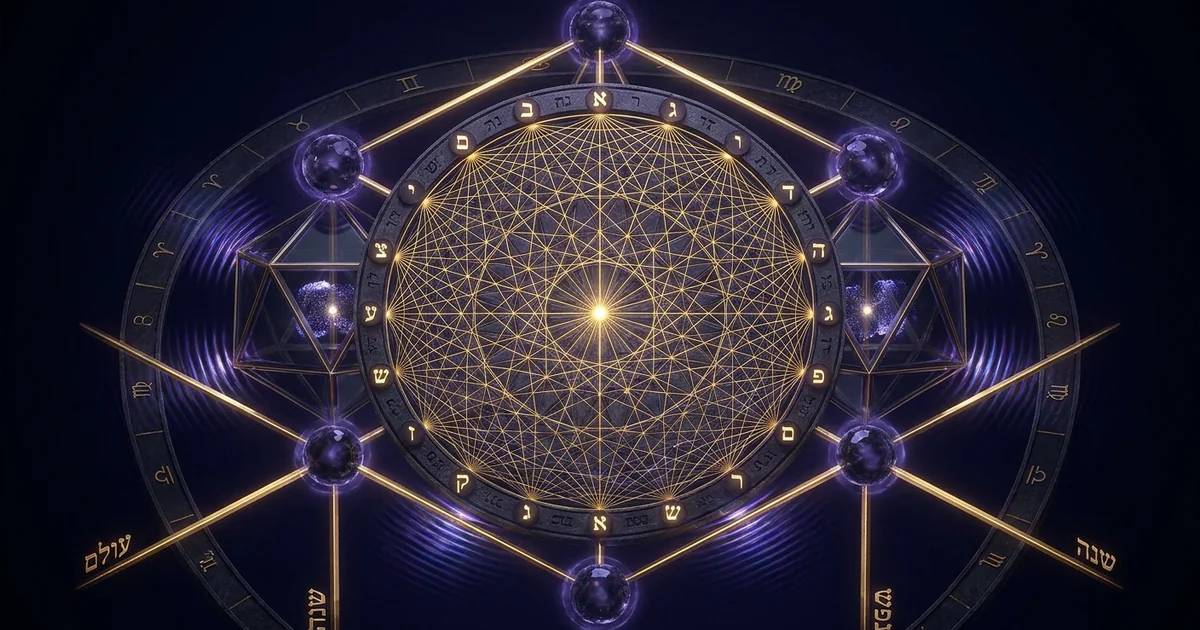
The central computational device detailed in chapter two of the treatise is the Galgal—the great rotating sphere or wheel of letters. The mechanic requires the practitioner or celestial geometer to place the 22 letters along the circumference of a circle and draw chords connecting every letter to every other letter. The resulting mathematical formula for this non-directed complete graph is expressed by the standard combinatorial equation:
$$C(n, 2) = \frac{n(n - 1)}{2}$$
Where $n = 22$:
$$C(22, 2) = \frac{22 \times 21}{2} = \frac{462}{2} = 231$$
These 231 lines of connection are designated as the 231 Gates of Formation (Sha’arei Galgal). Every gate represents a bilateral pairing of two letters (such as Alef-Beit, Alef-Gimel, and so on).
The text specifies that the wheel can be rotated in two fundamental orientations: forward (Panim, Face-to-Face) for creation and light, or backward (Achor, Back-to-Back) for deconstruction, dissolution, and judgment.
Total Combinations = 22 × 22 = 484
Diagonal Autogenous Pairs (AA, BB, etc.) = 22
Bilateral Interactive Pairs = (484 - 22) / 2 = 231 Gates
Permutational Total (Direct + Reverse) = 231 × 2 = 462 Cipher Streams
Through this combinatorial process, known in later operational Kabbalah as Tzeruf (letter combination and permutation), every conceivable name, form, and ontological category is sequentially produced. The author states unequivocally: “There is nothing in good higher than Delight (Oneg, ע-נ-ג), and there is nothing in evil lower than Plague (Nega, נ-ג-ע).”
By rotating the phonetic root Ayin-Nun-Gimel into its exact inverse Nun-Gimel-Ayin, the absolute polarity between sublime ecstatic union and biological suffering is demonstrated to be a function of phonemic permutation within the exact same structural sub-matrix.
The Tri-Coordinate Matrix: Space (Olam), Time (Shanah), and Soul (Nefesh)
A core metaphysical postulate of the Sefer Yetzirah is that every discrete permutation executed across the 231 Gates outputs a simultaneous, three-dimensional echo across three interwoven cosmological registers:
- Olam (עוֹלָם): The spatial macrocosm—the outer physical coordinates of the universe, spanning the planetary spheres, constellations, and elemental physical structures.
- Shanah (שָׁנָה): The chronocosm—the temporal cycle of the year, tracking the seasons, lunar months, planetary hours, and the movement of astronomical time.
- Nefesh (נֶפֶשׁ): The somatic and psychological microcosm—the human body, its sensory faculties, organic operations, and internal emotional landscape.
This tri-coordinate matrix (O-Sh-N) dissolves the Cartesian bifurcation between the observing subject and the external objective universe. Reality does not happen outside of the human soul; rather, a single phonemic algorithm runs simultaneously through the stars (Olam), through the ticking of the calendar (Shanah), and through the neurological wiring of the somatic body (Nefesh).
The cosmos is a singular, recursive informational projection. A perturbation introduced into the Nefesh register through focused vocalization or meditative recombination causes an immediate structural ripple across the temporal and spatial registers.
Olam (Space / Macrocosm)
- Alef (Air): The atmospheric envelope and the balance of atmospheric pressures.
- Mem (Water): The oceans, the cryosphere, and the cold, structural strata of the earth.
- Shin (Fire): The radiant heavens, solar light, lightning, and interstellar plasma.
Shanah (Time / Chronocosm)
- Alef (Air): The temperate seasons; spring and autumn equilibrium nodes.
- Mem (Water): The winter season; cold, rain, metabolic deceleration, and ice.
- Shin (Fire): The summer season; heat, agricultural ripening, and solar intensity.
Nefesh (Soma / Microcosm)
- Alef (Air): The respiratory system, the chest cavity, and the central breath (Ruach).
- Mem (Water): The belly, the lymphatic/circulatory fluids, and digestive cooling.
- Shin (Fire): The head, the brain’s metabolic activity, and intellectual illumination.
Teli, Galgal, and Lev: The Axis, the Sphere, and the Anthropomorphic Core
To govern this tri-coordinate continuum, the Sefer Yetzirah introduces three overarching structural regulators: the Teli, the Galgal, and the Lev.
- The Teli (תְּלִי): The astronomical axis, frequently symbolized as the “Curled Dragon” or the cosmic serpent. In technical historical astronomy, this corresponds to the lunar nodal line—the intersection of the Moon’s orbit with the ecliptic where eclipses occur (the head and tail of the dragon, Caput and Cauda Draconis). Metaphysically, the Teli functions as the central gravitational kingpin or dimensional axis around which spatial matter is suspended. The text notes that the Teli in the macrocosm is “like a king upon his throne.”
- The Galgal (גַּלְגַּל): The zodiacal celestial sphere, the wheel that rotates continuously through astronomical time. It introduces change, rhythm, and seasonal progression. If the Teli is the static, vertical axis of the cosmos, the Galgal is its dynamic horizontal rotor, ceaselessly grinding through the 231 gates of form.
- The Lev (לֵב): The human heart—the somatic and affective core of the microcosm. The text asserts that the heart in the Nefesh is “like a king at war.” The heart serves as the subjective experiential fulcrum of reality, torn between the polar impulses governed by the Seven Doubles.
This tripartite dynamic demonstrates that the universe is regulated by an integrated cybernetic control system. Operating centuries prior to modern systems theory, the Sefer Yetzirah constructs an interdimensional architecture where celestial nodal physics (Teli), astronomical time cycles (Galgal), and somatic consciousness (Lev) continuously calibrate one another.
Within the framework of modern interdimensional-hypothesis investigations, this tri-coordinate interface suggests that what historical traditions recorded as anomalous or angelic interventions were encounters with structural projections originating from the linguistic fabric connecting Olam and Nefesh.
Initiatic Synthesis & Philosophical Implications: Digital Ontology, Theurgy, and Epistemic Hazards
The Sefer Yetzirah is fundamentally distinct from speculative metaphysical literature because it was designed to be operational. In traditional rabbinic and medieval esoteric circles, the text was utilized as a functional protocol for linguistic theurgy.
By recapitulating the algorithmic combinatorics through which God projected phenomenal reality, the human adept seeks to participate directly in the ongoing calculation of the universe.
The Golem Tradition: Anthropogenesis via Hermeneutic Computation
The most famous operational outgrowth of the Sefer Yetzirah is the historical practice of Golem anthropogenesis. Prominent in the medieval commentaries of the Hasidei Ashkenaz—specifically the instructional writings of Rabbi Eleazar of Worms (c. 1176–1238) and the Pseudo-Saadia glosses—the text served as a technical manual for breathing life into inanimate matter.
This operation was not viewed as an act of sorcery (Kishuf), but as a holy demonstration of applied cosmic orthography.
Virgin Earth -> Sculpted Body -> Inscription of EMET (Truth) -> Recitation of 231 Gates -> Animation
Destruction: Inversion of Gates (Achor) -> Erasing Alef to yield MET (Death) -> De-animation
The mechanic of Golem creation operated as an exacting computational proof-of-work:
- The adept gathers virgin earth from an unplowed mountain and kneads it with living water into the somatic form of a human child.
- The practitioner initiates the systematic recitation of the 231 Gates, combining every consonant of the Hebrew alphabet with every permutation of the Tetragrammaton and every primary vowel sound.
- As the phonemic sequences are vocalized with extreme meditative precision, the vibrational frequency of the phonetic bits alters the molecular state of the earth.
- To complete the activation, the word EMET (אמת—Truth), the seal of the living God, is inscribed upon the forehead of the creation. The Golem stirs with vitality.
- To undo the generation, the combinatorial wheel is rotated backward (Achor). The initial Alef (representing the primordial breath of life) is wiped from the forehead, leaving MET (מת—Dead). The creation immediately collapses back into inert dust.
This ritual underscores the text’s central epistemological premise: physical animation is not an irreducible divine spark granted arbitrarily by an anthropomorphic deity. It is a biological calculation achieved when a linguistic matrix is executed with structural perfection. The Golem is an ontological computer running an alphanumeric operating system.
From Mystical Semiotics to Digital Physics: Wheeler, Wolfram, and Generative Grammars
When divorced from its mythological dressing, the mechanics of the Sefer Yetzirah map directly onto the foundational tenets of modern informational philosophy and computational linguistics.
Consider the paradigm of cellular automata developed by Stephen Wolfram in A New Kind of Science. Wolfram demonstrates that remarkably complex, organic structures—identical to patterns found in biological organisms and astronomical systems—are generated from simple, discrete computational rules executed iteratively across a cellular grid.
The 22 letters of the Sefer Yetzirah are identical to these cellular units. Each letter functions as an ontological operator possessing specific qualitative constraints:
- A directional vector (derived from its position on the Cube of Space)
- An elemental identity (Fire, Water, Air)
- A phonetic gate parameter (hard/soft, plosive/fricative)
When these units are permuted across the 231 Gates, they construct a generative grammar identical to the deep linguistic structures theorized by Noam Chomsky, while operating as the computational baseline for cosmic rendering.
The Sefer Yetzirah does not anticipate modern digital physics merely by metaphor; it outlines the foundational axioms of the discipline: continuous phenomena are downstream illusions generated by underlying networks of discrete, interconnected informational nodes.
Ontological Shock and Epistemic Hazards of Operative Combinatorics
The historical manuals accompanying the study of the Sefer Yetzirah are marked by warnings regarding the extreme cognitive and physical perils awaiting any practitioner who attempts the operative combinations without rigorous psychological and ethical purification.
The Talmudic narrative of the four who entered the Pardes (the esoteric garden of metaphysical knowledge)—resulting in death for Ben Azzai, madness for Ben Zoma, and outright apostasy for Elisha ben Abuyah—serves as the archetypal warning for ungrounded engagement with this literature.
The epistemological hazards of Tzeruf are tied to the psychological mechanics of semantic overload. In meditative combinatorics, the adept forces their consciousness to dissociate words and letters from their conventional sensory referents, treating them as naked energetic and mathematical tokens.
Engaging this process for extended periods systematically dissolves the linguistic filters that stabilize everyday phenomenal perception.
Without extensive grounding, this dissolution induces profound depersonalization, structural dissociation, and severe psychological inflation. The ego mistakes its technical participation in the informational matrix for personal omnipotence, inviting catastrophic psychic disintegration.
The experimental combination of the foundational letters (Tzeruf) across the 231 Gates constitutes a deliberate disruption of consensus reality filters. Operating upon these linguistic gates without deep ontological stabilization reliably induces severe psychological decompensation.
Historical and contemporary records document recurring failure modes:
- Pardes-Pattern Psychosis: Rapid fragmentation of cognitive coherence caused by the collapse of semantic stability. The mind perceives infinite recursive signifiers with zero grounding in material referents.
- Autonomous Egregoric Feedback: Prolonged chanting and visualization of the bilateral letter pairs can nucleate self-reinforcing, semi-autonomous thoughtforms (egregore) that harvest the practitioner’s cognitive energy, generating severe manifestations of high-strangeness and sensory disorientation.
- Megalomaniacal Demiurgic Inflation: The practitioner’s personal ego identifies with the emanationist engine of the Sefirot, interpreting the subjective observation of alphanumeric code as evidence of personal divinity.
Operational engagement with this text must be regarded as an applied form of ontological engineering, accompanied by non-trivial risks to somatic and psychological equilibrium.
Frequently Asked Questions: Resolving Historical and Structural Cruxes
Ontological Status of the Sefirot: Cosmological Abstracta or Emanated Personae?
A common point of confusion among students of Western esotericism is the structural discordance between the Sefirot found in the Sefer Yetzirah and the more widely known Sefirot of 13th-century Zoharic and Lurianic Kabbalah. In later theosophical Kabbalah, the Sefirot are dynamic, anthropomorphic hypostases organized into the familiar three-column tree diagram (e.g., Chesed, Gevurah, Tiferet), functioning as psychological, emotional, and structural aspects of the divine personality.
In the Sefer Yetzirah, the Sefirot are non-mythological, abstract dimensions (Belimah). They possess no personal names, moral dispositions, or theomorphic features. They are pure, apophatic boundary states: the spirit of the living God (Ruach Elohim Chayim), three elemental states of matter (Air, Water, Fire), and six pure directional vectors of spatial extent (Up, Down, East, West, North, South).
The Sefer Yetzirah’s Sefirot are cosmological coordinate axes—the dimensional framework that makes metric extension and energetic manifestation possible within the empty void.
“In the Book of Creation, the Sefirot are not the divine emanations familiar to us from the Zohar, representing stages of the divine life that unfold within God Himself. Rather, they are the elemental coordinates of the universe, the ten primeval numbers or ideal dimensions of all that is… It is a cosmological, speculative grammar rather than a theosophy of the divine pleroma.” — Gershom Scholem, Major Trends in Jewish Mysticism (1974), pp. 75–78.
Mathematical Derivation of the 231 Gates of Formation
The mathematical logic governing the 231 Gates is rooted in discrete combinatorics. The text states: “Twenty-two foundational letters: He fixed them on a wheel with 231 gates, and the wheel rotates forward and backward.”
To arrive at this exact enumeration, consider the complete permutation of 22 distinct symbols taken in pairs:
- The total number of all possible ordered pairs between 22 elements is given by $22 \times 22 = 484$.
- Of these 484 pairings, 22 are self-reflexive, identity pairings (e.g., Alef-Alef, Beit-Beit, Gimel-Gimel). These autogenous pairs represent internal reflective balance and are excluded from the dynamic relational gates connecting distinct consonants: $484 - 22 = 462$.
- Because an unoriented line connecting Letter A to Letter B is geometrically and ontologically identical in structural connection to the line connecting Letter B to Letter A, this total must be halved to find the number of unique bilateral communication channels:
$$\frac{462}{2} = 231$$
These 231 channels represent the unique lines of connection forming a complete graph ($K_{22}$) between all 22 letters. When the text notes that the wheel rotates forward (Panim) and backward (Achor), it accounts for the direction of informational flow across these gates: $231 \times 2 = 462$ operational directed permutations.
This mathematical precision demonstrates that the text was composed by an intellect conversant with late antique Hellenistic and Babylonian combinatorial calculations.
Geometric Resolution: How Do the Twelve Simples Anchor the Cube of Space?
The spatial architecture of the Cube of Space represents one of the earliest known attempts to map an alphabetic system directly onto a three-dimensional Euclidean volume. The construction unfolds through precise directional alignments:
- The Three Mothers (Internal Axes): Form the three internal spatial axes that intersect at the dead center of the cube: Alef governs the horizontal atmospheric axis; Mem governs the deep, structural, hydronic axis; and Shin governs the ascending, thermal vertical axis.
- The Seven Doubles (Planar Faces and Center): Form the six exterior square boundaries (faces) enclosing the volume—North (Beit), South (Gimel), East (Dalet), West (Kaf), Height (Peh), Depth (Resh)—with the Seventh Double (Tav) anchoring the Holy Palace at the exact geometric midpoint where the three internal axes intersect.
- The Twelve Simples (The Twelve Diagonal Arms): Stabilize the exterior shell by tracing the twelve structural edges of the cube, divided into three sets of four boundary lines:
- Upper Diagonal Arms (Connecting the Top Face to the Sides): Northeast (Heh), Southeast (Vav), Upper East (Zayin), Upper North (Chet).
- Lower Diagonal Arms (Connecting the Bottom Face to the Sides): Southwest (Tet), Northwest (Yud), Lower West (Lamed), Lower South (Nun).
- Vertical/Lateral Diagonal Arms (Connecting the Lateral Corners): East-North (Samekh), West-North (Ayin), East-South (Tzadi), West-South (Qof).
Through this topological deployment, the Twelve Simples function as the cosmic frame. They lock the three-dimensional universe into metric stability, creating a persistent, coherent dimensional envelope within which the informational computations of the 22 letters project the drama of space, time, and human consciousness.