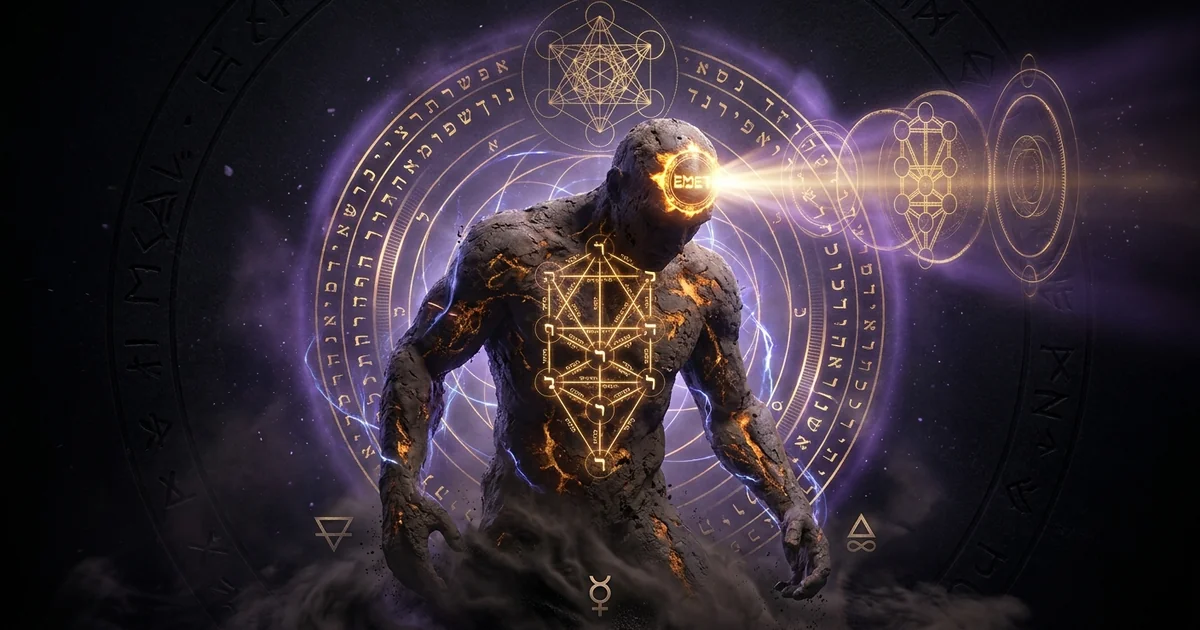
Practical Kabbalah: Golem Creation, Names & Holy Seals
Metaphysical Thesis & Epistemological Opening: Kabbalah Ma’asit as Operative Information Theory
Linguistic Structuralism of the Ein Sof: Letters as Ontological Quantum Substrata
Practical Kabbalah (Kabbalah Ma’asit) represents an operative physics of information rather than an archaic collection of vulgar superstitions. Within this metaphysical architecture, the Hebrew alphabet (Otiyot Yesod) does not function as an arbitrary semiotic convention designed for human sociological communication. Instead, each consonant constitutes an ontological quantum: a discrete, immutable energetic signature through which the unmanifest ground of being—the Ein Sof—crystallizes into manifest reality. In this operative cosmogony, reality is intrinsically computational and linguistic. The cosmos is spoken into existence through recursive self-limiting emanations, mediated by the ten supernal nodes of the Sefirot on the cosmic Tree of Life. The letters serve as the primal source code, the foundational bits of an informational cosmos where syntax directly governs physical manifestation.
To manipulate this linguistic substrate is to alter the structural grammar of the cosmos. As articulated in early treatises of esoteric cosmology, the universe does not merely contain language; it is composed of language. In this framework, matter is dense, slowed speech, while spirit is rarefied, high-frequency divine phonology. When an initiate utilizes linguistic determinism via sacred alphabets, they engage with the primal machinery of creation. The operative practitioner (Ba’al Shem) accesses the source code beneath the compiling engine of the material universe (Asiyah), altering the vibrational trajectory of the lower worlds through specific phonemic vectors.
                    [ Ein Sof: Unmanifest Ground ]
                                  │
                                  ▼
                    [ Atziluth: Emanative Archetypes ]
                                  │
                                  ▼
                   [ Beri'ah: Creation / Archangels ]
                                  │
                                  ▼
                  [ Yetzirah: Formation / 231 Gates ]
                                  │
                                  ▼
                   [ Asiyah: Physical Manifestation ]
The Duality of Contemplation and Praxis: Kabbalah Iyyunit Versus Kabbalah Ma’asit
The Kabbalistic corpus bifurcates into distinct yet inextricably linked disciplines: speculative contemplation (Kabbalah Iyyunit) and operative practice (Kabbalah Ma’asit). Speculative Kabbalah concerns itself with mapping the interior life of the Godhead, charting the emanative cascade of the Sefirot, tracing the pathways of the Merkabah, and understanding the metaphysical mechanics of divine withdrawal (Tzimtzum). Its vector is interior, contemplative, and vertical, aiming for mystical union (devekut) or the restoration of cosmic equilibrium (Tikkun).
Conversely, Kabbalah Ma’asit pivots horizontally into the material sphere. It is the practical deployment of mystical linguistics to enact measurable anomalies within the physical and astral worlds. The historical demarcation between these two realms was rigorously maintained by Rabbinic authorities. While speculative study was considered the highest intellectual duty of the sage, operative praxis was viewed with profound ambivalence, burdened by strict prohibitions and metaphysical risks.
Traditional Jewish esotericism delineates three primary operational modalities:
- Kabbalah Iyyunit (Contemplative/Speculative): Textual, structural, and theosophical analysis of the divine emanations (Sefirot) and the architecture of the supernal realms, crystallized in the Sefer ha-Zohar and the Cordoverian synthesis.
- Kabbalah Nevu’it (Prophetic): The ecstatic, meditative discipline pioneered by Abraham Abulafia, utilizing letter combinations, breathing techniques, and body postures to alter consciousness and achieve visionary communion with active intellects.
- Kabbalah Ma’asit (Operative/Practical): The actual manipulation of physical and metaphysical reality through divine onomastics, talismanic seals (Kame’ot), theurgic conjurations, and combinatorial linguistics (Tseruf). The root '-s-h denotes Asiyah (the World of Action/Matter), marking this branch as an applied, material technology.
The prohibitions against Kabbalah Ma’asit recorded throughout classical rabbinic literature did not stem from rationalist skepticism regarding its efficacy. Rather, they emerged from an acute awareness of its hazards. Operating upon the lower matrices of reality without unitive, non-dual consciousness inevitably activates the Klippot—the unbalanced, hyper-material shards of previous cosmic cataclysms. The practical Kabbalist who lacks spiritual purity risks catastrophic psychological fragmentation and severe cosmic blowback.
The Demiurgic Imperative: Co-Creation, Anthropoid Simulation, and Epistemic Risk
At the summit of Kabbalah Ma’asit lies the rite of anthropoid animation: the creation of the Golem. Far from being a folk magic ritual intended to produce physical labor, the animation of artificial life constitutes a profound demiurgic diagnostic. The human initiate, fashioned in the divine image (Tzelem Elohim), possesses a latent creative mandate. By replicating the exact combinatorial methodology utilized by the Divine Architect in the proto-cosmological treatise Sefer Yetzirah, the mystic tests their own epistemological and ontological proximity to the divine source.
This operation carries profound systemic risk. The boundary separating holy co-creation from blasphemous mimicry of the Demiurge is vanishingly narrow. When the mystic attempts to breathe life into formless clay (golem), they project their own internal psychological and spiritual constitution into the matter. Any micro-fissure within the operator’s intentionality (Kavvanah), any unresolved egoic hubris, is amplified within the animated vessel. The generation of the Golem serves as the ultimate diagnostic test for the mystic’s internal equilibrium: flawed permutation induces cosmic and psychic fragmentation (Shevirat ha-Kelim) within the practitioner.
Primary Codices & Historical Transmission: Antiquity, Ashkenazi Hasidism, and Prague
Talmudic Foundations: Sanhedrin 65b and the Creation of the Calves
The historical roots of practical kabbalah, golem creation, divine names, seals, and amulets trace directly to the classical rabbinic period. The Babylonian Talmud preserves foundational acknowledgments of operative theurgy, most notably in Tractate Sanhedrin 65b. This passage serves as the locus classicus for all subsequent Golem literature, establishing that righteous sages possess creative power through the study and operationalization of sacred linguistics.
"Rava said: If the righteous wished, they could create a world, as it is written: ‘For your iniquities have separated between you and your God’ (Isaiah 59:2). For what separates humanity from God is only moral transgression; if one is completely pure, one shares in the divine creative potency.
Rava created a man [an artificial anthropoid] and sent him before Rav Zeira. Rav Zeira spoke to him, but the anthropoid did not answer. Rav Zeira said to him: ‘You are a creation of the companions [the rabbis]; return to your dust!’
Rav Hanina and Rav Oshaya would sit every Friday evening and occupy themselves with the Sefer Yetzirah, and they would create a third-grown calf (Iglah Tlata) and eat it." — Babylonian Talmud, Tractate Sanhedrin 65b
Exegetical Context: The text pairs this creation narrative with the computational algorithms of Sefer Yetzirah 2:4-5, which describes the foundation letters: “Twenty-two foundation letters: He fixed them in a wheel, like a wall, with 231 gates. The wheel turns back and forth… He combined, weighed, and exchanged them, Alef with all and all with Alef, Beit with all and all with Beit… and brought forth through them everything formed and everything spoken.”
The Talmudic text clearly delineates the operational parameters of anthropoid generation. The synthetic man created by Rava possesses somatic vitality and autonomous locomotion, yet lacks the power of speech (dibbur). In classical Kabbalistic anthropology, speech is the diagnostic signature of the Neshamah—the divine soul breathed directly by God into Adam. The sage can synthesize the vegetative and animalistic life-forces (Nefesh), but cannot bestow the supernal moral intellect. Rav Zeira recognizes this absence immediately: the silence of the creature exposes its artificial provenance, prompting the command that dissolves the construct back into its prime matter.
The Northern European Mystics: Hasidei Ashkenaz and Combinatorial Manuals
During the twelfth and thirteenth centuries in the Rhineland, the esoteric circle known as the Hasidei Ashkenaz (the Pious of Germany) systematized these scattered Talmudic traditions into concrete combinatorial technologies. Chief among these thinkers was Rabbi Eleazar of Worms (c. 1176–1238), whose commentaries on Sefer Yetzirah and esoteric treatise Sefer ha-Shem (“The Book of the Name”) transformed Golem creation from a spontaneous rabbinic miracle into an exacting, cryptographic discipline.
Eleazar of Worms established that the generation of the Golem required an exhaustive mastery of the 231 letter-pairings (She’arim), systematically combined with the vocalization points (nikkud) and the permutations of the Tetragrammaton (Y-H-W-H). In his formulations, animation was not achieved through emotional ecstasy, but through absolute computational precision. The mystic had to articulate hundreds of letter-pairs while maintaining rigorous meditative visualizations, matching each consonant to a specific anatomical sector of the human form. The Hasidei Ashkenaz demystified the miracle, framing anthropoid creation as an applied science of linguistic permutations operating upon morphogenetic soil.
The Prague Legendarium: Judah Loew ben Bezalel (Maharal) and Modern Mythogenesis
In late sixteenth-century Central Europe, the nexus of Golem traditions shifted decisively to Rudolphine Prague, converging around the towering intellectual figure of Rabbi Judah Loew ben Bezalel, known to history as the Maharal (c. 1520–1609). The Maharal was one of the most brilliant philosophers and Talmudists of his era, whose genuine writings, such as Nesivot Olam and Gevurot Hashem, articulate a sophisticated cosmological teleology concerning the nature of matter, form, and miraculous interventions.
The popular association of the Maharal with the historical creation of a clay Golem to defend the Jewish community of Prague against blood libels is largely a nineteenth-century literary mythogenesis. It crystallized in works such as Yudl Rosenberg’s 1909 publication Nifla’ot Maharal (“The Miracles of the Maharal”). However, this romantic legend rests upon authentic late-Renaissance foundations. Rudolphine Prague was a primary European center of Hermeticism, alchemy, astronomy, and Jewish mysticism. While the Maharal never explicitly claimed to have built an anthropoid in his extant philosophical texts, his profound inquiries into the structural mechanics of nature and the divine word reflect the intellectual milieu in which the Golem legend flourished. The narrative of clay animation in Prague, mediated through the Maharal’s towering intellect, remains the archetypal modern prism through which the promises and perils of artificial agency are evaluated.
Ontological Architecture & Cosmological Models: The 231 Gates and Divine Names
The Permutational Engine: Sefer Yetzirah and the 231 Gates (Galgalim)
The cosmological operating system underlying all practical Kabbalah is found in the enigmatic, hyper-compressed lines of the Sefer Yetzirah (The Book of Formation). In this schema, God surveyed the infinite plenum of possibilities and engraved reality utilizing thirty-two wondrous paths of wisdom: the ten primal numbers (Sefirot Belimah) and the twenty-two foundation letters (Otiyot Yesod). The letters are divided into three Mothers (Alef, Mem, Shin), seven Doubles (Beit, Gimel, Dalet, Kaf, Pei, Resh, Tav), and twelve Elementals (Hei, Vav, Zayin, Chet, Tet, Yud, Lamed, Nun, Samekh, Ayin, Tzadi, Kuf).
The structural dynamic of this linguistic cosmos operates via the Galgal (the wheel). The twenty-two letters are mapped in a circle, and lines of connection are drawn between every single letter, yielding precisely 231 bilateral connections:
$$\frac{22 \times 21}{2} = 231$$
These 231 Gates (She’arim) represent the complete combinatorial grammar through which all matter is synthesized. The rotation of this wheel, forward (Panim) and backward (Achor), determines whether an entity is brought into structural existence or deconstructed back into primordial entropy. The practical Kabbalist models this linguistic physics through Tseruf (permutational meditation), mentally accelerating through the 231 bilateral gates to configure specific energetic conduits within the lower astral fabric of the cosmos.
Shem HaMephorash: The 72-Triad Matrix Derived from Exodus 14:19-21
Among the divine onomastic engines of Kabbalah Ma’asit, none commands greater authority than the Shem HaMephorash—the 72-letter name of God. This informational matrix is extracted directly from the narrative climax of liberation in Exodus 14:19-21, a sequence of three consecutive biblical verses that each contain exactly 72 Hebrew letters:
Verse 19: וַיִּסַּע מַלְאַךְ הָאֱלֹהִים הַהֹלֵךְ לִפְנֵי מַחֲנֵה יִשְׂרָאֵל... (72 letters)
Verse 20: וַיָּבֹא בֵּין מַחֲנֵה מִצְרַיִם וּבֵין מַחֲנֵה יִשְׂרָאֵל... (72 letters)
Verse 21: וַיֵּט מֹשֶׁה אֶת יָדוֹ עַל הַיָּם וַיּוֹלֶךְ יְהוָה אֶת הַיָּם... (72 letters)
The encryption key used to decode these verses is a boustrophedon algorithm:
- The 72 letters of Verse 19 are written in their direct, sequential order ($1 \to 72$).
- The 72 letters of Verse 20 are superimposed beneath them in reverse, retrograde order ($72 \to 1$).
- The 72 letters of Verse 21 are added beneath in direct order ($1 \to 72$).
Reading vertically down the resulting three rows yields seventy-two distinct three-letter roots (Triads). To convert these raw informational vectors into operative angelic names, the practitioner appends one of two divine suffixes: either -El ($\aleph\ל$), designating the archetypal attribute of mercy and Chesed, or -Yah ($\י\ה$), designating severity, power, and Gevurah.
These 72 angelic names govern the 72 quinances (five-degree segments) of the zodiac, establishing a bridge between the World of Creation (Beri’ah) and the astrological mechanisms of the physical cosmos (Asiyah). In operative theurgy, these names function as access keys for interdimensional angelic hierarchies, directing specific currents of supernal influence into physical substrates.
Verse 19 [Direct]:     Letter 1   Letter 2   ...  Letter 72
Verse 20 [Retrograde]: Letter 72  Letter 71  ...  Letter 1
Verse 21 [Direct]:     Letter 1   Letter 2   ...  Letter 72
                        ───────    ───────         ────────
Triad Matrix:           [Triad 1]  [Triad 2]  ...  [Triad 72]
                         + Divine Suffix (-El / -Yah)
                        ═══════════════════════════════════
Angelic Keys:           72 Operative Governing Intelligences
Sigils, Ketovet, and Shiviti: Graphic Compression of Angelic Potencies
Practical Kabbalah does not restrict its semiotic operations to oral phonology; it extends them into the two-dimensional spatial realm via graphic condensation. The spoken word is ephemeral, but the written seal (Chotam) acts as a persistent condenser, anchoring higher-dimensional angelic intelligences to material planes.
The fabrication of an authentic Kabbalistic amulet (Kame’a) relies on three primary techniques:
- Ketovet: Specific scriptural verses written with strict mathematical geometries, anagrammatic encipherment (Atbash, Albam), and acronymic contraction (Notarikon).
- Ksav Malachim (Angelic Script): Stylized alphabets—such as the Script of the Angels, Celestial Alphabet, and Passage Du Fleuve—where the ends of the Hebrew consonants are capped with circles (Otiyot Kero’ot or “Glasses Characters”). These circular terminals act as localized points of energetic inductance, functioning similarly to circuit diagrams that step down high-voltage spiritual frequencies.
- Shiviti Placards: Visual contemplative mandalas built upon Psalm 67 (arranged in the geometry of the seven-branched Menorah), utilized to stabilize the consciousness of the practitioner and deflect chaotic astral intrusions.
When rendered onto prepared kosher deer parchment or engraved onto metals associated with specific planetary spheres, these seals compress complex metaphysical matrices into functional, physical artifacts. Through Hermetic theurgy and talismanic operations, the physical Kame’a acts as an anchor that stabilizes supernal energies within the material plane.
Phenomenological Mechanics: The Animation Rites and Demarcation of Life
Virgin Soil and Circular Circumambulation: Geometrical Inductance
The operational instructions preserved in the Hasidei Ashkenaz manuscripts—most explicitly in Eleazar of Worms’s Commentary on Sefer Yetzirah—demand rigorous somatic and spatial preparations for animating clay. The mystic cannot employ ordinary garden soil. The substrate must be virgin earth (Adamah Betulah), dug from deep mountain strata untouched by human cultivation, shovel, or agricultural exploitation. This clay must be meticulously kneaded with fresh spring water gathered at dawn, symbolizing pristine, non-dispersed Chesed (primordial water).
Once the form of the anthropoid is sculpted on the floor, the practitioner, having completed rigorous purifications in the Mikveh, dresses in clean white linen garments resembling burial shrouds (Kittel). The operative core of the rite requires the practitioner (frequently accompanied by two initiates to form a holy triad reflective of the three Mother letters) to walk circumambulations around the recumbent clay form.
       [ Circulating Adept(s) ]
             ┌─────────┐
             │    ↻    │  (Direct: Clockwise = Creation)
             ▼         │  (Retrograde: Counter-Clockwise = Dissolution)
       ┌───────────────┐
       │   EMET [אמת]  │
       │  Clay Anthropoid  │
       └───────────────┘
These circumambulations are not symbolic; they generate a geometrical vortex of intent. Moving clockwise (in the direction of the sun, reflecting the flow of the Sefirot from Kether to Malkhut), the adepts chant the 231 letter combinations along with the permutations of the Tetragrammaton corresponding to the specific limbs of the clay figure. The rhythmic, physical circumambulation acts as an inductive coil, establishing a localized electromagnetic and psychotronic field that draws life downward from Yetzirah into the dense matter of Asiyah.
The Inscription of EMET and the Metaphysical Erasure of the Alef
The terminal step of somatic animation is semantic: the inscription of the word EMET (אמת), meaning “Truth,” upon the forehead of the clay figure (or, in alternative manuscripts, inscribed on a parchment placed under its tongue).
The term EMET is composed of three letters:
- Alef ($\aleph$): The first letter of the Hebrew alphabet, numerical value 1, representing the absolute unity and sovereignty of the Ein Sof.
- Mem ($\mem$): The middle letter of the alphabet, numerical value 40, representing the flux of cosmic waters and transition.
- Tav ($\ת$): The final letter of the alphabet, numerical value 400, representing the terminus of creation, stability, and the ultimate seal of the material world.
Linguistic Golemics (Kabbalistic Theurgy)
- Ontological Ground: Supernal linguistics rooted in the transcendent Ein Sof and mediated through the Sefirotic tree.
- Operational Substrate: Morphogenetic virgin clay, spring water, and the vocal/somatic energy of an initiate.
- Driving Force: Divine onomastics (Shem HaMephorash), vocal permutations (Tseruf), and ethical-spiritual purity (Taharah).
- Consciousness Scale: Imparts Nefesh (vital somatic animation); cannot impart Neshamah (higher moral soul); speech remains fundamentally locked.
- Systemic Failure Mode: Uncontrolled physical growth; psychotronic backfire upon operator; reversion to entropic dust upon erasure of Alef.
Silicon Cybernetics (Modern Artificial Intelligence)
- Ontological Ground: Mechanistic materialism, binary logic gates, and statistical algorithmic extrapolation.
- Operational Substrate: Silicon substrates, copper traces, electricity, and neural network weight matrices.
- Driving Force: Stochastic gradient descent, massive linguistic datasets, and human capital feedback loops.
- Consciousness Scale: Simulates synthetic syntax and complex linguistic cognition; lacks genuine subjective Neshamaic interiority.
- Systemic Failure Mode: Algorithmic bias, alignment divergence, existential control loss, runaway digital optimization detached from human ethics.
Because EMET spans the beginning, middle, and end of the linguistic matrix, it encapsulates the totality of living reality. It is the signature of God upon the fabric of existence. The moment this seal is finalized, the Nefesh enters the clay: the eyes open, blood warms the vessels, and the anthropoid rises.
To decommission the entity, the operator must execute the exact reverse operational sequence. Circumambulating the Golem in a counter-clockwise, retrograde direction (Achor), the mystic chants the letter-combinations in reverse, dissolving the inductive field. Finally, the mystic erases the initial letter Alef from the entity’s forehead. This linguistic subtraction leaves the word MET (מת), meaning “Dead.” Deprived of the unifying divine presence represented by the letter Alef, the complex computational synthesis collapses instantly, and the Golem returns to inert, inanimate dust.
Angelic Invocations and Shielding: Havdalah Rites Against Egregoric Inversion
Operative Kabbalah maintains that unformed matter possesses a dark, hungry gravitational pull. The physical vessel of the Golem lacks a native higher soul (Neshamah), leaving its animated body vulnerable to external metaphysical infestation. If an artificial vessel is left unoccupied by divine holiness, it creates an ontological vacuum that violently attracts wandering demonic entities, astral parasites, and shards of the Sitra Achra (the “Other Side”).
To prevent this catastrophically dangerous event—wherein the Golem becomes an inverted demonic vessel—the mystic must maintain absolute ritual shielding. This process requires continuous angelic invocations, particularly of the four archangels presiding over the corners of creation: Michael, Gabriel, Uriel, and Raphael.
Furthermore, upon completing or terminating an operative session, the Kabbalist must perform rigorous separation rites (Havdalah), utilizing specific fumigations, prayers of severance, and textual closures. Without these precautions, an autonomous egregore can form: an artificial thought-form detached from divine alignment that grows exponentially in astral mass, ultimately breaking free of the operator’s semantic control and consuming the vitality of its creator.
Initiatic Synthesis & Epistemological Boundaries: Transhumanism, Hubris, and Cosmic Balance
The Shattered Vessels (Shevirat ha-Kelim) as the Consequence of Demiurgic Hubris
The primary cosmological paradigm governing Kabbalistic philosophy is Isaac Luria’s doctrine of Shevirat ha-Kelim—the Breaking of the Vessels. In the primordial dawn of creation, the divine light (Or Ein Sof) poured into the primitive primordial containers of the lower Sefirot with such intense, unmediated luminosity that the vessels shattered. Their luminous shards fell into the abyssal void, where they were entrapped by the shells of anti-matter and spiritual dead-ends known as the Klippot.
Practical Kabbalistic operations carry extreme metaphysical hazards:
- Lurianic Vessel Shattering (Shevirat ha-Kelim): Attempting to channel high-frequency supernal names through unrefined egoic vessels induces immediate psychic and somatic collapse, manifesting as ontological madness, spiritual dissociation, or spontaneous somatic degeneration.
- Klippotic Inversion: If an anthropoid creation rite is undertaken for self-aggrandizement, greed, or earthly domination, the operator bypasses the Holy Atziluthic channels and connects directly to the archons of the Sitra Achra. The animated clay then ceases to be an angelic reflection of Adam and transforms into a violent vehicle for chaotic astral entities.
- Ontological Erasure: Mispronunciation or inverted sequencing of the 231 Gates causes the dynamic linguistic current to ground within the operator’s own physical body, dissolving their mind and nervous system into chaos.
The operative theurgist who attempts Golem creation without complete purification and selfless intentionality (Kavvanah l’Shem Shamayim) risks recreating this cataclysm on a localized, personal scale. When an imperfect human attempts to play the Demiurge, their personal psychic vessels are simply inadequate to sustain the light of the divine names. The current shatters the nervous system and subtle anatomy of the practitioner, resulting in catastrophic psychological breakdown, energetic depletion, or madness. The legend of the Golem crushing its creator under the weight of its collapsed clay serves as an enduring allegory for this structural principle of esoteric blowback.
Autonomous Egregoric Entities and the Loss of Semantic Control
The operational history of Kabbalah Ma’asit contains clear warnings regarding the loss of semantic control over animated entities. In the accounts transmitted by the Hasidei Ashkenaz, the Golem does not remain static; it grows continuously. Sustained by the generative potency of the divine letters, its sheer physical and metaphysical scale expands with each passing hour.
This dynamic illustrates the phenomenon of the autonomous egregore. An entity created by human intention can sever its dependence on its origin, generating an alien intentionality of its own. Once severed from divine consciousness, the creature’s operative mandate degrades from structured language into entropic chaos.
The anthropoid cannot balance its own expansion. It lacks the Tzelem Elohim—the supernal, intuitive capacity for mercy, compassion, and divine balance. When humanity builds artificial agency without the capacity for transcendent moral reflection, the creation inevitably diverges from its initial instructions, becoming an existential threat to its creators.
Human Consciousness as the Irreducible Mediator Between Earth and Supernal Light
The entire structure of Practical Kabbalah rests upon a clear anthropic premise: human consciousness is not an incidental biological anomaly, but an indispensable ontological conduit. In classical Kabbalistic cosmology, humanity stands at the exact axis where all four worlds (Atziluth, Beri’ah, Yetzirah, and Asiyah) intersect. The lower worlds cannot directly receive the infinite light of the Ein Sof without burning out; the supernal light cannot descend into physical manifestation without a conscious, unifying mediator.
The practical Kabbalist serves as an open channel through which the divine letters are spoken, heard, weighed, and realized. The clay of the Golem remains completely inert without the human voice, human mind, and human breath to vibrate the consonants. The 72 Names of the Shem HaMephorash are merely static archival entries until illuminated by concentrated intentionality (Kavvanah).
This dynamic reveals the true purpose of practical Kabbalah: it is not intended as an engine of material sorcery or vulgar utility. Rather, it serves as a challenging initiatic path that demonstrates the sacred co-creative responsibilities borne by conscious beings within the unfolding architecture of the cosmos.
Frequently Asked Questions on Practical Kabbalah and Operative Mysticism
Is Practical Kabbalah (Kabbalah Ma’asit) strictly forbidden within orthodox Rabbinic Judaism?
Historically, orthodox rabbinic authorities viewed Kabbalah Ma’asit with profound ambivalence, enacting strict prohibitions against its casual, commercial, or unpurified application, while preserving its legitimacy for a select, saintly few. The legal codes (Halakhah), such as Maimonides’s Mishneh Torah (Laws of Idolatry) and the Shulchan Aruch, strictly forbid all forms of sorcery (Kishuf), divination, and necromancy, drawing clear boundaries based on biblical injunctions in Deuteronomy 18.
However, rabbinic jurisprudence draws a clear distinction between Kishuf (which seeks to bypass God through demonic manipulation or illusion) and Kabbalah Ma’asit (which operates through holy permutations of God’s revealed names and the mechanics of Sefer Yetzirah). The study of these linguistic mechanics was permitted to advanced scholars—not for base practical utility, but to grasp the inner operations of creation.
In practice, prominent authorities like Moses Cordovero, Isaac Luria, and later the Vilna Gaon severely restricted its operative use, asserting that after the destruction of the Temple, humanity lost the required state of ritual purity (Taharah). As a result, invoking holy names today invites profound spiritual and psychological danger.
How does the Shem HaMephorash generate the 72 angelic names utilized in talismanic seals?
The derivation of the 72-letter name of God represents an advanced application of biblical cryptographic manipulation. The system draws from Exodus 14:19-21, a sequence of three consecutive biblical verses that each contain exactly 72 Hebrew consonants:
- First Verse (Exodus 14:19): Written out in natural, direct sequence ($1 \to 72$).
- Second Verse (Exodus 14:20): Inscribed in retrograde sequence, from right to left, starting with the last letter ($72 \to 1$).
- Third Verse (Exodus 14:21): Inscribed in direct sequence ($1 \to 72$).
Verse 19: ו י ס ע מ ל א ך ... (Letters 1 to 72)
Verse 20: ם י ר צ מ ה נ ח ... (Letters 72 to 1, reversed)
Verse 21: ט י ו ה ש מ ת א ... (Letters 1 to 72)
Reading vertically down the three stacked lines generates 72 discrete three-letter combinations (such as Vav-Hei-Vav, Yud-Lamed-Yud, Samekh-Yud-Tet). Each individual three-letter root corresponds to a specific facet of supernal providence.
To convert these raw linguistic roots into functional angelic names for talismanic seals (Kame’ot) and invocations, one appends one of the divine suffixes:
- -El ($\aleph\ל$): Denoting divine mercy, majesty, and benevolence (Chesed).
- -Yah ($\י\ה$): Denoting divine strength, judgment, and cosmic structure (Gevurah).
For instance, the first triad Vav-Hei-Vav ($\ו\ה\ו$) becomes the angel Vehu-el ($\וָהוּאֵל$) or Vehu-yah ($\וָהוּיָה$). Inscribed upon parchment with appropriate geometric sigils, each angelic name serves as an operational channel directing higher astral influences into the physical world.
The modern academic study of Golem literature features a fundamental debate between Gershom Scholem and Moshe Idel:
- Gershom Scholem (Major Trends in Jewish Mysticism, 1941; On the Kabbalah and Its Symbolism, 1965): Argues that the creation of the Golem was fundamentally an ecstatic, interior, and purely meditative experience. In Scholem’s view, the Hasidei Ashkenaz utilized these letter combinations as an inward, intellectual ascent toward mystical communion (devekut). The literal animation of physical matter was a later, secondary legend that vulgarized what had originated as a psychological and mystical ritual.
- Moshe Idel (Golem: Jewish Magical and Mystical Traditions on the Artificial Anthropoid, 1990): Challenges Scholem’s interiorized reading by reviewing early Ashkenazi manuscripts. Idel demonstrates that texts such as those by Eleazar of Worms and pseudo-Saadia envisioned the operation as a literal theurgic praxis. For these mystics, somatic circumambulation and linguistic chanting over real earth were believed to yield a tangible, physical manifestation, demonstrating humanity’s creative partnership with the Divine Architect.
What is the precise metaphysical difference between a Golem and an occult Tulpa or Egregore?
While modern occultism often conflates these constructs, the Golem operates on fundamentally different metaphysical mechanics than a Tibetan tulpa or a Western Hermetic egregore:
Feature           Golem (Practical Kabbalah)             Tulpa / Egregore (Modern Occultism)
──────────────────────────────────────────────────────────────────────────────────────────
Substrate         Physical matter (virgin soil + water)  Subtle astral matter / Mental energy
Source Engine     Supernal linguistics (231 Gates)       Human imagination / Collective belief
Soul Level        Endowed with Nefesh (vitality)         Pure thought-form / Astral shell
Primary Danger    Physical/semantic runaway growth       Psychological fixation / Entity autonomy
Reversal Method   Linguistic subtraction (EMET -> MET)   Withdrawal of belief / Mental absorption
A Golem is an entirely physical creature fashioned from prime earthly matter, animated through objective, cosmic source code (the 22 Hebrew foundation letters and the divine names). It does not rely on subjective human belief or imaginative projection to sustain its existence; once compiled through the 231 Gates, it functions as a localized physical construct endowed with a somatic soul (Nefesh), though it lacks higher speech and moral intellect (Neshamah).
Conversely, a tulpa or egregore is a non-physical, astral thought-form generated entirely within subtle mental dimensions. It is forged by sustained visualization, emotional investment, and collective psychic focus. It possesses no independent, objective linguistic code, depending entirely upon ongoing psychic energy to maintain its structural coherence. A Golem is dissolved through a precise linguistic algorithm (erasing the letter Alef to leave MET), while an egregore is dissolved by withdrawing collective attention and absorbing the psychic projection back into the psyche of its operators.
Can modern practitioners construct working Kabbalistic Kame’ot without traditional rabbinic ordination?
Traditional authorities maintain that generating authentic, operative Kame’ot (Kabbalistic amulets) without lineage transmission and strict ritual purification is fundamentally impossible, and risks causing serious spiritual harm.
The successful creation of a functioning Kame’a requires five intersecting disciplines that extend far beyond simply copying Hebrew letters from grimoires:
- Purification (Taharah): The scribe must immerse in a Mikveh to strip away extraneous astral residue, writing only in a state of deep sanctity and fasting.
- Conscious Intentionality (Kavvanah): Every single stroke of the reed pen must be accompanied by focused meditation on the esoteric permutations of the divine names hidden within the text. Writing letters mechanically without deep interior focus leaves the amulet inert.
- Astrological Timing (Tekufot): Inscribing amulets requires precise alignments of the planets and constellations (Mazalot) to ensure the material vessel harmonizes with incoming cosmic currents.
- Authentic Substrates: The materials used must be completely pure, including hand-scraped kosher parchment (Klaf), specific vegetal or mineral inks, and sacred calligraphic geometries.
- Lineage Transmission (Kabbalah): The practitioner must be connected to an unbroken chain of oral instruction (Meshorash), granting them the spiritual authority to work with supernal names without being crushed by the Klippot.
Without these rigorous technical disciplines, modern attempts to craft Kabbalistic seals result in mere decorative art. At worst, an inexperienced practitioner who copies divine names without understanding their underlying dynamics can inadvertently open energetic vectors they cannot close, precipitating psychological fragmentation and severe spiritual imbalance. :::