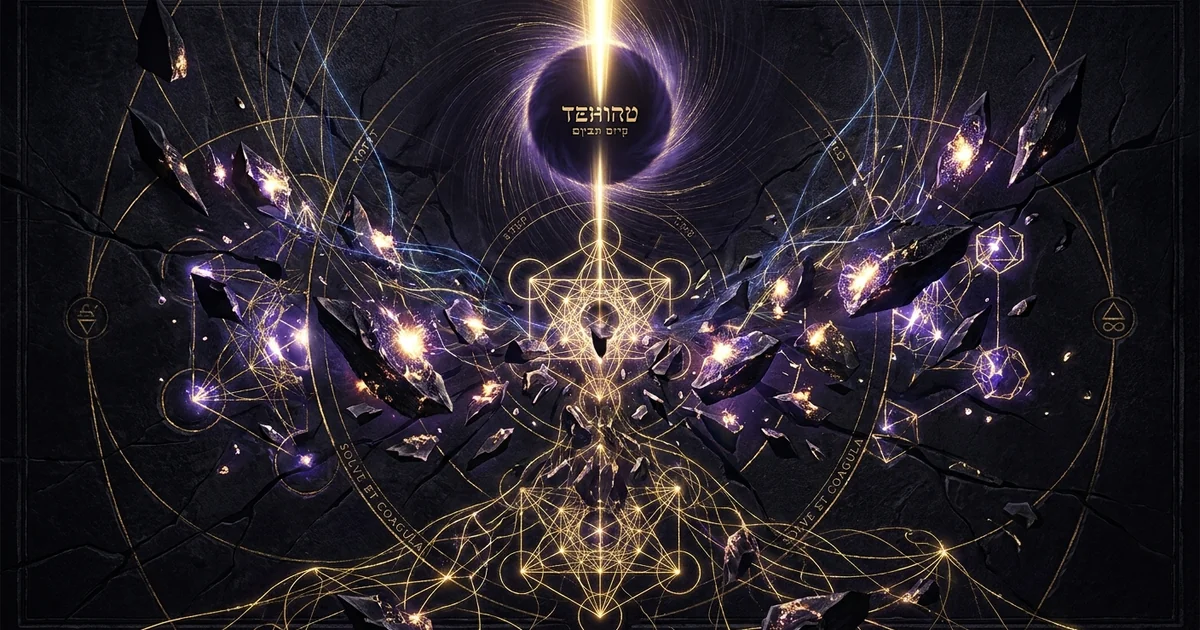
Isaac Luria and Tikkun Olam: Shattering Vessels & Repair
Metaphysical Thesis & Epistemological Opening: The Catastrophe of Emanation
The Radical Inversion: Tzimtzum as Primordial Self-Abnegation
Lurianic Kabbalah marks an unprecedented ontological rupture in Western esoteric cosmology. Classical Neoplatonic models, alongside the early medieval Kabbalah articulated in the Provencal-Catalan schools and codices like the Zohar, conceived of genesis as an uninhibited outward radiation: an unbroken, hierarchical cascade of luminescent plenitude descending from the Ein Sof (the Transfinite Divine) down to the base material sphere. Isaac Luria (1534–1572), operating in the mountain enclave of Safed, inverted this foundational paradigm. He posited that the inaugural gesture of the Absolute was not expansive self-manifestation, but radical withdrawal, self-limitation, and metaphysical abnegation: the phenomenon of tzimtzum divine contraction.
Before any world could exist, the Ein Sof saturated all potential reality. Being infinite, homogenous, and unconditioned, its undifferentiated presence precluded the ontological alterity required for finite existence. To create space for the Other, the Ein Sof had to evacuate its own infinite center, drawing inward toward its periphery. This primal retraction forged the tehiru—an ontological vacuum or metaphysical void predicated strictly upon divine absence. Yet, this clearance was not absolute; it retained the reshimu, a faint residual trace of divine light clinging to the dimensional boundaries of the void, analogous to the scent of perfume remaining in an emptied vial. Creation emerges not out of divine omnipotence asserting itself, but through divine self-evacuation, establishing a cosmos grounded in radical absence, alienation, and metaphysical trauma.
The Hebrew root צמצם (tz-m-tz-m) holds a profound lexical tension across rabbinic, talmudic, and kabbalistic literature. While colloquial usage frequently renders the term as mere physical “contraction” or “shrinkage,” its technical deployment within early modern Kabbalah signifies a catastrophic act of self-delimitation, concentration, and ontological concealment (he’elam). In midrashic antecedents (such as Genesis Rabbah), God contracts His presence to dwell within the localized confines of the Tabernacle’s Holy of Holies. Luria radicalizes this midrash: the tzimtzum of the Ein Sof (אין סוף) is not spatial displacement within an existing volume, but the ontological generation of volume itself through interiorized self-diminution.
The Hydrodynamics of Infinity: Light, Vessel, and Structural Limit
Following the production of the tehiru, the cosmogonic process commenced through an asymmetrical re-entry of the divine source. The Ein Sof projected a singular, focused vector of undifferentiated light—the kav (the divine ray)—into the primordial abyss. This influx was tasked with establishing the archetypal architecture of the universe, mapped onto the metaphysical sefirot architecture on the tree of life. However, this transmission immediately initiated an unresolvable dialectic between the pure fluidity of infinite divine transmission and the finite structural capacity of the emanated containers (kelim) designed to house it.
For emanation to stabilize into discrete metaphysical domains rather than dissolving back into undifferentiated infinity, the descending light required vessels capable of measurement, differentiation, and structural boundary. The higher levels of this process—manifesting initially as the transcendent configuration of Adam Kadmon (the Primordial Anthropos)—sustained this tension through sheer proximity to the transfinite source. But as the interior light descended toward actualization in the lower worlds, the disparity between energetic intensity and structural resilience escalated exponentially. The vessels were not passive conduits; they were crystallizations of divine judgment (Din), charged with containing a boundless mercy (Chesed) that perpetually threatened to exceed their dimensional thresholds.
Cosmic Trauma as the Engine of Cosmogenesis
In this fragile emanation mechanics, Isaac Luria situated his most radical insight: systemic failure is the structural engine of cosmic reality. The cosmogonic sequence did not unfold as an uninterrupted progression of celestial perfection; rather, it suffered an absolute structural collapse known as shevirat hakelim (the shattering of the vessels). When the untamed, hyper-concentrated light of the primordial realm of Olam Ha-Tohu (the World of Chaos) struck the delicate vessels of the lower seven sefirot, the containers catastrophically imploded. The resulting metaphysical debris precipitated a universal down-fall, establishing an inherently traumatized universe.
This structural collapse fundamentally reorganizes classical theodicy. Within the architecture of lurianic kabbalah tikkun olam shevirat hakelim shattering vessels, evil and systemic entropy are neither incidental moral corruptions generated by fallen terrestrial humanity, nor arbitrary creations of an inscrutable deity. Evil is the inevitable ontological fallout of cosmogonic labor—the coagulated shards of broken celestial receptacles intermingled with trapped divine luminescence. The universe did not fall from perfection; it was born through fracture. Consequently, human experience is embedded within an unfinished, structurally unstable cosmos, demanding active systemic intervention rather than passive contemplation.
Primary Codices & Historical Transmission: From Safed to Hermetic Transmission
The Vitalian Exclusivity and the Manuscripts of Safed
The historical transmission of Lurianic doctrine presents an epistemological challenge unprecedented in Western esoteric historiography. Isaac Luria himself committed virtually none of his comprehensive cosmogonic system to writing, preferring oral transmissions delivered within an insular, initiatic fraternity (chavurah) in Safed between 1570 and his premature death in 1572. Luria operated as a charismatic visionary whose pedagogical methodology combined ecstatic visionary states, cemetery incubations over the graves of Tannaitic sages, and complex dynamic diagrams drawn in the dust. The dissemination of his system rests almost entirely upon the codices compiled by his disciples, chief among them Chaim Vital (1543–1620).
[ Isaac Luria (Safed, 1570-1572) ]
                        |
       +----------------+----------------+
       |                                 |
[ Chaim Vital ]                  [ Joseph ibn Tabul ]
(Eight Gates / Etz Chaim)         (Drush Cheftzi-Bah)
       |                                 |
[ Controlled Esotericism ]        [ Systematic Metaphysics ]
       |                                 |
       +----------------+----------------+
                        |
               [ Israel Sarug ]
       (Philosophical Neo-Platonization)
                        |
        [ Knorr von Rosenroth (1677) ]
            (Kabbala Denudata)
                        |
  [ European Esotericism & German Idealism ]
Vital claimed exclusive, monopolistic authority over the Lurianic corpus, declaring that all alternative transcriptions produced by fellow disciples were flawed, premature, or actively distorted. Vital organized this vast metaphysical material into a monumental architecture known as the Shemonah She’arim (Eight Gates), culminating in his magisterial magnum opus, Etz Chaim (The Tree of Life). Vital’s recension is characterized by its phenomenological density, mapping with geometric pedantry every pulse, retraction, and reconstitution of the celestial lights. Vital guarded these manuscripts with extreme jealousy, burying portions of them and ordering his brother, Moses Vital, to withhold them from circulation—a prohibition that spawned clandestine copying, archival excavations, and metaphysical disputes across the Levant.
“Know that prior to the emanation of the emanated beings and the creation of the creatures, there was an upper, simple light filling all existence… And when it arose in His simple will to create worlds and emanate emanations, to bring to light the perfection of His actions, His names, and His appellations… behold, He contracted Himself in the central point within Him, at the very center of His light, and He contracted that light and withdrew to the sides around the central point, leaving an empty space, a vacuum, and a hollow sphere… And into this vacuum He drew forth a single ray of light from His infinite essence, descending in stages into that interior void… Yet when this light reached the vessels of the Points (Nekudot), their nature was atomized, each standing alone without unity, and their vessels were brittle, incapable of enduring the immensity of the influx. And the light shattered them, breaking them into shards that fell down toward the Abyss of Asiyah.”
Divergent Lineages: Joseph ibn Tabul and Israel Sarug
Despite Vital’s attempts to enforce strict textual hegemony, alternative and intellectually formidable currents of Lurianic doctrine emerged from Safed. The most philosophically rigorous of these alternative lineages was articulated by Joseph ibn Tabul (c. 1545–1610). In treatises such as Drush Cheftzi-Bah (The Exposition of the Desired), Ibn Tabul preserved a divergent, highly dialectical interpretation of the tzimtzum. Unlike Vital, who often sanitized or downplayed the anthropomorphic and violent dimensions of the contraction, Ibn Tabul explicitly argued that the primary purpose of the tzimtzum was the cathartic purge of the elements of severe judgment (Din) inherent within the infinite nature of the Ein Sof. In Ibn Tabul’s schema, the primal withdrawal was a necessary purification, an ontological necessity that concentrated the latent forces of severity into a single nexus, thereby guaranteeing that their eventual rupture would not destabilize the ultimate source.
Concurrently, Israel Sarug (fl. 1590–1610), who claimed to be a direct disciple of Luria—a claim rigorously contested by Vital’s partisans—emerged as the primary geographical vector for Lurianic thought across Italy and Northern Europe. Sarug translated the dense, mythical structures of Safed into a Neoplatonic, philosophically palatable idiom. He introduced elaborate metaphysical preliminaries absent in Vital’s recension, such as the Malbush (the primordial garment woven from the letters of the Hebrew alphabet within the Ein Sof prior to the tzimtzum). Sarug’s teachings captivated influential Jewish philosophers like Menahem Azariah da Fano in Mantua and Abraham Cohen de Herrera in Amsterdam, directly facilitating the hybridization of Lurianic Kabbalah with late Renaissance metaphysics.
European Transmission: The Kabbala Denudata and Renaissance Esotericism
The broader Western intellectual tradition encountered the Lurianic system through Christian Hebraist filters, fundamentally shifting early modern philosophy. The central node of this transmission was Christian Knorr von Rosenroth’s monumental two-volume compendium, Kabbala Denudata (The Kabbalah Unveiled), published in Sulzbach between 1677 and 1684. Von Rosenroth synthesized vast sections of Vital’s Etz Chaim, Ibn Tabul’s treatises, and Sarugian commentaries into scholastic Latin, translating complex Jewish theosophy into the lingua franca of European humanism.
Through the Kabbala Denudata, the Lurianic doctrine of cosmic catastrophe crossed cultural boundaries, influencing minds like Gottfried Wilhelm Leibniz, Henry More, and the Cambridge Platonists. Later, this translated mythos filtered into the bloodstream of German Idealism. The Lurianic intuition—that reality is sustained through divine alienation, structural breakdown, and heroic historic reconstitution—resonates throughout G.W.F. Hegel’s dialectical historical phenomenology and Friedrich Schelling’s Die Weltalter (Ages of the World). The Lurianic cosmology ceased to be a localized Mediterranean Jewish mysticism; it became a pervasive, underlying architecture of modern European speculative philosophy, presenting an understanding of history as a redemptive process driven by internal metaphysical contradiction.
Ontological Architecture & Cosmological Models: The Mechanics of Shevirah
Adam Kadmon and the Secretion of Primordial Lights
The structural architecture of Lurianic cosmogenesis unfolds through a series of hypostatic emanations within the tehiru, mediated by the trans-spatial figure of Adam Kadmon (Primordial Man). As the kav penetrates the void, it does not immediately crystallize into fragmented worlds. Instead, it coalesces into this first anthropomorphic macrocosm. Adam Kadmon acts as an immense metaphysical prism, receiving the transfinite pulse of the Ein Sof through his transcendent crown (Keter) and re-emanating it through his sensory apertures: his ears (Ozen), nose (Chotem), mouth (Peh), and eyes (Einayim).
The lights emanating from the ears, nose, and mouth possess an exceptionally high degree of spirituality. In these upper zones, light and vessel exist in a state of undifferentiated unity; the containers are not distinct, solid objects, but transparent dimensional thresholds completely dissolved within the light they mediate. These pristine emanations constitute the worlds of Akudim (the Bound), where the lights are bound together in a singular, harmonious vessel. Here, the divine realm experiences no division, estrangement, or dialectical tension. However, this sublime integration begins to unravel as the cosmogonic vector descends beneath the forehead and bursts forth from the eyes of Adam Kadmon, inaugurating the catastrophic domain of Nekudim (The World of Points), structurally synonymous with Olam Ha-Tohu (The World of Chaos).
The Cataclysm of Olam Ha-Tohu: Structural Incoherence of the Vessels
The World of Tohu was doomed to structural failure by its fundamental topology. Unlike the unified lights of Akudim, the lights issuing from the eyes of Adam Kadmon emerged as isolated, hyper-concentrated points (Nekudot). Each sefirah manifested as an atomized monad, closed off from its adjacent counterparts, lacking any mechanism for mutual inter-penetration, communication, or horizontal energy exchange. This condition is described in the Zohar and seized upon by Luria as the mystery of the “Kings of Edom who reigned and died before there reigned any king over Israel” (Genesis 36:31)—a mythic code for the succession of unbalanced, primordial worlds that collapsed because they were built upon pure, unmediated egoism and structural isolation.
When this volatile luminescence descended into the vessels of the lower seven sefirot—Chesed (Mercy), Gevurah (Severity), Tiferet (Beauty), Netzach (Eternity), Hod (Splendor), Yesod (Foundation), and Malchut (Kingdom)—the containers could not endure the ontological charge. The upper three vessels (Keter, Chochmah, and Binah), possessing greater spiritual density, survived with structural fractures or superficial displacements. But the lower seven, constructed primarily from the unyielding, restrictive force of Din (Judgment) without the tempering balance of collective integration, catastrophically shattered. The vessels did not merely crack; they imploded under the sheer, vertical pressure of an infinity they were structurally unequipped to hold.
The Genesis of the Klipot and the Entrapment of the Nitzotzot
The cataclysm of shevirat hakelim set into motion an irreversible cosmic dispersion. As the vessels fractured, the divine light attempted to retract back to its transcendent source in Adam Kadmon. However, this retreat was incomplete. Just as the dross cannot fully separate from refined ore during sudden smelting, two hundred and eighty-eight major configurations of primordial holy sparks—the Rapa’ch Nitzotzot (רפ״ח ניצוצות)—remained intimately fused to the falling shards of the broken vessels.
These fallen shards, composed of rigid, severed Din, tumbled downward through the empty expanse of the tehiru, cross-pollinating with the shadowy trace of the reshimu. As they plummeted, their spiritual density coagulated, undergoing an ontological phase shift from pure metaphysical vessels into opaque, spiritually deadening husks known as the Klipot (shells) or the Sitra Achra (the Other Side). The Klipot do not possess autonomous, independent ontological vitality. They are metaphysical parasites; their existence is sustained entirely by the trapped divine sparks (nitzotzot) incarcerated within their hardened, entropic matrices. Matter itself, alongside the dense, fallen regions of the terrestrial sphere, was generated as the final, calcified debris of this celestial wreck, leaving the divine sparks held hostage inside a hostile, alien system.
Phenomenological Mechanics & Interdimensional Interaction: The Extraction of Nitzotzot
Birur: The Energetic Sorting of Light from Demonic Density
Within the classical Lurianic taxonomy, human existence does not unfold within a pristine Edenic garden or a morally neutral physical realm. Instead, humanity finds itself situated within the thickest concentration of the post-catastrophic debris: the lowest structural tier of the universe, Olam Ha-Asiyah (the World of Action). Consequently, the primary operational imperative of the human subject is Birur—an analytical, phenomenological, and spiritual process of separation, discernment, and energetic extraction.
Birur is the deliberate sifting of the holy sparks from their incarceration within the Klipot. Every object, historical situation, biological process, and material substance encountered in the mundane sphere contains an imprisoned spark of divinity awaiting liberation. Without the interior spark of nitzotz, the surrounding shell would instantly cease to exist, dissolving back into absolute nothingness. The human being acts as a walking ontological refinery: through focused interaction, the subject must recognize the trapped divine impulse within base reality, sever the parasitic attachment of the klipah, and elevate the purified spark back into the cosmic circuit of the divine countenances.
Olam Ha-Tohu (The World of Chaos)
- Topology of Isolation: Manifests as atomized, independent points (Nekudot). Sefirot are monads incapable of mutual inter-inclusion.
- Absence of Reciprocity: Each vessel asserts imperial self-sufficiency: “I shall reign.” Complete lack of horizontal energetic conduits.
- Structural Fragility: Hyper-concentrated divine light overwhelms unyielding containers formed exclusively of unmitigated Din (Severity).
- Outcome: Catastrophic structural implosion (Shevirah), generating the debris of the Klipot and the entrapment of 288 sparks.
Olam Ha-Tikkun (The World of Rectification)
- Topology of Integration: Manifests as interconnected face-to-face configurations (Partzufim). Sefirot contain holographic micro-representations of one another.
- Dynamic Reciprocity: Systemic balance maintained through continuous energetic exchange, mutual interdependence, and collective circulation of light.
- Structural Elasticity: Flexible, resilient matrix capable of housing transfinite intensities through coordinated shared load-bearing.
- Outcome: Harmonious stability, gradual extraction of sparks, and the reconstitution of the primordial Anthropos into wholeness.
Theurgic Kavanah: The Mind as a Microcosmic Extraction Interface
The primary instrument of Birur is not political legislation or moralistic sentimentality, but rigorous, initiatic theurgy. In the operational manuals written by Vital, such as Sha’ar Ha-Kavanot (The Gate of Intentions), the human mind is treated as a high-precision metaphysical extraction interface. Through kavanah—the intensely focused, visionary intentionality directed toward the permutations of divine names during prayer, ritual actions, and physical consumption—the practitioner systematically engages with the metaphysical anatomy of the universe.
When an initiate ingests food, for example, the act is converted from an animal survival mechanism into a high-stakes metaphysical operation. If the food is consumed with gross biological gluttony, the practitioner’s lower consciousness falls prey to the husk, strengthening the klipah and pulling the human soul deeper into the entropic mud of the Sitra Achra. Conversely, if the food is consumed with precise, meditational kavanah aimed at the divine names governing that material substance, the shell is broken, its hold is shattered, and the trapped holy spark is extracted and integrated into the practitioner’s luminous body, ultimately returning to its ancestral location within the cosmic sefirot.
The Mechanics of Klipotic Mimicry and Interdimensional Parasitism
The structural dynamics of the Klipot bear profound phenomenological similarities to Jacques Vallée’s informational control system framework and modern conceptions of non-human intelligence (NHI). The Klipot are not static, inert obstacles; they function as a living, intelligent, parasitic matrix designed to deceive, manipulate, and harvest human energetic expenditure. Because the husks are cut off from direct access to the Ein Sof, they face constant starvation. To prevent the human agent from accomplishing Birur—which would completely strip them of their stolen vitality and dissolve their structural cohesion—the Klipot generate elaborate systemic illusions, or egregores of cultural, religious, and existential deceit.
The Klipot simulate spiritual experiences, induce dogmatic fanatical obsessions, and foster societal hyper-materialism. They construct an artificial reality that keeps human consciousness focused strictly on horizontal, competitive, and destructive behavioral loops. In this Lurianic phenomenology, human moral depravity, ideological madness, and psychological fragmentation are direct results of klipotic manipulation: parasitic entanglements where systemic entities feast upon the misplaced vital fire of human consciousness. The practitioner tasked with gathering sparks of holy light klipot must constantly navigate a minefield of mimicry, piercing the deceptive architectures of an invisible occupying system to reclaim the authentic divine luminescence that keeps the entire dimensional theater functioning.
Initiatic Synthesis & Philosophical Implications: Tikkun Olam as Cosmological Realism
Demythologizing Modern Tropes: Reclaiming Tikkun Olam from Secularization
In the late twentieth and early twenty-first centuries, the term Tikkun Olam underwent a sweeping sociological sanitization. It was extracted from its dense, dangerous metaphysical matrix and retrofitted into a benign slogan for generic socio-political activism, environmental awareness, and progressive philanthropy. While these ethical efforts are socially valuable, this contemporary secularization completely obscures the radical, cosmic-metaphysical realism of the original Lurianic doctrine.
In the Safed schema, Tikkun Olam is not a humanistic program to make a fundamentally good world slightly better; it is a desperate metaphysical operation to salvage a world born out of systemic cosmic failure. To reduce Tikkun to secular ethics is an epistemological category mistake that strips the concept of its cosmic terror and divine urgency. Lurianic Kabbalah does not promise an uncomplicated, benevolent universe. It reveals that the godhead itself is injured, broken, and held hostage within the bowels of matter. The imperative of cosmic restoration and healing demands an ontological transmutation of reality itself, not merely political adjustments within a broken system.
Engaging with the Lurianic mechanics of Birur and Tikkun carries profound psychological and existential danger. When a practitioner approaches these operations through the lens of personal ego-will, messianic grandiosity, or spiritual bypassing, the result is severe ontological vertigo and psychic collapse. To believe that one is unilaterally saving the cosmos without having first purified their own interior Din invites swift counter-action from the Klipot. The literature of the Safed circle and later Hasidic movements repeatedly warns of practitioners driven mad, stricken by terminal physical wasting, or possessed by lower-dimensional entities (dybbukim) after attempting theurgic extractions without the requisite moral, textual, and ritual purification. Metaphysical surgery on the cosmic anatomy will destroy the operator if approached as an extension of personal hubris.
Reconstitution of the Divine Face: The Dynamic Architecture of Partzufim
The ultimate mechanical objective of Tikkun is the structural transformation of the unstable, point-like sefirot into complex, dynamic networks known as Partzufim (Divine Countenances or Faces). The World of Tohu collapsed because each sefirah existed as an isolated monad, an imperial point asserting its own exclusive existence. The World of Tikkun (Rectification) operates on an entirely different ontological geometry: hyper-relationality, structural inter-penetration, and holistic mutual balance.
Through the extraction of the nitzotzot, the broken archetypes are reconstituted into five primary, macrocosmic Partzufim:
- Arikh Anpin (The Long Face / Macroprosopus): The countenance of primordial compassion and transcendent will.
- Abba (The Father): The hypostasis of primordial wisdom (Chochmah).
- Imma (The Mother): The hypostasis of systemic understanding and divine matrix (Binah).
- Ze’ir Anpin (The Short-Faced One / Microprosopus): The emotional and systemic nexus composed of the reconstituted lower six sefirot.
- Nukva (The Female / The Shechinah): The receptive, immanent presence of the Divine within reality (Malchut).
[ Arikh Anpin: Transcendent Will / Keter ]
                            |
           +----------------+----------------+
           |                                 |
   [ Abba: Wisdom ]                  [ Imma: Matrix ]
      (Chochmah)                         (Binah)
           |                                 |
           +----------------+----------------+
                            |
           [ Ze'ir Anpin: Microprosopus / Son ]
                 (Six Reconstituted Sefirot)
                            |
                            v
           [ Nukva: Shechinah / Immanent Face ]
                  (Reconstituted Malchut)
In this rectified state, the Sefirotic attributes no longer stand as fragile, unyielding vertical columns. Instead, they gaze upon one another panim el panim (face-to-face). The dynamic integration of Ze’ir Anpin and Nukva—the sacred marriage (yichud) of the transcendent dynamic spark and immanent vessel—is the ultimate telos of the Lurianic system. By assembling the fractured, isolated lights of reality into relational countenances, reality transitions from an entropic, catastrophic vulnerability into a resilient, self-healing macrocosmic organism.
Anthropocosmic Sovereignty: Human Agency as the Axis of Cosmic Restoration
This architecture places human agency at the absolute center of reality’s survival. Humanity does not inhabit the universe as a contingent biological accident or a subservient supplicant cowering before an aloof, all-powerful deity. In Luria’s schema, God cannot heal Himself without humanity. Because human souls are the fractured, microcosmic shards of the primordial Adam Kadmon, the human being functions as the nervous system of the macrocosm. Humanity holds sovereign agency over the macrocosmic circuit.
Every deliberate action, every refined thought, and every ethical or theurgic engagement either extracts an imprisoned spark and anchors the divine faces, or plunges additional spiritual energy into the jaws of the Klipot. The cosmos is paused in an agonizing, unresolved equilibrium, awaiting the completion of the human task. Lurianic Kabbalah transforms anthropology into cosmology: the fate of the absolute is bound to the historical choices of the localized initiate. The redemption of the Transfinite is an unfinished task handed directly to the finite agent.
Frequently Asked Questions: Esoteric Clarifications on the Lurianic Schema
Tzimtzum: Literal Spatial Vacuum or Informational Concealment?
A fierce debate within Kabbalistic history focuses on whether the tzimtzum must be understood as a literal, spatial event (Tzimtzum Kipshuto) or as an allegorical, epistemic concealment (Tzimtzum She-eino Kipshuto). The literalist school, championed by Italian Kabbalist Immanuel Hai Ricchi in his work Yosher Levav (1737), argued that the Ein Sof physically evacuated a real metaphysical point, creating an actual void devoid of divine essence, into which the kav descended. Without a real evacuation, Ricchi argued, the distinction between creator and created dissolves into pantheism, and evil becomes an illusion directly hosted within the Godhead.
Conversely, the non-literalist school, articulated by the Vilna Gaon, Moses Chaim Luzzatto (Ramchal), and systematized comprehensively by Shneur Zalman of Liadi in Habad Hasidic thought (Tanya), insisted that a literal spatial contraction within the infinite is impossible. The Ein Sof remains entirely omnipresent; there is no place devoid of It (leit atar panur minei). Rather, tzimtzum represents an informational phase-shift—an extreme, systemic self-concealment (he’elam) relative to the perception of emanated beings. The vacuum is not an objective absence of divinity, but an engineered perceptual veil. From the perspective of the Absolute, no contraction ever took place; from the lower perspective of created consciousness, the concealment produces the operational reality of the void, facilitating the illusion of self-sovereignty required for authentic free will and moral agency.
“The expulsion from Spain in 1492 was the catastrophe that generated the Lurianic system. The trauma of exile ceased to be merely the historical destiny of the Jewish people and was transformed into the fundamental condition of the universe itself. In the myth of the shattering of the vessels, the exile of Israel is elevated to the rank of a cosmic archetype: the divine presence itself is in exile, scattered in fragments throughout the demonic realms of the Klipot. Tikkun, therefore, is not a quietist resignation to historical suffering, but a revolutionary, messianic act of cosmic repatriation. The mystic does not accept history; he breaks through it to repair the shattered foundation of Being.” — Gershom Scholem, Major Trends in Jewish Mysticism (1941)
The Ontological Paradox of Evil: Why Did the Infinite Suffer Rupture?
If the Ein Sof is entirely perfect, self-sufficient, and without lack, why was the cosmogonic catastrophe allowed to unfold? Did the Transfinite suffer an accidental failure, or was the shevirah an intentional, necessary descent designed into the cosmogonic blueprint? Moshe Idel, in Kabbalah: New Perspectives, challenges the view that Luria merely reacted to external historical pressures, demonstrating that the Lurianic paradigm represents a systematic expansion of internal mythic motifs rooted deep within early rabbinic literature and the Zohar.
The Lurianic masters resolved this paradox through a dialectic of necessary fracture. A universe constructed purely of infinite, unyielding light would be a homogenous monolith, entirely incapable of containing individuated consciousness, dynamic alterity, or authentic love. Had the vessels remained unbroken, reality would have lingered as a static, crystalline perfection—a frozen extension of the divine will without dynamic interior life.
The shevirah was therefore an intentional necessity: an existential crucible wherein the vessels had to break so that reality could experience genuine separation, vulnerability, and radical estrangement. Only through structural breakdown could distinct entities emerge, endowed with the sovereign agency to willingly choose alignment with the Absolute. Evil is the terrifying, dangerous cost of manifesting finite existence—a functional friction without which the divine drama of love, free agency, and self-restoration could never occur.
Sparks, Gnosticism, and Archontic Parallels: Is Luria a Gnostic Revivalist?
The phenomenological parallels between Lurianic Kabbalah and classical Christian Gnosticism (especially the 2nd-century Valentinian school) are striking. Both mythologies posit a catastrophic rupture within the primordial divine realm (Pleroma); both trace the origin of the material universe to this celestial fall; both describe holy sparks of spiritual luminescence (pneuma or nitzotzot) held captive within a dense, material matrix ruled by dark, parasitic forces—whether termed archons within gnostic cosmogony or Klipot within Safed theosophy.
[ Primordial Pleroma / Ein Sof Plenitude ]
                           |
             +-------------+-------------+
             |                           |
  [ Valentinian Gnosticism ]   [ Lurianic Kabbalah ]
             |                           |
    (Cosmic Error: Sophia)      (Cosmic Law: Shevirah)
             |                           |
     [ The Evil Demiurge ]       [ The Entropic Klipot ]
  (Materiality is intrinsically (Materiality is broken divinity,
       flawed and despised)         salvageable via theurgy)
             |                           |
    [ Ascetic Escape / Flight ] [ Active Cosmic Transformation ]
       (Abandon the World)           (Heal the World: Tikkun)
However, the deep structural ontology of the two systems reveals an absolute divergence in programmatic response. For the classical Gnostic, the material realm is the irrevocably depraved construct of an insane or malicious counterfeit architect: the demiurge. Consequently, Gnostic redemption is inherently world-denying: it demands ascetic withdrawal, the total repudiation of physical matter, and the flight of the isolated spark out of the cosmic prison to reunite with the transcendent Father.
Lurianic Kabbalah rejects this escapism. The material cosmos is not an evil prison fabricated by an alien tyrant; it is the fractured, calcified body of the living God. The material vessel is sacred, holding the divine sparks within its very molecular and systemic substrate. The goal of the Lurianic initiate is not flight from the world, but the tikkun of the world—the active, theurgic sanctification, transformation, and structural elevation of physical reality from within. The initiate does not abandon the material sphere; they dive into the density of the Klipot to tear the holy sparks out of the jaws of chaos, compelling the lowest world of Asiyah to become a palace worthy of the unreserved manifestation of the Infinite. :::