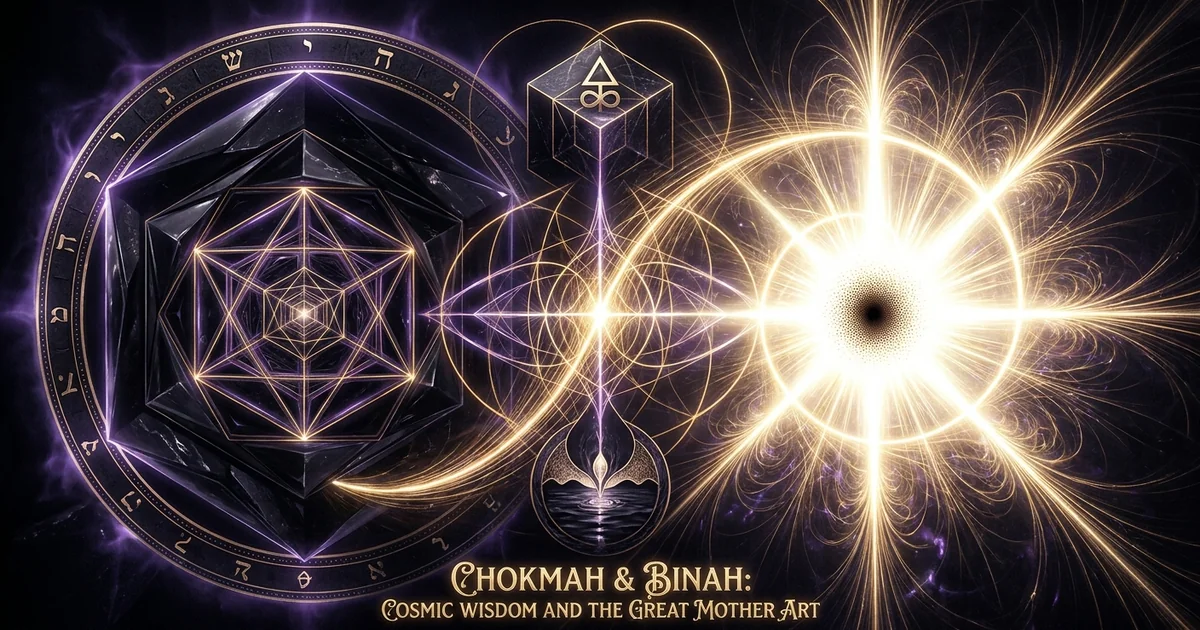
Chokmah & Binah: Cosmic Wisdom and the Great Mother Art
Metaphysical Thesis & Epistemological Opening: The Primordial Supernal Bifurcation
From Monadic Singularity to Dyadic Rupture: The Mechanics of Kether’s Emanation
The descent of absolute reality from the unmanifest concealedness of the Ein-Sof into structural manifestation commences with a radical metaphysical rupture. Within the primary architecture of the Tree of Life, the monadic singularity of /spirituality/kether-the-primordial-point represents the supreme point of undifferentiated consciousness—a zero-dimensional horizon wherein potentiality and actuality remain indivisibly collapsed. Kether is the absolute Ayin (Nothingness) concentrated into a singular, dimensionless locus (nekudah rishonah), possessing no interiority, no exteriority, and no dialectical counterpart. However, an ontological reality defined solely by self-contained simplicity cannot initiate cosmogenesis; monadic equilibrium is indistinguishable from ontological stasis.
To generate a cosmos, the monad must undergo an emanative polarization. This primary bifurcation within the /spirituality/sefirotic-tree-of-life-architecture does not occur through an exterior addition, but through an intrinsic ontological unfolding: the radiant, outward surge of Chokmah (Wisdom) and the reciprocal, boundary-defining matrix of Binah (Understanding). This Supernal Dyad represents the fundamental cosmogonic phase transition. Through this dynamic, the unconditioned simplicity of Kether ruptures into an informational and operational field. In this structural movement, the singular point of the infinite expands into dynamic polarity, laying the ontological groundwork for all subsequent dimensional descent through the /consciousness/gnostic-pleroma-and-emanational-physics.
The initial propulsion of this dynamic is Chokmah, the second sefirah, traditionally designated as Abba (the Supernal Father). Chokmah is the immediate emanative realization of Kether’s concealed will—an explosive, unconstrained kinetic radiance carrying the total systemic data of the cosmos in a state of absolute, pre-conceptual compression. It is the raw velocity of the creative flash (chokmah), an unchanneled light that surges outward without regard for containment or differentiation. Yet, pure dynamic force without an operational substrate remains ontologically inert, incapable of sustaining discrete entities.
The kinetic velocity of Chokmah requires an immediate, simultaneous counter-principle to arrest its formless dispersal. This counter-principle is Binah, the third sefirah, personified as Aima (the Supernal Mother). Binah is the architectural matrix, the primordial spatial field that receives, decelerates, and parses the continuous, non-local radiation of the creative flash. Where Chokmah is dynamic force, Binah is the womb of form; where Chokmah is the unpunctuated informational stream, Binah is the grammar of dimensional limitation.
The dialectic of the Supernal Dyad is embedded directly within Hebrew linguistic morphology. The term Chokmah (חָכְמָה) is historically parsed in classical Kabbalistic hermeneutics as a portmanteau: Koach Mah (כֹּחַ מַה), literally signifying “the power of What Is” or “the potentiality of the undefined.” It denotes raw, undifferentiated capacity prior to formal attribution. Conversely, Binah (בִּינָה) derives from the tri-consonantal root Bein (בֵּין), meaning “between,” “interval,” or “discernment.” Binah constitutes the operational principle of relational spacing, introducing interval, distinction, and syntactic structure into the dimensionless, continuous radiance of Chokmah. The transition from Chokmah to Binah is thus the ontological transition from pure ontological potential (Mah) to structural, differentiated interrelation (Bein).
Wisdom and Understanding: Defining the Epistemological Field
The structural interplay between Chokmah and Binah establishes the epistemic foundation of Kabbalistic metaphysics. Historically mistranslated in colloquial occultism as vague psychological attributes, “Wisdom” and “Understanding” in the classical Kabbalah denote two irreconcilable yet interdependent epistemological modalities. Chokmah is holistic, non-discursive apprehension. It operates outside the categories of time, sequential logic, and spatial differentiation. When consciousness interfaces with the Chokmahic register, knowledge is received as an instantaneous, indivisible whole—an unmediated gnosis wherein subject, object, and the act of knowing remain fused in non-dual proximity. It is the unfragmented blueprint of the total system, present all at once, utterly defying analytical decomposition. Because it lacks spatial and conceptual coordinates, Chokmah cannot be communicated, preserved, or operationalized in its native state; it is an blinding luminescence that eludes linguistic transmission.
Binah represents the operationalization of this holistic gnosis. Binah is the architectonic intelligence that constructs the epistemological field itself. It takes the non-temporal, dimensionless lightning of Chokmah and introduces internal differentiation, generating the conceptual architecture of duration, causality, and taxonomical distinction. Binah analyzes, measures, and categorizes; it builds the linguistic vessels, archetypal geometries, and logical parameters through which the raw data of Wisdom becomes comprehensible to lower dimensional strata.
Without Binah, Chokmah is an unnavigable, chaotic brilliance that blinds rather than illuminates. Without Chokmah, Binah is an empty, sterile gridwork—a labyrinthine architecture devoid of life and luminous impetus. The interplay of chokmah binah abba aima cosmic father mother kabbalah supernals establishes that meaning is never a static property, but an ongoing generative resonance between pure dynamic insight and structural articulation.
Deconstructing Modern Materialist Teleology via Emanational Realism
The recognition of the Supernal Dyad as the primary cosmological engine mounts an incisive challenge against modern materialist teleology. The dominant paradigms of physicalist reductionism operate on an inverted metaphysical assumption: they posit that consciousness, form, and structural order are late, accidental epiphenomena emergent from the chaotic, mechanical collision of blind physical substrates. In this mechanistic paradigm, complexity arises mechanistically from basic physical interactions, and subjective understanding is reduced to a neurochemical abstraction generated by material survival pressures.
Kabbalistic emanational realism, preserved across the primary textual lineage, demonstrates that this physicalist schema commits a profound category error. Form and consciousness are not late-stage accidents of matter; they are the fundamental, primordial ontological operators of cosmogenesis. Matter itself is the densest, most crystallized refraction of the primary dialectic between force (Chokmah) and form (Binah).
By tracing the architecture of the cosmos back to its emanational taproot, one discovers that the universe does not run on brute, unguided mechanics, but on an informational control dynamic. The dialectic between the undifferentiated informational density of Chokmah and the algorithmic, spatial constraints of Binah mirrors the fundamental dynamics of contemporary emanational physics and systemic information theory. Space-time is not a fundamental vacuum within which objects happen to exist; it is an engineered metric, an ongoing systemic translation enacted by Binah upon the boundless, non-local energy vector of Chokmah.
Consequently, the physical universe is an externalized, hyper-complex mirror of the Supernal dynamic—a coherent, multi-tiered computational field designed to transcribe infinite divine potentiality into finite, self-reflective conscious agents. The naive dualisms of mind and matter, subject and object, are dissolved in the realization that the cosmos is an emanational continuum structured by the primordial polarization of Wisdom and Understanding.
Primary Codices & Historical Transmission: Textual Evolution of the Supernal Dyad
Sefer Yetzirah: The Numerical Coordinates of Flash and Boundary
The earliest textual crystallization of the Supernal Dyad appears within the enigmatic, aphoristic layers of the Sefer Yetzirah (The Book of Formation), composed between the second and sixth centuries CE. Operating as a structural manual of proto-Kabbalistic cosmogony, the text articulates the generation of the cosmos through thirty-two mystical paths of wisdom (netivot peliyot chokmah), comprised of the ten sefirot belimah (the ten bounded, ineffable numbers) and the twenty-two foundational letters of the Hebrew alphabet. Within this archaic stratum, the sefirot are not yet adorned with the elaborate theosophical anthropomorphisms that characterize medieval Kabbalah; instead, they are presented as raw dimensional axes, primordial computational limits, and ontological metrics.
                  [ Ein-Sof: The Boundless Infinite ]
                                  │
                                  ▼
                   [ Kether: Primordial Monad ]
                                  │
                  ┌───────────────┴───────────────┐
                  ▼                               ▼
       [ Chokmah: Wisdom / Yod ]      [ Binah: Understanding / Heh ]
         (Undifferentiated Spark)        (Palace / Spatial Matrix)
The Sefer Yetzirah defines the foundational mechanics of Chokmah and Binah as an immediate, recursive analytical mandate: “Understand with Wisdom, and be Wise with Understanding” (Haben be-chokmah, va-chakam be-binah). This injunction establishes the co-equal, reciprocal dynamic of the two potencies. The text characterizes the sefirot as possessing an infinite vector of tension: “their end is embedded in their beginning, and their beginning in their end, like a flame bound to a burning coal.”
Here, the creative flash of Chokmah is the raw vitality of the flame, while the structural containment of Binah is the dense, stabilizing substrate of the coal. The Sefer Yetzirah establishes that the architecture of manifest existence demands an ongoing computational feedback loop between quantitative limit and qualitative force, positioning the dyad as the numerical and linguistic coordinates through which the cosmic fabric is calculated, bounded, and sustained.
The Zoharic Concealment: Idra Rabba and the Unveiling of the Partzufim
With the emergence of the Zohar in thirteenth-century Castile, compiled and redacted within the circle of Moses de León, the technical, numeric schemata of the Sefer Yetzirah underwent an ontological revolution. Within the core narrative of the Zoharic corpus—most notably within the profound, esoteric assemblies of the Idra Rabba (The Greater Holy Assembly) and the concise, hermetic contractions of the Sifra di-Tzni’uta (The Book of Concealment)—the sefirot are transformed from abstract cosmological categories into the dynamic, relational personae known as the Partzufim (Divine Faces or Configurations).
Within this framework, Chokmah is transfigured into Abba, the Supernal Father, and Binah into Aima, the Supernal Mother. This anthropomorphic morphology was not conceived as a descent into crude literalism, but as a sophisticated symbolic syntax designed to articulate the deeply relational, reciprocal, and organic mechanics of the Godhead.
“The Ancient One, most concealed of all, expanded and emanated a point of light, which is Chokmah. This point expanded further, and from this expansion there was formed a Palace (Heikhal), which is Binah. This Palace is the holy womb wherein all things are conceived, shaped, and woven into being. The point is Father (Abba); the Palace is Mother (Aima). They are never separated; they emerge as one, dwell as one, and do not part from one another. Thus it is written: ‘A river issues forth from Eden to water the garden’—the river is Binah, which flows unceasingly from the hidden spring of Chokmah.”
As Daniel C. Matt emphasizes in his commentary on the Pritzker Edition of the Zohar, the imagery of the point (nekudah) expanding into a palace (heikhal) constitutes one of the most sublime ontological metaphors in the history of mysticism. The point of Chokmah is dimensionless, hyper-dense, and utterly internal; it contains all forms in potential, yet has no spatial extension. Binah is the construction of structural interiority itself. By expanding the dimensionless point into a multidimensional “palace,” Binah creates an internal space (chalal) wherein the divine light can be refracted, reflected, and distributed to the lower worlds.
The Zohar emphasizes that Abba and Aima exist in a state of continuous, uninterrupted copulation (zivug lo pasik). Should this Supernal union ever rupture, even for an infinitesimal instant, the flow of vital informational energy sustaining the lower worlds would collapse back into absolute void.
Cordoverian Systematics and Lurianic Rectification (Tikkun)
The intellectualization of these primary Zoharic myths reached its zenith in sixteenth-century Safed, driven by two divergent yet complementary hermeneutical giants: Moses Cordovero and Isaac Luria. Moses Cordovero, in his masterwork Pardes Rimonim (Orchard of Pomegranates), established a systematic, rigorous philosophical framework to reconcile the transcendence of the Ein-Sof with the multiplicity of the sefirot. Cordovero analyzed the internal dialectic of Chokmah and Binah through the doctrine of the kelim (vessels) and orot (lights). He demonstrated that within the Supernal realm, essence and vessel exist in a state of near-absolute transparency; Binah acts as a vessel for Chokmah, not by being opaque or distinct in substance, but by acting as an emanated lens that focuses, refracts, and cools the scorching light of Wisdom without corrupting its divine essence.
Following Cordovero’s death, Isaac Luria (the Ari) radically transformed Kabbalistic cosmology by introducing the catastrophic meta-narrative of Shevirat ha-Kelim (the Shattering of the Vessels) and its subsequent Tikkun (Rectification), meticulously recorded in Hayyim Vital’s Etz Chaim (The Tree of Life). Luria posited that prior to our current cosmic order, the primordial world of Tohu (Chaos) emerged as isolated, point-like sefirot (Nekudim). In this primordial configuration, the light of Chokmah surged forward into vessels that were structurally autonomous, rigid, and disconnected from one another. Lacking the collaborative containment of a mature, integrated Supernal matrix, the lower vessels could not withstand the unmitigated impact of the creative flash; they shattered, plunging the cosmos into catastrophic rupture.
PRIMORDIAL COSMOGENESIS (TOHU)
[ Uncontained Chokmahic Force ] ──> [ Isolated Rigid Vessels ] ──> [ Shevirah / Shattering ]

RECTIFIED COSMOGENESIS (TIKKUN)
[ Supernal Union: Abba & Aima ] ──> [ Interlocking Partzufim ] ──> [ Stable Dimensional Worlds ]
In the subsequent world of Tikkun (Rectification), the structural dynamic of the Supernal Dyad undergoes a comprehensive architectural restructuring. Chokmah and Binah are permanently organized into fully realized, stable Partzufim—Abba Ila’ah (Higher Father) and Aima Ila’ah (Higher Mother)—which do not interact as isolated points, but as complex, inter-penetrating hypostatic systems. Luria demonstrated that Binah’s role is cosmic redemption: through her structural matrix, she catches the descending light, gathers the scattered sparks (nitzotzot) cast into the abyss of matter, and weaves them into the living, resilient architecture of Zeir Anpin (the Microprosopus). In the Lurianic system, the understanding and wisdom duality ceases to be a static binary; it becomes the primary engine of universal restoration.
Ontological Architecture & Cosmological Models: The Dynamic Mechanics of Abba and Aima
The Yod and the Heh: Tetragrammaton Dynamics in the Supernal Triangle
The fundamental mechanics of the Supernal Dyad are syntactically encoded in the primary orthography of the divine name: the Tetragrammaton (יהוה, Y-H-V-H). In classical Kabbalistic semiotics, the initial two letters—the Yod (י) and the primary Heh (ה)—serve as the metaphysical signatures of Chokmah and Binah. The Yod is visually and conceptually the smallest, most foundational character in the Hebrew aleph-bet. It is a suspended, unextended point of ink—dimensionless, without parts, containing within its minimalist geometry the embryonic blueprint of all subsequent letters.
The Yod is the graphic manifestation of Chokmah: pure, concentrated masculine potency, the seed of light carrying an infinite density of unexpressed data. It is the indivisible creative impulse, hovering immediately beneath the apex of the transcendent crown of Kether.
                    ┌── Kether (Apex of the Yod: Monadic Origin)
                    │
           [ י : YOD ] ──> Chokmah (The Seed of Infinite Data)
                    │
           [ ה : HEH ] ──> Binah (The Womb / 5-Dimensional Matrix)
                    │
           [ ו : VAV ] ──> Zeir Anpin (The Microcosmic Vector / Son)
                    │
           [ ה : HEH ] ──> Malkuth (The Lower Manifestation / Bride)
The upper Heh of the Tetragrammaton immediately succeeds the Yod, standing as the graphic embodiment of Binah. Structurally, the letter Heh is constructed from two lines forming an open, receptive enclosure with a detached, interior coordinate, denoting a three-dimensional spatial chamber. The transition from Yod to Heh is the primary geometric transformation of cosmogenesis: the zero-dimensional point unfolds into a spatial volume. The numerical value of Heh is five, reflecting the five dimensions of the spatial matrix through which Binah measures, bounds, and distributes the unified force of the Yod.
When the Yod enters the chamber of the Heh, the seed of divine will is systematically unpacked, differentiated, and nurtured within the metaphysical womb of the Great Mother. This architectural union (Yod-Heh) constitutes the concealed, supernal half of the Tetragrammaton—the transcendent sanctuary that remains forever united, guaranteeing the ontological continuity of the lower half (Vav-Heh), which governs the descent of form into manifest time and historical reality.
The Palace of Mirrors: Binah as the Universal Womb and Matrix of Form
Within the architectural hierarchy of the Tree of Life, Binah is designated as Aima Ila’ah (the Sublime Mother) and Knesset Yisrael (the Archetypal Assembly). It operates as the universal womb of form, housing the legendary Fifty Gates of Understanding (Nun Sha’arei Binah). These Fifty Gates are the systemic ontological conduits through which the undifferentiated light of the infinite undergoes progressive deceleration and dimensional refraction. Classical Kabbalah asserts that forty-nine of these gates are accessible to perfected human consciousness—with the forty-ninth representing the absolute summit attained by Moses at Mount Sinai—while the fiftieth gate remains shrouded in the unfathomable depth of the Supernals, accessible only through the total dissolution of creaturely identity.
Chokmah (Cosmic Wisdom / Abba)
- Divine Personification: Abba (The Supernal Father; the primary outward radiance).
- Semiotic Glyph: The Yod (י); the dimensionless, hyper-dense informational point.
- Informational Dynamic: Zero-entropy burst; non-local, unconstrained, holistic data stream.
- Cosmological Principle: Dynamic, kinetic force; the continuous, radiant impulse of cosmogenesis.
- Epistemological Locus: Non-discursive, instantaneous intuition; direct, unmediated gnosis.
- Temporal Modality: Non-temporal eternal present; all configurations perceived simultaneously.
Binah (The Great Mother / Aima)
- Divine Personification: Aima (The Supernal Mother; the architectonic womb of forms).
- Semiotic Glyph: The Upper Heh (ה); the open, bounded spatial chamber and structural matrix.
- Informational Dynamic: Structural negentropy; dimensional parsing, filtering, and structural formatting.
- Cosmological Principle: Spatial limitation, measurement, and systemic constraint; the womb of form.
- Epistemological Locus: Discursive logic, taxonomical analysis, linguistic articulation, and syntactical thought.
- Temporal Modality: The origin of sequential duration; past, present, and future woven through cosmic cycles.
Binah acts as a vast Palace of Mirrors. In this palace, the singular, blinding radiance of Chokmah is caught within an intricate array of reflective surfaces, casting its unified light into infinite, interlocking geometric facets. It is here that the archetypes are forged. Binah does not merely receive the light; she actively interprets it, determining how the abstract divine will can manifest as discrete physical laws, organic morphologies, and spiritual hierarchies.
She is the cosmic weaver, spinning the luminous thread of Wisdom into the multidimensional tapestry of the cosmos. As the Great Mother, Binah is both sublime joy (Simchah)—as she rejoices in the birth of the seven lower sefirotic children (Banim)—and primordial sorrow, for the very act of constructing boundaries, limits, and dimensional form inevitably introduces the possibility of distance, separation, and eventual decay.
Informational Entropy and Negentropy: The Physics of Emanational Containment
When translated into the operational lexicon of modern informational dynamics and systemic cybernetics, the Supernal Dyad operates as a cosmic thermodynamic engine. Chokmah represents maximum informational density paired with minimum systemic constraint. It is a state of raw, uncompressed signal—a boundless informational flood resembling infinite bandwidth carrying an unformatted transmission. If this unmitigated signal were to flood directly into lower structural domains without intermediary transformation, the receiving systems would suffer total energetic overload. In informational terms, raw, unformatted signal operating without a syntactical filter is functionally indistinguishable from noise; its sheer intensity annihilates any possibility of discrete semantic comprehension.
Binah functions as the cosmic negentropic operator. By imposing rigorous formal constraints, filtering thresholds, and structural boundaries, Binah reduces the overwhelming, chaotic velocity of the raw signal, translating infinite potentiality into finite, highly structured, and computationally intelligible packets of information. Binah introduces semantic architecture: she determines what is permitted to manifest, how it is sequenced, and where its boundaries lie. This dynamic precisely mirrors the informational control systems framework articulated by researchers such as Jacques Vallée: interdimensional phenomena do not interact with our reality through brute physical force, but through structured, symbolic, and metered informational interventions.
Binah is the universal control system that prevents the cosmos from collapsing into thermodynamic death or white-out luminescence. Her severe judgments (Dinim) are the protective dampening fields, the necessary cosmic resistance that permits light to be recognized as light, ensuring that manifest existence can endure without being instantly consumed by the unshielded radiance of its source.
Phenomenological Mechanics & Interdimensional Interaction: Intuitive Lightning and Cognitive Spatialization
The Phenomenological Flash: Direct Gnosis and Non-Discursive Apprehension
The macrocosmic architecture of the Supernal Dyad is mirrored within the microcosm of human consciousness. The human cognitive apparatus is an embodied, self-reflective interface designed to run the Supernal algorithm. The phenomenological experience of Chokmah manifests as the direct, instantaneous cognitive flash—an experience historically documented across contemplative traditions as the flash of creative inspiration, the Eureka event, or unmediated noetic apprehension.
In this state, an individual apprehends the total solution to a mathematical problem, the complete architecture of a philosophical treatise, or the comprehensive vision of an artistic work within a fraction of a second, entirely outside the mechanics of inner verbalization.
This intuitive lightning strikes the mind without discursive antecedents; it is non-sequential and completely unified. In the moment of pure Chokmahic apprehension, there is no internal monologue, no division between the thinker and the thought, and no progressive accumulation of evidence. The consciousness is momentarily seized by an overwhelming, trans-rational clarity. However, this flash is notoriously volatile and structurally unstable. It arrives and departs with the speed of an electrical discharge. If the subject attempts to preserve it purely within its native, formless state, the memory of the insight swiftly evaporates, leaving behind only the faint emotional trace of an unfathomable revelation that cannot be articulated or applied.
The Processing Loop of Binah: Translation, Articulation, and Archetypal Grammar
To rescue the lightning of Chokmah from oblivion, the cognitive matrix of Binah must immediately engage. What Chokmah grasps in an indivisible point, Binah translates into a structured, sequential narrative. Binah receives the raw, wordless data of the epiphany and initiates an iterative processing loop: she parses the holistic insight into discrete concepts, constructs syntactical relations, subjects the data to logical critique, and encodes the revelation into linguistic and symbolic structures. This is the arduous, architectural labor of thought—the labor of the Great Mother Art.
This secondary cognitive processing requires time, space, and intellectual effort. Where the reception of Chokmah requires radical receptivity and the silencing of internal noise, the activation of Binah demands rigorous analytical discrimination. Binah builds the explanatory frameworks, the scientific equations, the systematic philosophies, and the artistic techniques through which the original, wordless vision is externalized and made transmissible to other conscious observers.
Without the disciplined cognitive vessels provided by Binah, the visionary becomes a manic conduit of raw, incoherent energy—deluged by cosmic insights they are entirely powerless to substantiate, evaluate, or integrate. Binah stabilizes the lightning, transmuting private gnosis into public, culture-bearing reality.
Da’at as the Invisible Node: Synthesis, Dimensional Horizon, and the Abyss
The dynamic equilibrium and reciprocal resonance between Chokmah and Binah generates an emergent metaphysical phenomenon within the Sephirotic architecture: the phantom sefirah of /spirituality/daat-the-abyss-and-hidden-knowledge (Knowledge). In classical Kabbalah, Da’at is not an autonomous structural center, but the dynamic synthesis, the living child of the Supernal union (Abba and Aima). Da’at is the explicit, operational realization of the implicit wisdom contained in Chokmah and the analytical understanding developed in Binah. It is the locus where theoretical knowledge is transformed into existential, transformative consciousness—where gnosis becomes direct, embodied being.
            [ Chokmah: Pure Gnosis ] ──┬── [ Binah: Structural Matrix ]
                                       │
                                [ Perpetual Zivug ]
                                       │
                                       ▼
                     [ Da'at: The Dimensional Event Horizon ]
                                       │
                    ═══════════════════╧═══════════════════
                    THE ABYSS (TEHOM) / ONTOLOGICAL GAP
                    ═══════════════════╤═══════════════════
                                       │
                    [ Manifest Multiplicity: Lower Sefirot ]
Da’at occupies a unique, precarious position: it sits immediately above the catastrophic precipice of the Abyss (Tehom), the ontological chasm separating the divine, unitive Supernal triad from the fractured, sequential multiplicity of the seven lower sefirot. Da’at functions as a dimensional event horizon. For human consciousness seeking ascent back up the central pillar of the Tree, Da’at is the ultimate threshold. It is the throat of the cosmos, the zero-point where discursive intellect must surrender its categorical divisions to pass into the unitive silence of the Supernal realm.
In encounters with non-human intelligences (NHI) or transdimensional phenomena, the contact occurs precisely along this Da’at horizon. Such encounters typically project an overwhelming, high-density informational download (a Chokmahic rupture) that violently destabilizes the observer’s normative cognitive architecture. The witness is thrown into an acute crisis of reality until their interior Binah-construct can successfully synthesize, translate, and assimilate the alien grammar into an expanded, operational paradigm of the real.
Initiatic Synthesis & Philosophical Implications: Balancing Force and Form for Human Sovereignty
The Pathological Imbalance: Unchecked Force versus Paralyzing Rigidity
The foundational premise of initiatic Kabbalah is that cosmic mechanics are directly reflected in moral, psychological, and institutional realities. Spiritual and civilizational pathologies are never spontaneous anomalies; they are direct systemic consequences of a catastrophic rupture in the Supernal equilibrium. When the dialectic between Chokmah and Binah breaks down, two primary structural pathologies inevitably emerge: the pathology of uncontained force and the pathology of suffocating form.
                         THE PATHOLOGICAL RUPTURES

    Unchecked Chokmahic Force           Unchecked Binahic Form
  (Formless Mania / Catastrophe)     (Dogmatic Rigidity / Paralysis)
                │                                   │
                ▼                                   ▼
    • Spiritual bypassed mania          • Bureaucratic petrification
    • Dissolution of coherent ego       • Legalistic religious dogma
    • Schizoid mystical inflation       • Claustrophobic rationalism
A unilateral surplus of Chokmahic energy manifests as formless mania, uncontrolled fanaticism, and catastrophic mystical inflation. In this state, an individual or a culture becomes intoxicated by raw, unintegrated spiritual impulses, mistaking the blinding velocity of intuitive flashes for verified, operational truth. This is the syndrome of the premature mystic who, scorning the rigorous discipline of structure, grammar, and ethical integration, plunges headlong into the transpersonal realms. The result is the complete dissolution of the coherent ego-vessel—a spiritual bypass that frequently terminates in psychological fragmentation, ungrounded megalomania, or psychotic decompensation. Such consciousness becomes an engine without a steering mechanism, a blazing fire that scorches the ground it was intended to warm.
Conversely, a unilateral dominance of Binah produces an equally devastating pathology: dogmatic petrification, claustrophobic hyper-rationalism, and sterile institutional legalism. In this mode, the structural vessels become so thick, rigid, and defensive that they completely choke off the living flow of the creative flash.
Societally, this manifests as totalitarian bureaucracy, hyper-mechanistic science, and authoritarian religious structures that obsess over literalist codes, rigid taxonomies, and punitive boundaries while denying the very existence of transcendent intuition. The individual trapped within an overdeveloped Binah becomes paralyzed by compulsive analysis, analytical cynicism, and an inability to act. Form ceases to be a vehicle for the spirit and becomes a cosmic tomb.
The historical and psychological archives of Western esotericism are littered with the psychic casualties of the Shevirah. Initiatic traditions issue a continuous warning against premature, unshielded attempts to breach the Supernal veil without adequately fortified psychological and ethical vessels (kelim). Direct exposure to the raw, unmitigated kinetic current of Chokmah—stripped of the analytical dampening and spatial containment of Binah—induces catastrophic systemic collapse. The ego-complex, mistaking the universal, non-local informational download for its own personal illumination, suffers profound inflations, frequently manifesting clinically as messianic delusions, persecutory paranoia, or permanent cognitive fragmentation. Initiatic safety demands that the vessel be constructed with ironclad structural integrity before the fire of the altar is summoned. One does not invoke the lightning unless the grounding architecture is absolute.
The Great Mother Art: Alchemy of Form, Time, and Transmutation
To genuinely comprehend the depth of Binah is to master what historical Hermeticists and advanced Kabbalists have designated as the Great Mother Art. In classical planetary correspondences, Binah is esotericized as Shabbathai—the sphere of Saturn. To the novice, the association of the Sublime Divine Mother with Saturn—the dark, distant planetary lord of limitation, time, death, and melancholy—appears contradictory or malevolent. Yet, this correlation reveals the ultimate esoteric mystery of emanational metaphysics.
Saturn is the cosmic boundary. Saturn represents Chronos—the introduction of sequential duration, cyclical time, decay, and physical mortality. Binah is the womb through which divine spirit clothes itself in the garments of limitation so that it may enter the arena of material incarnation. Thus, the Great Mother is the architect of the tomb as well as the womb; she gives birth to creaturely life, yet the very condition of that birth is submission to the laws of entropy, spatial confinement, and temporal sequence.
The Great Mother Art is the initiatic alchemy of working through constraint rather than seeking infantile escape from it. It is the realization that spiritual sovereignty is not achieved through disembodied flight into the void, but through the deliberate, courageous transmutation of form. True mastery demands that the adept embrace the Saturnian weight—matter, time, discipline, and suffering—and utilize these severe limitations as the precise resistance against which the divine spark is polished, awakened, and crystallized into self-conscious immortality. The vessel is not a prison; it is the alchemical crucible through which absolute light achieves self-awareness.
Integrative Gnosis: The Reconstruction of Sovereign Consciousness
The ultimate philosophical mandate of the Supernal Dyad is the achievement of integrative gnosis: the conscious, willful stabilization of the Supernal Zivug (Abba and Aima) within the core of individual human awareness. Human sovereign agency is not forged through the unilateral annihilation of structure, nor through passive, mechanical submission to cosmic or social codes. It is realized through the active synthesis of transcendent vision and immanent mastery.
The sovereign individual must embody both the Father and the Mother. One must cultivate the capacity for radical receptivity—clearing the interior clearing to receive the blinding, non-linear flashes of raw gnosis descending from the heights of Chokmah—while simultaneously cultivating the profound intellectual, linguistic, and strategic discipline of Binah to translate those flashes into enduring, transformative cultural and structural realities.
In this state of perfected balance, human consciousness becomes a living temple wherein Wisdom and Understanding dwell in perpetual, ecstatic union. The adept ceases to be a passive biological organism swept along by the currents of nature; they become an active co-creator, a conscious theurgic agent who draws the infinite potentiality of the Ein-Sof across the threshold of the Supernal Dyad and anchors it firmly into the waking fabric of the manifest cosmos.
Frequently Asked Questions: Ontological, Historical, and Practical Hermeneutics
Resolving Supernal Gender Beyond Anthropomorphic Misreadings
The attribution of gender to the Supernal Dyad—designating Chokmah as Abba (Father) and Binah as Aima (Mother)—has provoked extensive theological critique, historically resulting in either crude literalist anthropomorphisms or reactionary dismissals of the tradition as inherently patriarchal. How does genuine Kabbalistic hermeneutics resolve this dynamic?
In authentic Kabbalistic metaphysics, gender is not a biological or sociological category projected onto the heavens; rather, biological gender is a late, severely degraded physical refraction of a transcendent, ontological polarity. As Gershom Scholem methodically demonstrated in Major Trends in Jewish Mysticism, the Partzufim of the Kabbalah are not mythic deities or humanized projections, but profound structural configurations of emanational dynamics. “Father” and “Mother” denote fundamental vectors of metaphysical action.
                               THE POLARITY VECTOR
                 ┌──────────────────────────────────────┐
                 │  CHOKMAH (Radially Outward Vector)   │
                 └──────────────────┬───────────────────┘
                                    │
                                (Dynamic)
                                    │
                 ┌──────────────────▼───────────────────┐
                 │   BINAH (Architectonic Receptivity)  │
                 └──────────────────────────────────────┘
The “Father” denotes the radially outward, active, kinetic, and non-local vector—the capacity to emit, seed, and illuminate without spatial restriction. The “Mother” denotes the architectonic, receptive, containing, and stabilizing vector—the capacity to envelop, differentiate, gestate, and articulate. Neither principle can exist without the other; they are co-eternal and ontologically co-dependent. To reduce these cosmic operators to human biological terms is to commit an epistemological inversion, projecting the shadows on the wall of the cave back onto the original light that casts them. The Supernal Dyad represents the fundamental informational dialectic of the cosmos: the dynamic seed and the geometric matrix, eternally united in generating the fabric of reality.
The Paradox of Binah’s Severity and Its Status as the Higher Palace of Mercy
A primary paradox within the architecture of the Tree of Life is the dual nature of Binah. On the one hand, Binah is designated as the root of the left pillar—the Pillar of Severity (Din)—and the metaphysical fountainhead from which all the lower Gevurot (judgments, limitations, and catastrophic strictures) emanate. On the other hand, Binah is crowned in the Zohar as Olam ha-Rachamim (the World of Absolute Compassion) and Teshuvah (the Great Return / Cosmic Redemption). How can the source of cosmic judgment simultaneously be the ultimate sanctuary of mercy?
In his foundational work Major Trends in Jewish Mysticism (1941), Gershom Scholem elucidates how the Kabbalistic dialectic reconciles this paradox: “Binah is indeed the source of Din [Judgment], because the first root of separation, boundary, and limitation is planted within her womb. Yet, precisely because she is situated above the Abyss, within the transcendent Supernal sanctuary, her judgments are entirely root-judgments, untouched by the bitter dregs of actualized division.”
Daniel C. Matt, annotating the Pritzker Edition of the Zohar, reinforces this profound dynamic: Binah is called Teshuvah—a term commonly translated as “repentance,” but which fundamentally means “Return.” Binah is the great ontological home to which all emanated forms ultimately re-ascend. Her severity is compassionate because her boundaries exist solely to give creatures distinct existence, while her sanctuary is mercy because within her sublime interior, all fractures are healed and all scattered sparks are gathered back into the divine womb.
The resolution of this paradox lies in understanding that limitation is the ultimate prerequisite for mercy. If the unconditioned light of Kether or Chokmah were to shine upon finite creatures without intermediary dampening, it would instantaneously obliterate their individual existence through total energetic absorption. The establishment of boundaries, spatial metrics, and structural resistance enacted by Binah is therefore the supreme act of cosmic compassion: it grants creaturely reality the ontological space to exist as an “other,” to develop self-reflective consciousness, and to embark upon the journey of deliberate, self-willed return. Her judgments are bitter only when viewed from the isolated, fearful perspective of the lower fractured ego; when viewed from the initiatic perspective of the complete Tree, the constraints of the Great Mother are the very scaffolding of cosmic redemption.
Differentiating Chokmah from Da’at in Phenomenological Experience
Because both Chokmah (Wisdom) and Da’at (Knowledge) are associated with profound states of illumination and cognitive transformation, students of the esoteric often conflate the two states. What is the precise phenomenological and structural boundary separating the experience of Chokmah from the experience of Da’at?
The distinction between Chokmah and Da’at is the distinction between pure unformatted insight and integrated, embodied realization. Chokmah is the formless, lightning-fast seed. When a subject touches the sphere of Chokmah, the experience is marked by an absolute, non-spatial intuition that carries zero linguistic, visual, or conceptual markers. It is an overwhelming epiphany that occurs outside the bounds of the personal self; it has no parts, cannot be explained, and leaves the conscious mind scrambling to construct a vocabulary capable of capturing its essence. Chokmah is the unmediated transmission of the divine blueprint, pure light before it has struck a prism.
Da’at, by contrast, is the prism itself operating in full structural synthesis with the light. Da’at is the living progeny born of the union between Chokmah and Binah. Therefore, the phenomenological experience of Da’at is not formless; it is the profound, overwhelming integration wherein the intuitive flash (Chokmah) has been completely circulated through, processed by, and wedded to the conceptual, analytical matrix (Binah). Da’at is conscious knowledge made flesh—it is gnosis that has survived the crucible of critical intellect and anchored itself directly into the emotional and bodily awareness of the subject.
While Chokmah is an ephemeral flash that frequently vanishes as quickly as it arrives, Da’at is a permanent restructuring of the subject’s ontological horizon. Da’at is the knowing that one is; it is the experiential bridge spanning the Abyss, transforming abstract theoretical wisdom into unshakeable, operational being.